—Salt Lake City is to be illuminated by the electric light.
Joseph Cook is about to begin a series of lectures in Edinburgh.
—Another shipload of Socialists has left Hamburg for America.
—Mr. Muller of Bristol, England, is on his third visit to this country.
—A Chicago special states that navigation on the lakes is practically closed.
—Commissioner Prescott sailed from China on the 20th ult. with the new treaty.
—Beaconsfield has been engaged for years on his forth-coming political novel, "Endycion."
—Prof. Watson, the eminent scientist and astronomer of Wisconsin State University, is dead.
—An emigrant train on the U. P. R. R., near Carbon, was run into by a construction train, Nov. 18, killing two persons and wounding nine.
—Nine ocean steamers were overdue in New York, Nov. 29. Those that have arrived report extraordinarily severe weather on the Atlantic.
—Preliminary steps have been taken in Chicago to form a Central Land League, the purpose being to assist in the defense of Parnell and his party in Ireland.
—The trials of the indicted Land Leaguers have been fixed for the 17th. Fourteen men were arrested at Cork last week for participation in a Fenian procession.
—The ringing of the curfew bell which was introduced by William the Conqueror to warn the people to cover up their fires and retire to rest, has been resumed at Stratford-on-Avon, England.
—By a collision of two Atlantic steamers, the Ortegia and the Uncle Joseph, the latter was so injured that she soon sank. She had 300 passengers on board, only fifty of whom are supposed to have been saved.
—Unusually cold weather has prevailed in Oakland and vicinity for the last two weeks. An Oakland paper tells the story when it says that "sleigh rides were indulged in by the little folks Friday morning on the hoar-frosted sidewalks."
—The stockholders in the Old Colony Railroad, Boston, have directed the officers to employ no persons hereafter who use intoxicating liquors. If all other companies would do the same, many fearful accidents would be prevented.
—It is said that the Union Pacific Railroad Company recognizes the tendency toward lower passenger fares; and the rate from Omaha to Ogden, a distance of 1033 miles, has been reduced from $77 to $62, or from 7½ cents per mile to 6 cents per mile.
—Five signers of the Declaration of Independence—Joseph Hewes of North Carolina, William Whipple of New Hampshire, John Witherspoon of New Jersey, Elbridge Gerry of Massachusetts, and Charles Carroll of Carrollton, Maryland—died in November.
—A five-thousand-dollar prize has been offered by the American Humane Association for the best and most practical improvement in cattle cars. The President, Hon. Edwin Lee Brown of Chicago, has received many models, and the time of competition is extended to January next.
—The manager of Booth's theater, New York, says that he feels he has no right to set his single opinion against that of almost the entire community, and thus to outrage any sentiment they possess, and therefore he has concluded not to produce or give any representation whatever of The Passion Play.
—Fears are entertained that the prevalence of diphtheria in Brooklyn, N. Y., will compel the closing of the public schools. Out of 161 cases reported in one week, there were no less than 57 deaths, or a percentage of fatality greater than even that in the Southern States during the yellow fever epidemic of 1878.
—The Japanese Mail states that the 'Japanese Government is making preparations for a very cordial reception of the Russian fleet, which is shortly expected to visit that port. It has been determined to offer every hospitality to Admiral Lessoffsky and his officers during their stay in Yokohama, en route to Chinese waters.'
—After a sharp skirmish of eight hours, the Turkish commander was successful in gaining possession of Dulcignio. He at once informed the Montenegrins of his ability to transfer the town to them. They hesitated at first, asking a guaranty for their possession from the Powers; but the Pasha said they must occupy within twenty-four hours. This they did. Whether Montenegro has been strengthened or weakened by this addition to her territory remains yet to be seen.
—The managers of the New York Cooking School, under the presidency of Mrs. Robert L. Stuart, have this season extended their scheme of training so as to cover all branches of housework. All applicants must be of good character, over fifteen years old, and willing to bind themselves to the service of the School for one year, and to take places as domestics when the year expires, or before, at the discretion of the managers. In return, they will receive thorough training, board and lodging, two suits of clothing, and a small compensation. At the end of the year certificates of proficiency will be given, and situations provided.
—The Parnell defense fund grows slowly. It now amounts to about £2,500. The League officially announces that the expenses will be at least £10,000, and urgently appeals for more. The town of Enniscorthy, where, eight months ago, Parnell was rotten-egged, has subscribed £800 for the defense. This shows which way public opinion is leaning in Ireland.
—Father Gavazzi, the noted Italian clergyman, has arrived in New York. He comes to this country to collect funds for the support of the Free Church of Italy. There are now five different Protestant evangelizing agencies in Italy—the Baptist, American, Episcopalian, Wesleyan English, Waldensians, and the Free Church of Italy—the last two being mainly supported by Presbyterians and Congregationalists. Father Gavazzi contemplates traveling through the south, and thence to this coast.
—The Examiner and Chronicle, speaking of the extensive preparations made for the late naval review at Hampton Roads, which was attended by the President and his Cabinet, says: "But nothing could conceal the fact that while there was a distinguished company of reviewers, there was pitiably little for them to review. We should not like to see our whole naval fleet pitted against a single war-ship like the Duilio. The result would be too likely to hurt our national pride, and blow what navy we have out of existence."
—To make shoe-pegs enough for American use consumes annually 100,000 cords of timber; and to make our lucifer matches 300,000 cubic feet of the best pine are required every year. Lasts and boot-trees take 500,000 cords of birch, beech, and maple, and the handles of tools 500,000 more. The baking of our bricks consumes 2,000,000 cords of wood, or what would cover with forest about 50,000 acres of land. Telegraph poles already up represent 800,000 trees, and their annual repairs consume 300,000 more. The ties for our railroads consume annually thirty years' growth of 74,000 acres; and to fence all our railroads would cost $45,000,000, with a yearly expenditure of $15,000,000 for repairs. These are some of the ways in which American forests are going.
—A New York dispatch to the Alta California, says: "The storm of opposition to the production of 'The Passion Play' still continues. Abbey has already felt compelled to announce that all proceeds, after expenses are paid, will be devoted to charity, but this has not allayed the storm a bit. Not only has the pulpit of this city denounced 'The Passion Play' with all the fearful energy and ability it possesses, but the newspaper press, without a single exception, is opposing it, and even the dramatic profession is outspoken in condemnation of the play, which they, in common with the general public, denounce as sacrilegious, an outrage upon the religious sentiment of the community, and in wretchedly poor taste. The rehearsal has been proceeding with the role of the Virgin Mary unfilled, simply because no competent actress in New York City could be found who would take the part. Abbey has been compelled to send to San Francisco for a Virgin Mary. The part has been offered to nearly twenty New York actresses, who, in spite of the salary of $200 a week, have all refused to take it."
SCHOOL OR BUSINESS.
YOUR boy is fourteen years old. You are considering the question whether you shall take him out of school and put him into business. In the shop he can earn his living at once. In school he costs you from $300 to $800 a year. Even if he goes to a public school his board at home costs something and he earns nothing. And what is the use of his learning Latin, Greek and Algebra for the practical affairs of life? Will his musa, musae, musae, and his x, y and z ever enable him to sell more calicoes for more cents a yard, or to get more bushels of wheat out of an acre of ground, or even to convince a jury of practical Americans that his client is entitled to $1,000 damages from the railway company that smashed his trunk or by its delay caused him to miss an important appointment? He can read, write and speak the English language correctly; why not apprentice him to his trade and let him begin? Shall I keep him in school or put him to business? That is a question a great many fathers are considering this winter and every winter.
Keep him in school.
He that apprentices his boy chooses his career for him. If he is put into a store it is very unlikely he will ever become a lawyer; if into a lawyer's office it is hardly probable that he will emerge a civil engineer. By putting him into business you decide what business he shall go into. But you can no more tell what your boy of fourteen ought to be at forty than you can tell what an unlabelled paper of seeds will become if planted. He is a mere bundle of possibilities. What life has for him you cannot foresee.
A purely business education is always a narrow education. It develops a particular power and leaves others undeveloped. It tends to make lopsided men; men of narrow horizons; men of limited abilities; that is, of abilities limited to a single sphere of action. The boy who goes into a store at fourteen to stay till he is twenty-one may graduate a capital salesman, but he will learn nothing else in his school but how to sell goods; and life may have some other service. The boy who graduates at college at twenty-one will not know how to do any one thing as well as his mercantile companion, but he will be able to learn how to do any one of a hundred things.—Exchange.
TO MOTHERS—BARE LIMBS.
BARE limbs of children gratify the vanity of mothers, but they send multitudes of beautiful children to a premature grave. It would be safer to have the arms, hands, feet and legs, warmly encased in a double thickness of woolen flannel, with less on the body in the fall of the year. It is especially important to keep the extremities of children and infants warm for every second of their existence. Whether a child is sick or well, when the hands and feet begin to get cold, it is nearing the grave, because the blood retreats to the inner organs, oppresses them, and causes painful and dangerous congestions and inflammations, which often induce death in a few hours, as in croup, diphtheria, quinsy, and the like. A young mother should never go to bed until she has noticed that the feet of her sleeping ones are abundantly warm; to be assured of that is to know that croup before morning is impossible.
OBITUARY.
By R. D. Benham
DANKS.—Fell asleep in Beaverton, Washington Co., Oregon, Bro. Augustine H. Danks, of heart disease, contracted in the army during the late rebellion. The disease gradually wore him away, until during the last year of his life his sufferings became so intense at times, that he would wish for death to put an end to them. Not being able for the last six weeks to lie in bed, he usually sat by the fire, or reclined for short intervals on a couch. At last, on the night of October 21, his wife, arising about eleven o'clock to see if he needed anything, found him lifeless on the floor. Bro. Danks embraced the third angel's message about four years ago, mostly through reading. During the last five days of his life he was often at the throne of grace, and earnestly sought forgiveness of God and of his brethren for all past offenses. A funeral discourse was preached by Eld. A. Snashall (First-day Adventist), from Num. 23: 10. He leaves a wife and three children to mourn their loss.
*Another mound heaped 'neath the willow,
Another soul gone to his rest;
Now the wind sighs a dirge o'er his pillow,
And night weeps her dew o'er his breast.*
*How weary and worn seemed his footsteps,
As slowly he faded away;
That form once so strong and so active,
That heart once so happy and gay.*
*The light of another home rifted,
Went out with his faltering breath,
As slowly his frail bark was drifted,
Far out on the ocean of death.*
*How often he longed for the coming
Of death to relieve him from pain,
To sleep till the dawn of that morning
When Christ should awake him again.*
*At last when that shadow bent o'er him
With all his dim fears and alarms,
The scenes of earth faded before him,
And he slept in the fell monster's arms.*
*He quietly sleeps on the hillside,
Mid solitude, shadows and gloom;
But we hope the first trump will awake him
To burst from the bars of the tomb.*
Salem, Oregon, Nov. 5, 1880. R. D. BENHAM.
THE WAY OF LIFE.
By Editor
THE instructive engraving, "The Way of Life," is now published with the commandments and the title in five different languages—English, French, German, Danish, and Swedish. The picture illustrates man's fall in consequence of sin, and his redemption through Christ. It presents to the eye, at a single glance, the design of the forms and ceremonies of the Patriarchal, Jewish, and Christian systems of religion. It also illustrates the fact that the law of God and the gospel of Christ run parallel, from the fall of man to the end of probation. Size 19x24 inches; price with key, a 16-page pamphlet of explanations, $1.00.
The publishers of THE SIGNS OF THE TIMES and of our papers in French, German, Danish, and Swedish now offer this beautiful engraving as a premium to new subscribers.
THE SABBATH-SCHOOL LESSONS.
By William C. White
EVERY school from which we have heard, reports an increase of interest since the adoption of the New Testament lessons, and many inquiries are made as to the best sources from which information may be gained relative to the condition of the Jewish people, the reign of Herod, the history of the temple, and the organization and duties of the priestly order at the time of our Lord's advent.
While there is no one book or set of books that will contain all the facts that a teacher or scholar will desire to find, there are in the most common books of the Bible student's library many of the facts most desired. But these are so hidden among a multitude of other things which he does not particularly care about at this time that the inexperienced searcher will be apt to overlook them.
The articles on the "Temple" and "Priests," in our smallest Bible Dictionaries, throw much light upon Lesson One, also the articles on "Bethlehem," "Nazareth," "Herod," the "Wise Men," etc., on other lessons. Much valuable information about the temple and its services will be found in Eld. Smith's "Sanctuary and its Cleansing." Cunningham Geikie, in his "Life and Words of Christ," gives several chapters on the holy land at the time of Christ, the reign of Herod, the Rabbis at the time of Christ and their ideas respecting the Messiah.
All will be interested in reading the article given in our Sabbath-school Department this week, "The Visit of the Wise Men." Perhaps no set of books will be of so much help to the student of the New Testament as Mrs. White's second and third volumes of Spirit of Prophecy, which treat of the life of Christ and the ministry of his apostles.
No one should mourn if all these and many other books of the kind are not within his reach. It is not the number of books one owns so much as the amount of study he devotes to those within his reach that measures his knowledge.
W. C. WHITE.
SERMONETTES.
A WRITER in the Chicago Interior commends the recently introduced habit of some pastors of giving after the Scripture reading every Sunday morning what is called a "Sermonette"—a little sermon. This is addressed particularly to the children of the congregation, and the ideas and words are such as they can readily comprehend. It occupies only about ten minutes. Then after prayer and singing follows the regular long sermon for the "children of a larger growth." Some clergymen have been so successful in the "Sermonette" line, it is said, that they have been requested to confine themselves to that.
THE RIGHT TO EDUCATE.
THE New York Illustrated Christian Weekly says: "Protestant Christians must never forget nor overlook the fact that the Church of Rome holds tenaciously to its right to control the education of the children, and is determined to overthrow the public school system as soon as it has the power. The Catholic Herald of this city, in a recent editorial, takes the broad ground that 'the State has no right to educate the children, nor even have parents, merely as parents; the Church and spouse of Jesus Christ alone has the right and duty to educate.' This and other recent utterances indicate that the Catholic hierarchy here, as in Belgium, will bring the power of their Church to bear on this matter."
REPORT FROM NEW ENGLAND.
By Stephen Nelson Haskell
WE spent Sabbath and First-day, November 6 and 7, at Newburyport, Massachusetts. This was the first place in which Eld. Canright pitched his tent in 1877. A few then embraced the truth. As the result of missionary effort and occasional ministerial labor, a goodly number are now keeping the Sabbath. Our meetings seemed to encourage them much. The Spirit of God gave freedom in speaking, and the word of God was readily received.
Tuesday night, November 9, we were at New Ipswich, and Thursday night at Amherst, New Hampshire. These visits, we trust, were timely, and we hope that good results will be seen.
Sabbath and First-day, the 13th and 14th, we were at Washington. It was at this place that the Sabbath reform first commenced among Adventists. Some of the early members are still living, but the church is largely composed of the children of those who first embraced the Sabbath. At this meeting there was a general attendance of the scattered brethren and sisters, some being present from Marlow, Lempster, Unity, and Cornish. Our meetings were characterized with much feeling. The interest increased till the close. Sunday night a few arose and expressed a desire that the brethren would pray for them. We regretted much that we could not spend more time at this place. The perils of the last days are upon us, and a living connection with Heaven is necessary to secure us from the snares of the devil; yet God comes near to his people when they draw nigh to him. S. N. HASKELL.
MELCHIZEDEK.
By Lyman Abbott
MANY are the traditions which have gathered about his name, and among the theories which have been propounded some ancient traditions pronounce him to be a survivor of the deluge, the patriarch Shem; a notion which has had such distinguished defenders in later times as Luther, Melancthon and Lightfoot. Others, especially among the Christian Fathers, counted him an angel appearing in the guise of man; still others, a manifestation of God himself, either the Holy Ghost or the Son of God appearing in human guise. This legend we may pass by without any further notice, as consistent neither with the narrative nor with the spirit of Scripture, which gives us but three suggestive hints respecting the character of this extraordinary man. He was a priest of the most high God; but a priest, says the author of the Epistle to the Hebrews, "without father, without mother, without descent, having neither beginning of days, nor end of life;" that is to say, he belonged to no priestly order; he was simply a man, who, in a large community always given over to idolatry, stood as a witness to, and servant of, one God, and who ministered in some rude way undesignated in the narrative as a priest of that one God. He was the one light that shone out in the almost universal darkness; this priesthood belonged to him not by virtue of any official position, but by virtue of personal character. He was a man of singular uprightness, so that he bore the name of King of Righteousness; and we may safely add that it was this uprightness of character which gave him recognition among his contemporaries as a true priest of the living God. And he was also King of Peace. His piety and his practical righteousness gave him a position among all tribes round about as a kind of arbiter; they looked to him as a minister of justice between God and man. As in the earlier ages the rude barbaric Christians looked to the Church as represented in its bishops and popes, so this King of Peace became by virtue of his character rather than by virtue of his official authority, a kind of master mind in all the region round about.—Lyman Abbott, in Christian Union.
GOOD AGENTS WANTED.
By Editor
Five hundred Experienced Agents would find profitable employment in canvassing for our Health and Temperance Books; and for Good Health and THE SIGNS OF THE TIMES. Address,
PACIFIC PRESS, Oakland, Cal.
Business Department.
RECEIVED FOR THE "SIGNS."
$2.00 EACH. Mrs L A Humphreys 7-44, John A Boulsby 7-41, H B Hayward 7-44, Mrs R G Livingston 7-44, A Barry M D 7-44.
$1.00 EACH. A N Allen 7-24, Mrs Melvina Koonce 7-20.
OTHER RECEIPTS.
NEVADA T. AND M. SOCIETY. 19.50.
CAL. CONFERENCE. Petaluma 6.00.
CAL. S. S. ASSOCIATION. Vacaville S S 32.00.
CAL. T. AND M. RESERVE FUND. M Beglinger 100.00, W Butcher 50.00.
CAL. T. AND M. SOCIETY. 28.40. Membership, W Butcher 10, John Loveland 10.
NEVADA TEMPERANCE SOCIETY. 8.17.
ST. CLAIR T. AND M. SOCIETY. 17.83.
LIFE SKETCHES.
By Editor
THE "Life Sketches of Elder James White and Mrs. E. G. White" is now ready and having a rapid sale.
We have just received from Battle Creek the folded sheets of the closing chapters of this book, the printing of which up to page 305, was done in this office. A large number will be immediately bound and ready for shipment by the time orders will reach us.
The first 125 pages contain sketches of the ancestry, early life, and labors of Elder White. Pages 125-324, contain sketches of the parentage, early life, Christian experience, views, and extensive labors of Mrs. White. The work is concluded with sketches of the rise and progress of the cause of present truth, presenting a brief history of our publishing work, the tract work, the Sanitarium, and the College.
The book contains 416 pages, is printed on fine tint paper, and is neatly bound. In it are given the steel engravings of Mr. and Mrs. White, and fine engravings of the Pacific Press, and of the publishing house, College, Sanitarium, and Tabernacle at Battle Creek, Michigan. Price, postpaid, $1.25.
History of the Signs of the Times
By Editor
As we are about to enter upon the seventh volume of this popular religious journal it may not be uninteresting to our numerous readers to give a brief history of its early rise and progress, and a description of the office of publication from which it is now issued.
In 1868, Elders J. N. Loughborough and D. T. Bourdeau were sent by the General Conference of S. D. Adventists on a mission to California. Previous to this time the views now advocated by the SIGNS OF THE TIMES were little known on the Pacific Coast. It was soon seen that the growing cause in this locality needed a medium of communication nearer than the publishing house in Michigan, by which it had heretofore been supplied, and by the earnest efforts of Elder James White the first number of the SIGNS OF THE TIMES was issued June 4, 1874. It was started as a weekly paper, and contained eight pages of reading. The editorial work and type-setting were done in a small room at the corner of 12th St. and Broadway, Oakland, and the forms then taken to another office for the papers to be printed.
Elder White continued to publish the SIGNS regularly till April 5, 1875, when an association, called the Pacific Seventh-Day Adventist Publishing Association, was organized and duly incorporated under the laws of the State of California, to carry on the publishing work.
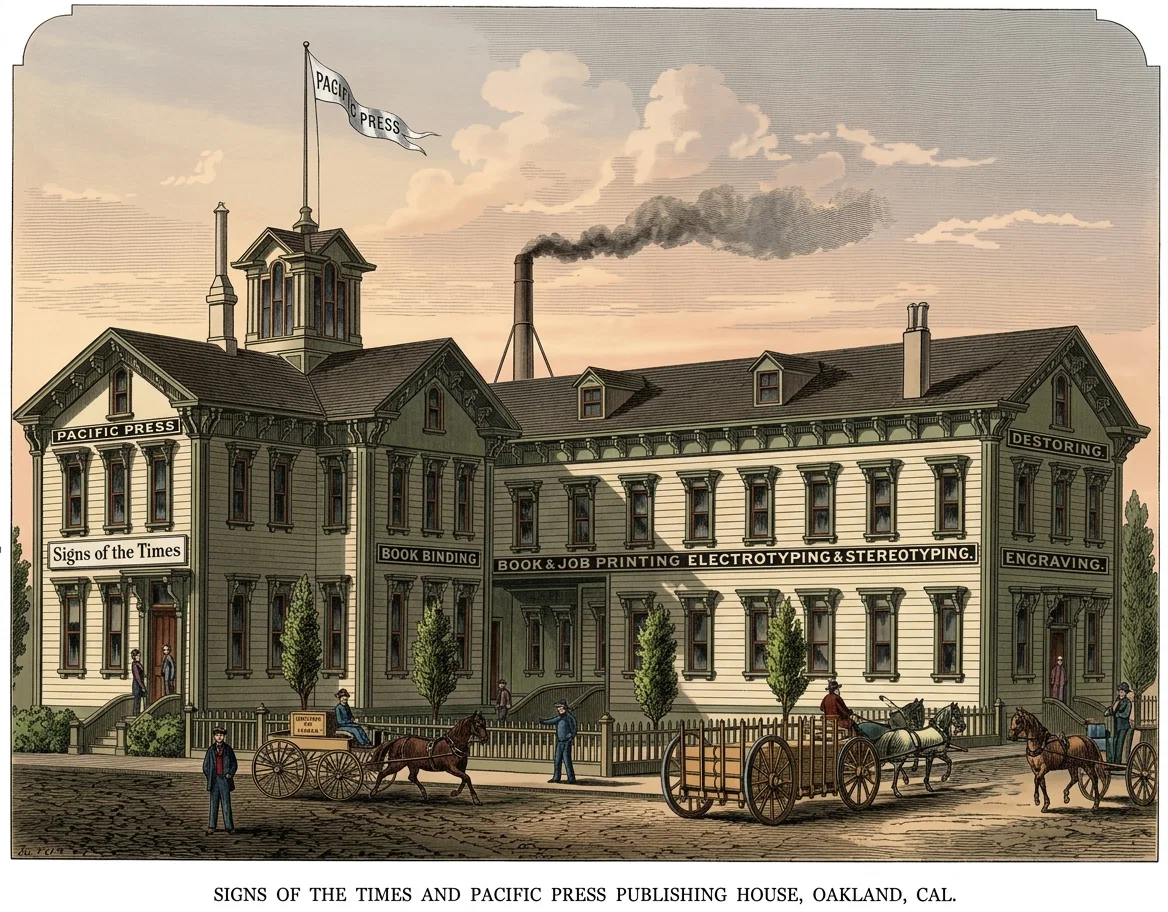
The subscription list of the SIGNS increased rapidly, and calls began to come in for books, pamphlets and tracts treating upon the views which were advocated in this paper. The old quarters were found to be entirely inadequate to carry on the business of the Association, therefore, in the Spring of 1876, the Association purchased a lot of land on Castro Street, between 11th and 12th streets, and commenced the erection of a building especially suited to its work. It was built in the form of a Greek cross, the main portion 26x66 feet, the transverse section 26x44, two stories high, with basement and attic. This office was thoroughly fitted up to publish the SIGNS, books, pamphlets, tracts, etc., for which there was an increasing demand. An engine, boiler, and large cylinder press were ordered from the East, and everything that was thought would ever be needed to carry on the work. But the plans then laid were soon found to be on entirely too small a scale.
The success of the SIGNS as a Missionary paper far surpassed the expectations of the most sanguine and at the close of the year the demand for books and tracts had so increased, that the office was taxed to its utmost to fill the orders.
In addition to the regular denominational work, the demand for job work by business men of this city and San Francisco was so great that a complete job printing office was added.
It was seen, that unless immediate steps were taken to secure more room, the work would greatly suffer, therefore, another lot of land was purchased facing 12th street and adjoining that already owned by the Association, and during the Summer of 1878 a second building was erected, 30x84 feet, two stories and an attic. It was connected with the other building in the rear, which it is finished to match.
At the close of the year 1879 the buildings were again found to be overcrowded. At that time the office was running two cylinder and three job presses, but with these running night and day the demand could not be supplied. The buildings were already crowded with machines and to make room for another press it was found necessary to raise the main building, the one first erected, enlarge the basement and put the presses in this. This was accordingly done in the Spring of 1880, and the engraving herewith gives a very good idea of the buildings as they now stand.
A large two-revolution four-roller cylinder press was ordered of Messrs. Cottrell & Babcock and is now in operation. This press has a bed 40x60 inches, and is the largest book printing press on this coast.
We have briefly traced the history of the SIGNS OF THE TIMES from its small beginning down to the present time,—from the circulation of a few hundred to that of nearly ten thousand copies weekly,—from the little room on Broadway to its present large and commodious quarters.
We will now take a brief survey of the interior of this office of publication. In the basement of the main building facing Castro Street, is a large and commodious press room, well lighted and ventilated, also, engine, boiler and stock room. The first floor is divided into a commodious counting room, a book and general sales and shipping room, and rooms for casting and finishing type.
On the second floor is a reception parlor and fully equipped book bindery. The attic is divided into five apartments and is used for storage. The whole is surmounted by a neat and commodious observatory which gives a fine view of the cities of Oakland and San Francisco, the Bay and the surrounding country.
The building fronting on Twelfth street is 30x84 feet. The first floor is occupied by the Job Printing office and is well lighted and conveniently arranged. In point of completeness, variety and extent of material and appliances this office is second to none in the State. The second story is used entirely as a composing room. This is where the type for the SIGNS OF THE TIMES and book work generally is set up. The attic is used for storage.
At the rear of this building, and properly forming a part of it, is a three story frame building 14x24. The first floor is occupied by a complete stereotype and electrotype foundry; the second and third for bath and lodging purposes.
Over all is a 5000 gallon water tank, which is supplied from a well by a steam pump, and furnishes water for the entire institution and some neighboring dwellings.
The Association also owns the large, two-story, double, frame dwelling in the delta of the two business houses—not shown in the engraving.
The whole investment, including stock on hand, is about $90,000.00. The number of hands employed is about fifty-five. This Association has assumed the name of the PACIFIC PRESS PUBLISHING HOUSE and is generally known in this vicinity by that name.
Early in the Spring of 1879 the increasing San Francisco trade rendered it necessary to open an office in that city, and we now have an office at 527 Commercial street under the management of Mr. J. W. Gardner. At this office we have a first-class engraver and do all kinds of designing and engraving.
The office of the SIGNS OF THE TIMES, as it stands to-day, is one of the largest and best equipped printing and publishing houses west of Chicago.
This Association is owned and controlled by stockholders who may be found in Oregon, Washington Territory, Nevada, Colorado, and many of the States east of the Rocky Mountains. At the annual meeting, which is held on the first of April, the stockholders elect a Board of Trustees, consisting of six persons, to manage the affairs of the Association. The officers consist of a President, Vice-President, Secretary, Treasurer and Auditor, and are elected annually by the Trustees. The officers elected at the last annual meeting are as follows; President, Elder S. N. Haskell; Vice-President, W. C. White; Secretary, L. D. A. Carruth; Treasurer, John Morrison; Auditor, J. D. Rice.
The Publishing Committee consists of three persons, and are also elected annually by the Board of Trustees. The Committee elected to serve the present year are, Elder S. N. Haskell, Elder J. H. Waggoner, and W. C. White.
During the coming year especial attention will be given to the SIGNS OF THE TIMES, and the publishers are determined to make it one of the best religious papers in the world. See prospectus for 1881, on another page.
Domestic Hygiene and Medicine
HOME HAND-BOOK OF DOMESTIC HYGIENE AND RATIONAL MEDICINE.—The most complete of any popular treatise on the subjects of Anatomy and Physiology, Hygiene and Domestic Medical Practice. Among the topics embraced in the table of contents may be mentioned the following, in addition to Anatomy and Physiology, and General Hygiene:—Hygiene of the Air, Ventilation, Hygiene of Food, Dietetics, Adulteration of Food, Examination of Drinking Water, Gymnastic Exercises, Swedish Movements, Remedies for Disease, Hydro-therapy, Miscellaneous Non-medicinal Remedies, Medicinal Remedies, Disease and its Treatment, and Diseases of Women and Children. The work will be illustrated with over five hundred engravings, and twenty full-page colored plates, and will contain over one thousand pages, royal octavo size. Agents wanted to sell this work by subscription. A good commission given.
HOLIDAY BOOKS
FOR YOUNG AND OLD.
Will be sent by Mail, post-paid, for the prices named.
CHILDREN'S BOOKS.
Golden Grain Series.—A choice collection of instructive stories suited to the wants of children from ten to sixteen years and older, illustrated and beautifully bound in three volumes.
Vol. 1, The Hard Way, 40 cents.
Vol. 2, The School-boy's Dinner, 40c.
Vol. 3, Grumbling Tommy, 40 cents.
Other volumes in preparation.
Golden Grains—In Ten Pamphlets.—The same reading contained in Vols. 1 and 2, is put up without pictures, in ten pamphlets of 32 pages each. In this form they are especially suited to Sabbath-school work, being unequaled as prizes for juvenile classes.
List of the series:—
No. 1, Robin's Judgment Book.
No. 2, Annie's Savings Box.
No. 3, Always the Bible.
No. 4, The Hard Way.
No. 5, The Sister's Lesson.
No. 6, The School-boy's Dinner.
No. 7, Seven Times.
No. 8, The Wicket Gate
No. 9, The Sensitive Plant.
No. 10, The Two Gardens.
Price of the series 50 cents.
Sabbath Readings for the Home Circle. In three volumes, containing moral and religious reading for the household; carefully selected, and compiled for the use of Sabbath-schools and family libraries. These volumes will be found the most forcible teachers of the principles of obedience, kindness, and benevolence, by relating instances of conformity to them and departure from them, in such a manner as to lead to their love and practice. Great care has been taken to exclude anything of a sectarian character.
Vol. 1 is especially adapted to the wants of the youthful mind. 384 pp., 60c.
Vol. 2 continues the same course of reading, and introduces articles suited to the wants of the whole family circle. 416 pages, 60 cents.
Vol. 3 continues the same line of reading as Vol. 2. 380 pages, 60 cents.
The Advent Keepsake.—A collection of Bible texts for each day of the year, on the subjects of the Second Advent, the Resurrection, etc. Muslin, 136 pages, 25 cts.
Sunshine Series.—Ten small books, containing numerous choice stories adapted to children from the ages of five to twelve years. This little series of books is a careful selection from a great amount of excellent reading matter for children, and are acknowledged by all acquainted with them to be the best in print. Prof. U. Smith says, "If you want to know how to please, and at the same time profit your children, I can tell you. Send and get for them a package of the little books for children, for sale at the SIGNS Office, Oakland, Cal." Price 50 cents.
The Child's Poems.—Containing Little Will and other stories that captivate the young reader and teach many lessons of temperance and virtue. Bound in cloth, and richly embossed with gold and black. 128 pages, 30 cents.
The Game of Life.—Three lithographic illustrations, with explanations. These scenes represent Satan playing a game with man for his soul. In the first scene, The Game in Progress, Satan and man are represented as intent upon the game spread before them upon a covered sarcophagus. The second scene, The Game Lost, represents Satan as victor, man in despair. The Game Won reverses this scene. Neatly bound in boards. Price 50 cents.
TEMPERANCE BOOKS.
Bible Temperance..................$2.50
Alcohol and the State............. 1.50
The Arts of Intoxication........... 1.25
Wasted Resources.................. 1.25
The Prohibition Text Book ......... 1.00
Divine Law as to Wines............ 1.0
Bases of Temperance Reform......... 1.00
Bacchus Dethroned................. 1.00
Richardson on Alcohol.............. 1.00
Alcohol, its Nature and Effects..... .90
Alcohol and Tobacco................ .75
Four Pillars....................... .75
Medical Use of Alcohol............. .60
Scripture Testimony on the Use of Wine .60
Bible Wine ........................ .60
Gospel Temperance.................. .60
Alcohol as Food.................... .60
Communion Wine..................... .50