Lost! I have lost him! Where did he go?
Lightly I clasped him. How could I know
Out of my dwelling he would depart
Even as I held him close to my heart?
Lost! I have lost him! Somewhere between
Schoolhouse and college last he was seen,
Lips full of whistling, curl-tangled hair.
Lost! I have lost him! Would I know where.
Lost! I have lost him, Chester, my boy!
Picture-book, story-book, marbles and toy,
Stored in the attic, useless they lie.
Why should I care so much? Mothers, tell why.
Yes, he has gone from me, leaving no sign,
But there's another calls himself mine.
Handsome, and strong of limb, brilliant is he;
Knows things that I know not. Who will can it be?
Face like the father's face, eyes black as mine,
Steps full of manly grace, voice masculine;
Yes, but the gold of life has but one alloy,
Why does the mother heart long for her boy—
Long for the mischievous, queer little chap,
Ignorant, questioning, held in my lap?
Freshman so tall and wise, answer me this:
Where is the little boy I used to kiss?
— The Cork Examiner.
Some Common Swindles Exposed
In a recent article contributed to The Outlook, the Assistant Attorney of the Post-office Department at Washington, Edwin W. Lawrence, makes an expose of the swindling that is done in this country through the post-office; that is, by lying advertisements and the use of the United States mails. The government makes it a crime to use the mails for the purpose of swindling, and does a vast amount of work in discovering and putting a stop to such practices, yet the number of these unscrupulous persons who successfully operate their schemes, and fatten upon the public credulity, is legion. These lying advertisements appear in all classes of papers and periodicals, reputable as well as otherwise, and religious journals are often as culpable in this respect as any others. The statements made by this government official on the subject are worthy of the widest publicity, and it is possible they may have a financial value to some readers of the REVIEW, and through them to the cause for which it stands. For this reason we make the following quotations from his article:—
“The boldness of some men and the credulity of others are startling and wonderful. The following show some of the representations made to secure a remittance without intending to send anything in return: That a court rendered a decision authorizing the writer to proceed with the distribution of prizes awarded in a contest, upon which an attachment had been placed by creditors, and the addressee’s prize is a ‘horse, lily buggy and harness’ worth $275, which will be shipped upon receipt of $29.60 for freight charges; that men are desired to work in a company store at one hundred dollars per month, and a pass worth twenty-five dollars will be sent one desiring to take the work, but only upon advancement of ten dollars as a ‘guarantee of good faith;’ that employment at the World’s Fair will be furnished by ‘The Bureau’ for all sorts of clerks, waiters, etc., at salaries of one hundred and fifty dollars per month, but five dollars ‘good faith’ money is required. A person at Binghamton, N. Y., advertised to loan money on property, to purchase or sell houses, farms, etc., and upon receiving an answer, he said a personal examination of the property was necessary, and that therefore he must have money sent him for transportation one way. After remitting, the victim would hear nothing from the company. A concern in Syracuse, N. Y., advertised to pay three dollars per day for men to distribute circulars, tack signs, etc. To secure work, one dollar must be sent. A list of one thousand names of firms doing extensive advertising was the only return. Farmers all over the country are induced to send butter, cheese, cider, maple sugar, and produce of all kinds to cities by professional crooks, who quote a high price, but never intend to remit for the goods. Such cases frequently reach the Department.
“Men actually seem to have reached the belief that they can ‘gather grapes of thorns and figs of thistles.’ A man in Belfast, Maine, advertised that his ‘business was peculiar,’ that he dealt in money of several kinds, and had a ‘money-making method’ that would enable one to acquire good cash by exchanging bank bills for coin. If two dollars is remitted, he said he would send samples of money representing fifty dollars. A Confederate fifty-dollar bill was sent. A man in Minneapolis with greater enterprise advertised ‘fifty dollars for one dollar—not Confederate.’ Upon receipt of one dollar a book containing directions for removing ‘kinks’ from negroes’ hair, how to make ‘obesity soap,’ etc., was sent, with the information that it ‘contains fifty dollars’ worth of information and schemes, so you get what we stated.’
“The folly and greed of some people is well illustrated by the large number who remitted three dollars, expecting to get a well-equipped bicycle, in response to an advertisement giving a detailed description of it, and received only a cheap watch-charm in the design of a bicycle. Also by those sending a like amount obtained from selling bluing for a company, expecting to get in return a large and valuable sewing-machine. They received a small hand instrument, labeled the ‘Soezy Sewing-machine,’ to be fastened on the edge of a table. . . .
“All will admit the propriety of the name given the machine—‘Soezy.’
“A Tennessean at Knoxville displayed equal genius when, under the name of the Button Top Bedspring Company, he sent elaborate circular matter with an offer, as was alleged, to introduce his new invention set forth in detail. He said: ‘We will send one sample spring, charges prepaid, on receipt of one dollar. If you do not like the spring after seeing it, you will be under no obligation to accept the agency, as we do not want an agent that can not recommend this spring above all others. We will give two dollars for each recommendation we receive and use. We send only one sample spring to a firm, and under no circumstances will we send two or more springs at this price.’ The last statement is doubtless true, for the one dollar brought only a small coil of wire. . . .
“A few years ago an advertisement appeared in religious papers that the writer, a minister, on his visit to the holy land, chanced upon some seeds of Jonah’s gourd of Bible fame, and secured a few to bring back with him. These few he desired to distribute among Bible students, and on receipt of a dollar would send one. Among the thousands of orders was one from a well-known Connecticut authoress. She wrote the seller that she had tried the seed, but feared the severe climate was accountable for its failure to grow, and so she sent another dollar, hoping she might be successful with the second one. It was sent her with the remark that, true to the Bible description, it ‘came up in a night and perished in a night,’ and probably escaped her observation. She was advised to watch this one closely. Investigation developed that the story of the alleged minister was entirely false, and that pumpkin seeds, boiled so as to deprive them of their germinating power, were sent. A14scheme, the converse of this, was to advertise ‘A Book for Gamblers, $1,’ and send a Bible. One individual claimed to send directions and material for drawing a tooth without pain for fifty cents. Paper and pencil were sent, with instructions to draw the tooth on the paper.
“Home-work schemes, appealing to needy widows and the infirm, are in favor with swindlers. A great many of these operating in New York City were suppressed last spring. The Majestic Lace Company advertised that fifteen dollars could be earned weekly by working at odd times at home. An order for fifty dollars’ worth of medallions was sent, but the applicant was required to remit two dollars for a machine which cost thirty-six cents. The company offered two cents a medallion; it was, however, impossible to make over three an hour. The result was that, out of 1,250 persons remitting the two dollars, only one hundred and fifty dollars was received by them as recompense, the victims becoming tired of their work soon after starting.
“Twenty dollars per thousand for copying letters at home is another inducement. A dollar must be remitted for the outfit, which consists of a pen and penholder worth five cents. Not until remitting is the person enlightened as to the letter, and it then appears to be of such a nature that no one would care to copy it, or is much longer than represented. . . .
“Numerous advertisements appear in all kinds of publications offering a premium of a ‘rifle, a solid gold brooch or ring with genuine diamond, a gold watch, or a sewing-machine for a few hours’ work’ in selling a dozen boxes of pills for twenty-five cents each. When the three dollars from the sale of the pills is received by the company, it sends a letter saying the person could not have read the advertisement correctly, as it is necessary to sell a hundred or more boxes to secure the premium desired. The task disgusts the duped person, and the company, having received three dollars for the goods, hears nothing further from him.
“To a limited extent the Department can protect the public against fraudulent mining and oil companies, and has issued a number of orders against such concerns in the last year. But the extreme difficulty of procuring sufficient evidence, and the fact that such evidence as can be obtained consists largely of opinions, mitigates against action.”
The Baby's Toilet
By EULALIA S. SISLEY-RICHARDS
EULALIA S. SISLEY-RICHARDS, M. D.
EVERY morning at a certain hour baby should have his bath. It matters not so much as to the time chosen, as that this hour be regularly observed. In the early months of life nine or ten o'clock is a suitable hour, though care should be taken that the bath is not given too soon after feeding. At least an hour should elapse after taking food. Later on, when the little one is up and dressed for breakfast, his bath may be taken on rising.
Before undressing the baby everything that will be required for his bath should be in readiness, as it is most inconvenient, and dangerous to the child's health as well, to suspend proceedings after once begun, while hasty search is made for some forgotten necessity.
The following articles should be in readiness:—
A suitable bath tub, conveniently standing upon a low support so as not to involve too much bending on the part of the mother or nurse.
A supply of hot and cold water.
A bath thermometer, preferably one protected by a wooden frame so that it will float in the water.
A wash basin. The double china sponge basin is good.
Two soft sponges or Turkish gloves.
Plain castile or other non-irritating soap.
Two soft towels which should be warm and dry.
A bath apron to protect the nurse's dress.
A change of fresh clothing should be placed on a rack near the fire.
The baby's toilet basket, containing the usual articles, should be near at hand.
The temperature of the bath is a matter of considerable importance. While it is desirable to lower it gradually from week to week, it must be remembered that young children do not well withstand cold. In regulating the temperature of the bath the hand is an unsafe guide. Still more unsafe is it to judge by the appearance of the baby, as did a certain Bridget, who concluded that the bath was too hot if her little charge turned red, or too cold if he turned blue. To use a thermometer is the only absolutely safe method.
The following table is given merely as a guide—not as a rule to be followed in every case:—
Bath Temperature for Different Ages
AGE
DEGREES, F.
At birth
98–100
During first three or four weeks
95
One to six months
92.5
Six to twelve months
90
One to two years
85
Then gradually reduce in summer to
80
In the third or fourth year, if possible, reduce to
75 or 70
Some little children would react well to a brief application of water at a temperature even lower than this.
Order of Procedure
All preparations having been made, the baby should be undressed, and wrapped in a soft, warm blanket.
The face is first washed in clear, warm water, then dried with a soft towel. Use the wash basin and one of the sponges or Turkish gloves in cleaning the face.
The angles of the eyes, ears, and nose should be gently cleansed. No attempt should be made to crowd anything into the ears for the purpose of cleansing them internally, as it is really quite unnecessary, and injury may result therefrom.
It is, however, very essential that the nostrils be kept clean. If this is neglected, and especially if baby has a cold, secretions dry in the nose, seriously obstructing respiration. Perhaps the safest and easiest method of cleansing is to use a bulb syringe wholly composed of soft rubber, gently forcing a little cool 'normal salt solution' into one nostril, and allowing it to flow out of the other. In making this solution add one slightly rounded teaspoonful of table salt to one pint of water. It is absolutely necessary that this direction be followed carefully; for if too much or too little salt is used, the solution is very irritating to the nasal mucous membrane. The child's head should be held slightly forward during this cleansing process. No mother need fear to adopt this measure, as it is quite free from danger (if employed as directed), and accomplishes much good in preventing a catarrhal condition of the nose. While it may not be necessary to thus cleanse the nose every day, it should certainly be done whenever there is any indication of a cold or of dried secretions in the nostrils. This normal salt solution is also excellent for cleansing the eyes.
Having performed these offices for baby, his scalp should be washed with soap, rinsed with clear water, and then dried.
Using the other glove, the body and extremities are then thoroughly soaped, giving special attention to the folds around the neck and groin.
Having ascertained that the bath temperature is correct, the little one is now gently lowered into the water. His head is supported by the left arm of the nurse, her hand grasping his left shoulder to prevent his slipping down into the water. After remaining in the bath one or two minutes, he is lifted out, and is wrapped in a warm, soft towel, and then quickly but gently dried.
Baby should now be warm and rosy, showing that a healthy reaction has taken place.
When the skin is perfectly soft and clear, no powder is needed; but as it is so difficult to dry the skin with the required thoroughness, it is usually safest to use a good toilet powder. A mixture consisting of starch and talcum, equal parts, and one fourth the quantity of boric acid does very well.
And now another word in behalf of baby's comfort. His tender skin often becomes painfully chafed because of neglect regarding his napkins.
To avoid this condition, his body must be kept scrupulously clean, and his napkins changed as soon as they are soiled.
Napkins made of butter muslin are less irritating and wash much more easily than the harsh and heavier materials often selected for this purpose.
Religious and Social Conditions in Iceland
By David Ostlund
DAVID OSTLUND
The people of Iceland are mostly moral, there being but few criminals. Thefts and fights are very rare, and robbery and murder are never heard of. The prison in Reykjavik has very few inmates. The people are sober, and not addicted to strong drink. The prohibition movement has made great progress. The most prominent people take part in it.
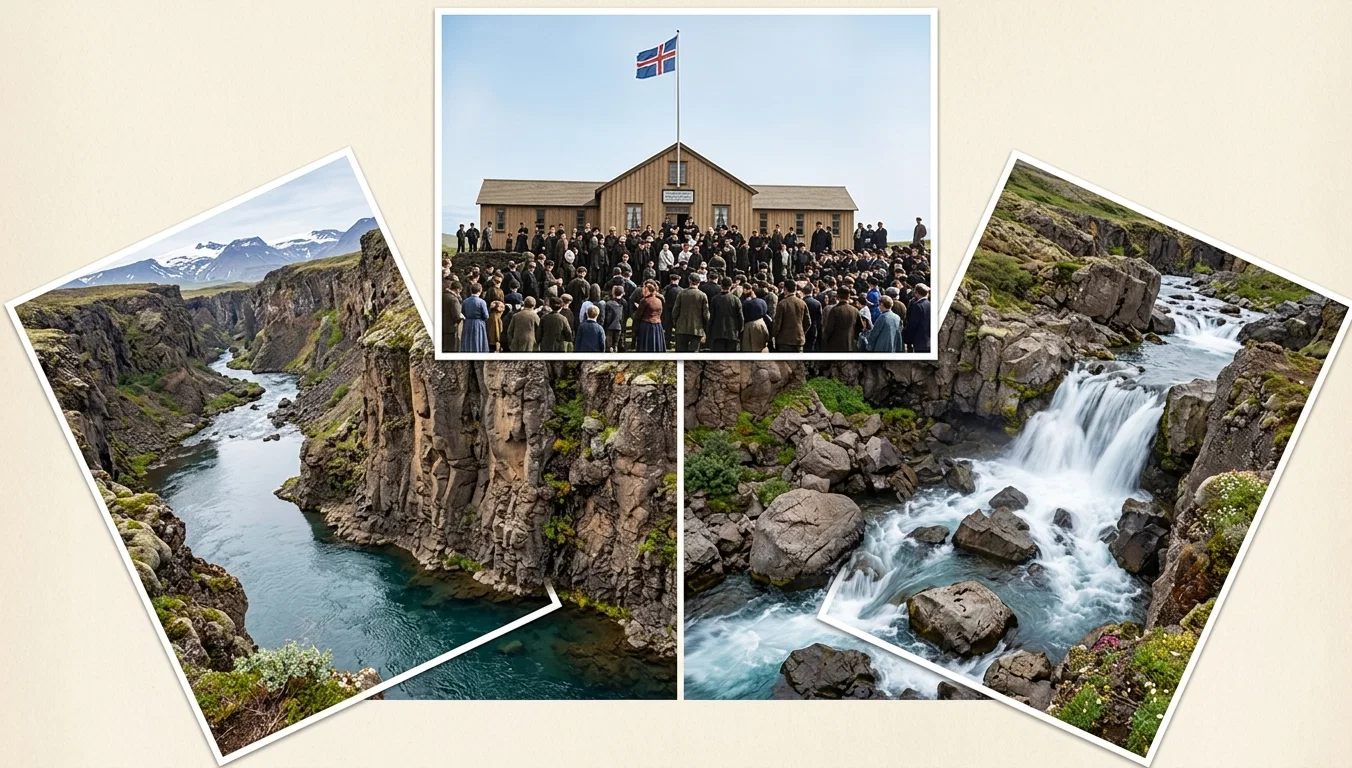
SCENES IN ICELAND
But though the people are morally good, as much can not be said concerning the religious conditions. The Lutheran Church is the state church. There are a few Free Lutherans, who have a society. This was organized about eighteen years ago, and has its headquarters in the eastern part of the island. It comprises two churches, with upward of four thousand members. The difference between the Free Lutherans and the state church is mainly this: the former will not recognize any authority of the state, working according to its own convictions. I can not say, however, that this movement has any strong tendency toward awakening the people, being built on the same foundation as the other — baptism of infants, confirmation, etc. Personal piety is not urged as we would like to see it. It can not be questioned, however, that this movement has its effect, as far as the spiritual condition is concerned. The religious work inaugurated by it has found great sympathy, both among the educated and among the common people, and even many of the priests of the state church view it with sympathy.
A few years ago the Mormons began work in the country. They succeeded in raising up a small company, the majority of whom went to Utah. Recently their work has ceased.
The Catholics have sent some missionaries to Reykjavik and other places in the eastern part. In the capital they have a little church building, and in Faskrudsfjord they have erected a hospital. They have so far had but little success on this island, but undoubtedly have the intention of propagating their doctrine in the future.
For the last few years the Salvation Army has held meetings here. Their headquarters are in Reykjavik. They have also begun their “war” in two other cities, though they have made very little progress.
In December, 1898, the Seventh-day Adventists began work in Reykjavik. From the beginning, this work has made advancement, and many are showing an interest in it, and the outlook for the future is not dark. The people of Iceland are a thinking, reflecting people. Preaching, which has for its purpose education, seems to have the best promise of being accepted. The writer believes that better days will dawn in this field; for the truth must find its way to many hearts.
Reykjavik, Iceland.
The Scandinavian Union Conference
By L. R. CONRADI
L. R. CONRADI
OF the five unions in the General European Conference, the Scandinavian has by far the least number of inhabitants, as it contains only about twelve and one-half millions of people. One great advantage the laborers here have over the workers in other parts of Europe is that Scandinavia is almost entirely Protestant, and religious liberty is well nigh universal.
Scandinavia is one of the first fields we entered in Europe. The Danish Conference was organized in 1880, the Swedish in 1882, and the Norwegian in 1887. In the Latin Union Conference, the first, or present French-Swiss Conference, was organized in 1884. The first German Conference was organized in 1898, and the first British Conference was organized in 1902.
As early as 1891, Sweden had the largest membership of any field outside of the United States, save Australia, which had twenty-five members more. At that time the three Scandinavian conferences contained half the membership of Europe—1,132—and they had half the European tithe.
While this promising field started so well in raising up a number of live churches under Brother Matteson, times changed, and our brethren in Scandinavia began to give more of their time to institutional work. They established the first foreign sanitarium and school, in Denmark, and their publishing house in Christiania was completed shortly after the erection of the Central European Publishing House in Basel. All our brethren are conversant with the financial perplexities in which the Scandinavian publishing house found itself later on, and these troubles naturally had a very disastrous effect upon the progress of the evangelical work in the entire field. We find to-day that this union, although it is the smallest of any of our European unions in point of population, has more money invested in institutions than any of the other unions—about $205,000. But its growth has been much slower, so that its present membership is not one fourth that of Europe, and its tithe is only one fifth.
Instructive as is such a view of the past, we are glad to tell our brethren in other lands that Scandinavia is again lifting up its head, and the cause of God is rising. Even before the Christiania crisis, we had to begin publishing in Finland, as the existing laws of that country would not allow canvassing for any books produced outside of Finland; and during the Christiania crisis, when it seemed that the house must be dissolved, Denmark, Norway, and Sweden were able to conduct their book work only by establishing local and independent book missions. To this end they secured five thousand five hundred dollars from the Basel house, and of course by operating these small book missions in these small fields, the three conferences engulfed themselves still further in debt. Finland was also in debt, and its depository was losing. The conferences were in debt. The Danish Conference owed about five thousand dollars, and the Norway Conference owed about one thousand dollars. Had there been indebtedness on only one institution, the people could have rallied much easier; but as almost everything was in debt, and there were so many institutions, it meant a long, hard, steady pull. We are glad to-day to say to our brethren in America who so faithfully helped to supply the Scandinavian institutions, that the Lord has helped us, and that we have brighter reports to give. To-day every one of the conferences and mission fields is free from debt. The same is true of the individual book missions;16and the publishing houses have enough capital to pay cash as they go, although they are naturally much hindered by having so little capital. With the money raised in the field and the help of the Mission Board, debts to the amount of twenty thousand dollars have been wiped out in the last five years.
One great thing that we have tried to accomplish was the organization of the Scandinavian Union Conference, and the creation of a union treasury. By this arrangement we have endeavored to so shape matters that we could carry each local conference on nine tenths of its tithe, so that one tenth of its tithe and all its offerings could go toward the support of the mission fields in Iceland and Finland, and toward a partial support of the union president. We had to go about this step by step, and it was not until the past summer that the arrangement was finally completed. This year (1904) Denmark, as the first of the three Scandinavian conferences to lead out, will carry on its evangelical work with nine tenths of its tithe, and devote one tenth of its tithe and all its offerings to the work carried on by the union treasury. At the council meeting held in Christiania (November 24-27), Norway pledged itself to do the same thing for 1905, and Sweden will likewise follow suit during 1905, with the exception of two hundred and fifty dollars. By this arrangement, the Scandinavian Union will soon be able to become fully self-supporting.
Up to this time, Finland has received but little help. But the plans now being executed will enable us to assist Finland more with workers and means. We have considered the advisability of transferring some of the workers from Sweden, where the conference funds are quite short, to Finland, so that the finances of their own field would be relieved, and the work in the Finnish Mission be replenished with laborers. One worker has already gone from Sweden to Iceland.
At the council we presented a call from Brother Pilquist, of China, asking that the Scandinavian field find and support a missionary in China. As Brother Pilquist is from Sweden, some special donations have already been raised for the Chinese Mission in that country. We encouraged our people to continue this good work, and as soon as the union finances will permit, we expect to dedicate the First-day offerings of the Scandinavian Union to the support of a missionary in China. We feel sure that as the conferences of Scandinavia become self-supporting, and the eyes of the people begin to turn to the regions yet beyond, God's blessing will rest upon them in a still greater degree.
While we can not see all the growth we naturally might expect, yet there is continual advancement. The membership at the close of the second quarter of 1904 was 2,341, and the quarter's tithe was $2,899. The tithe for the first quarter of 1904 was $3,126. For the year 1903 the tithe was $12,800. The offerings for 1903 were about $2,400.
The union committee meeting was very profitable to us all. We are pleased also to be able to report to our brethren that, while the Christiania house has heavy mortgages and a high interest to pay, yet, in spite of it all, it is to-day gradually gaining.
Perhaps one of the greatest problems we have on our hands now is the proper disposition of the former Frederikshavn High School property. It is being used as a health institution, and Dr. Nelson is barely able to make the work self-supporting. We would be very glad if we could in some way dispose of this property later on, as really so small a country as Denmark does not seem to need more than one well-equipped sanitarium. The Skodsborg Sanitarium has had a greater income this year than for any previous twelve months, but the institution is still greatly crippled for lack of sufficient funds. The Danish brethren have raised about two thousand dollars for a much-needed, modest building at Skodsborg. They expected that additional help would be given them from America, and thus the institution could be provided with the necessary rooms. At present they must accommodate a number of their patients in rented buildings in the neighborhood, and for these quarters the sanitarium must pay a heavy rent. As our brethren in America are so busily engaged with their own enterprises, the Danish brethren have thought best to wait quietly. However, we would like to ask if there are not among some of our good Scandinavian friends in the United States those who would feel it a privilege to assist the Skodsborg Sanitarium in securing additional rooming facilities? A few thousand dollars would help us out of this difficulty nicely. It would also seem to us a wise thing for the Scandinavian brethren in America to unite with their friends on this side of the Atlantic in supporting a Scandinavian missionary in China. There would be a blessing in this to our brethren in America and in Europe.
Another question that received considerable attention was that of the co-operation between the College View publishing house, and the Christiania and Stockholm and Helsingfors houses. This would aid the houses here to increase their capital, and they could do a great deal more and better work for the fields around them, in sending out the printed page in these languages.
We are thankful to God for the good omens of brighter days to come in Scandinavia. We are sure that if all will pull together, the Scandinavian Union Conference will yet prove a strong factor in the closing work of the last message.
Hamburg, Germany.
Karmatar Training-School and Orphanage
By Mrs. J. L. Shaw
MRS. J. L. SHAW.
Our native training-school and orphanage are located at Karmatar, about one hundred and seventy miles from Calcutta, on the East Indian Railway. Leaving Calcutta at half-past ten in the evening, one reaches Karmatar at six o'clock the next morning. The train passes the mission house, where usually a crowd of happy children rush to see the event of the day, the in-coming train. It is really very interesting to watch the children at their work or play, and see their simple and free manner in their country home.
Miss Knight and Miss Whiteis are working very hard to make the school and the home life what it should be; and many things indicate that they are really getting a work established that will mean much for the native work in India. In the training-school there are some noble young women, who will, by God's blessing, develop into capable workers. One who has spent some years in educational work in India describes the Bengali girl as “gentle and quiet, pleasant and graceful in manner, and lovable on the whole.” This really describes the character of our Bengali girls in our training-school. They are quick to learn and very studious; and in the work in the home they take hold most nobly.17
The medical work is a very strong feature in their school work; in fact, this is a part of their training, and they are required to give some time each day to this special line of work. At this time of the year there is considerable illness in the villages near Karmatar, and every day many people with ailments of different kinds come for help.
The mission home is located on the cart road leading to some of the large cities of India. Many pilgrims pass each day on their way to shrines, where they are going to do penance. Many of these travel hundreds of miles, and it is not an uncommon thing for some to die on the journey. While we were there, a poor man was trying to get back to his home. Many miles of his journey were still before him, and he was already greatly emaciated from fever, which he had contracted during his trip. He was given some simple treatment, and a tract and a gospel leaflet containing words of life in his own language, with a few pice to buy food as he journeyed. This poor man was seeking to save his life by his long pilgrimage, and yet in the very attempt he may lose it. It is to be hoped he received some word that would help him to learn a Saviour's love. This is only one of many cases that are continually appealing to our sympathy.
OXEN AND CART
It is quite a common thing to see some of the medical workers start out on an ox-cart, to visit the sick in the native villages. One evening we went with them on one of these trips to a village about two miles from the mission house. Toward the last of the journey the road became so bad that it was thought impossible to take the oxen farther; so some of the party went on ahead, going through water and mud over shoe tops, to see the poor sufferer, who was a little child about four years old, badly bloated from his head to his feet. The workers proceeded to give some simple water treatment in the open yard, surrounded by scores of natives, who were anxious to see what seemed to them strange sights. After an hour's treatment, Miss Whiteis gave instructions for them to bring the child to the mission home the next morning, where it would have further treatment. Though the poor mother had cried bitterly all the time the little one was being treated, evidently she was impressed that it was good; for every day he was brought to the mission house and carefully treated until he had quite fully recovered from his illness, which at first seemed so serious.
In the orphanage there are some very interesting children. I must tell you about a little fellow who was brought from the famine districts a few months ago. He is a bright little Hindu. His father, mother, and sister all died of cholera within a week, leaving him without friends or home. His Hindu name is Tulsi, and he is between five and six years of age, an active, happy little fellow, naturally of a very loving disposition, and very grateful for every kindness shown him. Tulsi's idea of obedience was foreign to all ideas of reason when he first came to the orphanage. When passing to and from class in school, he thought nothing of giving a little spring, heels over head, never imagining he had done anything out of the way. For a time he held to his heathen customs, and the first time food was given him, he took it with great fear lest some of his caste should see him, and he would have to suffer for it. For a Hindu to take food from one not of his caste, means breaking his caste; and separates him from his family and Hindu friends to wander an outcast in the world alone, and receive the displeasure of the gods. These things are taught the children when they are only babes in their mother's arms; and when in their own homes, it is seldom that they can be prevailed upon to break their caste, preferring rather to suffer hunger.
Our orphanage children represent only a few of the many homeless children there are in India; for of the three hundred millions of people, one hundred and seventeen millions are boys and girls. Indeed, if these children all stood in a line, shoulder to shoulder, and a great bridge were made across the sea for them to stand on, they would reach round the world! They'd make an immense ring twenty-five thousand miles long. And only ten children in each mile of that big ring have ever heard the name of Jesus.
Calcutta, India.
Foundation of Missionary Interest
INFORMATION is the true foundation of missionary interest.
A Little Argument With Myself
If I refuse to give anything, I practically cast a ballot in favor of the recall of every missionary, both in the home and in foreign fields.
If I give less than heretofore, I favor a reduction of the missionary force proportionate to my reduced contribution.
If I give the same as formerly, I favor holding the ground already won, but I oppose a forward movement, forgetting that the Lord never intended that his army should take refuge in a fort. All his soldiers are under marching orders always. They are commanded to “Go.”
If I advance my offering beyond former years, then I favor an advance movement in the conquest of new territory for Christ. Shall I not join this class? If I add one hundred per cent to my former contributions, then I favor doubling the missionary force at once. If I add fifty per cent, I say, Send out one half as many more; and if I add twenty-five per cent, I say, Send out one fourth more than are now in the field. What shall I do? I surely do not favor the recall of our whole missionary force, or any part of it. Neither am I satisfied simply to hold our own so long as this message is due to the world in this generation, and the great majority of the heathen world as yet have never even heard of Christ. I do believe in greatly increasing the present number of our missionaries, therefore I will increase my former offerings to missionary work.—Selected.
Mission Notes
A NEW help to the evangelizing of Central Africa is a line of English government steamers on the Nile, running once a month from Khartum to Gondokoro, the frontier town of Uganda. The schedule allows fifteen days for the round trip.
AT the opening of the new Free Methodist College at Wen-chow, China, about thirty government officials were present in state, and one hundred students from a Chinese school came twenty miles to see the opening ceremony. This is one more evidence that the missionary's opportunity in China is now!
ALL the awakening in China to the attractions of Western virtue is but the opening of doors for the entrance of the one truth that will produce lasting and fruitful reform in that country. Upon the Christian church lies responsibility for entering the open doors quickly, lest some scoffer get in before the messenger of Jesus Christ.
THE British and Foreign Bible Society has received from Rev. Mr. Casalis, of the Paris Mission in Basutoland, South Africa, $826 as an offering for its Century Fund, from the Basuto churches. About forty dollars of this amount is from a newly organized church under charge of a young native pastor, which has very few men on its list of members. Most of the money came from the sixty women of the church. These black women earned it a few cents at a time, and made it truly a thank offering.
THE work of German missionary societies is less generally known in America than it should be. A table of statistics to January, 1904, prepared by the Moravians at Herrnhut, shows that thirteen principal German societies (including the Moravians and the Basel Society) have 573 stations and out-stations, 924 European and 5,077 native workers, 425,489 converts, 21,542 baptized in 1903, and 61,280 catechumens under instruction for baptism. The receipts of these societies in 1903 amounted to 6,452,962 marks, or $1,535,805.20. Nine of the societies suffer from a deficit on the expenses of the year.
THREE years ago a Mohammedan merchant from Timbuctoo went for trade to the English settlement of Bathurst on Gambia River. Some one gave him a text card in Arabic. The next year he traded again in Bathurst, and asked for the book from which that wonderful text was taken. When the Bible was shown him, he bought it, and went away. The third year the merchant came to Bathurst, and bought eighteen Bibles for friends who wanted the book. Now the British and Foreign Bible Society is arranging to open a Bible depot in Timbuctoo, the synonym in all the Sahara for Mohammedan exclusiveness and fanaticism.