Review and Herald Publishing Company · Battle Creek, Mich. · Jun 5, 1902
The Land of Warm Winters and Cool Summers
By David Paulson
Most places that have the advantage of mild winters have also the disadvantage of excessive heat in summer; but nature seems especially to favor San Diego, California, in this matter. During the last ten years there have been, on an average, only three days in each year that were entirely without sunshine. According to United States Signal Service reports, this region possesses the mildest and most equable climate in this country, and perhaps in the world, the average difference between the temperature of summer and winter being only about ten degrees. On the tenth of February I noticed ripe strawberries in one of the gardens. This shows how little winter means in this section.
San Diego is situated in the extreme southwestern corner of the United States, the hills within the Mexican line being in plain view only a few miles away. It was here that the Spanish missionaries settled in 1769, and established the first of that remarkable series of old missions, the ruins of which are scattered all up and down the California coast. Two of its ancient bells, which were cast in Spain over a century ago, now hang in front of a more modern church, built on a former mission site in the Old Town portion of San Diego.
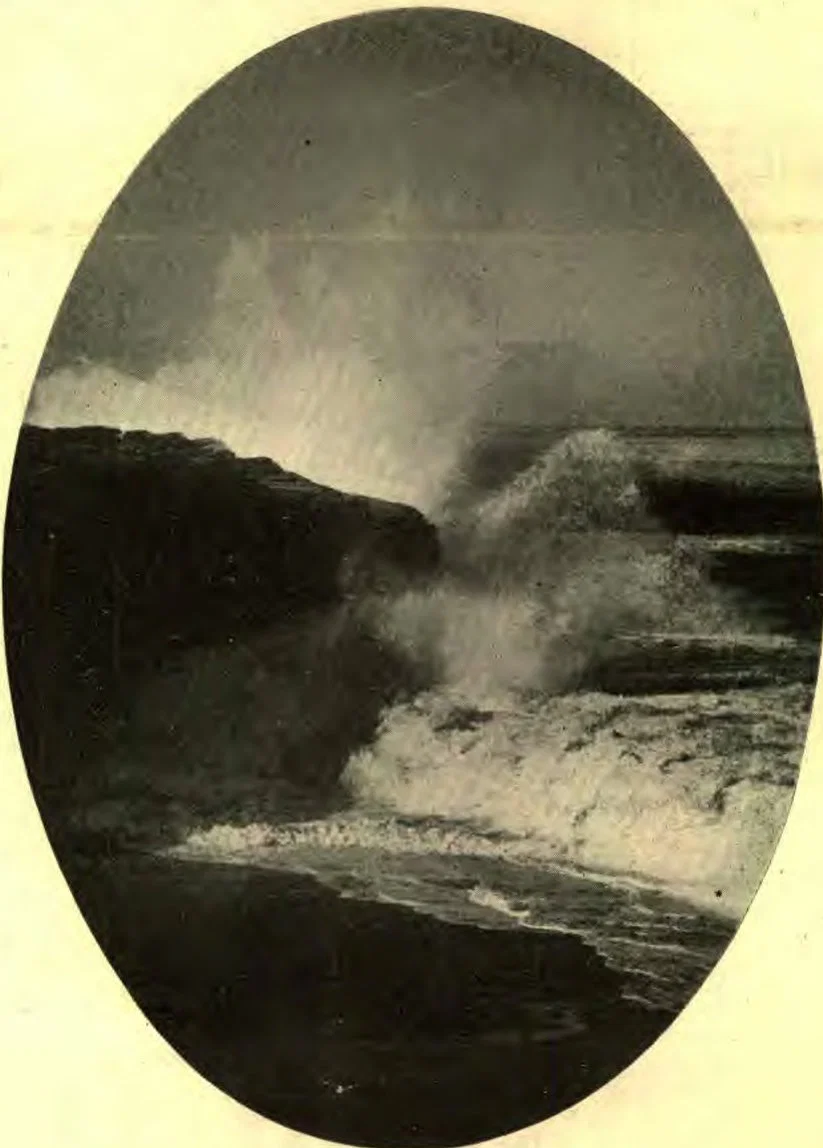
SURF SCENE AT LA JOLLA
As the rainfall is very limited here, it is necessary to depend almost entirely upon irrigation; but when this Western country is well irrigated, magnificent crops are produced. In some cities on the Coast, permanent exhibits of the various farm products are maintained in a public place, that visitors may see in a few moments the possibilities afforded by that section in this direction.
In the tent colony on Coronado Beach just across the bay from San Diego, a thousand persons are sometimes in camp at the same time. The grounds are lighted with electric lights, and otherwise supplied with all that is necessary to make a tent colony pleasant, healthful, and desirable. In the distance is a view of Hotel Del Coronado, said to be the largest resort hotel in the world. It is built in a rectangle, with an open court in the middle, thus covering and inclosing several acres. The beach in front is magnificent, and furnishes an admirable bathing place. One meets in this hotel renowned men and women from all parts of the world. Here, too, come the rich and the idle, who seem to vie with one another as to who shall display the largest number of costly jewels and the most elaborate and fashionable garments.
A sharp contrast with this scene of vanity and gayety is found only a few miles away, in the surf scene at La Jolla. This is grand beyond description, and to one who gazes upon it reverently, it must always give new views of the power of God.
A few rods farther up the beach, the ceaseless washing of the ocean waves has worn away portions of the softer rock, thus creating caves, natural bridges, and other striking effects, which leave a picture on the mind that time does not efface.
While all may never have an opportunity to look upon these enchanting scenes, we may all learn to see the beauties in the place where we are. God is revealed in the glistening dewdrop, in the sunbeam, in the flash of lightning, the roar of the thunder, and the gentle breeze, as well as in what we are accustomed to regard as his more wonderful works; and wherever he is, there is beauty.
DAVID PAULSON, M. D.
The Lesson of the Wilderness
By Edison Driver
It would be hard to find anywhere in history a young man who started out with better prospects of success than Moses. He was learned in all the wisdom of the Egyptians, and was mighty in words and deeds. Contrary to all the customs of that time, which held that an Egyptian must rule in Egypt, King Pharaoh loved Moses so much that he was determined to make him heir to the throne; and we can readily believe, from what we know of him, that as a king he would have been second to no ruler in any time or in any land. But God had chosen Moses for a higher service than Pharaoh could bestow. He had adopted him into the great family of the King of kings, and the lesser glories of Egypt did not attract him.
As we see how grandly Moses was equipped for his life-work, it seems strange to read that his whole mission to the world came near being a failure. But such is the case.
God sent word to Israel that Moses should deliver them from bondage. Moses, too, knew this was to be his life-work, and as he saw himself growing up in strength and wisdom, he had confidence in himself that he could deliver God's people. I have no doubt he often wondered when he should begin. No doubt as forty years went slowly by, he thought, not realizing that God was waiting for him to learn the lesson of humility and meekness, that he was wasting lots of time. It seemed to him that he was ready to undertake the work of delivering Israel. So he became impatient, and started out with his own plan. He killed an Egyptian first, thinking to show the Israelites that he was ready to lead them against the oppressor. But they did not understand; and Moses was compelled to flee for his life, thinking, no doubt, that his mission to the world was a complete failure. We can imagine something of the bitterness and loneliness he must have felt away off there in the wilderness of Midian,—he, who had been reared in a king's palace, and honored by a whole nation. But as the years passed, and Moses thought about his mistake, and what caused it, he learned the lesson that God was trying to teach him, and became so little in his own eyes, of a humility so genuine, that he has since been known as the meekest man who ever lived. All thought of greatness was forgotten: he was willing to serve God as a poor shepherd. Then God, seeing that178Moses was ready for the work, told him to go and deliver Israel. Did Moses say, “Yes, Lord, I am all ready now. I've been thinking it all over, and I'm sure I have a plan that will work this time?”—No, indeed! He said, “Who am I, that I should go?” It was only after God had promised time after time to be with him every step of the way that he finally consented to go. He had learned the great lesson at last.
Let us notice the lesson for a moment. After his first failure, not a single step would Moses take till God said, distinctly, “I will send thee unto Pharaoh,” and, “certainly I will be with thee.” God wrote that lesson for our learning. The Lord will teach us just as clearly as he did Moses. He showed himself to Moses in the burning bush, and talked to him face to face. To us he says: “He that loveth me shall be loved of my Father, and I will love him, and will manifest myself to him.” Think of it! God wants to manifest himself to us no less than he did to Moses. Let us not be satisfied till he fulfills his promise.
There are many other lessons that might be learned from the forty years in the wilderness, but this is the great lesson. It is the one that the Bible, from Genesis to Revelation, was written to teach,—that “the just shall live by faith,”—by Christ's faith. That was what Moses learned during his stay in the land of Midian. He is called the type of Christ because he learned the lesson of humility, and it brought Christ into his life. EDISON DRIVER.
Let Me Help You
By Frank Walcott Hutt
“Let me help you,” is a saying
That is not too widely known
In a world so busy paying
Heed to little but its own.
When some comrade falters blindly,
Let us say it, sweetly, kindly.
“Let me help you,” opens many
Doors and windows to the sun;
Bars and bolts, when there are any,
Give way surely, one by one.
Walls and towers of fear are broken
When these gentle words are spoken.
— Frank Walcott Hutt.
Facing the Orient
By Mrs. J. N. Anderson
From Correspondence to the Mission Board
Facing the Orient
Our first sight of the “Celestial Empire” was at Wusung, a small city at the mouth of the Yangtse. But for the current outward, the river here might be taken for an arm of the sea, so broad is the stream. At the time of our arrival, the waters of the ocean were discolored for two hundred miles out into the deep by the discharge of its yellowish, clayey flood.
Shanghai lies twelve miles inland, on the Hwangpu, the southern estuary of the Yangtse. Twenty-five years ago the Hwangpu opposite the site of Shanghai was eighteen hundred feet wide. At the present time it has narrowed to twelve hundred feet. On account of a bar at the entrance to the channel, ocean steamers are unable to enter the river. This is a source of heavy loss to merchants and shipowners, as all freight and passengers must be transported by smaller boats. Occasionally a heavy tide enables large vessels to float over the bar, and reach the docks or shipyards; but, once there, they must wait for a similar tide to carry them out to sea.
Wusung, being on the sea, and of somewhat more sanitary surroundings than Shanghai, is coming to be used as a place of summer residence for Europeans. During our stay at this place we were advised that a sanitarium at Wusung could be made to do good service for missionaries.
The course of the river from Wusung to Shanghai is through a low, level plain occupied by rice fields and vegetable gardens. All along the low banks may be seen the small thatched or palm-leaf lodges of fishermen, with bamboo poles set for game. The river itself is fairly alive with curious old junks propelled by sail and oars, so antique in appearance as to give one the impression that somehow the dial of the ages has suddenly and mysteriously been set back at least fifteen hundred years.
THE EMPEROR OF CHINA
The city of Shanghai, with its population of certainly more than four hundred thousand souls, lies in the heart of a vast plain so fertile as to be called “the garden of China.” The population in this section is very dense, eight hundred inhabitants to the square mile not being thought too high an estimate. The soil produces rice, cotton, grains, and all common vegetables, including potatoes and yams. Of the fruits, peaches, plums, strawberries, medlars, and persimmons are common. Apples, pears, and grapes are brought down from the northern provinces, and tropical fruits are imported from the south.
Shanghai the Trade Center of the Empire
Manufactories have been crippled by the opposition of native authorities to foreign companies, and especially to the importation of machinery; but at the close of the war in 1895 the Japanese secured the insertion in the treaty of a clause specially authorizing the importation of machinery. As a consequence, large cotton factories, operating from forty thousand to sixty thousand spindles each, have been established under the auspices of foreigners. To supply the demand for the raw product, the rice fields are being pushed farther away from Shanghai, and cotton plantations are taking their place. The vessel in which we sailed carried a large cargo of baled cotton, part of which was delivered in Japan and part in China. The best China-made silks come from Shanghai looms, and this industry is on the increase. Immense quantities of raw silk are exported. In manufactories Shanghai is the rival of Bombay. Besides, it is the emporium for the trade of Yangtse, northern, and Korean ports, and to some extent for Japan. I may say on good authority that more than half the whole trade of China in foreign vessels belongs to Shanghai, which is known as “the commercial metropolis of China.”
MRS. J. N. ANDERSON.
The Danger of Self-Confidence
By Ellen G. White
EVERY day the youth are exposed to the perils of self-confidence. The enemy knows how to work most effectually to cripple their usefulness. He tries to fill their minds with thoughts of themselves, of their knowledge, of what they are able to accomplish. And with many he succeeds. Filled with self-sufficiency, they make no effort to correct the objectionable traits of character that have been handed down to them as a birthright. They feel that they need no cautions. They are constantly making mistakes, but when corrected, they show impatience. “Pride compasseth them about.” They think that by their course they are raising themselves in the estimation of others, but how greatly they mistake! The self-conceited youth gains little respect. It is reticence and modesty that win respect.
It is the superficial thinker who deems himself wise. Men of solid worth and high attainments are generally most ready to admit the weakness of their own understanding. Humility is the constant attendant of true wisdom.
I entreat our youth to guard against boastfulness and conceit. When placed in positions of responsibility, how many persons of great natural ability have fallen, while in the same position men of less ability and less education have succeeded. The reason is that the former trusted in themselves, while the latter trusted in Him who is wonderful in counsel and mighty in power.
Before honor is humility. To fill a high place before men, Heaven chooses the worker, who, like John the Baptist, takes a lowly place before God. Simplicity, self-forgetfulness, self-distrust, are attributes that Heaven values. These are the characteristics of real greatness.
The youth have many difficult lessons to learn before they are prepared for usefulness. In order to be fitted to fill positions of trust, they must submit to the stern teaching of rebuff and disappointment. Days of suffering are necessary to teach wisdom.
For the self-confident there is a lesson in the179history of the apostle Peter. In his early discipleship, Peter thought himself strong. When on the eve of betrayal, Christ forewarned his disciples, “All ye shall be offended because of me this night,” Peter confidently declared, “Though all men shall be offended because of thee, yet will I never be offended.” Peter did not know his own danger. Self-confidence misled him. He thought himself able to withstand temptation; but in a few short hours the test came, and with cursing and swearing he denied his Lord.
When the crowing of the cock reminded him of the words of Christ, surprised and shocked at what he had just done, he turned and looked at his Master. At this moment, Christ looked upon Peter; and beneath that grieved look, in which compassion and love were blended, Peter understood himself. He went out, and wept bitterly.
The evil that led to Peter’s fall is proving the ruin of thousands to-day. There is nothing so offensive to God, or so dangerous to the soul, as pride and self-sufficiency.
The nearer we come to Jesus, and the more clearly we discern the purity of his character, the more clearly shall we see the exceeding sinfulness of sin, and the less shall we feel like exalting ourselves. Those whom Heaven recognizes as holy ones are the last to parade their own goodness. Men who have lived near to God, men who would sacrifice life itself rather than knowingly commit a wrong act, men whom God has honored with divine light and power, have confessed the sinfulness of their own nature. They have put no confidence in the flesh, have claimed no righteousness of their own, but have trusted wholly in the righteousness of Christ. So will it be with all who behold the Saviour.
MRS. E. G. WHITE.
The Need of the Hour
By E. R. Palmer
THE needs of the hour are great; and far above all other things we need an army of workers qualified by the Holy Spirit, as Jesus was, to serve their fellow men. Some one has said, “If one half the time we spend in praying for the Spirit were spent in fulfilling the conditions upon which it is promised, we should have much more of it.” When all the people are ready to be used by the Spirit in any place where duty calls them, the latter rain will fall, the gospel will quickly go to all nations, and the great day of our deliverance will be ushered in.
E. R. PALMER.
A Christlike Name
By George Klingle
He who would contented be
Little slights must never see.
Putting self in second place
Yields a wealth of gentle grace
Nothing else can ever give.
He who would contented live
Will be patient, though forgot,
Claim no homage for his lot,
Find in crowns which others win
Joy reflected. To have been
Self-forgetting and content,—
When the fires of time are spent,
This will leave, spelled out in flame,
The record of a Christlike name.
—George Klingle.
An Unselfish Boy
This little story is told of a spelling-class in China:—
The youngest of the children had by hard study contrived to keep his place so long that he seemed to claim it by right of possession. Growing self-confident, he missed a word, which was immediately spelled by the boy standing next him. The face of the victor expressed the triumph he felt, yet he made no move toward taking the place, and when urged to do so, firmly refused, saying, “No, me not go; me not make Ah Fun’s heart solly.”
That little act implied great self-denial, yet it was done so thoughtfully and kindly that spontaneously came the quick remark, “He do all same as Jesus’ golden rule.”
The Two Faucets
By E. L. Paulding
A Study of Water Pressure
At our hillside home are two faucets connected with the town waterworks pipes. One is down in the garden, and to this the hose is attached for watering the plants. The other is up at the house, and is the main supply for domestic uses, watering the horse and cow, etc.
The faucet at the house gives off its water at a level several feet higher than the one in the garden. When the water is allowed to run from the open hose, as we sometimes use it in watering the larger beds and clumps of shrubbery, the water in the upper faucet will not run. The reason for this is that the tank that supplies the water is at an altitude so slightly above our place that the water-pressure does not carry the stream strongly enough to fill both faucets. When the sprinkler is put on the lower hose, however, it shuts off the free flow of water somewhat, and then the upper one gives a stream, though with greatly diminished power.
Anemone Patens
We have been studying in the Sabbath-school and elsewhere about God’s being the source of all power, and that every act of our lives is performed by power that comes from him; for in him “we live, and move, and have our being.” His life, like the water in the pipes, is the motive power and life in us. Only our wills are left free to determine whether the acts we perform shall be good or evil; whether he shall be the Christ found within, “the hope of glory,” or whether he shall be made to “serve with our sins.”
In order to receive the power of God in most abundant measure, all the lower faucets of our nature must be closed. “Ye can not serve God and mammon.” All secret as well as open sins must be put away, and the faucet turned hard upon them, that there be no leaks. “Grieve not the Holy Spirit of God, whereby ye are sealed unto the day of redemption. Let all bitterness, and wrath, and anger, and clamor, and evil speaking, be put away from you, with all malice.” We must put away pride, idolatry, worldliness, vanity, and folly, as well as the grosser sins. The seed that fell among thorns may have fallen into good ground; but as it180grew, it became entangled. So with one who becomes engrossed with the things of this world. “No man that warreth entangleth himself with the affairs of this life.” Why not?—“That he may please him who hath chosen him to be a soldier.”
The lower faucets of our nature are love of self and of the world. Some are content to keep most of the pressure upon these lower faucets, and get but a dribble of spiritual life and power; others keep everything wide open below, and get no spiritual good. Let us who are enrolled under the blood-stained banner of Him who has chosen us to be his soldiers, close up the lower faucets, that the pressure of spiritual power may be great. Then let us keep wide open the channels that connect us with God, and allow his power and love to work out through us to our fellow men. E. L. PAULDING.
Anemone Patens
By B. E. Crawford
Wild Pasqueflower
DESCRIPTION.—Corolla absent; sepals five to seven; flowers purplish or whitish, one inch or more across, and borne singly on erect, silky-hairy stems from three to six inches high, which spring from a woody rootstock. Involucre sessile and cup-shaped, its upper part consisting of many narrow divisions. Leaves radical, twice or thrice ternately divided, and not developed until after the plant has blossomed.
In this description we have one new botanical expression,—“twice or thrice ternately divided.” A leaf that consists of more than one lobe, with the incisions extending either to the base of the leaf or to the midrib, is said to be divided. If the lobes are three in number, it is trisected, or ternately divided. Each of these lobes may consist of three divisions, in which case it is twice ternately divided. In some cases this branching process is carried further, and each secondary lobe is again separated in three parts, constituting a thrice ternately divided leaf.
Leaf of Anemone Patens
Divided leaves bear a close resemblance to compound leaves, and, in fact, there is no absolute distinction between compound leaves and divided simple leaves. If the separate pieces of which the leaf is composed have distinct petioles of their own, and are attached by means of joints to the main petiole, just as the latter is to the stem, the leaf is always regarded as compound. Otherwise it may be classed either as a divided simple leaf or as a compound leaf.
This species of anemone is known as the American Pasqueflower, because it is peculiar to America. A very similar one, however, grows wild in Europe and Siberia.
The pasqueflower does not grow in the eastern United States, but is found from Illinois north and west. It is one of the earliest spring flowers, blossoming during the last of March or early in April. On the rocky hillsides of Colorado it grows in great abundance.
The fruit cluster consists of a head of acheniums with long, silky tails. The thick underground stem, with its buds and scale-like leaves, affords an excellent example of the rootstock, or rhizome.
The plant is easily recognized by its peculiar involucre and its thick covering of silky hairs.
B. E. CRAWFORD.
She Could Not Forget
“THE case certainly looks very black for me, Miss Blanchard. I don’t see how you can help believing that I stole that essay, but I didn’t!”
The speaker was a sophomore in a woman’s college, and was as pretty and frank-looking a girl as one would wish to see. The teacher paused a full minute before she spoke. Finally she said: “That settles the matter, Charlotte. Your word is the ultimate appeal in the case. I shall never mention the matter to any one else, nor to you again. Destroy the essay, and forget it—if you can.”
So the long and painful interview came to an end. Miss Blanchard registered in her thought another failure. The “deadly parallel column” had proved to her beyond a doubt that the theme had been stolen, and the girl had added to the theft a persistent lie.
Miss Blanchard was tempted to doubt for the moment the wisdom of her theory,—that, for a girl, conviction without confession is of no effect in the creation of character.
Two years and a half went by. Commencement and Charlotte Hubbard’s graduation were but a week away. Her course had been creditably finished. She had won honors. She was respected and admired by her classmates. Her future seemed assured.
Yet unclouded as her present and future seemed to be, she knocked one afternoon at Miss Blanchard’s door, and her face told her story before she could command her voice.
“I have been trying to tell you the truth every day for more than two years, Miss Blanchard. That essay was not mine. What shall I do?”
So conscience conquered. Time and the one inexorable judge had wrought their saving work. At last the tortured girl was ready to brave any penalty, face any shame, to escape the one intolerable pain, the accusing inner voice—which yet had saved her, and made her from a reckless girl into a truth-loving woman.—Selected.
A Little Plant
A LITTLE plant
Trembling with green and gold,
That grew aslant
A mound of quickened mold,
Was deemed a weed, and so
It fell before the hoe.
Yet all man's art,
Fine wit, and fertile brain
Could not impart
Life to that plant again.
'Twas in his way; and so
It fell before the hoe.
How many things
All tremulous with joy,
Plants and blossomings,
We recklessly destroy.
They feed no mouths, and so
They fall before the hoe.
— Springfield Republican.
Our Present Privilege
WE are accustomed, when we read or hear the accounts of wars and rumors of wars, of increasing famines, plagues, and earthquakes, to regard all these things as signs of the soon coming of our Lord. And such indeed they are. In a recent talk on the signs of the times to the Young People's Society of Battle Creek, Elder Spicer, speaking of the recent disaster in the West Indies, and our neglected opportunity in St. Pierre, directed the attention of his hearers to the solemn fact that these things are signs of that event to the people among whom they occur as well as to us, and that we are held responsible before God to let them know what these things mean. He continued:—
When the plague came to Calcutta, and the authorities announced a house-to-house visitation, thousands of people fled in terror, some carrying little personal belongings; the servants, with a few household goods packed on their heads, running with their masters; women who, perhaps, had never appeared in the streets before, hastening afoot through crowded ways to get to the railway station. And after every available space in the trains was crowded, multitudes were fleeing through the country roads—anywhere to get away.
The authorities sent out proclamations by criers and drummers. The drummer would stand on a street corner and drum until a crowd gathered, and then the crier announced to the people that they need not be afraid of either plague or sanitary inspection, and might settle down.
The calamities of which we read mean to us that the Lord is coming. Is it not about time that we get in among the people who are looking at these things every day, who themselves are living in dread, looking for that which is coming upon the earth? Is it not time that we go to them, and tell them that these things are a sign that Jesus is coming,—that they need not be afraid, for they can put their trust in him?
Miss Burros one day visited an Indian zenana, where the woman went out and called all her neighbors, saying: “Come in and hear what the mem says. Their Jesus is coming, and the famine and plague and earthquake and war are signs that he is coming soon. You come in and hear what the mem says.” They did so, and talked it in their families and in the community.
Unrest in the East
There is a feeling abroad among the people of the East that something tremendous is about to happen. They themselves say it must be the end of the age. The Mohammedans expect the Messiah, the Hindus another reincarnation of Krishna, or some other great event.
The Lord is by his grace preparing the way before us—and yet the world's great fields beyond are largely unoccupied. The one thing is to arouse the people at home, and to go ourselves into the field. We may quickly fill the whole earth. We young people need not lay plans to settle down and have a home,—a house and lot in Battle Creek,—and think this thing must go on another twenty-five years. I am glad that those of us who are young and strong may rise up and say, “We are going to the world with this message.” Let us do it. The Lord will help us to find a way out. He rolls this burden upon our young people.
The people are stirred. The Lord is working upon hearts, and he is getting people ready to go. I recently visited Union College, where there were about three hundred young people, getting ready to go into the work—and they are going. After our union conference meeting in Des Moines, and we had gone on to Topeka, I received an invitation to stop in Iowa again, on my return journey, to talk with some who were seriously considering going to the fields at their own charge. We may count upon one well-qualified worker, at least, among these, who proposes to go to India soon. I got a letter yesterday from a sister saying she had long felt impressed that she ought to go to India, and the Lord had just “marvelously and miraculously,” as she put it, opened the way so that she could go, paying her own way.
The Work before Us
This world is bound to be warned. The Lord is going to help us do it. He is the strength and the resource. Let us remember in Battle Creek that we are getting ready to go, and let us take on the burden of prayer for the work in the regions beyond.
Fifteen years ago I went away from this town, and first got acquainted with Europe. There was Portugal, and not a soul of us in it at that time; Spain, and nothing done in it at all by us; Italy—nothing at all doing there; Greece, with not a representative of the message in all its borders,—millions of people easy of access, nothing to hinder our entering in.
I am home again, and associated with the Mission Board. As I have passed some of these countries on the boat, I have seen their green hillsides, beautiful seaboard towns, splendid countries to work in. How is it now, in this year 1902?—We have not a soul in Portugal, not a soul in Spain, not a soul in all southern Italy, not a soul in Greece! And yet God has given us a message to take to the world quickly! He has told us to hurry, because the people are perishing. O, we must get up and do this work, and we can do it.
I expect God will show many of the young people how to go into these fields themselves. The Mission Board is not some supernatural agency that knows just how to do the work, and is going to see that it is done. We know such a little bit about this world, and how to get into it. We are just as you are, God's servants, pledged to this thing, and we are praying the Lord to help us to find the means and the workers to go. Let us as a people unite to seek God to help us to enter in through the doors that are opened on every hand.
You can do a great deal by talking these things right here in Battle Creek. Perhaps many of you came from country churches; just write them that the time has come for a new thing in this world—that now we are to rise up, and actually take upon ourselves the burden of warning the world. Stir up everybody you know about it. You do not know what little effort in faith may accomplish some great end.
Here is the place to begin, for here is where we are. God calls us to service. Let us throw ourselves into this blessed work without reserve.
The Standard
By Well Spring
WHEN I can say at set of sun:
“Each deed in love was wrought,
Nor harshness nor uncharity
Hath marred one inward thought,”
Then may I on the judgment seat
With cold, impartial mind,
All deeds unloving swift condemn,—
When I am always kind!
When I am faithful to my friends,
Always and everywhere,
And when my feet are never lured
Into Deception’s snare;
When from the Right I never swerve,
Nor need my faith renew,
Disloyal ones let me condemn,—
When I am always true!
Ah, soul of mine! be on thy guard,
Lest, casting the first stone
Against thy erring brother’s fault,
Thou shalt condemn thine own;
When thou art perfect, be the judge
Of his imperfectness;
Till then, shall not thy prating tongue
Be silent save to bless?
— Well Spring.
(a) The Neglected Continent, touching area; population; countries entered by the third angel’s message; those unentered; number of missionaries; work for the Indians.
(b) Religious Conditions of the South American Continent, showing particularly why this field should have immediate attention.
(c) Facing the Orient. Mention also the present condition of China, and why the call to enter this field now is so imperative.
(d) India; her great need; the Parsees, and the work that appeals to them; reports of progress.
(e) Monthly Survey of the Field, noting new fields entered; new Sabbath-keepers reported; churches organized, and other encouraging facts, also special needs and appeals for help.
3. Closing Exercises:—
(a) Reading or address by the leader. “Face to Face with Solemn Obligations.” Review and Herald, May 20, page 4.
(b) Consecration Service.
NOTE.—The study this month is based upon articles which have appeared in the Review and Herald and the INSTRUCTOR during the months of April and May. From this time forward the basis of the study each month will be found in the monthly issues of these two periodicals.
E. H.
SUE BELLER
By Sue Beller
From Joplin, Missouri
WE have a Young People's Society of fourteen members, with a regular attendance of twenty-five. We hope to have more members soon. The workers are divided into three classes:—
Visiting Committee,—those who visit the poor, aged, and sick.
Distributing Literature,—those who sell, loan, and give away papers, and also leave papers at the jail.
The Reserves,—those who are ready for any kind of work.