“PRUDY, don’t you suppose you could iron some of those dresses well enough?”
“I don’t know,” answered Prudy, in an uncertain tone. “I’m afraid not, grandma.” The voice grew more hesitating as the little girl looked at the pile of dampened clothes, and then at sister May, with doll Rosy dressed in her best gown and hat. “You know I don’t iron very well, and—and—”
Grandma looked up, and Prudy’s wistful look and quivering lip finished the sentence.
“Well, run on and play. It isn’t right to keep you working all the time.” Grandma’s voice was kind, but it sounded tired, and there was a sigh she could not help, as Prudy snatched up her bonnet, and bounded off to join May and Rosy on their walk.
It was a holiday. The little girls had worked all the forenoon, and had done a great deal for eight- and ten-year-olds. They had ironed a large pile of towels, napkins, and handkerchiefs, besides washing dishes, helping get dinner, and taking the many steps which fall to the lot of little folks. After dinner they had cleared the table, washed, and put away the dishes,—not even a skillet was left uncared for,—brushed the stove, and swept the floor. It really did seem as if they had earned their play-spell.
How they did long to run, jump, and climb trees! And now the time had come. Grandma had said, “Run on and play,” and away they flew to the big apple-tree where there was a swing, wide enough for two, and a “play” hammock for Rosy. They picked blossoms, and trimmed Rosy’s hammock and dress, and swung her to sleep; then they climbed the tree to peep into a half-finished nest, over which Mistress Robin scolded and chirped. Then they put blossoms in their hair and on their dresses, and settled down for a swing, as happy as the birds themselves.
Happy as the birds?
Did any little bird in that orchard have something whispering in its ear about a tired grandma and a pile of unironed clothes? There was such a voice whispering somewhere, and after a while the swing stopped with a jerk, and little May was startled by the sudden exclamation: “I just can’t stand it! I’m going to the house.”
“Stand what, Prudy? Am I crowding?” asked puzzled May, edging over to her side of the swing.
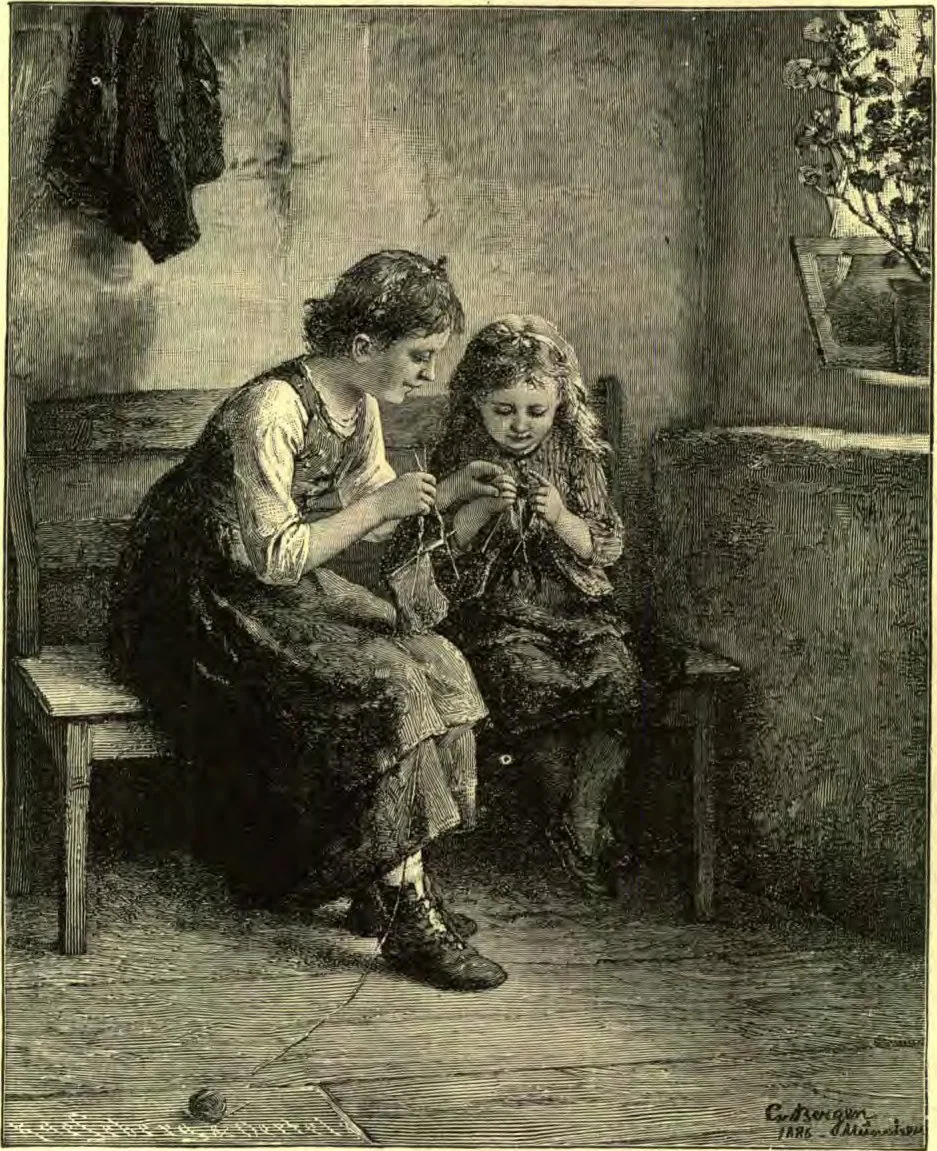
SHE SHOWS ME HOW TO KNIT AND SEW
“No; it’s grandma. I’ve got to iron those clothes.”
“But we did iron a whole lot, and grandma said it wasn’t right for us to work all the time.”
“I know—and maybe it isn’t. But it isn’t any righter for her to work all the time. She’s tired, and I know it. And I can iron those dresses—I just didn’t want to. They’re ours, and baby’s, and we’ve got it to do. Suppose,” and the earnest voice fell lower, “suppose she couldn’t take care of us—then what? Don’t you remember when mama died, and we cried and were so lonely till grandma came? Then papa said, ‘Mother, do you feel that you can take the burden of my family on your shoulders?’ and she said, ‘I’ll try, Rob, but I can’t do it all.’ Papa told her we were able and willing to work, and I promised I’d do every bit I possibly could—and I didn’t do it to-day. You and Rosy may stay and play, and I’ll go and iron.”
“No, I’ll go too,” said May. “I can help some way.”
The two girls slipped quietly into the house. There was no one to be seen, not a sound was heard, and, half-frightened, May whispered to Prudy, “S’posin’ we hadn’t any grandma?”
But grandma was all right. She had lain down with baby Nell a minute till the little one would fall asleep—just a minute! But poor grandma was so tired and worn out that she fell asleep herself, and both were resting sweetly.
Prudy shut the door, filled the stove with cobs, put the irons on, and soon two little girls were busily and quietly at work. May forgot all about the forsaken swing, and no more whisperings troubled Prudy.
“I almost thought to-day I should have to give it up,” said grandma to papa that night. “Nell had been restless, and I was so tired!—I actually went to sleep and slept for almost two hours. I was frightened when I woke up, and thought of the work undone. But what do you think? The ironing was all finished, supper ready, and the house as neat as a pin. Pretty soon I won’t have anything to do but be taken care of.”—Happy Hours.
Country Spectacles
TOM and Harry had been in the country less than a week, when one day they came into the sitting-room, and threw themselves discontentedly upon the carpet.
“What’s the matter, boys?” asked grandma. “You look almost as much out of sorts as your father did one time when he was a little boy, and was chased around the yard by a turkey gobbler.”
They brightened up a little at this, and made her tell the story. But when she finished, they fell back into their former attitudes of listless dejection.
“It’s so awful poky in the country,” complained Tom. “I don’t see what makes father like it. There’s no boys to play with, no people flying ’round—no nothing. It’s just stagnation.”
Harry mumbled a dolorous assent.
“You didn’t bring your country spectacles along,” said grandma. “Of course you can’t expect to see without them.”
They stared at her questioningly.
“You are wearing city ones now,” she went on182, placidly, “and can see nothing but the bustle and confusion of streets. When people change their residence, they should always change their spectacles.”
Harry looked blank, but Tom’s eyes began to gleam with an inkling of her meaning.
“Don’t believe we could see much with country ones here,” he muttered.
Grandma affected not to notice.
Suddenly Harry rose to a sitting posture, and began to sniff the air suspiciously.
“Ain’t Hannah making cookies?” he asked, eagerly.
“I shouldn’t wonder.” Grandma sewed on composedly, and Harry’s eyes grew bigger and bigger. Why didn’t she tell him to run and get some? he thought, impatiently.
At last her thread ran out, and she reached across to a spool on the window-sill, and broke off a new piece.
“If you boys are willing to enter my service for, say, half an hour,” she said, “you may then take some cookies and go down to the brook for the rest of the forenoon.”
They were on their feet in an instant. Evidently they were energetic enough if they knew what to do.
“What is it, grandma? Of course we will!” they cried.
“Very well. Now I like to know what is happening outside, but I am so busy to-day that I will depend on you for the news. Harry, you go and sit under the big apple-tree, and watch everything going on. See what the birds are doing, and how many varieties there are, and how many houses they are building in the tree. Watch the ants going up and down the trunk, and see what sort of work they are up to. And if there are any butterflies or grasshoppers or anybody else around, just watch and tell me all about them.”
“And, Tom, you go to the arbor in the corner of the garden, and do the same thing. I will ring the bell at the end of half an hour, and then you may come and tell me what you have seen.”
The boys raced out of the house to see which could get to his station first,—Tom, with a sly twinkle in his eyes, as if he understood the little game, but was willing to humor it; and Harry, taking the matter more literally, and evidently determined to get all the news he could for poor grandma.
When the bell rang at the end of half an hour, they came racing back with glowing faces and sparkling eyes.
“O grandma!” they both cried. Then Tom stopped, and let Harry tell his news first.
“There were ten birds,” the little fellow went on, excitedly; “and I counted four different kinds and three nests. And such funny ants! Two of ’em were carrying a regular mountain of a load up the tree; and when they got tired, two more came and took their places; and when they got tired, some more came. And there was a little chap running back and forth and speaking to every one he met.”
Tom looked at grandma, and colored a little, self-consciously.
“I guess it isn’t such a bad place,” he acknowledged, manfully. “You are right about the spectacles, and I’m going to wear my country ones after this. I saw no end of funny things—butterflies, and bugs, and all sorts of queer stuff. And there was a chipmunk sitting on the wall, and scolding for all he was worth. I am going out there again, and make friends with him if I can. Come along now, Harry, if you don’t want me to eat all the cookies.”
Grandma listened to them as they went noisily through the kitchen, and then picked up her work.
“It isn’t hard to get along with boys if you meet them half-way,” she thought, and smiled happily.—Selected.
A Grown-up Sister
By Elizabeth Rosser
A GROWN-UP sister’s good to have.
When I come home from school,
We take our books out on the porch,
To learn the last new rule;
And when our lessons all are learned,
We to the garden hie,
To watch the ant, the bee, the bird,
And painted butterfly.
A grown-up sister’s good to have.
On dark and stormy days
She sings me songs, she tells me tales,
And teaches me new plays.
She shows me how to knit and sew,—
Such arts she understands,—
And willingly lays down her work
To guide my clumsy hands.
A grown-up sister’s good to have.
I am so glad for mine;
Her voice is low, and soft, and sweet,
Her eyes with love-light shine;
So all her gentle ways I watch,
And like her try to do;
Because some day I’m going to be
A grown-up sister, too.
ELIZABETH ROSSER.
Kept for the Master's Use
What are your hands for—little hands? “To do each day the Lord’s commands.”
What are your feet for—busy feet? “To run on errands true and fleet.”
What are your lips for—rosy, sweet? “To speak kind words to all I meet.”
What are your eyes for—starry bright? “To be the mirrors of God’s light.”
— Selected.
Launching a Ship
By Katherine E. Magee
In all times the launching of a ship has been a momentous event, the various forms and ceremonies of which have changed very little since the era of shipbuilding began, except that anciently, when of much more infrequent occurrence than now, in addition to the formalities connected with the launching, it was made the occasion for a general holiday. The ship was garlanded with flowers, and all the sailors, also many who came to witness the launching, wore their best clothes, and head-dresses of flowers.
On the prow of all ancient vessels was placed an image called the “figurehead,” usually representing some god or saint worshiped by the people, over which, at the moment the ship glided into the water, a libation, or offering, of wine, committing the vessel and crew to the protecting care of the chosen divinity, was poured by a priest. Out of this practice originated the custom now in vogue of christening a vessel at the time of launching.
In those early times the ceremonies connected with the launch were not concluded until the ship was fairly afloat, when the captain and crew partook of their first meal aboard. This meal invariably consisted of eggs and sulphur. The origin and significance of this strange custom are both obscure. The sulphur was probably symbolical of purification; while the egg—which has been used since the days of the Druids in the rites and ceremonies of different nations as a symbol of the universe, and the power possessed by a supreme being—must have had some such meaning in this case. From this ancient custom comes the one now universally observed on similar occasions of treating the crew to cake and wine.
Even to-day sailors, as a class, are the most superstitious people in the world, believing in all sorts of signs which a landsman would laugh to scorn; but perhaps of all omens and superstitious notions connected by Jack Tar with his seagoing life, to none does he attach more significance and weight than those associated in his mind with the launching of the ship on which he is to sail; and for this reason it is very essential that everything connected with the ceremony should be gone through without break or halt. If there is not sufficient tallow on the “ways” and “cradle” to permit the ship to glide smoothly and gracefully into the water; or if there is a hitch in the “dog shores;” or if the bottle of wine fails to break at the proper moment; or if any of the many things which are likely to happen do happen, the omen is considered a bad one.
Unlucky indeed is that ship which sticks, and does not get afloat before sundown, as was the case with the “Great Eastern,” the mightiest ship in the world (made famous by the service she rendered in laying the Atlantic cable), which always had the greatest difficulty in obtaining a crew, owing to the fact that her launch was attended by a serious hitch. Because of her immense length, she was built with her keel parallel to the water. Either because the ship was too heavy or the slope too gradual, it took three months, even with the help of powerful hydraulic rams, to push the mass of one hundred and twenty thousand tons into the water. Strange to say, her career, at least the earlier years of it, was marked with disaster.
While it is now common to have the ceremony of christening a ship performed by a young woman, in former times it would have been regarded by the sailors as the forerunner of evil. For centuries it was thought—and, for that matter, all our veteran “salts” still retain the belief—that especial good luck attended the ship christened by a beautiful child. In Europe, as a rule, the oldest sailor aboard christens the ship.
While to the mere spectator one day answers as well as another for the launch, not so with the crew, who on no account could be induced to set sail in a ship so unfortunate as to have been launched on a Friday.—Katherine E. Magee, in Youth and Age.
Which Way?
“O BENNIE, you keep slipping so!” said the older sister, half-impatiently, to the seven-year-old trudging beside her along the snowy walk.
“Yes, it’s slippery, but I’m getting ahead,” answered the little fellow, bravely, “’cause ’most always I slip forward.”
It makes a great deal of difference which way our slips take us. Life is full of slippery places, and no one is wise or strong enough to walk always steadily; but even mistakes and falls may carry us forward if only we are determined that it shall be so. Trials, obstacles, disappointments, may embitter the spirit and sap its strength, or they may teach valuable lessons, and arouse to more earnest purpose and stronger effort. Many a slip there needs must be; but there are those who struggle up from each one of them a little farther forward. Nothing can really hold back the soul which has chosen the best, and is pushing toward it.—Well Spring.
How a Sod House Is Made
PERHAPS all do not understand how a sod house is constructed, and a brief description of one will be interesting. The first thing to do is to set heavy posts in the ground, to mark the outline of the dwelling. Usually there are three or four on each side of the building, and a corresponding number through the middle, these latter being higher, to make the slant of the roof. On the top of these posts are timbers for the roof to rest on, and also for fastening the boards, or slabs, which make the inner part of the walls. Many, however, do not have anything but the bare sod for the walls. The roof is composed of, first, boards, slabs, or rails, as the builder can afford, nailed fast to the ridge-pole, and resting on the lower timbers of the outside posts. On top of this frame is put a covering of the coarse, tall marsh-hay called “bluejoint.” Then the house is ready for the outside covering, which is prepared in the following manner:—
Furrows are plowed on low land, where there are heavy grass roots. A sod eight inches deep is cut with a spade into any lengths desired; and these pieces are laid up in the same form as brick or hewn stone, the blocks of sod being made to break joints in the same way. But of course there is no mortar nor similar substance used between the courses of sods.
Snow or wind can not penetrate a wall made in this way, and it will last three or four years. The Russians in Dakota cover their sod walls with a lime preparation that makes them white and hard, and those so treated last much longer. Our house had a wall of slabs placed with the smooth side in, was papered with clean newspapers, and had a floor above and below. Except for the posts, it looked much like any other house inside. This proved to be the most comfortable house for winter I ever lived in. But little fire was required to keep us warm. The fiercest winds could not reach us; indeed, it was so close that we had to ventilate it to be comfortable. I have lived in fine houses, with beautiful architecture, plate-glass windows, stained-glass transoms, and expensively finished even to the door-bell, but they were not so warm as our sod-house.
THE INTERMEDIATE LESSON
XI—The Fall
(June 14)
“And the Lord God commanded the man, saying, Of every tree of the garden thou mayest freely eat: but of the tree of the knowledge of good and evil, thou shalt not eat of it: for in the day that thou eatest thereof thou shalt surely die.” Gen. 2: 16, 17.
“And the serpent said unto the woman, Ye shall not surely die: for God doth know that in the day ye eat thereof, then your eyes shall be opened, and ye shall be as gods, knowing good and evil. And when the woman saw that the tree was good for food, and that it was pleasant to the eyes, and a tree to be desired to make one wise, she took of the fruit thereof, and did eat, and gave also unto her husband with her; and he did eat.” Gen. 3:4-6.
“And unto Adam God said, Dust thou art, and unto dust shalt thou return.” Gen. 3: 19.
“Sin, when it is finished, bringeth forth death.” James 1:15.
(The Scripture texts are the lesson to be studied. Go over these carefully every day, until you know just what each one teaches. Then the following notes will help to a fuller understanding of the lesson. Read them carefully several times. Lastly go over all the questions, and be sure you can answer each one in the words of Scripture.)
There is only one way of life for all things. It is the law of God. Obedience to God brings happiness and life; disobedience brings sorrow and death. Every command of God is given in love, for our good, because he knows what is best for us, and what will do us harm.
To do what God tells us not to do, or not to do what he tells us to do, is to go in the way of death. This is not because God punishes with death those who do not obey him, but because sin itself brings forth death. Sin is the evil seed of which death is the bitter fruit.
When God told Adam and Eve not to eat of a certain tree, he told them the reason—“lest ye die.” He knew it would bring death to them.
But that old serpent called the devil and Satan, which deceiveth the whole world, came to Eve with lying words that contradicted the word of God. Satan had fallen from heaven because he tried to put himself in God’s place. He said, “I will be like the Most High.” And now he came with this same temptation to man. He told Eve that the fruit of the forbidden tree would make them like God—so wise that they could do without him, and rule the earth by themselves. He made her think that this was why God had kept it from them, and that he was keeping back something that would be good for them.
Satan tempted Eve not to believe God’s word, until she really thought that the fruit which God had said would kill them was “good for food,” and “a tree to be desired to make one wise.” So, forgetting all the goodness of God, and all the tokens of his love that he had given them, she took the fruit and did eat, and gave also unto her husband with her, and he did eat.
Up to this time they had been able to look upon the face of God without fear, and he had walked and talked with them in the beautiful garden that was their home. But now they were terrified at the thought of meeting him.
They had been clothed with righteousness as a garment of light, and crowned with glory and honor. But sin had robbed them of their crown and their royal robe. Naked and dishonored, they hid themselves from God, who, knowing all about their fall into sin, was seeking them to comfort them and lift them up again. If only they had known him better, they would have fled to him instead of trying to flee from him.
God reminded man of the meaning of his name—“Dust thou art.” Man by himself without God is nothing but dust, and those who will not have him to dwell in them and rule over them must go back into the ground whence they came.
And not upon man only, but upon the whole earth and everything in it, the curse of death was brought by his fall. For God had given man dominion over the earth. So when Satan got into man’s heart, he got power over the earth and became the god of this world. But all the power that he has is the power of death—the power to destroy.
Everything was lost—man’s innocence, his kingdom, and his life. But God did not leave him in this sad state to perish without hope. Next week we shall learn of the promise of a Saviour, who will restore all that man has lost by sin.
Questions
Where did God put Adam and Eve?
What did he say about the trees of the garden?
What tree did he tell them not to eat of?
Why were they forbidden to eat of this tree?
What may we know about every command of God?
What does disobedience always bring?
Who tempted the woman to disobey God?
Who was it that took the serpent’s form?
How did Satan contradict God’s word?
What did he say that the forbidden fruit would do?
Whom did he say that it would make them like?
What did Eve “see,” and what did this lead her to do?
Whom did she tempt to disobey also?
What did God say to Adam after he sinned?
In what does sin always end?
What did man lose by sin?
What did Satan become when he overcame man?
What is all that he can do to everything over which he has power?
What has he brought upon the whole earth?
XI — David’s Response to God’s Promises
(June 14)
MEMORY VERSE: “For thou, O my God, hast told thy servant that thou wilt build him an house: therefore thy servant hath found it in his heart to pray before thee.” 1 Chron. 17: 25.
As David sat in his house, what did he plan to do for the Lord? See v. 1.
What message did the Lord send David concerning his purpose? Vs. 4–16.
What did David then do?
To whom did he speak? Notice that he prayed. See v. 27.
In what question did David express his unworthiness of the Lord’s blessings?
How did he compare the house which he already had with the one promised by the Lord?
What did David evidently mean by his question in verse 19? See 1 Chron. 17: 17.
Why did he think it unnecessary to say more concerning himself?
What did David say concerning the Lord’s purpose in making these promises?
With what words did he exalt his name?
How great did David say that he is?
What had the greatness of God done for Israel? Compare 1 Chron. 17: 21.
Why had God redeemed them from Egyptian bondage?
From what else had he taken his people?
What confirmation did David acknowledge concerning Israel?
With what words did he accept the Lord’s message?
Whose name did he wish to be magnified? In what statement? See note.
What petition did he make?
Why had David found it in his heart to pray thus to the Lord?
What confidence assured David that God’s promises would be performed?
For what blessing did he ask?
For how long did he pray that the blessing might continue?
What prompted David to make such a request?
Notes
1. Notice that David received the Lord’s message with gratitude. It was in David’s heart to magnify the name of God; and when he found that his own plan interfered, he willingly gave it up, and accepted the Lord’s way. “David knew that it would be an honor to his own name, and would bring glory to his government, to perform the work which he had purposed in his heart to do; but he was ready to submit his will to the will of God.”—“Patriarchs and Prophets,” page 712. In this is a great lesson for us—the lesson of giving up.
2. David showed the spirit of true humility by acknowledging his own unworthiness, and yet accepting with unquestioning faith the complete fulfillment of all that the Lord had promised, just as Mary did. Luke 1: 38. Because God was God, his words would come true. His seed would be “set up,” his house would be “established forever,” his kingdom and his throne would be “established forever.”
3. As David sat in his own house, comparing it with the tabernacle, it seemed far superior to the Lord’s dwelling-place; but when the Lord gave him a glimpse of the one which he would build for him forever, David’s house seemed very small, and he said, “This was yet a small thing in thy sight, O Lord God.”
SOLID THROUGH TRAINS OF
WIDE VESTIBULE COACHES and PULLMAN SLEEPING CARS BETWEEN
Battle Creek and Chicago, Buffalo, New York, Philadelphia, Toronto, Montreal, Boston
For time-tables, descriptive matter, and information, apply to any representative of the company.
Satisfied
In that day we shall ask of him nothing, John 16 : 23
For his face we shall see and rejoice;
And we shall come forth in his likeness, Ps. 17 : 15
When we wake at the sound of his voice. 1 Thess. 4 : 16
We shall thirst there no more, neither hunger,
Neither faint in the heat of the day;
We shall dwell by the fountains of waters,
And God shall wipe all tears away. Rev. 7 : 16, 17
And Rachel, who wept for her children,
Shall see them returning again, Jer. 31 : 15, 16
In that land where there is no more crying,
Nor sorrow, nor dying, nor pain. Rev. 21 : 4
There we shall build homes and inhabit,
Sojourners no longer to be;
For the righteous in Zion shall flourish,
All his days as the days of a tree. Isa. 65 : 21, 22
There the eyes of the blind shall be opened;
The lame man shall leap as the hart;
The deaf shall rejoice to find hearing,
And the hands of the dumb burst apart. Isa. 35 : 5, 6
When the meek all the earth shall inherit, Matt. 5 : 5
The earth to its beauty restored, Isa. 35 : 1, 2
We shall gather, from Sabbath to Sabbath,
In Zion to worship the Lord. Isa. 66 : 23
In that day we shall ask of him nothing,
We'll offer him praise, and not prayer; Rev. 5 : 13
For we know that we shall be like him, 1 John 3 : 2
And Jesus himself will be there. Eze. 48 : 35
Shorthand by Mail
YOUR spare time can be well improved by studying shorthand, and this may be done at small expense to you by taking a mail course at your home. We are using “The Rogers Compendium of the Graham System of Shorthand,” a method arranged especially for home study, and giving an epitome of a system of shorthand acknowledged to be the best, the briefest, and the most complete. The only presentation of Standard Phonography in which all shorthand outlines are written as first learned, thus greatly abbreviating the work on the part of the student. A complete course in thirty lessons, illustrated by facsimile notes, with key. The correction of all students’ papers given special attention by experts. Reasonable tuition rates. If interested, write for full particulars. Practicing stenographers wishing to prepare for rapid reporting work should secure the last twenty lessons.
FIRESIDE CORRESPONDENCE SCHOOL,
Battle Creek, Mich.
WHAT IS GOING ON IN THE WORLD.
THE REPUBLIC OF CUBA.—May 20 marked the fulfillment of the hopes of Cuban patriots, when the long-dreamed-of republic of Cuba became a fact. After President Palma had taken the oath of office, and signed the necessary documents, the American flag was lowered by General Wood, and forty-five salutes were given from Cabanas Fortress across the bay—one for every State in the Union. Following this ceremony the Cuban flag was raised, the whole city of Havana greeting it with cheers. In the festivities attending the occasion, the Spanish inhabitants were as enthusiastic as the Cubans themselves.
A WEEK OF DISASTERS.—The papers call attention to the fact that the week during which occurred the catastrophe on Martinique was the occasion for a number of serious disasters in this country. Excessive rains in the Red River territory turned large areas of low-lying wheat lands into marsh and lakes, rendering them unfit for use this season, and thereby shortening the yield of this great wheat region 18,000,000 bushels. A cyclone in Texas destroyed one town, and killed about one hundred persons, injuring many others. An explosion in a Tennessee coal mine resulted in the death of two hundred and twenty-five men, and thus left one thousand widows and children without support.
THE NEW KING OF SPAIN.—On May 17, the occasion being his sixteenth birthday, Alphonso XIII ascended the throne of Spain, and took the oath to maintain its constitution and laws. The ceremonies attending his accession to the throne were comparatively simple; he was proclaimed king at his birth, and therefore a coronation was thought unnecessary. The king is a slender, frail-looking boy; and although with the care that has been exercised to fit him for the duties of ruling his country wisely and well, equal attention has been given to the development of his body, it is feared that he will not be long-lived. Certainly this lad, king from his birth though he has been, need be no object of envy to any sturdy, clear-headed, healthy boy, no matter how humble his position in life.
CHANGING THE SABBATH.—At the conference of American rabbis, held at New Orleans a few weeks ago, the proposition that Jewish congregations in the United States should transfer their rites of worship from the seventh to the first day of the week was seriously discussed; and as a result a commission was appointed to ascertain the views of the congregations, and report at the next meeting. Some of the comments on this proposed change are significant. The Chicago Tribune says: “In 1878 the Parliament of the United Kingdom provided that when Jewish manufacturers closed on Saturday, the laws governing the employment of women and young persons on Sunday should be in certain specified ways modified for their benefit. In 1900 bills were prepared in Massachusetts and New York for the purpose of allowing Jews who practiced Saturday-closing to indulge in Sunday-opening. These bills, however, were not passed. Perhaps it is well they were not, although it would seem to be only just to recognize the scruples and wishes of a class of American citizens who now number more than a million. It is well that there should be one day of rest for the whole population. Unanimity in this matter will have great value.” These things are signs of the times. Do we, as Seventh-day Adventist young people, read their meaning?
Calls for Christian Schools in Marathi Mission Field
From India
THE “Report of the American Marathi Mission” for 1901 has just been received, by courtesy of Miss Abbott, to whose school in Bombay the INSTRUCTOR readers are sending a club of papers. The report is one of unusual interest in its survey of work done during the last year, and its record of opportunities for further service. One incident will show the anxiety of the people in a certain district to provide Christian education and training for their children:—
“One Sunday afternoon a company of sixteen farmers, headed by the town clerk, came to our house. They were from a village six miles to the south. They showed a carefully written list of the names of over sixty children. This conversation followed:—
‘These are the names of children in our village; we have come to ask for a teacher.’
‘But our teacher will be a Christian; he will teach from the Bible; he will tell the children and all who hear him about Jesus Christ.’
‘We know all that, but we want a teacher, and here are the names of children. We have a place which you may use as a schoolhouse. The teacher can live there also. You may have your services there, and use it for what you will. It belongs to a Brahman of our town; we will pay for the books. When will the teacher come?’”
The report adds: “The calls for new schools are overwhelming. A dozen towns are beseeching us for Christian teachers, and the farmers of higher caste in three villages are uniting with Christians and Mahars and Mangs in these requests. This fact has made it easy to call the attention of the people to their duty to pay fees and buy their own books and slates.”
Other similar requests for schools are mentioned, and their value in bringing the people to Christ is acknowledged.
Those who have contributed so faithfully to the India Mission Fund, which goes to pay for the club of INSTRUCTORS sent to Miss Abbott’s school, will be glad to read the following brief report of her work:—
“The boys continue well and bright. In the late examination, I asked the two higher classes to repeat a verse of Scripture in turn. They were so prompt the first time that I asked for a second, and then a third round; and at the end, the stock seemed in no wise exhausted.”
“The girls’ school continues a delight, with its seventy-five bright faces. On my return from America, I moved the school into larger quarters. One dear girl in the highest class of the school was taken away by the plague while I was at the Hills in May last. She was beloved by all. The mother told me that the verses and prayers she had learned in school were constantly upon her lips, even in her delirium.”
Concerning her widows’ home in Bombay, Miss Abbott writes: “The home is now in its fifth year. All but three or four of the women are studying in regular classes. From ten until four are the school hours, including the hours for sewing and embroidery. The rest of the time is taken up in their household work, exercise, and study. Some work at embroidery out of the regular hours, to earn money for themselves. All are earning money in some way or other for their church tithes and benevolences.
“Last January I opened the sewing room with forty women, which number soon increased to eighty. I employed a man born to embroidery for a master, and those women who have been expert and diligent in embroideries, are able now to support themselves. The women are more and more identifying themselves with the Christian women, attending the prayer-meetings, etc. Some are asking to be taught to read; one has bought a Bible. The daily Scripture lesson is always listened to very attentively, and many carry it in memory.”
Summer Assembly Announcement at Berrien Springs, Michigan
The Announcement of the Summer Assembly, to be conducted at Berrien Springs, Michigan, under the direction of the Educational Department of the General Conference, is now ready for distribution. It is a beautifully printed little booklet, illustrated with two full-page views of the St. Joseph River, on whose banks the assembly will be held. Parents, teachers, and Sabbath-school workers, as well as those who wish special work in music, a business course, or to prepare for the position of matron or preceptress, are cordially invited to send for a copy of this announcement. Address Prof. E. A. Sutherland, Berrien Springs, Michigan.