The Youth’s Instructor, Vol. 31, No. 34.

FRESH-AIR EXCURSIONS

The Youth’s Instructor

Aug 22, 1883

S. D. A. Publishing Association · Battle Creek, Mich. · Aug 22, 1883

FRESH-AIR EXCURSIONS.
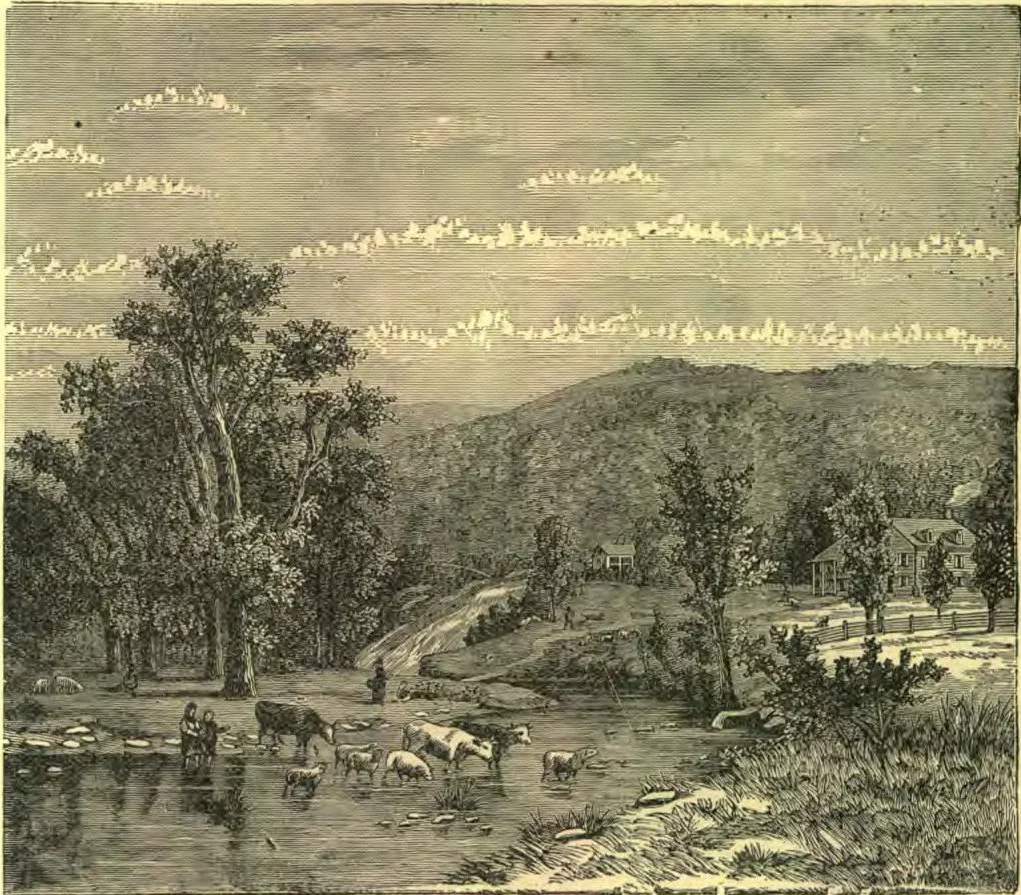
The hot, sultry days of August have at last come,—days with never a cloud in the sky; and the sun goes down round and red; the insects lazily buzz and hum in the grass by the roadside; the leaves on the trees hang motionless, or perhaps stir faintly with the passing breeze; the flowers droop, and the corn curls up its long leaves. The sheep scattered under the trees nibble the short grass, while the cattle stand knee-deep in the brook. From the field comes the rhythmic sound of the whetstone, or the clatter of the reaper cutting down the bearded grain. Listen to the merry whistle of yonder farmer boy, riding homeward on the loaded wain!
Those who behold such scenes every day of the year can hardly appreciate the delightful sense of rest and freedom which strikes the beholder from our crowded cities. To one accustomed only to close streets, hot, stony pavements, and perhaps but a small square of door-yard grass, such a spot seems almost a Beulah land.
It may be that many of our readers who live in town are already taking a short rest from work and care, at some hospitable farm-house or quiet lake; yet to most of the dwellers of our larger towns, such a privilege is entirely unknown. Kind hearts have often been so stirred by the sight of hundreds of children growing up to a future of vice and wickedness, in the stifling air of some city court lighted with but a few hours’ sunshine each day, that the pity at last resolved itself into thought, and the thought into action. So a few summers ago there was started by the New York Tribune, excursions for the purpose of taking these children from their homes to spend a week or two at some country farm-house. The country was thoroughly canvassed, and arrangements were made with kind-hearted people, so that the children might be properly cared for.
It is a touching sight to see the eager faces watching for the train, and to hear their childish voices talking excitedly over the good times they expect to have, and wondering what the country will be like. And it is no less pleasing, when their pleasant stay is over, to see them returning, with their wan faces rounded out, their cheeks rosy, and their eyes sparkling, and nearly every hand holding some happy reminder of their visit, in the shape of daisies, buttercups, and violets, or something more substantial from the farmwife’s shelves.
This good work has not stopped with one year’s trial. Every year, all the summer long, excursion trains are running between our large cities and the small country villages around, carrying hundreds who perhaps in no other way could ever enjoy the sights to be found among the hills.
Recently the churches have taken hold of the work, and are building convenient houses where children, with their mothers, can have a short recreation, the length of their stay being varied according to their needs. And surely no gospel sermon could more deeply affect these overworked, overburdened women than that preached by the fresh air and bright sky, speaking to their tired nerves, as it does, of the beneficence and love of the Creator. Indeed, as one of them said, “One can’t help thinking of God; the sunrise, and the sunset, and everything, speaks of him here.”
In one church the funds necessary for carrying on the work are raised solely by donations from children in better circumstances, more than one thousand dollars having been donated in this way last year.
If this earth, even with the curse upon it, can look so beautiful to these poor people, what will be their joy should they reach a home in God’s new country, where they will go no more out forever, but where are to be found only the things that are good and pure and beautiful, and where evil and sorrow and pain will be as though they had not been! W. E. L.

Lessons of Diligence and Obedience in Humble Service

LET us learn the lessons of diligence and obedience. The path to greatness is the path of humble service and patient and diligent endeavor—the path of Him who “came not to be ministered unto but to minister, and to give his life a ransom for many.”

A SUMMER DAY.

Midsummer, veiled in golden mist, And crowned with golden leaves, Comes tripping with her sandaled feet Among the gathered sheaves. Bright clouds and winds and sunbeams play Around this bright midsummer day.
Along the upper pearl-rift shore The clouds like purple banners lie; Austere and grand, the noonday sun Is sloping westward through the sky; Now, fainting on his couch of rest, A thousand arrows pierce his breast.
Upon the hills the cattle graze, Knee-deep in clover white as snow; The very silence seems to be Full of their distant, lazy low, And round the far-off valley lies The perfect rest of Paradise.
Nature’s sweet harmony without Creates a harmony within; Why should we wage perpetual strife With want, and poverty, and sin? Sweeter it is to lie at rest, Dear Mother Earth, on thy soft breast.
And this is rest—a perfect calm. I watch the blue mists float away; The stillness seems like holiness; The earth is better for this day. Oh, if all strife, all care, would cease Forever in this perfect peace!
—Selected.

HOW KITTY VISITED IN PRISON.

Kitty Travers came out of church thoughtfully. The sermon had been about the judgment day, how Christ will say to them on his right hand, “I was sick, and ye visited me; I was in prison, and ye came unto me.” And Kitty knew that doing it for one of the least of his brethren was the same as doing it for Christ.
Kitty hoped she would be standing on the right hand on that last great day; but she feared she was not doing the kind of work that would be spoken about at the judgment. There seemed never much chance for visiting sick people; indeed, Dame Pierson was the only sick poor person that Kitty knew about, and the dame was so well taken care of by the Ladies’ Aid Society that she never needed anything. As for prisons, there wasn’t one in Elm village. Kitty almost began to think the text was not meant for her, and then she remembered about Hesba Lane,—Hesba had not been at Sabbath-school that morning. Perhaps she might be sick. Kitty resolved to go the very next day, after school, and see about it.
The Lanes were new comers in the village. Kitty almost trembled as she knocked at a shop-door, where it read on the outside: “Umbrellas mended. Other repairing neatly attended to.” A lame man opened the door, Hesba’s uncle; and when he said Hesba was sick, Kitty felt almost glad for a minute,—though directly she was ashamed of it,—she was so very anxious to please the Lord Jesus, and to do the kind of work for him that would be spoken about at the judgment.
Kitty found her friend lying upon a lounge in a small but very neat room behind the shop. She had chills and fever, so Hesba’s aunt said,—a pale lady, who presently went out of the room. Hesba told Kitty that one had to take “lots and lots” of medicine for chills, which cost very much. From this it came out naturally that Hesba’s uncle had not nearly work enough. Being lame, he could not go out to hunt it up like other people, but must only sit still and wait; and “the people in Elm village seemed never to need anything mended,” Hesba added with a quaver.
Kitty noticed how faint the fire was in the sitting-room; and besides, she couldn’t help half suspecting that Hesba hadn’t food enough—or, at least, not the right sort. She felt how hard it must be for Hesba’s uncle just to sit in the shop and wait, like a prisoner, when the coals were out. She wondered if Mr. Lane’s shop could be one of the sort of prisons that the Lord meant.
Kitty thought it wasn’t of much use to visit people and not help them. All the way home she tried to contrive how she might do something for the Lanes. She thought she would take a turn with her sled on the hill before dark, and talk over the matter about the Lanes with a particular friend of hers before school the next morning. Kitty climbed the long hill, and, taking two or three girls behind her upon her good “Reindeer,” started to slide down. A bad boy saw the party coming, and thought it would be rare fun to place a stick across the path and make them “jump.” He did so, and the girls were all thrown violently into the snow. Kitty was so badly hurt in one of her ankles that she had to be carried home. When she recovered from the fright of having a bone set, and of hearing that it would be several weeks before she could walk again, she thought how strange it was to be laid up herself just when she had begun to visit the sick and in prison. Kitty found it very dull lying in bed all the time, and to divert herself she wrote a letter about her accident to Cousin Angeline, in New York.
Four days after this, Kitty’s brother, Bob, came up-stairs bringing a box from the post-office with Kitty’s name on the outside, and so very light that Bob declared it was filled with emptiness. However, he waited for Kitty to take off the wrapper, when there came out the loveliest “creation,” all in tissue paper, crimped in three layers to form a lamp shade, trimmed round with fringe and adorned on one side with a beautiful bunch of flowers. What was better, there was a note with full directions for making a shade, with a tea rose, a poppy, and a daisy to pull apart for patterns, and a ream of the best English tissue paper, in choice colors, lying snugly in the bottom of the box. Cousin Angeline thought these things might amuse Kitty in her confinement. Everybody in New York was making lamp shades. Cousin Angeline herself had made ten for a fair, which were sold at a dollar and a half apiece.
Forthwith Miss Kitty had an idea,—not of a fair, however; but she was very busy the next few days patiently drawing sheets of paper, folded something like soldiers’ caps, between her thumb and finger, till they were creased in fine, straight lines. Then she trimmed the points off to make a place for the lamp chimney. Cutting and sewing the fringe on was tedious. The daisies required much patience in the making, but the poppies and tea roses were easy. At last four shades were completed,—a pale blue and a pale green one, a pink and a red. Kitty put them carefully in a box with a note, and Brother Bob carried the box to Hesba. When Hesba saw the lamp shades, she was wild with delight. She knew from the note that they were to hang in her uncle’s shop window because he hadn’t work. Perhaps somebody would like to purchase them. They were a dollar and a half apiece in New York, but perhaps they ought only to be a dollar in a village.
Mr. Lane was a man of taste, and when he had hung the shades up in the three middle panes of his window, he declared they looked so handsome that people would surely be in to buy. Meanwhile, Kitty, who didn’t do things by halves, wrote notes to all the school-girls, begging them to ask their mothers, and cousins, and aunts, and sisters to go and see the pretty lamp shades for sale in Mr. Lane’s front window. So they went, and Mr. Lane got acquainted with more nice people in one day than he had supposed the village contained.
Of course, there were not shades enough to go around; but the visitors all heard about the “repairing,” and almost every one of them could think of something at home that needed mending.
So it fell out that a procession of umbrellas, wash-tubs, boilers, and other disabled things, followed to the shop after the shade-buyers; and when Kitty was well enough to go around there again, she found the lame man so cheerful that it seemed he was fairly out of prison.
And Kitty felt sure that the Lord must have seen how much she wanted to help one of his prisoners, and just put it into Cousin Angeline’s heart to show her how best to do it.—Helen B. Williams.

GOD'S CREATURES.

A little boy was tormenting a poor, frightened dog on the street one day. He had a stout cord around the poor creature's neck, and was using all his strength to drag the dog along. Of course the frightened little animal tried to pull away, and the harder he pulled the more he was choked, and the more terrified he grew.
A lady passing along the walk laid her hand gently on the boy's shoulder, and said,—
“My dear boy, do you know that is God's little dog?” The boy looked into her face with a funny, frightened look, and said,—
“No; is it really?”
“Yes, it really is; and so I think you will have to be careful how you treat it.”
Then she went on. Looking back a moment after, she saw that the boy had let go of the string, and the dog was running away as fast as his feet could carry him!
No doubt the boy was happier in letting the poor dog go than he had been in tormenting him; it can't be that there is pleasure in hurting anything, though it does seem as if some folks found pleasure in just that way!
Must it not be that such folks do not consider that any creature which can feel is one of God's creatures? If the boy who torments the dog, frightens the cat, bereaves the mother-bird, or in any way acts out the savage, could only see that every living thing belongs to God, how tender and kindly it would make him! Indeed, boys and girls, believing in God is the cure for everything that is hard and unloving.

AIM HIGH.

He who aims at the sun when overhead will shoot highest. The boy or girl who aims studiously and perseveringly at an elevated mark in education will gain a high degree of knowledge and power. The boy or girl who aims carefully and steadily at a superior mark, morally and religiously, will attain to a worthy and noble character. Let it be your aim always to be most strict and watchful in speaking the truth, and you will secure the grand advantage of always being believed. Be it your aim to be most careful and conscientious in the use of pure language in every respect, and you will reach a modest and dignified form of expression that will pass anywhere like gold from the mint. Always aim—earnestly and prayerfully aim—to form correct and pious habits of conduct, and you can face the world without shame, and may hope to fill your days with usefulness. With such aims and efforts, you will rise high in self-respect, in the confidence of others, and in the favor of God. Boys and girls, I say again, Aim high! Aim high in all good things! Aim high early! Aim high everywhere! Aim high always!—Lutheran Sunday-school Herald.

Room Enough for All of Us

Do not try to build yourself up by pulling others down. There is room enough here for all of us.

THE WORD OF THE LORD.

Thy word is like a garden, Lord, With flowers bright and fair; And every one who seeks, may pluck A lovely nosegay there.
Thy word is like a deep, deep mine, And jewels rich and rare Are hidden in its mighty depths, For every searcher there.
Thy word is like the starry host; A thousand rays of light Are seen to guide the traveler, And make his pathway bright.
Thy word is like a glorious choir, And loud its anthems ring; Though many tongues and parts unite, It is one song they sing.
Thy word is like an armory, Where soldiers may repair, And find, for life's long battle day, All needful weapons there.
O, may I love thy precious word, May I explore the mine; May I its fragrant flowers glean, May light upon me shine!
O, may I find my armor there— Thy word my trusty sword; I'll learn to fight with every foe The battle of the Lord!
—Edwin Hodder.

NEW-TESTAMENT HISTORY.

LESSON 149.—PAUL AND SILAS IMPRISONED.

After remaining at Antioch some time, Judas returned to Jerusalem, but Silas chose to remain at Antioch, where Paul and Barnabas, with many others, were still “teaching and preaching the word of the Lord.” After a time, Paul suggested to Barnabas that they should go and look after the prosperity of those who had received the gospel through their preaching. Barnabas wished to take with them John whose surname was Mark; but Paul was unwilling to again take into service a man who had deserted them in the hour of their need. So determined was Barnabas, however, that he, with Mark, sailed alone unto Cyprus, while Paul, accompanied by Silas, took a tour through Syria and Cilicia, confirming the churches wherever they went.
Among other places, they visited Derbe and Lystra. At the latter place, Paul found a very worthy young man named Timothy, who was the son of a Jewess, but whose father was a Greek. This young man had witnessed the cruel persecution which was raised against Paul and Barnabas at Lystra, and it is quite likely that he had seen Paul stoned, taken out of the city as dead, and afterward restored by the power of God. Notwithstanding all this, Timothy had remained undaunted and true, and Paul felt sure that he would not shrink from danger, as John Mark had done. Timothy showed in his character the results of the excellent training which he had received from his mother and grandmother. See 2 Tim. 1: 5.
In our last lesson we have seen that under the gospel dispensation, circumcision was not regarded necessary to salvation; but Paul had Timothy circumcised to remove an obstacle that might prevent many Jews from receiving the gospel; for they all knew that his father was a Greek. This shows that being circumcised did not cut a man off from Christian fellowship, or destroy his hope in Christ, unless he trusted in that circumcision as a means of salvation.
As the apostles went from place to place, they delivered to the disciples the decrees that were ordained by the apostles and elders at Jerusalem. Thus encouraged, the churches became stronger in faith, and went on increasing in numbers. Paul and his companions first traveled northward and then westward, passing through Galatia and Phrygia, and coming to Mysia, which bordered on the Hellespont, or Strait of Dardanelles. The western part of the peninsula of Asia Minor, bordering on the Ægean Sea, or Grecian Archipelago, was at that time especially designated as Asia. Having been in some way forbidden of the Spirit to preach in those parts, Paul had a mind to travel northward into Bithynia, which borders on the Black Sea and the Sea of Marmora. But from this purpose he was turned by the intervention of the Spirit, and passing by Mysia, came down to Troas. Here Paul had a night vision, in which he saw a man of Macedonia standing and beseeching him, saying, “Come over into Macedonia and help us.” In obedience to this vision, the apostles immediately embarked upon the water of the Ægean Sea, and sailed to Philippi, touching, by the way, at Samothracia and Neapolis. Philippi was a Roman colony and the chief city of that part of Macedonia.
When the Sabbath came, Paul and his associates went outside the gate of the city, and sat down by the side of a river at a place where people were accustomed to assemble for prayer. There they spoke the word of God to some women, among whom was a woman from Thyatira, named Lydia, a dealer in purple. Being a sincere worshiper, God so opened her heart that she attended to the things which were spoken by Paul. Being convinced that his words were true, both she and her household were baptized. Then she said, “If ye have judged me to be faithful to the Lord, come into my house and abide there.” And so urgent was her request, that the apostles complied with it.
Day by day, as the apostles and those that believed their teaching were going to the place of prayer, they were met by a damsel who had a spirit of divination, and brought her masters much gain by soothsaying. Following after Paul, she cried out continually, “These men are servants of the most high God, which show unto us the way of salvation.” At last Paul was so grieved that he turned and said to the spirit, “I command thee in the name of Jesus Christ to come out of her.” That very hour the spirit departed from her.
When the masters of this damsel saw that the hope of their gains was gone, they rudely seized Paul and Silas, and dragging them into the market place, brought them before the magistrates of the city, saying, “These men, being Jews, do exceedingly trouble our city, and teach customs which are not lawful for us to receive, neither to observe, being Romans.” Then rose up the multitude against them; and the magistrates, rending off their clothes, commanded that they should be beaten with rods. After enduring many stripes, these men of God were handed over to the jailer, who, having received a special charge to guard against their escape, thrust them into the inner prison, and made their feet fast in the stocks.
About midnight, as Paul and Silas were praying and singing praises unto God so loud that the prisoners could hear them, there came a sudden earthquake, which so shook the prison as to immediately throw open all the doors, and in a moment every prisoner’s bands were loosed. The keeper of the prison was suddenly awakened from sleep, and supposing from the open doors that the prisoners were fled, was about to thrust himself through with his own sword, when Paul cried out, saying, “Do thyself no harm, for we are all here.” Then the keeper, calling for a light, sprang in, and trembling with fear, fell down before Paul and Silas, saying, “Sirs, what must I do to be saved?” And they said, “Believe on the Lord Jesus Christ, and thou shalt be saved, and thy house.” Then the apostles spoke the word of the Lord to him and to all that were in his house; and the same hour of the night the jailer took them and washed their stripes, and was baptized, with all his family. Then he brought them into his house, and set food before them; and both he and his house rejoiced greatly because of the light which God had given them.

QUESTIONS.

  1. What course was pursued by Judas and Silas after having delivered their message to the church at Antioch?
  2. How were Paul and Barnabas employed at this time?
  3. What suggestion did Paul finally make?
  4. On what point did Paul and Barnabas differ?
  5. How did Barnabas carry out his determination?
  6. Who accompanied Paul on his visit to the churches?
  7. Through what parts did they first go?
  8. What helper did Paul find at Lystra?
  9. Describe the character and experience of Timothy.
  10. What gave Paul confidence in him?
  11. What reputation did Timothy bear? Acts 16: 2.
  12. What results were shown in his character?
  13. In our last lesson what have we learned in regard to circumcision?
  14. Why did Paul have Timothy circumcised? Verse 6.
  15. What did this show?
  16. What did the apostles do as they went from place to place?
  17. How were the churches benefited?
  18. On leaving Derbe and Lystra, which way did Paul and Silas travel?
  19. Through what countries did they pass?
  20. Where was Mysia situated?
  21. To what part was the term “Asia” specially applied?
  22. On being forbidden to preach the word in Asia, into what country did Paul have a mind to go?
  23. How was he turned from this purpose?
  24. What course did he pursue?
  25. How was he here instructed in regard to duty?
  26. Describe the journey taken in obedience to this vision?
  27. What are we told with reference to Philippi?
  28. Where did Paul and his associates go on the Sabbath?
  29. To whom did they there speak the word of God?
  30. What noted woman was among them?
  31. How did she receive the doctrines spoken by Paul?
  32. How did she manifest her faith?
  33. What did she persuade the apostles to do?
  34. How were the apostles annoyed day by day as they went to the place of prayer?
  35. What did Paul finally do?
  36. How did her masters revenge themselves, when they saw that the hope of their gains was gone?
  37. What accusation did they bring against the apostles?
  38. How were the apostles treated by the magistrates?
  39. How did the jailer guard against the escape of these prisoners?
  40. How did Paul and Silas employ their time that night in prison?
  41. What happened about midnight?
  42. Describe the fright of the jailer?
  43. How was he prevented from committing suicide?
  44. What did Paul say in answer to the jailer’s question, “What must I do to be saved?”
  45. What did the apostles then proceed to do?
  46. Describe the obedience and consequent happiness of the jailer and his family.

NOTES.

Acts 16 : 6. Phrygia.—Phrygia denoted at this time broken portions of a territory in Asia Minor, under the jurisdiction of three or four distinct governors. It was west of Antioch in Pisidia. Its chief cities mentioned in the New Testament are Colosse, Laodicea, and Hierapolis.—Rev. Com.
Ver. 10. Macedonia.—This country was now a Roman province. The Roman governor resided at Thessalonica, which was the general capital. Philip and his son (330 B. C.), Alexander the Great, were the first to bring Macedonia into prominence, and to extend its territory and influence over Greece.—Rev. Com.
Ver. 11. To Samothracia.—This was an island in the Ægean Sea, not far from Thrace. It was peopled by inhabitants from Samos and Thrace, and hence called Samothracia. It was about twenty miles in circumference; and was an asylum for fugitives and criminals.—Barnes. And the next day to Neapolis.—This was a maritime city of Macedonia, near the borders of Thrace. It is now called Napoli.—Ibid.
Ver. 12. And from thence to Philippi.—The former name of this city was Dathos. It was repaired and adorned by Philip, the father of Alexander the Great, and after him was called Philippi. It was famous for having been the place where several battles were fought in the civil wars of the Romans, and among others, for the decisive battle between Brutus and Antony. At this place Brutus killed himself. Extensive ruins still mark the site of the old city.—Ibid.
Ver. 13. By a river side.—What river this was, is not known. It is known, however, that the Jews were accustomed to provide water, or to build their synagogues and oratories near water, for the convenience of the numerous washings before and during their religious services.—Ibid.
Ver. 14. A seller of purple.—Purple was a most valuable color, obtained usually from shell-fish. It was chiefly worn by princes and by the rich; and the traffic in it might have been very profitable.—Barnes.
Ver. 16. A maid having a spirit of divination.—This was a female slave possessed, to translate the Greek literally, “with a spirit of Python.” Python was the spirit that traditionally guarded Delphi. To be possessed by it, was to be supernaturally endowed with wisdom and a prophetic spirit.—Rev. Com. Python, or Pythios, was one of the names of Apollo, the Grecian god of the fine arts, of music, poetry, medicine, and eloquence. Of these he was esteemed to have been the inventor. He had temples on Mount Parnassus, at Delphi, Delos, Claros, Tenedos, etc., and his worship was almost universal. In the celebrated oracle at Delphi, the priestess of Apollo pretended to be inspired; became violently agitated during the periods of pretended inspiration, and during those periods gave such responses to inquirers as were regarded as the oracles of the god. Others would also make pretensions to such inspiration; and the art of fortune-telling, or of jugglery, was extensively practiced, and was the source of much gain.—Barnes.
Ver. 19. The market place.—That is, the forum, where the city authorities, who in a “colony” like Philippi, were styled prætors, held their courts of justice.—Rev. Com.
Ver. 24. Their feet fast in the stocks.—An instrument of torture as well as of confinement, consisting of a heavy piece of wood with holes, into which the feet were placed in such a manner that they were stretched widely apart, so as to cause the sufferer great pain. Frequently the stocks have five holes, two for the feet, two for the hands, and one for the neck.—Rev. Com.

A CHURCH IN THE WILDERNESS.

MANY, many years ago the Lord’s people were slaves in a strange land, where they were very cruelly treated. But they cried to the Lord and told him all their troubles, and finally he raised up a man to lead them out of bondage.
There were a great many of the people, and they had a good deal of trouble in getting away from the king of the land, who wanted them to stay and build cities and towers, and do his other hard work for him. But the Lord helped them through all their hard places because they were his people, and brought them safely out of the land of Egypt by the hand of his servant Moses.
There was a great multitude of men, women, children, and cattle, and they all traveled on foot and camped out at night. There was no trouble or confusion about the way they were to go, or the proper time for breaking up camp; for the Lord set a pillar of cloud to go before them by day and a pillar of fire by night. When that pillar rested, the people went into camp; when it moved forward, the people journeyed as it led. After traveling several weeks, they came to a mountain in the desert, and here the pillar rested for a long time, nearly a year. While there, the Lord called Moses up into Mount Sinai, and told him many things which he was to teach the people; and once he spoke to them by his own voice and gave them the law of the ten commandments, which we now have in our Bibles. He also wrote what he had spoken, on tables of stone, and gave them to Moses, so that the people might not forget it.
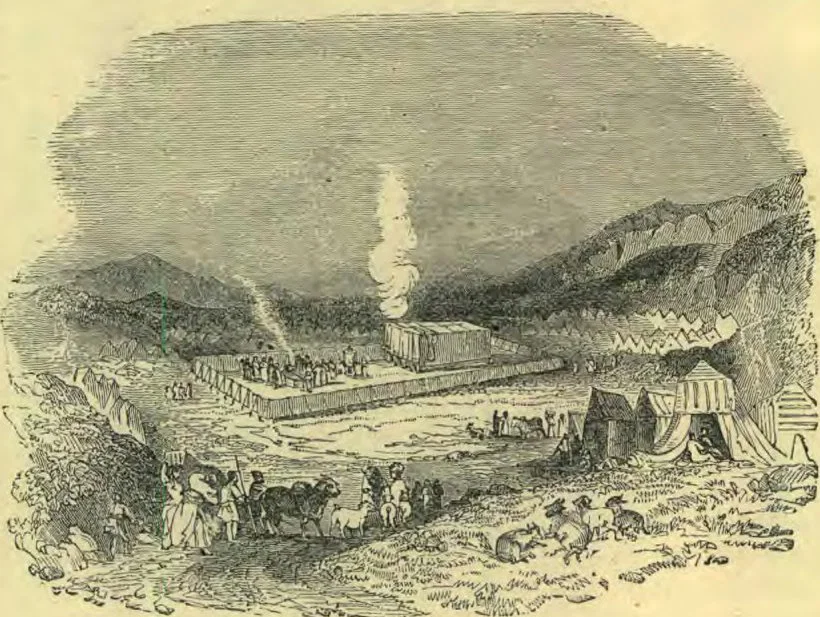
While Moses was up in the mount, the Lord gave him directions for making a place where God was to be worshiped. The building was not called a church, as we call such places now-a-days, but a tabernacle. It was something like a tent, and could be taken down and moved when the people journeyed. The sides were of boards of a very fine wood called shittim wood, and were overlaid with gold on the inside. These boards were all set in sockets, so that they would stand firm without being nailed or fastened in any way, and yet could be easily taken down. Inside the boards were hung beautiful curtains of fine linen, embroidered with blue and purple and scarlet.
The tabernacle had nothing that could be really called a roof, but four different coverings were spread over it, one above another. The first, or inner one, was of fine linen embroidered, like the curtains hung around the sides; the second was of a coarse cloth made of goats’ hair; the third was of rams’ skins dyed red; and the fourth, or outside one, was of badgers’ skins.
There were two rooms in the tabernacle,—the “holy place” and the “most holy place.” In the most holy place was kept the ark, a beautiful chest overlaid with gold inside and out, and having a solid gold cover. This the Lord had Moses make to hold the tables of stone on which he had written the ten commandments. In the holy place was a great golden candlestick, with which the place was lighted; a table, where bread was kept always fresh before the Lord; and an altar, on which was burned sweet incense. All these were covered with gold. Between the two rooms of the tabernacle was hung a curtain even more beautiful than the others, and called a veil.
Around the tabernacle was a large yard called a court, and in this was another altar, where were offered the animals which the people brought for sacrifice. You see they had a different way than we do of worshiping the Lord in those days. Ask some one to tell you about it, if you do not know already.
Some one has made a picture of the tabernacle, as nearly as we can make out how it looked by what the Bible says about it; and we have given it to you on this page. If you look at the picture carefully, you will see many things to interest you besides the tabernacle itself. The tabernacle was kept for many years, and finally carried with the Lord’s people into the land of Canaan, where it was still used till the temple was built at Jerusalem.
Perhaps some of you will wonder where Moses got things to make so beautiful and costly a building away off there in the wilderness. The Bible says that the people gave them from the little they had brought away with them from Egypt. Quite likely they brought to Moses many things which they would have liked to keep for themselves. But the Lord told Moses he was to take no offering that was not given “willingly.” There is a great deal of meaning in that. I wonder if any of us ever give unwilling service to our parents or to the Lord! E. B. G.

NEVER TAKE ANYTHING WITHOUT FIRST ASKING.

CHARLIE was going home with his uncle. They were on the steamboat all night. A steamboat is furnished with little beds on each side of the cabin. These little beds are called berths. When it was time to go to bed, Charlie undressed himself.
“Make haste and jump into your berth, boy,” cried his uncle.
“Mayn’t I first kneel down and ask God to take care of us?” asked Charlie.
“We shall be taken care of fast enough,” said his uncle.
“Yes, sir,” said Charlie, “but mother always tells us not to take anything without first asking.”
Uncle Tom had nothing to say to that; and Charlie knelt down, just as he did by his own little bed at home. God’s bounty and goodness and grace you live on day by day, my children, but never take it without first asking.

Kindness as the Noblest Weapon

KINDNESS is the noblest weapon to conquer with.

MUSIC BOOKS.

Pearly Portals for the Sabbath-school. By D. S. Hakes. The music in this work is new. The words from the best authors. 160 pp. Boards, 35 cents per copy. Cloth, .50
Song Anchor for the Sabbath-school, praise-service and fireside. 164 pp. Boards, 35 cents. Cloth, .50
Temperance and Gospel Songs. For the use of Temperance Clubs and Gospel Temperance Meetings. Price, .30
Better than Pearls. A new collection of the best Gospel Songs, Hymns, and Tunes for use in Tent and Camp-Meetings, as well as in Revivals, Social and Praise Service. Cloth, 40 cents. Board, .30
Songs for Class and School. For Singing-School, Day-School, Convention and Fireside. 160 pp. $.35
Hymn Book. “Hymns and Tunes for those who keep the Commandments of God and the Faith of Jesus.” It has 237 hymns, and 147 tunes, 416 pages. Muslin Bound, $1.00. Morocco, gilt edges, $1.50
All of the above works will be sent by mail, post-paid, on receipt of prices named. Address,
REVIEW & HERALD, Battle Creek, Mich.

DAY AND NIGHT.

The breeze is a-blowing, all out of the west; The proud cock is crowing and lifting his crest; The red light is growing, the darkness is going, Night may be pleasant, but day-time is best!
The robins are flying each one to his nest; The young lambs are lying all folded to rest; The low winds are sighing, the sunset is dying: Day may be pleasant, but night-time is best.
—St. Nicholas.
Continue reading: Letter Budget