Elder G. T. Wilson and wife have gone from Australia to Tasmania to labor.
Elder N. C. McClure reports the addition of six persons to the church at Eureka, Cal.
Elder W. C. Grainger and Brother T. H. Okohira, our missionaries to Japan, have located in Tokio, the capital.
Following on the labors of Elders A. J. Howard and F. Stebbeds at Nebraska City, Neb., a Sabbath school has been organized with thirty-one members.
The camp-meeting held at Adelaide, South Australia, in the autumn, has been followed by a continuous interest, and some forty baptisms are reported.
A church of thirteen members was organized at Alliance, Ohio, January 3, by Elders S. S. Shrock and A. M. Mitchell. A tract society was also organized.
A Sabbath school with twenty-seven members has been established at Central City, Neb., as a result of labor by Elder C. N. Hart and Brother E. L. Stewart.
The work at Hanley, Iowa, by Brethren H. M. J. Richards and C. A. Hansen, is fruitful of interest and some accessions to the faith. An organization is expected in the near future.
Elder R. D. Hottel, who has for some time been a laborer in the Atlantic Conference, has been transferred to the southern field, and located at Birmingham, Ala. His address is 1008 North Twenty-first Street.
An encouraging series of meetings at Exira, Iowa, is reported by Elder E. G. Olsen, who is laboring in the interest of the Scandinavian people. There was a refreshing revival in the church, and about a score began the service of the Lord for the first time.
A church of nineteen members was organized at Lodi, Cal., January 9, by Elder M. C. Israel. The greater part of this number had been connected with the church at Stockton. This organization is not only a great convenience to the brethren at Lodi, but it gives a new impetus to the work there.
We are often reminded of the fact that opposition to the truth works to its advantage, and that “all things work together for good to them that love God.” It has frequently occurred that our brethren have been stimulated to build church edifices of their own because they were denied the use of places that were accessible to people of other denominations. This is aptly illustrated by the experience of some brethren in Cass County, Texas. An unorganized company constructed an arbor in which Brother J. N. Sommerville held a series of meetings, after which a church was organized, numbering twenty-three members, and took the name New Hope Church. Brother Sommerville says: “We were not allowed to use any of the church buildings or schoolhouses, so the brethren decided to build. . . . There has been much opposition, but God has wonderfully blessed the work.” That the Lord will manifest his power in times of apparent disaster, was demonstrated at the Red Sea. That vicissitudes which appear to seriously cripple the work may be made the direct means of furthering it all the more, was illustrated at Jerusalem: “And at that time there was a great persecution against the church which was at Jerusalem; and they were all scattered abroad throughout the regions of Judea and Samaria, except the apostles. . . . Therefore they that were scattered abroad went everywhere preaching the Word.” Acts 8:1-4.
Union College, at College View, Neb., has now an attendance of 236. Elder W. B. White says the school “is getting a reputation among the other churches, and also in the world, as an excellent school, and now in the ladies’ dormitory more than half the students are from the world or other churches.”
A good work is reported at Vance Creek, Wis., under the labors of Brother D. C. Burch, who began work there in the fall by holding meetings in a union church. The result is a company of about forty who have covenanted to “keep the commandments of God and the faith of Jesus.” The attendance at Sabbath school is about sixty.
An encouraging report of mission work in Wyoming, under the labors of Elder O. S. Ferren, appears in the Review. In the past year he has held meetings in eight different places, and organized two churches, four Sabbath schools, and two tract societies. At the date of his report, Elder Ferren was holding meetings at a mining camp, with a good attendance.
Sometimes the cry of “hard times” becomes more of a bugbear than a real hindrance to canvassers. Other people do not, as a rule, throw up their business because of hard times. They are obliged to continue their work on the farm or in the workshop or store in spite of hard times. They continue even if there is little or no profit. In Elder D. C. Babcock’s report to the Review there is a word of encouragement that will bear repeating. He speaks of West Virginia, and says: “We can see a general revival in the work, and our workers are meeting with better success than they have had for some time. One of our old canvassers, who has been out of the work for some time, decided to begin work again. She commenced with her nearest neighbor, and sold six books at the first six houses.” He further states that she sold nine books the next day, six of them to Catholics, and this work was done in territory that had been canvassed several times. “Speak unto the children of Israel, that they go forward.” Times always will be hard, but the Gospel of the kingdom must be proclaimed unto the ends of the earth, and all power in heaven and in earth is behind it. “Go ye therefore.”
37 “But though he had done so many signs before them, yet they 38 believed not on him; that the word of Isaiah the prophet might be fulfilled, which he spake,
Lord, who hath believed our report?
And to whom hath the arm of the Lord been revealed?
39 For this cause they could not believe, for that Isaiah said again,
40 He hath blinded their eyes, and he hardened their heart;
Lest they should see with their eyes, and perceive with their heart,
And should turn,
And I should heal them.
41 These things said Isaiah, because he saw his glory; and he 42 spake of him. Nevertheless even of the rulers many believed on him; but because of the Pharisees they did not confess it, lest they should be put out of the synagogue: for they loved the glory of men more than the glory of God.
43 And Jesus cried and said, He that believeth on me, believeth not on me, but on him that sent me. And he that 44 beholdeth me beholdeth him that sent me. I am come a light into the world, that whosoever believeth on me may not abide 45 in the darkness. And if any man hear my sayings, and keep them not, I judge him not: for I came not to judge the world; 46 but to save the world. He that rejecteth me, and receiveth not my sayings, hath one that judgeth him: the word that I 47 spake, the same shall judge him in the last day. For I spake not from myself; but the Father which sent me, he hath given me a commandment, what I should say, and what I should 48 speak. And I know that his commandment is life eternal: the things therefore which I speak, even as the Father hath said unto me, so I speak.”
QUESTIONS.
How did the Jews respond to the works of Christ?
With what was this result in harmony?
What prophetic inquiries had foretold this situation?
What was the result of their previous unbelief?
How had this also been foretold?
What experience of the prophet caused these utterances?
Who, however, did believe on Jesus as the Christ?
What prevented their open allegiance to him?
What was the real cause of their unwillingness to own him?
How did Jesus declare his oneness with the Father?
In what other words did he express the same general truth?
As what did Jesus come? For what purpose?
How did Jesus treat those who refused his teaching?
What reason did he give for this plan of action?
What is true of the rejecter of his teaching?
What will appear against him at the last day?
Why did such results come from the rejection of the words of Jesus?
What is the nature of the Father’s commandment?
What principle did Jesus follow in all his teaching?
NOTES.
1. “THERE is a terrible danger—a danger not sufficiently understood—in delaying to yield to the pleading voice of God’s Holy Spirit, in choosing to live in sin; for such this delay really is. Many are quieting a troubled conscience with the thought that they can change a course of evil when they choose; that they can trifle with the invitations of mercy, and yet be again and again impressed. They think that . . . in a moment of terrible extremity they can change their course. But this is not so easily done. The experience, the education of a lifetime, has so thoroughly molded the character that few then desire to receive the image of Jesus.”
2. “It is not the plan of God to compel men to yield their wicked unbelief. Before them are light and darkness, truth and error. It is for them to decide which to accept. The human mind is endowed with power to discriminate between right and wrong. God designs that men shall not decide from impulse, but from weight of evidence, carefully comparing scripture with scripture. Had the Jews laid aside their prejudice, and compared written prophecy with the facts characterizing the life of Jesus, they would have perceived a beautiful harmony between the prophecies and their fulfilment in the life and ministry of the lowly Galilean.”
3. “THESE things said Isaiah, because he saw His glory.” R. V. The wonderful view granted to Isaiah was but a foreshadowing of the outshining of His glory (Heb. 1:3) as it would be revealed in Christ, and the prophet saw that such an exhibition of the glory of the Lord would simply blind the eyes of those who had persistently refused to receive the light as it was gradually revealed, and as they were able to bear it. One who persists in living in a dark cave is blinded when a bright light suddenly breaks upon his vision.
4. MEN of influence were convinced that Christ’s claims and teaching were true, but refrained from acknowledging them and him for fear of losing their standing in society and the church; “for they loved the glory of men more than the glory of God.” R. V. The glory of fellowship with God was quite eclipsed by the glory of living in the eye of the people as wise and estimable persons.
2. What relation is suggested between conversion and healing? Compare with Ps. 103:3.
3. What principle of true religious liberty is taught in verse 47?
4. In the judgment the believer is acquitted by the law, and the Gospel witnesses to the righteousness of the acquittal; the sinner is condemned by the same law, and the same Gospel witnesses to the justice of the condemnation.
5. What law of life for the Christian is suggested in verse 49?
6. How is life only in Christ taught in this lesson?
Lincoln Fountain Pen.
By Editor
We are constantly receiving words of recommendation for this pen, and we are thoroughly convinced that it is just as represented in every way. We are allowing special prices on orders for a dozen or more at one time.
Our offer to send the pen for only 75 cents to any one subscribing for the SIGNS OF THE TIMES for one year, and paying the regular subscription price of $1.00, still holds good. Both the SIGNS and the pen for $1.75.
Pacific Press Pub. Co., Oakland, Cal.
New York City. Kansas City, Mo.
Christ Our Saviour
Published in
ENGLISH
GERMAN
DANISH
SWEDISH
SPANISH
A book which gives in simple and direct language the life of the Redeemer from his birth to his death, resurrection and ascension. It is printed in large, clear type, and is profusely and aptly illustrated by engravings made especially for the book. The directness and simplicity of the story of Christ Our Saviour gives to the book a special charm, and the interest deepens as the reader progresses with the story that is so old yet is ever new. One hundred and sixty large octavo pages, substantially bound in the following styles:—
Just the Book for Young People. Interesting. Elevating.
PRESENTATION EDITION
Two colors Vellum cloth, embossed in jet, green, and gold, gilt top . . . $1.25
Heavy tagboard covers, printed in colors . . . .35
ADDRESS,
PACIFIC PRESS PUBLISHING CO.
Kansas City, Mo. OAKLAND, CAL. New York City
The Sunday School
International Series.
Lesson VIII.—Sunday, February 21, 1897.
THE FIRST CHRISTIAN MARTYR.
NOTE.—We have noted in the church the manifestations of the power by which it was instituted. We have also studied the manifestations of that power by which the church has been opposed from its very birth and will be opposed until the end of time. We have seen how the power of God made hypocrites afraid to join themselves to the church, and how the church was strengthened and increased by the opposition of its enemies whether from without the fold or from within. This lesson shows to what lengths opposers of the truth will go—even to the taking of life; but the martyrdom of Stephen bore fruit to the church. Persecution of the church drives out of it the insincere, and makes the work of those who are sincere a powerful instrument for good.
8 “And Stephen, full of grace and power, wrought great wonders and signs among the people. But there arose certain of them that were of the synagogue called the synagogue of the Libertines, and of the Cyrenians, and of the Alexandrians, and of them of Cilicia and Asia, disputing with Stephen. 9 And they were not able to withstand the wisdom and the Spirit by which he spake. Then they suborned men, which said, We have heard him speak blasphemous words against Moses, and against God. 12 And they stirred up the people, and the elders, and the scribes, and came upon him, and seized him, and brought him into the council, and set up false witnesses, which said, This man ceaseth not to speak words against this holy place, and the law: 14 for we have heard him say, that this Jesus of Nazareth shall destroy this place, and shall change the customs which Moses delivered unto us. 15 And all that sat in the council, fastening their eyes on him, saw his face as it had been the face of an angel.”
54 “Now when they heard these things, they were cut to the heart, and they gnashed on him with their teeth. 55 But he, being full of the Holy Ghost, looked up steadfastly into heaven, and saw the glory of God, and Jesus standing on the right hand of God, and said, 56 Behold, I see the heavens opened, and the Son of man standing on the right hand of God. 57 But they cried out with a loud voice, and stopped their ears, and rushed upon him with one accord; 58 and they cast him out of the city, and stoned him; and the witnesses laid down their garments at the feet of a young man named Saul. 59 And they stoned Stephen, calling upon the Lord, and saying, Lord Jesus, receive my spirit. 60 And he kneeled down, and cried with a loud voice, Lord, lay not this sin to their charge. And when he had said this, he fell asleep.”
Golden Text.—“Be thou faithful unto death, and I will give thee a crown of life.” Rev. 2:10.
SUGGESTIVE QUESTIONS.
(1) Who is introduced in the beginning of this lesson? Verse 8. Note 2. (2) What called him into prominence? Ib. (3) By whom was he withstood? Verse 9. Note 2. (4) By what two things were Stephen’s adversaries confounded? Verse 10. Note 3. (5) Being unable to cope with him in debate, what did they do? Verse 11. Note 4. (6) What was the result of this wicked conspiracy? Verse 12. (7) By whom was he accused? Verse 13, first clause. Note 5. (8) Of what did they accuse him? Ib., last part. (9) What had they heard him say? Verse 14. Note 6. (10) How did God testify to Stephen’s innocence? Verse 15. Note 7. (11) After listening to Stephen’s defense, how were his accusers affected? Chapter 7, verse 54. (12) How were their feelings manifested? Ib. Note 8. (13) How was Stephen enabled to stand this persecution? Verse 55, first part. (14) What merciful vision did he have? Ib., last part. (15) What startling declaration did he make? Verse 56. (16) What did this cause his accusers to do? Verse 57. (17) What did they do with Stephen? Verse 58, first part. (18) What significant incident is mentioned in this connection? Verse 58, last part. Note 9. (19) In what was Stephen engaged while the Jews were stoning him? Verse 59. (20) What was Stephen’s prayer for his slayers? Verse 60, first part. Note 10. (21) What followed the prayer? Ib., last clause.
NOTES.
1. And Stephen.—Stephen was chosen from among the lay members of the early church to be one of the seven who were to have charge of distributing food and clothing among the poor. These seven were the first deacons of the church. Two of them, Stephen and Philip, labored as evangelists. Stephen is especially mentioned as being full of faith and of the Holy Ghost. It was this that enabled him to do “great wonders and miracles among the people.”
2. Libertines . . . and them of Cilicia.—The Libertines were descendants of Jewish slaves taken captive during the wars of Pompey, but emancipated at Rome and allowed to return to Jerusalem, where they maintained a synagogue independent from the other Jewish synagogues. Among the Cilicians who held debate with Stephen it is probable that Saul took an active part, both from the fact of his high scholarship and his presence at the execution, as well as from his zeal in the persecutions which followed.
3. The wisdom and the spirit.—The wisdom with which Stephen met and overwhelmed his opponents was not the wisdom of men. Therefore their arguments had no power to stand before it. The “spirit” was the Spirit of God that was in him. The spirit of the accusers was earthly, and this is shown in the malicious way in which it manifested itself. Here are truth and error, the Spirit of God and the spirit of wickedness, brought face to face. Truth, in the person of Stephen, was “crushed to earth;” but in that very act truth is permitted to “rise” to heaven itself and in vision look upon the approving face of the Author of truth.
4. They suborned men.—The universal tactics of the unprincipled in defending falsehood. The word is defined as “to bribe or unlawfully procure to some act of wickedness—specifically, in law, to giving false testimony.” These false witnesses were secretly instructed, by the accusers of Stephen, in the perjured testimony which they were to give. Even so they hired false witnesses against our Lord. Matt. 26:59, 60.
5. False witnesses.—In making a pretended fight for the honor of God, they broke one of his express commands, “Thou shalt not bear false witness against thy neighbor.” These witnesses were false because they told what they had been hired to tell as tho they themselves had seen and heard it. Their witness was false in that they distorted and perverted the teachings and words of Stephen.
6. Shall destroy this place.—Stephen’s prophecy in regard to Jerusalem being destroyed was in harmony with the prophecy of Jesus recorded in Matt. 24:2, and also of the prophet Micah, whom they professed to believe (Micah 3:12). Stephen had also showed them how that the ordinances and customs pointing to the Messiah had come to an end. Type had met antitype; shadows had met substance; the work of the Levitical priesthood was finished, as is shown by the fact that the “vail” of the temple was rent in twain when the antitypical Sacrifice was offered on Calvary; the priesthood and sanctuary service had been transferred to heaven (Heb. 8:1-3); and Christ, whom they had slain, was the minister of “the true tabernacle which the Lord pitched and not man.” In this, however, there was no abolition of the law of God “written and graven in stone.” Sin exists. There must be a law or sin could not be; for “sin is the transgression of the law.” 1 John 3:4; Rom. 7:7. The acknowledged existence of sin proves the existence of the law of God. There can be no transgression of the law where no law is, and it takes the transgression of God’s law to make sin. “If thou kill, thou art become a transgressor of the law.” James 2:11. That law is the law in which occurs the command, “Thou shalt not kill,” which is the Ten Commandments. Paul says (Rom. 3:31) that the law is not made void through faith, but that it is established thereby. Christ says, “It is easier for heaven and earth to pass, than one tittle of the law to fail.” Luke 16:17.
7. His face . . . as the face of an angel.—Angelic light will never illumine the face of him who opposes God or his truth. Stephen was accused of conspiring against Moses, Mosaic customs, and the law of the Lord. God exonerates Stephen of the charge by permitting that same light which shone from the face of Moses, when he came down from Mount Sinai, to illuminate the face of the accused man.
8. They gnashed on him.—The honest-hearted welcome light, even tho it shows them in grievous error, in order that they may alter their course. The other class welcome light if it is in accordance with their course, or will minister to their own ends. Otherwise they prefer to drift where their own inclinations may take them, heedless of consequences. Note the contrast between the appearance of Stephen and that of his accusers, as shown by verse 15 of chapter 6 and verse 54 of chapter 7.
9. Whose name was Saul.—The martyrdom of Stephen bore fruit, and that fruit was seen in the conversion of Saul, who, tho consenting to Stephen’s death, was afterwards one of the staunchest defenders of the same truths which Stephen advocated.
10. Note in verses 59 and 60 the prayer of Stephen, and its similarity to the prayer of the Saviour on the cross. Christ said, “Father, into thy hands I commend my Spirit.” Stephen prayed, “Lord Jesus, receive my spirit.” Both committed their lives into the hands of God. Christ prayed, “Father, forgive them; for they know not what they do.” How like this is Stephen’s, “Lord, lay not this sin to their charge”?
The Gospel Primer
Over 300,000 Copies Already Sold
Published in GERMAN SWEDISH DANISH PORTUGUESE SPANISH
SIMPLE Gospel truths told to youthful readers in connection with the learning of the alphabet. Thus the mind receives the beautiful thoughts of the Scripture while learning to read.
Every chapter is an outline of a subject which may be enlarged upon by the parent or teacher.
Just the book to assist in guiding the little feet in Gospel paths.
Very Fully Illustrated
And Neatly Bound, as follows:—
Cloth, embossed in ink . . . . . 50c
Heavy Board, in four colors . . . . 25c
Address,
PACIFIC PRESS PUBLISHING CO.
Kansas City, Mo. OAKLAND, CAL. New York City
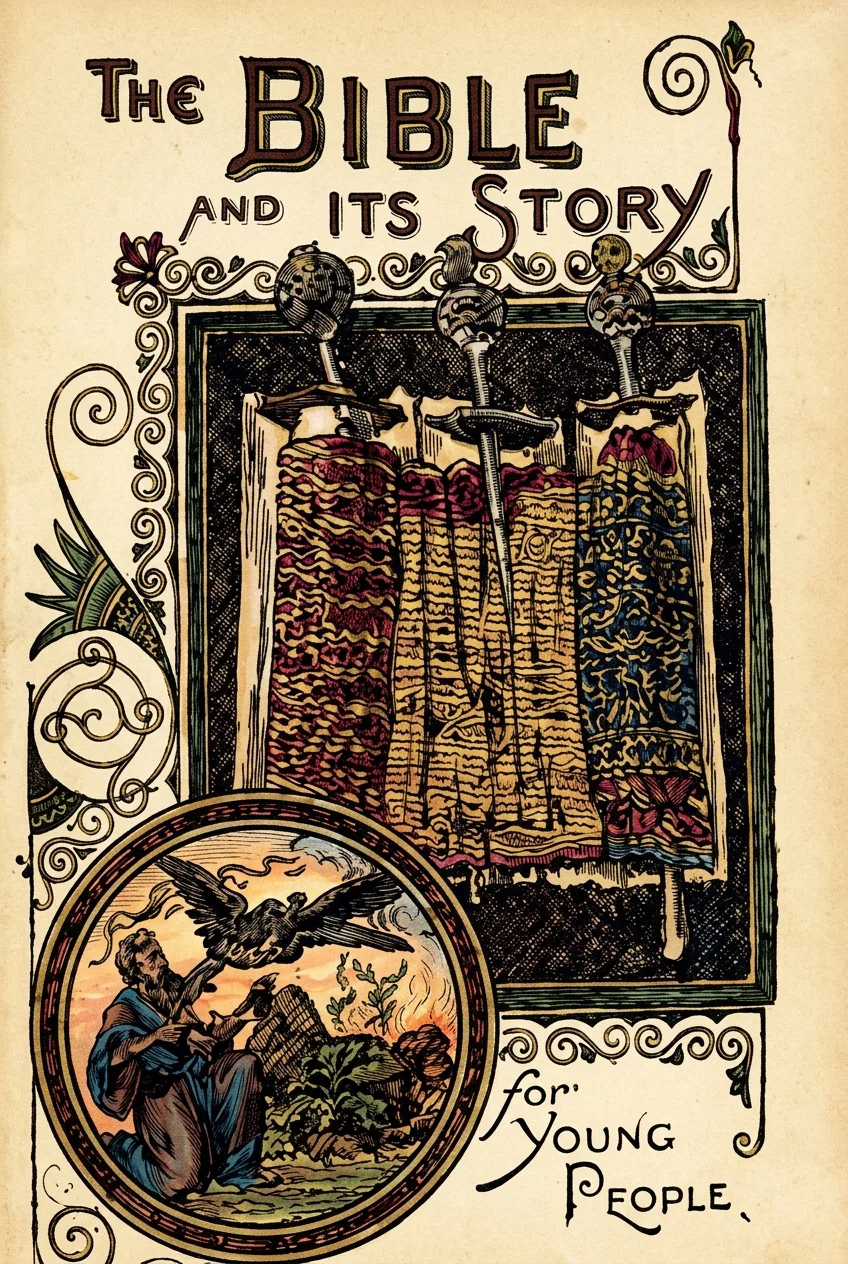
The Bible and Its Story
By Josephine Pollard
By Josephine Pollard
This volume has been published to assist parents, guardians, and teachers in the religious instruction of those under their charge, by enabling them to place in their hands a book which would reverently tell the Bible story. The one object that has been kept steadily in view throughout its preparation, has been to present a connected narrative of the sacred events, consecutively arranged in the order of their occurrence. The book contains 558 pages, with 280 illustrations. PRICE, Cloth, $1.00.
Address,
Pacific Press Publishing Co.
39 Bond St. Oakland, Cal. 18 W. 5th St.
New York City Kansas City, Mo.
FACTS FOR THE TIMES.
Containing historical extracts, candid admissions from authors, ancient and modern. A Book for the Times. Revised 1893. A compilation of facts that are astounding, by students of biblical and historical research. 340 pages, wine-colored cloth binding. Price, 75 cts., postpaid. Pacific Press Pub. Co., Oakland, California.
News and Notes
FOREIGN.
—Field Marshal Count Yamagata has been appointed by the mikado to represent the Japanese nation at Queen Victoria’s jubilee.
—Baron Edmond de Rothschild is establishing another colony in Palestine, not far from Damascus. The district selected covers 3,000 acres.
—Advices from Jamaica report a serious railroad accident in the Barbadoes, in which a train plunged over a precipice, killing a large number of passengers.
—Sir Isaac Pitman, the inventor of the Pitman system of shorthand writing, died in London on January 22, at the age of 84. He was knighted by the queen in 1894.
—China has ordered in all eleven armored cruisers and torpedo destroyers, and intends to order four more large cruisers next spring. These will be built by a German firm.
—Plans are being laid this year for six polar expeditions, three to the north and three to the south pole. Herr Andree will again attempt a balloon voyage across the north pole.
—The island of Kishma, in the Persian Gulf, was recently visited by an earthquake, which destroyed the lives of more than one-third of the entire population. So far 1,400 bodies of victims have been recovered.
—Prof. Mara Glaino, of Genoa, Italy, claims to have discovered a serum which, when injected into the system, will cure all but the most advanced cases of consumption, and will arrest the progress of the disease even in cases of long standing.
—The Italian Government has decided to abandon the entire territory of Erythrea, in Abyssinia, except Massowa; and it is reported that the question of continuing the occupation of any part of King Menelik’s domain will be made an issue of the coming elections.
—Reports from Madrid state that harrowing distress prevails in Andalusia province, Spain. The people are plundering bread shops and thousands are begging in the streets. The recent storms in Spain threaten floods in various parts of the country.
—The steamer Gaelic, which reached San Francisco, January 23, reports a shocking calamity in a Chinese theater at Kwangtow, in which 300 persons, including men, women, and children, were caught in the burning building and trampled and burned to death.
—The continued seismic disturbances in the State of Oaxaca, Mexico, are causing much excitement and alarm. Scientific men think that a volcano is forming in the hills, while on the coast submarine explosions are continually sending huge waves upon the shore.
—Mr. Akiyama, second secretary of the Japanese Legation at St. Petersburg, while visiting New York picked up a Bible in his room at the Sturtevant House, read it, became converted to Christianity, was baptized, and is now on his way to Japan to tell what he has found.
—A Cape Town despatch of January 23 reports that Rhodesia, South Africa, is suffering a famine. Natives have been exhuming and devouring the bodies of cattle which died several months ago from the rinderpest. As a consequence a terrible mortality prevails among them.
—The new armored cruiser, Terrible, which has recently been added to the English navy, is said to be the most formidable vessel of her class in the world. The vessel is 500 feet long, is well protected, and carries a heavy armament. The cost of this floating fortress was $4,000,000.
—Funds for famine-stricken and plague-stricken India are being collected in nearly every country in the world; but the donations in general are small. The Empress of India, Queen Victoria, sent from her immense store of wealth but £500. William Waldorf Astor quadrupled this amount.
—It is reported that Russia has finally consented to allow force to be brought to bear upon the sultan, if necessary, to secure the introduction of reforms in Turkey, but that this consent was not obtained until the part which Russia was to play in the operation had been fully conceded by Great Britain.
—A despatch from Odessa states that Russia is making extensive and rapid preparations for war. Her activity in this direction is said to have been equaled only during the periods immediately preceding the last two great wars. This is significant in view of her recent agreement to assist in forcing reforms in Turkey.
—Emperor William, regretting the course he took in 1889 in endeavoring to reconcile the individual workingmen, is going back to a policy of restriction and repression of liberal ideas, especially socialism; and laws will be enacted touching political organizations, rights of meeting, and the criticisms of the press, which it is claimed will be severer than those obtaining during the period of the Bismarck regime. And hence we will see a revival of the Socialistic and Nihilistic propagandas.
—Major Fondevielle, frequently referred to as “Weyler’s assistant butcher,” narrowly escaped capture and consequent retribution, at the hands of Captain Welche’s Texan band, on January 20. He was knocked from his horse, and was being tied to a Cuban saddle-horse when reenforcements arrived. Ten of Fondevielle’s body-guard and five of Welche’s band were killed.
—Prof. Otto Burke, an aeronaut of long experience, has completed negotiations with the Cuban Junta for conducting the aeronautic operations of the insurgent army. His two predecessors in this risky service were captured by the Spaniards and shot, their balloons having been pierced by rifle-balls. Prof. Burke’s balloon will be bullet-proof and will be surrounded by a number of flounces which will act as parachutes when the aeronaut descends.
—The Indian plague shows no signs of abating. The Russian minister of the interior has declared the whole of India infected with the dread disease. Fresh outbreaks are reported from various provinces. Dr. Yersin has discovered a serum which it is claimed will do effective work in fighting the bubonic scourge. Twenty-three out of twenty-seven inoculated with the serum were saved. The London relief fund has now reached the sum of $750,000.
—From Cuba during the past week we have the following: A Cuban hospital in the Siguanea Mountains was captured by the Spaniards, and nurses, members of the Red Cross, and sick and wounded soldiers, were all put to the bayonet, and the hospital was then burned down over the dying inmates. A bold but unsuccessful attempt was made by the Cubans to capture General Weyler, in which a score of his body-guards were killed and wounded. Spanish soldiers poisoned a well in a Cuban village, expecting to put an end to a Cuban regiment. Another company of Spaniards entered the village, drank the water, and a large number died. The enraged survivors shot the principal residents, and burned the town, afterwards learning that their comrades were responsible for the deed. A Spanish gunboat anchored near the shore was attacked by the Cubans at night and captured, together with a large quantity of ammunition, rifles, and two quick-firing cannon. A Spanish fort in Santa Clara province was captured by the Cubans, with a loss to the Spanish of 75 killed and 30 taken prisoners. Smallpox is epidemic at Havana, with a death rate of 35 per cent. Gen. Calixto Garcia captured the town of El Caney, near Havana. The fight lasted two days and the Spanish loss was 200 men. Soon after the same general met and routed a Spanish column of 2,000. Two expeditions have landed in Cuba with arms and ammunition. General Weyler reports two engagements with the insurgents in which the latter were completely beaten. He also reports the almost complete pacification of the western division of Cuba. Colonel Rotger, one of Spain’s most cruel guerrilla leaders, was led into ambush by the Cubans on January 22, and lost 130 of his men. The leader himself was wounded.
DOMESTIC.
—Sandusky, Ohio, had a $100,000 fire on January 23.
—New York was visited by a $70,000 fire on January 26.
—The whole business portion of Pacific Junction, Iowa, was destroyed by fire on January 26. The amount of loss is unknown.
—A withdrawal of $30,000 from the First National Bank of Tacoma, Wash., caused that institution to close its doors on January 26.
—Fire destroyed the factory of the Northwestern Stove Repair Company at Chicago on January 24. The estimated loss is over $400,000.
—The Burlington and Missouri River coach shop at Plattsmouth, Neb., was burned on the night of January 25. The loss is placed at $150,000.
—The New York Assembly has appointed a committee to investigate the subject of trusts, and report remedial legislation before March 1, 1897.
—On January 23 the Government of the United States entered suit in the Federal Court of Omaha for the foreclosure of its lien on the Union Pacific Railway.
—A young Cuban aeronaut, who was practising with his balloon near Key West, Fla., fell with the balloon into the ocean on January 24, and was drowned.
—The three-masted schooner Nahum Chapin went aground at Quogue, L. I., on January 21, and her entire crew of seven, with the captain’s wife and child, were lost.
—On January 22 Congress passed a bill to pension the survivors, or widows of survivors, of Grant’s battalion of Arkansas volunteers who served in the Mexican War.
—The Watsonville beet sugar factory, near Santa Cruz, Cal., produced during the present season 18,881 tons of sugar, the largest output for one season from any factory in the world.
—Sixteen acres of land in the city of Los Angeles, Cal., have been deeded to seven trustees for the establishment of a Christian home for indigent women, homeless children, and worn-out Christian workers. The institution will be known as the Carlisle Christian Home, in honor of the founder, S. B. Carlisle.
—Melville W. Fuller and Justice Brewer have been named as commissioners to serve on the arbitration tribunal to determine the boundary line between British Guiana and Venezuela.
—Another attempt is soon to be made to effect a union between the two factions of the Salvation Army. General Booth is planning another visit to this country with that object in view.
—By a recent decision of the Supreme Court of Maryland the Congregational Church Building Society will receive $300,000, which will be used chiefly to develop the work in large cities.
—The Senate Committee on Post-offices held a second hearing on the Loud Postal Bill on January 23, and listened to earnest protests against its passage from representatives of a number of publishing firms.
—The people of Colorado are rejoicing over the reported termination of the great Leadville strike. Part of the members of the labor union have cut loose from the dictation of their leaders, and will resume work.
—Three masked men held up a train on the Southern Railway, near Birmingham, Alabama, on the night of January 21, uncoupled the baggage car, broke it open, and robbed it. The train was delayed but twelve minutes by the occurrence.
—Dairy and Dryman, two young Kentuckians, rivals for the affections of the same young lady, fought a duel over the matter on January 21, the object of their affections being an unwilling witness to the scene. Both fell at the first fire and died soon after.
—The American gunboat Mechias arrived at Bangkok, Siam, on January 23, having been ordered there on account of an attack made by the Siamese soldiers on Vice-Consul General Barrett. An apology has been demanded, and Siam may be asked to salute the American flag.
—On January 22 Mr. Olney transmitted to Congress a list of the claims filed by United States citizens against the Spanish Government, on account of personal injuries received, arrest and imprisonment, and property losses, in the island of Cuba. These claims amount to $8,943,408.
—On the morning of January 26 the city of Philadelphia was visited by one of the most destructive conflagrations of recent years. The buildings occupied by a number of large manufacturing firms were completely destroyed, together with their contents. The loss is estimated at $2,500,000.
—Dr. Thomas Powell, of Los Angeles, Cal., claims to have discovered a preparation by which he can render himself proof against the most virulent diseases. He has demonstrated his claim in regard to tuberculosis, and now proposes to submit to inoculation with the germs of all contagious diseases, not even excluding leprosy.
—As a result of the Harbor and Coast Defense Convention recently held at Tampa, Florida, a National Defense Association has been organized. This association will work for improvements in the army, an increase in the militia of the several States and in the naval reserve, and a general extension of the naval and coast defenses of the nation.
—Sixteen American sailors who were engaged in killing seals on the Siberian coast were captured in January, 1896, thrown into a dungeon, and sentenced to five months’ imprisonment. At the close of their term they were tried over again and sentenced to eighteen months’ imprisonment. They expect to be sentenced again when their present term expires.
—At the Transmississippi Exposition to be held at Omaha from June to November, 1898, there will be a “silver palace” 400 feet square, surmounted by mammoth ornamental towers, and the entire structure will be covered with rolled silver. There will be over 300,000 square feet to be plated in this manner. This and much more is told us by the Omaha Daily Bee of January 16.
—During the week ending January 22 there were 429 business failures in the United States, or 49 less than during the previous week. Dunn’s Weekly Review states that there is more business being done, although prices do not increase, than during the past few weeks. The demand from manufacturers for wool is increasing, and hopes are entertained that prices will soon advance.
—During the past week the northern, middle, and eastern States have been experiencing a spell of very cold weather, which in most of the States was rendered more biting by a high wind. In the large cities much suffering was reported among the poorer class who were unable to protect themselves against the rigor of the blast. Railway travel was impeded on a number of lines, and great numbers of cattle on the plains died from the effects of the cold.
—As a result of the continued jealousy and war between the two factions of Chinese highbinders in San Francisco, Fong Ching, familiarly known as “Little Pete,” the leader of the Sam Yup faction, was murdered on the night of January 23. Fong Ching was a wealthy Chinese, and the power which he exercised in “Chinatown” was recognized and feared by all his enemies. Other prominent Chinese are marked for death by the “hatchet men,” and the Mongolian element of the whole Pacific Coast is in consequent feverish excitement.