The Roman Catholic papers are very joyous, jubilant even, over the organization of the Church Extension Society which held its great meeting in Chicago a short time since, and which was reported in this journal; and they are making the11most of it. One of the resolutions passed at that time was that the secular press should be used, and we see examples of this in the reports of Catholic meetings and what Roman Catholics are doing, to a larger extent than usual. And the secular papers seem to have no limit to the space that is accorded the Roman Catholic Church. Protestant churches are given stinted space. Reports from their great conventions are very meager, but not so with the reports concerning the Roman Catholic Church. Any city which possesses a bishop notes all the news of his movements and work, and repeatedly the same photograph appears in the papers. They seem to take extra pains to exploit in every way the work and influence of the leading Catholic prelates and the work of the church itself. In this way Roman Catholicism is gradually molding the minds of the people of the United States. The daily press is the educator of many. Very many times these articles on Romanism, or inspired by Romanism, in the daily press discount in every way possible the history of the past; and many Protestants, or men with Protestant leanings, have come to believe that the history of the past concerning the Roman Catholic Church and the persecutions of the Dark Ages are falsehoods; that the church itself is greatly maligned. Receiving these impressions, the natural conclusion is that the Reformation was itself a mistake, and in the light of a present-day Protestantism with no standard, many conclude that the better way to do is to turn back to Roman Catholicism.
Another thing which is helping along the great Catholic movement is the remarkably ornate display which is made on all great occasions. It has ever been true in the history of the race that when the church possessed the least of deep spiritual experience she was more affected by outward display. Human nature is naturally superstitious, and the immense parades, the appeal to the senses, of which the Latin church is the master, have their effect upon the ordinary mind. This, too, is manifest in the trend in that direction on the part of Protestant churches in the making so much of Christmas, Easter, Lent, etc. When Protestantism departs from the simple Gospel of Christ and the standard of the word, she is left to the currents and winds of the great open sea, without chart or rudder. Some will follow science falsely so called, while others will drift back to the great church of tradition. Thank God there are a few who still cleave to His word.
In Protestant Circles.
One of the noted things in the Protestant religious world, as The Homiletic Review, the great ministers’ monthly, observes, is the growing strength of a Socialistic spirit, not only in political circles, but in religious circles, shown by the increasing number of clergymen, both in this country and in England, who have thrown themselves into the Socialistic propaganda, and have indorsed “Dr. Campbell’s recent pronunciamento, that Socialism is the economic expression of the Christian ideal. Never before in the history of the church have social questions occupied so large a place in the attention of the pulpit.” And yet Socialism is not Christianity, nor is the political Socialism of the day the economic expression of the Christian ideal. The only true expression of the Christian ideal is that which grows out of Christian character, and Christian character is only wrought by being begotten again by Jesus Christ through the word.
— The Review also notes the amazing progress of the Emmanuel movement which is reaching out from Boston and establishing itself in other great cities. This is another great movement which masquerades hypnotism and hypnotic suggestion under the garb of Christianity.
— Almost constantly are we met by manifestations which indicate the outward drift of Protestantism and reveal its unsettled, feverish condition. For instance, here is the title of an article in the last Biblical World: “How May Christianity Be Defended To-day?” The simple fact is that it is not Christianity that needs defense. It is poor humans. God has not presented His religion for humanity to defend, but He has presented Christianity to defend humanity. It is the great refuge that He has presented to a storm-tossed, storm-beleaguered world. It is the great cleft Rock into which they can run and be safe. If the Christian ministry had confined themselves to the one object for which they were called,—the proclamation of the Gospel of Jesus Christ, the teachings of His holy word,—they would not now be met by a thousand questions to which they have no answer to make; they could have pointed to souls redeemed—the mightiest miracle of the Gospel—as an answer to all the objections which the critics could bring against the religion of Jesus Christ. It is not theology which the world needs; it is religion. Neither is it a religion of mere ethics that the world needs; it is the religion of life and power.
“As Christ Would Live.”
Just recently a lawyer in an Eastern city asked the young people to live for two weeks just the way Christ would live, and something like two thousand pledged themselves to do it. Of course such a scheme as that would be futile. If these young people were truly regenerated and converted to Christ they would endeavor to live as did the Master anyway, not for two weeks, but for all the time; but to live as Christ did without the life of Christ which comes only through conversion, is always a fruitless task. It is the experience of Romans 7 over again. A popular writer notes the experience of one of these who started out so to live, a stenographer connected with one of the biggest business houses in Cleveland. Her testimony is that no girl can live a consistent Christian life and hold a business position. She says: “The business world is too deceitful and too crooked and business life is too wicked. I have tried to be a consistent Christian in my business life for three days, and I will either have to give up my job or quit trying to keep up to my new ideal. I had to tell three lies for my employer in three different letters the very first hour of the very first day I was trying to lead the ideal Christian life.” It seems as tho the stenographer had a better conscience than this popular writer, for she tries to tell the stenographer at once that her employer’s conscience belongs to him and that she has no more to do about what he dictates than has the machine upon which she writes, and the wicked old aphorism is given by this popular writer: “Business is business, and not religion,”—one of the sophistries by which thousands of professed church-members are trying to excuse their sin and criminality in the business world, and pose at the same time as consistent Christians. When people come before the great judgment-seat of Christ there will be no such discrimination. The question will not be over the kind of business that we have done, nor for whom we have done it, nor the competition we have had in it, but it will be over character. And character will be measured not by a fallen standard in the world, but it will be weighed in the balances of God’s sanctuary.
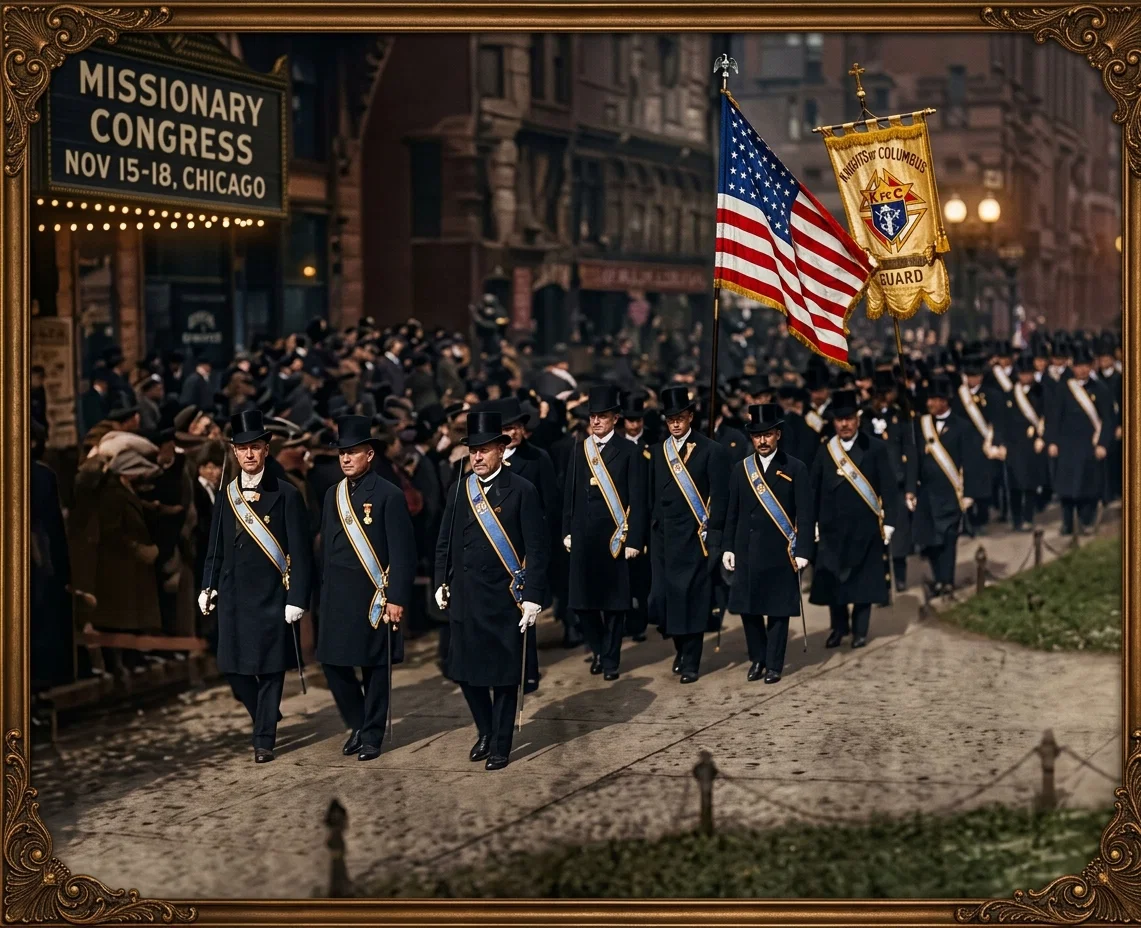
Knights of Columbus, at the great Catholic Missionary Congress at Chicago, Nov. 15-18. The Knights formed a special guard of 500.
Seismic Troubles.
The latest news from southern Italy and Sicily, while cutting down a little perhaps the number of lives lost from the first reports, indicate fearful conditions. Many have died in consequence of exposure, disease, and accident, so that there will probably be not less than 200,000 deaths as the result of the earthquake. The shock itself was probably not harder than that which affected San Francisco and vicinity, but the buildings seemed to have been more frail. It is called by various authorities the greatest earthquake of modern times, if not the very greatest on record in its awful loss of life and property combined, altho in violence, as stated by The New York Independent, it does not rank among the strongest shocks even of the present year. The same paper says again: “Hitherto the Lisbon earthquake of 1755, when 60,000 people were killed, has been in the first rank among the cataclysms of nature, tho some of the earthquakes of southern Asia have destroyed far more lives.” Both of the volcanoes, Etna to the south, and Stromboli to the north, are active, and the scientists would have us believe that these have no direct connection with the earthquake, but it will be difficult to convince the ordinary man. Why is it that these volcanoes broke out just at the time that the earthquake came?
There has been a hearty response to the Italian sufferers from all parts of the world. The sympathies of humanity have been touched, and from every civilized land on the face of the earth means have been forwarded to the suffering in southern Italy. One sad thing was that succor could not have been given earlier. But inasmuch as railways were broken up and telegraph lines were down, information was slow in reaching those who could help.
In other parts of the world there have also been seismic tremors. We noted last week that off the coast of Georgia the sea was seen to be boiling. In West Virginia hot springs had broken out. The report comes from Santa Cruz, Cal., that showers of hot stones had fallen. News comes from Seattle, January 11, that that city was severely shaken by an earthquake at 3:55 in the afternoon of January 11. Buildings of all sorts were rocked and moved perceptibly. Thousands ran into the streets and some fainted. Bellingham, Wash., had the same experience. The old earth is sick and her rheumatic troubles are increasing.
Among the Nations.
The Prime Minister of England, Mr. Asquith, came to the close of his session with two of the measures which he hoped to crystallize into law, still unpassed. One was the licensing bill, a very moderate temperance measure indeed, and the other was the education bill. There had been many councils and compromises, and it was thought the bill would carry, but it was defeated. Finally, a new bill was introduced which provided for popular control of the schools, and teachers’ freedom from tests, and the concession of denominational facilities in all schools on two mornings a week, with a statutory provision of universal Bible teaching. But this, too, failed. These defeats really leave the present administration weak.—The old-age pensions bill was carried, but this was favored by both parties.—There was a surplus in revenue over the last year of 4,726,000 pounds sterling, which was devoted to the reduction of the national debt, paying off in three years up to March 31, 1909, £46,700,000.—The naval estimates amount in round numbers in American money to $160,000,000 for the coming year, $4,500,000 over the previous year. The army estimates amounted to $133,000,000, a decrease of $1,500,000 during the past year. (Continued on page 13.)12
Among the Nations.
(Continued from page 11.)*
On account of the criticism which has been raised over the Panama Canal, the President has invited six prominent engineers,—men who have had to do with great works,—to go to Panama, examine conditions there, and report. They will make a thoro inquiry.
Turkey.
Great interest has been taken in the new constitution in Turkey, and the opening of the first parliament was indeed a very auspicious one. Old rivalries and enmities between Mohammedans and Christians seem to have been buried for a little time at least, and the spectacle was seen of devotees of these rival religions falling upon each other’s necks and marching together through the streets to celebrate the new liberty in which they equally rejoice. The latest news is that Turkey has accepted $10,800,000 from Austria-Hungary as indemnity for the loss of Bosnia and Herzegovina. It is thought that the powers signatory to the Berlin treaty will agree to this. But the Balkan troubles are not yet settled. The condition of Europe is a very delicate one. The slightest turn in international affairs may set all Europe ablaze. Thoughtful men are doing all in their power to smooth matters over, at the same time preparing for great crises. The Christian may be assured, however, that God has a hand in the matter, and He will overrule to His glory. Certainly now is the time when missionaries should be placed in Turkey. This freedom of speech ought to be improved to the fullest.
India.
News from India is little more assuring than it was a month or two ago. The vigorous way in which the English Government has taken hold of the matter has quieted things in a measure. Some of the independent tribes which were seemingly in doubt as to which way they would turn, have manifested a much more friendly spirit, and are cooperating with England, while those of anarchistic tendencies have been very quiet. It is hoped that the crisis is over.
Russia.
Russia, however, is not free from Nihilism; 500 have been arrested within the last month or so, and the season’s crop for this year seems to be an increase over any year previous. It has been truly remarked that if the government’s agents would give more attention to the condition that makes Nihilists, and less to the agitators themselves, they would find their task much lighter. The whole tendency of the age in the social, religious, and political, as well as in the medical, world, is to treat symptoms rather than to get at the causes.
A Big Gun.
We recorded last week the immense guns with which Great Britain is fitting her latest ships. A new naval gun has been designed and made in Washington, said to be the most powerful in the world, able to propel in almost a horizontal line a shell 1,300 pounds in weight, to a distance of nine thousand yards, at which distance it can penetrate the best armor in use by any of the great naval powers of the world. Its initial or muzzle velocity is 3,100 feet a second. Experts are now at work on a scheme by which some ship armored like the best modern battle-ships, shall be made the target for this supreme test of gun power and precision in firing. And still there are greater guns to be invented and stronger armor-plate to be made, of which more in the future.
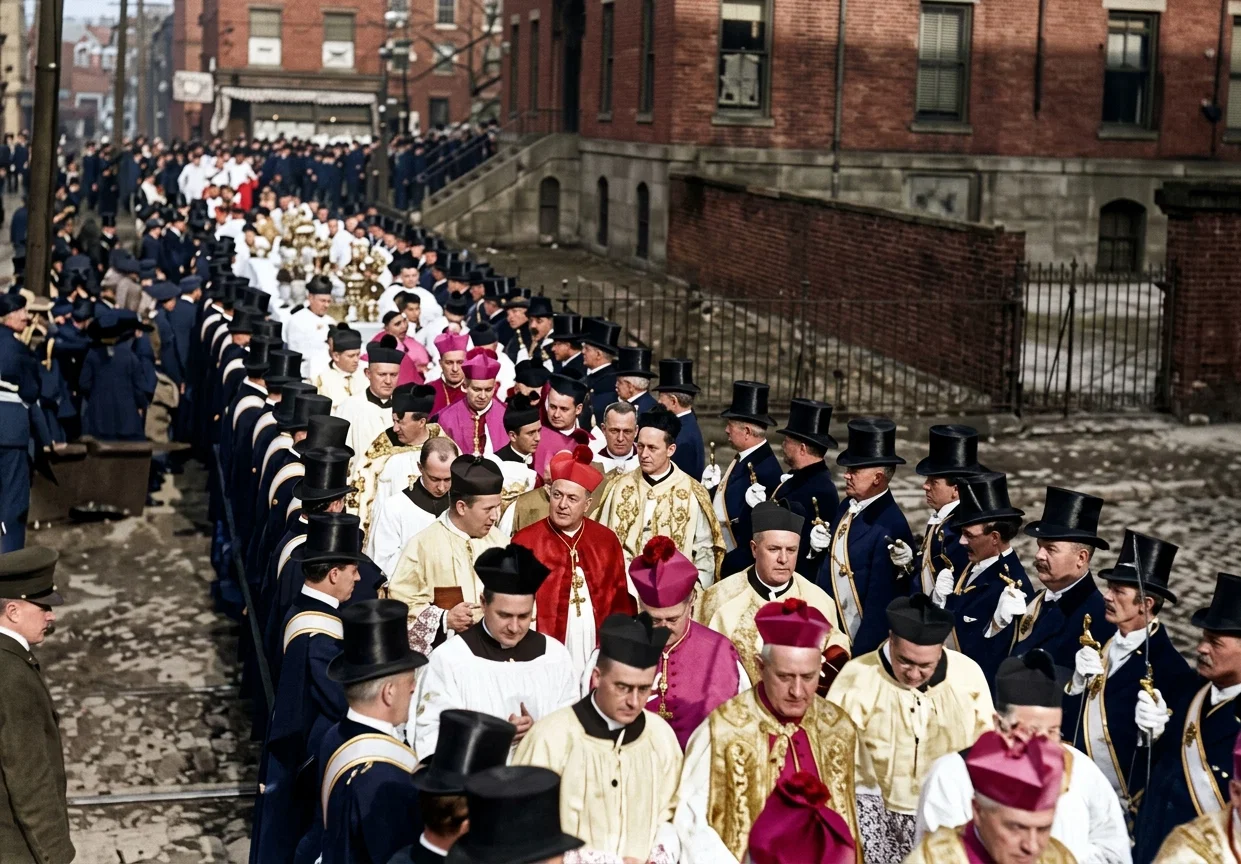
A Procession of Priests. Those standing at the side in silk hats and with swords are Knights of Columbus.
Rising Divorce Rate in America
A recent report of the Census Bureau of the United States just issued, declares that of all the couples married in a given year in America, one in twelve are ultimately divorced. In no other civilized nation in the world is there so large a proportion of divorces, either to the population, or to the number of marriages, and the difficulty is increasing rather than decreasing.
Some Statistics Worth Thinking About.
The Chicago Daily Tribune keeps what is probably the best record of news in the United States of any paper published. On the first of the year it issues its summary. Here are some of the figures which that paper has given for 1908:
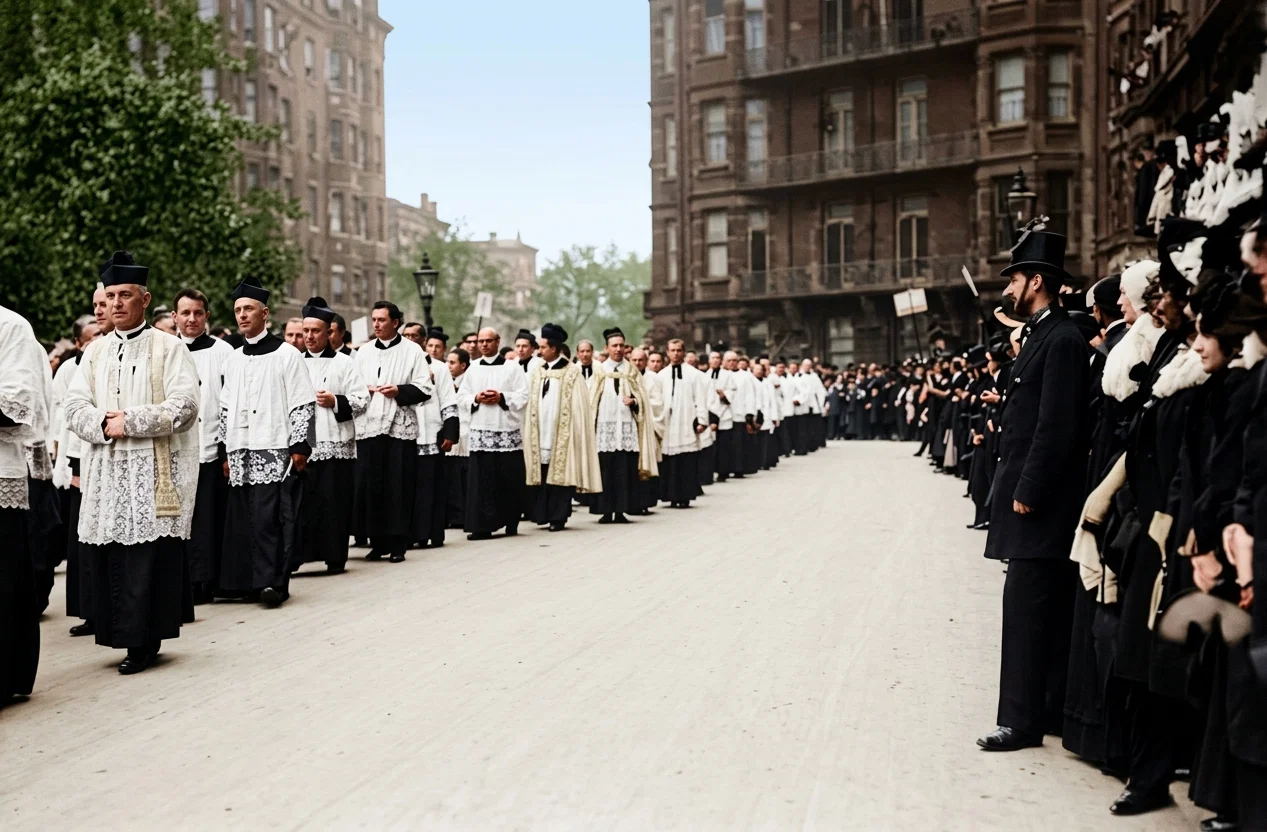
The great procession at the Catholic Missionary Congress, Chicago, Nov. 15 to 18, 1908. A company of the clergy.
At the Catholic Missionary Congress. A procession of priests, guarded on each side by Knights of Columbus. Papal Delegate Falconio in front.
Of the accidents or disasters during the year, including some of the most extraordinary fatalities and disasters abroad, none of which are recorded, numbering less than 5, there were 236,568 lives lost. This places the loss of life in Italy at 125,000. It was probably 200,000. In that case the loss of life would be more than 300,000. Of the others, 5,000 of the 300,000 were lost in a flood at Hyderabad, India; 5,000 in a typhoon, October 17, in China; 1,000 in a typhoon, July 29, in China; 2,000 in a flood in Asia Minor, July 16; 2,000 in a flood, April 13, in China; and May 13, 10,000 in a flood in China. Twenty-five thousand have perished in China alone from floods and storms. In this country alone, 1,335 perished from fires; 1,679 from drowning; 766 from cyclones, storms, and lightning.
Embezzlements in this country in 1908 amounted to $13,555,536 which were discovered. This is greater than last year, and two thirds of this large amount must be charged to bank officials and employees. Ten bank presidents, 28 cashiers, 11 bank clerks, and 4 brokers have embezzled over $10,000,000; public officials nearly $350,000; forgers over $1,328,000; postmasters, $5,450, and a miscellaneous lot the rest.
The suicide record was an increase on the year before—10,852 reported in the public press, increasing from 5,340 in 1899. Since that time there has been a steady increase every year. Of the last year, 7,864 were males, 2,988 females. Among professional men, physicians as usual head the list; 16 lawyers, and 14 clergymen were guilty of self-murder. There has been a great increase in suicides during the year from business losses—634. Liquor is made responsible for 536, altho it probably figures in a great many of the others. To despondency is laid 5,318; domestic infelicity, 738; of those disappointed in love, 519.
The number of deaths of all kinds of personal violence in 1908, except suicides and lynchings, as recorded by telegraph and in the newspapers, was 8,952, an increase of 240 over 1907, in which year the number was 638 less than in 1906. But the gain in general has been slow and steady for a number of years. It is difficult to get at the causes of all of these; some may be accidental, and then there are on the other hand many murders that never come to light in the papers. Of these deaths more than half are attributed to quarrels. A very steady increase is also noted of murder by highwaymen—712, 101 more than in 1907. Liquor is responsible for 786. It probably is basically responsible for the majority of them.
The lynchings in 1907 were the smallest in 20 years; in 1908 they were 100, the largest number since 1903; 97 of these were in the South, 3 in the North; 93 were negroes, and 7 were whites. The causes given are 34 for murder, and 24 for criminal assault or attempted criminal assault. Several were lynched on mere suspicion.
The executions for capital crime number 36 in the North, and 56 in the South; 46 of those executed were whites, 44 blacks, and 2 Chinese; 87 of those were for murder, 5 for criminal assault. In 1907 there were 104; 1906, 123. The Tribune remarks: “The legal executions in this country steadily decreased, while the volume of crime increases.”
The railroad fatalities in 1908, including passengers only, were 3,145 killed and 10,296 seriously injured. The inter-state commission report will be much larger since that includes trainmen, yardmen, trespassers on tracks, employees of every description.
Holiday casualties during the year number 75 persons killed and 91 injured in season, and out of season 109 killed and 35 injured. This was a little less than last year. The sporting in holiday casualties numbers 368 killed and 3,820 injured. Thirty-nine were killed on the innumerable baseball fields. In the much fewer football fields 18 were killed and 313 injured. “The insane Fourth of July celebrations cost 103 killed and 2,812 injured.” “The idiots who rock the boat have drowned 8, and the criminally reckless who didn’t know it was loaded killed 41 and wounded 21.” There were 126 more killed in 1908 than in 1907.
The epidemics of the year in three countries, which are almost wholly from cholera, are as follows: 7,700 in Russia, 12,000 in the Philippines, and 30,000 in China. The great losses which have occurred in India are not given.
War Losses.— While there were no great wars in 1908, the loss of life in the minor outbreaks have amounted to 22,179.
Fire Losses.— The fire losses in the country during 1908 are appalling, estimated at $172,000,000 as compared with $150,000,000 in 1907. Adding the fire losses in Canada the total loss is estimated at $220,000,000. These figures are exclusive of forest fires which have involved a loss in ten states of $74,000,000 more, making a total of nearly $300,000,000.
There are some encouraging items. The manufacture and consumption of cigarettes and beer have greatly decreased; 2,000,000 less cigarettes were handled by the revenue department last year, with 50,000,000 barrels less of beer. Prohibition and work among the young doubtless have had their effect.
The number of gifts and bequests during the year by Americans amounted to the vast sum of $90,932,000, but this was a great falling off from the previous year, which amounted to nearly $150,000,000. In round numbers there was given to educational institutions, $36,000,000; to charities, $40,000,000; to religious organizations, $4,500,000; to museums and public improvements, nearly $9,500,000; and to libraries, $854,000. This was exceeded by 1905 and 1906 and 1907. It will be noticed that a very small part of it went for religious purposes. It would naturally seem that if religious influence were increasing a far greater amount would have been given to religion in view of the great needs of the mission fields and some of the religious institutions of the land. Many of these gifts make for intelligence, yet education does not necessarily mean betterment of morals.
A Curious Language.
MRS. LIZZIE NELSON FRYER, wife of Dr. John Fryer, an expert in the Chinese languages, of the University of California, who with her husband is touring in China, speaks thus in the Sabbath Recorder of a meeting they attended:
One of the hymns written for this occasion is a very curious piece of Chinese composition; the stanzas were sung by reading the characters both forward and backward. As I have written this, my husband has translated one stanza for me which reads as follows:
“My love to God has the breadth of the earth,
and the width of the sky;
I will sing hymns and praise Him for His goodness, which extends from pole to pole.”
Reading the characters backward, it may mean:
“From pole to pole His goodness will I praise and sing;
For as wide as the heavens and as broad as the earth is the Lord’s love for me.”
My husband says that only such an elastic language as the Chinese, without grammatical rules or inflections, could possibly be used in so curious a manner.
The Crowded Life versus the Full Life.
By John Sheridan Zilia
TO-DAY our greatest danger is the crowded life. And nearly all our programs and specifics against it seem to live but a few months at best. What, then, is the opposite of the crowded life? Not the empty life, but the full life. The crowded life and the empty life are the same thing. As the water turned on at full power from the faucet will drive itself out of the glass you hold for it, and leave it empty, no matter how much water is passing through, so the life that is opened to too strong a stream of pleasure and excitements will never be full. There is room enough, but there might as well not be. And one of Christ’s influences is to lay a moderating hand upon these things so that they come in in a way which enables them to stay. It was not that Christ brought absolutely new and unheard-of things into the world so much as that He enabled men to keep and hold the things which were always theirs, but always escaping them, so He touches this crowded life of ours, and it becomes that satisfying and peaceful thing, a full life.—John Sheridan Zilia.
Our Work and Workers.
BROTHER I. M. MARTIN baptized nine young people at Hatfield, Pa., recently.
BROTHER H. H. BURKHOLDER reports the organization of a church of nineteen members at Ravenna, Ohio.
NINE new members were recently added to the church at Scranton, Pa.
A CHURCH of fourteen members has been organized at Yuma, Colo.
BRETHREN F. H. ROBBINS and J. W. Watt conducted meetings at Erie, Pa., during the autumn. Five were baptized as the result.
SIX young people were buried with their Lord in baptism at Ann Arbor, Mich., by Brother L. G. Moore a few weeks since.
THE church at Kalamazoo, Mich., dedicated a new place of meeting December 19, Brother A. G. Haughey having the services in charge. The church is free of debt.
A NEW sanitarium was dedicated at Hastings, Neb., December 10, a number of the prominent citizens of the city assisting in the exercises. Speeches were made by the mayor, who acted as chairman, Senator A. L. Clarke, Dr. A. E. Turner, president of Hastings College, and Dr. David Paulson. The institution is well established in a substantial building, and is prepared to do good work.13
ELEVEN were recently baptized at the sanitarium at St. Helena, Cal., by Brother C. L. Taylor.
WORD from Prof. B. F. Machlan, principal of the academy at South Lancaster, Mass., states that the school is larger this year than ever before and that everything is going nicely.
IN Paris, France, there is a church of believers numbering fifty. Opposition from pulpit and press is experienced, but the work is onward. Brother H. H. Dexter reports from Lyons that souls are seeing and accepting and obeying the commandments of the Lord.
A Word of Thanks.
By H. H. Votaw
“The strength of the hills is His.”
THESE words of Israel’s sweet singer express the feelings of the tired worker on the burning plains of Hindustan. When all the broad expanse of the Indian Empire lies enveloped in a sheen of heat; when the torrid rays of a tropical sun beat down mercilessly for days, weeks, aye, even for months at a time, and the heat from above is increased and intensified by the returning heat waves which arise from the parched earth; when the land can be compared to but a giant oven and the energies are at the lowest ebb,—then it is that the “hills” are fully appreciated. At such times the majestic Himalayas seem to be indeed not only under God a source of our “help,” but the fountain of health as well.
Two Burmese Girls.
Even the casual reader knows what an important part these mountains have played in the politics of the East. But for them it is extremely doubtful whether Britain would have been able to preserve her supremacy in India and hold back the “Colossus of the North.” In another and even more marked sense have they been the upholders of British power, for they have furnished a temperate climate for the sons of the North, without which, ere this, their numbers must have been greatly lessened by the terrific heat of the plains. The hills have truly been as “the shadow of the great rock in a weary land,” as the “shadow from the heat, when the blast of the terrible ones is as a storm against the wall.”
It has been my privilege to spend about three months in the beautiful Mountain Rest Home, Annfield House, toward the purchase of which the readers of the SIGNS OF THE TIMES contributed so liberally. I desire to express thanks to every one who gave to this fund. Surely in the day of rewards the Master will count the gift as unto Himself.
In offering these thanks, I not only speak in behalf of Mrs. Votaw and myself, but I wish to speak for “the children of missionaries, the involuntary inheritors of their parents’ suffering.” These suffer most from the heat. Their natural activities are stifled by the heat, and it is doubly painful to see them with wan faces and reduced forms. But how quickly their strength returns when they reach the cool, bracing climate of the “hills,” and the merry children’s voices and laughter help to brighten the Rest Home. To see the glow come to the cheeks of the children and the sparkle return to their eyes would pay you abundantly, dear giver, for your liberality.
“And the King shall answer and say unto them [you], Verily I say unto you, Inasmuch as ye have done it unto one of the least of these My brethren, ye have done it unto Me.”
H. H. VOTAW.
Kemmendine, Burma.
The Life I Seek.
By Robert M. Offord
Nor in some cloistered cell
Dost Thou, Lord, bid me dwell
My love to show,
But ’mid the busy marts,
Where men with burdened hearts
Do come and go.
Some tempted soul to cheer
When breath of ill is near
And foes annoy;
The sinning to restrain,
To ease the throb of pain—
Be such my joy.
Lord, make me quick to see
Each task awaiting me,
And quick to do;
O, grant me strength, I pray,
With lowly love each day,
And purpose true,
To go as Jesus went,
Spending and being spent,
Myself forgot;
Supplying human needs
By loving words and deeds—
O, happy lot!