The Youth’s Instructor, Vol. 67, No. 14.

Brief News Items From Around the World
Earlier text: Brief News Items From Around the World

The Beauty of Truthfulness

“MRS. SMIDCHT, will you give me a paper sack to put this sugar in?”
“Why don’t you go to the man of whom you bought the sugar?” the lady asked somewhat severely.
“We did go back, but the store was closed,” said one of the trio.
“Closed! that’s queer!” but the subterfuge saved the children from retracing their steps and gained for them the paper sack.
Mrs. Laon, in relating the foregoing dialogue, said: “I knew there were but two places in town where the sugar could have been bought, so I took pains to see if under some extraordinary circumstance either store could be closed; but I found that people were coming and going as usual from both. The cold-blooded falsehood told so easily by the little girl seemed a terrible thing. I could not forget it. So on my return home, as I kissed my own lassie and laddie, I sent heavenward an earnest prayer for wisdom to guide my children far from deception’s shoals, that wreck and despoil character.”
“I knew that Heaven required me to have a part in answering my own petition; so I determined to strike while the iron was hot, by immediately preparing for our evening lesson something that might aid in instilling a deeper love for truth in my children.”
“As the story hour drew near, Lucile asked, ‘What are we to have tonight, mother?’
‘Can’t we have something more about war heroes?’ suggested Carroll.
‘I have in mind another kind of hero for tonight, my son.’
‘All right, mother; we are ready for anything.’
‘Bring your chairs near to mine, then. Which do you like better, this beautiful tea rose or this very good imitation of one?’
‘I’ll take the real rose every time,’ declared Lucile, as she took the rose from my hand, ‘for it smells so sweet, and is so very delicate and pretty.’
‘Mother, you couldn’t find anybody in the wide world,’ answered Carroll, ‘who would choose the made rose instead of the real one.’
‘Perhaps not, but people often prefer artificial things to the real. The real tea roses are to be preferred, of course, to their best imitation; but how about peaches and oranges, Carroll?’
‘Don’t speak of peaches, mother. My mouth waters now for a real Alberta. No imitation peach for me! How about you, sister?’
‘None for me, either.’
‘Look at this picture of King George’s scepter, and notice this immense diamond. It is a part of the great Cullinan diamond found twelve or thirteen years ago in one of the South African mines. Though the original stone was no larger than your hand, the Transvaal government paid the mine owners $1,000,000 for it, and presented it to King Edward of England, King George’s father.’
‘There are imitation diamonds, too, aren’t there, mother?’ inquired Carroll.
‘Yes, but would any one pay $180,000 for a very small imitation stone, as did Mrs. McLean, of Washington, D. C., for the little blue Hope diamond? No; fancy prices are paid for the real, not for the imitation.’
‘Now tell me, please, what is the most interesting thing the Lord ever made?’
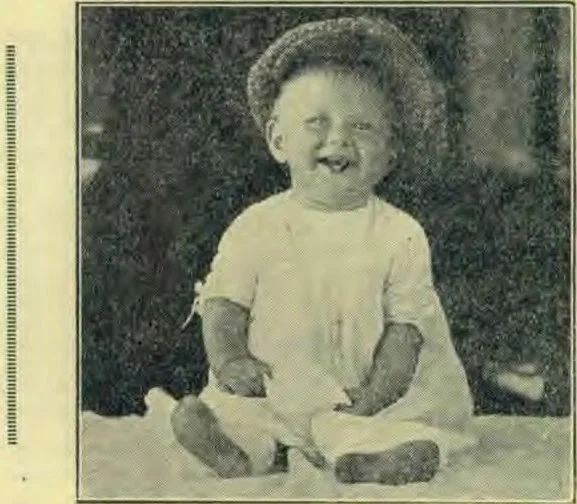
‘Lucile, catching a glimpse of a picture that lay in her mother’s lap, shouted gleefully, “I know. It’s a baby!”’
‘Do you agree, Carroll?’
‘I think so, mother, if it is as sweet as our own little Pearl.’
‘But a baby is a man or woman in the making. The Lord began the work well and he expects the boy and girl, the parents, teachers, and friends to help in the finishing process. He stands ready, however, to advise, and to help whenever needed. In fact, he wants to have a hand continually in the molding, fashioning process, and has given explicit instruction for the character-developing work. What is one trait of character the Lord expects every boy and girl to possess?’
‘He expects them to obey their parents,’ volunteered Lucile.
‘Yes, but what does he expect them to speak?’
‘Speak the truth, be the matter what it may,’ answered Carroll.
‘A Spanish proverb says, “Truth is God’s daughter,” and a lie is the child of Satan. The Lord loves his own daughter, but loathes untruthfulness and deception. A boy who does not tell the truth is not a genuine boy, just a poor imitation, a sham. People very soon learn that he is a counterfeit, and so do not put a high value on him.’
‘If imitation roses, peaches, and diamonds, are poor substitutes for the real, much more is a lying boy or girl a poor substitute for the upright and truthful one. Truthfulness is the solid foundation rock upon which good character is built, and no worthy character can be built upon any other foundation.’
‘True men detest a liar. There is an interesting story told of Wu Ting Fang, at one time China’s ambassador to this country. Like most Chinese, Mr. Wu liked to ask questions, so he said to a young reporter who was interviewing him, “What is your weekly salary?” The young man, wishing to make a favorable impression, answered glibly, “One hundred fifty dollars, sir.” Mr. Wu did not hesitate to say he thought that was too much.’
‘Another day the reporter called at the embassy to get some important information for his paper, but Mr. Wu would give him none, saying, “You lied to me about your salary, as I later learned. If you will falsify about such a thing as that, you will lie about anything. I do not trust you. I have nothing to say to you. And I want to revise my former estimate of your value. Instead of your being worth twenty-five dollars a week, as I then suggested, you are not worth anything, sir,” and with this he curtly dismissed the young man. Some time was required for the reporter to recover from the shock of this unexpected confession, but he never forgot the lesson.’
‘He was just an imitation man, wasn’t he, mother, and Mr. Wu was genuine,’ suggested Lucile.
‘Yes, the reporter was a human sham, because he loved not the truth.’
‘One day an eagle was seen gracefully soaring over our beautiful Chautauqua Lake, when it suddenly darted toward the water, catching in its claws a large fish. “There was a clash, and a splashing of fins and feathers,” said an observer of the incident, but slowly the bird rose in the air with its captive dangling and wriggling below. When at a height of about one thousand feet, the bird, still clinging to the fish, began to sink slowly toward the lake, gaining speed as it descended, and finally fell with a splash into the water. Later both fish and bird were found together, dead. The fish had evidently been too heavy for the eagle to carry, but its claws were so firmly embedded in the flesh that it could not release its hold, and as its strength gave way it sank into the water and was drowned.’
‘So it is with one who attempts to climb to the heights of good character with so heavy a soul weight as untruthfulness. He can never mount very high, but is carried down to lower and lower levels until finally his life ends in failure and death.’
‘The gates of Paradise swung to after the expulsion of Satan, the father of lies, nevermore to open only to those who love the truth.’
‘That’s why the Bible says, “Without are dogs, and sorcerers, . . . and whosoever loveth and maketh a lie,” isn’t it, mother?’
‘Yes, my boy. Now will you each make a list of great men who have loved the truth and hated lying? for we shall have another lesson on this subject.’
‘I believe I shall love the real things better than ever, mother dear,’ said Lucile, as she gave me a good-night kiss.
‘And from Carroll’s quiet pressure of my hand as he kissed me good night, I felt that he echoed Lucile’s words.’
F. D. C.
(To be concluded)

Me, in Boston

WHEN daddy suddenly decided to go away for a few days on a business trip, he said, “What am I going to do with you, Bab?” I said, “Take me with you, dad.” But he shook his head and said that would never do.
It was finally decided that I should pay a visit to Aunt Em, in Boston. This did not please me very much, for I had never seen Aunt Em, so I couldn’t know that she was just the best kind of aunt. I was comforted somewhat when daddy said that Nurse Betty was to go along with me.
Getting ready for the trip was lots of fun. Nurse Betty and I shopped one whole afternoon. We bought some pretty things and then had tea in a real restaurant, in New York. Going to Boston wasn’t so bad, after all.
Daddy took us to the train, and stayed with us until the conductor called “All aboard” for the last time. Then he stood on the platform and we waved our handkerchiefs to each other until he couldn’t see me and I couldn’t see him. Then I cried and I cried and I cried, until Betty said, “My, but it’s awful damp in here.” Then I laughed. But I wished daddy was going to Boston with me. Daddy is the kind of fellow I like to have around all the time. We like each other, dad and I.
I looked out of the window, and asked a lot of questions about the things I saw. Nurse Betty is very patient, but there are a lot of things she doesn’t know. I guess she hoped that I would go to sleep, but I didn’t.
It was dark when we reached Boston, and there was no one at the station to meet us. Betty said we had to get on a car, and she left me to take care of the bags while she asked a big man in uniform how to go to C—— Avenue. He was a very polite man and helped us on the car.
At last we reached Aunt Em’s. She lives in such a nice house, and all around it is a lovely garden, full of flowers. Aunt Em was glad to see me, and I liked her right away, and before bedtime we were just like old friends.
And I had the nicest visit. I was in Boston only a week, but the days went very quickly. I saw the old South Church, and Aunt Em told me the story of Paul Revere and his midnight ride. It was rather hard work to listen, because I knew the story well and could recite the poem about it, but I did listen, and when Aunt Em had finished I said, “Can you recite the poem about Paul Revere?” Aunt Em said, “No, indeed; can you?” I recited it for her, and she said, “That is very fine.”
Then we visited the grave of Henry Wadsworth Longfellow, and when we were at home that evening Aunt Em read “Hiawatha” to me. I liked it very much. Then we went to the Agassiz Museum, where I saw the most beautiful flowers, all made out of glass. And there were rides on the sight-seeing bus and trips into the city.
And then it came time for me to go home. The day before I left Boston, Aunt Em said, “Bab, I want to give you something to take back with you, so you will not forget your visit to Boston. What should you like?” Aunt Em was pleased when I said I did not need a gift to make me remember my visit, but she insisted on my selecting something just the same, so I said I should like a copy of “Hiawatha.” And if you were here now I would show you my beautiful book. It is full of pictures, and I just love a book with lots of pictures, don’t you?
Of course I did not feel so bad about leaving Boston as I did about leaving daddy, but I felt pretty bad. I think I should have cried, only I knew Nurse Betty would make remarks about it. I’ll never cry again when I have to go to Boston, but, my, wasn’t I glad to see daddy, and wasn’t he glad to see me! We are pretty good friends, daddy and I.—Maud Alice Newcomb, 2d, in The Christian Advocate.

Admiration Belongs to Those Who Do Best

“THE world gives its admiration, not to those who do what nobody else attempts, but to those who do best what multitudes do well.”

The Story of Paper, Briefly Told

So far as is known the ancient Egyptians were the first to use paper for writing purposes, preparing it from the papyrus plant. They called it papyrus; and from this the name “paper” has been derived. This plant, which grows in wet, marshy soil,—mainly now near Jaffa, Syracuse, and Lake Thrasymenus, to the north of Egypt,—has stems eight or ten feet long, resembling the ordinary rush in outward appearance. The lower end of the stem, the portion under the mud and water, is whiter and more compact than the portion above. The thin layers of tissue under the outer skin of these underwater parts were used for the manufacture of the writing material.
These thin layers were carefully separated and laid side by side with their edges overlapping. Crosswise on them with edges likewise overlapping, other layers were placed until a sheet of the desired thickness was obtained. After subjecting it to pressure for a time the sheet was dried in the sun. It was then ready for use. When new, it was white or brownish white in color, but gradually became darker with age.
Rolls of papyrus, some dating back to 2000 B. C., have been found in Egypt, in most cases having been interred with the dead. Their preservation for this remarkable length of time is due to the careful way in which they were put away and to the dry climate of the country. These ancient papyri have become light or dark brown in color and are extremely brittle, so that a mere touch is sufficient to break them.

Raw Materials Used

In Asiatic countries, notably China and India, the leaves of various plants and the bark of certain trees were used in very early times for writing purposes, the characters being impressed on them with a sharp-pointed instrument. Such materials are used to some extent to this day by certain of the primitive peoples.
Some writers believe that the use of these materials suggested a method of manufacturing paper from vegetable fibers, a method that gradually developed into the paper-making art of the present day. Others have suggested that by watching the work of paper-making wasps man first learned the secret of recombining finely divided vegetable fibers into thin sheets.
The Chinese knew the fundamental principles of paper making as early as the beginning of the Christian era—perhaps much before that time, so far as any one knows. They probably utilized cotton fibers, the soft parts of bamboo stems, and the barks of trees. The Arabians learned the art from the Chinese some seven hundred years later, and from the Arabians the secret was passed along to the Moors in Spain where cotton and probably hemp and flax were used for paper making.
For a time in the sixteenth century cotton and linen rags were the principal raw materials for the manufacture of paper, as they were found to yield an exceptionally fine product. They are still used to a considerable extent for the best grades of paper.
Several hundred kinds of paper materials are now known. Among these are grasses of various kinds, wood, straw, bark, and various vegetable substances. The bulk of all paper manufactured particularly for printing and wrapping, is made from wood pulp. Large quantities of waste paper of various kinds are worked over into new stock.

The Way Paper is Made

The process of manufacture differs considerably, according to the kind of materials being used and the purpose for which the finished product is to be used. After being freed from all dust and dirt, the raw materials are reduced to a pulp by grinding, mixing with water, and treating with chemicals. After a slightly mucilaginous composition and coloring matter have been added, the pulp is thoroughly mixed and agitated. This work, like all the succeeding steps in the process of manufacture, is usually done by ingeniously constructed machines.
When the pulp has been reduced to an almost impalpable fineness, it is strained and conducted in the chests of the machine from which it issues through an orifice onto a fine screen, usually made of wire, over which it is spread in a thin film. Special provision is made for rapidly absorbing the moisture in the pulp at this point.
When the film is sufficiently dry, it passes through a series of rollers, being made thinner and thinner as it goes along until it is reduced to the thickness desired. The last rolls through which it passes are heated so that a large part of the remaining moisture is removed and the paper is given a smooth, glossy finish. The paper comes from the machine in a continuous sheet and is wound on rolls; single rolls containing fourteen miles and more have been made.
For some purposes the paper is cut up into sheets of whatever size may be required, but for big modern printing presses it is carefully wrapped and shipped in the roll, being fed into the press in a continuous web, just as it came from the paper-making machine.
It is not known just when the idea of watermarking paper—impressing on it a device by means of an impression on the fine web of wires or threads or on the rolls between which it passes in the machine—was conceived, but watermarked paper was used for a manuscript known to have been written as early as the thirteenth century.
The first paper manufactory in America was established by William Rittinghuysen in 1690, on land which lies within the present limits of Philadelphia. Wood pulp and wood fibers for paper making were first introduced by an American manufacturer more than sixty years ago.—The Pathfinder.

A Roll Call

“You may answer with quotations,” said Professor Owl one day, “The roll call.” O’er the Forest School he held unquestioned sway.
“Mr. Crow! Attention all! Bad manners ’tis to push.” “‘A bird in the hand,’” he shrilly cawed, “‘Is worth two in the bush.’”
“Mr. Sheep! Please books aside—there’s plenty of time to cram!” “‘God tempers the wind,’” he bleated forth (from Sterne), “‘to the shorn lamb.’”
“Mr. Collie!” called Professor Owl, in his commanding way. “‘Every dog,’” he answered promptly, he knew, “‘has his day.’”
“Mr. Wolf! I wish to hear none in the schoolroom growl!” “‘Live with wolves,’”—a Spanish saw,—“‘and you will learn to howl!’”
“Mr. Leopard! You who dwelt late with the Hottentots.” “‘A leopard,’” and he glanced ’round proudly, “‘cannot change his spots.’”
“Mr. Shetland!” With a doubtful shaking of his head, “‘A horse is a vain thing for safety.’ That’s what the psalmist said.”
“That will do. Now let each present learn all that he can. Before recess; the work assigned is on the topic ‘Man.’”
ADELBERT F. CALDWELL.

An Acid Test

WHEN the chemist speaks of a “test,” he means “a procedure or reaction employed to recognize or distinguish any particular substance or constituent of a compound.” Thus there is, for instance, the iodine test for starch, and the acid test for gold.
This latter phrase, “the acid test,” is frequently employed in a figurative sense in connection with character.
“Yes, he is all right,” the remark may be heard; “the acid test was applied to him, and he came out pure gold.”
A merchant determined to apply an acid test to the young men in his employ. For some time it had been known in the establishment that there was to be a promotion to a position of unusual responsibility. A dozen employees thought longingly of the tempting position; half as many felt they had a good chance to win. It was generally agreed, however, that there were but two real possibilities. One of these, Lawton, was a quiet, unassuming young man who for more than five years had been doing good work for his employer.
“But I fear he doesn’t stand as much of a show as Nelson,” an interested bystander said; “he isn’t self-assertive enough. He is conscientious, capable, and dependable, but he doesn’t take pains to impress himself on the rest of us as he should. Nelson never allows us to forget his presence and his worth. Lawton needs to be more like him. To tell the truth, though, there isn’t much choice between them. I am glad I don’t have to make the difficult decision.”
The merchant, also, found the choice difficult. At length he realized that the two were so evenly matched that he must have additional light before he could decide between them. He resolved to make a character test. He wondered how he was to do this, until he learned that Lawton and Nelson, who had been good friends, were growing apart. After a time, he decided that the fault was Nelson’s, for Nelson was saying bitter things about Lawton, and Lawton was saying nothing about Nelson. So far, he thought, Lawton was proving himself the better man. But here was an opportunity for a further testing of both men.
One day the merchant went to Nelson.
“What do you think of Lawton’s fitness for more responsible service, Nelson?” he asked.
The reply came instantly:
“I fear he could not give satisfaction; he is good as far as he goes, but he cannot go far.”
Next, Lawton was approached, and to him was put the same question as to Nelson’s fitness for promotion. After a moment’s hesitation, the answer was made:
“I think well of him. I feel sure he has ability for many things for which he has not been tested.”
Why was this an acid test? Why did the merchant choose Lawton for the position? Why was he right?
It is told of President Hayes that he once recommended for a position a man who had talked outrageously about him.
“How could you do it?” asked a friend. “Do you know what that man thinks about you?”
“Oh, yes,” answered Hayes, “but they asked me what I thought of him, not his opinion of me.”
Of course it is difficult to be fair in expressing our opinion of one who has seemed to be unfair to us. But can we afford to be unfair simply because we have been treated unfairly? Are we willing to take a place beside the young man of whom the author of a recent story told, the man who “couldn’t for the life of him understand that his personal feeling toward a man should not under any circumstances make any difference in his judgment of the man”?
But a critical world expects just this of a man. Can we demand less of ourselves?—Selected.

For the Finding-Out Club

Part I

GIVE the pronunciation of the following words, stating your authority:
adobe bade chapeau
algae belligerent chic
allies bateau coma
deficit baton comatose
apropos bouffe comptroller
armistice garage confidant
aspirant bouquet combatant
attaché catafalque decadence

Part II

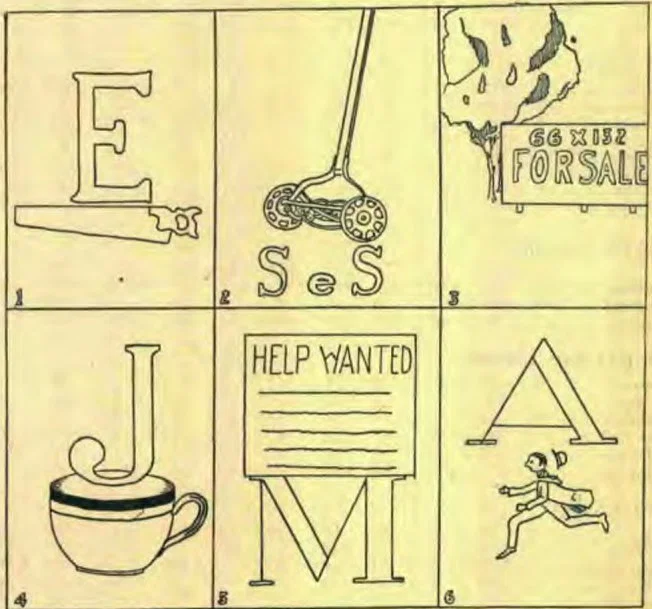
Name the Bible characters represented below.

Members of the 1919 Finding-Out Club

Stanley Altman <sup>6</sup> Mary E. Kester <sup>3</sup>
Mrs. G. H. Baber <sup>8</sup> E. A. Light
Mabel Bellchambers <sup>3</sup> Clifford McDowell <sup>4</sup>
Alberta L. Betts <sup>3</sup> Idamae Melendy
Maude Bostwick <sup>4</sup> Genevieve I. Melendy <sup>3</sup>
Jeanne Boyd Ardis C. Melvin <sup>3</sup>
Ethel Bolye <sup>5</sup> Bessie Mount
Mrs. A. C. Brown <sup>3</sup> Mary Moore <sup>2</sup>
Grace Bruce <sup>2</sup> Blanche Nesmith <sup>2</sup>
Pearl E. Budd <sup>2</sup> Josephine Paden <sup>2</sup>
Gladys Camp <sup>2</sup> Violette Putnam <sup>2</sup>
L. Vesta Clymer <sup>3</sup> Ruth Rahn <sup>4</sup>
Mrs. O. L. Dart <sup>2</sup> Alpha Rahn <sup>4</sup>
Ramona Dimond <sup>2</sup> Winslow Randall <sup>2</sup>
Laura E. Downs Emma Ramstead <sup>2</sup>
Alva Downs Grace Ravan <sup>3</sup>
Lillie Emanuel <sup>2</sup> Wilma Ray <sup>3</sup>
Mrs. N. C. Erntson <sup>2</sup> Lillian Rochambeau <sup>2</sup>
Adelaide Eye <sup>2</sup> Ophal Rogers
Mrs. J. J. Franklin Mrs. J. T. Spriggs <sup>3</sup>
Titus Frazee R. R. Sweany
Lillie Freeborough Sarah Tates
Mrs. Norman Gartly <sup>2</sup> Rosa Marie Thomas
Esther H. Gifford Elsa P. Thompson <sup>3</sup>
Irma Halladay Mrs. C. L. Thompson
Harold B. Hannum <sup>4</sup> Floyd Timbey <sup>2</sup>
Mrs. W. R. Hanson <sup>5</sup> Grace Wagner
Hazel L. Hanson <sup>6</sup> Amelia L. Wendell <sup>3</sup>
Mrs. Grace Hoover <sup>9</sup> Nettie Wilson <sup>4</sup>
Jean Jack Vida V. Young <sup>2</sup>
Alfred Youngberg
Continue reading: Summary of the Missionary Volunteer Work in North America for Quarter Ending September 30, 1918