Your ShelfYour Projects

Signs of the Times, Vol. 34, No. 19.

Armed Peace

Signs of the Times

May 6, 1908

Pacific Press Publishing Company · Mountain View, California · May 6, 1908

"Armed Peace."

Peace, peace, the nations fondly cry, The Philadelphian day draws nigh When nations lay their hatred by, And peaceful banners stream! When swords to plowshares shall be made, When warriors turn to peaceful trade, The weak shall flourish unafraid, And love shall reign supreme!
But one there was in days of old, A man of God, a prophet bold, Who of the latter days foretold,— Prepare, for war prepare! Go make the metal white with heat, To spears and swords your plowshares beat, Go forth in armor all complete, To meet the foeman there!
Behold, in our own day we see, In our own land so great and free, That lasting peace can never be With dogs of war abroad! From sea to sea, from shore to shore, In accents louder than before, We hear the cannon's sullen roar, And gathered hosts applaud!
Great armies gather in their might, And fleets with thundrous guns bedight, Surcharged, impatient for the fight— The dove of peace they scorn! The world in admiration stands, And eyes from near and distant lands Gaze on the fleet which bravely stands Around the stormy Horn!
A welcome waits the sailors brave, Who face the dangers of the wave, Who heart and hand their land will save That Freedom's flag may fly! The world e'er honors with a cheer And with a patriotic tear, Defenders who, without a fear, For freedom live or die!
O would that soon the day might be That nations from the curse were free, That from the wrong the world might flee, And learn of war no more! Then angel hosts would gather home The weary waiting ones who roam, And faithful saints see heaven's dome Upon the shining shore!
Max Hill.

With Our Inquirers

"If ye will inquire, inquire ye."
[All questions to this department will be answered which to the editors will seem to minister to the good of the readers and to the mission of the paper. The same question can not be answered repeatedly in the same volume. The name and address must accompany question, not for publication, but as an evidence of good faith, and that answer may be made by letter if deemed advisable. It is well always to enclose a stamp for reply.]

2489.—The Child Shall Die an Hundred Years Old.

In Isa. 65:17-25 is given a description of the new earth, and our homes there, but verse 20 says, "There shall be no more thence an infant of days, nor an old man that hath not filled his days; for the child shall die an hundred years old; but the sinner being an hundred years old shall be accursed." How do you harmonize it with the description given in Rev. 21:1-4 where it says there shall be no more death?
It is often difficult to understand the very brief predictions of the Old Testament, which include, sometimes in the same sentence, things very widely separated. Take, for instance, Isa. 61:2, "To proclaim the year of Jehovah's favor, and the day of vengeance of our God." The first part of that is quoted by our Lord Himself, in Luke 4:21, in which He declares, "To-day hath this scripture been fulfilled in your ears;" but you will notice that He closes His quotation with "the year of Jehovah's favor." "The day of vengeance of our God" is left to the last-day message to proclaim. Rev. 14:6-14.
So Isa. 65:17-25 covers a great period, and does it very briefly. Verse 17 speaks of the new heaven and new earth which shall be so wonderful, conditions that shall be so joyful that the former things shall not be remembered nor come upon the heart. God's people are therefore called upon to rejoice over it, and in the 19th verse the Lord declares that He Himself will rejoice in Jerusalem and joy in His people, "and there shall be heard in her no more the voice of weeping and the voice of crying." Verse 20 refers to past conditions, and declares that those conditions will not be in the new creation of God; "there shall be no more thence"—that is, from that time forward, in that new-earth state—"an infant of days, nor an old man that hath not filled his days; for the child shall die an hundred years old; but the sinner being an hundred years old shall be accursed." And this seems to be the thought; that that "little season," during which time the wicked live upon the earth after the second resurrection (See Revelation 20, the last clause of verse 3 and verse 7) will be about one hundred years. In that resurrection will be the children who died unrepentant after the age of responsibility. They will be allowed to live during that period, and will demonstrate during that time that God was just in placing them among the wicked. The sinner himself will—some sinners, at least—continue during that period, at the end of which time all the wicked shall die; and then death shall be no more forever, for in that new heaven and new earth there shall be no more death. The dying refers to the period of time just preceding the setting up of the new heaven and new earth.

2490.—Food of Satan.

Does Satan eat food now? If so, what keeps him alive during the one thousand years?
Spiritual beings may have food to eat of which we know nothing. In fact, humans generally do not recognize the breadth and scope of the things in which they themselves find sustenance. We talk simply of food which we masticate, and which passes thru the mouth and stomach as the food which we eat, but just as truly are sunshine, and air, and water, food. Spiritual beings may find their sustenance in the air or in substances of which we ourselves are not cognizant at all. There are some things in the Scriptures that would seem to indicate that they drew vitality from material beings here. As for instance, when the demons were cast out of the man from the tombs, they besought Christ that they might enter into the herd of swine. In the twelfth chapter of Matthew, forty-third verse, we read, "But the unclean spirit, when he is gone out of the man, passeth thru waterless places, seeking rest, and findeth it not." Then he comes back to the place whence he was cast out and enters it again and takes up his abode there. Spiritualist mediums tell us that whenever they are possessed by the spirits, their vitality is greatly affected. Evil angels may draw nourishment from the air and from other creatures in this sin-possessed earth.

2491.—Three Days and Three Nights.

Will you kindly explain why the Bible says that Christ was three days and three nights in the tomb when He was crucified Friday afternoon and arose Sunday morning? Two young friends of mine have just begun to find out that the Bible contradicts itself.
In the first place, it is nowhere stated in the entire Bible that Christ was to be in the tomb three days and three nights. Settle that forever. The expression evidently referred to is Matt. 12:40, "As Jonah was three days and three nights in the belly of the whale [margin, "sea-monster"]; so shall the Son of Man be three days and three nights in the heart of the earth."
Now what is meant by the heart of the earth? What right have we to say that it means the grave? The expression is used nowhere else; there is no other passage in the Scriptures which tells us just what it does mean. Why may it not mean something entirely different from what you suppose? Another thought; day and night is a Hebrew term expressing day. It may not mean a whole day and a whole night, but part of the day and part of the night, meaning the day just as we speak in a general way, "I have expended three days upon that task," "I have lost three days this week," and it may be one whole day and parts of two days. If you will look up in different parts of the word of God where day and night is mentioned in this way, you will find that the period of time does not necessarily include just exactly so many full-hour days.
At the time when Jesus predicted His passion, included in that the time of three days, He mentioned not simply being killed and after three days rising again, but also the betrayal and rejection; as for instance, Matt. 16:21, that Jesus "must go unto Jerusalem, and suffer many things of the elders and chief priests and scribes, and be killed, and the third day be raised up." Of course we may say the three days means after He was killed, it may also mean after He was betrayed. See Luke 24:20, in which is the account of the two disciples on their way to Emmaus; who spoke of Jesus and His work, and said, "And how the chief priests and our rulers delivered Him up to be condemned to death, and crucified Him. . . . Yea and besides all this, it is now the third day since these things came to pass." They said that at the close of the first day of the week; that was the third day since the time that He was delivered up to be crucified. In this connection, read also John 12:27, 31, "Father, save Me from this hour. But for this cause came I unto this hour." "Now is the judgment of this world: now shall the prince of this world be cast out." Connect with that Luke 22:53, the words of Jesus to those who arrested Him, "This is your hour, and the power of darkness." From the time that Jesus was delivered into the hands of the agents of the prince of this world began the three days. That was Thursday night, the beginning of the sixth day of the week, including the night and the day of the sixth, the night and the day of the seventh, and the dark part of the first day of the week as the day began to dawn. Looking upon it in this common-sense way, there is no contradiction.

2492.—Selling Religious Publications on the Sabbath.

Would it not be right to take subscriptions for the SIGNS OF THE TIMES or any other good paper or good book such as teach the Bible and our duty to God on the Sabbath day? Did not Jesus say on the Sabbath, "My Father worketh hitherto, and I work"?
He did, and it is proper for us to do proper work for God on that day. The Lord did not design the Sabbath to be a day of idleness. Jesus declares, "It is lawful to do well on the Sabbath day;" but if we are selling papers or religious publications on that day in order in any wise to benefit ourselves, it certainly is not right; we are doing our own work. Then again, the example itself would be bad. It would be pretty hard to distinguish many times between selling for our own benefit and the commission that we might get, and for the sake of the souls to whom we sold. If we had the burden of souls in mind, why not give the papers away on that day? It would be very difficult, indeed, for one looking upon it from the outside to see that we were not doing it for ourselves, however laudable it might be; in other words, making a gain out of godliness. To such things would apply that text, "Abstain from all appearance of evil." Do not in any wise violate conscience.

2493.—The Lord Repented. Gen. 6:6.

If the Lord foresaw that Adam and Eve would sin and that the people of this world would become so wicked, why did He say that He repented that He had made man?
The Lord accommodated Himself in His great infinitude to our limited understanding. He speaks to us in our human language, limited by our human feelings and vision. Looking at it from the human standpoint, it would seem that when the earth became so wicked at the time of the Deluge, it would have been better if man had never been created, and from that viewpoint, if there had been nothing further, the Lord repented that He had made man. He sorrowed as He looked upon the use that man made of his opportunities; it grieved Him at heart that man had so perverted the good which might have been his. The text expresses the infinite sorrow of the Deity in the language of man. And yet, despite all that Satan has done, God will bring glorious triumph, and His plan concerning the earth and its dwellers shall not be frustrated.

2494.—"Time and Times, and the Dividing of Time."

Have not the saints and times and laws been given into the hands of the little horn for a longer period than "time and times, and the dividing of time"? It seems they are still in his hands.
The prophecy relates to the time when the little horn would have power to enforce his laws and decrees. Its customs might continue a long time after that power was lost, but when the time of the decree passed and the authority was taken away from the little-horn power, he could no longer enforce his decrees against God's people, and from 1798, when the time, and times, and the half time ended, the light from God's word began to go forth into the world as never before.

2495.—Strong Drink.

The strong drink of Deut. 14:26 would probably not be called intoxicating drink nowadays. They had no distilled liquors in ancient times; yet God's people were at liberty to drink the fermented drinks if they so desired. They always have been. God in His wisdom has given His people the choice of doing wrong if they wish to follow that choice. But if the children of God came together to rejoice in Jehovah, as in Deuteronomy 14, with the heart to do God's will, they certainly would not become drunken.

2496.—Gen. 11:7.

"Let us go down." The "us" probably refers to the Lord and His angels, speaking after the manner of men, in contradistinction to the speech of the builders of the Tower of Babel.

"Follow Me, and I Will Make You Fishers of Men"
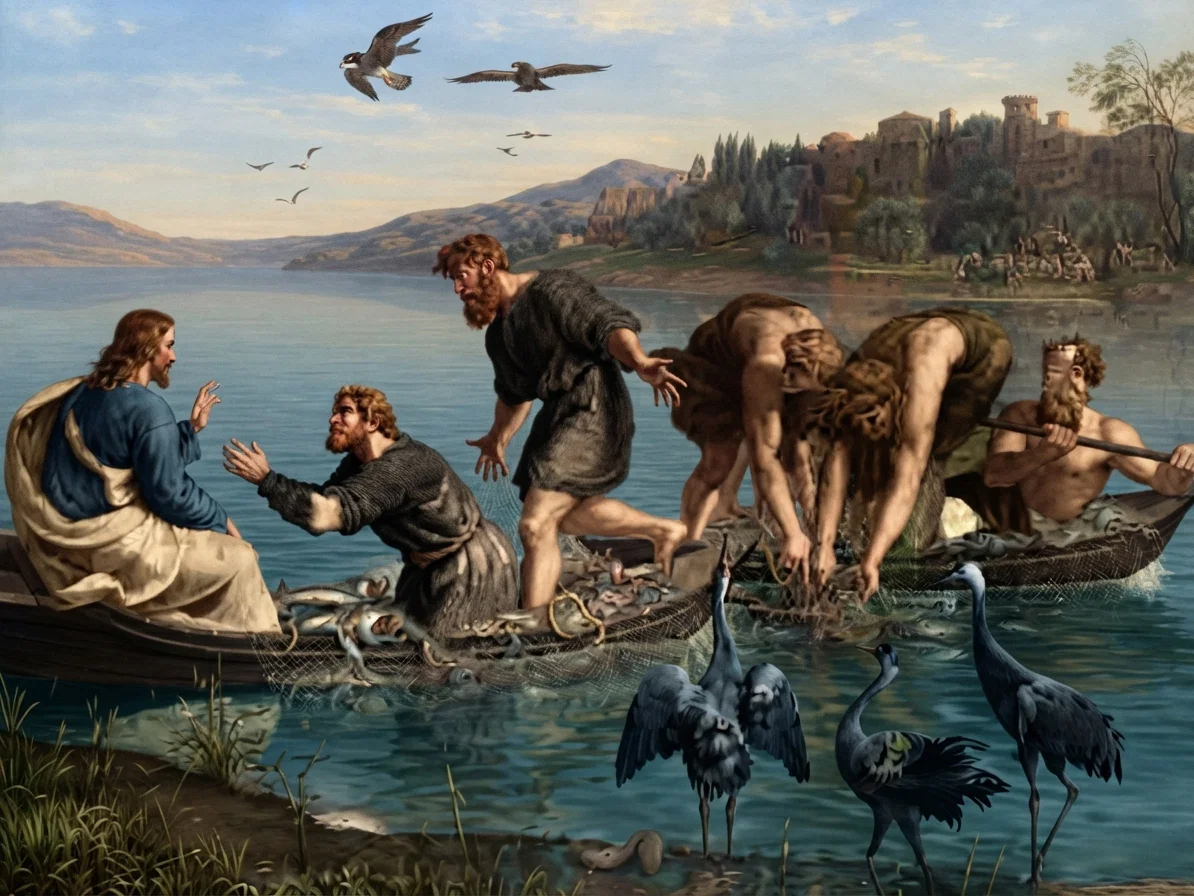
By Mrs. E. G. White
Miraculous Draft of Fishes.
AND it came to pass, that, as the people pressed upon Him to hear the word of God, He stood by the lake of Gennesaret, and saw two ships standing by the lake; but the fishermen were gone out of them, and were washing their nets. And He entered into one of the ships, which was Simon's, and prayed him that he would thrust out a little from the land. And He sat down, and taught the people out of the ship."
The discourse ended, Jesus turned to Peter, and bade him launch out into the sea, and let down his net for a draft; but Peter was disheartened. All night he had taken nothing. During the lonely hours he had thought of the fate of John the Baptist, who was languishing alone in his dungeon. He had thought of the prospect before Jesus and His followers, and of the ill-success of the mission to Judea, and the malice of the priests and rabbis. Even his own occupation had failed him; and as he watched by the empty nets, the future had seemed dark with discouragement. "Master," he said, "we have toiled all night, and have taken nothing; nevertheless at Thy word I will let down the net."
Night was the only favorable time for fishing with nets in the clear waters of the lake. After toiling all night without success, it seemed hopeless to cast the net by day; but Jesus had given the command, and love for their Master moved the disciples to obey. Simon and his brother together let down the net. As they attempted to draw it in, so great was the quantity of fish enclosed that it began to break. They were obliged to summon James and John to their aid. When the catch was secured, both the boats were so heavily laden that they were in danger of sinking.
But Peter was unmindful now of boats or lading. This miracle, above any other he had ever witnessed, was to him a manifestation of divine power. In Jesus he saw One who held all nature under His control. The presence of Divinity revealed his own unholiness. Love for his Master, shame for his own unbelief, gratitude for the condescension of Christ, above all, the sense of his uncleanness in the presence of infinite purity, overwhelmed him. While his companions were securing the contents of the net, Peter fell at the Saviour's feet exclaiming, "Depart from me; for I am a sinful man, O Lord."
Altho Peter said to Christ, "Depart from me," he still clung to the Saviour's knees, feeling that he could not be parted from Him. "And Jesus said unto Simon, Fear not; from henceforth thou shalt catch men." When they had brought their ships to land, Peter and his companions forsook all, and followed Jesus. Thus were these humble fishermen called by the God of heaven to their life-work.
Every one who in living faith follows Jesus, with an eye single to His glory, will see of the salvation of God just as surely as these discouraged fishermen saw their boats filled by the miraculous draft. It was because Christ was in the ship that they were successful in their efforts to catch fish. The indwelling presence of the Saviour is equally necessary in the work of winning souls.
In order to save the fallen race, Christ, the Majesty of heaven, the King of glory, laid aside His royal robe and kingly crown, clothed His divinity with humanity, and came to this earth as our Redeemer. Here He lived as a Man among men, meeting the temptations that we must meet, and overcoming thru strength from above. By His sinless life He demonstrated that thru the power of God it is possible for man to withstand Satan's temptations.
We may endeavor to resist temptation in our own strength, doing our best to overcome; but we shall meet with disappointment after disappointment. And thus it is in our efforts to win men and women to the Saviour. Dependence on our own wisdom will result in repeated failure, causing us much anxiety and sorrow. This was the condition of mind in which Christ found the fishermen on the shore of the Sea ofGalilee, after their night of unrewarded labor.
Long had the fishermen toiled that night; often had they been disappointed, as time and again the net was drawn up empty. But now, at the bidding of the Divine One, they launched out into the deep, and once more cast their net into the sea. And what an abundance of fish they gathered! The sight of the miraculous draft swept away their unbelief, and they were ready to respond to the Saviour's invitation to follow Him, and learn to be fishers of men.
The breaking net, the sinking ship, the surprise and gratitude of Peter and his companions, their willingness to follow the Saviour and to do His bidding—all these are object-lessons for us in the work of soul-saving. However long and faithfully we may toil in our human strength, we can hope for no results for good; but as soon as we welcome Christ into the heart, He works with and thru us for the salvation of souls.
God has promised to cooperate with those who choose to labor in harmony with His purpose. We are to do our utmost to act our part faithfully, in order that He may demonstrate to the world what He can do thru us. "Ye are laborers together with God," He declares. It is God that gives success to human endeavor. Without His presence with us, our efforts would amount to nothing. We are simply channels thru which His blessings flow to our fellow beings. From every one in whose heart Christ is an abiding presence, will go forth a power that will influence others to accept the Saviour as their Redeemer.

Were the Christians of Past Centuries Sealed without the Sabbath?

(Concluded from Last Week.)
THE third part of the message (Rev. 14: 9-12) is a warning against the worship of the beast and his image, and against receiving his mark. With remarkable unanimity Protestant commentators have applied this beast symbol to the papal power. The mark of the beast is that which the beast claims as his mark. It is a part of his religion,—the chief part,—and God permits every one to choose his own religion. The writer has many quotations on this point from both Catholic and Protestant authorities. However, only one will be given at this time. Speaking of the change of the Sabbath, Cardinal Gibbons says:
"Of course the Catholic Church claims that the change was her act. It could not have been otherwise, as none in those days would have dreamed of doing anything in matters spiritual and religious without her; and the act is a mark of her ecclesiastical power and authority in religious matters."
Again, the mark of the beast is that institution which the beast has set up to displace God's sign, or mark. Reader, do you know what it is that has been trying to crowd out and supersede the seventh-day Sabbath ever since the days of Constantine? Do you know that the Sunday institution was trying to crowd out the Lord's Sabbath in the old dispensation as well as in the new? Says Morer, in his "Dialogues on the Lord's Day:"
"It is not to be denied but we borrow the name of this day from the ancient Greeks and Romans; and we allow that the old Egyptians worshiped the sun, and as a standing MEMORIAL of their veneration, dedicated this day to him. And we find by the influence of their examples, other nations, and among them THE JEWS THEMSELVES, doing him homage; yet these abuses did not hinder the fathers of the Christian Church simply to repeal, or altogether lay by, the day or its name, but only to sanctify and improve both, as they did also the pagan temples polluted before with idolatrous services, and other instances wherein those good men were always tender to work any other change than what was evidently necessary, and in such things as were plainly inconsistent with the Christian religion; so that Sunday being the day on which the Gentiles solemnly adored that planet, and called it Sunday, partly from its influence on that day especially, and partly in respect to its divine body (as they conceived it), the Christians thought fit to keep the same day and the same name of it, that they might not appear causelessly peevish, and by that means hinder the conversion of the Gentiles, and bring a greater prejudice than might be otherwise taken against the Gospel."
This quotation shows that the Sunday institution originated in sun-worship. A writer in the Old Testament Student declared sun-worship to be "the oldest, most wide-spread form of idolatry known to man." The North British Review called Sunday "the wild solar holiday of all pagan times," and Constantine, in his famous Sunday edict, styled it "the venerable day of the sun." Paul said that "the things which the Gentiles sacrifice, they sacrifice to devils, and not to God; and I would not that ye should have fellowship with devils." 1 Cor. 10: 20. It is certain, then, that everything connected with sun-worship emanated from the mind of Satan. And it is equally certain that Christ would not lay aside His own hallowed rest-day and put in its place an institution set up by Satan and used in his worship for thousands of years. In the quotation from Morer, Sunday is called the Egyptians' "memorial." Shall we read what the Bible says of the heathen's memorial? "Thou hast rebuked the heathen, Thou hast destroyed the wicked, Thou hast put out their name forever and ever. O thou enemy, destructions are come to a perpetual end: and Thou hast destroyed cities; their memorial is perished with them." Ps. 9: 5, 6. This is a prophecy of the final destruction of the wicked. Their memorial, which is the mark of their character and name, is to perish with them. ## The Jews as Sun-Worshipers. Morer states that even the Jews were at times drawn into sun-worship. Then, of course, they kept Sunday, and, at such times, had no use for the Lord's Sabbath. See how Ezekiel states the facts: "And he brought me into the inner court of the Lord's house, and, behold, at the door of the temple of the Lord, between the porch and the altar, were about five and twenty men, with their backs toward the temple of the Lord, and their faces toward the east; and they worshiped the sun toward the east." Chapter 8: 16. "They despised My judgments, and walked not in My statutes, but polluted My Sabbaths: for their heart went after their idols." Chapter 20: 16. The testimony shows that this counterfeit sabbath has been trying to usurp the place of the Lord's Sabbath almost since the entrance of sin into our world. It is the mark, or sign, which Satan has set up in opposition to Christ's mark, or sign. The beast, as the agent of Satan, has adopted Satan's sign. "And all that dwell upon the earth shall worship him, whose names are not written in the book of life of the Lamb slain from the foundation of the world." Rev. 13: 8. "And the third angel followed them, saying with a loud voice, If any man worship the beast and his image, and receive his mark in his forehead, or in his hand, the same shall drink of the wine of the wrath of God, which is poured out without mixture into the cup of his indignation; and he shall be tormented with fire and brimstone in the presence of the holy angels, and in the presence of the Lamb." Rev. 14: 9, 10. Over and over again it has been proved in the SIGNS OF THE TIMES that this Threefold Message was due to the world at the termination of the two thousand and three hundred days, or years, of Dan. 8, and that this period expired in A.D. 1844. It is also a well-known fact that at that time God raised up messengers in different parts of the world to carry the message, and that they have been proclaiming it continuously since that time until it has encircled and well-nigh covered the earth. For over half a century, they have been pulling off the cloaks of ignorance on the subject of the Sabbath, and thousands have responded to the call of God to come out of Babylon.But some say that they can not see this subject as the messengers see it. That was the trouble in Noah's day; they could not see the message as Noah did. The real difficulty was that the people who rejected the message did not fear God and tremble at His word. They were not so much interested in giving glory to God as they were in securing earthly glory for themselves. They were not courting the presence of the Holy Spirit. Those who did not see the message were swept away by the waters of the flood.

Failing to See the Message.

John the Baptist and Christ met people who were unable to see the message as they did. Jesus said: "For this people's heart is waxed gross, and their ears are dull of hearing, and their eyes they have closed; lest at any time they should see with their eyes, and hear with their ears, and should understand with their heart, and should be converted, and I should heal them." Matt. 13: 15. He told them that the queen of the South, and the people of Nineveh would rise up in the judgment and condemn that generation; for when they heard a message from God, they accepted it. Just as surely will those who have accepted the Threefold Message in this generation rise up in the day of judgment and condemn those who have rejected it. The lives of those who accept God's messages of warning, who receive His Spirit and walk in His commandments, are a constant reproof, warning, and condemnation to those who resist His Spirit and trample upon His law.

The Sin of Ignorance.

The Lord bears long with sins of ignorance. He is long-suffering and plenteous in mercy toward those who desire to do right, but have lacked opportunity to become acquainted with His word, or have been misled by false teachers. But when He sends the light and removes their cloak of ignorance, they are left without excuse. That which before was a sin of ignorance now becomes a sin of presumption. "But the soul that doeth ought presumptuously, whether he be born in the land, or a stranger, the same reproacheth the Lord; and that soul shall be cut off from among His people. Because he hath despised the word of the Lord, and hath broken His commandment, that soul shall utterly be cut off; his iniquity shall be upon him." Num. 15: 30, 31. "For if we sin wilfully after that we have received the knowledge of the truth, there remaineth no more sacrifice for sins." Heb. 10: 26. There is but one sacrifice for sins, and that is the righteous life of Christ. As His righteousness was His obedience of the commandments of God, it follows that to reject the commandments which He observed is to reject the righteousness of Christ. To repudiate the seventh-day Sabbath is to repudiate Christ's Sabbath-keeping, or Sabbath righteousness. And to repudiate His righteousness is to repudiate His sacrifice for sins. Hence to those who do that knowingly, wilfully, and stubbornly "there remaineth no more sacrifice for sins, but a certain fearful looking for of judgment and fiery indignation which shall devour the adversaries." See Heb. 10: 26-31. Those who were sealed in past centuries with Christ's Sabbath righteousness, could never have been sealed had they rejected the Sabbath truth. It was impossible for them to reject what they had never heard. Of course there were a few all the way along who understood the truth, and they were held responsible. Let no one think to-day that he will be sealed by Christ while he repudiates the seal. "The times of this ignorance God winked at; but now commandeth all men everywhere to repent." Acts 17: 30.

Up to Jerusalem.

LIKE a lamb to the slaughter led, Sinless, He, in the sinner's stead, Goes up to die. And shall not we His steps pursue, That last eventful journey thru To Calvary?
Up to Jerusalem He goes, With all impending pains and woes Fully foreknown. Ready to pay the awful price, Ready to make the sacrifice, Our sin t'atone.
Each act He did, each word He said, Each drop of blood, each tear He shed, Along the way, The heinousness of sin reveals, And to heaven for man appeals, Judgment to stay.
O, wondrous love! O, matchless grace! He goes to take the sinner's place, Your place and mine. Our condemnation to endure, And righteous pardon to secure, Thru blood divine.
Then let us go with Him to die, Our carnal selves to crucify, That so likewise, From out the grave of buried sin, The new-created man within May daily rise. —J. Q. Waters.

Serving from Principle—A Parable.

A FATHER, who is to be absent from home for a certain length of time, says to his son, a lad of twelve years: "Now I am to be away from home for a few weeks, and I want you to be sure that the house is well supplied with wood during my absence. There are seven piles of wood you see out in the yard. Remember to take the wood from that seventh pile, for that is the one I designate to be used while I am away."
The command is certainly plain enough, and there is no excuse for any misunderstanding of it. After the father leaves, the son begins to look the matter over, and to reason upon it, and to study his own convenience. He says to himself, "Now that seventh pile is quite a distance from the kitchen wood-box where I am to place the wood. Just think, it is way down at the end of these six long piles. The first pile is only a little way from the kitchen, and how much more convenient for me to take wood from that pile. I don't think father cares anyway from which pile I take it. Wood is wood, whichever pile I take it from. Then father emphasized the fact that he wanted the wood supplied. That is the principle of the thing in his command.

It Makes No Difference to Father.

"When I mentioned the matter to Bridget, the kitchen servant, she agreed with me that it would not make any difference to father. He only wanted the wood supplied, and when I talked the matter over with my schoolmates, they all thought it would be all foolishness for me to spend my time in carrying from way down in that seventh pile. I would have more time to give to my studies, and it would please father so much to see what advancement I had made in science by this fine calculation on the wood business. And when he sees how well I have improved the time thus saved, he will excuse me from any apparent neglect of doing just exactly as he said."
So reasoning the son neglects the seventh pile of wood, and does all his carrying from the first pile, congratulating himself with the thought, "When father returns, he will say, 'Well done, my son, how faithful you have been in doing as I commanded you. And then, I see by your version of my command, you have gained so much time, and made such splendid progress in your study of science; I am well pleased with it all.'"
At last the father returns, calls up his son, and says, "What does all this mean? Did I not tell you plainly that you were to take wood from that seventh pile? And here you have been demolishing this first pile, which is not mine; but is the property of a man who was to come for it on my return, not simply for stove-wood either, as there were some choice sticks wanted for artistic work; but you have all these consumed in the kitchen fire. I have no commendation for your course, nor for your false reasoning which is making all this trouble. Remember, when I tell you to do a thing,I expect you to obey the exact words, without any of your fixing, or of your reasoning contrary to it. Remember always that one is not seven."
And is not this the exact way people are reasoning with what God has commanded? He said, "The seventh day is the Sabbath of the Lord thy God." Remember, and "keep it holy." "O," say latter-day reasoners, "A day is a day anyhow, and what does the Lord care so long as we devote a day to Him. It is only the principle of the thing that He requires." Yet these same persons are anxious to have the first day of the week enforced by law upon all men, even claiming that this must be done so that all shall obey the commandment of the Lord. If the Lord should now speak directly to them, He might inquire, "Who hath required this at your hand?"
It is just as true now as when Moses spake to Israel of old, "And it shall be our righteousness, if we observe to do all these commandments before the Lord our God, as He hath commanded us." Deut. 6:25. The only safe position in which we can walk, after our sins have been canceled by virtue of Christ's blood, is in heeding the counsel of the apostle James: "So speak ye, and so do, as they that shall be judged by the law of liberty." James 2:12. And that law of liberty is the law of Ten Commandments. He refers to two, the sixth and the seventh, to show of what law he is speaking. The fourth precept of that same law says, "The seventh day is the Sabbath of the Lord thy God."
Not far hence we shall all be called into the presence of our heavenly Father. Can we expect Him to accept our human contrivances which are thought to be more convenient, as obedience to His commands? Will He say of such, "Well done"? It is "impossible for God to lie." Heb. 6:18. So let us beware of our course.
J. N. LOUGHBOROUGH.

The Day Begins in Prayer

SUCCESSFUL is the day whose first victory is won in prayer. Holy is the day whose dawn finds thee on the top of the mount! Health is established in the morning. Wealth is won in the morning. "Awake, psaltery and harp; I myself will awake early."

The Parent’s Duty to Discipline

To DISCIPLINE is the parent's duty; but it must not all be done upon the child.

The Days in Which We Live.

By Frances E. Bolton.
THESE are days of wild excitement,— Mobs arise beyond control, Lynch law reigns without indictment, Tho it scars the human soul. In the fever of a moment, In the furor of a fray, In the silence of long torment, Men cast hope and life away.
These are days of fierce achievement,— Competition's race begun, Click of hammer, no relievement, Hot, the toiling wheels whirl on, Rush of cars in webbed commotion, Men are running to and fro, Strain of nerve and keen emotion Is the whole world's undertow.
These are days of hard contrastings,— Rich in lavish luxury, Poor in bitter, sad recastings, Under goad of penury, Beggars, menials, workmen, languish, Pressed by heartless grasp and cold, What to those who gain their anguish? Men grow calloused as their gold.
These are days of world-enthronement,— Lust of eyes and pride of life, Days when self hath great endowment To attain the end of strife. Days of epicurean festal, Days of fatness for the lewd, Days when men grow coarse and bestial From the slaughter of the good.
These are days of warring nations— Armies, navies blast and boom; Picked, the flower of rank and station, Facing deathward for their doom; Hearts defiled and homes dismantled, Earth's a charnel-house of dust. Is there aught for man implanted To survive the reign of lust?
Yes, my soul, behold, above you Flies an angel with a scroll Written on, "The Father loves you, He will save the seeking soul;" Flying, crying as he passes, "Turn to Christ and Calvary," O awake the frenzied masses, Ere time strikes eternity.
In these days of swift probation, O join all, ye hearts that ken, Publish out the great salvation, That still waits repentant men; For these days are of decision; Souls to lasting choice are driven; Swiftly comes the just concision, Hate to doom, and love to heaven.
Continue reading: A Personal, Intelligent God