Your ShelfYour Projects

Review and Herald, Vol. 75, No. 45.

THE REVELATION OF GOD

Review and Herald

Nov 8, 1898

Seventh-day Adventist Publishing Association · Battle Creek, Mich. · Nov 8, 1898

THE REVELATION OF GOD.

MRS. E. G. WHITE.
“God, who commanded the light to shine out of darkness, hath shined in our hearts, to give the light of the knowledge of the glory of God in the face of Jesus Christ.”
Before the fall, not a cloud rested upon the minds of our first parents to obscure their clear perception of the character of God. They were perfectly conformed to the will of God. For a covering, a beautiful light, the light of God, surrounded them. The Lord visited the holy pair, and instructed them through the works of his hands. Nature was their lesson-book. In the garden of Eden the existence of God was demonstrated in the objects of nature that surrounded them. Every tree of the garden spoke to them. The invisible things of God were clearly seen, being understood by the things which were made, even his eternal power and Godhead.
But while it is true that God could thus be discerned in nature, this does not favor the assertion that after the fall a perfect knowledge of God was revealed in the natural world to Adam and his posterity. Nature could convey her lessons to man in his innocence; but transgression brought a blight upon nature, and intervened between nature and nature’s God. Had Adam and Eve never disobeyed their Creator, had they remained in the path of perfect rectitude, they could have known and understood God. But when they listened to the voice of the tempter, and sinned against God, the light of the garments of heavenly innocence departed from them; and in parting with the garments of innocence, they drew about them the dark robes of ignorance of God. The clear and perfect light that had hitherto surrounded them had lightened everything they approached; but deprived of that heavenly light, the posterity of Adam could no longer trace the character of God in his created works.
The things of nature upon which we look to-day give us but a faint conception of Eden’s beauty and glory; yet the natural world, with unmistakable voice, proclaims the glory of God. In the things of nature, marred as they are by the blight of sin, much that is beautiful remains. One omnipotent in power, great in goodness, in mercy, and love, has created the earth, and even in its blighted state it inculcates truths in regard to the skilful Master Artist. In this book of nature opened to us,—in the beautiful, scented flowers, with their varied and delicate coloring,—God gives to us an unmistakable expression of his love. After the transgression of Adam, God might have destroyed every opening bud and blooming flower, or he might have taken away their fragrance, so grateful to the senses. In the earth, seared and marred by the curse, in the briars, the thistles, the thorns, the tares, we may read the law of condemnation; but in the delicate color and perfume of the flowers, we may learn that God still loves us, that his mercy is not wholly withdrawn from the earth.
Nature is filled with spiritual lessons for mankind. The flowers die only to spring forth into new life; and in this we are taught the lesson of the resurrection. All who love God will bloom again in the Eden above. But nature can not teach the lesson of the great and marvelous love of God. Therefore, after the fall, nature was not the only teacher of man. In order that the world might not remain in darkness, in eternal spiritual night, the God of nature met us in Jesus Christ. The Son of God came to the world as the revelation of the Father. He was that “true Light, which lighteth every man that cometh into the world.” We are to behold “the light of the knowledge of the glory of God in the face of Jesus Christ.”
In the person of his only begotten Son, the God of heaven has condescended to stoop to our human nature. To the question of Thomas, Jesus said: “I am the way, the truth, and the life: no man cometh unto the Father, but by me. If ye had known me, ye should have known my Father also: and from henceforth ye know him, and have seen him. Philip saith unto him, Lord, show us the Father, and it sufficeth us. Jesus saith unto him, Have I been so long time with you, and yet hast thou not known me, Philip? he that hath seen me hath seen the Father; and how sayest thou then, Show us the Father? Believest thou not that I am in the Father, and the Father in me? the words that I speak unto you I speak not of myself: but the Father that dwelleth in me, he doeth the works. Believe me that I am in the Father, and the Father in me: or else believe me for the very works’ sake.”
The most difficult and humiliating lesson that man has to learn is his own inefficiency in depending upon human wisdom, and the sure failure of his own efforts to read nature correctly. Sin has obscured his vision, and of himself he can not interpret nature without placing it above God. He can not discern in it God, or Jesus Christ, whom he has sent. He is in the same position as were the Athenians, who erected their altars for the worship of nature. Standing in the midst of Mars Hill, Paul presented before the people of Athens the majesty of the living God in contrast with their idolatrous worship.
“Ye men of Athens,” he said, “I perceive that in all things ye are too superstitious. For as I passed by, and beheld your devotions, I found an altar with this inscription, TO THE UNKNOWN GOD. Whom therefore ye ignorantly worship, him declare I unto you. God that made the world and all things therein, seeing that he is Lord of heaven and earth, dwelleth not in temples made with hands; neither is worshiped with men’s hands, as though he needed anything, seeing he giveth to all life, and breath, and all things; and hath made of one blood all nations of men for to dwell on all the face of the earth, and hath determined the times before appointed, and the bounds of their habitation; that they should seek the Lord, if haply they might feel after him, and find him, though he be not far from every one of us: for in him we live, and move, and have our being; as certain also of your own poets have said, For we are also his offspring. Forasmuch then as we are the offspring of God, we ought not to think that the Godhead is like unto gold, or silver, or stone, graven by art and man’s device.”
Those who have a true knowledge of God will not become so infatuated with the laws of matter or the operations of nature as to overlook, or refuse to acknowledge, the continual working of God in nature. Nature is not God, nor was it ever God. The voice of nature testifies of God, but nature is not God. As his created work, it simply bears a testimony to God’s power. Deity is the author of nature. The natural world has, in itself, no power but that which God supplies. There is a personal God, the Father; there is a personal Christ, the Son. And “God, who at sundry times and in divers manners spake in times past unto the fathers by the prophets, hath in these last days spoken unto us by his Son, whom he hath appointed heir of all things, by whom also he made the worlds; who being the brightness of his glory, and the express image of his person, and upholding all things by the word of his power, when he had by himself purged our sins, sat down on the right hand of the Majesty on high.”
The psalmist says: “The heavens declare the glory of God; and the firmament showeth his handiwork. Day unto day uttereth speech, and night unto night showeth knowledge. There is no speech nor language, where their voice is not heard.” Some may suppose that these grand things in the natural world are God. They are not God. All these wonders in the heavens are only doing the work appointed them. They are the Lord’s agencies. God is the superintendent, as well as the Creator, of all things. The divine Being is engaged in upholding the things that he has created. The same hand that holds the mountains and balances them in position, guides the worlds in their mysterious march around the sun.
There is scarcely an operation of nature to which we may not find reference in the word of God. The word declares that “he maketh his sun to rise,” and “the rain to descend.” He “maketh grass to grow upon the mountains. . . . He giveth snow like wool; he scattereth the hoar-frost like ashes. He casteth forth his ice like morsels: . . . he sendeth out his word, and melteth them: he causeth his wind to blow, and the waters flow.” “He maketh lightnings for the rain; and bringeth the wind out of his treasuries.”
These words of Holy Writ say nothing of the independent laws of nature. God furnishes the matter and the properties with which to carry out his plans. He employs his agencies that vegetation may flourish. He sends the dew and the rain and the sunshine, that verdure may spring forth, and spread its carpet over the earth; that the shrubs and fruit-trees may bud and blossom and bring forth. It is not to be supposed that a law is set in motion for the seed to work itself, that the leaf appears because it must do so of itself. God has laws that he has instituted, but they are only the servants through which he effects results. It is through the immediate agency of God that every tiny seed breaks through the earth, and springs into life. Every leaf grows, every flower blooms, by the power of God.
The physical organism of man is under the supervision of God; but it is not like a clock, which is set in operation, and must go of itself. The heart beats, pulse succeeds pulse, breath succeeds breath, but the entire being is under the supervision of God. “Ye are God’s husbandry, ye are God’s building.” In God we live and move and have our being. Each heart-beat, each breath, is the inspiration of him who breathed into the nostrils of Adam the breath of life,—the inspiration of the ever-present God, the great I AM.
The ancient philosophers prided themselves on their superior knowledge. Let us read the inspired apostle’s understanding of the matter. “Professing themselves to be wise,” he says, “they became fools, and changed the glory of the uncorruptible God into an image made like to corruptible man, and to birds, and four-footed beasts, and creeping things. . . . Who changed the truth of God into a lie, and worshiped and served the creature more than the Creator.” In its human wisdom the world can not know God. Its wise men gather an imperfect knowledge of God from his created works, and then in their foolishness they exalt nature and the laws of nature above nature’s God. Those who have not a knowledge of God through an acceptance of the revelation he has made of himself in Christ, will obtain only an imperfect knowledge of him in nature; and this knowledge, so far from giving elevated conceptions of God, and bringing the whole being into conformity to his will, will make men idolaters. Professing themselves to be wise, they will become fools.
Those who think they can obtain a knowledge of God aside from his Representative, whom the Word declares is “the express image of his person,” will need to become fools in their own estimation before they can be wise. It is impossible to gain a perfect knowledge of God from nature alone; for nature itself is imperfect. In its imperfection it can not represent God, it can not reveal the character of God in its moral perfection. But Christ came as a personal Saviour to the world. He represented a personal God. As a personal Saviour, he ascended on high; and he will come again as he ascended to heaven,—a personal Saviour. He is the express image of the Father’s person. “In him dwelleth all the fulness of the Godhead bodily.”

A LITTLE WHILE.

L. D. SANTEE.
(Princeville, Ill.)
“For yet a little while, and he that shall come will come and will not tarry.” Heb. 10:37.
A little while, O faint and sorely wounded! Only a little while, and toil shall cease; Soon shall ye be by angels bright surrounded In that bright home of love and joy and peace.
Only a little while shall pale lips quiver, And eyes grow heavy with their weight of tears; Soon shall ye drink of life's calm, shining river, And dwell in peace through God's unchanging years.
Then lay aside your burdens and your sadness; Bring to your care-worn features, hope's glad smile; Wear on your upturned faces, looks of gladness: Jesus is coming in a little while!

THE WORK OF THE SPIRIT.

J. N. LOUGHBOROUGH.
Our Saviour’s promise of the Spirit clearly presents the idea that the Spirit has a work to do in us and for us. Read the promise: “He will reprove [both the Revised Version and the text of Dean Alford give “convict” for the word “reprove”] the world of sin, and of righteousness, and of judgment.” John 16:8. “He will guide you into all truth. . . . He shall receive of mine, and shall show it unto you.” Verses 13, 14. This same divine guidance is spoken of by the prophet Isaiah: “And thine ears shall hear a word behind thee, saying, This is the way, walk ye in it, when ye turn to the right hand, and when ye turn to the left.” Isa. 30:21.
Concerning the work wrought by the Spirit of God, we have an illustration in the instruction given to Saul by Samuel: “And the Spirit of the Lord will come upon thee, and thou . . . shalt be turned into another man.” 1 Sam. 10:6. In Paul’s letter to Titus we read, “According to his mercy he saved us, by the washing of regeneration, and renewing of the Holy Ghost.” Titus 3:5.
In the Philippian letter, Paul said of the work of the Spirit: “For it is God which worketh in you both to will and to do of his good pleasure.” Phil. 2:13. In the Corinthian letter he said: “But we all, with open face beholding as in a glass the glory of the Lord, are changed into the same image from glory to glory, even as by the Spirit of the Lord.” 2 Cor. 3:18.
In the tract “What Must I Do to be Saved?” we read: “It remains for us to choose whether we will be set free from the bondage of sin, to share the glorious liberty of the sons of God. What you need to understand is the true force of the will; this is the governing power in the nature of man, the power of decision, or choice. Everything depends on the right action of the will. The power of choice, God has given to men; it is theirs to exercise. You can not change your heart, you can not of yourself give to God its affections; but you can choose to serve him. You can give him your will; he will then work in you to will and to do according to his good pleasure. Thus your whole nature will be brought under the control of the Spirit of Christ, and your affections will be centered upon him, your thoughts will be in harmony with him.”—Apples of Gold Library, No. 17, page 7.
In writing to the Ephesians, Paul speaks of man’s natural state as “being alienated from the life of God through the ignorance that is in them, because of the blindness of their heart.” Eph. 4:18. To the Colossians he wrote: “And you, that were sometime alienated and enemies in your mind by wicked works, yet now hath he reconciled.” He calls this reconciled state, “Christ in you, the hope of glory.” Of the obedience thus wrought by the power of God, he says: “I also labor, striving according to his working, which worketh in me mightily.” Col. 1:21, 27, 29. The apostle Peter speaks of those in such condition in Christ as “partakers of the divine nature, having escaped the corruption that is in the world through lust.” 2 Peter 1:4.

THE LIGHT OF A CANDLE.

L. A. REED.
I wish to discuss this proposition: The light of a candle is a manifestation of the goodness of God, this goodness being manifested that it may lead us to him. We have already seen that God’s goodness is revealed in the fact that he makes his sun rise on the evil and on the good. But he makes the candle shine, also, for the evil and the good. We have seen that all power operating in the material world is a manifestation of the Creator; and the power of cohesion, chemical affinity, heat, the whole phenomenon of combustion, is nothing more nor less than the power of God,—his own personal act, planned by him, and executed under the direction of his will.
Now here is a candle. I strike a match, and apply its blaze to the end of the wick. The heat of the match flame melts the wax, or paraffin, or tallow, and the wick drinks it up. All tubes exhibit the power of sucking up fluids; the finer the tube, the higher it is able to draw the liquid. The tubes of the wick, acting in this manner, carry the melted wax up to the flame of the match. The heat of the flame turns this wax into gas, and a cloud of this red-hot combustible gas forms about the end of the wick. Like all fluids, it tends to a spherical shape; but it is lighter than the air, and rises. While rising, the oxygen of the air rapidly unites with it; and by the time it has risen an inch from the wick, it has all been burned, and is reduced to a mere point. But other spheres of hot combustible gas continue to rise, one after the other, each in turn being burned as it rises, and made smaller and smaller, until, having become but a point, it is entirely consumed.
But by this time the match is burned out; and by what means is the wax still changed into the hot combustible gas?—By means of the heat of the burning gas. As the melted wax creeps up to the end of the wick, the flame of the burning gas converts the melted wax into vapor; thus the flame is continually supplied with combustible gas, and the candle burns on until the wax is all consumed.
This combustible gas is composed mainly of hydrogen and carbon, or charcoal. In its free state, hydrogen is a gas. When combined with the carbon in the wax, it helps to form a solid. But it has so great a tendency to go back to the gaseous condition that, when heated, it renders the carbon, one of the most fixed of the elements, gaseous. But the two elements, having taken the gaseous condition, the bonds between the hydrogen and the carbon are instantly severed, and the carbon falls back into its solid condition; for as yet it has not been sufficiently heated to turn into gas. This solid carbon is distributed as fine dust all through the burning gas; and these fine particles, being heated white-hot in the flame, give forth the light. Hydrogen burns with a flame because it is a gas; but this flame is almost invisible, because gases, no matter how intensely heated, do not emit a bright light. Only ignited solids radiate white light.
Of the two elements in the wax, hydrogen has the greater affinity for the oxygen. Thus the carbon is momentarily left behind in the burning gas, in the form of minute particles. These are at once heated white-hot, and each glowing particle of white-hot carbon becomes a center of radiation, throwing out rays of light in all directions. The next instant these particles are also turned into gas by the heat, and consumed by the oxygen. Thus the process continues: as fast as these particles are consumed, others rise in the same manner, to be burned in turn, and thus the light of the candle, though dependent upon evanescent sparks of light, is continuous.
By exerting a greater attractive force between the hydrogen and the oxygen than between the carbon and the oxygen, the Creator makes the candle shine. And he does this not only for the good, but also for the evil, even as he makes the sun rise on both the evil and the good, and sends rain on the just and on the unjust. We shall next consider the goodness of God as exhibited in this candle flame.

WE’LL NOT GROW OLD IN HEAVEN.

MRS. L. D. AVERY-STUTTLE.
We’ll not grow old in heaven, Youth’s spring will always stay; No grief nor tears through endless years To crown our heads with gray; In perfect peace our hearts shall rest Forever and for aye.
We’ll not grow old in heaven, Its habitants are fair; No withering blight nor sorrow’s night To bow us down with care. These furrowed brows, no longer marred, A crown of light shall wear.
We’ll not grow old in heaven, Our eyes will not grow dim; But we shall walk and sing and talk With shining seraphim. We’ll see our glorious King, and live Eternally with him.
We’ll not grow old in heaven; The flowers will never fade, And poisonous reptiles ne’er will start From verdant glen or glade; For sin’s dark hand will never mar The beauties God hath made.
We’ll not grow old in heaven; Thrice welcome, joyful day! For these dim eyes in paradise Shall weep no more for aye. Come quickly, blessed Master, O, quickly come, we pray!

“THE OPEN GRAVE.”

Present Truth.
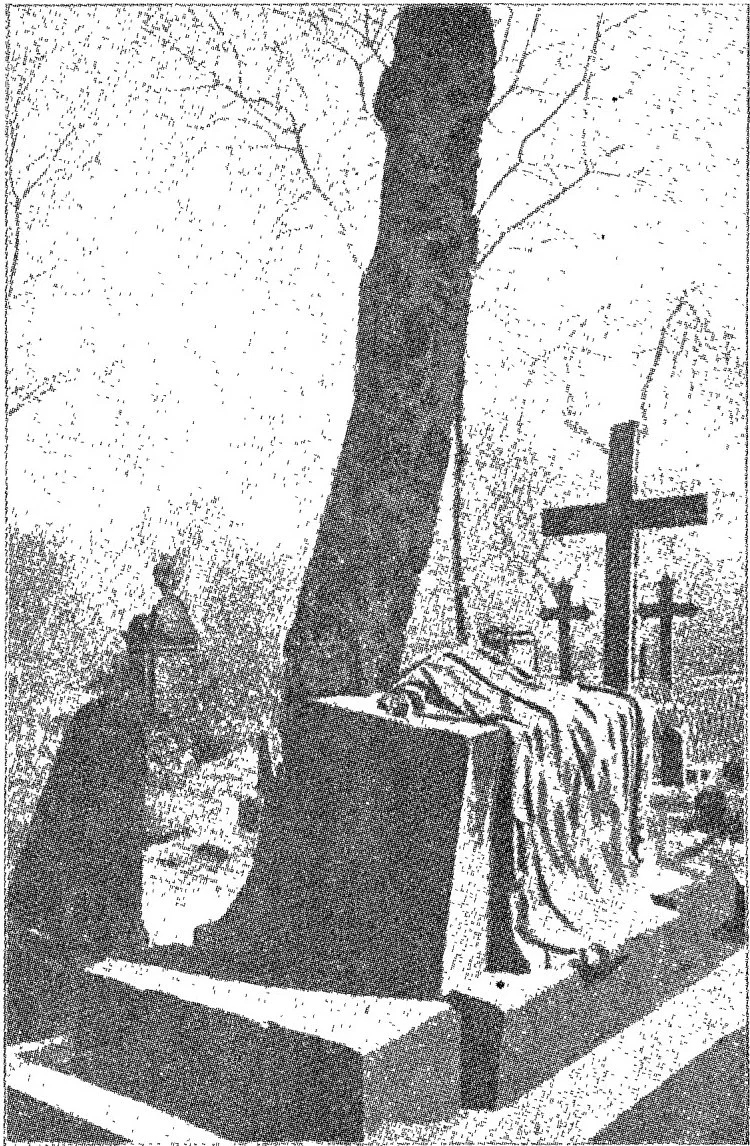
In the city of Hanover, Germany, there is in one of the churchyards a grave which attracts the attention of hundreds of visitors every year. Pictures of it are to be found for sale in nearly every stationer’s shop, and it is known far and wide as “The open grave.” In brief, its history is this:—
More than a hundred years ago a woman was buried there; and the following inscription (whether by her own direction or not, I do not know) was placed on the lowermost stone of the tomb: “This grave, purchased for eternity, must never be opened.”
The grave, as will be seen from the illustration, was covered with heavy stones, the top one being a solid block that doubtless weighs not less than a ton, and all the stones were bound firmly together with iron bands. But no human device can hinder the working of the power of life. Either a seed fell into the grave before it was closed up, or else a shoot from a tree penetrated the grave from beneath, and in obedience to the law of life, proceeded to make its way to the light.
Slowly and imperceptibly, but with irresistible power, it forced its way between the huge stones, and burst every iron band. Now none of the stones are in their original position, although no hand of man has ever presumed to try to move them.
A vigorous birch-tree is now growing from the open grave, which was to remain closed to all eternity. The tree is flattened where it comes in contact with the huge covering stone, so that it fills the entire side of the grave; but immediately above the block it assumes the natural, round shape, and is about fifteen inches in diameter.
There is in the same churchyard another grave that has been opened in the same way by a small locust-tree; but it does not attract the attention that the first one does, since it has no inscription and no iron clamps. Both, however, teach the same thing,—the power of life.
How easily the voice of God sounding from heaven can rend all the tombs! That voice, which at the last day will shake the earth, and open every grave, is the same voice which, in the beginning, said, Let the earth bring forth grass and trees; and although no sound of it is heard, that word is able, as we have seen, to break every bond. That is the power of the resurrection.
But the power of the resurrection of the last day is only the power which Jesus Christ, who is risen from the dead, exerts in every believer. He is near to every soul, with all the power of his resurrection life. “The word is nigh thee, even in thy mouth, and in thy heart: that is, the word of faith, which we preach; that if thou shalt confess with thy mouth the Lord Jesus, and shalt believe in thine heart that God hath raised him from the dead, thou shalt be saved.” Rom. 10: 8, 9.
That word, which at the last will open every grave, and whose power is shown in the bursting of the iron bands that were designed to keep the Hanover grave closed, is able to burst every bond that would hold any soul down to this earth and its groveling life. Jesus still comes, as of old, anointed with the Holy Spirit, “to proclaim liberty to the captives, and the opening of the prison to them that are bound.” Who will listen to him? “Hear, and your soul shall live.”

TITHE-PAYING IN RIGHTEOUSNESS BY FAITH.

G. B. STARR.
(Clayfield, Queensland, Australia.)
When we now pay the tithe into the Lord’s treasury, it becomes a part of the great stream that has been flowing from the earliest ages to the present time. We thus become connected with all the work done to redeem fallen man in all ages, and are thus made workers together with God from the beginning. Whatever is done in faith toward Jesus Christ is connected with everything ever done by Christ or for Christ. Thus the influence of the widow’s mite and the fragrance of Mary’s ointment are as far-reaching as the influence of Christ, and are talked of not only in the remotest part of this world, but also among the angels in other worlds. The angels made the silent record of these acts of love, and they love to talk them over. Anything done for Christ is of the deepest interest to all who love him. And whatever is prompted by faith in Christ and by love for God is an act of righteousness; Christ is its author.
“Now he that ministereth seed to the sower both minister bread for your food, and multiply your seed sown, and increase the fruits of your righteousness.” There is no righteousness but that which is by faith of Jesus Christ, and thus this righteousness connected with giving is the righteousness of Christ. “Thanks be unto God for his unspeakable gift” of Christ, which prompts all other gifts worthy the name. Faith underlies all true giving. Faith believes the promises of God, and acts upon them.
“Give, and it shall be given unto you; good measure, pressed down, and shaken together, and running over, shall men give into your bosom.” Luke 6:38.
“Honor the Lord with thy substance, and with the first-fruit of all thine increase: so shall thy barns be filled with plenty, and thy presses shall burst out with new wine.” Prov. 3:9, 10.
“Bring ye all the tithes into the storehouse, that there may be meat in mine house, and prove me now herewith, saith the Lord of hosts, if I will not open you the windows of heaven, and pour you out a blessing, that there shall not be room enough to receive it. And I will rebuke the devourer for your sakes, and he shall not destroy the fruits of your ground.” Mal. 3:10, 11.
“But this I say, He which soweth sparingly shall reap also sparingly; and he which soweth bountifully shall reap also bountifully. Every man according as he purposeth in his heart, so let him give; not grudgingly, or of necessity: for God loveth a cheerful giver. And God is able to make all grace abound toward you; that ye, always having all sufficiency in all things, may abound to every good work (as it is written, He hath dispersed abroad; he hath given to the poor: his righteousness remaineth forever).”
Faith accepts these promises, and acts upon them. The tithes and offerings are presented to God in faith, with the firm belief that he will do just as he has promised; and he never fails. Thousands who have proved him are ready to witness to the goodness and faithfulness of God. Thus faith is back of all obedience to God.
Unbelief is back of all disobedience. The man who withholds the tithe, and appropriates it to his own use, robs God. “Will a man rob God? Yet ye have robbed me. But ye say, Wherein have we robbed thee? In tithes and offerings. Ye are cursed with a curse: for ye have robbed me, even this whole nation.” The man who withholds the tithe, covets and appropriates a devoted thing, as did Achan. Joshua 6:19; 7:19–21. God had overthrown Jericho, and to him belonged the spoils of war; he definitely claimed them, as he definitely claims the tithe. Covetousness, which leads to the appropriation of God’s tithe, is idolatry. Self is placed before God. Thus the man who withholds the tithe is a commandment breaker on a large scale. Unbelief, commandment-breaking, sin, unrighteousness, selfishness, and idolatry go together; while faith, obedience, righteousness, love, and liberality are companion graces, honoring to God, and the cause of abundant thanksgiving to him.
Reader, may you, with Jacob, decide, “Of all that thou shalt give me I will surely give the tenth unto thee.”

God Is the Only Help in Trouble

THE only help in trouble is God. He is a suitable help in every trouble. He is a present help in every trouble. He is a reliable help in every trouble. He is an efficient help in every trouble. He is a sympathizing help in every trouble.

Chinese Mint Machinery Ruined by Neglect in Transit

THE United States consul-general at Shanghai, China, reporting that China has bought from American manufacturers, machinery for her mints, says: “The machinery for the mint at Chengtu was delivered by the company supplying it free on board at Ichang, the head of navigation of the Yangtse River, where it was taken in charge by the Chinese authorities. Its subsequent treatment was characteristic. The machinery was in boxes, as shipped from the factory. It was left on the bank at Ichang for a month, so close to the water that when a slight flood came, the boxes were under water, and the muddy water deposited sediment until the boxes were full of mud. In this condition they were taken to Chengtu, being about two months on the way. When the boxes were opened, they were found to be caked up solidly with mud, except where the rats had dug holes and made nests while the boxes lay at the arsenal. The machinery finally was got into condition to be put together, but the dies were so badly rusted that they would be condemned in an American mint. The Chinese, however, made no objection to the imperfect places in the coin, apparently thinking them additional safeguards against counterfeiting. Some parts of the machinery were entirely ruined, and others were so badly rusted that they can not last long.”

THE TWO SERVANTS.

Joseph Newton Holmes, D. D.
“Who then is a faithful and wise servant, whom his Lord hath made ruler over his household, to give them meat in due season? Blessed is that servant whom his lord when he cometh shall find so doing.” “Faithful” to his lord and to his daily duty; “wise”—far-seeing, looking for the coming of his lord. He holds everything as in trust for his lord, his master, like a good and faithful steward. We have a picture here of the faithful minister of Christ. He comes to his high office not through self, but by the appointment of his Master. He must regard himself, not as the head, but as the servant, of his flock. He must be obedient and faithful to all the commands of his Master. He must be wise and prudent in all things, that he may win others to the Lord. He must give his family their food in due season,—food that shall afford them nourishment and the means of growth, that from babes in Christ they may grow up to the fulness of the stature of men and women in him. Blessed is he who thus watches and waits for his Lord! Having been faithful to the duties allotted him, he shall be promoted to the highest position as his honorable reward. Having proved himself worthy of trust, still higher trust and honor will be put upon him. For the faithful and wise servant there are always still higher possessions and honor in reserve. Even now, as Paul assures us, each saint owns all God’s possessions.
“But and if that evil servant shall say in his heart, My lord delayeth his coming; and shall begin to smite his fellow servants, and to eat and drink with the drunken; the lord of that servant shall come in a day when he looketh not for him, and in an hour that he is not aware of, and shall cut him asunder, and appoint him his portion with the hypocrites: there shall be weeping and gnashing of teeth.”
We have drawn in these verses a character the opposite of that of the faithful servant. He is evil because he neglects to be faithful; and his negligence grows out of his disbelief in his lord’s coming, or of thinking that he will put off, or defer indefinitely, his coming. He forgets that his lord has named no time, and that his return at any moment is a part of the bargain, against which the servant should be always ready. The uncertainty of time should always be an inspiration to duty. His lord’s delay in coming illustrates his patience and forbearance, yet it is abused by him to indulge his evil propensities and to work all manner of iniquity.
The unfaithful servant is not only guilty of neglecting important interests, but he begins to smite his fellow servants, who are to be understood here as applying to such as are faithful servants to their absent master. He scolds, abuses, and unjustly treats them, and eats and drinks with the drunken. Instead of keeping things in order, and observing a wise economy, he gives way to self-indulgence, all at his master’s expense; he associates with the vilest characters, giving himself up to carousing and drinking,—two besetting sins often found, alas! among those in the higher ranks of social life. Step by step, he progresses from one vice to another, until he becomes a leader in sin and iniquity. He has said in his heart so often, “My lord delayeth his coming,” that he begins at last to believe that he will not come at all, and so will never find out what his servant is doing.
But at last there comes a day of reckoning for the unfaithful servant. Because it has been delayed, he has foolishly imagined that it would not come. He has neglected his master’s interests, used his master’s goods as his own, beat his fellow servants, and squandered his master’s goods in carousal and debauchery. How many such we find in daily life. But in a day and an hour when he looks not, in the midst of fancied security, the master comes. Judgment breaks upon him out of an apparently clear sky.
So it was that Sodom, at the height of its glory, and at the full ripeness of its iniquity, was swept by the fiery winds that made it a desolation. Men will chaffer with one another in controversy over disputed points and difficulties, which a reverent heart will cover with the shield of faith; they will go on indulging their selfish appetites and desires, and demanding, “Where is the promise of His coming?” till suddenly the great trumpet sounds, and the Judgment is upon them. But however much the Master may delay his coming, be assured that he will come. Blessed, then, will they be whose faithful watching finds them in readiness for him.
“Thou art coming, O my Saviour! Thou art coming, O my King! In thy beauty all resplendent, In thy glory all transcendent; Well may we rejoice and sing! Thou art coming, thou art coming! We shall meet thee on thy way, We shall see thee, we shall know thee, We shall bless thee, we shall show thee All our hearts could ever say.”

“NOT THAT,” “BUT THAT.”

T. E. BOWEN.
(Newburg, W. Va.)
Not that our way shall be made into God’s way, but that his way shall become our way.
Not that we shall dictate to the scepter upon the throne, but that the scepter shall dictate to us the way the great King would have us go.
Not that we shall come into the King’s presence in the spirit of Haman, filled with self-exaltation and pride; but that we shall humbly examine our motives, as did the queen, by fasting and prayer, that with firm trust we may enter his courts.
Not that we shall obtain our requests because of our finely framed and beautifully spoken prayers; but that the soul shall utter its cries as did Hannah of old within the courts, and the publican who smote upon his sinful breast.
Not that we shall be saved by doing some great thing for the Lord; but that the love of God shall so dwell within the soul that we shall do nothing but great things.
Not that we shall be called great among men, but that among men we shall be called great by God.
Not because we are by nature better than other men, will Christ choose us out of the world when he comes; but because we, being even as bad as the worst, take his life for what it is, and leave ours behind for what it is not.

GOD'S KINDNESS TO US.

ALEXANDER RITCHIE.
(Winnipeg, Manitoba.)
We were dead. “But God, who is rich in mercy, for his great love wherewith he loved us, . . . hath quickened us together with Christ, . . . hath raised us up together, and made us sit together in heavenly places in Christ Jesus.”

JUST WHAT HE DID FOR LAZARUS.

He quickened him. “Lazarus, come forth.” John 11: 43.
He raised him. “He that was dead came forth.” Verse 44.
He made him sit with him. “Lazarus was one of them that sat at the table with him.” John 12: 2.
Jesus did this to show the glory of God. “Said I not unto thee, that, if thou wouldest believe, thou shouldest see the glory of God?” The glory of God is his goodness. See Ex. 33: 18, 19.
  • Goodness is grace, favor, kindness. And God hath quickened, raised, “and made us sit together in heavenly places in Christ Jesus: that in the ages to come he might show the exceeding riches of his grace in his kindness toward us through Christ Jesus.” Eph. 2: 6, 7. “For by GRACE are ye saved through faith; and that not of yourselves: it is the gift of God: not of works, lest any man should boast.”
How much did Lazarus do toward regaining his life?—He never moved a muscle. Then how much did he have to boast of?—Not an atom. And that is just how much you and I can do toward our salvation from death, and that is just how much we have to boast of.
O brother! forever look away from yourself to Him whose glory is his goodness, and who has raised you from the dead, that you “should be to the praise of his glory.”

Humanity's Need of God's Goodness and Grace

We, in our emptiness, ignorance, guilt, and corruption, have need of the Lord in his goodness, mercy, truth, and grace; and he has need of us for the exercise and communication of these to our necessities.
Continue reading: DORA'S GIFT