HELP FOR THOSE LABORING AMONG THE COLORED PEOPLE IN THE SOUTH.
By George A. Irwin
OUR hearts are touched with the constant appeals that come to us for help, from those who are engaged in work among the colored people in the South. We are personally acquainted with nearly all of these workers, and have visited the localities where they are working; hence we speak from personal knowledge when we say that these appeals are not overdrawn, but in most cases are only a mild presentation of the great need that exists. The hands of these godly, consecrated workers are, to a great degree, tied for the want of a little money at the right time to assist those in distress, and also to purchase a few necessary supplies, in order the better to teach these people not only how to read and write, but also how to labor and become self-supporting.
Small schools have been established in different localities, and in every instance the Lord has blessed the efforts put forth; but much more might have been accomplished in each place had even a few dollars been put into the hands of those in charge, which they could have freely used in their work. I know of no class of workers who are more devoted and self-sacrificing than those engaged in this work. They are content to live in humble quarters, wear plain clothing, and subsist upon the simplest food, that they may have something left from their small allowance to help others, and carry forward the work.
I know, personally, of cases where these workers have engaged in other occupations for a time to earn money to enable them again to take up the work that lay nearest their hearts. A brother who spent a year in South Carolina canvassing for our books as a means of support while becoming acquainted with the people and their customs, was called away on account of the sickness and death of his father. He and his wife now desire to return to the same community, purchase a tract of land, and open a school where those attending can receive instruction in agricultural work. He is a practical farmer, as well as a teacher and nurse. He has two or three hundred dollars that he is willing to invest in the enterprise; but he will need some help to purchase a team and an outfit, and enough supplies to tide the work over until something can be raised with which to support it.718
In another place, where we have ten acres of land, and a dwelling and schoolhouse built, and a school in operation, help is called for to purchase a horse and cart, and a few other necessary things, to break up and cultivate the land. In another place, help is needed to pay for a meeting-house and schoolhouse combined. Thus it goes. Lack of space forbids the mention of many other equally worthy calls.
The reader may say, Why does not the General Conference furnish this money? I answer, Because it does not have it to give. How can the General Conference get money? We can not manufacture it. All the money the General Conference has at its disposal is what comes in from the tithe and contributions. The former, we have been told, must be sacredly guarded, to be used only in paying those who labor in word and doctrine; and the latter is just what we are now asking for.
This is why this appeal is made,—that a fund may be created by personal gifts, or free-will offerings, to be placed at the disposal of the superintendent of the Southern District and the committee associated with him, to be disbursed as they, from their close, personal knowledge of the work, deem best. One company or point alone should not receive all, nor even a large share, of our support, and thus be built up disproportionately; but many points should receive help, and thus widen our influence and work, and thereby bless a much larger number.
This can best be done by counsel and co-operation with those who have charge of the work in the Southern field, and have made it their business to acquaint themselves with its needs. The Lord would have order and system in his work, not to bind about nor hinder, but that there may be counsel with those who have been placed in charge of the work by the General Conference, to see that all parts pull in even lines, and that some particular part is not built up disproportionately, through the personal ambition of some individual or company of workers.
To make it plain that this appeal is in harmony with the Lord’s mind, I would call special attention to what he has said in the quotations that follow:—
“Those who work this [Southern] field must practise self-denial, and facilities must be provided wherewith they can work this field. . . . Missionaries must not be sent to this field without the facilities to carry forward this work. Means is required. . . . We are not only to pity the Southern people, but we are to help them as they need help. There is a field in America, nigh, and not afar off. . . . I know it is impossible to remain in the field where you are, barehanded. God does not require this of any worker in the Southern States. All who engage in labor must have something wherewith they shall help the suffering ones at the right time. . . . We must strip ourselves of all extravagances, deny ourselves luxuries, and undue gratification of appetite. Let those who have not laid aside unnecessary articles of diet, do so. Let them refrain from adornments and costly furnishings. Let us set ourselves to do work for the Southern people. Let us not be content with simply looking on, with simply making resolutions that are never acted upon; but let us do something heartily unto the Lord to alleviate the distress of our colored brethren. The burden of poverty is sufficiently weighty to arouse our heartfelt sympathy. We are not simply to say, ‘Be ye warmed, and go ye fed,’ but we are actually to relieve the needs of the poor. . . . Who will go on in indifference, and pay no attention to the woes of those who are in hunger, in nakedness, in ignorance and degradation? . . . When the hearts of God’s professed people are animated by the principle of the living faith that works by love and purifies the soul, there will be a response to these appeals. . . . Let those in responsible positions give their sympathy to such workers, and furnish them with facilities whereby they may do the work required.”
Our sympathies are certainly with these workers, and we would gladly furnish them with facilities; but we are powerless, only so far as our personal contribution may go, and that is necessarily limited by the numerous other calls that should receive their share of what we have to give. The Review and Herald Publishing Company has agreed to give, through its Atlanta branch, two hundred and fifty dollars in books, tracts, and periodicals, that can be used to good advantage in this work.
To start a cash fund, I will give fifty dollars,—not that this should be the maximum of individual contributions, by any means, but because it is all I can afford at this time. I trust that the Lord will put it into the hearts of those who have money to give several times this amount, and that all will respond in proportion to their ability.
Our opportunities to give will soon be over. The work is fast closing up, and we are each being tested on the point of benevolence.
“When the Son of man shall come in his glory, and all the holy angels with him, then shall he sit upon the throne of his glory: and before him shall be gathered all nations: and he shall separate them one from another, as a shepherd divideth his sheep from the goats: and he shall set the sheep on his right hand, but the goats on the left. Then shall the King say unto them on his right hand, Come, ye blessed of my Father, inherit the kingdom prepared for you from the foundation of the world: for I was an hungered, and ye gave me meat: I was thirsty, and ye gave me drink: I was a stranger, and ye took me in: naked, and ye clothed me: I was sick, and ye visited me: I was in prison, and ye came unto me. Then shall the righteous answer him, saying, Lord, when saw we thee an hungered, and fed thee? or thirsty, and gave thee drink? When saw we thee a stranger, and took thee in? or naked, and clothed thee? or when saw we thee sick, or in prison, and came unto thee? And the King shall answer and say unto them, Verily I say unto you, Inasmuch as ye have done it unto one of the least of these my brethren, ye have done it unto me.”
God grant that in these days of proving, we may so act our part that in the great gathering day, when the King shall claim his own, the welcome, “Come, ye blessed of my Father, inherit the kingdom prepared for you,” may be spoken to each of us.
All offerings for the Southern field should be sent to I. A. Ford, 243 South Boulevard, Atlanta, Ga., the receipt of which will be acknowledged through the Southern Review, and also through the REVIEW AND HERALD.
GEO. A. IRWIN.
THE MELBOURNE MISSION.
By W. E. C.
When the Lord sets his hand to a work on the earth, it goes; and more, its confines are marked only by the extent of human need, and that is wherever men and women exist. The Saviour’s commission was, “Go ye into all the world, and preach the gospel,”—not to a favored few, but to all, and especially to the “poor,” the “broken-hearted,” the “captives,” the “blind,” and the “bruised.”
We have had committed to us a solemn message for the world, fraught with eternal consequences. That message has twice encircled the globe, both above and below the equator; and now there is hardly a country or an island where it has not been proclaimed.
In the parable of the supper,—the last meal of the day,—after the first general invitations were given, the man of the house commanded his servant to “go out quickly into the streets and lanes of the city, and bring in hither the poor, and the maimed, and the halt, and the blind;” and it was done. So if the message that this people are giving is of the Lord, we are now in the time when we may look for a special work among those in the streets and lanes of the city. That work is now being done.
Within the last two years, almost as if by magic, missions have been opened in scores of cities in the United States and in foreign countries, especially to reach the poor and outcast; gospel wagons, from which the truth is preached on the street corners, are multiplying; evangelists especially fitted for this work are rapidly coming among us, from other denominations; and wealthy men, who were wholly unknown to us, are almost daily contributing to sustain the movement. And it is not alone in one church or one community, nor even in one Conference, or one country, that this work is being done; but it is everywhere, in foreign lands as well as in our own.
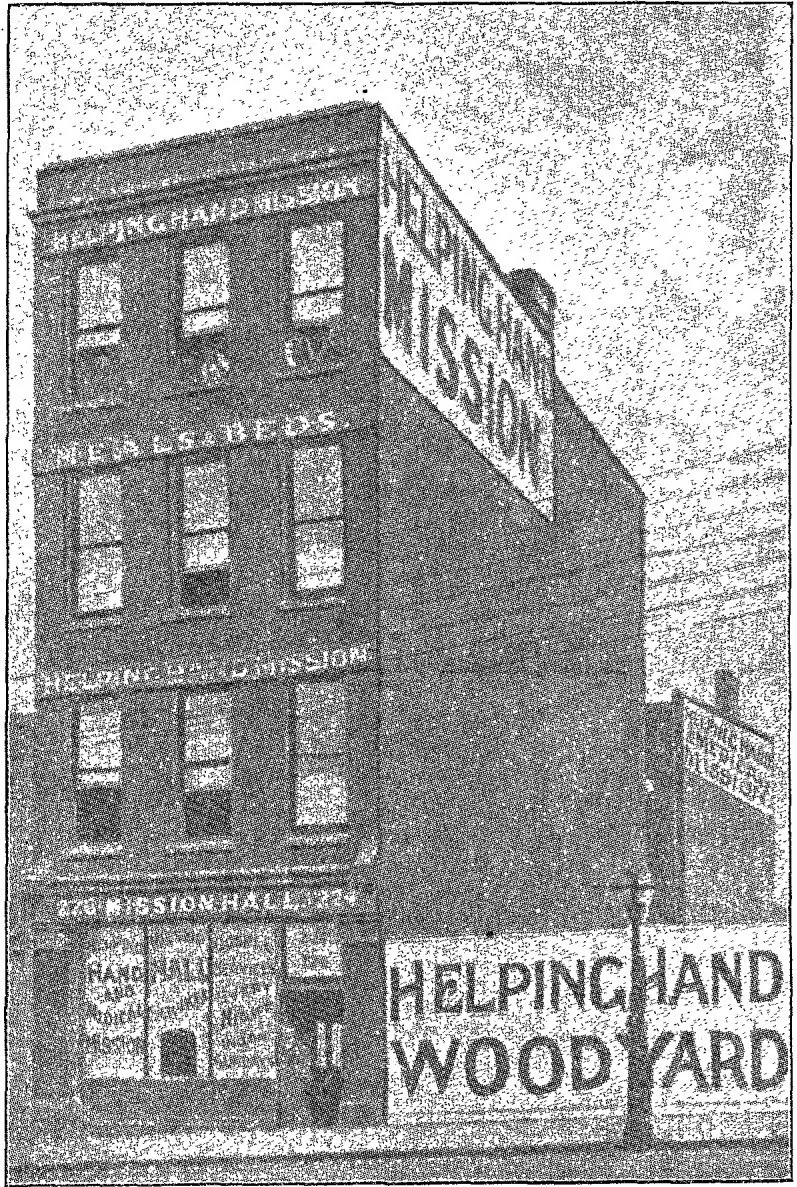
We present on this page an illustration of the Helping Hand and Medical Mission lately opened in Melbourne, Australia; and from the Bible Echo of September 26, which number is devoted entirely to mission work, we gather a few facts concerning this particular mission that may be of interest to our readers. The buildings shown in the picture are connected by a “right of way,” or iron bridge. Together, they would make a structure twenty feet wide, one hundred and twenty feet deep, and four stories high. On the ground floor of the main building is an office at which meal- and bath-tickets can be procured. The chapel, tastily decorated with paintings and mottos, where services are held each night and on Sundays, is also on this floor. The second floor is divided into a reading-room, a lunch-counter apartment, and a kitchen. The two upper floors are used as dormitories, and are supplied with about fifty bedsteads, each one being furnished with a uniform outfit of bedding.
THE MELBOURNE MISSION.
Before any one is allowed to occupy a bed, he is taken to the bath-room, thoroughly scrubbed by an attendant, and then furnished with clean pajamas, a loose garment covering the whole body, for the night. His clothes are thoroughly fumigated, to destroy germs and vermin, and then placed in a bag and given to an attendant, who returns them to their owner in the morning.
The bath-rooms are on the top floor of the rear building. On the same floor there are also dressing-rooms; wash-tubs, where men may wash their clothes, and a place to dry them quickly; and the doctor’s consulting- and treatment-room. A wood-yard has been opened in connection with the mission, to provide work for men who are willing to earn the accommodation afforded them. The other floors of the rear building will be used to carry on such industries as can be made to pay expenses.
The mission was dedicated September 12, and the occasion was a memorable one. Leading men of the city were present to participate in the exercises, and with one accord they bade the enterprise Godspeed.
The work in Australia starts out with good prospects. The managers of the mission will doubtless encounter obstacles, but what of that, when behind the movement are the united prayers and effort of a people in whom is the real spirit of the message for this time? May the Lord bless the Melbourne Helping Hand and Medical Mission. W. E. C.
HOME, CHURCH, AND CONFERENCE SCHOOLS.
By Wm. Covert
WM. COVERT.
(Concluded.)
Passing from the family dwelling in a single household, the subject expands, and embraces a community of families organized into a church. All the children and youth belonging to these families should be trained for the Lord, and hence the need of church schools.
Jehoshaphat, king of Judah, is commended because he had church schools conducted in all the congregations in the province where he ruled. “In the third year of his reign he sent to his princes, even to Ben-hail, and to Obadiah, and to Zechariah, and to Nethaneel, and to Michaiah, to teach in the cities of Judah. And with them he sent Levites, even Shemaiah, and Nethaniah, and Zebadiah, and Asahel, and Shemiramoth, and Jehonathan, and Adonijah, and Tobijah, and Tob-adonijah, Levites; and with them Elishama and Jehoram, priests. And they taught in Judah, and had the book of the law of the Lord with them, and went about throughout all the cities of Judah, and taught the people.” 2 Chron. 17:7–9. The good result which followed this work is told in these words: “And the fear of the Lord fell upon all the kingdoms of the lands that were round about Judah, so that they made no war against Jehoshaphat.”
In this account it is seen that five princes were appointed to teach in the principal cities, and nine Levites and two priests took charge of the work of education in other parts of the realm. These were to make effective the school system in all the realm; and when this was done, the Lord had possession of the country, and the enemy made no war against the people.
“There should be schools established wherever there is a church or company of believers. Teachers should be employed to educate the children of Sabbath-keepers. . . . In the light that has been given me, I have been pointed to the churches that are scattered in different localities, and have been shown that the strength of these churches depends upon their growth in usefulness and efficiency. . . . In all our churches there should be schools, and teachers in these schools who are missionaries. . . . Let us in our educational work embrace far more than we have done of the children and youth, and there will be a whole army of missionaries raised up to work for God. I say again, Establish schools for the children where there are churches,—those who assemble to worship God. Where there are churches, let there be schools. Work as if you were working for your life to save children from being drowned in the polluting influences of this life. . . . Let the church carry a burden for the lambs of the flock in its locality, and see how many can be educated and trained to do service for God.”
These extracts are sufficient to show that the Lord requires his people to establish schools wherever there are churches or companies of believers. It would be well to establish schools as early as other parts of the work are organized.
BUILDINGS NECESSARY.
“If the people would encourage the church in which they are members to establish small, humble school buildings, in which to do service for God, they would accommodate their own children within their own borders.”
Let these be primary. “We should have primary schools in different localities to prepare our youth for our higher schools.”
From these quotations it is evident that those in charge of our church schools should not encourage719the boarding of small children away from home, that they may attend these schools. The necessity of the co-operation of the parents with the teachers is emphasized over and over again. Both the home and the church school are helpers in the home training, and nothing should be done that will tend to call the child away from the home influences, provided those influences are good. This point should be strongly emphasized.
CONFERENCE SCHOOLS.
Beyond the schools established for single churches, the Testimonies speak of a union of interests for schools on a more extended scale: “Wherever there are a few Sabbath-schools, let the parents unite together in providing a place for a day-school where the children of the various Sabbath-schools can come together. Let them employ a Christian teacher, who is a consecrated missionary, who will educate the children in such a way as to lead them to become missionaries themselves.”
“I can not go contrary to the will of God, and say, Erect more buildings in Battle Creek; but I would say, Build in other localities. There should be fewer interests centered in Battle Creek, and far more in other places, where there is nothing to give character to the work of God.”
LOCATION OF SCHOOLS.
“No pains should be spared to select places for our schools where the moral atmosphere will be as healthful as possible; for the influences that prevail will leave a deep impression on young and forming characters. For this reason a retired locality is best. The great cities, the centers of business and learning, may seem to present some advantages; but these advantages are outweighed by other considerations.”
“Never can the proper education be given to the youth in this country, or in any other country, unless they are separated a wide distance from the cities. The customs and the practises in the cities unfit the minds of the youth for the entrance of the truth.”
“Send the children to schools located in the city, where every phase of temptation is waiting to attract and demoralize them, and the work of character-building is tenfold harder for both parents and children.”
EXTENSIVE LANDS.
“In connection with our schools, there should be, as far as possible, large flower gardens, and extensive lands for cultivation.”
“This education in felling trees, tilling the soil, erecting buildings, as well as in literature, is the education our youth should each seek to obtain. Further on, a printing-press should be connected with our school, in order to educate in this line. Tent-making should be learned. There are also many things which the lady students may be engaged in. There is cooking, dressmaking, and gardening to be done. Strawberries should be planted, plants and flowers cultivated. This the lady students may be called out-of-doors to do. Thus they may be educated to useful labor. Bookbinding also, and a variety of trades, should be taken up. This will not only be putting into exercise brain, bone, and muscle, but will also be gaining knowledge. The greatest curse in this our day is idleness. It leads to amusement merely to please and gratify self. The students have had a superabundance of this way of passing their time; they are now to have a different education, that they may be prepared to go forth from the school with an all-round education.”
An all-round education prepares for usefulness in any essential and proper calling in life. This proposition sets forth a more complete work than has yet been attained in our schools.
God is able to bring us to that efficiency which he says we should reach; and to accomplish this we shall still go forward. May there be no more backward steps taken, by any in this cause.
NOVA SCOTIA.
By G. E. Langdon; L. D. Longard
PARESBORO.—It is eleven weeks since we began tent-meetings in this place. We stored our tent, September 14. Since then we have held five meetings each week in the opera-house, with a good attendance. Sixty-six discourses and thirty-two Bible readings have been given, over two hundred visits made, two hundred periodicals distributed, and eighty-five dollars’ worth of books and tracts sold. We have received $44.17 in contributions.
Brother John Dickie, one of our canvassers, canvassed the surrounding country, and delivered one hundred and seventy-five copies of our subscription books. This place, with the country around, was canvassed a few years ago for “Great Controversy” and “Bible Readings,” and a large number of these books were sold. We found two men who are keeping the Sabbath as the result of reading these books, and others are thoroughly convinced of the truth of the message for this time.
The Sabbath question is now being discussed. Fifteen adults have begun to keep the Lord’s holy day, and others are under conviction. The ministers are becoming much stirred up over the light that is shining forth from God’s word, and are very active in working against the truth, from the pulpit, through the press, and from house to house. We pray that God will continue to send angels to those who are seeking for the truth as it is in Jesus, and will break the power of darkness with which Satan would bind their minds. Brother F. W. Morse, who has been laboring with us for about nine weeks, has now gone to hold meetings in King’s County, New Brunswick.
We have many warm friends who minister to our temporal necessities.
G. E. LANGDON,
L. D. LONGARD.
THE CAMP-MEETINGS.
By S. M. I. Henry
The visit to Nebraska was of peculiar interest to me, because of the fact that I had spent the two years from November, 1884, to October, 1886, inclusive, in traveling over the State in my W. C. T. U. evangelistic work, during which time many things occurred that now have a new and peculiar significance to me. I had spent some time in York in 1886, in evangelistic work, and could not but feel the influence of the memories of those days through all this meeting.
I was met at the train by the president of the local W. C. T. Union, and the treasurer of the State union, who took me to the camp-ground. I was invited to participate in the special memorial services on Miss Willard’s birthday, the 28th of September, at which time I made the address, and was most cordially greeted by the women.
I was also met at the train by two sisters from Red Cloud, who had been members of the union at that place when I held evangelistic meetings there in the spring, and also in the winter, of 1885. They were in attendance upon the camp-meeting, and greeted me, as they expressed it, as “sisters in the faith of Jesus,” which statement, while it attracted no especial attention from the other W. C. T. U. sisters who were standing by, expressed volumes to me, as it indicated that they had also become believers in present truth.
I also met at this meeting a brother, now a brother in this precious faith, who had been in attendance upon the meetings which I held at Bloomington, Neb., in January, 1885, at which place, later on, I came in contact for the first time with Seventh-day Adventists,—these same Seventh-day Adventists being Brethren L. A. Hoopes and O. A. Johnson, although we did not meet personally. If we had, much in my life might have been different.
We went from York to College View, where we were entertained at the sanitarium. When I first thought of going to Nebraska, I found my mind drawn out toward the school at College View, and I formed the purpose of stopping there, if only for one day. While at Omaha, I received an invitation to come and spend some time at the sanitarium; this confirmed my determination, and from this time I had a growing sense of burden for the work there. All through the camp-meeting at York this was the case. When at last I was on the college grounds, and ready to begin, I found myself under a heavy pressure, which I could not understand. The first service was in the church on Monday night; and I must acknowledge that never in all the history of my work, was I so conscious of spiritual darkness everywhere as that night. I seemed to be caught in a tunnel, from which there was no escape, and under the heavy pressure of a stagnant atmosphere. I do not remember ever speaking12under circumstances so trying. I could not understand it. The house was full, and I could not but believe that I was among friends; yet I could get nowhere near them. I had the conviction that I must give them the same message that I had been giving at the camp-meetings concerning the Holy Spirit in its practical work in the home and personal living, and with a special application to the young people in the college.
Tuesday morning I met the students at their chapel exercises for a forty-minutes’ service. I realized more freedom in this meeting, but still the same pressure was manifest. Expressing myself concerning this to Professors Johnson and Bland, and saying that I wished I could meet the members of the church, it was decided to give me the opportunity to do so by calling a meeting at three o’clock. We came together at that time; and I told the brethren and sisters how the sense that I was in a stagnant atmosphere had taken possession of me. I did the best I could to lay at least a part of my burden off on them. The Spirit of the Lord witnessed to this effort, and together we sought the Lord most earnestly, and waited.
The next morning I was obliged to go to Arcadia, to keep a promise that I had made to meet the brethren there in their camp-meeting. The brethren at Arcadia had been hindered in preparations for the meeting by the failure of the railroad company to deliver the tents on time, and therefore were not ready. I was entertained in the village, and held a meeting that night in the Methodist church. The next morning I went out to the camp-ground, where I had the privilege of waiting about in the sun, the weather being so cool as to make the sun-heat very agreeable, and enjoying a day of rest such as I had not known before in years, with nothing whatever to do all day except to watch the pitching of the camp, and converse with any who had a little leisure. I shall never forget that day. It was just what I needed after the long series of journeys and meetings.
In the evening we had our first meeting, and the Lord was with us. Early the next morning we had a most precious time together, after which I was taken in a carriage to the train for Lincoln.
On Sabbath evening we met again in the church at College View. A few of us had agreed to spend the day in fasting and prayer, and there was a little increase of life and light in the atmosphere of the Sabbath-evening service; but we all came to the Sabbath morning with heavy hearts. I met the students in their chapel at a quarter to nine, continuing the study on the Holy Spirit. We had a good meeting; it was a comfortable hour. At 11:15 we met in the church for the morning service. As the congregation came in, I could not but notice a change in the atmosphere that came with them. Light was breaking. Prayer breathed everywhere; and as the service progressed, we had the same kind of outpouring of the Holy Spirit that has marked so many of the Sabbath mornings on the camp-grounds. From that time until the close, the work went on from victory to victory. The sermon on Sabbath morning was followed by a consecration service of unusual power, in which the greater part of the audience united.
In the afternoon the quarterly-meeting services were held. This was to me a very precious occasion, it being the first time that I had had the privilege of participating in such a service since the day that I was baptized, when I was still too ignorant to appreciate it.
I have never known a deeper solemnity to settle over an audience than was manifested in the meeting that night after the Sabbath. It was oppressive. I was told that both morning and night, the audience passed out in almost absolute silence, which is very unusual.
On Monday morning I again met the students in their chapel at 9:20, and also met the helpers at the sanitarium at 11:30. These two meetings were devoted to considering social questions for the benefit of the young people. In fact, nearly all the services, except on Sabbath morning, were mostly for the young people. I was made to realize, especially on Monday morning, that the students had appreciated this effort in their behalf; and that they had accepted the message I had brought to them, and were disposed to profit by it.
I turn my face eastward with the consciousness that I have discharged the obligation that rested upon me, and that I have the approval of God, and that he will take care of the work I have tried to do in his name. I wonder now, as I look back, that I ever could have started out on such a mission. It must have been by the direct leading of the Spirit of God, or I could not have done it. I have been conscious of this leading every day, and that I have been hidden in him. The summer has been full of blessed experiences, which I would not have missed for anything in the world.
I wish in this letter to send greeting to all those with whom I have worshiped in this camp-meeting tour, and to ask once more that you will remember me personally in the work that I have still before me this autumn.
I would like to say, to the glory and praise of God, that my physical strength has stood the test remarkably. I am in no sense exhausted, nor even worn. I feel as vigorous as I did when I first started out, although I have traveled many hundreds of miles, and have worked almost incessantly, not only in public, but also in private, with my pen as well as with my voice and in personal interviews.
MRS. S. M. I. HENRY.
AMONG THE CHURCHES IN NORWAY.
By L. Johnson
Since my last report I have visited our brethren along the coast up to Trondhjem; and in returning to Christiania by rail, I also stopped at Hamar, where we celebrated the ordinances of the Lord’s house. It is with gratitude to God that I am able to report that he is working everywhere by his Spirit; so that while some who know the present truth are careless, we have many evidences of his faithfulness in drawing to himself all who will let him draw them. In many places the brethren testified to the mercy of God in making the truth so beautiful and attractive to them when they first heard it; and they said they saw so plainly his hand in leading them to become acquainted with this people. I also found that in dwelling upon this, hearts were made tender, and filled with gratitude, which made me think of the words: “Bless the Lord, O my soul, and forget not all his benefits.” Ps. 103:2.
The work is onward at Hamar and vicinity. About thirty brethren and sisters assembled on the Sabbath, and all took part in praising the Lord for salvation through Christ. Brother N. P. Nelson is laboring there, and the Lord is opening the way before him. He finds some here and there with whom the Spirit of the Lord is at work, and to whom he gives repentance and forgiveness of sins.
Here at Christiania we have also experienced the blessing of God. Last Sabbath we celebrated the ordinances, and the Spirit of God made it a good place to be. The Sunday meetings are well attended. We have lately started health and philanthropic work here, and have already had encouraging experiences. We have three trained nurses, who work both for those who are able to pay and for those who are not. We have rented some rooms in the best part of the city, where the nurses live, and give massage and electric and water-treatment. We intend soon to begin in the poorest district of the city also. May the Lord lead and bless his children in their efforts to do good. L. JOHNSON.
Christiania, October 6.
DISTRICT 6.
By A. J. Breed
After the camp-meeting in Utah, I came to Montana; and in company with Elder Martin, visited Butte, Helena, Great Falls, Missoula, Stevensville, Bozeman, and Livingston. The brethren at Darby met us at a schoolhouse near Hamilton. As I met the brethren at these places, I was pleased with the interest manifested. The general meeting was held at Helena, September 29 to October 9. It being somewhat cool at the time, no tents were pitched. Rooms were secured for those who wished them, so all were made comfortable. The meetings were held in our chapel at the corner of Pine and Warren streets.
A larger number were present than at any other meeting of our people ever held in the State. The mission field was organized into a Conference, with twelve churches, and a membership of three hundred and twenty-five. It has been several years since the work was started here; and while it has met some discouraging influences, it has gone steadily forward until it has become self-sustaining. It took some time to transact all the business of the mission field, and to perfect the organization; but in all the deliberations a gentle, tender spirit was present.
The Conference was organized with four ordained ministers, three licentiates, and three Bible workers. It had been recommended that Elder W. B. White make Montana his field of labor, and he was elected president of the Conference. Elders C. N. Martin and W. J. Stone were associated with him on the executive committee. The State is large, and railroad rates are high, so it was thought best to place only three members on the Conference Committee.721
The prospect is good for an increase in the finances of this new Conference; but it was thought best to move carefully, and not incur any more expense than would be met by the tithe paid last year. The spiritual interests of the meeting were carefully looked after, and a spirit of freedom and confidence came in, and many claimed the victory. The last Sabbath was a day long to be remembered by the brethren present. Many sought the Lord earnestly for his Holy Spirit; at the close of the meeting in the forenoon, we prayed that God would fill us with his Spirit, and he fulfilled his word. Before prayer was offered, opportunity was given for all who were not ready to pray, to take time to call aside those with whom they wished to speak. Parents sought their children, others went to brethren; and wrongs of long standing were made right. Still others sought the Lord for help to attend to things when they returned home. About an hour was spent in this way, after which prayer was offered, and God’s Holy Spirit came into the meeting with power. In the afternoon Elder Harrison Grant, many years president of the Minnesota Conference, spent an hour telling the brethren of the spirit that was in the first message in 1844. He said the work that they did was the same that was done before the tenth day of the seventh month, when they expected the Lord to come. Then followed a social meeting of which the brethren said that it seemed as solemn as the thought of the day of judgment.
The brethren returned home filled with courage. We expect to see the work rise, and extend its influence into many cities, towns, and homes in this great State. This closes the general meetings for the season in District 6; and as we look back, and see what has been done, we can only say, The Lord has been among his people. The spirit of labor is one of the best evidences of light. Conference committees are planning for the work on a much broader basis than ever. Brethren, we have reached the time for which we have been looking so long; now let us do the work the Lord has for us to do, and hasten the day of his coming. A. J. BREED.
Mission Work in Port Antonio, Jamaica
By George F. Enoch; Bertha G. Enoch
Jamaica.
PORT ANTONIO.—We arrived at Port Antonio, July 4, after a pleasant trip from our home in the North Pacific Conference. We found meetings already in progress, which had been begun by Elders Haysmer and Hall. As these workers were both called to other parts of the field, the work here was placed under our care. I wish our brethren in America could see the situation as we have found it. The word of the Lord that what might have been done in times of prosperity would have to be done under most discouraging circumstances, has been fulfilled here. Two years ago, while passing through this place, Elder Haysmer held a few meetings, and the people were anxious to hear; but for lack of laborers the place could not then be entered. Now, when the tabernacle was set up, it was almost impossible to get any one to come out to hear. With very small congregations the work was begun.
As the people would not come out to hear the message, we decided to carry it to their doors. Accordingly, a native Bible worker was provided, and we began a canvass of the place on the envelope plan. We also ordered a club of the Signs to sell from house to house. Since beginning the work in this place, our native boys have sold several hundred of our smaller books. Since September 9, about eight thousand pages of tracts have been lent, and two thousand pages sold. We can only sow the seed, and must leave results with the Lord. Opposition to the work has already developed. One church here has organized a society for the promotion of Bible study, sending Bible workers from house to house.
October 5 nine persons were buried with their Saviour in baptism. Our Sabbath-school numbers nineteen members.