BECAUSE of His foreknowledge, Jehovah can not be surprised by any event, nor can His eternal purpose be thwarted by any calamity that may befall, for He is infinite in resources, limitless in power. Therefore He will eventually bring victory out of every untoward event, and glorious triumph out of every calamity which may seem for the time being to defeat His plans.
When strange, mysterious rebellion entered the universe, and dire calamity befell our human family, the resources of Divinity were more than equal to the emergency. But to meet the crisis, redeem man's failure, neutralize sin, crush the rebellion, and, as it were, readjust the universe to principles of righteousness, required the revelation, the expression, of unfathomable love by supreme sacrifice. The plan of salvation must, of necessity, be laid in infinite sacrifice.
Inherent in divine nature is the great law of sacrifice,—latent when the condition of none of God's creatures necessitates its being brought into action, but ready for instant expression, active, operative, when the needs of any of His creatures demand its exercise.
The law of sacrifice is in reality but an outward expression, in action—an object-lesson—of divine love. When sin had entered, and man had fallen, and as a result stood face to face with eternal ruin, the demand came for the expression of divine love in infinite sacrifice.
None Other than the Creator Could Redeem
The central figure in the expression of divine love by the law of sacrifice, for the salvation of our human family, was "the Lamb of God," "slain from the foundation of the world." Rev. 13: 8. Not that Christ actually shed His blood at the foundation of the world; but when the woman and the man whom He had created in His own image had sinned, in the act of committing the first sin they virtually slew their Creator. Jesus Christ was the Creator of mankind (John 1: 1-3; Eph. 3: 9; Col. 1: 14-17), and it devolved upon Him to pay with His own life the death penalty of the beings whom He had brought into existence, or else leave them to eternal ruin. "The broken law of God demanded the life of the sinner. In all the universe there was but One who could, in behalf of man, satisfy its claims. . . . None but Christ could redeem fallen man from the curse of the law, and bring Him again into harmony with Heaven."—"Patriarchs and Prophets."
Love the Compelling Power
There was one thing that compelled the Son of God, the Creator, to pay the purchase price necessary to redeem the man—the race. This was not a physical power from without, but rather the inherent, overflowing divine love in His very nature. It was the very essence of His nature, as well as His choice, to redeem man.
Doubtless the greatest possible expression and revelation of divine love was the condescension of Jesus to become man, and then—the cross of Calvary. The death penalty demanded by sin could not be visited upon Him until He put human nature on.
"But 'God so loved the world, that He gave His only-begotten Son, that whosoever believeth in Him should not perish, but have everlasting life.' O, the mystery of redemption! the love of God for a world that did not love Him! Who can know the depths of that love which 'passeth knowledge'? Through endless ages, immortal minds, seeking to comprehend the mystery of that incomprehensible love, will wonder and adore."—"Patriarchs and Prophets."
The Sacrificial System a Means of Expressing Faith
"Before the foundations of the earth were laid, the Father and the Son had united in a covenant to redeem man if he should be overcome by Satan. They had clasped Their hands in a solemn pledge that Christ should become the surety for the human race."—"Desire of Ages."
When Christ had thus pledged Himself to become the surety for man's redemption, "then joy, inexpressible joy, filled heaven. The glory and blessedness of a world redeemed, outmeasured the anguish and sacrifice of the Prince of Life. Through the celestial courts echoed the first strains of that song which was to ring out above the hills of Bethlehem,—'Glory to God in the highest, and on earth peace, good will toward men.'"
To keep alive in the breast of humanity the flame of hope that "the Seed of the woman" would come in due time and bruise the serpent's head, Infinite Wisdom instituted a daily object-lesson of the great law of divine sacrifice. The keeping of this institution, the observing of the object-lesson system in the offering of innocent victims, typical of "the Lamb of God," was also a means of expressing faith in the one and only all-sufficient Sacrifice, whose blood—the only antidote for the deadly poison of sin—would be shed in the fulness of time.
"As Adam's transgression had brought wretchedness and death, so the sacrifice of Christ would bring life and immortality." "Christ, by His sacrifice paying the penalty for sin, would not only redeem man, but recover the dominion which he had forfeited."
"The sacrificial offerings were ordained by God to be to man a perpetual reminder10and a penitential acknowledgment of his sin, and a confession of his faith in the promised Redeemer. They were intended to impress upon the fallen race the solemn truth that it was sin that caused death. To Adam the offering of the first sacrifice was a most painful ceremony. His hand must be raised to take life, which only God could give. It was the first time he had ever witnessed death, and he knew that had he been obedient to God, there would have been no death of man or beast. As he slew the innocent victim, he trembled at the thought that his sin must shed the blood of the spotless Lamb of God. This scene gave him a deeper and more vivid sense of the greatness of his transgression, which nothing but the death of God's dear Son could expiate. . . ."
"But the plan of redemption had a yet broader and deeper purpose than the salvation of man. It was not for this alone that Christ came to the earth. . . . It was to vindicate the character of God before the universe. To this result of His great sacrifice—its influence upon the intelligences of other worlds as well as upon man—the Saviour looked forward when, just before His crucifixion, He said, 'Now is the judgment of this world; now shall the prince of this world be cast out. And I, if I be lifted up from the earth, will draw all unto Me.' . . ."
"It was the marvel of all the universe that Christ should humble Himself to save fallen man. That He who had passed from star to star, from world to world, superintending all, by His providence supplying the needs of every order of being in His vast creation—that He should consent to leave His glory and take upon Himself human nature, was a mystery which the sinless intelligences of other worlds desired to understand."—"Patriarchs and Prophets."
Character and Purpose of Sin-Offerings
Doubtless the reader is familiar with the character of the various typical offerings connected with the sacrificial system. They consisted of sin- and trespass-offerings, burnt and consecration-offerings, peace- and free-will-offerings, meat-, first-fruit, and atonement-offerings. Turtle-doves, young pigeons, lambs, kids, sheep, goats, and cattle were the victims. Each blood-offering, in a vivid manner, pointed to Christ, "the Lamb of God."
Throughout the patriarchal ages, or from Adam to Moses, this ritual system was conducted by the head of each family; but when Israel was organized as a nation under Moses, the priesthood was vested in one of the twelve tribes, and centered in a daily and yearly sanctuary service.
Thus for four millennia there was almost an unceasing flow of the life-blood of innocent victims. But all of this round of service would have been a meaningless mockery, a shameful cruelty, unless it all reached a focal point in an efficacious sacrifice, "for it was not possible that the blood of bulls and of goats should take away sins." But in infinite wisdom, the sacrificial system was the best possible "figure for the time then present," the most touchingly vivid object-lesson system of expressing faith in the true atoning Sacrifice, to be offered upon the cross of Calvary. They confessed sin, and by their slain sacrifices expressed faith in a Saviour to come, even as now we express faith, by bloodless emblems, in the One who was nailed to a Roman cross.
The light-rays, the faith-glances, of the whole sacrificial system, which was operative for forty centuries, were concentrated upon, and reached their focal point in, one event and one Person. That event was Calvary; that Person, the Majesty of Glory, the great antitypical Lamb of God, slain for humanity from the foundation of the world.
The sacrificial system was a thrilling, soul-stirring drama of sin and its terrible cost, of the love of God, and of the plan of salvation; but it lacked the central figure until the cross of Calvary was set "in the midst," with the immolated Son of God affixed thereto.
Each sin-offering was to Christ a daily reminder that He must come and be sin's one and only atoning Sacrifice. But as the centuries stretched into millennia, He did not turn from His purpose to redeem man; and thus, having identified Himself with humanity "through the eternal Spirit," He offered Himself upon the altar of sacrifice until the time came that the sacrifice must be literal, personal, actual, upon the terrible cross. Through the ages, Christ saw Himself nailed to the cross and dying of a broken heart, that we who, by our sins, carried the sentence of eternal death, might go free. "Having loved His own which were in the world, He loved them unto the end."
The Potency of Calvary
The most potent factor ever introduced into a sinful world for neutralizing sin and its results, for bringing hope to hopeless humanity, peace and joy to the disconsolate, righteousness to the unholy, life to the death-doomed, victory to the conquered, and for inducing undying love in the hearts of all who will avail themselves of its eternal benefits and thus survive the ravages of sin, was the cross of Calvary.
While Calvary was the supreme tragedy of the universe, it was also a revelation of divine love beyond conception, and as such will finally gather together all intelligent beings in the universe and bind them by the law of love to the government of Jehovah.
Both the payment for the full penalty of all pardonable sin, and the sum total of all typical sacrifices for sin, reached their common focal point in one Person and one event. That Person was Christ, the event Calvary, the instrument of execution a Roman cross, upon which Jesus was vicariously hanged as the only true penalty-paying Sacrifice for sin. In His death as the sin-bearer, full provision was made for the blotting out of all pardonable sin; and the sacrificial system as introduced into our world when Adam fell, meeting its antitype, ceased to be operative.
The cross of Calvary brought life and immortality to light, and prepared the way for transplanting sinless, immortalized humanity into a world of unalloyed happiness and ecstatic joy that will know no end.
Its ultimate results will be the reconciliation to God of all intelligences in the universe, as it is written, "And, having made peace through the blood of His cross, by Him to reconcile all things unto Himself; by Him, I say, whether they be things in earth, or things in heaven."
One of the most vivid and appalling portrayals of sin and its dire results was the crucifixion of the Lord of Glory. Sin personified, the most complete monster that all eternity has revealed, most cruelly and without reason slew—nailed to the tree—the sinless Son of God, "the One altogether lovely."
"As Christ in His expiring agony upon the cross cried out, 'It is finished!' a shout of triumph rang through every world, and through heaven itself. The great contest that had been so long in progress in this world was now decided, and Christ was conqueror."—"Patriarchs and Prophets."
As a result of pouring "out His soul unto death," He will eventually "see of the11travail of His soul," and "be satisfied" with the price paid for the redemption of the saved of earth.
Realizing that they had been saved by the triumph of Calvary, "the multitude of captives" whom Christ rescued from the tomb and took with Him to glory, united their voices in saying, "Worthy is the Lamb that was slain to receive power, and riches, and wisdom, and strength, and honor, and glory, and blessing." Rev. 5: 12.
"Once in the end of the world hath He appeared to put away sin by the sacrifice of Himself;" and after He had offered one sacrifice for sins forever He sat down on the right hand of God.
Our Bible Reading
What Is Sin?
1. What is the Bible definition of sin?
"Whosoever committeth sin transgresseth also the law: for sin is the transgression of the law." 1 John 3:4.
2. How is sin produced?
"Then when lust [unlawful desire] hath conceived, it bringeth forth sin: and sin, when it is finished, bringeth forth death." James 1:15.
3. What are the wages of sin?
"For the wages of sin is death; but the gift of God is eternal life through Jesus Christ our Lord." Rom. 6:23.
4. Is there provision made to save the sinner from this death?
"This is a faithful saying, and worthy of all acceptation, that Christ Jesus came into the world to save sinners." 1 Tim. 1:15.
5. Who receives for us the punishment that, as sinners, we would otherwise have to endure?
"He [Christ] was wounded for our transgressions, He was bruised for our iniquities: the chastisement of our peace was upon Him; and with His stripes we are healed." Isa. 53:5.
6. Why did Christ suffer for us in the flesh?
"Forasmuch then as the children are partakers of flesh and blood, He [Christ] also Himself likewise took part of the same; that through death He might destroy him that had the power of death, that is, the devil." Heb. 2:14.
Wearied Because of Murderers
By T.
It is truly marvelous how strikingly graphic is the Bible in giving expression to the conditions that exist in this very time. As an illustration of this, read the following words:
"For I have heard a voice as of a woman in travail, and the anguish as of her that bringeth forth her first child, the voice of the daughter of Zion, that bewaileth herself, that spreadeth her hands, saying, Wo is me now! for my soul is wearied because of murderers." Jer. 4:31.
A time is here brought to view when the "soul is wearied because of murderers." It is perfectly apparent, from the reading of the latter part of this fourth chapter of Jeremiah, that the prophet is viewing scenes that are to occur in the closing days of time. In the nineteenth verse he tells of the awful scenes of war that pain his heart and cause it to make a noise in him. Then he passes on to describe the scenes of destruction that are on every hand. He beheld the mountains trembling, and all the hills in commotion. He sees the fruitful place turned into a wilderness, and all the cities of earth broken down, and all this because men have become "wise to do evil, but to do good they have no knowledge." These conditions of "wisdom in sin" call for the presence of the Lord and His fierce anger, as recorded in the twenty-sixth verse; and all these statements lead up to the exclamation, "Wo is me now! for my soul is wearied because of murderers."
One can not scan the daily papers in these times without being impressed with the frightful prevalence of murder. Just now the Rosenthal case of New York is before the country, together with the recent confessions that involve the police force of that great city. Police Lieutenant Charles A. Becker has been placed under arrest, charged with murder. He did not commit the murder himself, but as a police officer he had demanded that the murder be committed by other men.
He had assured the men who directed the murder plot, that he was in a position to protect them, and that they would not be found out or arrested. And for a number of days they went about feeling secure in this promised protection. But finally the men who actually did the killing, as well as those who directed it under the police lieutenant, were arrested, and after a time broke down and confessed the whole thing. Following this, Becker was arrested, and charged with murder in the first degree, on the ground that he was really responsible.
Rosenthal, who was murdered, was a part of the clan of gamblers and thieves who were operating in New York under the direct protection of the police force. He got a grievance at Becker, the police lieutenant, and threatened to inform on him, whereupon Becker decreed at once among his associates in crime that Rosenthal should be killed.
It seems incredible that in this civilized land, in this "Christian nation," it would be possible for our great cities to be thus under the power of thieves and murderers. To be sure, there are some honest officials, otherwise we would have the social chaos of anarchy. But where we have such conditions as those that are revealed in New York City, it is always the case that not only the police force but many of the police judges are a part of the criminal organization. Hence it places the safety of the citizens in the hands of robbers, gamblers, and murderers, who are masquerading as officers.
If this were the first time that New York City had passed through this experience, it might not seem so bad. But when we reflect that she has had one experience after another of this kind, it shows that her condition is becoming desperate. It has been but a few years since the New York legislature appointed a committee, with Mr. Lexow at its head, to investigate the things that were reported to exist in New York City. That committee made exhaustive investigations, and gave an elaborate report. It exposed the facts that the police force and the police judges were in league with the gamblers, the thieves, the prostitutes, and all the rest of the vile and criminal class. It showed that scores of innocent persons were oppressed and defrauded as well as robbed. The account set forth such base, such vile, such wickedly criminal conditions, that the late William T. Stead was moved upon to tell the story of it in his well-known book "Satan's Invisible World Displayed."
And if the city of New York were the only place infected with this moral defilement, it still would not be so bad. But every well-informed person knows that practically all the cities of this whole world are in much the same condition. The criminality takes on different forms in different nations, and this country has its peculiar type. For one while it is the exposure of municipal corruption in San Francisco; then the scene shifts to Los Angeles; then later we have it in Seattle; then St. Louis comes in for some of the same kind of infamous advertising; and then Chicago, and Pittsburg, and so on to the end of the list.
There is no avoiding the disagreeable fact that the nation is very rapidly developing a class of officials that are in league with the basest element of society. If such were not the case, it would be impossible for us to have our "white slave traffic" and kindred evils. There would be no difficulty in ridding the earth of such things if we did not have large numbers of officials who are financially interested in stealing young girls for the brothel, and who are willing to protect the thief for a share of the spoils. It is not necessary to offer proof of these statements, for every well-informed person knows that they are true. The press of the world is teeming with the evidence all the time.
Following on from the text quoted at the head of this article we read further:
"Run ye to and fro through the streets of Jerusalem, and see now, and know, and seek in the broad places thereof, if ye can find a man, if there be any that executeth judgment, that seeketh the truth; and I will pardon it. And tho they say, The Lord liveth; surely they sware falsely. O Lord, are not Thine eyes upon the truth? Thou hast stricken them, but they have not grieved; Thou hast consumed them, but they have refused to receive correction: they have made their faces harder than a rock; they have refused to return. Therefore I said, Surely these are poor; they are foolish: for they know not the way of the Lord, nor the judgment of their God. I will get me unto the great men, and will speak unto them; for they have known the way of the Lord, and the judgment of their God: but these have altogether broken the yoke, and burst the bonds. Wherefore a lion out of the forest shall slay them, and a wolf of the evenings shall spoil them, a leopard shall watch over their cities: every one that goeth out thence shall be torn in pieces: because their transgressions are many, and their backslidings are increased."
"How shall I pardon thee for this? thy children have forsaken Me, and sworn by them that are no gods: when I had fed them to the full, they then committed adultery, and assembled themselves by troops in the harlots' houses. They were as fed horses in the morning: every one neighed after his neighbor's wife. Shall I not visit for these things? saith the Lord: and shall not My soul be avenged on such a nation as this?"
"Go ye up upon her walls, and destroy; but make not a full end: take away her battlements; for they are not the Lord's. For the house of Israel and the house of Judah have dealt very treacherously against Me, saith the Lord. They have belied the Lord, and said, It is not He; neither shall evil come upon us; neither shall we see sword nor famine: and the prophets shall become wind, and the word is not in them: thus shall it be done unto them. Wherefore thus saith the Lord God of hosts, Because ye speak this word, behold, I will make My words in thy mouth fire, and this people wood, and it shall devour them." Jer. 5:1-14.
Possibly you are ready to say that the foregoing scripture is describing scenes that occurred in the times of ancient Israel. But is the text not also most graphically describing scenes that are before us now? Is there not now the lack of executing judgment and of seeking after truth? If men were not assembling themselves in troops at the harlots' houses, just as the text says, there would not be the demand for the "white slave trade" that is cursing this time. And if there were justice in the land, criminals could not be under the protection of the officers of the law.
In reading these texts that many superficial readers think refer to ancient Israel alone, there is a failure to recognize the import of the following:
"Moreover, brethren, I would not that ye should be ignorant, how that all our fathers were under the cloud, and all passed through the sea; and were all baptized unto Moses in the cloud and in the sea; and did all eat the same spiritual meat; and did all drink the same spiritual drink: for they drank of that spiritual Rock that followed them ['went with them,' margin]: and that Rock was Christ. But with many of them God was not well pleased: for they were overthrown in the wilderness. Now these things were our examples, to the intent we should not lust after evil things, as they also lusted. Neither be ye idolaters, as were some of them; as it is written, The people sat down to eat and drink, and rose up to play. Neither let us commit fornication, as some of them committed, and fell in one day three and twenty thousand. Neither let us tempt Christ, as some of them also tempted, and were destroyed of serpents. Neither murmur ye, as some of them also murmured, and were destroyed of the destroyer. Now all these things happened unto them for ensamples: and they are written for our admonition, upon whom the ends of the world are come. Wherefore let him that thinketh he standeth take heed lest he fall." 1 Cor. 10:1-12.
Many of the sins pointed out in the texts before quoted from Jeremiah are here enumerated by the apostle Paul; and he distinctly states, in two different places in the quotation, that these things are for our admonition and example. "All these things happened unto them for ensamples: and they are written for our admonition, upon whom the ends of the world are come." And not only do we have for our guidance this Scripture statement of a Scripture principle, but the foregoing texts from Jeremiah are taken from the midst of a scripture that is speaking distinctly and specifically11of the breaking down of the earth at the presence of the Lord as He arises to destroy the intolerable injustice and wickedness that are sinking the world.
If we are not now in the time when the text applies, "Wo is me now! for my soul is wearied because of murderers," what will it be when the time is fully reached!
T.
Duelling and the German Army
By Editor
The German emperor has decided that an officer in the army who will not fight a duel when insulted, will no longer retain his rank in the army. This has led to very much criticism in the various journals, and some strong protests from Christian papers. But the Western Watchman (Roman Catholic) defends the emperor's act, and says:
"We think the German emperor is perfectly right. An army is only a weapon to be used in defense of the nation; anything that weakens or mars that weapon must be eliminated. We like blessing of banners and guns; but if holy water interferes with the efficiency of a gun, then eliminate holy water, or make all the guns immune. If the German army loses its morale by refusals to fight a duel, then eliminate the refusers. Better still, change the army and make it immune from the hara-kiri. But that is an affair of the Reichstag."
Of course fighting of duels goes fairly well along with war. Neither one is Christian. But the Roman Catholic Church is the church militant with weapons not spiritual. The idea that because two men differ, or one feels himself insulted, there must be an attempt made at each other's lives, is the sheerest sort of nonsense.
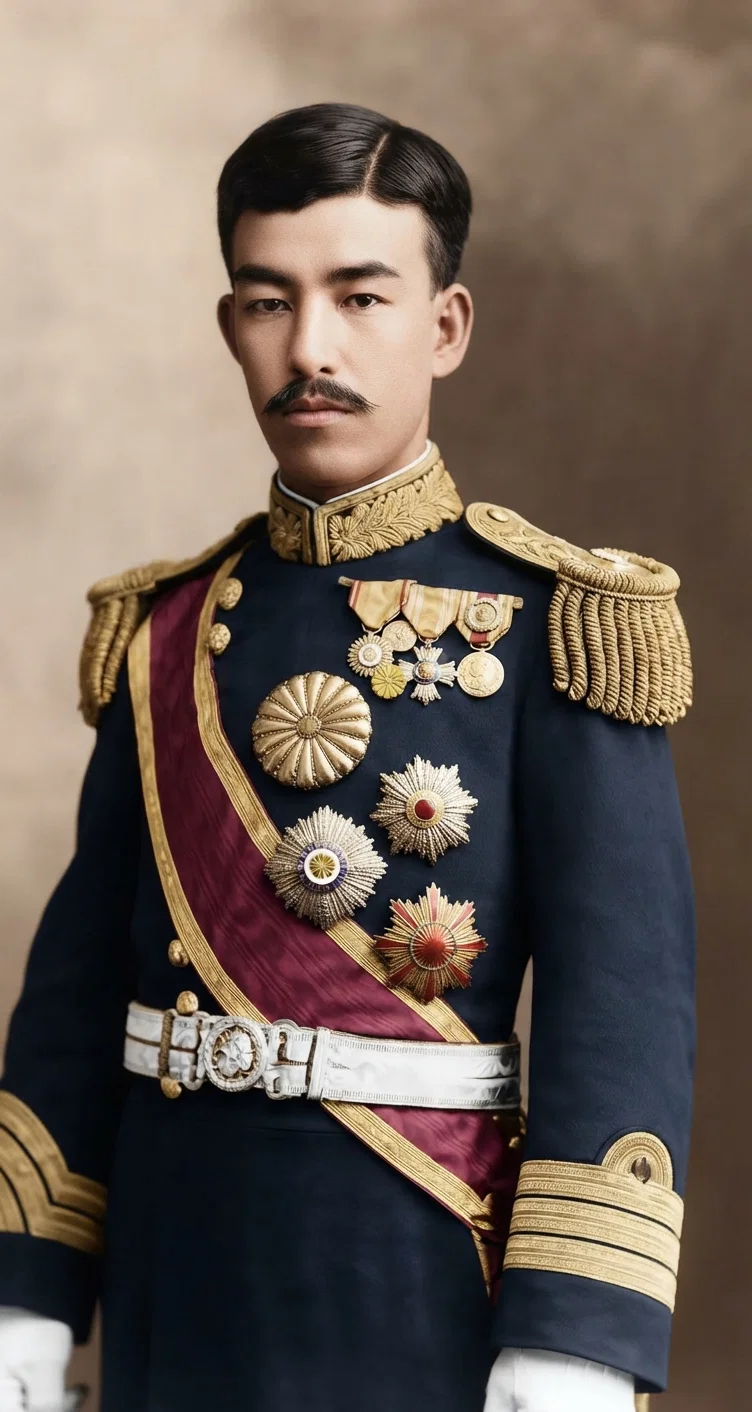
Yoshihito, the new emperor of Japan
Mutsuhito, who was for forty-four years emperor of Japan, died on the night of July 29. His son the Crown Prince Yoshohito, according to the formula provided by the Japanese constitution, has been proclaimed emperor instead of his father. The long reign of the late emperor was a period of great advancement and prosperity for Japan. During that time the "Sunrise Kingdom" has advanced to the position where it is taking its place along with the great civilized powers of the world. Western ideas and Western civilization have been brought into Japan largely through the late emperor's desire to keep abreast with the advancement of the times. It is to be hoped that his son will emulate the example of his father, and continue the good work.
"Underground Waters for Farm Use," by Myron L. Fuller, connected with the United States Geological Survey (Water Supply paper, No. 225), is the title of a very valuable government document. The document has been so much in demand that already three editions have been printed. It sets forth the great dangers from typhoid fever that are lurking in wells. It is now a well-established fact that typhoid fever is contracted either from the water we drink or the food we eat, and in the most of cases it comes from drinking-water. It is well to secure the document, and make a study of the conditions that surround your premises, to see whether or not you are endangered from typhoid fever.
The United States Geological Survey estimates that they have discovered nearly ten billion tons of gypsum in large beds in Utah. This is a very valuable deposit, but nothing can be done with it until transportation facilities are provided.
Among all the religious persecutions with which almost every page of modern history is stained, no victim ever suffered but for the violation of what government denominated the law of God.—United States Senate Report, 1829.
The Future of China
By Editor
"Church and State Religion"
ONE of the great questions in the new republic of China is, Shall China have a state religion, and what shall it be? One of the periodicals which promises to become a leading journal is the "Republican Advocate of China," published weekly at Shanghai, the second number of which, June 15, has come to us. Among the questions discussed is the one above stated. The editor tells us that a large number of replies have been received, on all sides of the question. He prints three characteristic ones: one from the Rev. C. Spurgeon Medhurst, who advocates a state religion. The letter clearly shows that the writer does not understand the real questions at issue, and it contains very little of the American principle of separation of church and state. He declares that the American republic was founded by devout Christians, to whom state and religion were synonymous.
But state and religion were so far from being synonymous that the fathers of the American republic felt that it was absolutely necessary to place in the fundamental law the prohibition that Congress should make no law respecting an establishment of religion, and to declare that no religious test should ever be required of any citizen. But this writer argues that "circumstances in China are different. . . . The government dare not ignore the strength to be derived from the agreement of many minds, such as religion only supplies. To specify the nature of this state religion is more difficult. Personally, I believe China will only become a strong nation as she becomes a Christian nation, yet I should oppose the state recognition of Christianity." But it might be answered, If one is going to demand a state religion, why not take the best religion there is? Of course to him who understands it, there can be no true union of Christianity with the state; it is only a form of religion with the state that could be effected. Christianity is life, and not a matter of human law. This writer would have such a state religion with no other definition than "God is love," or "Love is God," with the ethics of the Golden Rule,—a sort of namby-pamby religion that would please nobody.
Mutsuhito, the late emperor of Japan
Another reply comes from "Gualterio," whom some may recognize as one of our own correspondents, Mr. W. E. Gillis. He states it this way:
"Should China have a state religion?" is the most vital issue now confronting the nation. To answer in the affirmative means to support a policy that puts a premium on hypocrisy and stultifies the mission of true religion. Should China have a state religion? — Never! The experiences of history forbid it. The voice of reason says No!"
"Gualterio" then refers to the various classes of government, — the divine right of kings, the old pagan form; and the second class, the papal dominations of Europe for 1,260 years, and the loss of millions of lives to witness to its deplorable régime. "The United States of America is a luminous example of the third class. Conceived and brought forth as the offspring of those who fled the persecutions of church domination in Europe, the government was launched with an entire divorce of church and state. That the result has been preeminently satisfactory is amply evidenced by the expansion of territory and people, education and wealth, in the brief period of 136 years. Here is proof that freedom in religion, as in labor, has the same inspiration of hope."
The third reply printed is from Mr. John Duroch, of the General China Tract Society, Hankow:
"I do not think there can possibly be two answers to the question which you have propounded to your readers. China should not have a state religion, and therefore there is no need to consider what that religion should be. In this respect China is no different from any other nation. No nation can have a state religion without discriminating against those of its people who are conscientiously opposed to that religion. You can have a state system of education, because all the people will accept the same system of secular instruction. These and such other functions as taxation, representation, etc., are properly within the control of the state. Religion is a personal matter, an affair of the individual conscience, and as such is absolutely above and beyond the control of the state. I am a Christian, but am firmly convinced that the worst thing China could do for Christianity would be to make that the state religion of China."
This is most excellent. They are brave, noble words, and we earnestly hope that such sentiments as that will prevail in the new republic. They have worked out satisfactorily in America, sad tho it is that there are now zealous men endeavoring to overthrow them.
W.
HOME AND FIRESIDE
By Charles Poole Cleaves
Motherhood
(By Charles Poole Cleaves, in "Mothers' Magazine")
O, anxious mothers! could you only know
How often in the bosom of a child
Fountains of love spring up and overflow,
Wasting, yet longing but to be beguiled
Along some low, green vale of mother love;
How little arms are eager to caress,
And little hearts, that know not how to prove
Their love, have power to comfort and to bless;—
You would not try your mission to fulfil
By stern tasks only, that repress and mar
The instinct for the beautiful and good.
O, seize the timely moments to instil
Dear, happy memories. For home memories are
The safeguard of the child, the sweets of motherhood.