Review and Herald, Vol. 92, No. 12.

Nebuchadnezzar's Dream and Its Interpretation
Earlier text: Nebuchadnezzar's Dream and Its Interpretation

The Great Image of Daniel 2

The Kingdoms of the World and the Kingdom of God

A BIBLE STUDY
1. What statement did Nebuchadnezzar, king of Babylon, make to his wise men whom he had assembled? “And the king said unto them, I have dreamed a dream, and my spirit was troubled to know the dream.” Dan. 2:3.
2. After being threatened with death if they did not make known the dream and the interpretation, what did the wise men say to the king? “The Chaldeans answered before the king, and said, There is not a man upon the earth that can show the king’s matter; therefore there is no king, lord, nor ruler, that asked such things at any magician, or astrologer, or Chaldean. And it is a rare thing that the king requireth, and there is none other that can show it before the king, except the gods, whose dwelling is not with flesh.” Verses 10, 11.
3. After the wise men had thus confessed their inability to do what the king required, who offered to interpret the dream? “Then Daniel went in, and desired of the king that he would give him time, and that he would show the king the interpretation.” Verse 16.
4. After Daniel and his fellows had sought God earnestly, how were the dream and its interpretation revealed to Daniel? “Then was the secret revealed unto Daniel in a night vision. Then Daniel blessed the God of heaven.” Verse 19.
5. When brought before the king, what did Daniel say? “Daniel answered in the presence of the king, and said, The secret which the king hath demanded cannot the wise men, the astrologers, the magicians, the soothsayers, show unto the king; but there is a God in heaven that revealeth secrets, and maketh known to the king Nebuchadnezzar what shall be in the latter days. The dream, and the visions of thy head upon thy bed, are these.” Verses 27, 28.
6. What did Daniel say the king had seen in his dream? “Thy dream, and the visions of thy head upon thy bed, are these: . . . Thou, O king, sawest, and behold a great image. This great image, whose brightness was excellent, stood before thee, and the form thereof was terrible.” Verses 29–31.
7. Of what were the different parts of the image composed? “This image’s head was of fine gold, his breast and his arms of silver, his belly and his thighs of brass, his legs of iron, his feet part of iron and part of clay.” Verses 32, 33.
8. By what means was the image broken to pieces? “Thou sawest till that a stone was cut out without hands, which smote the image upon his feet that were of iron and clay, and brake them to pieces.” Verse 34.
9. What became of the various parts of the image? *“Then was the iron, the clay, the brass, the silver, and the gold, broken to pieces together, and became like the chaff of the summer threshing floors; and the wind carried them away, that no place was found for them; and the stone that smote the image became a great mountain, and filled the whole earth.”* Verse 35.
10. With what words did Daniel begin the interpretation of the dream? “Thou, O king, art a king of kings; for the God of heaven hath given thee a kingdom, power, and strength, and glory. And wheresoever the children of men dwell, the beasts of the field and the fowls of the heaven hath he given into thine hand, and hath made thee ruler over them all. Thou art this head of gold.” Verses 37, 38.
NOTE.— The character of the Babylonian Empire is fittingly indicated by the nature of the material composing that portion of the image by which it was symbolized, the head of gold. It was “the golden kingdom of a golden age.” The city of Babylon, its metropolis, according to history towered to a height never equaled by any of its later rivals. “Situated in the garden of the East; laid out in a perfect square sixty miles in circumference, fifteen miles on each side; surrounded by a wall three hundred and fifty feet high and eighty-seven feet thick, with a moat, or ditch, around this, of equal cubic capacity with the wall itself; divided into six hundred and seventy-six miles; laid out in luxuriant pleasure grounds and gardens, interspersed with magnificent dwellings,—this city, containing in itself many things which were themselves wonders of the world, was such another and still mightier wonder. . . . Such was Babylon, with Nebuchadnezzar, youthful, bold, vigorous, and accomplished, seated upon its throne.”
11. What was to be the nature of the next kingdom after Babylon? “After thee shall arise another kingdom inferior to thee.” Verse 39, first part.
12. Who was the last Babylonian king? “In that night was Belshazzar the king of the Chaldeans slain. And Darius the Median took the kingdom, being about threescore and two years old.” Dan. 5:30, 31.
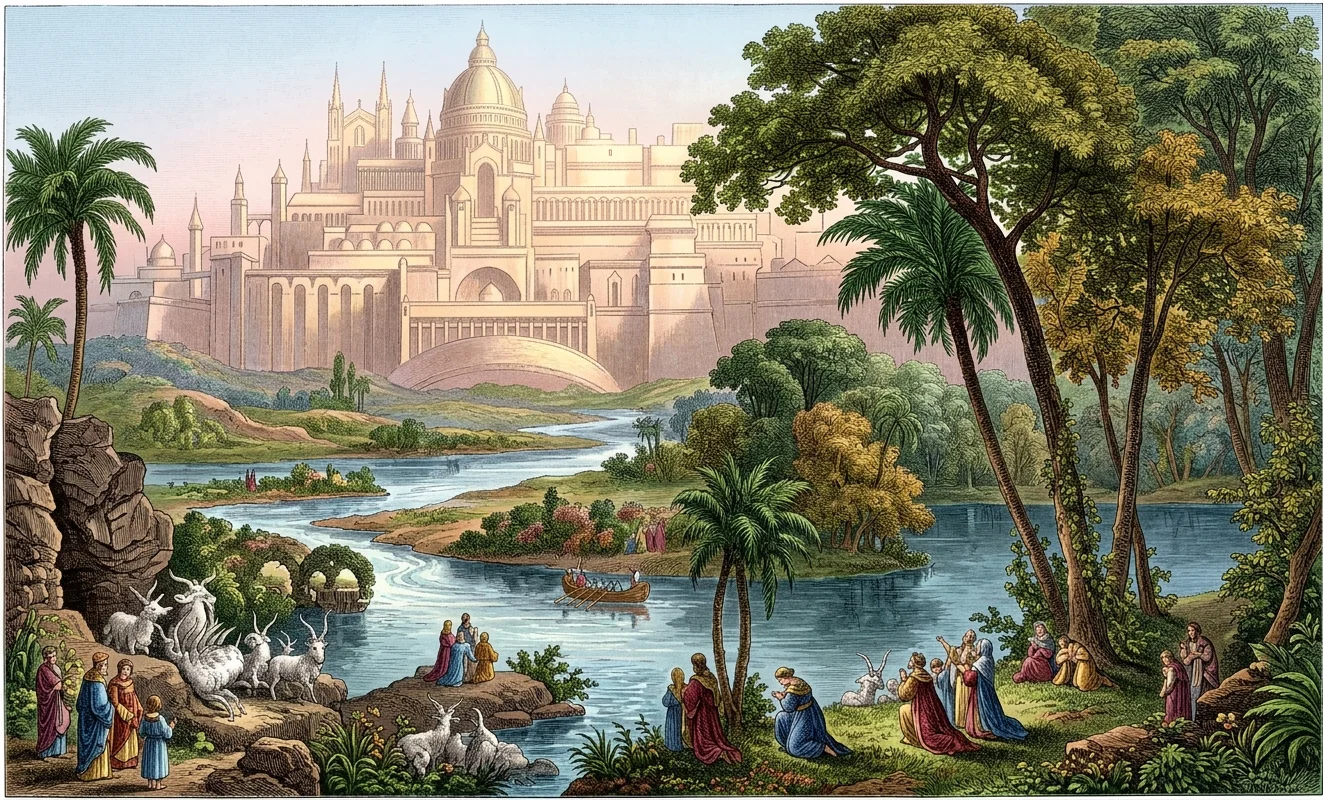
THE LAND OF PEACE.—“I SAW A NEW HEAVEN AND A NEW EARTH.” REV. 21:1
13. To whom was Belshazzar’s kingdom given? “Thy kingdom is divided, and given to the Medes and Persians.” Verse 28.
14. By what is the Medo-Persian Empire represented in the great image? By the breast and the arms of silver. Dan. 2:32.
15. By what is Grecia, the kingdom succeeding Medo-Persia, represented in the image? “His belly and his thighs of brass.” Verse 32. “And another third kingdom of brass, which shall bear rule over all the earth.” Verse 39.
16. What is said of the fourth kingdom? “And the fourth kingdom shall be strong as iron: forasmuch as iron breaketh in pieces and subdueth all things; and as iron that breaketh all these, shall it break in pieces and bruise.” Verse 40.
17. What scripture shows that the Roman emperors ruled the world? “And it came to pass in those days, that there went out a decree from Cæsar Augustus, that all the world should be taxed.” Luke 2:1.
NOTE.— Describing the Roman conquests, Gibbon uses the very imagery employed in the vision of Daniel 2. He says: “The arms of the republic, sometimes vanquished in battle, always victorious in war, advanced with rapid strides to the Euphrates, the Danube, the Rhine, and the ocean; and the images of gold, or silver, or brass, that might serve to represent the nations and their kings, were successively broken by the iron monarchy of Rome.”—“Decline and Fall of the Roman Empire,” chap. 38, par. 1, under “General Observations,” at the close of the chapter.
18. What was indicated by the mixture of clay and iron in the feet and toes of the image? “And whereas thou sawest the feet and toes, part of potters’ clay, and part of iron, the kingdom shall be divided.” Dan. 2:41.
19. In what prophetic language was the varying strength of the ten kingdoms of the divided empire indicated? “And as the toes of the feet were part of iron, and part of clay, so the kingdom shall be partly strong, and partly broken” (margin, “brittle”). Verse 42.
20. Were any efforts to be made to reunite the divided empire of Rome? “And whereas thou sawest iron mixed with miry clay, they shall mingle themselves with the seed of men: but they shall not cleave one to another, even as iron is not mixed with clay.” Verse 43.
21. What is to take place in the days of these kingdoms? “And in the days of these kings shall the God of heaven set up a kingdom, which shall never be destroyed: . . . but it shall break in pieces and consume all these kingdoms, and it shall stand forever.” Verse 44.
NOTE.— This verse foretells the establishment of another universal kingdom, the kingdom of God. This kingdom is to overthrow and supplant all existing earthly kingdoms, and is to stand forever. The time for the setting up of this kingdom was to be “in the days of these kings.” This cannot refer to the four preceding empires, or kingdoms; for they were not contemporaneous, but successive; neither can it refer to an establishment of the kingdom at Christ’s first advent, for the ten kingdoms which arose out of the ruins of the Roman Empire were not yet in existence. It must, therefore, be yet future.
22. In what announcement in the New Testament is the establishment of the kingdom of God made known? “And the seventh angel sounded; and there were great voices in heaven, saying, The kingdoms of this world are become the kingdoms of our Lord, and of his Christ; and he shall reign forever and ever.” Rev. 11:15.
23. For what have we been taught to pray? “Thy kingdom come. Thy will be done in earth, as it is in heaven.” Matt. 6:10.
24. What event is closely associated with the establishment of God’s everlasting kingdom? “I charge thee therefore before God, and the Lord Jesus Christ, who shall judge the quick and the dead at his appearing and his kingdom.” 2 Tim. 4:1.
25. With what prayer do the Scriptures close? “He which testifieth these things saith, Surely I come quickly. Amen. Even so, come, Lord Jesus.” Rev. 22:20.

The Night Feast of Belshazzar

By Daniel March
BELSHAZZAR was the last of the Babylonian kings. The great feast which he made for a thousand of his lords was on the last night of his reign. He belonged to the proud and profligate race of the Chaldeans, whom the Hebrew prophets describe as tender and delicate, given to pleasures, dwelling carelessly and trusting in wickedness. Their young men were showy, sensual, and self-indulgent. They dressed themselves in dyed garments of brilliant colors, curled their hair, used unguents and perfumes, wore jewelry, and carried walking sticks with the beak of a bird or the head of a serpent carved on the handle. They were fond of silver plate and splendid carpets, costly furniture and great suppers. They frequented dramatic entertainments in which female singers and dancers appeared on the stage with little dress and less decency, for the amusement of the audience. They drank wine, sang lewd songs, were out late at night, and did everything else that wild, half-intoxicated young men are most likely to do.
All this can be abundantly shown from the Hebrew prophets, Isaiah, Jeremiah, and Ezekiel; from the Greek historians, Herodotus, Xenophon, and Diodorus, and from inscriptions on monuments that remain to this day. Knowing all this concerning the young men of that great and mighty city of ancient time, we are not surprised that Babylon became a desolation. The day of doom is not far off from any great city when its young men have become “tender and delicate,” and given to pleasure; when they have grown effeminate, self-indulgent, fond of amusement, and afraid of work; when they are excited and passionate about trinkets and trifles—nerveless and spiritless about the nobler demands of effort and duty.

The Germs of Decay

There is no more effectual way to destroy a great and mighty nation than to give its young men all the money they want, provide them with plays and festivities and amusements and dances and wine, and leave them to sweat the life and manhood out of body and soul in the hotbed of pleasure and self-indulgence. That is the way Babylon was ruined. That is the way imperial Rome became an easy prey to northern barbarians. That is the way Christian Constantinople came under the debasing and abominable sway of Mohammedans. That is the way Venice ended a thousand years of independent and glorious history with shame and servitude. And nothing worse could come upon the fairest and most Christian city in the world than to have a generation of tender and delicate young men, without energy, without principle, without conscience, with money enough to support elegant pleasures and costly vices. Let such young men give tone to public opinion, and take the lead in the highest circles of society in any city of our land, and they would soon make it the Sodom of America.

A Character Sketch of Belshazzar

Belshazzar had everything to flatter his pride and indulge his passions. He was an absolute monarch, holding the life and property of his thousand lords and his countless people entirely at his disposal. His servants were princes. His concubines were the daughters of kings. His capital was enriched with the spoils of nations; his provinces were cultivated by captive people. He was hasty and violent in temper, yet effeminate and luxurious in his habits of living. He was gracious and indulgent toward his favorites; and yet when their best efforts to please him did not happen to suit his caprice at the moment, he would be as cruel as the grave. His anger kindled at the slightest provocation, like flax in the flame, and he yielded to the seductions of pleasure and flattery as the early frost melts in the morning sun. In his soft and passive mood he could be molded like wax by those who studied his caprices and played upon his weaknesses; but let him be crossed in his will, let him receive a slight or a sudden provocation, and his effeminate face would darken with the ferocity of a demon.

The Dimensions of Babylon

We have several independent statements in regard to the dimensions of Babylon, and although they all seem like immense exaggerations, we shall venture to take them as they stand for the purpose of illustration, without attempting to improve upon them by our conjectures. Let Herodotus, the father of history, be our principal authority.
The front of the great palace of Belshazzar was six times as great as the front of St. Peter’s Church at Rome, four times as great as the length of the Capitol at Washington. The whole structure was surrounded by three walls, so high that it would take thirteen tall men, standing erect one above the other, to reach the top. The outer wall of the palace inclosed more ground than Central Park in New York. The city in which Belshazzar reigned was a square fifteen miles on a side, surrounded by walls as wide on the top as a large church, and seventy-five feet higher than the highest tower or steeple in America. If Broad Street, in Philadelphia, were graded and built up to the full extent of the city limits, it would be the longest, straightest, widest street in the world. Ancient Babylon had fifty such streets, straight as an arrow, crossing each other at right angles, and wider by one third than the widest street in Philadelphia. And this mighty city of old was furnished with towers and temples and palaces and pleasure gardens correspondent to its greatness. Belshazzar’s so-called father, Nebuchadnezzar, was the most magnificent builder the world ever saw. According to Herodotus, he put into the walls of his capital alone more than five thousand millions of solid feet of masonry. Babylonian bricks, a foot square, inscribed with the name of Nebuchadnezzar, have been found by Sir Henry Rawlinson in more than a hundred different places in the country about the ruins of the great city, and there are millions of such bricks today lying just where they were placed by the hand of the workmen twenty-four hundred years ago.
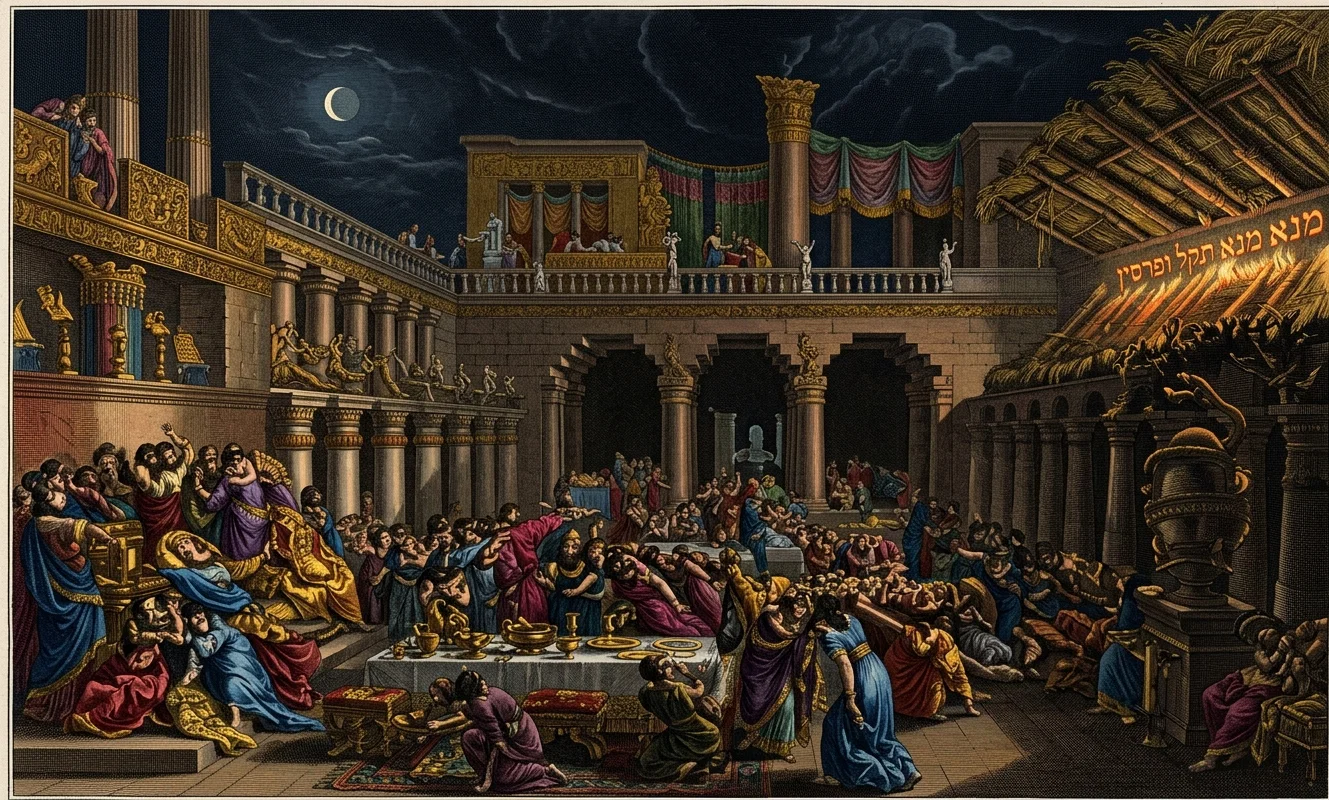
THE HANDWRITING AT BELSHAZZAR'S FEAST

The King’s Inheritance

Belshazzar inherited the pride, the glory, the riches, the power, the palaces, the capital, the kingdom, of his great father. He inherited enough to ruin any young man who was not fortified by great strength of character and a severe mastery of his own appetites and passions. He was admitted to a share in kingly power at fifteen, and the glory, which was too great for the mighty Nebuchadnezzar, easily turned the head of an effeminate and giddy youth, who had earned by his own exertions nothing of all he had. He lifted himself up against the Lord of heaven, and despised the kings and armies of the earth.

The Stratagems of Cyrus

At the time immediately preceding the great feast which Belshazzar made for his thousand lords, the province of Babylon had been overrun and the capital assailed by a great army from the north. But, for some strange and inexplicable reason, the besieging force had apparently withdrawn. No effort appears to have been made to discover what had become of the enemy or what had occasioned their disappearance. It was enough that they could no longer be seen from the towers and walls. It was taken for granted that the siege was abandoned and the war was over. The whole city was immediately given up to rejoicing and every form of riotous excess. Belshazzar set the example, and people and princes were only too ready to imitate their king. The retiring enemy were ridiculed. The guards deserted their posts. The gates in the palace walls and the river banks were left open. No attention was given to the strange and startling fact that the water in the river was beginning to fall, and that when the night of the great feast began the bed of the stream was in many places bare, and that the empty channel left an open pathway for an army to march beneath the walls. There was feasting and dancing everywhere, and the mad revelers thronged the streets and houses, the palaces and pleasure gardens, through all the city. The flames of idolatrous sacrifice rose high into heaven from the lofty tower of Belus. The Hanging Gardens were hung with lanterns and torches, till they seemed like a mountain of fire at midnight. Torchlight processions flowed like rivers through the broad streets. The light of lamps outshone the starlight, and the blue Chaldean heavens looked black above the blaze of the great illumination.

Babylon’s Fatal Hour of Revelry

Meanwhile, Belshazzar has entered the hall of banquet—
“And a thousand dark nobles all bend at his board; Fruits glisten, flowers blossom, meats steam, and a flood Of the wine that man loveth runs redder than blood; Wild dancers are there, and a riot of mirth, And the beauty that maddens the passions of earth; And the crowd all shout, while the vast roofs ring, All praise to Belshazzar, Belshazzar the king!”
“The music and the banquet and the wine; the garlands, the rose odors, and the flowers; the sparkling eyes, the flashing ornaments, the jeweled arms, the raven hair, the braids, the bracelets, the thin robes floating like clouds; the fair forms, the delusion and the false enchantment of the dizzy scene,” take away all reason and all reverence from the flushed and crowded revelers. There is now nothing too sacred for them to profane, and Belshazzar himself takes the lead in the riot and the blasphemy. Even the mighty and terrible Nebuchadnezzar, who desolated the sanctuary of Jehovah at Jerusalem, would not use his sacred trophies in the worship of his false gods. But this weak and wicked successor of the great conqueror, excited with wine and carried away with the delusion that no foe can ever capture his great city, is anxious to make some grand display of defiant and blasphemous desecration.
“Bring forth,” cries the monarch, “the vessels of gold Which my father tore down from the temples of old; Bring forth, and we’ll drink, while the trumpets are blown, To the gods of bright silver, of gold, and of stone. Bring forth.” And before him the vessels all shine, And he bows unto Baal, and he drinks the dark wine, While the trumpets bray and the cymbals ring, ‘Praise, praise to Belshazzar, Belshazzar the king.’ Now what cometh? Look! look! without menace or call, Who writes with the lightning’s bright hand on the wall? What pierceth the king, like the point of a dart? What drives the bold blood from his cheek to his heart? Let the captive of Judah the letters expound. They are read, and Belshazzar is dead on the ground. Hark! the Persian has come on the conqueror’s wing, And the Mede’s on the throne of Belshazzar the king.”

The Last Ceremonial of the Chaldean Kings

The graphic lines of the modern poet do not exaggerate the rapidity with which the ministers of vengeance came upon Belshazzar and his thousand lords on the last night of his impious reign. At the very moment when their sacrilegious revelry was at its height, the bodiless hand came forth and wrote the words of doom upon the wall of the banqueting room; the armies of Cyrus had turned the Euphrates out of its channel and marched into the unguarded city along the bed of the stream beneath the walls; they were already in possession of the palace gates when Belshazzar and his princes were drinking wine from the vessels of Jehovah and praising the gods of gold and silver and stone. That great feast of boasting and of blasphemy was the last ceremonial of the Chaldean kings. “In that night was Belshazzar the king of the Chaldeans slain. And Darius the Median took the kingdom,” Dan. 5:30, 31.

The Universal Kingdom of God

The Fifth Kingdom of Prophecy

By C. M. Snow
When Daniel, under inspiration of God, had caused Nebuchadnezzar to see again the “great image” of his dream, he said, “Thou art this head of gold.” He told him of another kingdom inferior to his, a third kingdom represented by the brass of the image, and a fourth kingdom of iron and finally of “iron mixed with miry clay”—the divided state of the Roman Empire, as we see these divisions today. And then the divine record continues:—
“And in the days of these kings shall the God of heaven set up a kingdom which shall never be destroyed, nor shall the sovereignty thereof be left to another people; but it shall break in pieces and consume all these kingdoms, and it shall stand forever.” Dan. 2:44.
That was God’s kingdom, to be set up after all earthly kingdoms had been broken in pieces and had been scattered to the four winds. That is the kingdom, and its ruler is the ruler referred to in this prophecy of the psalmist:—
“Jehovah said unto me, Thou art my Son; this day have I begotten thee. Ask of me, and I will give thee the nations for thine inheritance, and the uttermost parts of the earth for thy possession. Thou shalt break them with a rod of iron; thou shalt dash them in pieces like a potter’s vessel. . . . His wrath will soon be kindled. Blessed are all they that take refuge in him.” Ps. 2:7-12.
It was of that kingdom that Jesus himself was speaking to his disciples when he said: “A certain nobleman went into a far country, to receive for himself a kingdom, and to return.” (Luke 19:12) And the interest and partnership of the saints of God in that fifth universal kingdom are set forth in these words of Scripture:—
“And the kingdom and the dominion, and the greatness of the kingdoms under the whole heaven, shall be given to the people of the saints of the Most High; his kingdom is an everlasting kingdom, and all dominions shall serve and obey him.” Dan. 7:27.
That glorious consummation is the climax of prophecy and the end of history. Toward that consummation every loyal intelligence in the universe of God has been laboring with intensity of purpose through the ages that have been made sorrowful by sin.
This is the kingdom lost to man through his disobedience, and usurped by Satan when he brought man into subjection to himself through deception, false hopes, and falsehood. It was promised to man again through the Seed of Abraham:—
“Now to Abraham were the promises spoken, and to his seed. He saith not, And to seeds, as of many; but as of one, And to thy seed, which is Christ. . . . God hath granted it to Abraham by promise. . . . And if ye are Christ’s, then are ye Abraham’s seed, heirs according to the promise.” Gal. 3:16-20.
Of what promise is the sacred writer speaking?—The promise that he should be the “heir of the world.” Rom. 4:13. Man had been the heir of the world, the king of the earth; but when he disobeyed God and yielded to Satan, he lost his dominion, and became the subject of the “prince of the power of the air,” and of the “spirit that now worketh in the children of disobedience.” The restoration of that dominion to the possession of man comes about through the life and sacrifice of the man Christ Jesus; and that restored dominion is the fifth kingdom. Concerning that restoration we read:—
“And thou, O Tower of the flock, the Stronghold of the daughter of Zion, unto thee shall it come, even the first dominion; the kingdom shall come to the daughter of Jerusalem.” Micah 4:8.
That “first dominion,” lost in Adam, is restored by Christ, the “Tower of the flock” and the “Stronghold” of those who put their trust in him. Of that kingdom there will be no end, and they who are its happy subjects will be the trophies of divine grace, whose sins have been forgiven, whose mortality has been swallowed up in immortality, upon whom death no more can lay its icy grasp. In all the history of the world no other such glorious prospect has ever been held before the human race. Life, eternal life, in a kingdom that shall never pass away, who would not strive for such an inheritance!
In this world, kingdoms have risen and fallen, and others have built upon their ruins; but that restored dominion is a kingdom whose continuance will measure with eternity. Here the greatest rulers perish after a few short years; but there neither rulers nor subjects will feel the touch of death, and the bloom of eternal youth will be upon the faces of all God’s people. Here we have the cripples, the dumb, and the destitute; but there “shall the lame man leap as an hart, and the tongue of the dumb shall sing,” and the wealth of a limitless universe will be shared by all the subjects of the realm. Here death and decay, sorrow and crying, sickness and pain, smite the rich and the poor, the young and the old; but there the almighty Ruler, the Prince of Peace, the Redeemer of a rebel race, the loving Father of mankind, “shall wipe away every tear from their eyes; and death shall be no more; neither shall there be mourning, nor crying, nor pain, any more: the first things are passed away. And he that sitteth on the throne said, Behold, I make all things new.” Rev. 21:4, 5. Then
will this scripture also be fulfilled:—
“Behold, the tabernacle of God is with men, and he shall dwell with them, and they shall be his peoples, and God himself shall be with them, and be their God.” Rev. 21:3.
With this agrees the testimony of the Spirit through the prophet Isaiah:—
“For, behold, I create new heavens and a new earth; and the former things shall not be remembered, nor come into mind. But be ye glad and rejoice forever in that which I create; for, behold, I create Jerusalem a rejoicing, and her people a joy. And I will rejoice in Jerusalem; and joy in my people; and there shall be heard in her no more the voice of weeping and the voice of crying. . . . And it shall come to pass, that, before they call, I will answer; and while they are yet speaking, I will hear.” Isa. 65:17-24.
That is God’s renewed universe, when the fires of God’s judgment and his cleansing shall have burned and purified this breeding place of sin, and the New Jerusalem shall have come down “from God out of heaven, prepared as a bride adorned for her husband.” Rev. 21:1, 2. In that kingdom, with sin, sorrow, misery, and death, wiped out, with even the desert places fruitful and blossoming as the rose, with beauty and joy on every hand, and every inhabitant sealed to everlasting life and privileged to enjoy the association of the Father who lives with us and the Christ who redeemed us, the highest hopes of the human heart will be realized, and love and peace and satisfaction will reign forever. What more could man ask? What more could God give?

THE BEREAN LIBRARY

All who desire to study further the important Bible subjects presented in this series of Extras should order from this list of valuable books put up in paper covers, postpaid, at the following very low prices:—
Steps to Christ, 144 pages........................ $ .25 Thoughts on Daniel, 345 pages...................... .25 Thoughts on Revelation, 430 pages.................. .35 His Glorious Appearing, 124 pages................... .15 The Sabbath in the Scriptures, 216 pages............ .25 The Sabbath in History, 600 pages................... .50 Capital and Labor, 208 pages........................ .25 Here and Hereafter, 360 pages....................... .25 Bible Footlights, 320 pages........................ .35 Our Paradise Home, 128 pages....................... .15 Religious Liberty in America, 448 pages............. .35 The Coming King, 320 pages.......................... .50
Order from the publishers, whose address is given below

Look for the Waymarks

Look for the waymarks as you journey on, Look for the waymarks, passing one by one; Down through the ages, past the kingdoms four,— Where are we standing? Look the waymarks o'er.
First, the Assyrian kingdom ruled the world, Then Medo-Persia's banners were unfurled; And after Greece held universal sway, Rome seized the scepter,—where are we today?
Down in the feet of iron and of clay, Weak and divided, soon to pass away; What will the next great, glorious drama be?— Christ and his coming, and eternity. — F. E. Belden.

The Evidential Value of Fulfilled Prophecy

Of all the various lines of Christian evidence none is so specially adapted to these last days as that based on fulfilled prophecy. . . . The prophecies of Daniel stand preeminent among all others in their evidential value. It is an astounding fact that not only does his brief book give a foreview of twenty-five centuries of Jewish and Gentile history, including the first and the second advents of Christ, but that it also fixes the chronology of various episodes of the then unknown future, with a simple certainty which would be audacious if it were not divine.—H. Grattan

You have reached the end of this edition.

Review and Herald · Mar 8, 1915