The Youth’s Instructor, Vol. 34, No. 26.

SEEING THE BLOOD

The Youth’s Instructor

Jun 30, 1886

S. D. A. Publishing Association · Battle Creek, Mich. · Jun 30, 1886

“SEEING THE BLOOD.”

FATHER, I cannot sleep; the prophet’s words Ring in my ears; they fill my heart with fear; For am I not the first-born, and the one On whom the destroying angel’s shaft would fall Were not the token on the lintel found? Thrice have I named the patriarchs, and once The creatures great and small that Noah drove Before him in the ark; but all in vain. I cannot sleep. O father, art thou sure The blood is sprinkled as God gave command?”
“Peace, peace, my child; just as the evening fell The fairest lamb of all the flock was slain, And roasted then with purifying fire; With bitter herbs, and bread devoid of leaven, In haste we ate the Lord’s appointed feast. Nor were the means of saving thee forgot; Scarce was the yearling slain ere I gave word For sprinkling of the blood upon the door; Sleep, then, my first-born; God’s avenging one Will see the signal, and pass over thee.”
Thus on that dark night which God had chosen For passing throughout all fair Egypt’s land, To smite on every side the loved first-born, Sparing not e’en the firstlings of the flock, A Hebrew father soothed his restless child; Restless himself, as now with girded loins, Sandals upon his feet, and staff in hand, He waited for that solemn midnight hour, When God’s almighty arm should break the chain That bound his people to proud Pharaoh’s throne. The bread unbaked was in the kneading-trough, The scattered flocks were gathered in the fold, And all betokened plans for hasty flight. There was a thrilling silence in the air; A quiet joy burned in the Rabbi’s breast, Joy that was not unmingled with regret At leaving thus his birthplace, though it was A house of bondage, for the promised land.
The night wore on.
And yet again the pleading voice was heard: “Father, sleep will not come; before my eyes I see the angel pass, and at our door Pause sadly, as though he wept to enter, Yet dared not hasten unavenging by. O father, if the blood has been removed, Or if the herd-boy heeded not thy voice, Then never shall my weary eyes behold The land of Canaan with its waving fields.”
“Rest, little one; faithful our Jared is. Not only on the side-posts of the door Should be the stain, but on the one above; So if some hungry dog should from its place One token lick, the others would remain. Sleep, my sweet child, for thou hast need of rest; The journey will be rough for little feet.”
The anxious voice was silent; for in that home Obedience reigned supreme, though not as yet The law had sounded forth from Sinai’s top; With patience dutiful she sought to woo Soft slumber to her long-unclosed eyes; Sleep came at last, but with it dreams of fright, Wherein she tossed, and moaned, and oft cried out.
The midnight hour drew nigh; unbroken still The darkness’ solemn hush; the child awoke With a loud cry, “Father, I thought I heard The cock’s shrill crow to greet approaching morn. My heart is beating with a sickening dread Of danger near. Oh! take me to the door, And let me see the red blood sprinkled there.”
Lighting a torch, the father gently took His first-born in his arms, and bore her forth— Started and paled to see no paschal sign, No warning that their door should be passed by! With trembling hand he snatched the hyssop then, Himself applied the blood in eager haste. A long sigh of relief escaped the child; Almost before he placed her on the couch Sweet sleep had fallen on her heavy lids, Nor when that “great cry” rose did she awake; That agonizing wail of man and beast Reached not her ears, with drowsy slumber sealed, And at the dawn they bore her, sleeping still, Away from Egypt’s darkness and despair.
Christ, our blest Passover, is slain for us; The “blood of sprinkling” for our sins is shed; Have we the atoning sacrifice applied, Made sure our entrance to the promised land? —Lucy Wade Herrick, in Christian Weekly.

THE PASS'OVER.

THE history of the chosen people of God has ever been filled up with remarkable and interesting experiences. In every age of the world we find this true. And as we read their history in ancient times, we cannot fail to be impressed with many of the wonderful occurrences of those times. There is, perhaps, in all the Bible no more deeply interesting narrative in relation to their history than that covering the time from Joseph’s abduction and carriage into Egypt, to the time of their deliverance from the cruel bondage under which they were permitted to suffer for many generations.
Our tenderest feelings of sympathy are touched by the recital of the cruel treatment which Joseph received at the hands of his brethren, through jealousy; and gratitude and wonder inspire us as we read of the remarkable providence of God in preserving him amid the dangers and trials through which he passed, to be the instrument in God’s hands for the preservation of his father’s family and of the nation, when death by famine seemed inevitable. Though hidden from their understanding, God had a grand and beneficent purpose in permitting all these experiences to come to his people.
The record tells us that after a season of prosperity in the land of Egypt, changes in their circumstances occurred. Joseph was long since dead. The king who ruled in the land when they first found a home in it was no more. Other kings had occupied the throne who were less kind and friendly to them. The numbers of the family of Joseph had increased until they had become a vast nation. Then arose a feeling of jealousy in the hearts of the rulers of Egypt, who feared that the strangers in their land would become so strong and numerous that they could not control them, and that they would, in case of any trouble with the neighboring nations, join with them in war, and overthrow the Egyptian throne. So they made the children of Israel slaves to the Egyptian king, and set taskmasters over them, who treated them most cruelly, and afflicted them with heavy burdens. “But the more they afflicted them, the more they multiplied and grew. And they were grieved because of the children of Israel.”
Thus they lived under the cruelties and hardships of slavery for many long and weary years. Generation after generation lived and passed away, and no deliverance came. Their burdens were constantly being increased, and they subjected in every way to the most cruel treatment by their wicked masters. Their innocent children were murdered to prevent their growth to manhood, and to decrease the number of the people.
But we read that “in process of time the king of Egypt died: and the children of Israel sighed by reason of the bondage, and they cried, and their cry came up unto God by reason of the bondage. And God heard their groaning, and God remembered his covenant with Abraham, with Isaac, and with Jacob. And God looked upon the children of Israel, and God had respect unto them.”
God’s grand purpose was during all this time being fulfilled. But the time had now come when a change,—a mighty change,—was to take place. The time for their deliverance from slavery and restoration to freedom, was at hand. God chose a man, preserved from death in his infancy in a remarkable manner, reared amid the wealth and splendor of the Egyptian court, educated in all the wisdom of the nation, and taught in the school of adversity,—such a man was chosen as his instrument for their deliverance.
At last the children of Israel, through Moses and Aaron, made request of the king that they might be allowed to go three days’ journey into the wilderness to sacrifice unto God. The king refused to grant their request, and oppressed the people still more heavily. But by mighty wonders and miracles, afflictions and distresses which were allowed to come upon the nation, the king at last consented to their request. Terrible distress had come upon the nation in consequence of their refusal to grant the request of the Israelites.
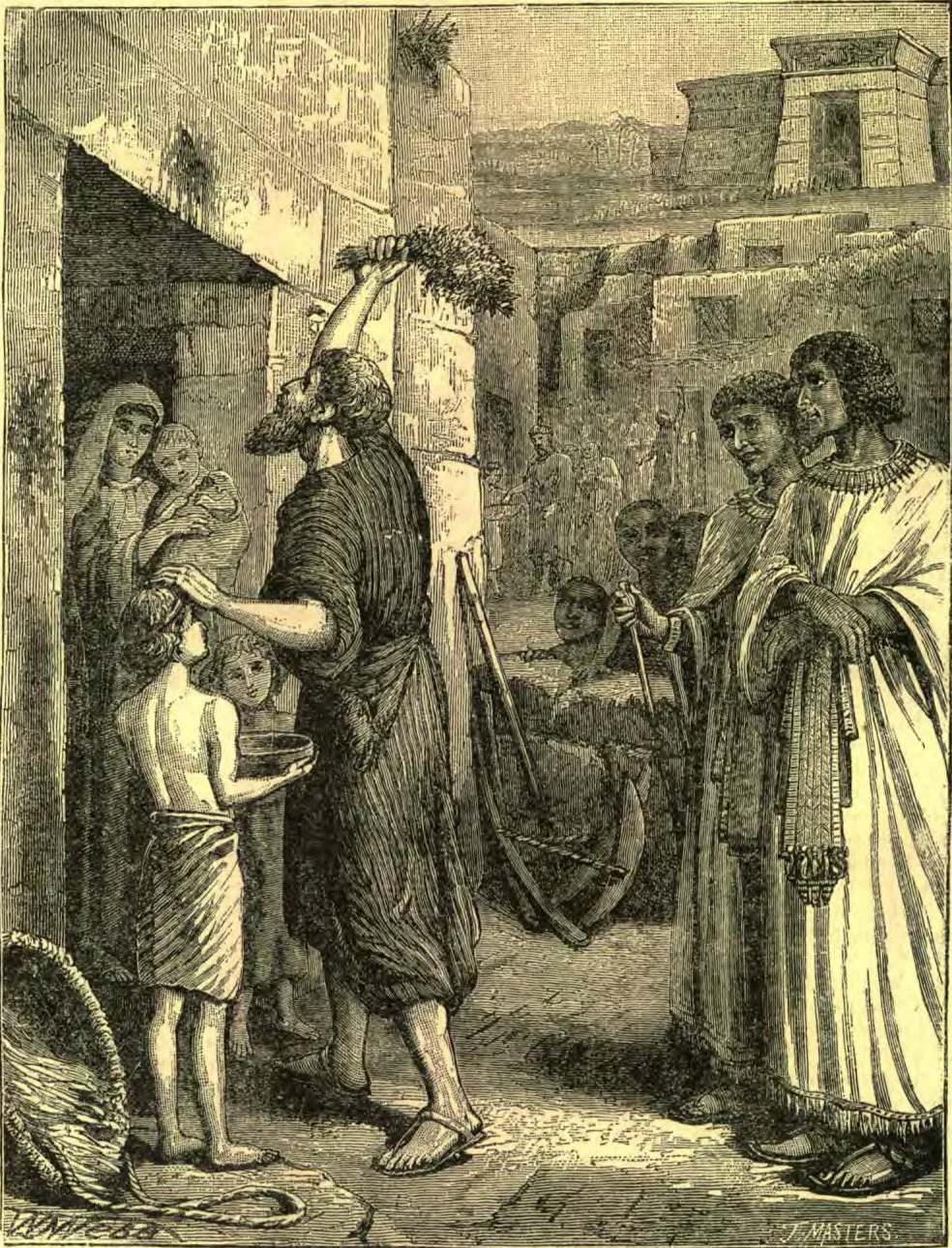
The Lord had given definite directions to his people, what they were to do. Their sure deliverance was promised, and the day of its accomplishment made known to them. Specific directions in regard to the preparations for their departure were given them. Every thing was in readiness, and the people waited. The Lord spake to Moses and Aaron to instruct the people upon a certain day of the month to take a lamb from the flock, and in the evening to slay it. Here our artist has most impressively represented the next scene, in the accompanying engraving. They were then to take the blood of the lamb in a basin, and dipping a bunch of hyssop into it, strike the side and upper door-posts with it. The father, the head of the family, is in the act of doing this. With what awe and wonder his wife and children watch him, who have doubtless been fully instructed in regard to its meaning, and understand what is to occur. Standing a little aside we see some of the Egyptians, watching the scene with curiosity and contempt. What significance has it to them?—Not much, we think. In the background we see a company of idolaters wending their way to their temple of worship, and others engaged in various employments, little dreaming of the scenes so soon to transpire. But what means this strange proceeding on the part of the children of Israel? Surely it must have some important significance. We turn to the 12th chapter of Exodus, and there we learn its meaning. The last and most terrible punishment that was to come upon the people of Egypt for their refusal to let the children of Israel go, was the destruction of the first-born in every family, from the king on his throne to the captive in the dungeon. In the night season the angel of the Lord was to go through the land and smite with death; but every house which bore upon its door-posts the marks of the blood, he was to “pass over,” and spare its first-born. Realizing its significance as they did, what solemnity must have accompanied the ceremony, in the minds of the children of Israel, and what a terrible significance to the stricken nation of Egypt when, upon a certain morning, their dead revealed to them its meaning.
The hearts of the king and his people had become hardened in their wickedness; and notwithstanding the oft-repeated promise of the king to let the people go, it was as often broken, and their request denied. But God had spoken, and his promise could not be broken. In the silence of the night, while the people lay unconscious in slumber, the angel of the Lord passed through the land, and visited every dwelling; and whatsoever house bore upon its door-posts that significant token of blood, was safe from the terrible doom that awaited those thus unprotected.
At midnight a fearful cry arose in all the land of Egypt; for there was not a house in which there was not one dead. The king and his servants rose up and urged the children of Israel to depart; for they said, “We be all dead men.” With hasty preparations for their journey, the burdened slaves went forth from the land of their adoption and bondage—six hundred thousand, besides children and a mixed multitude; and they sang upon the farther banks of the Red Sea their glorious deliverance from their pursuing oppressors, whom they saw most miserably perish in its rolling waters.
And of such importance was this simple token of blood, with its accompanying services performed in the land of Egypt, that the Lord gave his people directions that each recurring year, upon the fourteenth day of the month, when they came to the land which he would give them, it should be repeated as a memorial to them and their children forever; that when their children should ask what these things meant, they should say, “It is the sacrifice of the Lord’s passover, who passed over the houses of the children of Israel in Egypt, when he smote the Egyptians, and delivered our houses.”
Thus we find through all the subsequent history of this people, their strict observance of the “feast of the pass-over,” to them so full of interest and meaning. J. W. B.

Written for the INSTRUCTOR

LULU'S EXPERIENCE.

Lulu had just left the Sabbath-school class-room. She did not wait for her friend Julia, with whom she always used to walk home. She was so busy with thoughts of her own, that she forgot all about her.
“What were her thoughts,” do you ask? I will tell you: Miss Barney had given to each of her scholars a Bible verse to repeat for next Sabbath. Lulu's was: “And as ye would that men should do to you, do ye also unto them likewise.” Luke 6:31. They were to live out their verse during the week, and relate their experience the next Sabbath. This was why Lulu was so busy thinking; she was planning out ways for doing good.
As she reached home, she went up to her little room, and took her Bible for the purpose of reading her verse again. While she was turning the leaves to the place, her eyes fell on these words: “I am the vine, ye are the branches. He that abideth in me and I in him, the same bringeth forth much fruit: for without me, ye can do nothing.”
Here Lulu stopped, and thought to herself, “If this verse means what it says, and it certainly does, then, in my own strength, I can do nothing, no, not even live out this verse which my teacher gave me. But I'll ask God to help me, and then I'll be able to do it.” So she knelt down by her bed and prayed that God might give her grace and strength to do his will.
She rose up with a new feeling in her heart. She first went downstairs, where she found her mother sick with a headache, and the children playing under the window outside.
Lulu, seeing the opportunity, went to the pantry, and was soon back with a glass of water, and a bottle of camphor. After seeing that her mother was comfortable, she quieted the children, and amused them by telling them Bible stories, of which they were very fond.
She found some opportunity every day; and she did not forget to ask God daily for help and strength.
She had sister Julia's hair to comb, the children to put to bed, father's slippers to get, the table to set, and baby to take care of, all of which had been her mother's work before.
She wondered many a time through the day why she had not seen these little duties before. She now realized why her mother always looked so tired.
Sabbath came again; and Lulu was preparing for Sabbath-school.
“My dear,” said her mother, when Lulu was ready to start, “You have been very good this week; I feel ever so much better. My headaches haven't been half as hard as usual. Thank you for your help,” and Lulu felt paid for her trouble. When she came to relate her experience, they all said hers was the best. And why? Because she had asked heavenly help, and the rest did not.
How many of the INSTRUCTOR family will try this, too? Do not forget, as the other scholars did, to ask God's help. You may not all have the same duties that Lulu did, but you can do what you do have to do cheerily. H. R.

WHAT THE PHONOGRAPH SAID.

I witnessed a very interesting incident a short time since, which I think the readers of the INSTRUCTOR will like to hear about. Several of us went into a hall to see the workings of that wonderful little instrument called the phonograph, invented by Mr. Edison. Every little child ought to be familiar with his name; for he has invented many wonderful things, and is still inventing more.
Phonograph means, writing by sound. We went into the hall, and there we saw something that looked very much like a common tin tunnel, such as we use in filling bottles, jugs, and the like. It had a very large mouth on one end, and a small tube on the other. Over the small end of this tube was stretched a sheet of rubber, with a little pencil on the opposite side from you. Then there was a cylinder, that is, a round tube like a stove-pipe. On this cylinder was tin-foil, on which the end of the pencil made marks as the cylinder was turned around by a handle. One of our company, who was a good singer, went up, put his mouth in the large end of the tunnel, and sang a verse into it. This caused the rubber to vibrate, and the pencil to make marks on the tin-foil. Another man stepped up, and whistled a tune into it; and a third man followed, speaking some loud, rough words. After this, the operator fixed his instrument a little, and by turning that cylinder around, he reproduced exactly what these three men had said into that tunnel, or phonograph. First came the song, just as our friend sang it. You could hear not only the words, but the tune; and more than that, you could tell whose voice it was. Then followed the whistle right over again, and then the rough words spoken by the last man. Was not that remarkable?
I cannot explain how that could be; but I know it was so, for I heard it with my own ears. Just think of it, children. You sit down and talk, and this little instrument takes it down, just exactly as you say it. When you are through talking, it will talk back to you. If you speak fast, that speaks fast; if you speak loudly, that speaks loudly; if you speak softly, it speaks softly. If you speak good words, it will do the same; and if you speak bad words, you will hear them again, and you will hear them repeated in the same way, and hear them, too, just as you said them. If you should say them in an angry way, you will know your own voice, too.
After witnessing this, I said to myself, if man can invent an instrument that will take down our words just as we speak them, and will reproduce them so that we can hear them over again as we said them, cannot the Lord do it too, and probably in a good deal better way? Can he not take down all the words we say, good or bad, just as we speak them every day? I really think that it must be so, that our words are all taken down. Then they will all be kept carefully in a book till the day of Judgment. As we then stand up there before God, that book will be brought out, and we shall have to listen to the words we have spoken on earth. They will sound just as they did when we spoke them. We cannot deny them. Every good word, every prayer, will be down; and so every bad word, every angry word, or every untruthful word; we shall hear them over again.
If this is so, as the Bible plainly declares, how careful we ought to be of our words! I think the Bible plainly teaches that this will be so. Hear what Jesus said about it: “But I say unto you, that every idle word that men shall speak, they shall give account thereof in the day of Judgment.” Matt. 12:36. How plain that is! Not only the big words, or now and then some important word will be taken down, but Jesus himself says that “every idle word that men shall speak” will be brought up in the Judgment. The cruel words, the impatient words, the scolding words, the hasty words,—not one of them will be left out. How careful children ought to be about their words! Listen to those two little girls having a little quarrel. Remember that every word is taken down. How will they feel in the Judgment, as they listen to those same words, right in the presence of God and of the angels? Will not they wish then that they had not quarreled? Will not they be ashamed and sorry?
In a good many places the Bible says that we shall be judged out of the words written in these books. Here is one text: “And the books were opened: . . . and the dead were judged out of those things which were written in the books.” Rev. 20:12. That plainly says that we shall all be judged out of the things written in the books. And these things will be largely our words. Will you try to remember this hereafter? Say just as many good things as you can in just as good a way as you can, just as you will like to hear them in the Judgment. And when you are tempted to say something bad, or to say it in an angry, scolding tone, stop and think that all this is written down in the books in heaven, and by these things you will be judged. D. M. CANRIGHT.

A JUNE SONG.

A SONG for June, whose breath is sweet With blossoms opening at our feet; Whose voice is heard in brooks that run Through meadows, glad with song and sun. Oh, happy, happy, June!
The robin in the apple trees His nest among the branches sees, And, bubbling from his silver throat, What worldless songs of rapture float!
Above the world the firmament Spreads out the azure of its tent; How blest are we, whose dwelling is Beneath so kind a roof as this!
Our hearts are glad with bird and bee For what we feel, and hear, and see; Life seems a song to sweetest tune. Oh, would it were forever June!
—Eben E. Rexford, in Vick's Magazine.

FIVE CENTS.

Holding out his hand for the change, John's employer said, “Well, my boy, did you get what I sent you for?”
“Yes, sir,” said John; “and here is the change, but I don't understand it. The lemons cost twenty-eight cents, and there ought to be twenty-two change, and there's only seventeen, according to my count.”
“Perhaps I made a mistake in giving you the money?”
“No, sir. I counted it over in the hall, to be sure it was all right.”
“Then perhaps the clerk made a mistake in giving you the change?”
But John shook his head. “No, sir; I counted that, too. Father said we must always count our change before leaving a store.”
“Then how in the world do you account for the missing five cents? How do you expect me to believe such a queer story as that?”
John's cheeks grew red, but his voice was firm. “I don't account for it, sir; I can't. All I know is that it is so.”
“Well, it is worth a good deal in this world to be sure of that. How do you account for that five-cent piece that is hiding inside your coat-sleeve?”
John looked down quickly, and caught the gleaming bit with a cry of pleasure. “Here you are! Now it is all right. I couldn't imagine what had become of that five-cent piece. I was certain I had it when I started from the store to return.”
“There are two or three things that I know now,” Mr. Brown said, with a satisfied air. “I know you have been taught to count your money in coming and going, and to tell the exact truth, whether it sounds well or not,—two important things for an errand-boy. I think I'll try you, young man, without looking any farther.”
At this John's cheeks grew redder than ever. He looked down and up, and finally he said, in a low voice, “I think I ought to tell you that I wanted the place so badly, I almost made up my mind to say nothing about the change if you didn't ask me.”
“Exactly,” said Mr. Brown, “and, if you had done it, you would have lost the situation, that's all. I need a boy about me who can be honest over so small a sum as five cents, whether he is asked questions or not.”—Pansy.

Keeping Hands Clean in Trade

THERE are two ways of keeping the hands clean. One is with soap and water, and hard scrubbing sometimes. The other is by never allowing them to touch a dishonest penny, or a knife, or ball, or top, or a marble that you have not paid for in some way all it is worth, unless it has been given to you. We know a lad whose hands are very fair and clean to look upon, but who manages, in trading with his playmates, always to get some advantage on his side, so that he receives more than he gives. If this kind of dirt showed on the hands as it does on the conscience, he would be so ashamed that he would want to wear gloves all the time. Keep your hands clean both ways!—Selected.

SOME CRAWLING LEAVES.

When Australia was first discovered by the English, as many strange stories were told about the wonderful things to be found there as we used to hear in the early days of California. Among other things it was said that the leaves of a certain tree had a habit of descending from their proper place and walking along the ground.
A party of English sailors had left their ship to roam along the coast and “see what they could see.” They were resting under a tree, lying on their backs probably, and naturally gazing upward, when a sudden breeze shook down a number of leaves, which turned somersaults in the air, after the manner of leaves generally, and then floated to the ground. The sailors were surprised at this shower, because it was not the fall of the year, but midsummer, and these falling leaves looked fresh and green. It was strange to see leaves deserting the tree without any sort of reason; but this was nothing to what followed.
After a short rest, these able-bodied leaves began crawling along on the ground toward the trunk of the tree from which they came, and the amazed sailors started up in terror. They probably knew from experience that people who came in contact with the ground may also expect to come in contact with various crawling insects, but walking leaves were something altogether out of the common way; and they took to their heels at once, and lost no time in getting on board the vessel. The land was certainly bewitched, and one of the men said, in relating their adventure, that he expected every minute to see the trees step out and dance a regular jig.
Fortunately this singular phenomenon has been fully explained by later travelers who were not too much frightened to stop and examine the matter. It was discovered that these queer leaves are really insects that live upon the trees, and are of the same color as the foliage. They have very thin, flat bodies, and their wings are like large leaves. When anything disturbs them, as a breeze, for instance—they fold their legs away under their bodies, and then the leaf-like shape, with stem and all, is complete.
Not only are they of a bright green in the summer, like the foliage of the trees at that time, but they actually change when the leaves do to the dull brown produced by frost. Another peculiarity of these leaf-insects is that, although they have a generous supply of wings, they seldom use them, but when they have been shaken to the ground, after lying there for a few minutes as if they were really leaves, they crawl toward the tree, and ascend the trunk without seeming to know that they have the power of getting back to their quarters in a much quicker and easier way.—Harper’s Young People.

IMPORTANT BIBLE SUBJECTS.

LESSON 13.—REDEEMED FROM THE CURSE OF THE LAW.

1. From what has Christ redeemed us? Gal. 3: 13, first part.
2. What is the keeping of the commandments? 1 John 5: 3.
3. If keeping the commandments is love, can it be also the curse of which Paul speaks?
4. Upon whom does the curse of the law fall? Gal. 3: 10; Jer. 11: 3, 4.
5. What is the curse for disobedience? Rom. 6: 23.
6. How many people have been perfectly obedient? Rom. 3: 9, 10, 23.
7. Then upon how many does the curse of the law fall? Rom. 3: 19.
8. How many, consequently, stand in need of redemption?
9. How has Christ redeemed us from the curse of the law? Gal. 3: 13.
10. How was he made a curse for us? Gal. 3: 13.
11. What does this prove the curse of the law to be?
12. Having suffered the curse of the law, death, what does he give to those who believe in him? John 3: 16.
13. For what is the blessing of life promised? Gal. 3: 12; Matt. 19: 17.
14. And what is inseparably connected with faith? Rom. 3: 31; Rev. 14: 12.
15. How only is it possible for us to keep the commandments, and thus gain the blessing of life? John 15: 4, 5; Heb. 11: 6.

SOWERS AND REAPERS.

Does it ever occur to Sabbath-school teachers that, in the prosecution of the Lord’s work, there are some to sow the seed, and some to reap the harvests that spring from the seed? And have they ever formed any just idea of the comparative importance of the two works? It is to be feared that, because the teacher’s part is to scatter the little seeds, he is often tempted to undervalue the importance of his work, and to perform it without due care, or in a half-desponding mood, because no higher work is intrusted to him.
The late Henry Moorhouse, the English evangelist, in his little work on “Ruth the Moabitess,” says a few words that may rouse teachers to a sense of the true importance of their work, and send them to it with a heart full of gratitude that they have the privilege to be sowers of the seed; and of anxiety that they may do their work well.
“I once lived next door to a farmer, and I used to see him when he went out to sow his fields. I said to him one day:—
“‘Why do you do that yourself?’
“‘Because,’ he said, ‘I have not got a servant that I can trust to sow. I had one once that I could trust, but he has left me. I must have one to sow the seed in whom I can put confidence.’
“I have seen that very farmer go and hire the first Irish laborer that came along, to put in the sickle and reap. Who did the most important work? Not the man that reaped; but the man that sowed. So you, perhaps, who are toiling and laboring for the Lord Jesus Christ—you never see a soul won to the Saviour. Thank God for the great honor he is conferring upon you in making you a sower, even if he makes somebody else the reaper. ‘One soweth and another reapeth,’ but ‘neither is he that planteth any thing, neither he that watereth; but God that giveth the increase’ (John 4:37; 1 Cor. 3:7). Sow the seed beside all waters, and, by and by, both sower and reaper shall rejoice together. When the Master winnoweth the barley we all shall get the praise that is due to us.”—The Baptist Teacher.

Smiles That Draw People to Church

The Christian, of London, tells a story worth remembering, of what can be done by smiles that come from the heart. A lady of position and property, anxious about her neighbors, provided religious services for them. She was very deaf—could scarcely hear at all. On one occasion one of her preachers managed to make her understand him, and at the close of their conversation asked, “But what part do you take in the work?” “Oh,” she replied, “I smile them in, and I smile them out!” Very soon the preacher saw the result of her generous, loving sympathy in a multitude of broad-shouldered, hard-fisted men, who entered the place of worship, delighted to get a smile from her as she used to stand in the door-way to receive them. Many more of those who now neglect the church and Sabbath-school would be found there if Christians would “smile them in and smile them out.”

The Teacher's Influence on the Scholar

There should be a bond of sympathy between teacher and scholar—a good knowledge of each other, and an influence on the part of the teacher—that will remain as a felt-power of the scholar for all time. “I was influenced more than I was taught,” has been the testimony of many good men, who, looking back to their Sabbath-school days, recall their teachers to memory.

A LESSON FROM THE VINE.

Have you seen the little tendrils Of the closely clinging vine, How they seek for something stronger Than themselves, whereon to twine? Reaching out and always upward, Getting farther from the ground, They climb their leafy ladders To the very topmost round.
So let your best endeavor To noble heights aspire; Let faith be like the tendrils Whereby you rise the higher; Leave sin's alluring pleasure Where the vine has left the sod. Beneath you is the darkness, Above the light of God.
—S. S. Advocate.

A HUGE KITE.

KITE-SAILING is a very pleasing pastime for boys at certain seasons of the year; and who is the boy that does not delight in making a kite that will soar very high heavenward?
Perhaps no people enjoy this amusement any better than the Chinese, who set apart a certain day in September, which they call the “Ascending on High Day,” when both the men and boys give themselves up to kite-flying. Their kites present a very attractive appearance; for they pattern them after men, beasts, birds, and fishes, and paint them in gay colors, which make them showy even in the distance. Some of them measure forty and fifty feet in length. This holiday ends up with a great feast.
If grown-up men do not thus amuse themselves in America, one would suppose that at least the big-grown boys sometimes participate in the sport, and lend a hand in the manufacture of some of the enormous kites which soar in American skies. One of these, perhaps as large as any our young friends have ever seen, is thus described in Golden Days:—
“One of the largest kites that ever soared in American air was given to the breeze at New Haven, Conn., on the 28th of March, 1884. The kite was twelve feet wide, and fifteen feet long. Its ballast was a tail of manilla rope, seventy-five feet long and weighing thirty-eight pounds. On the day of the trial-trip a strong breeze was blowing. After several vain attempts to send the kite aloft, it caught the breeze and went upward like a huge monster on widespread wings. Two men were required to run the reel. The kite sailed away until one thousand yards of clothes-line had been paid out. It was fortunate that a reel had been provided, for if those present had depended on their unassisted strength, the kite would have escaped. When it reached the extent of the rope, the strain was so great that forty men had hard work to pull it down. Aloft in the air, it looked to be less than half its real size. Thousands watched it soar above the city of New Haven, and many boys dreamed of kites when they went to bed that night.”

A ROYAL MUMMY.

Modern researches in Egypt result in bringing to light many objects of interest, and one of them is a royal mummy, recently on exhibition in Mr. Brookwalter’s “Art Collection,” and obtained by Mr. B. “from Brusch Bey, director general of the Boolak Museum, Cairo, Egypt.” A late journal gives the following description of it by one who has seen it:—
“The sarcophagus is hewn out of sycamore wood, and is supposed to be over 2,500 years old. The lid, forming one half of the coffin, is profusely decorated with painted figures of men, alligators, dogs, cats, and snakes. The colors are very various and well preserved. At the head is a painted face that is believed to be a picture of the one within. Taking off the lid, we find a figure wrapped from head to foot in over one hundred thicknesses of cloth. At New York, Mr. Brookwalter had one-half of the embalming cloth of flax removed, to show the features; the other half remains as wrapped years ago. Upon taking the cloths from the face, they found a mask highly gilded and just like the face painted on the outside of the sarcophagus. Around the neck they found a large band of beads, also figures and scarabæus set in gold. These last two are a sort of bug that is supposed to watch over the body while the soul is absent. The features are all well preserved; the teeth are regular, small, and white. The hands, instead of being folded after the modern fashion, are crossed reaching almost to the shoulder. The finger nails are perfectly plain; but there is no hair to be seen. The body is that of a royal princess. It is five feet two inches in length. This is a peculiar fact, that the foot is fully twelve inches long, about one-fifth the length of the body, corresponding remarkably with the length of the feet found on the bas-reliefs of antiquity and paintings on the sarcophagus. This might be used as evidence that mankind at one time had larger feet than at present. The ankle was correspondingly large. This royal mummy is certainly a remarkable object to see and to study.”

WHERE DID HE LIVE?

For the more systematic management of that great city of London, wherein are so many persons, the city necessarily has to be divided up into numerous districts or divisions; and we have the authority of one who has resided there, that the arrangement by which the districts are regulated sometimes seem so complicated that one is puzzled to tell to what local division he does belong. This is forcibly illustrated in a letter from a householder to a London paper. We quote it, from an exchange, as follows:—
The writer asks, “Where do I live? Can any one tell me? I cannot, for reasons as follows: The deeds of my house state at Upper Tooting. The postal authorities say at Balham. The taxing masters say Clapham. The rating people say Battersea. The local directory says Wimbledon and Putney. If I pay my taxes, I must go to Clapham. If I pay the gas, I must go to Bermondsey. If I pay the water-rate, I must do so at Kingston-on-Thames. To pay local rates, I must go to Battersea. If I give a vote for a member of Parliament, I must vote for Clapham division. If I look out in front of the house, Wandsworth Common is two hundred yards in front of me, and Battersea two miles beyond that. If I look out at the back of the house, Upper Tooting Park is only fifty yards from me. If I walk to the end of my road, I am then in the parish of Wandsworth. If I go to the other end of the road, I am in Streatham. If I cross over the road, I am in Battersea. If I get over my garden wall, I can sit on a post with a part of my body in three or four parishes at the same moment.”
Continue reading: A GEOGRAPHICAL CLOCK