The Youth’s Instructor, Vol. 34, No. 26.

SEEING THE BLOOD
Earlier text: SEEING THE BLOOD

A GEOGRAPHICAL CLOCK.

Among new school appliances is a clock designed to show the time at any given moment in all parts of the world. The clock does not differ in mechanism from any other clock, the novel feature being the arrangement of the figures on the dials. Two dials are used, one over the other, the smaller being in the form of a ring, and moving over the other dial in unison with the hour-hand. The larger dial covers the whole clock-face, and is marked with four systems of figures. The first system, in Arabic numerals, stands next to the edge of the dial, and begins at the beginning of the universal day, or midnight. The first number is at the left of the lowest point of the dial, and the others are arranged at regular intervals around the dial to 24 o’clock, or midnight. Midday, or 12 o’clock, is at the top of the dial, all the numbers to the left being marked A. M., and all to the right, or from 13 to 24 o’clock, being marked P. M. Within the circle of figures is a circle of Roman numerals, beginning also at the same point, or midnight, and marking XII. figures to midday, and then XII. more till midnight. Within this circle is another circle of 60 figures and points to mark the minutes for the hour-hand. Within this circle is also another system of figures giving 15 degrees of longitude, or one hour, and divided into sixty parts. The second dial moves over the larger dial with the hour-hand, and is marked with the degrees of longitude east or west in groups of 15 degrees. The hour-hand is in two parts, a single hand pointing to the minutes, and a series of 15 minor hands that move with it. Supposing the clock is to be used at some point, say on the 75th degree west of Greenwich, the smaller dial is adjusted so that the figure 75 is opposite the hour-hand. The dial now moves with the hour-hand, and to find the hour at any degree of longitude it is only necessary to find the hour opposite that degree. The minute-hand will also give the time before or after that hour. This dial system explains a number of interesting geographical and time questions, and will, no doubt, prove of value in school.—The Century Magazine.

Fish Oil Slicks Reveal Feeding Schools Below

A CORRESPONDENT of The Scientific American says, in explanation of the many smooth tracks seen upon the ocean when no vessels are in sight from which oil or grease could have been thrown to cause them, that certain fish, such as the menhaden, will exude oil when bitten by other fish. This oil, rising to the surface, causes the smooth streaks, and fishermen are in the habit of watching for these “slicks,” as they call them, as indicating the presence of schools of large fish feeding upon smaller ones.

Flowers for the Table and Home Conservatory

The beauty and fragrance of flowers adds not a little to the pleasure of the table hour. A large, fragrant bouquet takes the place of an extra dish. And nothing is so cheap as flowers. During a considerable part of the year, they cost absolutely nothing. It is the sweetest pleasure to grow them. And it is surprising how cheaply a small conservatory may be managed.

Origin of the Cantaloupe Melon

MELONS were first called cantaloupes from being cultivated at Canteluppi, a villa near Rome, where they had been introduced from Armenia, by missionaries. The name is said to be still in use in some parts of Europe for a class of deeply-ribbed, yellow-fleshed melons. In this country it is applied to different kinds of melons in different localities.

Letter Budget.

It doesn’t seem quite right that our letters should have so much to say about the snow and cold these bright, sunny days, and so next week we shall begin to crowd hard on the letter box in order to make room for something fresh and new. We may give only some of your names, but your letters are carefully read by us, and much prized, and we invite all to write again.
MINNIE M. BRONSON, of Oswego Co., N. Y., an interested reader of the INSTRUCTOR, attends Sabbath-school and learns her lessons in the paper. She writes: “Our Sabbath-school had a very nice Christmas tree on Christmas eve. We had singing and speaking. Quite a number of visitors were present from other places, and among them were Eld. E. E. Miles and wife. They remained until Monday, during which time they held meetings, which I enjoyed much. A year ago last fall I attended the camp-meeting at Syracuse. I wanted to go last fall, but could not. My grandpa’s folks live there. They all keep the Sabbath who are at home, but grandpa. I have kept the Sabbath one year. I have a little brother Ernest, and a sister Maud. I am fourteen years old. I am trying to live a Christian life, so that when Jesus comes I may be one of his children, and inhabit the new earth. I wish all a Happy New Year.”
WM. McCONKEY, whose home is in Washington Co., Penn., wrote as follows: “My home is twenty-five miles west of Pittsburgh. I cannot go to Sabbath-school very often, for we are ten miles from the church; but mother and I learn the lessons every Sabbath in the INSTRUCTOR. I like the INSTRUCTOR very well. We are having very cold weather; it has been snowing and blowing two days and nights. I go to day school. I have a white rabbit and eleven chickens. Elds. Robinson and Russell held tent meetings here six weeks in 1884, when we obeyed the truth, and are very thankful for it. This is my first letter to the Budget. Please print it.”
MAY CORNELIA VAN GUNDY sent a letter from Deer Lodge Co., Montana. She wrote: “I am a little girl eleven years old. I wrote you a letter once, but as I see the Letter Budget is getting empty, I thought I would write you another. We went to school every day, until now we are having a week’s vacation on the holidays. We go to Sunday-school every Sunday. We did not have any Christmas tree at our Sunday-school, but we had a festival. We had a tree at home, and I got a writing-desk and work-box. I am writing on the desk now. I like the letters of the Budget very much, and the stories. I will give my love to all.”
NEXT we have a letter from FRED. W. JOHNSON, of Poweshiek Co., Iowa. He writes: “I have been going with Mr. H. D. Hollenbeck, a minister who is blind, selling ‘Thoughts on Daniel and the Revelation.’ I traveled with him as guide in Maquoketa Co., Iowa, nearly four months, at the rate of ten dollars a month. I intend to pay one-tenth of my wages into the tithe box at my home. My mother has kept the Sabbath nearly five years. I have two sisters at home. I have not seen them in about four months. My father does not keep the Sabbath. We are praying that he may give his heart to God and be saved. I want you to pray that I may have my sins blotted out when the ‘times of refreshing shall come from the presence of the Lord.’”
LUKE C. CHAMBERLAIN, writing from the Province of Quebec, says: “I am a little boy twelve years old. I live out in Canada. We have a church school of twenty scholars, with two teachers. One of them teaches the small scholars; and the other the larger ones, and has time to do missionary work. We love our teachers and try to learn all we can. We have meetings and Sabbath-school every Sabbath. Eld. Owen lives near us, and is here some of the time. He is very busy holding meetings among the people. I have a little sister eight years old. She does not go to school, but she can read and write a little. I have two nice sheep and a nice calf. I mean, by the grace of God, to be a good boy, and meet the INSTRUCTOR family on the earth made new.”
FROM Saline Co., Neb., we have a letter by MAUD M. NICHOLSON. She says: “I have seen some very nice letters in the Budget, but none from here, so I thought I would write one. Mamma keeps the Sabbath with us girls, but papa does not. I hope he will soon. He conducts family prayer. My sisters and I take turns in reading the Bible. I have a nice Bible that Eld. Cudney gave me. I am twelve years old. This is my first letter to the Budget.”
THE next letter is from Ada Co., Idaho, from MARY RUSSELL. She writes: “I am ten years old. I had seven nieces, but one of them died two years ago. I wish to be good, so I will meet her in Christ’s kingdom. I always have a nice time because my brothers and sisters live near me. We hold our Sabbath-school in neighbor’s houses. The school directors are men who do not love the truth, and so they closed the school house against us. I am sorry, for they have some little girls that I love very much, they being my school-mates.”

HOW JOHNNY HELPED.

“Dear me! dear me!” said Johnny’s mother, in a tone of great dismay. “I do believe that’s old Mrs. Brand coming up the road. Look out and see, Johnny.”
“Yes, it is,” said Johnny.
“And she always stays to tea. I don’t say but I’m glad to have her, but somehow my work’s all behind to-day—and now I can’t get the baby to sleep. And I haven’t a speck of fruit for tea.”
But Johnny quickly said,—
“Put baby in his buggy, mamma, and I’ll take him out in the garden. And don’t you think I could find enough strawberries for tea, if I look hard?”
“You’re a helpful little fellow! Then I can put off these other things, and have a nice visit with the old lady. No, I’m sure there are not enough strawberries ripe.”
“But if there were just a few, you could flatten ’em out in the glass dish so they’d look like a good many; and when you said, ‘Have some strawberries, Johnnie?’ I’d say, ‘No, I thank you, mamma,’ just as sober; and then they’d go round, you see.”
Johnny thought his plan very clever indeed, but mamma only laughed and shook her head, as Johnny drew baby out the back door, just as Mrs. Brand slowly came in at the front one.
“I’ll see, anyhow,” said Johnny to himself, for he had a very tender feeling for his mother’s small troubles. “Now, Harry, you sit still, while I get mamma some berries.”
Harry chattered in very crooked English to some dandelions and buttercups, while Johnny peeped among the strawberry vines, greatly delighted at soon finding some of the red fruit.
“I thought so,” he said to himself, in great satisfaction; “I thought we hadn’t had these two hot days for nothing.”
He ran softly into the house to get a pail without mamma’s knowing, and then eagerly bent over the bed.
Johnny was not afraid of work, and laughed merrily to his small self as one after another the berries seemed to smile out at him as he spied them in their hiding-places under the green leaves.
Into the pail they went, and it filled up so fast that he forgot all about the hard work in thinking how glad mamma would be.
And Harry really must have had some kind of an idea of how important those strawberries were, for he turned his curly little head over and went to sleep just as Johnny was ready to take the hulls off them.
He got the glass dish, and carried them in as mamma was setting a dish of honey on the table and thinking how trying it was to have no other sauce, when all the neighborhood had honey, and Mrs. Brand was probably tired of the sight of it.
Mamma was just as much surprised and delighted as he expected her to be.
And when the berries were helped, Johnny, with a smile on his face, which only mamma understood, said,—
“Yes, if you please, ma’am.”
For there were plenty to go round.—Sidney Dayre.

HOW CAN I TELL?

“Papa, do you love me? I love you,” said little Emma, climbing up on papa’s knees and putting her arms around his neck.
“Do you?” said papa; “what makes you think you do, my dear little girl?”
“Why, papa, what a queer question. Don’t I know when I love folks? Why, I feel it all over me inside.”
“Well, but how can I tell? I can’t see inside.”
“Why, papa, you can tell, ’cause I love to have you come home, and I love to get up in your lap, and to see you and to hear you talk.”
“Supposing I was away?”
“Then I’d read your letters.”
“Supposing I was very busy or very sick?”
“Then I’d keep so still, papa, and I’d run errands and do all I could to help you and make you well.”
“And supposing I wanted you to do something you didn’t like to do?”
“O papa, I wouldn’t mind the didn’t like. I’d do it just as if I did, ’cause ’t was for you.”
Papa kissed her. “Emma, do you love Jesus?”
“Yes, papa.”
“How can I tell?”
Emma thought a minute; then she said, “Just the same way, I guess.”
“That is so,” said papa.—Selected.

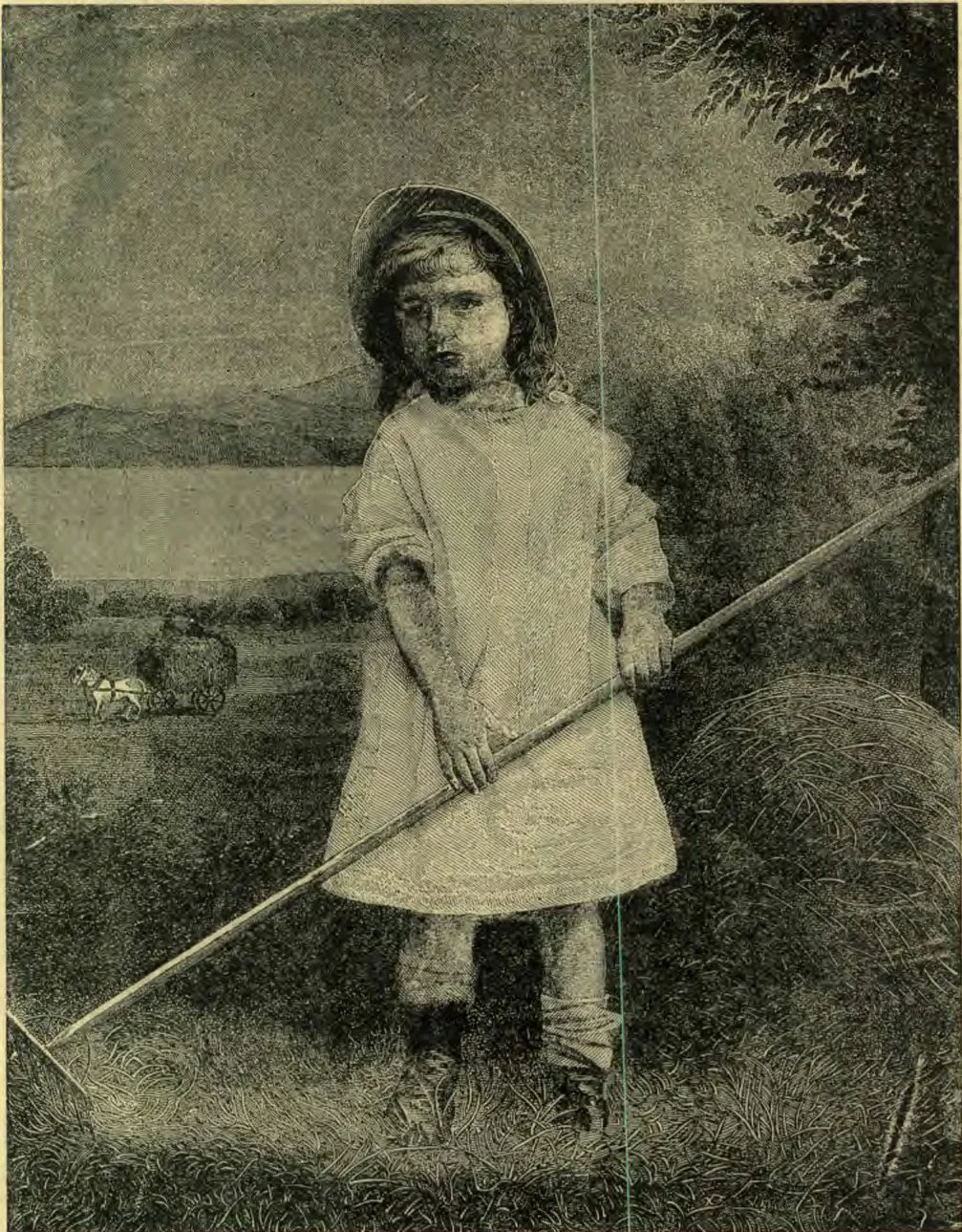
MY JESSIE.

My Jessie lives beyond the town, Just where the moorland, bare and brown, Looks over to the sea; A little maid of lovely birth, But, oh! of all the girls on earth, The dearest girl to me!
Few summers hath she known; her eyes Are bluer than the summer skies, And brimming o’er with fun; Her hair is like a golden crown; Her little hands are sadly brown; Her cheek tells of the sun.
But could you see her come and go, In summer shine and winter snow, As I do, day by day; Now rising like the lark at morn; Like Ruth, now gleaming in the corn; Now busy in the hay;
Now racing like a greyhound fleet Along the glistening sands, with feet Like snow so white and bare; All beauty, health, enjoyment, mirth, You’d say no queen on all the earth Was ever half so fair!
—Mrs. Edwards.

You have reached the end of this edition.

The Youth’s Instructor · Jun 30, 1886