MANY trusts at this writing are waiting the decision of the Federal Supreme Court in the trust cases before it. The essence of the Sherman act is well stated in the following:
Every contract, combination in the form of trust or otherwise, or conspiracy, in restraint of trade or commerce among the several States, or with foreign nations, is hereby declared to be illegal.
The real question or questions are: Did the monopolists or monopolies or trusts INTEND to restrain trade, as many of them doubtless have done? Did the Congress of the United States INTEND to make illegal every contract, combination, or conspiracy which might restrain trade?
Will the Supreme Court decide in the affirmative? Then the trusts must go, competition will be restored, and further infractions of the law punished.
In his recent plea before the great court against the Standard Oil Company, Mr. Kellogg, among other things, said:
“I am not going to deal in romances, but I am going to tell the court the cold, pitiless facts. I say on my oath as a counselor of this court — which honor I do not lightly prize — that the equal in this record in oppression and abuse of power is not known in the commercial history of the country. I distrust my own ability to present to you these facts.”
“It covered Pennsylvania with wrecks,” exclaimed Mr. Kellogg. “It was born and reared in fraud and oppression. It hangs over commerce today like a threatening cloud.”
Taking up repression and concentration, Mr. Kellogg said that while the Standard had absorbed 114 companies, the number in the trust had been held down to twenty. He disputed Mr. Milburn's statement that the Standard merely acquired other companies in the ordinary course of business. He said refineries were bought and dismantled to destroy competition.
“Fear of the law and of prosecution,” exclaimed Mr. Kellogg, “is the only thing that makes the Standard Oil combination approximately conservative. Take away the fear of the law, and every rival concern in this country will be closed in five years. Apprehension alone has kept the Standard within bounds. Remove the dread of prosecution, and the Standard will expand its course of unfair practices and persecution. The removal of its power for evil is the only safeguard for the future.”
It reduced selling prices to drive out independents. Its profits were enormous. Mr. Kellogg recited that a check for $23,000,000 had been drawn and never found. Officials had been examined, Mr. Archbold had made investigation, but no trace of that amount could be found.
The decision of the Supreme Court is of far-reaching importance. What will it be? Will it curb the repressive and oppressive power of great corporate wealth? Or will it give plutocracy a new lease of life?
— ★ ★ —
Selfishness a Curse
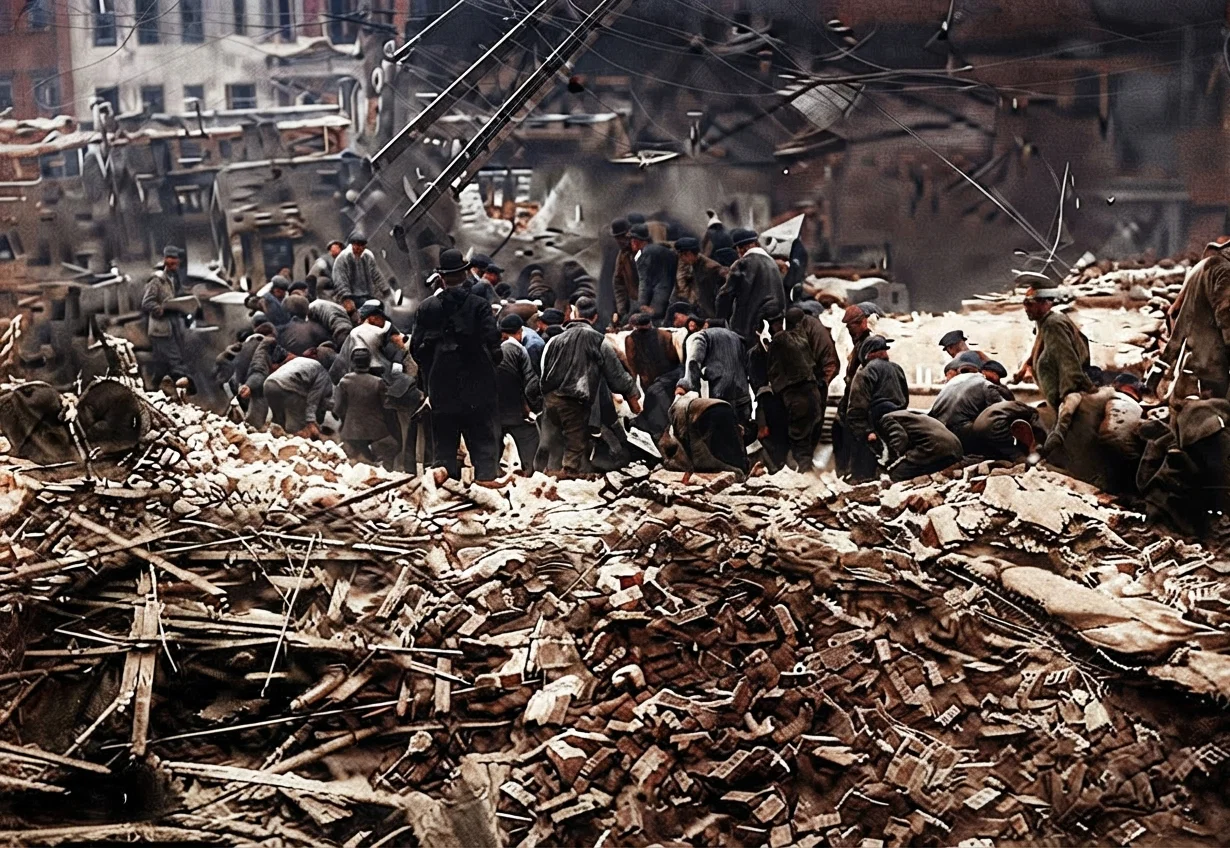
Digging for human beings alive or dead in the ruins after the explosion. The cause seems to have been the ignition of Pintsch illuminating gas mixed with air by an electric spark. The explosion followed the breaking of a gas-main under the power-house.
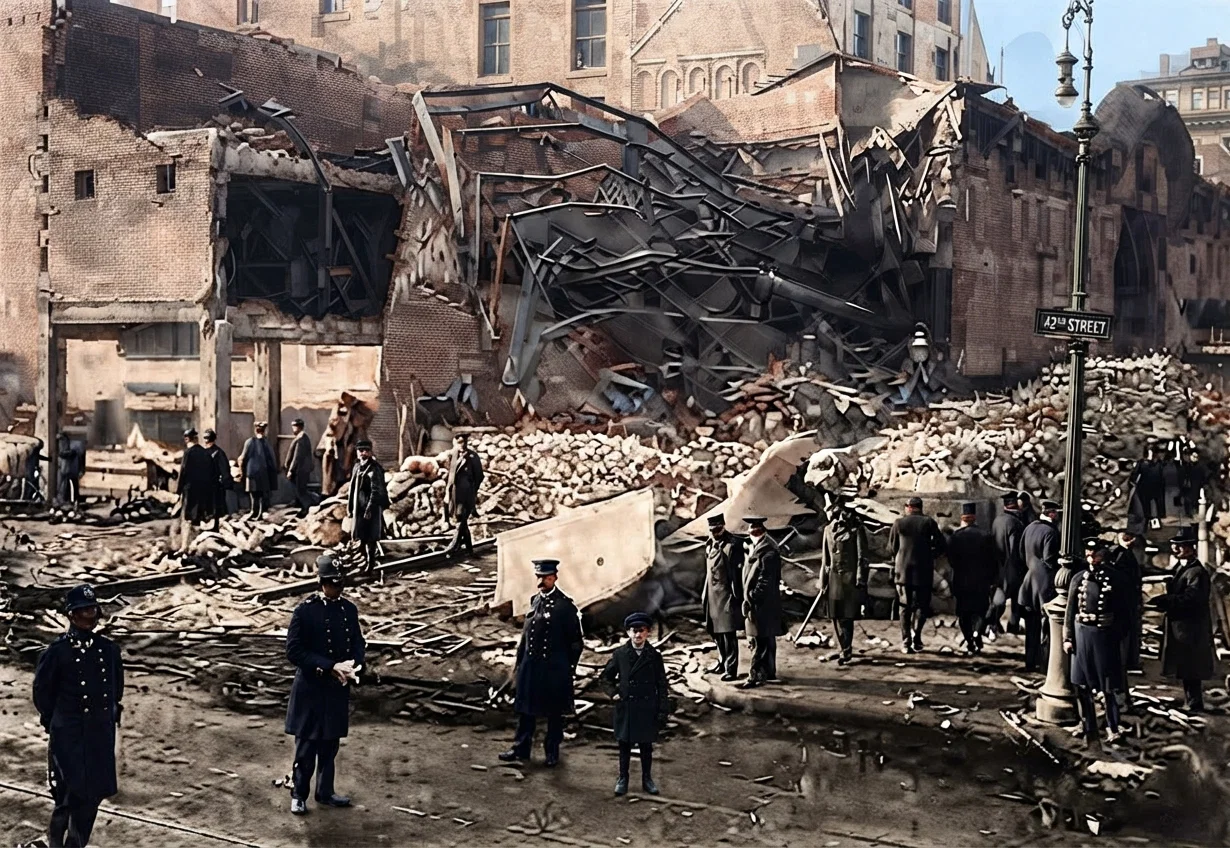
The ruins of the power-house at the Grand Central Terminal in New York, December 20, said by the "Scientific American" to be the worst at railway terminals; 10 were killed and 200 injured. The ruins show the tremendous power exerted.
ITS votaries are to be found everywhere, in every walk of life. See it in our cities, where men strive and struggle to push their way to the front, caring not on whom they trample, and where skill and cunning concentrate their forces to build up out of the failure of the many the fortunes of the few.
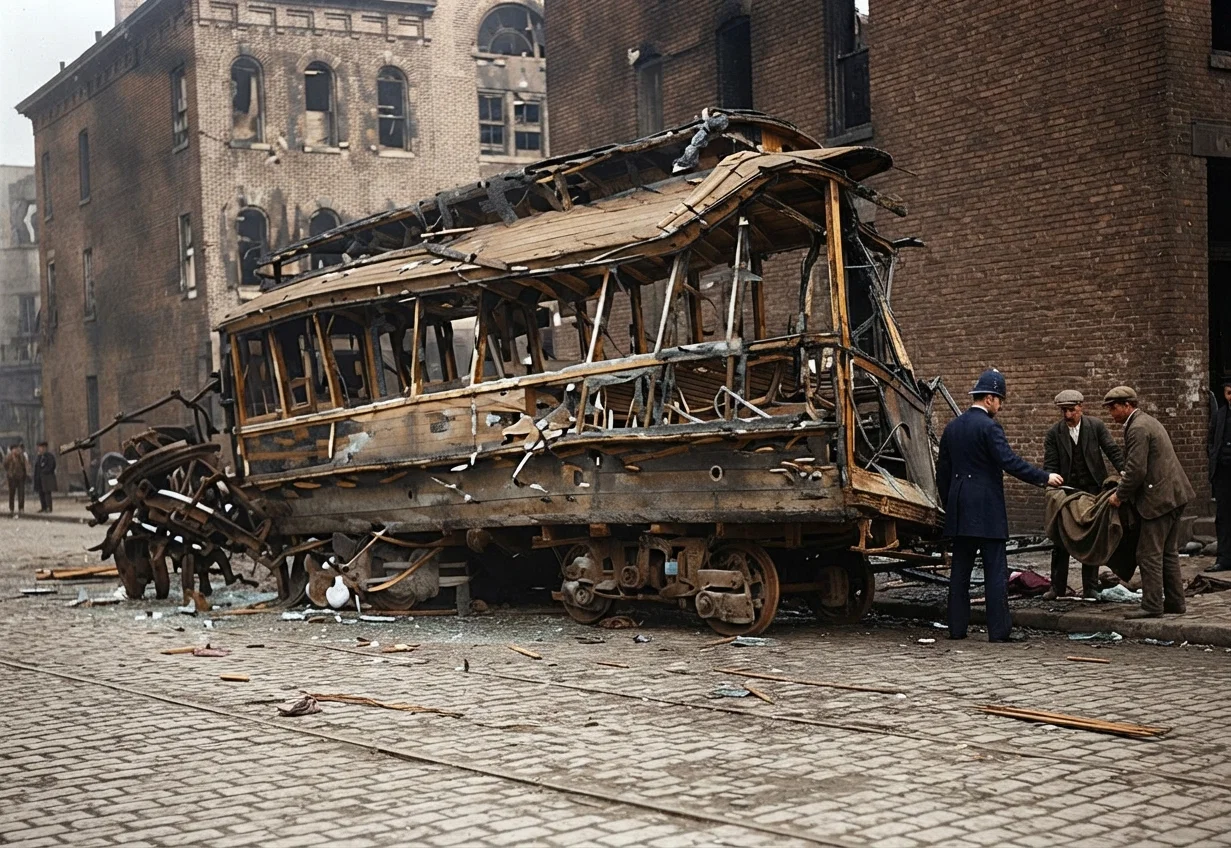
The car which was lifted bodily off the track and turned over. Five pupils of the normal college were killed and twenty injured in this car. The "Scientific American" well says that "electricity and gas are dangerous agents to be used side by side."
See it in our parliaments, where the foremost interests of truth and justice and the loftiest claims of enlightened patriotism are sacrificed to the contemptible triumphs of party, and where it is assumed that a nation's glory is in its material prosperity, its mines and resources and munitions of war, rather than in the harmonious development of its manhood, the peace and happiness and comfort of its toilers.
See it in the law courts, where laws are so administered that a starving man who takes a loaf of bread, or a miserably paid clerk who, in some dire extremity, filches a sovereign, is committed to jail with all its consequent degradation and ruin to their homes, while the daring and unprincipled speculator who fails in his schemes is still allowed to live in ease and luxury after he has paid his creditors a small sum to the pound, and while men who are in powerful positions are allowed to continue through their vile trade to wreck and blight and blast the lives of their fellow men, and ruin their families, and bring them to the lowest of depths of shame, while they live in luxury on their ill-gotten gains.
See it in the churches, where prayer-books bound in silver and ivory are held in jeweled hands which have never performed one deed of holy ministry to want and suffering; and where the sacramental wine, symbol of the blood shed for the world's uplifting, is sipped by lips from which no mercy speaks, and which have never quivered for the woes of those for whom the Saviour died.
O, the glaring and terrible selfishness in our midst! How fitly it may cause us to bow our heads in shame and sorrow! O, the unattended sick-beds, the unregarded miseries, the cry of trampled weakness, and the shout of merciless strength, the tears which find no pity, the wailing to which no one harkens, the multitudes pinching, pining, perishing, while others bask and batten in luxurious ease, and boast of a human nature devoid of each human attribute! How distressing and appalling is all this to every noble mind!
And this infernal selfishness is as blind as it is cruel. It sets men to tasks which they hate, and to which they are impelled by physical force, until they are filled with discontent and hate. It makes laws about land and taxes and property which burden the toiler with a sense of injustice which is full of peril and danger to the nation.
Is it any wonder that the downtrodden and oppressed seek some solution to this awful problem?
It is urged by some of our greedy and strenuous money seekers that they are willing to distribute a portion of their surplus wealth11in charities. To this we reply that men have no right to put charity in the place of justice, and to make almsgiving, as one has said, "a ransom" for the rich. Nothing is really helpful which saps the foundation of self-respect in men and women. It is an insult to the toiler to offer in alms that which should have been distributed in wages. Charity finds its finest exercise, not in the dole which fills the empty stomach, but in justice to the toiler, of whatever sex, and in the lovely offices which minister moral sympathy and spiritual uplifting and strength.—The Christian Herald.
Cardinal Gibbons Honored
Cardinal Gibbons Honored.—January 15, at a mass and banquet given in Washington, D. C., in Cardinal Gibbons's honor, there were one hundred special guests, among whom were Baron Hengelmueller, the Austrian ambassador, dean of the diplomatic corps, occupying the place of second honor; ministers from the Netherlands, China, and Spain. The Western Watchman says: "Other guests at the mass and luncheon were Attorney-General Wickersham; Secretary of the Interior Ballinger; Secretary Nagel, of the Department of Commerce and Labor; Chief Justice White and Associate Justice McKenna, of the United States Supreme Court; Senators Beveridge, Scott, Bacon, Aldrich, Carter, Purcell, and Taylor; Speaker Cannon; Representatives Champ Clark, J. E. Ransdell, Olcott, C. V. Fornes, J. A. Goulden, T. E. Ansberry, J. F. O'Connell, J. J. Fitzgerald, J. M. Graham, J. H. Keliher, M. E. Driscoll, H. J. Dupre, and F. J. Mondell. There were also Surgeon-General O'Reilley and Gen. John M. Wilson, Rear-Admirals Rand and Sands, of the navy; Major Sylvester, chief of police; Dr. Hannis Taylor, former minister to Spain; Commissioner of Labor Neill, District Commissioner Rudolph, former District Commissioner West, Major W. A. McCathran, Judge De Lacy, Judge Mulloway, Justice Stafford, Gen. George H. Harries. . . . Attorney-General Wickersham spoke of the cardinal as a 'citizen of world-wide importance.'" Surely it was a representative and highly significant company.
That accidents to submarines will not necessarily be fatal hereafter, is believed by experts. An accident to the German submarine U-3 which resulted in its sinking with its crew of thirty men, gave opportunity to demonstrate the worth of the submarine telephone and the new salvage vessel Vulcan. The submarine at the bottom became securely lodged in the mud, and in three hours, with the use of the under-sea phone, it was brought to the surface, none the worse for the accident, and with its crew alive.
"Our Rome Letter" in "The Western Watchman" of January 19, after alluding to the fact that the Canalejas measures against the religious orders had passed the Chamber of Deputies in Spain by a vote of 108 to 20, says:
It may be then expected that developments of interest will take place shortly from which "the ambitious young man," Señor Canalejas, will learn more of the power of Rome.
It is reported that a plot has been revealed in which a clique of adventurers in Chicago was preparing a revolution to take place in Brazil in the hope of seizing the rubber industry there. The plans of the promoters were revealed by one who was asked but who refused to join them in their expedition. A steamship is said to have been chartered to carry the conspirators and ammunition to Brazil.
The American Red Cross Society has recently sent out a special car donated by the Pullman Company, for use as a traveling first-aid school. The car is fitted with all sorts of first-aid appliances, and stops at various manufacturing and mining centers long enough to institute classes in first-aid, and to interest local physicians who will conduct the classes after the car has gone.
The Chinese are vigorously protesting against the burning of the dead bodies of plague victims, for fear the ancestors of those stricken may not recognize them in the future life. Despite the precautions taken, several deaths from the plague are reported in Pekin. The Japanese are erecting plague camps capable of containing 4,000 persons.
A St. Louis Catholic paper tells of a dance given in a high school in that city in which the clothing worn by the girl of sixteen "was as flimsy as nothing," and all but 200 of the 2,000 spectators left the hall in disgust, those staying being school boys and girls. Such a dance is indecent anywhere. It ought not even to have been possible.
The Society for the Prevention of Cruelty to Animals in New York City, acting on the information that "acts of cruelty under the name of 'animal experimentation' are being performed" in the State, have passed a resolution asking Governor Dix to include in his message to the legislature some suggestions for the supervision of vivisection.
Medical tests made in Washington, D. C., show that one pupil in each twenty has eye or ear troubles, and one in every six has seriously defective teeth. Leaflets on children's health have been prepared by a volunteer committee of twenty educators, and distributed gratuitously, for the purpose of awakening parental interest.
Sir Alfred Pearce Gould, senior surgeon of the Middlesex Hospital in England, says that prolonged exposure to the X-rays is likely to produce cancer. He also states that alcohol increases the liability to cancer. "The disease," he says, "is twice as frequent in England among brewers and publicans as it is among clergymen, and the liability to cancer in any trade varies with the attendant habits as regards alcohol." "The disease is not limited to man, but occurs in all vertebrate animals." Vegetarians therefore would be less susceptible to the disease than flesh-eaters, total abstainers from alcoholic beverages less affected than those who indulge in alcoholics.
President VanHise of the University of Wisconsin says that one half of the people of the earth are always inadequately fed. In commenting, another remarks, "The universities had better leave a lot of their instruction in the dead languages and begin to teach living people the way of civilization."
Sixty-five thousand voters in California have placed their signatures to a petition protesting against the passage of any Sunday law at the next session of the State legislature, on the ground that Sunday laws are unconstitutional, and direct legislation in matters of conscience and religious liberty.
Commanding officers throughout the United States Army are officially directed to induce soldiers and civilians connected with the army to submit to vaccination against typhoid fever. The order, however, is not compulsory except under such conditions as may justify it.
With nearly 5,000 accredited delegates and thousands of visitors, the Thirteenth Triennial Convention of the International Sunday School Association at San Francisco in June, promises to be the most notable religious gathering in America during the present year.
An increase has been made in the salary of President Fallieres of France. He now receives $50,000 a month, which is as much as President Taft receives a year. The question is asked, "Are we Frenchmen fools, or can it be that you Americans are stingy?"
A bomb factory has been discovered on the outskirts of Lisbon. A number of arrests have been made by police who have raided the place, and who say they have evidence that connects the conspirators with a plot to overthrow the republican government.
The gross receipts from this year's Passion Play at Oberammergau are officially reported as $426,150. After defraying all expenses the balance of $108,750 has been placed in the village treasury for civic improvements and the maintenance of a hospital.
Altho other great engineering works have had their influence, it is thought that the great quantities of explosives required for the Panama Canal is partly responsible for the increase of more than fifty per cent in the price of glycerin.
A cotton-picking machine has been perfected by its inventor, Angus Campbell, after ten years of untiring labor. The average field hand can pick about 200 to 260 pounds a day, while the machine picks 250 pounds in twenty-five minutes.
Aviator Philip Parmalee, at the international aviation meet on the Selfridge Field, San Bruno, California, raised the American endurance record for flying. In a Wright biplane he remained in the air nearly three hours and forty minutes.
The International Congress for the Suppression of the Opium Traffic will be held May 30, 1911, at The Hague. It is stated that the United States will support England in the proposal to include morphia and cocain.
Twenty-six persons were either killed or drowned when the reservoir dam near the city of Huelva, Spain, gave way and the water swept down over the adjacent country in a raging flood.
Strained relations are existing at this writing (January 25) between Italy and Turkey to the extent that Italy is planning a naval demonstration to frighten the latter.
Four persons were killed and nearly a score injured in a rear-end collision on the New York Central at Batavia, New York.
Every year in the United States about 13,000,000 cattle are slaughtered.
What Does It Mean?
By C. H. Bliss
HAT does it mean, when over two thousand American citizens in one county alone, living under the American flag,—citizens of a government whose officers are supposed to be elected by the unbiased vote of the people, sell their votes to the highest bidder?
And this is not an isolated case. Office-seekers openly confess that it costs more to secure an office than the salary amounts to. It is not uncommon, during election campaigns, for companies of men to agree together to sell their votes. And the man who commands the most money secures the election. Having secured his election by the use of money, his favor is sought by the use of money, and the poor man fails to secure justice in our courts.
In selecting officers for ancient Israel, the Lord commanded that men be selected who hated covetousness. Later, however, Israel became corrupted, and it was said of them that "from the least of them even unto the greatest of them every one is given to covetousness." The Lord said further of them, "They afflict the just, they take a bribe, and they turn aside the poor in the gate from their right." Because of these sins Israel was overthrown. So it was in Rome. Officers were bought and sold; the rich ruled, and money controlled her courts. But Rome fell. Corruption ever leads to disintegration. Truly we are living amid the perils of the last days, when men are covetous—lovers of money.
What can the poor man do when our courts are largely controlled by men who have once been high salaried lawyers for rich corporations? Just a few days ago a poor man who endeavored to enter suit for damage against a railroad corporation was turned down because he could not put up the money for the cost of the suit. The judge had been a corporation lawyer.
The prophet says of the last days, "Justice has fallen in the streets and equity can not enter." C. H. BLISS.
Shiloh: the Man of Sorrows
By Mrs. L. D. Avery-Stuttle
By Mrs. L. D. Avery-Stuttle
Chapter LII.—The Story of the Guards
"HITHER goest thou, Mary Magdalene? for behold, it is yet dark; for the sun hath not yet risen above the mountains of Gilgal."
The speaker was one Malthace, the wife of a Roman citizen of Bethany, and an acquaintance of the family of Lazarus.
"I go up to Jerusalem," replied Magdalene, "that I may carry these spices and this ointment; and there be other women who meet me. We go that we may anoint the body of our Master, for He resteth in the tomb of Joseph of Arimathea."
The speaker sighed, and a tear trickled down her pale cheek,—pale with a sorrow too deep for words.
"But it is far to Jerusalem, and surely thou art sick with sorrow. Why may not another than thou carry these spices, and anoint the body of thy Master?"
"Hast thou forgotten, Malthace? dost thou not remember my sad state when I was torn and distracted by seven demons? Thou hast! Yet can not I forget that it was He—my Master—who healed me. Was it not He who gave me back my brother from the grave? How then shall I show my gratitude and my love for Him? Yet truly had we hoped that it had been He who should have redeemed our people Israel. But now He lieth in the sepulcher, and my hope is dead."
"My own heart goeth out in pity for thee, albeit I belong not unto thy people; and as thou knowest, my brother, even Lucius, is a centurion of the guard of Pontius Pilate. He hath told me of the dream of Claudia Procula; and he hath told me also of the prayer which the Nazarene thy Master prayed when He was in an agony when they nailed Him to the cross in Golgotha,—the cross which should have borne the body of Barabbas."
"Ah! the prayer! verily, I also heard the prayer," sighed Magdalene.
"My brother Lucius hath a heart too tender for a soldier of Pontius Pilate," declared the woman, "for after the prayer of thy Master, his heart smote him, so that he grieved to do the part assigned him that day."
"Verily, Malthace, it was thy brother, the centurion, who cried aloud, when he had seen the earthquake and the darkness, saying, 'Of a truth this Man was the Son of the living God!'"
"But now," continued the woman insistently, "why goest thou up to Golgotha while it is yet dark? Why didst thou not go up yesterday—thou and thy companions—to do this kindness unto the Man, thy Master—for see, thou hast thy spices and thine ointment?"
"But verily, Malthace, we made ready these things on the day of the preparation, after the death of our Master. Now, of a truth, thou hast been in the synagogs many a Sabbath day, and in the temple at Jerusalem, and thou knowest the commandment, even that which was spoken from Sinai by the God of Israel, which He did write with His own finger upon tables of stone."
"But," interrupted the woman, "I have heard the priests and the Pharisees affirm, saying, 'This Nazarene respecteth not the Sabbath day;' and I have heard Caiaphas, the high priest at Jerusalem, say that when this Man's disciples passed through the fields of corn on the Sabbath day, and did pluck the ears of corn, and did eat, rubbing them in their hands, thy Master rebuked them not. And so, of a truth, I did believe that this mighty Nazarene had come that He might destroy the law!"
"O Malthace! my Master came not to destroy the law, but to fulfil; for even thus He said unto us. But verily He heeded not the traditions of the Pharisees, albeit He magnified the law of His Father. And verily now, upon this first day of the week do we go that we may anoint His body. For," continued Magdalene, passing onward toward Jerusalem in the gray of the very early morning, "for verily at the death of our Master, upon Golgotha, we returned homeward and prepared spices and ointment, for it was upon the preparation day, and the Sabbath drew on. So we returned and rested the Sabbath day, according to the commandment."
Meanwhile the lonely garden on the slopes of Golgotha has witnessed an event the like of which this old earth had never before seen, and which must forever stand alone in majesty and sublimity unparalleled.
Arrived upon the scene, the women find the Roman guards scattered like autumn leaves before a tempest, the sepulcher open—the Master gone.
Not to the friends of the Crucified One came the angel of the resurrection from the blazing heavens; not to the eyes of the ardent and repentant Barjona; not to the view of John the Beloved, son of Zebedee; not to the enraptured senses of the holy women who loved and ministered unto Him; not even to the beloved mother in her widowed loneliness,—to none of these was it permitted to witness that one glorious and mysterious scene,—the arrival of the mighty messenger from the heaven of heavens,—while the shining galaxy of the sons of God waited in rapturous silence to hear the thrilling words:
"Son of the Eternal, Thy Father bids Thee rise!"
To none of these came the wonderful experience; but to a hundred heathen soldiers of the Roman procurator, Pontius Pilate. They alone, of the hundreds and thousands who had known the Nazarene in life, or had witnessed His tragic death—they alone were the favored witnesses. And therefore it is to the testimony of one of these that we will listen.
Let us hasten to the palace of Joseph Caiaphas. He is seated with Annas, his father-in-law, in a closely guarded chamber, talking over the events of the past days.
"I have just returned from the sepulcher of the Nazarene," he exclaimed, seating himself a little nearer the white-bearded man, where the rays of the candle may fall upon his face, and speaking rapidly and excitedly,—"just returned; and I find the place well guarded, the watchmen at their posts in the garden, and the great Roman seal at the entrance entirely unmolested. Surely thus far our plans have carried well. If we can but keep this Necromancer but a few hours longer safe in the rock-bound sepulcher of the Arimathean, all will yet be well. But of a truth, this Roman centurion—the heathen dog—giveth me small honor;" and Caiaphas repeated the gruff words of the centurion at the tomb.
"Speak not too loudly, my son," continued Annas in a whisper, "for even the walls have ears, and these accursed Roman dogs be our conquerors, as thou knowest; and to them poor Israel must pay her tribute. But we still have no small influence over Pontius Pilate the governor, tho we have but scant authority. For that we have influence, my son, witness how we succeeded in securing the condemnation of this Nazarene, even against the insistent demands of the governor—for verily Pontius Pilate feareth us. Now if but—"
But the arrogant priest never finished his argument.
At that moment a sound as of falling rocks and confused voices in the shadowy streets below, together with a frightful, deafening roar, caused the massive form of Caiaphas to tremble as he hurried to the window. Instantly the walls of the palace swayed and rocked like a ship in a tempest.
"See! there is an earthquake!" gasped Caiaphas, falling upon his knees—"an earthquake, like unto that which shook Golgotha and all Jerusalem when the Nazarene perished upon the cross!"
Soon there was a confused cry at the entrance of the chamber, and a sound of hurrying feet along the corridor. Then the guard Demas thrust his frightened face in at the doorway.
"There is word for thee, O Annas!" exclaimed a soldier entering the chamber without ceremony. His eyes were wild and staring, and his hair and garments torn and disheveled.
"The Nazarene—the Nazarene hath risen from the dead!" shouted the messenger, "and the centurion with his guards has rushed to the palace of Pontius Pilate on Mount Zion that they may tell him!"
"Go call them back, man! Fly! Fly!" screamed Annas; "here is gold for thee—I will make thee rich! Let not these soldiers go into the presence of Pilate till they have seen me! Bring them back, man! Demas, overtake thou these guards—and the centurion—haste! and bring them quickly into the palace."
A half hour passed. The centurion Lucius and some of his guards stood before the high priests.
"What hast thou seen, man?" questioned Annas, his face ghastly white and his voice shaking. "What hast thou seen? Have these accursed followers of the Nazarene stolen away His body?"
"Man, art thou mad?" The countenance of Lucius the centurion was ashen, and his limbs shook so that he grasped one of the marble columns for support, as he whispered hoarsely:
"If the body of the Nazarene hath been stolen, O Annas, it hath been stolen by the armies of heaven!"
"Speak no more foolishly," muttered Annas. "What sawest thou?"
"I will tell thee, O thou high priest, for verily thou hast caused the death of—of the Son of the Highest—but He liveth again! It was the fourth watch of the night, and thou, O Caiaphas," continued the centurion, turning to the younger priest, whose bulging eyes were staring and dreadful to look upon, "thou hadst gone from the garden of burial but an hour. The sentinels marched before the sepulcher, and my guards were at their post. Suddenly from out the northern sky flashed a light brighter than a thousand suns, and an earthquake shook the rocks until many of them leaped from the sides of Golgotha. Then we heard a sound as of myriad voices in the heavens. Immediately one descended whose countenance was like lightning, and whose raiment was white as snow. His voice was terrible, even like the rushing of great waters; and he touched the rock which sealed the sepulcher of the Nazarene—Him whom ye and we crucified on Golgotha—and immediately it rolled away, and he cried aloud:
"Awake, Thou Son of the living God! Thy Father calleth Thee!" Then came He forth—the Man—the Mighty One, while we fell to the ground like dead men; and when we awaked—"
"Where is the Man—the Nazarene!" interrupted Caiaphas, turning his protruding, bloodshot eyes toward the centurion.
"We know not; we did but hear Him cry, saying, 'I am the resurrection and the life!' and when we rose from the ground where we had fallen upon our faces, the tomb of the Crucified was empty, and the Man had gone. And now let us make haste that we may tell the governor, Pontius Pilate." And the deputy of soldiers, headed by the centurion, hurriedly turned to leave the room.13Then the craft and diplomacy of the wily high priest came to his aid.
"Look ye!" springing to the side of the centurion, he cried hoarsely, thrusting a large bag of silver into his hand. "Take this money, and divide it among thy soldiers, and say unto the people, 'Behold, we slept, and His disciples stole Him away.'"
"Ye know the law of the Romans, and that if the governor heareth that we slept, behold, we be all dead men,—and verily, O Caiaphas, we slept not!"
"Ye did sleep! ye DID sleep, and His disciples came and stole Him away!" repeated the high priest insistently, pressing another purse into the hand of the foremost soldier; "and if it come to the governor's ears, we will persuade him, and so secure you; for indeed it was at our request that ye were sent to guard this sepulcher."
The lure of the silver was more eloquent than the tongue of the priests, more eloquent than the voice of truth or the demands of duty and integrity, and more insistent than the clamorings of conscience,—and the lure of the silver prevailed.
"They took the money, and did as they were taught."