Your ShelfYour Projects

Review and Herald, Vol. 89, No. 5.

Christ Enthroned Within
Earlier text: The Need of the Spirit

Statement of the Fund for Year Ending Dec. 31, 1911

CONFERENCES MEMBERSHIP AMT. AT 10C A MEM. AMOUNT RAISED AMOUNT SHORT AMOUNT OVER
Atlantic Union Conference
Central New England 1133 $5891.80 $5963.29 $71.69
Greater New York 1001 5205.20 6068.14 862.94
Maine 428 2225.60 1236.51 $989.09
New York 730 3796.00 3335.05 460.95
Northern New England 444 2308.80 2664.64 355.84
Southern New England 509 2646.80 2728.35 81.55
Western New York 764 3972.80 4149.51 176.71
1450.04 1548.73
Totals 5009 26046.80 26145.49 98.69
| Canadian Union Conference | | | | | | | Maritime | 233 | 1211.60 | 901.06 | 310.54 | | | Ontario | 450 | 2340.00 | 2265.14 | 74.86 | | | Quebec | 163 | 847.60 | 921.75 | | 74.15 | | Newfoundland | 53 | 275.60 | 275.95 | | .35 | | | | | | 385.40 | 74.50 | | Totals | 899 | 4674.80 | 4363.90 | 310.90 | |
| Central Union Conference | | | | | | | Colorado | 1730 | 8996.00 | 6280.26 | 2715.74 | | | East Kansas | 1210 | 6292.00 | 6029.05 | 262.95 | | | Nebraska | 2286 | 11887.20 | 12706.91 | | 819.71 | | North Missouri | 636 | 3307.20 | 3345.87 | | 38.67 | | South Missouri | 641 | 3333.20 | 2813.63 | 519.57 | | | Western Colorado | 432 | 2246.40 | 2071.08 | 175.32 | | | West Kansas | 1155 | 6006.00 | 5332.69 | 673.31 | | | Wyoming | 474 | 2464.80 | 2606.23 | | 141.43 | | St. Louis Mission | 195 | 1014.00 | 510.00 | 504.00 | | | | | | | 4850.89 | 999.81 | | Totals | 8759 | 45546.80 | 41695.72 | 3851.08 | |
| Columbia Union Conference | | | | | | | Chesapeake | 552 | 2870.40 | 1888.57 | 981.83 | | | District of Columbia | 777 | 4040.40 | 4304.12 | | 263.72 | | Eastern Pennsylvania | 1114 | 5792.80 | 6146.54 | | 353.74 | | New Jersey | 659 | 3380.00 | 3558.77 | | 178.77 | | Ohio | 2100 | 10920.00 | 8079.39 | 2840.61 | | | Virginia | 406 | 2111.20 | 1074.91 | 1036.29 | | | West Pennsylvania | 757 | 3936.40 | 2282.55 | 1653.85 | | | West Virginia | 159 | 826.80 | 667.43 | 159.37 | | | | | | | 6671.95 | 796.23 | | Totals | 6515 | 33878.00 | 28002.28 | 5875.72 | |
| Lake Union Conference | | | | | | | East Michigan | 1760 | 9152.00 | 6009.99 | 3142.01 | | | Indiana | 1800 | 9360.00 | 7031.14 | 2328.86 | | | Northern Illinois | 1280 | 6656.00 | 6257.54 | 398.46 | | | North Michigan | 923 | 4799.60 | 1925.34 | 2874.26 | | | Southern Illinois | 561 | 2917.20 | 2905.44 | 11.76 | | | West Michigan | 2239 | 11642.80 | 12261.22 | | 618.42 | | Wisconsin | 2626 | 13655.20 | 9383.55 | 4271.65 | | | | | | | 13027.00 | 618.42 | | Totals | 11189 | 58182.80 | 45774.22 | 12408.58 | |
| Northern Union Conference | | | | | | | Iowa | 2534 | 13176.80 | 10838.41 | 2338.39 | | | Minnesota | 1525 | 7930.00 | 7929.40 | .60 | | | North Dakota | 960 | 4992.00 | 5075.70 | | 83.70 | | South Dakota | 1008 | 5241.60 | 5046.58 | 195.02 | | | | | | | 2534.01 | 83.70 | | Totals | 6027 | 31340.40 | 28890.09 | 2450.31 | |
| North Pacific Union Conference | | | | | | | Montana | 402 | 2090.40 | 3525.20 | | 1434.80 | | Southern Idaho | 512 | 2662.40 | 3324.23 | | 661.83 | | Southern Oregon | 513 | 2667.60 | 3499.72 | | 832.12 |
CONFERENCES MEMBERSHIP AMT. AT 10C A MEM. AMOUNT RAISED AMOUNT SHORT AMOUNT OVER
Upper Columbia 1920 $9984.00 $11834.39 $1850.39
Western Oregon 1501 7805.20 10485.90 2680.70
Western Washington 1443 7503.60 8173.57 669.97
Alaska 2 10.40 11.00 .60
East Oregon 37 192.40 146.32 $46.08
46.08 8130.41
Totals 6330 32916.00 41000.33 8084.33
| Pacific Union Conference | | | | | | | Arizona | 288 | 1497.60 | 1400.58 | 97.02 | | | Southern California | 2840 | 14768.00 | 17271.35 | | 2503.35 | | Utah | 187 | 972.40 | 436.91 | 535.49 | | | North. California-Nev. | | | 3580.73 | | | | Central California | 5089 | 26462.80 | 2836.07 | 4167.74 | | | California | | | 15878.26 | | | | | | | | 4800.25 | 2503.35 | | Totals | 8404 | 43700.80 | 41403.90 | 2296.90 | |
| Southeastern Union Conference | | | | | | | Cumberland | 465 | 2418.00 | 2430.45 | | 12.45 | | Florida | 678 | 3525.60 | 3651.18 | | 125.58 | | Georgia | 336 | 1747.20 | 2045.04 | | 297.84 | | North Carolina | 281 | 1461.20 | 1066.33 | 394.87 | | | South Carolina | 175 | 910.00 | 804.56 | 105.44 | | | Asheville | | | 337.66 | | 337.66 | | | | | | 500.31 | 773.53 | | Totals | 1935 | 10062.00 | 10335.22 | | 273.22 |
| Southern Union Conference | | | | | | | Southern Union | | | 6.00 | | 6.00 | | Alabama | 160 | 832.00 | 751.37 | 80.63 | | | Kentucky | 196 | 1019.20 | 742.13 | 277.07 | | | Louisiana | 264 | 1372.80 | 1394.36 | | 21.56 | | Mississippi | 141 | 733.20 | 925.84 | | 192.64 | | Tennessee River | 538 | 2797.60 | 1375.72 | 1421.88 | | | Southern Union Mission | 387 | 2012.40 | 1231.06 | 781.34 | | | | | | | 2560.92 | 220.20 | | Totals | 1686 | 8767.20 | 6426.48 | 2340.72 | |
| Southwestern Union Conference | | | | | | | Arkansas | 386 | 2007.20 | 1169.73 | 837.47 | | | New Mexico | 243 | 1263.60 | 975.68 | 287.92 | | | North Texas | 1863 | 9687.60 | 3568.26 | 6119.34 | | | Oklahoma | 1356 | 7051.20 | 7037.77 | 13.43 | | | South Texas | 289 | 1502.80 | 826.54 | 676.26 | | | West Texas | 267 | 1388.40 | 767.47 | 620.93 | | | Southwestern U. Mis. | 120 | 624.00 | 190.11 | 433.89 | | | | | | | 8989.24 | | | Totals | 4524 | 23524.80 | 14535.56 | 8989.24 | |
| Western Canadian Union Conference | | | | | | | Alberta | 337 | 1752.40 | 3320.67 | | 1568.27 | | British Columbia | 316 | 1643.20 | 2149.11 | | 505.91 | | Manitoba | 212 | 1102.40 | 1233.47 | | 131.07 | | Saskatchewan | 98 | 509.60 | 1685.69 | | 1176.09 | | | | | | | 3381.34 | | Totals | 963 | 5007.60 | 8388.94 | | 3381.34 |

Summary

CONFERENCES MEMBERSHIP AMT. AT 10C A MEM. AMOUNT RAISED AMOUNT SHORT AMOUNT OVER
Atlantic 5009 $26046.80 $26145.49 $ 98.69
Canadian 899 4674.80 4363.90 $310.90
Central 8759 45546.80 41695.72 3851.08
Columbia 6515 33878.00 28002.28 5875.72
Lake 11189 58182.80 45774.22 12408.58
Northern 6027 31340.40 28890.09 2450.31
North Pacific 6330 32916.00 41000.33 8084.33
Pacific 8404 43700.80 41403.90 2296.90
Southeastern 1935 10062.00 10335.22 273.22
Southern 1686 8767.20 6426.48 2340.72
Southwestern 4524 23524.80 14535.56 8989.24
Western Canadian 963 5007.60 8388.94 3381.34
Miscellaneous 14319.99 14319.99
$38523.45 $26157.57
Totals 62240 $323648.00 $311282.12 $12365.88

The Ten-Cent-a-Week Fund for 1911

The following report of the Ten-cent-a-week Fund for 1911 presents figures of special interest to all, trying, as we have been, to reach the goal of raising for missions a sum equal to ten cents a member each week during the year.
Had a little over twelve thousand dollars more been received at the General Conference treasury before our books were closed, our goal would have been reached. As it is, the figures show an encouraging gain over 1910 in our offerings to missions, there being a gain of $10,854.55.
Of the twelve union conferences, it will be observed, four exceeded the mark set for ourselves, and that by quite an excess. Two of the unions gave over $11,000 more than their ten cents a week amounted to. Of the eight unions not reaching the goal, three came within about $2,000, and one within $310, of making up the amount.
Of the seventy-five conferences and mission fields included in this report, thirty-three exceeded the ten-cent-a-week-per-member offering, leaving forty-two that came behind. Not much can be said as to the cause of this failure. It is worthy of notice that some conferences in sections where we would least expect the brethren and sisters to give large offerings to missions, have, notwithstanding, exceeded the ten-cent-a-week rate. In some sections the severe drought of last year may have had much to do with the shortage revealed in the accompanying table.
With 1911 our Ten-cent-a-week Fund closes. Increased demands are made upon the treasury for 1912. To meet these, it has been cheerfully agreed to place our endeavor a little higher by setting the goal at fifteen cents a week per member instead of ten cents, beginning Jan. 1, 1912. With a little change in the reckoning of funds to apply on this new rate, and the loyalty of all the brethren and sisters in helping to meet the extra demands made upon us by the rapid progress of the message in all lands, it is believed that during 1912 we shall be able to raise this amount, or to come very hopefully near it. It will be necessary, however, for each local conference to begin at once to plan for meeting the new standard. Never before in the history of the message were there such openings and pressing demands made upon us as at the present. New fields are being entered that beckon us on to increased activity. The Lord is going before his people and giving success to our missionaries in every land entered. Altogether, the prospects are bright before us for the year just opening.
W. T. Knox.

Subject to Higher Powers.—

“Put them in mind to be subject to principalities and powers, to obey magistrates, to be ready to every good work, to speak evil of no man, to be no brawlers, but gentle, showing all meekness unto all men.”

American Board Centennial Hymn

O thou to whom a thousand years Are but a day, how short appears The measure of a century's span, In carrying out thy sovereign plan!
A plan eternal in its scope, Immortal in its radiant hope, Dimly to Abraham revealed, Alone in old Chaldea’s field.
The glorious theme the prophets taught, Their souls aflame with God’s great thought, Through long, slow centuries rolling by With leisure of eternity.
At last, the Christ! Men's hearts are thrilled! Lo, now the plan will be fulfilled! Yet still the years their cycles run, And still thy work seems scarce begun.
Then swiftly in one century’s hour Jehovah bares his arm with power, Flings wide the gates in ancient lands, From fettered millions breaks the bands;
Bids learning, statecraft, science, gold, Arise and speed his purpose old; Inspires new heralds, wings their feet, Arms them with faith all foes to meet.
Almighty Father, Saviour, Friend! In awe before thy sway we bend; Empower our souls to read aright These tokens of thy love and might;
To see converging everywhere The answer to our daily prayer: Thy kingdom come, thy will be done, In every land by every one. — Frances J. Dyer.

Bombay, India

GEO. F. ENOCH
LATELY we have been on the move. The death of our little boy has been a very sad experience for us,— the saddest of all our lives,— and it almost incapacitated us for over two months. As none of us had felt well at Panvel, our committee concluded that the bungalow there was not an advisable residence; so while staying by the station and the work already opened, they thought best to advise me to locate my family elsewhere, until we should build our own bungalow. As we were not certain as to the best place in the district selected for the building of the bungalow, we have purchased a tent, and plan to tour this cool season among the villages. After this we can decide where we want our bungalow.
Brother and Sister A. G. Kelsey are nicely located at Lonavla, in the Bhor Ghat, where the railway to Poona and Madras crosses the Western Ghats [mountains; also a pass through a mountain range]. This is at the head of the valley we have occupied, and is a healthful location. For two years there has been an interest among the English railway people there. I had the pleasure of baptizing four sisters Nov. 26, 1911, and we hope soon to organize a little church at that place.
Our main mission station is Panvel, thirty miles nearer Bombay, a town of nearly ten thousand inhabitants, situated on the Bombay-Poona main wagon road. There are more than three hundred villages in our district and about two hundred thousand people. We have two schools in Panvel,— a boys' school with an enrolment of thirty-five, and a girls' school with twenty-five pupils. There are other calls for schools which we hope to give attention to in the near future. There are two native evangelists who daily preach in the villages and sell literature, chiefly Gospels. The people have treated us and our workers well the past year, and we have a sympathetic hearing for the gospel message. In India we must clear the land before we can even plow for planting, and it takes time for fruit to appear.
I returned from Mussoorie a month before Mrs. Enoch and Pearl came home, so as to get matters in shape. As Bombay and Panvel are only across the bay from each other, with a daily steamer, to hire a bungalow in Bombay was the best thing to do. At the time it seemed to me to be one year too early, as we were not expecting the English evangelist until next year, but I decided after earnest prayer that if a place opened up we would come. I am glad to say that we found a very good place, much better than we had hoped; so I closed the contract and we moved here.
Just after I had closed the deal, I received the letter saying two evangelists were coming in February, so it seemed providential; for surely one of the two can be spared for Bombay.
We are getting hold of the ropes and anxiously awaiting the coming of a minister and a Bible worker. We will then swing into a big effort for Bombay, and trust and pray for such an outpouring of the Holy Spirit that a good church, representative both of European and native, will be established in this great metropolis for West India.
We also have interests in Lonavla, Poona, and Ahmadabad, which we hope to develop as fast as possible when the reenforcements arrive.
We are looking forward with pleasure to the coming of the new workers. Dr. Mann and his family arrived all well, and after spending a short time here, left for Lucknow.
We are just recovering from the first sight of royalty. Bombay put on its best in parades, illuminations, fireworks, enormous crowds, etc., and we saw a real king and queen. [This was when King George and Queen Mary of England visited the East to be crowned emperor and empress of India.]

A Plea for the Hottentots of South Africa
ISAAC B. BURTON
“And I saw another angel flying in mid heaven, having eternal good tidings to proclaim unto them that dwell on the earth, and unto every nation and tribe and tongue and people.” Rev. 14:6, A. R. V.
It is well for us to consider just a moment the vastness, the extensiveness of the above text. The angel carrying the good tidings is to proclaim them to those dwelling on the earth. We would conclude from the words, “unto them that dwell on the earth,” that every person living in the time of this proclamation would have the privilege of hearing it; but the Lord is very definite in his commission, and in order that there be no possible chance of any one’s being overlooked, he says the good message is to go to “every nation and tribe and tongue and people.”
I am grateful for this promise, and knowing that what the Lord promises he is also able to perform, I can with a light heart pen a little information of a tribe which, had justice been done to it, would to-day stand as a leading nation in Cape Colony.
I have reference to the people now commonly called the Hottentots, but formerly known as the Quaiguais. Quaiquai was the tribal name, but the clicks being difficult for the Europeans to learn, they called them Hottentots, a name which now embraces both the original tribe and the remains of a few other tribes. By the onward march of civilization, these people have been driven together, and they have now become so mixed that it would be difficult to distinguish the separate tribes. Taken as a whole, they hold no aversion to being termed Hottentots.
Several years ago I wrote an article for the Medical Missionary on the Bushmen of the Karihara, not knowing at the time that they were a branch of the once powerful Hottentot tribe. Dr. Bleek states that “the Hottentots and Bushmen resemble each other in their mythology and in many of their customs, although their language is somewhat different.” These two races evidently branched from one parent stock at a distant period.
I hoped that something would be done for them before now, as they are much nearer than some tribes among whom we have established missions. Having faith in the promise that this gospel of the kingdom shall be preached to all, I again make the plea, not for the Bushmen only, but for the originals as well. They are at our very door, yet have been passed by; and sometimes it is even said, “O, he is only a Hottentot!” Yet these people have souls for whom Christ died.
These people once occupied practically the whole of Cape Colony, and are still to be found in large numbers in German West Africa and in the Colony, mostly in settlements extending to the Natal border.
They are described in history as “more akin to the Mongolians, having broad foreheads, high cheek-bones, oblique eyes, and a dirty olive-colored complexion. The orbits of the eyes are wide and distant from each other,” and their faces can not be considered attractive. The hair of the Hottentot is very peculiar in the way it grows on the head. Like that of the Negro, it is short, crisp, and woolly, but it possesses the peculiarity of not covering the head, growing in little patches, each about as large as a pea. These patches are quite distinct, and in many instances are scattered so sparingly over the head that the skin can be plainly seen between them.
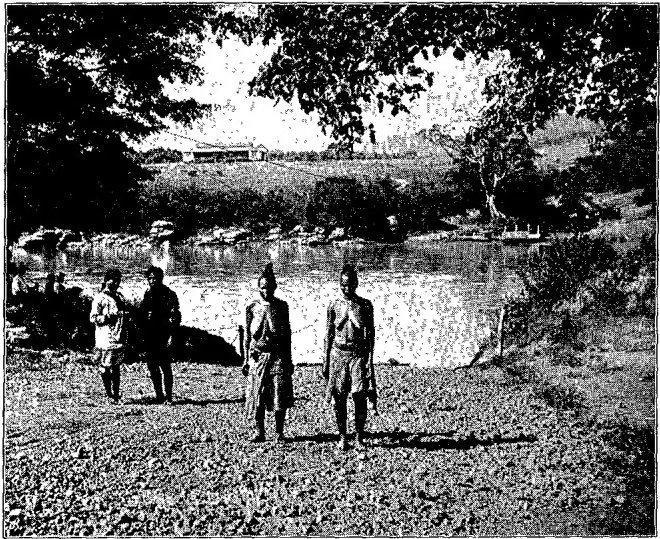
NATAL RIVER, WITH FARMHOUSE AND ORCHARD
IN DISTANCE
NATAL RIVER, WITH FARMHOUSE AND ORCHARD IN DISTANCE
These Hottentots are not like any of the other native races of Africa, either in language, customs, or physique. As to their origin, we have no clue, although many theories are advanced. One thing is certain, that they have migrated from the northern parts of the continent. According to their own traditions, they were once a powerful nation, divided into tribes, each tribe with its chief, ruled over by a king or head chief.
When the Cape was discovered in the fifteenth century, the records state that this people were living in peace and harmony, having large herds of stock, which fact alone would prove them to have been a pastoral people. They believed in a Supreme Being, and in the immortality of the soul, but had no idea of future reward or punishment. Like the Kafirs, they worshiped the spirits of their ancestors, and very much dreaded their influence. There is an insect called the Hottentots’ god, which is held in veneration. They also used to pray to the sun, moon, and stars.
Their weapons differed from the weapons of the Kafir tribes, who use spears, axes, and sticks. The Hottentots had bows and arrows, and often poisoned the arrows.
This people who at one time were so rich in flocks, have been driven by the gradual encroachment of the European colonists and by wars with other tribes, to seek a refuge in the deserts of the interior, among the inaccessible rocks; and are now found in settlements scattered over the Colony, and are practically destitute of flocks. In the Cape Colony records, 1809-11, I find these words: “A people not inferior in natural endowments to any upon the face of the globe were represented to the colonial government as unfit to live.” Had the government been enabled at that period to acquire the information necessary to decide upon the best measures to be adopted, the horrors which have since disgraced the name Christian in these parts might have been prevented.
The Dutch in the seventeenth and eighteenth centuries were determined to make the native a serf (and that spirit has not yet died out), and they denied him the rights of a man. If the native revolted against this treatment, he was put out of the way in a businesslike fashion; but if he submitted, as did most of the Hottentots, he was treated with patriarchal kindness and leniency. The Dutch settlers appear from the first to have disassociated their dealings with the Hottentots from their ordinary code of morals. It was not thought dishonest to cheat them, nor illegal to rob them.
The Hottentot is not so addicted to idleness as the other native races, and is really the most useful laborer the farmer has. He is the most intelligent worker, and is noted for his fidelity to his employer. It is not uncommon to find Hottentots who have been with their employers all their lives, and on no condition would they leave, as they consider themselves a part of the estate.
Unfortunately, many vices have crept in among them, of which drunkenness is the greatest, and this has played such havoc with them that it is bringing about the extinction of the race within the Colony.
The first mission in Cape Colony was established among the Hottentots in the year 1737, by the celebrated George Schmidt. He started the work by opening up what is to-day known as the Genadendal Mission, in the district of Caledon, under the direction of the Moravian Missionary Society. Mr. Schmidt’s health failed, and he left the Colony in 1744. When he wanted to return, the company refused him permission. Although nothing more was done for fifty-two years, the seed sown by the servant of God took root, and fruit was seen when the station was re-opened. There has always been a great deal of opposition to any instruction being given to the Hottentots, and that spirit is very much alive to-day.
This mission station has about five thousand inhabitants. Each family has a house and lot, the latter being large enough for a garden. Besides this, there is a tract of country which is used in common by all for pasturage. The mission has fine dwellings, large church-school buildings, a printing-press, and stores.
This is but one of the missions among this people. There are many more; but there are thousands without these privileges. Many of these people can read and write, and some are well educated. But when are we going to take to them the last message.
I plead for this people. We have not their hard language to learn; for they can be reached with the Dutch. There are many among us who are conversant with that tongue. Who will be the first to say, “Here am I; send me”? A great work can be done for them by working among them with a gospel wagon. It is one of the cheapest, simplest, and yet most efficacious methods of which we know. May the Lord open hearts so that this message may go to these waiting people, and the work be finished without delay.

The New Year

Like a stainless white page comes the new year to greet us, Pure as the petal of lily or rose, Perfumed and sweet as the breath of the spring-time— What shall we write as it hastes to its close, With pencil of speech, or of thought, or of deed, In business, in pleasure, in purpose, in creed?
Like a ship at the quay waits the new year to bear us Away on a voyage of weal or of woe,— Of woe if the chart and the wheel are neglected; Of weal if we steer by the Book that we know, In fog and in cloud, amid billow and blast And winds whistling sharp round rigging and mast.
Like a king from his throne comes the new year to show us The way to the summits of life and of love; Eyes beaming with hope and hands laden with good things, He would bless us, enrich us, and lead us above The low valley road of dark doubt and despair, To the sun-lighted heights, to walk evermore there.
— Robert Francis Coyle.

The Blind Child

“I KNOW what mother’s face is like, Although I can not see: It’s like the music of a bell; It’s like the way the roses smell; It’s like the secrets fairies tell,— All these it’s like to me.
“I know what father’s face is like, I’m sure I know it all: It’s like his step upon the stair; It’s like his whistle on the air; It’s like his arms that take such care, And never let me fall.
“So I can tell what God is like, The God whom no one sees: He’s everything my mother means; He’s everything my father seems; He’s like my very sweetest dreams: But greater than all these.” — Selected.

Two Examples

E. R. ALLEN
As showing that the salvation of our children depends very largely upon the influences with which they are surrounded in the home, the following incidents have come to our notice:—
The third angel's message came to a farmer and his wife who were living in a new and prosperous section of the country, where the soil was rich and the land cheap. They secured possession of a good tract, and by hard work and economy brought it to a high state of cultivation. Their home was a beautiful one, with all they could wish to make them happy. Two children, a boy and a girl, were entrusted to their care. The father and mother seemed to love the truth, and left a popular church to cast in their lot with the remnant people.
About the time the children were ready for an intermediate school, such an institution was established within a few miles of this home. The children begged to be allowed to attend; but their help was needed to do the farm work and to keep up the work about the house. So the privilege was denied them. The result was that when but a mere girl the daughter married a worthless man who soon left her. She married again in a short time, in each instance out of the truth. The parents were required to spend for her in her troubles much more than it would have cost them to have educated her. The boy also married into an unbelieving family in the neighborhood. Finally the father and mother found the way too strait, and gave up their faith in the message for this time. They became hard, cynical, and avaricious.
But we turn to another scene. Some thirty years ago two faithful brethren pitched a tent in a certain neighborhood, and organized a small church of Sabbath-keepers. In a few years, through death, apostasy, and removals, one family only was left to hold up the light of truth in the community. The father in this family soon fell ill, and after a lingering illness, died, leaving the mother and five children to fight the battles of life alone. The eldest son was an invalid, and the youngest but five years of age.
Part of the farm was sold to pay debts, part was rented, and the boys worked the rest as best they could. Four months each winter at the district school constituted their educational advantages. But in spite of droughts, losses, and hard times, the mother managed to provide the family with the REVIEW AND HERALD and Youth's Instructor, and occasionally to buy a good book. A home Sabbath-school was maintained, in which for a number of years the mother was superintendent, secretary, and teacher. Great stress was laid on the preparation of the lessons. Family worship was maintained morning and evening. The Testimonies were carefully studied by all, and were often read aloud at the worship hour. Each year some, if not all, of the family were at the camp-meeting. No matter what sacrifice this cost, it was arranged for.
As a result, every member of this family is to-day rejoicing in the truth, and all are bearing heavy responsibilities in connection with the work of the message. Each of these young people married in the truth. The mother has been allowed to live to see the results of her faithfulness, and is joyfully waiting for the coming of the Saviour.
Port Hope, Ontario.

To Save Our Children

MARY C. HANSON
There never was a time in our experience when the children were led away by the pleasures of this world as they are now. This being true, it is most important for us as parents to be awake to the situation. Many of our people live in cities, where there are all kinds of attractions for the children and youth. Parents should exercise great caution in this matter, lest the children be permitted to form appetites for these attractions, which will result in the ruin of their souls. Every city has its quota of moving-picture shows and other cheap shows. We call them cheap, but they are not cheap. They are taking the children's hearts, which belong to God.
Many parents, I fear, will not realize this till it is too late. Some let their children go to the theaters; some even go themselves. My heart aches when I think of it. There are neighbors and friends about us, millions beyond the sea, who have never heard the message of our Saviour's soon coming. How much better it would be for us to spend the evenings at home with our children, trying to interest them in missionary work by reading to them or with them our good REVIEW and Signs, or in other pleasurable and profitable occupations.
I am thinking of an experience which one mother had with one of her older boys, who was a member of the church. He came to his mother's bedside after she had retired, and desired to be permitted to remain away from church the following Sabbath, because it was quarterly meeting, and he did not feel worthy to take part in the ordinances. The mother showed him that this was Satan's effort to gain a victory over him, and she set before him the urgent necessity of standing loyal and steadfast for God and truth in view of the nearness of the journey's end. He was admonished to confess his sins to God if he had done wrong, and to meet the tempter with the words used by the Saviour when tempted in the wilderness. The boy kissed his mother good-night, and retired; and she had the blessed assurance that the victory was won.
Would that mother have had that experience with her boy that night if she had been in attendance at some show or theater? I believe not. To her it was not to be compared with any number of shows.
Forest Grove, Oregon.

Medical Question Corner

Answers by Dr. P. S. Bourdeau-Sisco, head lady physician of the Washington (D. C.) Sanitarium.

Intestinal Worms

Tapeworm

“A person is passing what looks like segments of a tapeworm in the stools. How may it be removed? E. M.”
TREATMENT.—For two days before the medicine is administered, the patient should be given a light diet. On the second day omit the evening meal and give a thorough laxative at night, following this in the morning by oleoresin of male fern, one-half grain. Give this in four doses one hour apart. Two hours after the last dose is given, administer a dose of salts. Only milk should be taken during this day. All stools should be carefully examined to see that the head has been expelled. If this does not come away, the links will form in a short time again. This course of treatment may have to be repeated more than once before the head is secured. The head is no larger than a pin-head, is round, and is connected with the first segment of the body by a narrow neck. It is very important that the stomach should be empty before the male fern is administered, and that this should be followed by a vigorous purging. Do not use castor-oil for this purpose.

Roundworm

“My little girl is troubled with roundworms. Please tell me how they may be removed permanently. E. R. S.”
TREATMENT.—These worms are from five to ten inches in length. Children from three to ten years of age are most likely to have them. The medicine most successfully used is santonin, two or three grains for an adult and one-half grain to three grains for a child. Follow by a dose of salts. This treatment may be repeated three or four days in succession.

Pinworm, or Threadworm

“My neighbor’s child has pinworms. Will you please tell me what to do for her? H. R. R.”
TREATMENT.—While this is considered a simple condition, it is sometimes difficult to reach these worms. The reason for this is that the condition has been allowed to go on until the whole colon is infected. The upper part of the colon is hard to reach with medicinal injections. Absolute cleanliness is essential in the treatment of these cases. After each stool the anus should be carefully washed with soap and water and one-per-cent solution of lysol or a weak solution of bichlorid of mercury. For the itching apply mercury ointment at bedtime. This usually relieves the symptom. Thoroughly wash out the colon by using lukewarm water containing one teaspoonful of boracic acid to a pint of water; after which, use an injection of bichlorid of mercury, one to ten thousand. Inject at least one-half pint of this bichlorid solution as high in the bowel as possible, using a high bowel catheter, and retain the medicine as long as possible. This treatment should be repeated every second or third night. If the worms are high up in the bowel, sometimes it is necessary to use medicines by mouth, such as Epsom salts, and simple bitters which will assist in eradicating them. One should be very persistent in this treatment, and be very sure that the worms are all out of the bowel; for if any remain, they multiply rapidly, and in a short time the condition will be as bad as it was in the beginning.

West Africa

A REPORT may be of interest in regard to the work at this place. We came here from Freetown last December, to take charge of the school, as Brother T. M. French had to go down the coast. At that time we had in the school twenty-four boys. Now we have forty-five. One has been sent out into the work, and we are hoping to send out four or five more after the general meeting, which we expect to hold about the first of the year.
The church at this place has gained fifteen members the past year, and all are of good courage and rejoicing in the light of the precious message.
We have built our factory, which is twenty-five by fifty feet, and fairly well equipped. We have done quite a little repair work, built six trucks, at an average price of twenty pounds each, and hope to build two more before the year closes. We would have accomplished much more had it not been for the sickness of Mrs. Lewis, which kept me away from my factory work a considerable part of the time.
The work is moving on well, and we are all of good courage. The cry is for more reapers, for the harvest truly is great.
The arrival of Brother and Sister F. S. Bolton has been a source of great relief, as they have taken over the greater part of the educational work.
W. H. LEWIS.
Waterloo.

Haiti

On Nov. 4, 1911, I took passage on the French steamer “Quebec” at St. Thomas, Danish West Indies, for Cape Haitien, Haiti. I had spent a week in St. Thomas and St. Croix with Elder H. C. J. Walleker and his family and the other laborers.
Elder Wm. Steele, of Porto Rico, had accompanied me to St. Thomas. He and Elder Walleker came with me on the “Quebec” as far as San Juan, Porto Rico. Elder Walleker was to spend a few days visiting the believers in Porto Rico.
On the morning of November 7 the ship arrived at Cape Haitien. Brother M. N. Isaac came out to meet me. Brother Henri Williams was quite sick, and though I did not leave Haiti until December 19, he was but little improved.
November 10 Brother Isaac and I went into the country to visit the brethren at Grande Riviere and Pignon. Grande Riviere is about eighteen miles from the Cape. Here we stayed over Sabbath and until Tuesday. I baptized thirteen candidates about midday Sabbath. That afternoon we had a good social meeting, and at night celebrated the ordinances. I have been a minister for some years, but here I performed my first marriage ceremony. All my work among these people was done through an interpreter. For the baptism I learned the French, “Mon frère, je vous baptise au nom du Père, du Fils, et du Saint Esprit;” changing to “Ma sœur” in case of a sister.
As this was the limit of my French, you can understand that I could do but little for the people through public labor.
In conversation I had little trouble, as the one who interpreted was familiar with both languages.
Several brethren from Grande Riviere went with us to Pignon about thirty miles farther on into the interior. Here two were baptized and three united with the church. The ordinances we celebrated on Wednesday night, and Thursday we returned to Grande Riviere. The following morning I returned to Cape Haitien. Traveling in Haiti must be done on horseback, but before long this trip may be made on the railroad.
Elder W. J. Tanner left Haiti last April. Since that time the field has been without a superintendent. I was much encouraged to find the brethren and sisters faithful to the truth and the work. We hope soon to have some one in the field who can take charge.
I spent one week in Port au Prince, the capital city of the republic. We have a good company in this city. Here I spoke several times, as I had a good interpreter.
December 17 I took ship for Jamaica, where I arrived the night of the twenty-ninth. Port au Prince is but thirty hours by steamer from Kingston, but the ship went via Port Limon, Costa Rica.
U. BENDER.

The Man Who Wins

It is not so much the thing which is done That counts for a man in the winning, As how much more of a man is the man In the end than in the beginning.
The man who wins is the man who stays In the race in spite of the odds; The strength of men is a man's, always, But the victor's is man's plus God's. — Selected.
Continue reading: Encouraging Progress