Pacific Press Publishing Company · New York · Apr 9, 1896
CHURCH AND STATE IN MEXICO.
The history of Mexico under the republic is largely a record of conflicts between the civil and ecclesiastical powers, arising from the union of Church and State inherited from Spain and the Papacy. It is a history from which valuable lessons may be drawn respecting the evils of Church and State union.
As bequeathed to Mexico by the Papacy, this union was complete. The Church was the dominant power, and the State executed her bidding; and as the will of the Church had been made the civil “law” as well, the Church could proceed against dissenters by “due process of law” in the civil courts.
As was natural under such conditions, the Church held title to vast possessions. To the power of superstition and absolute belief in the spiritual claims put forth by her priests and prelates, was added the power of immense wealth. With such resources at her disposal, and unchecked by considerations of justice and the rights of mankind, the Church haughtily and fatuously proceeded to illustrate the proverb that “pride goeth before a fall.” To the arbitrary and unscrupulous use of her great power, the soil of North America was not suited.
Bordered by a great republic “conceived in liberty and dedicated to the proposition that all men are created equal,” the spirit of liberty could not be debarred from her people. This desire for freedom first took visible shape in Mexico in an effort for political independence, which was realized in 1821. This achievement was shortly followed by the establishment of the republic.
The first constitution, adopted in 1821, was called the “constitution of the three guarantees.” These guarantees were “religion, independence, and union.” The religion guaranteed was Roman Catholic, and no other kind was tolerated.
The rebellion against ecclesiastical tyranny was successful in 1857. In that year the government, under the leadership of the Liberal party, passed what were afterwards called the “laws of reform.” As respects the attitude of the State toward the Church, these laws provided as follows:—
Section One.
Art. I. The State and the Church are independent of each other. No laws shall be made establishing or prohibiting any religion; but the State shall exercise authority over them all relative to the preservation of public order and the observance of its institutions.
Art. II. The Federal Government guarantees the free exercise of all religious services throughout the republic. It will reprove and punish those acts and practices only, which, although authorized by some tenet of faith, occasion a violation of the penal laws.
Art. III. No public officer, or corporation, or organized body of troops shall assist, in any official way in any religious service; neither shall demonstrations of any kind be made by civil officials with the object of religious solemnities. They shall therefore reject all holidays that do not have for their exclusive object the remembrance and celebration of acts purely civil. Sunday shall continue to be designated as a day of rest by the public offices and establishments.
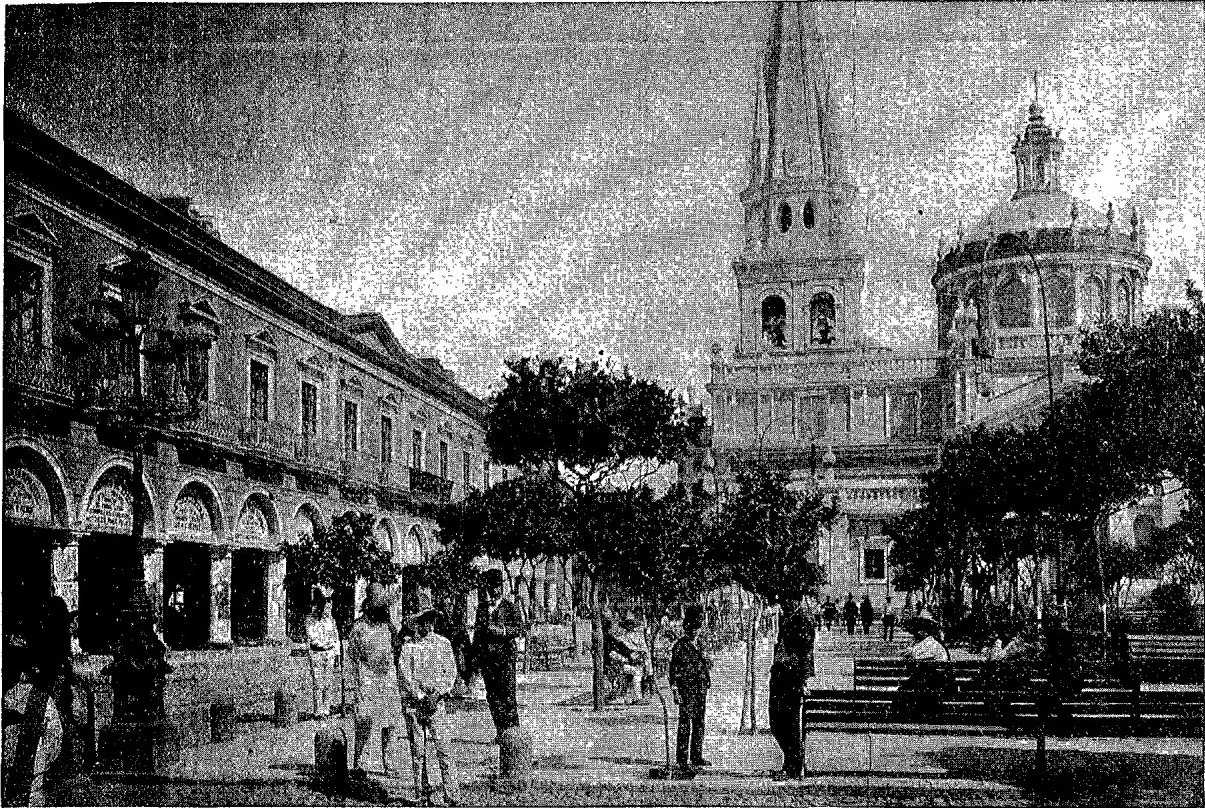
PLAZA DE ARMAS AND CATHEDRAL, GUADALAJARA.
Art. IV. Religious instruction, and the official practices of whatever form of worship, are prohibited in all the institutions of the Federal, State, and city governments. Moral instruction may be given in those which by their nature permit it, although without reference to any form of worship. The violation of this article shall be punished by a government fine of from $25 to $200, and by dismissal of the guilty parties in case of repetition.
Persons who reside in public institutions of whatever class, may, if they solicit it, go to places of worship, and in cases of extreme necessity may receive the spiritual aids of the religion which they profess in the institutions themselves. The rules of each institution may fix the manner of obtaining this privilege without doing violence to the objects of the institution, and without violating the provisions of Art. III.
Art. V. No religious act shall be performed publicly in any other place than the interior of the churches, under penalty of the rite being suspended and the authors punished by a fine of not less than $10 nor more than $200, or imprisonment for not less than two nor more than fifteen days. When, however, the act may assume a grave character by the number of persons that may engage in it or from whatever other cause, the author of it, as well as such other persons as may not obey the intimation of the authorities that the act should be suspended, shall114be placed under arrest and consigned to the judicial authorities, incurring a penalty of not less than two nor more than six months in prison.
Neither the ministers of any religious faith nor individuals of either sex who profess such faith, shall wear, outside of their places of worship, a dress or uniform peculiar to such faith to distinguish them, on penalty of a government fine of not less than $10 nor more than $200.
Art. VI. The use of bells shall be strictly limited to calling the people to religious worship. The legitimate use of church bells may be prescribed by police regulation in such a manner that the public may not be disturbed thereby.
Art. VII. (Relates to reporting churches and having them entered upon the public register as houses devoted to public worship and nothing more.)
Art. VIII. All wills and legacies made in favor of ministers of religion or of their relatives to the fourth civil grade, or of persons who dwell with such ministers, shall be null and void when such minister may have lent any kind of spiritual aid to the testator during the sickness of which he died, or may have been his confessor.
Art. IX. Wills and legacies are equally null and void, which, although made in favor of competent persons, may be fraudulent before the law, or an infringement of Art. XV., part III.
(Art. XV., part III. The right to receive alms or gifts shall never be interpreted to include real estate, mortgages on real estate, nor promises or obligations to be fulfilled in the future, be it in form of legacy, donation, gift, or whatsoever other class of obligations of that nature; all shall be null and ineffective.)
Art. X. Ministers of religion shall not, by reason of their office, enjoy any special privileges before the law over other citizens, nor shall they be subject to other prohibitions than those imposed on other citizens, nor shall they be subject to other prohibitions than those which this law and the constitution designate.
Art. XI. Discourses delivered by any minister of religion counseling disobedience to, or provoking any crime or violation of the laws, shall constitute such meeting illegal, and it shall cease to enjoy the guarantees given in Art. IX. of the constitution, and it may be dissolved by the civil authorities. The author of such discourse shall remain subject, in such case, to the provisions of Art. VI. of chapter VIII. of the third book of the Penal Code which is declared in force, in such cases, throughout the republic. Any minister of religion who may suggest or instigate crimes under this article shall be held as the principal author of such crimes.
Art. XII. All meetings in the churches shall be public and subject to the surveillance of the police, and the civil authorities may interfere when the circumstances demand it.
Art. XIII. Religious institutions shall be free to form ecclesiastical organizations as they may choose; but such organizations shall have no other legal authority than that of designating the officers of such organizations in the locality where they reside that they may receive the benefits of Art. XV. No minister of religion can, by reason of his office, address himself in his official character to the civil authorities. He shall do so in the form and according to the regulations imposed on any citizen who exercises the right of petition.
As may be supposed, the Papacy did not tamely submit to this curtailment of her power and authority. When the Liberal Constitution and “laws of reform” were put in operation by the government, the clerical party rebelled and set up an opposition government, whose object was the attainment of the following points:—
1. The inviolability of all church property and church revenues and the reestablishment of former exactions.
2. The reestablishment of the fueros, or special rights of the church and of the army. (Under these fueros the military and clergy were responsible only to their own tribunals, and not to the law of the land.)
3. The restoration of the Roman Catholic religion as the sole and exclusive religion of Mexico.
4. The censorship of the press.
5. The exclusive system with regard to foreign immigration, confining it solely to immigrants from Catholic countries.
6. The overthrow of the constitution of 1857 and the establishment of an irresponsible central dictatorship, subservient solely to the Church.
7. If possible the restoration of a monarchy in Mexico, or the establishment of a European protectorate.
This was called the Plan of Tacubaya and was proclaimed by Zuloaga. When the legitimate government under President Juarez got the ascendancy over this body of revolutionists and they saw they could not succeed, the Clerical party entered into a conspiracy with Napoleon III. of France, and Maximilian of Austria was invited to come to Mexico as emperor. Maximilian accepted; he first went to Rome and received the Pope’s blessing and the assurance that heaven would smile on his undertaking, and then came to Mexico and was proclaimed emperor. Assisted by the French soldiers he at first made some headway; but when in 1867, the French forces had to withdraw at the demand of the United States Government, Maximilian’s cause soon became demoralized and he and his two leading generals were taken prisoners, tried by a court martial and executed in Quereterro.
The constitution and “laws of reform” were then carried into effect. All property held by the Church, except the houses actually used for worship, was confiscated and sold, or turned into public uses for post-offices, school houses, barracks, museums, public libraries, etc.
As noticed recently in these columns, the property thus confiscated amounted in cash to the vast sum of $300,000,000, and the income derived from it was more than the entire revenue of the Mexican Government. And this vast property was, of course, untaxed.
Evils of Untaxed Church Property.
Under these circumstances, such a step on the part of the Mexican Government appears as a plain necessity of the situation. But it should be equally plain that the evil is, in principle, the same under any system which exempts church property from taxation. Such property is bound to accumulate, and with this exemption in force, it is only a question of time when the government will be forced to take some measures to free itself from an insupportable incubus, or to guard against the dangerous use of the vast power thus placed in the Church’s hands. The example of Mexico, as also that of France and other countries, shows that the danger is not imaginary. Under a liberal government, the Mexican Republic found in the Church its most formidable antagonist; and while expressing no dissent from her spiritual claims, the government saw in the curtailment of her temporal power a measure demanded by the instinct of self-preservation.
All history warns against the acquisition by the Church of temporal power. All Scripture forbids its use. The Church’s legitimate power is spiritual; it is the power of God, and of Him who said to his followers on the day of His ascension, “Lo, I am with you alway, even unto the end of the world.” Matt. 28:20. It is, of course, only the Church which covets temporal power that can become dangerous to the interests of good government; and any church which does seek for such power, whether Protestant or Catholic in name, shows thereby that she has lost her divine power, has separated from her living Head, and is no longer the true Church which is the body of Christ. And from a church thus separated from Christ, nothing but evil can be expected.
Untaxed Church Property in the United States.
The untaxed church property in the United States to-day amounts in value to nearly $700,000,000,—more than twice that in Mexico when confiscation became a necessary proceeding. There are no grounds in reason or justice upon which this property should be exempt from taxation. The principle that the State should look with favor upon an institution which tends to promote the integrity of its subjects, will not hold as regards the Church; for, as we have seen, and as all history attests, the Church apostatized from Christ, as the church of wealth and numbers is prone to be, is the most formidable enemy of the State’s prosperity; and the State cannot, of course, undertake to distinguish between the different religious bodies claiming to be the Church of Christ. Nor has the State any right in justice to exempt church property; for the burden of taxation thus shifted from the Church, must be laid upon the shoulders of the people, in addition to that which they would be justly obliged to bear, and thus they are taxed, indirectly but no less really, for the support of the churches. But compulsory support of the Church is not a principle of good government, nor is it in harmony with the will of God. It is a principle pertaining to a union of Church and State.
The Liberal Constitution.
The Liberal Constitution of Mexico, adopted in 1857, has been freely amended since that date, the change made being in pursuance of the liberal policy of government upon which the republic has happily set out. As touching the attitude of the State to the Church, the amendments made are as follows:—
Art. I. The State and the Church are independent of each other. Congress shall not make any laws establishing or prohibiting any religion.
Art. III. No religious institution shall acquire real estate or mortgages on the same except as provided in Art. 27 of the constitution.
(Art. 27 of constitution: No corporation, civil or ecclesiastical, whatsoever may be its character, name, or object, shall have legal power to acquire right in property or to control real estate with the exception of the buildings designed immediately and directly for the uses or purposes of the institution.)
Art. IV. The simple promise to tell the truth and to fulfill the obligations imposed shall take the place of the religious oath with all its pains and penalties.
Art. V. No one shall be obliged to labor without just remuneration and his full consent. The State will not permit any contract, covenant, or agreement to be carried into effect which has for its object the diminution, loss, or irrevocable sacrifice of personal liberty, whether it be on account of labor, education, or religious vow. The law, therefore, does not recognize monastic orders, neither can it permit their establishment whatever may be the name or object with which they pretend to be erected. Neither can it admit a contract in which a man may agree to proscription or banishment.
Thus far has Mexico proceeded toward the realization of that ideal system of government under which liberty and equality are secured within the limits of human power, to every citizen. It may well be true that not only the country of which Lincoln spoke in his Gettysburg address, but this entire western hemisphere, has been in the divine purpose dedicated to the proposition that all men are created equal; that here the despotisms which had enslaved the world for ages were to be broken, here should be a refuge for the oppressed of other lands, here the banner of liberty be upreared for the encouragement and enlightenment of mankind. But the foremost and greatest of the powers of this hemisphere is proving recreant to her sacred trust, so that her territory has become in many places the scene of religious persecution. Her pernicious example cannot but react most disastrously upon the progress of liberty throughout the world. But the Author of liberty is about to appear the second time, coming in all the glory of his Father, and with all his angels, as King of kings and Lord of lords, to sweep the world of its wickedness, and establish eternal righteousness and peace. In this lies the hope of the lovers of liberty and justice for mankind.115
“CHRISTIAN CITIZENSHIP.”
“A practical and adequate organization,” says the Christian Citizen, “has recently been called into existence in Chicago, called the ‘National Christian Citizenship League,’ which has already abundantly vindicated its reason for being. Its avowed three-fold object is:—
“1. To reveal Jesus Christ as the Saviour of the nation as well as of the individual.”
“2. To make Christian principles operative in public affairs.”
“3. To unite the followers of Christ in consistent, harmonious and aggressive action, not as church members, but as Christian citizens, for the following purposes, viz.:
“1. To prevent, by personal effort, the nomination and election of corrupt candidates and the enactment of corrupt laws in the city, State, and nation.
“2. To secure fidelity on the part of officers intrusted with the execution of the laws.”
“3. To exterminate the saloon as the greatest enemy of Christ and humanity.”
“4. To preserve the Sabbath.”
“5. To purify and elevate the elective franchise.”
“6. To promote the study of social wrongs, and the application of effective remedies.”
“7. In general, to seek the reign of whatsoever things are true, honest, just, pure, lovely, and of good report.”
The Christian Citizen further says:—
“We do not wish for a union of Church and State. Nor do we seek to govern the State through the Church. But we do propose to identify Christian citizens with public affairs, and thus infuse into industries, policies and administrations, the Spirit of Jesus Christ.
“To this necessary and sacred work we summon all, of whatever creed, party, nationality, or sex, who acknowledge God as supreme over all.”
Christ the Saviour of the Individual.
The reader familiar with the principles which should govern the relations of Church and State, need not be told that this so-called “Christian Citizenship” movement is the rankest kind of National Reform.
It seems strange that men do not see the absurdity of such leagues. Of course, if Jesus Christ is ever to be revealed “as the Saviour of the nation,” it must be by some human power, as God has never revealed him in any such way. The Scriptures set Christ forth as the Saviour of the individual, and of the individual only. “Whosoever believeth and is baptized shall be saved; but he that believeth not shall be damned.”
It is true that “the kingdoms of this world” are finally to “become the kingdoms of our Lord and of his Christ;” but it will not be by political action, nor will it be in the world that now is. That kingdom, as the Apostle Peter plainly tells us, is to be in the “new earth,” which is to come forth from the ashes of the present world which is reserved unto destruction against the day of judgment, and perdition of ungodly men, and in it is to dwell only righteousness. Moreover the inhabitant of that kingdom “shall not say, I am sick,” “for they which shall be all counted worthy to obtain that world and the resurrection from the dead, neither marry nor are given in marriage; neither can they die any more; for they are equal unto the angels; and are the children of God, being the children of the resurrection.”
Nor is this kingdom to be given to Christ by political action. He receives the kingdom from his Father, who says: “Ask of me, and I shall give thee the heathen for thine inheritance, and the uttermost parts of the earth for thy possession. Thou shalt break them with a rod of iron: thou shalt dash them in pieces like a potter’s vessel.”
Christian Principles in Public Affairs.
There is one sense, and one sense only, in which Christian principles can properly be applied in public affairs. The Christian must be honest in all the walks of life; whether in private or public he must and will discharge faithfully every duty devolving upon him. He cannot be an embezzler nor an extortioner. He must deal justly with his fellowmen, and discharge conscientiously every trust committed to him. The individual and the individual only can “make Christian principles operative in public affairs,” for only the individual can possess Christian principles.
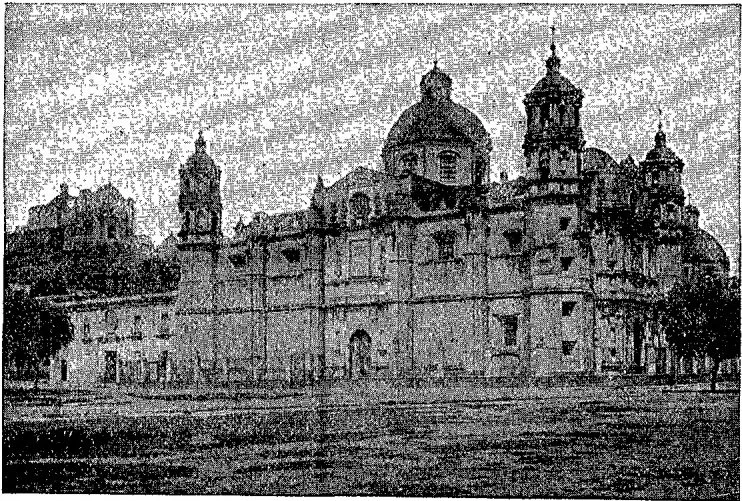
THE CHURCH AT GUADALUPE.
But Christianity is not the only system of ethics which enjoins honesty, and it is a sad fact that professed Christians are not as a rule more trustworthy than many who make no profession. A very large number of our unfaithful public servants, political tricksters, corrupt politicians, are men who make a profession of religion, as are likewise a great many embezzlers and defaulting bank officers. The public would gain nothing by making a profession of Christianity a stepping-stone to public office. Indeed to do so would only be to place a premium upon hypocrisy; and this the National Reformers of the various schools have already done.
In the early days of the National Reform movement it was predicted by one of the leaders that when the movement was seen to be a success, the politicians would hasten to secure front seats. As recently as 1892, during the agitation for the Sunday-closing of the World’s Fair, a direct premium was put upon political dishonesty by the threatened political boycott, which was likewise an implied promise that those who yielded to the demands of the advocates of Sunday-closing should receive their support at the polls.
Religious Combinations Dangerous.
It was declared by a committee of United States Congress more than sixty years ago that “religious combinations to effect political objects are dangerous.” It is equally true to-day, and this effort to unite the “followers of Christ” for “consistent, harmonious, and aggressive [political] action” is a menace to our free institutions. Such combinations never have and never can confine themselves to proper political objects. They always have and always will endeavor to use civil power for the furtherance of religion; and the danger is no less, because instead of being united in one denomination, they act simply as “Christian citizens.”
The Papacy was the outgrowth of just such a combination. It was not as Roman Catholics, but as “Christians” that the churches of that day brought their influence to bear upon the civil power. Not Roman Catholicism but “Christianity” was made the religion of the Roman Empire; what followed was only the logical, and, under the prevailing conditions, the inevitable result.
“To prevent by personal effort the nomination and election of corrupt candidates” through this gigantic religious combination means simply to prevent the election of anybody who will not be subservient to the dictates of these “Christian citizens.” And “to secure fidelity on the part of officers intrusted with the execution of the laws,” simply means, in this connection, to secure prompt attention to the demands of the church people for the enforcement of such civil laws as they may deem of advantage to them.
It means especially the rigid enforcement of Sunday laws, and the closing of saloons—on SUNDAY.
It has been plainly shown by these so-called Reformers that they do not desire so much the “extermination of the saloon” as they do the exaltation of Sunday. “To preserve the ‘sabbath’” is the great object in view, and everything else must be made to bend to that.
The explanation: “We do not wish for a union of Church and State” would never be made was there not a consciousness even on the part of these so-called Reformers that their movement must inevitably lead to such a result.
The Very Essence of Church and State.
The very essence of Church and State is the use of civil power to enforce religious dogma, or to advance the interests of the Church. It matters not whether that dogma be peculiar to one sect or many. All the evils of union of Church and State would be just as great and would develop just as speedily with a multitude of sects established by law as with a single sect. In fact they would be greater because a single sect established by law would necessarily be held in check to a great extent by other sects; but let all the sects, or at least the more powerful sects, be clothed with civil power to enforce the dogmas held by them in common, and the small minority left to protest, have practically no redress. This has been repeatedly demonstrated in the case of Sabbatarians who, it is urged, constitute only seven-tenths of one per cent. of the population, and are therefore not to be considered as having any rights which the majority is bound to respect.
The “pious” invitation: “To this necessary and sacred work we summon all, of whatever creed, party, nationality, or sex, who acknowledge God as supreme over all,” deserves passing notice. There are very many who acknowledge God as supreme over all, but who deny the right of any number of116men, or of any number of churches to dictate to them an interpretation of God’s will. And that is just what it means, for “‘God’ to be supreme over all.” If God were indeed supreme no one would have ought to fear; but those having control of legislation and not God would be supreme, ruling professedly in the name of God, but in reality administering not the law of God, but their own interpretation of that law. Thus, like the Papacy, they would sit in the temple of God, showing or professing themselves to be God. It would be nothing less than an image of the Papacy.
CHRISTIANITY AND COMMUNISM.
The world to-day is full of theories. Never was human thought more productive of speculation and alleged discoveries relative to panaceas for social and political, as well as physical ills. The human mind is prone to inventions. “God hath made man upright,” writes Solomon, “but he has sought out many inventions.” He has been continually trying, ever since the fall, to invent some means of becoming his own saviour. But his efforts in this line are, of course, as useless as those made to discover the long-sought “perpetual motion.”
The trouble with these “inventions” and theories is, they are human. Man has turned away from a field of knowledge opened before him by the wisdom of God, to wander in the mazes of his own wisdom and speculation. Man cannot be his own saviour. He cannot uplift himself from the plane of his fallen human nature by the force of his own laws and resolutions. But there is one adequate Saviour—Jesus Christ—and one adequate uplifting power for every fallen condition—the power of the gospel of Christ. There is one sure way of attaining happiness here and hereafter, and that is the way of God’s word. “Thy word is a lamp unto my feet, and a light unto my path.” Ps. 119:105. There is one way of securing uninterrupted prosperity, of having all things work together for our good; and that is stated in the inspired utterance, “All things work together for good to them that love God.” Rom. 8:28.
Men, however, are not willing to let happiness and prosperity be assured to them in this way. They have more confidence in the methods dictated by their own wisdom, than in those set forth in the God-ordained scheme of redemption, which their finite wisdom cannot grasp. They have more faith in a tower of babel as a means of attaining heaven than in the ladder of Jacob’s dream. Though it is recorded that the ancient builders “left off to build” the structure begun in the plains of Shinar (Gen. 11:1-10), their descendants have been busy rearing similar towers in the field of ethics, from that time down to the present.
The foundation stone of all these structures is salvation by works. Upon this we see being reared to-day the babel tower of governmental religion. The power of national law is to be made the means of regenerating and saving the nation. By the works of that law is the nation to be made Christian. The Christianity of the nation is to be the Christianity of the people; and when the Church, directing human legislation, shall fulfill(?) the prophecy, “Out of Zion shall go forth the law,” the cap-stone of the mighty structure will have been laid. But the work will end in confusion, as it ever has in the past.
Another monument of the modern Babylon may be seen in “Christian” communism. Communism is asserted by its advocates to be identical with Christianity. In this guise it is proclaimed from the pulpit, and in one Western college it is even made the basis of a professorship, under the name of “Applied Christianity.” But the very name “communism” indicates that the doctrine is one which deals with masses rather than individuals. Applied Christianity is the life of Christ in the heart of the individual. Christianity deals with individuals only, since it operates only through faith, which is something each person must possess for himself. Christianity operates through faith in Christ; communism operates through “faith” in a theory. The one seeks to give, the other seeks to receive. The one means self-denial, the other is self-assertion. Any doctrine which seeks to apply Christianity to the State, or the people en masse, or to make it operative through the theories and conceptions, or laws and resolutions, of men, is not Christianity, but a base counterfeit. It is the doctrine of self-salvation.
Communism in the pulpit proclaims that the “revelation of Jesus was a social idea,” and that “the career of Jesus was as truly political as was that of Mazzini or Sumner.” It asserts “that Jesus was crucified for disturbing the social order of things;” and that “Jesus went at Jerusalem more truly than Parkhurst at New York, and far more wisely.” But Jesus himself said, “My kingdom is not of this world.” He would not allow his servants to use the sword in his behalf. He refused to let the multitude make him a king. He refused to be made a judge. Neither military force nor political office pertain to the kingdom of Christ.
The world does not need more theories and more isms; it has too many of these already. It is not in need of new discoveries in ethics or sociology. It needs more of that which has been known and preached since the world began,—the “faith which worketh by love.” More love of humanity by humanity is the world’s great need, which no human inventions or theories can supply. More love of humanity means more of God in the heart, for “God is love.” And this means more faith in the Word of God, for there is enough of the Spirit of God if only the heart is open to receive him. Thus we come back again to the great truth which men have so persistently slighted, that to the gospel of Jesus Christ, which is “the power of God unto salvation to everyone that believeth,” and to that alone, must we look for peace, happiness, satisfaction and true success amidst the vicissitudes and troubles of this life.
“WHOSE OX,” ETC.
By H. B. Maurer
BY H. B. MAURER.
THERE are a few preachers and religious thinkers in our country who have not the natural ability, or training, to define the difference between tweedle-dee and tweedle-dum. Our pulpit and platform ability can evolve a discourse from an adverb, a conjunction, or preposition; can divide into longitudinal sections the finest specimen of capillary matter that was ever found in a second growth on any theological pate, however shiny; it can eisegete into scriptural texts ideas God and the angels would fail to find therein; can beat out moral questions into a thinness in comparison to which tissue paper is like China’s wall; while of moral principles, however subtle in themselves, it can make such fine-spun applications as to necessitate, for the ordinary intelligence, a Lick mental telescope to discover, and many other feats of intellectual jugglery it is able to perform; but when it comes to a consideration of a certain phase of religious matters, the support religion receives, directly or indirectly, from the State—a support that is inconsistent, unjust, unfair, and therefore un-Christian and un-American—the theologian’s sensibilities seem suddenly seared as with a hot iron.
There is a failure to detect the dishonesty and unfairness in the exemption of church property from taxation, which exemption besides is so palpably inconsistent with our theory of the union of Church and State, that it surprises one that there should ever be any claims made that we have here no such union.
Sabbath legislation, under the disguise of civil, sanitary, and other pretensions, is an insult to the ordinary intelligence, and “it gives one a pain” to think that the “Sabbath” reformers cannot see it in that light, and since they do not, what hope is there that they will ever see that such legislation is alike subversive of Christian as well as American principles?
Strong is the spell that error weaves,
In midnight madness for mankind;
And deep the trace that error leaves
Impressed upon the human mind.
Bright must the rays of God’s light break,
And strong the power of truth must be,
Ere men from error’s trance awake
And think, and act, and dare be free.
THE FOUNTAIN OF LAW.
“THERE is one Lawgiver, who is able to save and to destroy.” That which is in the truest sense entitled to be termed law, can from its very nature have but one Author.
The idea that law, as a rule of just conduct for individuals, can be manufactured by legislatures, is altogether erroneous. Neither law nor rights can be manufactured by any human power. The Declaration of Independence asserts that it is a self-evident truth that all men “are endowed by their Creator with certain unalienable rights.” This being true, as it certainly is, it follows that the law of those rights must lie equally without the sphere of human enactments. The law must be co-existent with the rights. The author of the one must of necessity have been the author of the other.
But, as the immortal Declaration asserts, governments are instituted among men, to preserve these rights. They are instituted to see that the law of these rights is enforced, or is observed by individuals. That is the civil law,—the law of civility, or respect for human rights. Of course, it must devolve upon sovereign power in a community or State to define the law for the common guidance of all; but obviously, this is not creating law. It is but discovering that which was already in existence.
“Our human laws,” says Froude, “are but the copies, more or less imperfect, of the eternal laws so far as we can read them; and either succeed and promote our welfare, or fail and bring confusion and disaster, according as the legislator’s insight has detected the true principles, or has been distorted by ignorance or selfishness.”
Law is a science; and of the principles of science man is the discoverer, not the maker. The laws of logic, or of mathematics, are discovered117and laid down in text-books for our guidance; but no man manufactured them. And so with respect to civil law.
An unjust “law” is therefore no more binding upon any person than is an incorrect “rule” of logic. No person can be rightfully bound by injustice; nor can any person under any circumstances throw off the claims of justice. This is not saying that private opinion is superior to legislative enactments, and that an individual may disregard such enactments on no higher authority than his own. The standard of justice is set up among men by the Author of human rights, and to that standard, more or less clearly visible to every mind, he may appeal. It was to this natural sense of justice implanted in man by the Creator, that our forefathers appealed when they sent forth to the world the Declaration of Independence. It was to this standard that Abraham Lincoln and his co-workers appealed when they publicly dissented from the Dred Scott decision of the Supreme Court.
But in the case of Sunday “laws,” we may appeal not only to the natural sense of justice which men possess, but to the most explicit declaration of God’s word. That word commands us to sanctify—set apart—the seventh day. We cannot make the seventh day distinct from other days, and at the same time make the first day also distinct in the same way; the one distinction breaks down the other. We are bound by the law of God, and there can be no real law, civil or otherwise, which conflicts with that. The sphere of the law of natural rights—the civil law—is altogether separate from the sphere of our obligations to God, and from the law by which those obligations are defined.