Your ShelfYour Projects

Review and Herald, Vol. 91, No. 8.

A Policeman Subscribes

Review and Herald

Feb 19, 1914

Review and Herald Publishing Association · Takoma Park Station, Washington, D. C. · Feb 19, 1914

A Policeman Subscribes

"You are a Protestant lady, are you not?" said a six-foot New York policeman to the financial secretary of the American Federation of Patriotic Societies, Washington, D. C., as he was helping her across Broadway. "Yes, indeed," said she. "Do you read the Protestant Magazine?" was his rejoinder. "No; where is it published?" answered the lady. "In Washington, D. C.," said the officer. "Why, that's where I live! I'll subscribe at once upon my return," said the woman. And she tells the manager of the Protestant Magazine that her name has never been off the list since that time, and never will!

THE WORK AND THE WORKERS

The first order from the Washington (D. C.) Sanitarium for the March Life and Health calls for 2,500 copies. Have you seen this number?

Copies for Massachusetts Clergymen

Elder H. C. Hartwell, president of the Massachusetts Conference, writes to ask that we reserve at least 2,000 copies of the February Protestant to be mailed to every Protestant clergyman in Massachusetts. He says: "Be sure to have enough on hand."

Conference Sales of the February Protestant

A FEW of the records made by the various local conferences in the sale of the February Protestant up to February 10 will be of interest: District of Columbia, 3,905 copies; Ohio, 1,497; East Michigan, 1,105; New Jersey, 1,020; Eastern Pennsylvania, 1,010; West Pennsylvania, 611.

The March Protestant

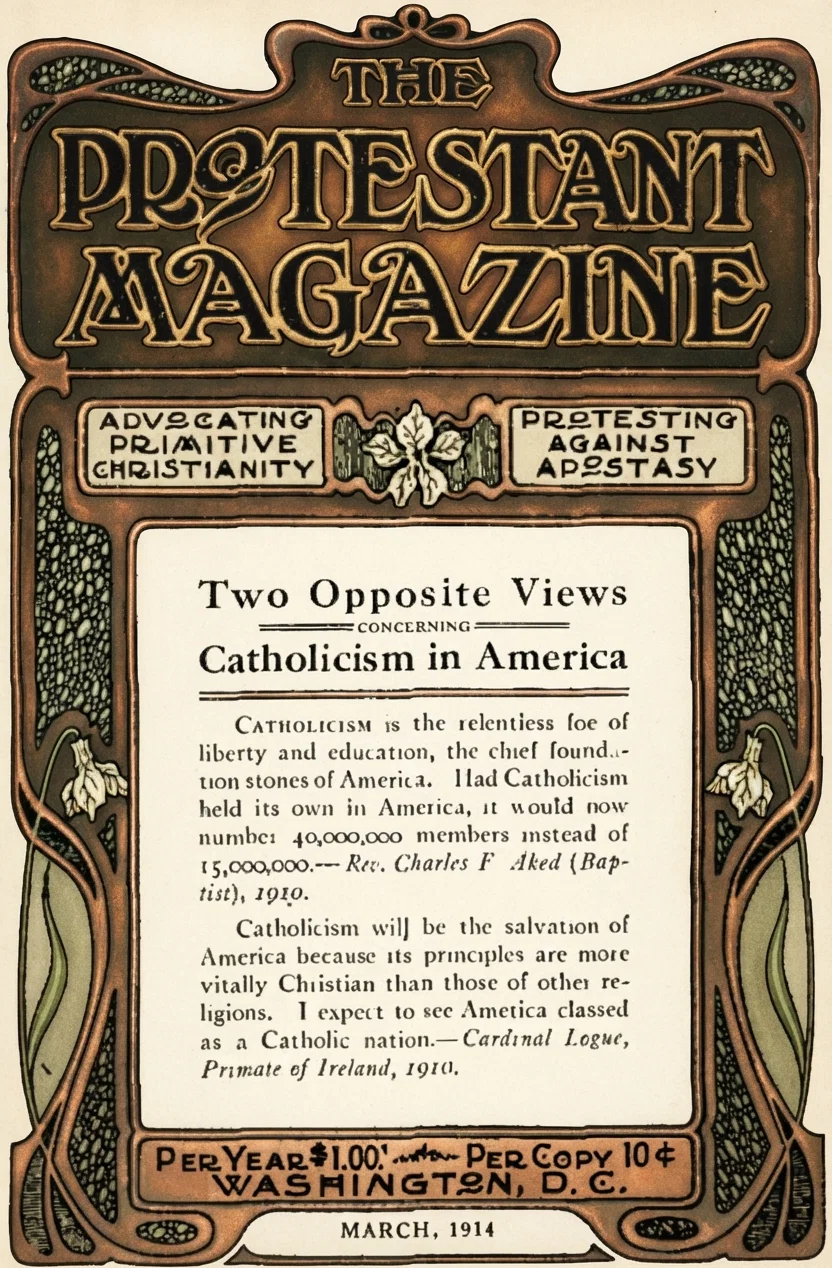
There will be an enormous demand for the March Protestant, owing to the fact that it will contain a photograph of President Wilson's letter to our editor in regard to Mr. Tumulty, his Catholic private secretary; also "Miss Columbia and the Pope"—a two-page cartoon from Puck; photographs of Roman Catholic Church lottery tickets for "free masses," several strong articles on "Jesuit Principles Up to Date," etc.

The February Protestant in Washington

District of Columbia Conference Officers and Workers Engaged in the Washington (D. C.) "Protestant Magazine" Campaign
Up to February 10, 3,905 copies of the great February or \"Protestant Mass Meeting\" and \"Roman Mask Put On Again\" number of the Protestant Magazine had been circulated in the District of Columbia Conference. The work is still progressing, and many interesting experiences are developing from a systematic canvass of Washington and surrounding territory. Numerous lists of subscriptions are being received from those to whom the conference workers and the Washington Missionary College students have sold the magazine. As a result of the sales on the street in front of the United States Treasury, a great interest was awakened among these government employees, as may be seen from the following post card received from a newsboy: \"F Street entrance, Treasury. Would you kindly send me 25 of those Protestant Magazines? I am a newsboy at the Treasury Department door, F Street entrance, and I have had enormous call for the magazine. I found some, but I had to pay 10 cents apiece for them. You can put me down for an order for 50 every month -- maybe more. Hope to receive them today. People here are ready for me to get busy. Yours respectfully, Coombs, or 'Shorty,' at F Street entrance to the Treasury.\"
LET OUR CONFERENCES, SCHOOLS, AND CHURCH OFFICERS EVERYWHERE INAUGURATE CAMPAIGNS TO INTRODUCE THIS AND FOLLOWING NUMBERS OF THIS MAGAZINE TO CLERGYMEN AND MEN OF INFLUENCE EVERYWHERE. GET THEIR TRIAL SUBSCRIPTIONS FOR FOUR MONTHS FOR ONLY 25 CENTS. SEND THE MAGAZINE TO FIVE DIFFERENT PERSONS FOR SIX MONTHS FOR ONLY $1.50 -- REGULAR PRICE, $2.50. Send $1.00 for 20 or $2.00 for 50 copies. Sell or give them away. Address all orders to your conference tract society or Protestant Magazine, Washington, D. C.

The March Life and Health

THE beautiful March or "What I Know About Rearing the Baby" number of Life and Health is now ready. Beautiful Niagara Falls cover design in three colors — the grandest and most inspiring cover we have ever printed.

Union Conference Sales

Up to February 10 the conferences in the Columbia Union had disposed of 8,520 copies of the February Protestant; the Lake Union conferences, 2,239. These figures do not, of course, include the many long lists of subscriptions received from these territories.

A Sanitarium Missionary Idea

D. Nicola, business manager of the Attleboro (Mass.) Sanitarium, writes for terms on one hundred yearly subscriptions for both Protestant Magazine and Liberty, the publishers to send a personal letter to each of the 100 friends to whom he orders the magazines to be sent for 1914. If a few other sanitarium managers indulge in this excellent missionary idea, we shall have to add to our force of stenographers.

Praise for McKim’s Address

A LEADING attorney of Rock Valley, Iowa, writes: "Recently I became a subscriber to your Protestant Magazine. It cost me only $1.00. Not for $10.00 would I have missed your February issue containing the wonderful address of Rev. R. H. McKim. I have read every word of it, portions of it two or three times over. No wonder the vast audience insisted on his continuing longer this masterly address. What now? Is this wonderful address to go no farther than the confines of Washington, D. C.?"

Magazine Department Enrollment

DURING the past two weeks our magazine department has enrolled 97 new Protestant Magazine agents, besides 62 new subscription agents; 25 new Life and Health agents, and 18 new Liberty agents, besides 16 new subscription agents.

Magazines for Public Libraries

SAMUEL H. RANCK, librarian of the Grand Rapids (Mich.) Public Library, advertising "over 150,000 books and 800 current periodicals" and "38 branches and stations," writes: "Mr. A. J. S. Bourdeau, circulation manager Liberty magazine, Washington, D. C. Dear Sir: We have been receiving recent issues of Liberty, and therefore take it that you have placed this library on your complimentary mailing list, for which please accept our thanks, on behalf of the Board of Library Commissioners. We are very glad to be remembered in this way." For $1.90 we will send Life and Health, Liberty, and the Protestant Magazine for one year to any public library. Regular price, $2.35.

Third Edition of Protestant Magazine

THIRD large edition of the Protestant Magazine now ready! Please get your orders in early. Holding forms for a fourth edition!

A Door of Hope

MRS. E. G. WHITE
In the terrible judgments brought upon the ten tribes, the Lord had a wise and merciful purpose. That which he could no longer accomplish through them in the land of their fathers, he would seek to accomplish by scattering them among the heathen. His plan for his people must be fulfilled; and in the afflictions brought upon Israel, he was preparing the way for his glory to be revealed to the nations of earth. Not all who were carried captive were wholly impenitent. Among them were some who humbled themselves before God, and who sought for pardon and peace; and these were numbered as "sons of the living God." Hosea 1: 10.
God's favor toward Israel had always been conditional on their obedience. At the foot of Sinai, the hosts of Israel had entered into covenant relation with God as his "peculiar treasure . . . above all people." Ex. 19:5. They were to be to him "a kingdom of priests, and an holy nation." Solemnly they had promised to follow in the path of obedience. "All that the Lord hath spoken we will do," they said. And when, a few days afterward, God's law was spoken from Sinai, and additional instruction in the form of statutes and judgments was communicated through Moses, the Israelites with one voice again promised, "All the words which the Lord hath said will we do." Ex. 24:3. At the ratification of the covenant, the people once more united in declaring, "All that the Lord hath said will we do, and be obedient." Verse 7. God had chosen Israel as his people, and they had chosen him as their King.
Near the close of the wilderness wandering, the conditions of the covenant were repeated. At Baal-peor, on the very borders of the Promised Land, many had fallen a prey to subtle temptation. Those who had remained faithful now renewed their vows of allegiance. Through Moses they were instructed concerning the temptations that would assail them in the future; and they were earnestly exhorted to remain separate from the surrounding nations, and to worship God alone.
"Your eyes have seen what the Lord did because of Baal-peor: for all the men that followed Baal-peor, the Lord thy God hath destroyed them from among you. But ye that did cleave unto the Lord your God are alive every one of you this day.
"Behold, I have taught you statutes and judgments, even as the Lord my God commanded me, that ye should do so in the land whither ye go to possess it. Keep therefore and do them; for this is your wisdom and your understanding in the sight of the nations, which shall hear all these statutes, and say, Surely this great nation is a wise and understanding people. For what nation is there so great, who hath God so nigh unto them, as the Lord our God is in all things that we call upon him for? And what nation is there so great, that hath statutes and judgments so righteous as all this law, which I set before you this day?"
The Israelites were specially charged not to lose sight of the commandments of God, in obedience to which they would find strength and blessing. "Take heed to thyself, and keep thy soul diligently," was the word of the Lord to them through Moses, "lest thou forget the things which thine eyes have seen, and lest they depart from thy heart all the days of thy life: but teach them thy sons, and thy sons' sons; specially the day that thou stoodest before the Lord thy God in Horeb, when the Lord said unto me, Gather me the people together, and I will make them hear my words, that they may learn to fear me all the days that they shall live upon the earth, and that they may teach their children."
The awe-inspiring scenes connected with the giving of the law at Sinai were never to be forgotten. "Ye came near," the Israelites were reminded, "and stood under the mountain; and the mountain burned with fire unto the midst of heaven, with darkness, clouds, and thick darkness. And the Lord spake unto you out of the midst of the fire: ye heard the voice of the words, but saw no similitude; only ye heard a voice. And he declared unto you his covenant, which he commanded you to perform, even ten commandments; and he wrote them upon two tables of stone. And the Lord commanded me at that time to teach you statutes and judgments, that ye might do them in the land whither ye go over to possess it."
The Israelites were about to possess a land where idolatry had reigned supreme; and they were warned not to follow after the gods of the heathen. "Take ye . . . good heed unto yourselves," was the counsel given; "for ye saw no manner of similitude on the day that the Lord spake unto you in Horeb out of the midst of the fire: lest ye corrupt yourselves, and make you a graven image, the similitude of any figure, . . . and lest thou lift up thine eyes unto heaven, and when thou seest the sun, and the moon, and the stars, even all the host of heaven, shouldest be driven to worship them, and serve them, which the Lord thy God hath divided unto all nations under the whole heaven." "Take heed unto yourselves, lest ye forget the covenant of the Lord your God, which he made with you, and make you a graven image, or the likeness of anything, which the Lord thy God hath forbidden thee. For the Lord thy God is a consuming fire, even a jealous God."
Moses was inspired to utter a prophecy outlining the sure result of apostasy. Plainly he traced the evils that would result from a departure from the statutes of Jehovah. Calling heaven and earth to witness against the people, he declared that if, after having dwelt long in the Land of Promise, they should introduce things which thine eyes have seen, and to graven images, and should refuse to return to the worship of the true God, the anger of the Lord would be aroused, and they would be carried away captive and scattered among the heathen. "Ye shall soon utterly perish," he warned them, "from off the land whereunto ye go over Jordan to possess it: ye shall not prolong your days upon it, but shall utterly be destroyed. And the Lord shall scatter you among the nations, . . . whither the Lord shall lead you. And there ye shall serve gods, the work of men's hands, wood and stone, which neither see, nor hear, nor eat, nor smell."
This prophecy, fulfilled in part in the time of the judges of Israel, met a more complete and terrible fulfillment in the captivity of Israel in Assyria and of Judah in Babylon. During the passing centuries, from generation to generation, Satan made repeated attempts to cause Israel to forget "the commandments, the statutes, and the judgments" (Deut. 6:1) that they had promised to keep forever; for he knew that if he could only lead Israel to forget God, and to "walk after other gods, and serve them, and worship them," the chosen nation would surely perish. Deut. 8:19. But the enemy of all souls had not taken into account the long-suffering of Him who "will by no means clear the guilty," yet whose glory it is to be "merciful and gracious, long-suffering, and abundant in goodness and truth, keeping mercy for thousands, forgiving iniquity and transgression and sin." Ex. 34:6, 7. Despite the efforts of Satan to thwart God's purpose for his chosen people, yet even in some of the darkest hours of Israel's history, when it seemed as if the forces of evil were about to gain the victory, the Lord graciously revealed himself. He spread before Israel the things that were for their welfare as a nation. "I have written to him the great things of my law," he declared of Israel through Hosea, "but they were counted as a strange thing." Hosea 8:12. "I taught Ephraim also to go," he declared, "taking them by their arms; but they knew not that I healed them." Hosea 11:3. Tenderly the Lord dealt with them, instructing them by his prophets, line upon line, and precept upon precept.
(To be concluded)

A. G. DANIELLS

Does the History of Turkey and Egypt Since 1798 Fulfill the Prophecy of Dan. 11: 40-44?—No. 18

A. G. DANIELLS

"But tidings out of the east and out of the north shall trouble him: therefore he shall go forth with great fury to destroy, and utterly to make away many." Dan. 11:44.
No sooner had Turkey succeeded in reestablishing undisputed sovereignty in the south in 1825 than the battle ground was transferred to the east and the north.
"War between Russia and Turkey broke out in 1828, each accusing the other of not having observed the Treaty of Bukharest. . . . A careful plan of campaign had been prepared. Turkey was to be attacked on all sides, by land and sea. Immediately after the declaration of war, Prince Wittgenstein placed himself at the head of an army of 150,000 men, and, on the seventh of May, crossed the [River] Pruth in three columns."
"Paskevitch was instructed to make an incursion from the Caucasus into the Asiatic [eastern] dominions of Turkey, so as to draw away her forces from Europe. Prince Menshikoff, with a separate detachment, was to take Anapa, and Admiral Geig, with the Black Sea fleet, was to silence the forts on the Bulgarian and Roumelian and other eastern coasts; while Admiral Heyden, with the squadron which was in the archipelago, was to close the Dardanelles so as to prevent reenforcements coming from Egypt to Constantinople."—"A History of Russia From Peter the Great to Nicholas II," by W. R. Morfill, pages 367, 368.
Alarmed and angered by Russia's extensive plans for the invasion of her dominions, Turkey went "forth with great fury to destroy, and utterly to make away many."
"Acting as he did on the defensive in Europe, the sultan meant to strike a vigorous blow in Asia. At the very beginning of the war he ordered the seraskier of Erzerum with an army of 40,000 men to make incursions in various directions upon Russian territory beyond the Caucasus. . . . The Mussulman provinces, roused by the instructions sent by the sultan, only awaited the arrival of the Turks, their coreligionists, to rise against the Russians en masse. Everywhere was agitation and everywhere treason."
"We must not forget the kind of man of whom we are writing. One of the most sanguinary of Turkish sultans, Mahmud has left a terrible reputation for his recklessness of human life. . . . For Erzerum a new seraskier was appointed, with unlimited powers. Hahki Pasha, a commander of known skill and bravery, was also sent to assist him. He was commissioned to arm 200,000 men in Anatolia."—Id., pages 367-375.
Sir Edward Creasy, in an interesting and instructive account of this conflict between Russia and Turkey, says:—
"Though Russia was nominally at peace with all the world (her Persian war having ended by a convention in November), she was calling out new levies of conscripts, concentrating troops in Bessarabia, and collecting military stores and transports in her harbors in the Black Sea, in readiness for an invasion of the Ottoman dominion."
"Convinced that his great enemy intended to attack him in the spring [of 1828], the sultan took the bold step of being the first to declare war; . . . and he called on all Mussulmans to show again the determined valor with which the Ottomans had in ancient times established in the world the true religion, and to resist the foe whose object was to annihilate Islam and tread the people of Mohammed underfoot."
"In the ensuing war the vigor shown by Mahmud astonished both friends and foes. Russia employed in the first campaign about 100,000 of all arms in European [northern] Turkey. . . . A far less spirited resistance on the part of the Turks was expected than that which was actually encountered."
"The artillery force was numerous and loyal, and the armed Turkish inhabitants of the towns which the enemy assailed, showed as usual, the greatest spirit of self-defense, and contributed greatly to the prolongation of the war, which was (in its first campaign, at least) principally a war of sieges."
"At the close of the European campaign, the position of the combatants was such that, in the words of the ablest military critic of the war (Von Moltke), 'If we consider the enormous sacrifices the war cost the Russians in 1828, it is difficult to say whether they or the Turks won or lost. It remained for a second campaign to decide the value of the first.'"
"The general feeling (especially in Austria) was that Russia had been overrated, that the sultan was unexpectedly powerful, and that the war was likely to be prolonged without any heavy catastrophe to the Turkish Empire. Russia herself felt keenly the need of recovering her prestige by more signal success in another campaign, which she resolved to make a decisive one."
"Accordingly, in 1829, more numerous and better-appointed forces crossed the Danube, and they were led by Marshal Diebitsch. 'He besieged one fortress, and fought one battle [says Von Moltke]; but this brought him into the very heart of the hostile empire. He arrived there followed by the shadow of an army, but with the reputation of irresistible success.' . . . He continued to impose upon the terrified enemy by the appearance of strength, and by well-simulated confidence and rapidly increasing weakness, and the deepest and most serious alarm."
"The only alternatives for Diebitsch were to obtain a peace, or to be destroyed; and in order to obtain peace, it was necessary to keep up the boldest semblance of waging war."
"Even the European ambassadors of Pera [European quarter of Constantinople] believed that Diebitsch was at the head of 60,000 efficient troops; and they joined the sultan's ministers in urging him to save the empire from total destruction, by negotiating instantly with the Russian general, and obtaining peace at almost any sacrifice. Mahmud is said long to have resisted their pusillanimous advice; and well would it have been for him and his empire if a single friend had then been near him to support his sovereign with manly counsel. At length the sultan yielded to the importunities of all around him."
"The whole current of the world's history would have been changed . . . if a single messenger of truth from Adrianople could have been heard in the divan, or at Pera, in the August of 1829; or, if Sultan Mahmud, in happy obstinacy, had resisted a little longer the solicitations of those who urged on him 'Peace, Peace,' when there should have been no peace."—"History of the Ottoman Turks," by Sir Edward Creasy, pages 512, 521.
# Results
The Russian forces were in the end successful. Those prosecuting the attack on the European territory in the north succeeded in taking the city of Adrianople, only one hundred and twenty-five miles from the sultan's capital. The army sent to the Asiatic territory in the East extended their conquests from the Black Sea on the Caucasus to the city of Erzerum, the capital of Turkomania. With General Diebitsch in possession of Adrianople, and General Paskevitch in possession of Erzerum, Turkey was helpless; "the two generals would doubtless have joined hands in Constantinople but for the efforts of diplomacy and the fear of a general conflagration. . . . Austria was ready to send her troops to the help of the Turks, and the English also seemed likely to declare for the vanquished. It was therefore necessary to come to a halt." But Turkey, "once so formidable, was henceforth at the mercy of her northern neighbor, the principal instrument of her decay."—"Historian's History of the World," Vol. XVII, pages 541, 545.
"This war, the most disastrous in its consequences in which Turkey had yet been engaged, was terminated by the Treaty of Adrianople. . . . In the course of her hostilities with Turkey in Asia, Russia had developed new and extensive projects of future conquest. . . . Thus Russia, by a long series of hostilities and intrigues, had not only conquered a large extent of the European and Asiatic territories of Turkey, but brought about the actual separation of Greece, and attempted the virtual separation of Servia, Moldavia, and Wallachia from the Ottoman Empire; had contemplated the occupation of Bagdad, and extended her secret connections to that pashalic and to the mountain of Kurdistan."—"History of Russia," by A. W. Kelly, Vol. II, pages 352-354.
"Russia had everything to lose and nothing to gain by a European war. It had reduced Turkey to submission, and might fairly hope to maintain its ascendancy at Constantinople during coming years without making any of those great territorial changes which would have given its rivals a pretext for intervening on the sultan's behalf. Under the guise of a generous forbearance, the czar extricated himself from a dangerous position with credit and advantage. As much had been won as could be maintained without hazard; and on the fourteenth of September peace was concluded in Adrianople."—"History of Modern Europe," by C. A. Fyffe, page 343.
"By the Peace of Adrianople, Sept. 14, 1829, Turkey recovered Moldavia and Wallachia and all the towns which Russia had taken in Bulgaria and Roumelia. Moldavia was to have an independent administration and free trade; Russia was to have free commerce throughout the Ottoman Empire and with all nations at peace with Turkey, and free navigation of the Black Sea. Turkey also agreed to pay a war indemnity, besides an indemnification for the losses of Russian subjects, and to acknowledge the independence of Greece."—"Library of Universal History," Vol. IX, page 2777.
As stated by Kelly, this war was "the most disastrous in its consequences in which Turkey had yet been engaged." The victories gained by Russia in the Treaty of Adrianople were permanent. They placed her in a position to maintain an "ascendancy at Constantinople during coming years," and to develop "new and extensive projects of future conquest" in the Turkish Empire.
It was at this time and in this way that there began a series of invasions and conquests in the eastern and northern parts of the empire that have "troubled" the government of Turkey and caused it to "go forth with great fury to destroy" its enemies. But all the way along it has suffered defeat in battle, the loss of a large portion of its territory, and the loss of its independence as a world power. Gradual dissolution has been going on, and will continue until "he shall come to his end."

Day and Date of Christ's Crucifixion

Annual Feasts and Annual Sabbaths—No. 6

Day and Date of Christ's Crucifixion

O. A. JOHNSON
For greater perspicuity and for convenient reference, a summary of the articles on "Annual Feasts and Annual Sabbaths" will here be presented.

Three Annual Feasts

At the time of the exodus, God instituted three annual festivals for Israel to observe, as follows:—
The first was the feast of the Passover, from the fifteenth to the twenty-first in the month Abib, or Nisan. Ex. 12:13-15; 13:4, 6, 7; 23:14, 15.
The second was the Feast of Weeks, or Pentecost. This feast came seven weeks and one day, or fifty days, after the first Passover sabbath, and it fell on the sixth day of the third month, or on the sixth day of Sivan. Ex. 23:16; Lev. 23:15, 16; Deut. 16:16.
The third was the Feast of Tabernacles; it continued seven days, closing, however, on the eighth day. This feast came in the seventh month, Tisri, from the fifteenth to the twenty-second day of this month. Ex. 23:16, 17; Lev. 23:34-39.

Seven Annual Sabbaths

The first day of the paschal feast, or the fifteenth of Abib, was an annual sabbath. Ex. 12:16; Lev. 23:6, 7.
The last day of this paschal feast was the second annual sabbath, and it fell on the twenty-first day of Abib. Ex. 12:16; Lev. 23:8.
The third annual sabbath corresponded to the day of Pentecost, on the sixth day of Sivan. Lev. 23:15, 16, 21; Acts 2:1.
The fourth annual sabbath was the first day of the old civil year, and came on the first day of the seventh month of the ecclesiastical year; this month was called Tisri. Lev. 23:23-25.
The fifth annual sabbath was the most important of all the annual sabbaths; for it was the Day of Atonement, and it came on the tenth day of the seventh month. Lev. 23:27-32.
The sixth annual sabbath corresponded to the first day of the Feast of Tabernacles, and it came on the fifteenth day of the seventh month. Lev. 23:34, 39.
The seventh and last annual sabbath corresponded to the last day of the Feast of Tabernacles, and it fell on the twenty-second day of the seventh month, or Tisri. Lev. 23:39.
These three annual feasts and seven annual sabbaths were separate from the weekly Sabbath; for they were "beside the Sabbaths of the Lord." Lev. 23:37, 38.
All these yearly feasts and sabbaths were especially set apart for various kinds of offerings and sacrifices, hence they ceased to be obligatory when the sacrificial system ceased at the cross: Lev. 23:37; Num. 29:39; Heb. 9:1, 9, 10; 10:1, 2; Col. 2:14-17.

Six Days Before the Passover. John 12:1

The sixth day before the Passover was Friday, Abib 8, 31 A. D.
The fifth day before the Passover was Sabbath, Abib 9, 31 A. D.
The fourth day before the Passover was Sunday, Abib 10, 31 A. D.
The third day before the Passover was Monday, Abib 11, 31 A. D.
The second day before the Passover was Tuesday, Abib 12, 31 A. D.
The first day before the Passover was Wednesday, Abib 13, 31 A. D.
The paschal lamb was killed on Thursday, Abib 14, 31 A. D.
Christ was crucified on Friday, Abib 15, 31 A. D.
Christ lay in the grave on Sabbath, Abib 16, 31 A. D.
Christ arose on Sunday, Abib 17, 31 A. D.
The day of Pentecost fell on Saturday, Sivan 6, 31 A. D.
The Jewish year consisted of twelve months with alternating 30 and 29 days, making 354 days instead of 365. "But as the Jewish festivals were held not only on certain fixed days of the month, but also at certain seasons of the year, consequently great confusion would, in process of time, arise by this method of calculating; the spring month sometimes falling in the middle of winter, it became necessary to accommodate the lunar to the solar year, in order that their months, and consequently their festivals, might always fall at the same season. For this purpose, the Jews added a whole month to the year as often as it was necessary; which occurred commonly once in three years, and sometimes once in two years."—Horne's "Introduction," Vol. II, part 2, chap. 4, sec. 5, par. 4.

The Call for Preachers of the Word

A Note for Young Men in Our Schools

THE situation pressing upon us in all the mission fields of the world, as well as in the home fields, constitutes a constant call to young men finishing their work in our training schools to consider whether the Lord by his Spirit and his providences is not calling for the dedication of their lives to the work of the ministry. It is an unmistakable fact, which appears every week in our correspondence with the mission fields, that the opening of the gates of entrance and the establishing of a foothold in the various countries demand the coming of more preachers of the message for this time.
In every land it is the preaching of the word of the living God in the terms of the third angel's message that brings out Sabbath keepers and raises up churches, and builds the training schools, the printing houses, and other institutional helps in the new fields. They all spring up from the preaching of the word. And now with the beginnings made, and the barriers down, the insistent call is for more evangelists to sound the message far and near among the masses of the people. It is still by what inspiration, quoting the criticism of the worldly, calls "the foolishness of preaching," that souls are won from darkness to light, and the cause of God pressed forward into new regions.
To meet this demand, an ever-increasing number of consecrated young men from the training schools must surely be found dedicating their lives to the ministry of the word of God.
We were struck with the emphasis given to this matter of the need of more evangelistic work in the mission fields at a recent conference of officers of all the Protestant missionary societies in North America, held at Garden City, Long Island. The leaders of these missionary societies certainly struck the evangelical and evangelistic note constantly in discussion of the needs of the fields and of the problem of missionary preparation. We quote a few paragraphs from the report of the committee on preparation of ordained missionaries. The committee had been working for two years on its report, gathering data from all lands. Speaking of the call for the dedication of service to foreign missions in this generation, and of the special need of preaching evangelists, the report says:—
The greatest need of reenforcements is not now for the auxiliary methods of work, though wise use should be made of them, but for direct country evangelization, and combination should be made wherever possible in educational and other forms of work in order to release as many missionaries as possible for direct evangelistic work.
The general conviction in these large missionary societies is that the tendency has been away from evangelistic work among the masses to institutional effort. The call is to swing the forces out again into the old-style evangelistic service that laid the foundations and built up the auxiliary agencies. Again the report appeals directly to young men in the schools to consider seriously whether the Lord does not call them to give their lives to the mission fields and to the ministry:—
The time has evidently come, not only to say to young men who have definitely decided to give their lives to medical or educational work or other similar forms of service at home, that they should consider whether the foreign field does not at this time offer them the largest field of service, but also to urge earnestly upon all young men who are not yet irrevocably committed to such forms of service that the present greatest need abroad is for trained evangelistic leadership, and that the loudest call is for reenforcements of thoroughly prepared ordained men.
Here is another statement from the same report:—
When young men are making their choice of the forms of action they are to pursue, it is just to press upon them these considerations which our correspondents have advanced, and also to direct them to the example of the most powerful and successful missionary who ever gave his life to the propagation of Christianity in other lands. What method did Paul pursue? He directly assailed his problems. He took his living gospel and went with it confidently out upon human life. In city and town and country he preached Christ. . . . He was forever on the watch for likely young men whom he bound to Christ and to his own missionary ideals, and whom he carefully trained in the most powerful of all schools, the school of his own blazing personal companionship. His ambition was to push out the bounds of the church to the rim of the world, to reach the unreached. . . . The committee has set forth with deep sympathy and general agreement these arguments for a larger preponderance of ordained men engaged in the most direct, aggressive, and comprehensive evangelistic work.
And we would press these arguments with all our power upon the attention of our young men. At the same time, we recognize, as our correspondents have done, the large and increasing place for other workers, and desire to guard against any unnecessary comparisons which might discourage young men who are not intending to enter the ministry from considering the claim of the foreign field.
As we have said, the call from our own mission fields sounds more urgently than ever this same cry for evangelists to go with this message to every tongue and people in the lands now opening before us. The educational and medical missionary and publishing institutional centers will of course increase with the growing work; but in the first place, and ever as the chief agency, must be the ministry of the word. Our fields are calling for help. The home conferences are ever ready to give of their best in response to the call of need from the yet more destitute mission fields. Sometimes a home conference feels itself hardly pressed indeed as it yields up soul-winning evangelists whose labors might most profitably be retained at home. But there is never an unwillingness to let the help go when the far fields call. The Lord is surely calling by his providence and by his Spirit for consecrated, thoroughly equipped young people to dedicate their lives to the ministry, and to shape their school work to this end.

Church Unity

The greatest question now before the Federal Council of the Churches is how to bring all the churches of the country into one organization, under one control. They do not themselves understand how it is to be brought about, but there seems to be a general agreement that in some way the problem will be worked out. At the national council of the Congregational Church held some weeks ago in Kansas City, Mo., Rev. Dr. Huckel, of Toledo, Ohio, spoke as follows concerning this great aim of the churches:—
“The wisest method of church unity is consolidation—an organic unity on terms of equality, with the preservation of the valuable points in each community, allowing all desired diversity in worship and work. Such a consolidation would lead to a great national church, the United Church of the United States, a part of the united church throughout the world.”
For years our denomination has been looking for the development in this country of an organization or body which would be in reality what this proposition shadows forth. Some day this nation will "speak" on a religious question to settle a religious controversy. That speaking will not be done by a lot of independent, unharmonious organizations uttering their independent purposes; but there will be some religious organization that will speak the religious ultimatum of the nation to all who are out of harmony with the organization's purpose. The organization will speak for the nation in religious matters. What could better and more perfectly fill the requirement than the proposed "United Church of the United States"? It is to be noted also that the proposed religious organization is to be a part of a larger organization, the United Church of the World. Such a body or organization would completely fulfill the requirement for some organization that will be able to cause "the earth and them that dwell therein to worship the first beast, whose deadly wound was healed." Rev. 13: 12.
When we see plans actually being laid for such an organization as that prophecy demands, we know that we are not far from the culmination of this work. That being true, we know also that the time for active labor is short, and that what is to be done by us as individuals in winning souls for Christ and this truth must be done quickly. C. M. S.
Continue reading: The Double Life