It is a terrible thing to live a double life. To profess one thing before our fellows, to live among our acquaintances as one actuated by pure purposes, while at the same time the heart is controlled by the basest motives, and the individual guilty of secret sins which would ostracize him in the eyes of Christian men and women,—this sham of a life, this hypocritical pretense, is a travesty on religion and a dishonor to God and to his cause. There are many in the world today who are living just such lives as this.
It is only as those individuals awaken to a sense of their true condition that they can recover themselves from the snare into which they have fallen. But God's power is able to snatch even these as brands from the burning. His love reaches out to save the vilest sinner. There is no depth of sin to which his mercy and compassion will not penetrate.
Some, in the awakened consciousness of sin, fear to return to God, believing that they have passed the boundaries of his mercy. This is Satan's further effort to fasten them forever in his toils. In the sense of awakened guilt and consciousness of wrongdoing, God is bidding the soul to return to him. Says the Saviour: "No man can come to me, except the Father which hath sent me draw him." No heart senses its sinfulness except as the Spirit of God creates this consciousness, and the very fact that God sends his Spirit to convict of sin is of itself an evidence that he is reach-ing out after the sinner's restoration.
God does not create in the human soul impulses for a better life in order that he may mock the sinner as he turns for a way of escape. He does not inspire the asking of bread in order that he may give a stone. To "every one that thirsteth" he extends the invitation, "Come ye to the waters;" and to him who stands penniless and without worth or merit of his own, to him "that hath no money," he says, "Come ye, buy and eat; yea, come, buy wine and milk without money and without price." Isa. 55:1. And the Saviour promises, "Him that cometh to me I will in no wise cast out." John 6:37.
Poor sinner, this word is for you. You may have wandered far from the Father's house; you may have spent the portion bestowed upon you in riotous living; your association even may have been with the swine of the field, but the Father's heart yearns for you still. "Come, come," is the word he gives you. "Come unto me, all ye that labor and are heavy-laden." "Come thou with us, and we will do thee good." "The Spirit and the bride say, Come. . . . And let him that is athirst come. And whosoever will, let him take the water of life freely." Rev. 22:17.
If you will come to him with all your heart, if you will throw yourself at the feet of Jesus just as you are, defiled, helpless, unclean, he will take you and cleanse you from sin by his own divine power. He will put within your heart his own life, and he will give you strength to stand, for "he is able also to save them to the uttermost that come unto God by him." Heb. 7:25. He "is able to keep you from falling, and to present you faultless before the presence of his glory with exceeding joy." Jude 24. He "is able to do exceeding abundantly above all that we ask or think." Eph. 3:20. But there must be on our part a willing mind, a renunciation of sin. Our will must be placed on the side of God's will. We must yield ourselves to him, and let him come in and take possession of our lives. Let us take with us words, and turn again to the Lord.
Modern Necromancy
By F. M. W.
NECROMANCY is defined by Webster to be “pretended communication with the dead.” It was a familiar practice among the nations of the ancient world, and had a standing even in the courts of kings, where its exponents and teachers were revered and honored as the wise men of earth. See Dan. 2:2.
It led to ancestor worship, hero worship, and to the deification of the dead. Later when the church of Christ had departed from its simplicity, and become corrupted by the false doctrines and practices of the heathen, necromancy found many devotees among professed Christians.
During the last century there has been a revival of this ancient belief. Under the names of spiritism, occultism, psychical research, etc., it has made rapid advancement.
A recent number of the Chronicle contains an interesting article on this subject, describing some of the experiments of a “psychical expert,” Mr. Rampert, and giving his estimate of the influence exerted and the fruit borne by this system of error. Mr. Rampert formerly was an English clergyman. He early began investigations into spirit phenomena. He was a close student of the experiments conducted by Sir William Crookes, the late Professor Lombroso, the late Professor James of Harvard, and other leading authorities. “There is no man in this country,” declares the Chronicle, “who is more steeped in the whole practice and philosophy of Spiritualism.” He is therefore competent to speak of the manifestations of modern necromancy. We are indebted to the New York Times of February 1 for his statements as published in the London paper.
Of the widespread influence of this evil system, Mr. Rampert declares:—
Apart from that encouragement [the recent utterances of Sir Oliver Lodge] there has been during recent years an immense amount of spiritualistic proselytizing under the guise of higher thought, theosophy, and other forms of belief which endeavor to establish communication with the spirit world.
All classes of society have been induced to dabble with these mysteries. Among the intellectuals there are thousands of men and women who, after abandoning Christianity, have, in the search for some kind of spiritual life, which is an essential craving of the human heart, plunged into the dark labyrinths of occult science with little knowledge and less discretion. Society women and shopgirls, scientists and city clerks, clergymen in large numbers, and young men with a smattering of self-taught culture are indulging in séances, crystal gazing, table turning, automatic writing, and the invocation of spirits by one means and another, to an extent which is incredible to those who, so far, have not come within this sphere of influence.
Of Mr. Rampert’s own experience the Times says:—
Mr. Rampert was present at many séances, where all the usual “phenomena” occurred—such as musical instruments played without visible agency, materialization of forms and faces, recognized by those present as in the likeness of dead friends or relatives, and flowers or fruits brought into the rooms in spite of locked doors. On one occasion a lot of lilies were deposited in a room which had been thoroughly searched and locked against all intruders,8and the spirits asserted through the medium that they had been plucked from a neighboring greenhouse. The party instantly searched, and saw, truly enough, where the flowers had been broken off their stems.
This writer offers the following interesting explanation of spirit materialization:—
In New York Mr. Rampert himself was photographed, and upon the plate being developed he saw his portrait surrounded by vague faces which he recognized as belonging to people, living and dead, with whom he had been closely related. But one curious fact struck him. Among the faces was one in the likeness of a woman whom he had known many years before at Beckenham. But it was a portrait of her in her young womanhood, as he had then seen her, and not changed by the time that had passed. It was obvious that in some mysterious way the plate had produced the images not of the actual faces, but only as they were remembered in the subconsciousness of Mr. Rampert himself.
It was this, among scores of other experiences, which led Mr. Rampert to believe that the spirits of the dead are not actually materialized, but that the spirits of evil draw upon the subconsciousness or subliminal self of those who call upon them, and use the knowledge so gained to imitate the personality of the departed. Spiritualists, he says, have utterly failed to prove identity. The spirits are able to give some facts relating to a deceased person with whom they claim identity. But these are generally of a superficial and trivial character, and are apparently gathered from the minds of the experimenters themselves.
As a result of his investigations this authority on Spiritualism has become thoroughly convinced that the influence of the system is evil, and only evil. While admitting its extraordinary phenomena, “Mr. Rampert denounces the practice of Spiritualism as belonging essentially to the ‘black art.’”
Throughout the whole of his experience, he says, he obtained proofs that the character of these spirits is immoral and of blighting influence upon their victims.
Although for a time they dictate high moral principles to those who indulge in automatic writing, they invariably degenerate into sinister, blasphemous, or obscene suggestions. They throw out hints that morality is a matter of conventionality, that certain instincts are implanted in us in order to be gratified. They suggest to women who have lost their husbands that these men will become materialized in other forms, and that they may indulge in free love with certain individuals without sin. Mr. Rampert asserts that he has known many women ruined utterly in body and soul by these debasing immoralities urged upon them when their will power has been destroyed by opening the doors of their mind to evil suggestion.
Concrete examples of this demoralizing influence are cited:—
In one case the wife of an eminent professor in New York was obsessed by the habit of automatic writing, and wandered forth into the streets in her nightgown to seek the man who, she was told, was her true affinity.
Another case investigated by Mr. Rampert is described in the victim’s own words. Having got in touch with a spirit which impersonated a dead friend, “I asked for tests of identity. But all were false; nothing but lies were told.” For a time the spirit tried to avoid giving definite proofs of identity by cajolery and vague explanations. “Then I said, ‘I am tired of humbug and of being deceived. I am not a fool. You are not R—. You don’t love me; you always seek to lead me wrong. . . . You are a devil.’ The pencil was gripped in my hand with superhuman force, and I could not unloose my hand. It wrote the most vile language and the most terrible curses. It was just a thunderstorm of hatred and obscenity.”
Of the harvest which many of the devotees of Spiritualism are reaping and of the terrible danger to the human family which its extension affords, it is declared:—
Mr. Rampert says the end of these experiments is in hundreds of cases the sanatorium or the asylum. Yet, in spite of the frightful danger to the nation, there is no attempt to check the propaganda of Spiritualists, who, even though they may be inspired by high motives or by scientific ideals, are inducing men and women to adopt a passivity of mind which opens the mystical doors of the soul to the evil spirits who prey upon weak-willed men and women, sapping their ethical and physical health, and driving them into vice and lunacy and moral death.
Fittingly do the Scriptures of Truth represent this work of evil spirits as one of the great, overmastering delusions of the last days. By the working of miracles it will seek to enforce its claims. It will go out to the kings of the earth, stirring them up to battle and conflict. Read Rev. 13: 14; 16: 13, 14.
That it is doing this evil work even men of the world recognize. Let us pray that from among its followers may be found many who will recognize its evil source, and before it is too late turn from its subtle, hypnotic power. And let us who recognize by the revelations of the prophetic word its evil character and the leading part it is to play in the final controversy between truth and error sound abroad the warning, seeking to recover those who have been taken captive by its snares, and saving others from coming under the power of its deadly destroying influence. F. M. W.
Wanting More Liberty
By C. M. Snow
A DISPATCH from Rome contains this expression from the Pope: "I hope before I die to see peace between the church and the state." Two speeches by Italian senators in the congress at Milan were the occasion for this expression of the Pope's hope. The speech of one of these senators is said to have done more to close the breach between the Vatican and the Italian government than anything that had taken place since the law of guaranties was promulgated.
One of these senators, Count Della Torres, "insisted that the Catholics of Italy were loyal to the constitution, and asked more than the complete liberty of the church 'within her own sphere.'"
Rome's demand in this particular is as old as her history. She has always wanted complete liberty "within her own sphere," and then complete liberty in any other sphere upon which her desires might be centered. When complete liberty was granted her by the Italian government "within her own sphere," and complete liberty to dominate over the Italian government was denied her by that government, the breach was made. As "Rome never changes," that breach will not be closed until the Roman Church is granted what she demands—"more than the complete liberty of the church 'within her own sphere.'"
The Pope could heal the breach at any time by merely agreeing to accept the situation as it is; to accept "complete liberty 'within her own sphere,'" as all the church can of right claim, and all she needs. But the Roman Church will not do this. She must have more liberty than that. She must have and exercise the right of interfering in matters of state, of dictating to rulers, of countermanding decrees of the government, of absolving subjects from allegiance to their rightful rulers, of deposing emperors, kings, and presidents when they will not yield to her domination; in short, of being an international censor of legislation and an overlord over all kings and countries.
The Pope believes that he is beginning to see signs of a return of the former conditions; and with the developments that are now taking place in England and America, and with Roman senators arguing for the liberty of the church in things outside her sphere, we believe there is tangible reason for his optimism. Rome's boldness and activity in the political affairs of the American government give a slight but unmistakable hint of what she will be doing and demanding in a few years when she has secured a little firmer grip on the reins of national and State governments. Men of the world see that a crisis is approaching in these matters, and tremble for the results.
We who have known for years that such a crisis is impending, and see the machinery now in operation to bring it about, have no excuse for listlessness or indifference toward such developments. There should be such zeal and earnestness as have never before been seen in the proclamation of this truth by voice, by pen, by the circulation of literature,9and by personal missionary endeavor. There is a great work to be done; the fields are white for the harvest; and, as in days of old, the laborers are pitifully few.
God is not depending upon ministers alone, or canvassers alone, or upon any other class. The demands of the hour call for every member to be an active worker; and the final rewards will be meted out upon that basis. "Well done, good and faithful servant," will not be said to any who have been depending upon others to do the work. The "servant" serves; and the "faithful servant" serves faithfully. God is going to say that to some one, to a few; if he says it to you, it will be because you have done the work. That church which is now wanting more liberty in things outside her sphere, and that combination of churches which is now seeking for dominance in national and State affairs, are drifting toward a coalition of forces which will, with each new year, make more difficult the proclamation of the message, and the circulation of the literature which contains it. We have yet a little time. May God grant that each of us shall improve it to the best possible advantage, and when the work is done, receive the "Well done" from the lips of him who loved us and gave himself for us.
Note and Comment
Affairs in Mexico
President Wilson, by an executive order dated February 2, removed all restrictions against the exportation of munitions of war into Mexico from the United States, placing the contending elements there on a basis of equality with respect to the purchase of firearms and supplies in this country. The executive order emphasized the desire of the United States to be in the same position of neutrality toward the contending factions in Mexico as are the other powers.
The long-expected uprising against Provisional President Huerta began during the night of February 6. The garrison in Guadeloupe, a suburb of Mexico City, revolted and marched on the national palace. Loyal troops rushed to the scene, patrols were established along the principal streets, and machine guns mounted on roofs. It is hinted that Felix Diaz, the man who by the seizure of the ciudadela last February paved the way for the overturning of the Madero administration, is behind a secret movement to overthrow his former friend and ally, Huerta. General Blanquet and the provisional president have immured themselves in the national palace under heavy guard, and are taking every possible precaution against any military coup d'état.
It is reported that a decree is awaiting Huerta's signature doubling duties on all imports from the United States. The Mexican government has commandeered virtually the entire oil-fuel supply at Vera Cruz, for the operation of its railroad. Considerable fear is entertained that the railroads operated by the government will soon be without fuel, and that Mexico City, on this account will be cut off from railway communication with the port of Vera Cruz.
Call to a Prophetic Conference
By Editor
TWELVE prominent ministers, representing various denominations, have issued a call for a prophetic conference, to be held at the Moody Bible Institute, Chicago, Ill., February 24-27. The call expresses the conviction that "the times demand another testimony to the doctrine of the premillennial coming of our Lord and Saviour Jesus Christ." It declares that—
the occasion will be used for students of prophecy to give prominence to neglected truths; to employ the true principles of Scripture interpretation; to warn against present-day apostasy; to awaken slumbering Christians; to present the most majestic of all motives for world-wide evangelism; to call attention to the doctrine of "last things" as a bulwark against the skepticism of modern theology; and to bring into closer fellowship all those who "love his appearing."
In publishing this call of the conference, the Sunday School Times of January 17 declares:—
There are evidences of a quickening interest in the subject which was the great "blessed hope" of New Testament Christians, and which is the blessedest hope held out to this earth since our Lord ascended and sent us his Holy Spirit,—the hope of his personal return. The subject is being treated again in recent books, some of which are shortly to be reviewed in these columns; and Bible conferences held in different parts of our country, without conscious co-operation, have been presenting afresh the Scriptural truth of Christ's coming. And now comes a formal call to a conference intended to bring together those who would unite in prayerful and reverent consideration of this great hope of the ages.
The conviction that events of a startling character are soon to take place is taking fast hold upon the minds of thousands throughout the world. This we believe is in God's order. It affords to this people the opportunity to present to those whose minds are thus awakened the prophecies of the Scriptures of Truth relating to these times in which we live. God is awakening the world to listen to his message of truth for this generation. Let us recognize his opening providence, and sow the seed as he prepares the soil for its reception.
A Note of Warning
IN the Christian Observer (Presbyterian) of January 21 an editorial note of warning is sounded against what might be called the proposed Christian lobby at Washington. The editor had in mind the appointment of Dr. H. K. Carroll by the Federal Council of the Churches as associate secretary of the council, with offices in Washington, and referred to the intimation printed broadcast that Dr. Carroll was to act in the same capacity for the united Protestant churches that the Roman Catholic apostolic delegate acts for the Roman Catholic Church. The editor fears that in making such an appointment the Federal Council would be "committing a blunder in the matter of the relation of church and state," and believes that an earnest protest should be made against the appointment of an official charged with such a duty. He says: "The church must be true to the trust imposed upon her by her divine Lord." The writer seems to see clearly that whenever church and state are joined, either in name or in fact without the name, the rights of the King are jeopardized, and freedom of evangelical action is circumscribed and hindered. Would that there were many more voices warning and protesting against the on-sweeping movement toward a union of religion and the state.
"I Came Not to Destroy"
By Editor
There has recently been sent us a copy of the teachers' edition of the "Illustrated Studies on the International Lessons" for the second quarter of 1912. The commentary on the lesson scripture contained in Matt. 25: 26 (page 40) declares with reference to the law:—
Many feared, and perhaps some hoped, that Jesus would do away with the old law altogether. Knowing this thought, Jesus took this occasion to say plainly that he by no means wanted to destroy the law of God; it is based on eternal principles of right and can never be destroyed; but he would himself fulfill the law perfectly, and help the people to fulfill it as he did. He strongly condemns any who break, or teach others to break, God's law, and commends those who keep it. Jesus' disciples must be even better than the Pharisees, for they must keep God's law from the heart. And then he took up some of the laws, one by one, and showed how by this new law sin is to be killed at its very root. Speaking of the law "Thou shalt not kill," Jesus told his hearers that this forbids not only actual murder, but also anger, which leads to murder.
Of the relation of faith to the law, the apostle declares: "Do we then make void the law through faith? God forbid: yea, we establish the law."
Dedication of the Kuji Church, Japan
By F. H. De Vinney
F. H. DE VINNEY
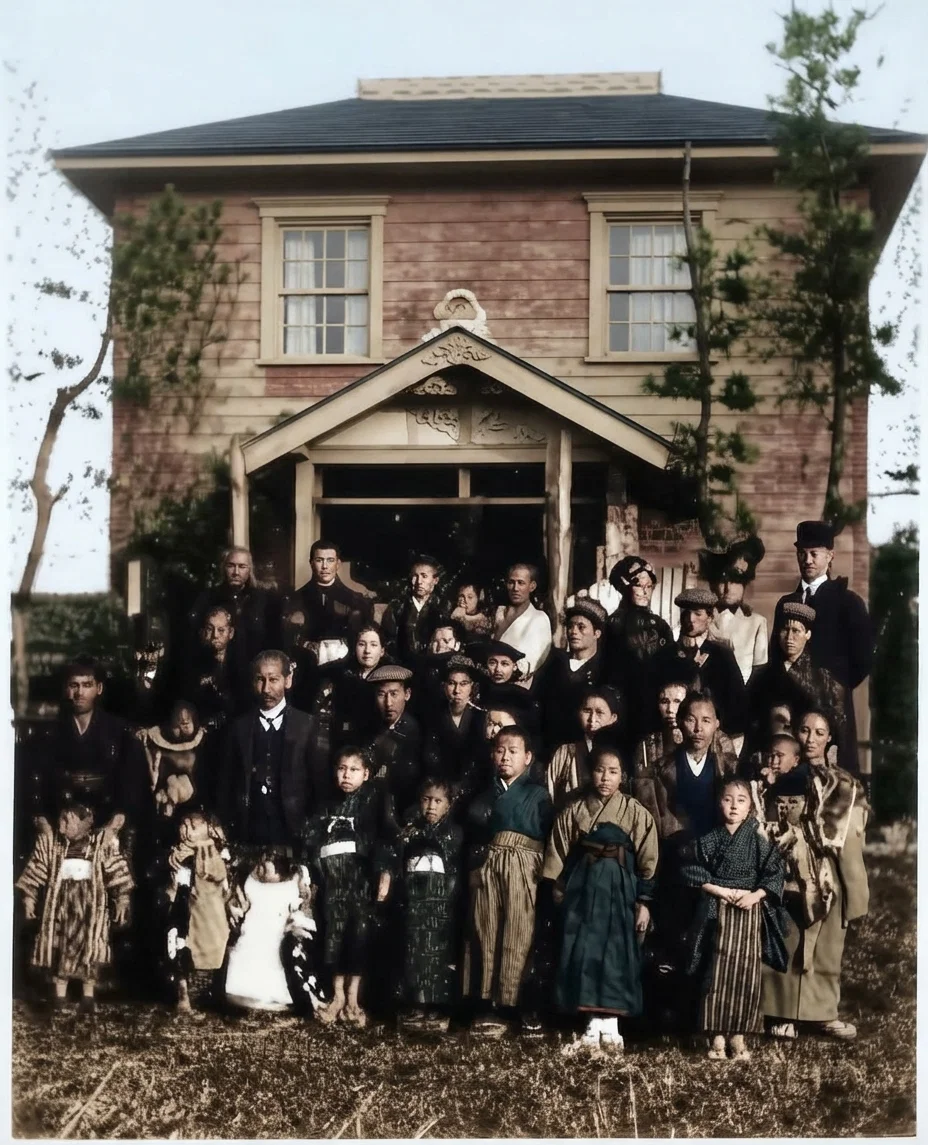
ABOUT one hundred and fifty miles north of Tokio, or about five hours' ride on the slow Japanese trains, out in the country and surrounded by the small, carefully kept, and intensely cultivated fields, stands the little Kuji church. Numbering only about thirty members, all farmers with slender incomes and taxed to the very limit of endurance, they have been worshiping in the home of one of the members, in one of those tiny Japanese houses with the floors of straw mats—each person must sit upon the floor—and with the sliding paper partitions which throw the whole house into one room, which is the rule in Japan.
Last winter the members began to plan for a real church building, and all with a will began to give, and to solicit from their friends, the necessary funds. One gave the land from the corner of his field, and in the early summer they began to build as the money came in, and by the beginning of December they had erected a modest little twenty-by-thirty-foot foreign-style house, painted, and furnished with seats, desk, stove, and lights, all ready for services. On the sixth of December a party of our foreign and Japanese workers left Tokio in the morning to assist in the dedication of this church. When we reached the station where we must leave the train, we found a party of our brethren awaiting us with negurimas, or little carts, for our baggage. After a walk of nearly three miles on the narrow, winding roads through the rice fields, we reached the little church by the road and the home of our Japanese evangelist, who lives close by.
When in the homeland last summer, while speaking on missions at the West Michigan camp meeting I mentioned the determined efforts which this church was making to get a church building. After the meeting closed, a number of the brethren and sisters came to me and said that they wished to have a part in the building of the Kuji church, and gave me from twelve cents to one dollar each. The amount received there, with a five-dollar bill given by a brother in New York for the same purpose, enabled me to call for all outstanding bills, and pay every cent then owing, so that we might dedicate the building and present it to the Lord free from debt. This was a cause of great rejoicing to the church, and will be an example for others to follow.
From sundown Friday evening an almost continuous service was held until bedtime, and then upon futones, or heavy quilts, thrown upon the floor in the guest room of the church, we slept soundly until morning. The Japanese houses being small, and the families usually large, it is embarrassing to them to entertain, especially a foreigner, who by habit and training is very different from them; so in planning the church building they provided a guest room on the second floor, which can also be used for the children in Sabbath school.
Photo by F. H. De Vinney. THE KUJI CHURCH AT THE TIME OF DEDICATION
The dedicatory services were held on Sabbath morning, after the regular Sabbath school, all the workers present taking part. The building was well filled, many not of our faith being present and showing interest in the exercises. In the evening following, we gave a stereopticon lecture on our visit to the Holy Land when on our way from Japan to attend the General Conference last spring. Only those who know how many of these little folk can crowd into a place by sitting on their feet on the floor, can imagine how many were present. Every spot and place was filled with deeply interested and attentive listeners, many of whom had walked several miles. Some were women with babies on their backs, and all through the meeting their little bright black eyes eagerly peering over their mothers' shoulders marked them not the least interested of any present. A phonograph had been taken from Tokio, with sacred music both in English and in the Japanese, and added greatly to their pleasure, as many who were present had never heard a phonograph nor seen stereopticon pictures. Even after the meeting closed, some who had walked miles after work and failed to get there on time, came and begged to hear just a little; and so we kept up the music until late.
In all, we held four services with the church, besides the Sabbath school. This is one of the very few Christian churches in Japan organized among the farmers. As a class the farmers are very slow to change,—very conservative in taking up any new idea or in adopting any custom contrary to the old order; but they are about the most stable class in the country when they once embrace Christianity. This church has been organized for several years, at first very small, but active and growing, and all well established in the faith. The success of the building enterprise has been a great encouragement to them as they see what determined effort can accomplish under the blessing of God. There is still a good interest among their neighbors, and meetings are being held several times a week by the local worker, besides carrying on his Bible work; and we are confident that what has been accomplished is only a beginning of what will be done here.
We left the little company on Sunday morning to return to Tokio, several of the brethren walking to the railroad with us. On our way we passed through a fishing village on the open ocean, and watched the fishermen taking the fish from their nets after the night's work. Though it was a calm, bright day, there was a very rough surf rolling, making sailing dangerous.
While we were standing by, a boat with three men attempted to put to sea through the surf, and was overturned. Two of the men succeeded in getting to shore by swimming, but the third clung to the boat. It was nearly train time, and we had yet a considerable distance11to go to reach the station; and as we could do nothing to help, we were obliged to leave. The last we saw of the poor fellow he was being taken out to sea, and was making frantic signals for help to the many on the shore who were watching, and who to us seemed quite indifferent.
A note from our worker the next day, written by request, said that the man was finally rescued by a boat coming in from the sea, and added: "How we ought to work for the salvation of these poor souls all around us who are drifting out into a hopeless eternity." We must not be indifferent to their peril and signals of distress, but must redouble our efforts to reach them before they drift too far from the haven of rest.
We are of good courage, and see brighter days ahead for the work in this great field.
The Fall of Nanking
By James E. Shultz
JAMES E. SHULTZ
SooN after arriving in China, by request I accompanied Dr. Selmon to Nanking to ascertain conditions which our recruits would of necessity meet should they attend the language school in that place during the coming year. The city had just surrendered to the government forces after a protracted siege, and the railroad announced that it would resume traffic with the unfortunate city September 11. Accordingly, we left Shanghai on the afternoon of the same day.12
The scenery en route to Nanking was indeed beautiful, and we were repeatedly impressed with the fertility of the soil. The Chinese agriculturist faces no such problems as does his Japanese neighbor; for, in the first place, he does not have such a proposition as mountain soil; and secondly, his soil is more responsive to cultivation. His greatest handicap seems to be the presence of innumerable graves, the land occupied by which, I am persuaded, if brought under cultivation would solve the problem of feeding China's poor; for these graves mark the resting places of China's millions for centuries.
On leaving Shanghai, our train was crowded; but as we continued our journey, nearly all the passengers left us, apparently not anxious to see Nanking. Another disturbing feature was that refugees were passing us by hundreds on freight as well as on passenger trains. Entire freight trains had been requisitioned and were packed to the doors with refugees, who were able to carry all they still possessed in a small bundle. Old and young of both sexes were huddled together indiscriminately, presenting a picture of abject despair.
At seven in the evening our train was stopped and searched for contraband, but we were not molested. One hour later we could plainly see the lurid flames of the burning city. Soon we alighted at what had been a beautiful outer city. Idle soldiers were everywhere, dressed in a variety of uniforms, apparently under no control. Outside the railroad station, all was charred13ruins. Customhouse, post office, and foreign hotels met the fate of the meanest huts. Desolation stared us in the face, and for a time baffled our efforts to find lodging for the night. However, after walking through scenes such as I have described, we came to a foreign house occupied by the family of an English gentleman, whose hotel had been burned. They had escaped with only their lives, and their excited description of what had happened, together with their prophecies of what would take place, were rather distracting. Nevertheless, despite the noise in the streets, the wakefulness of the populace, the tread of numerous bands of soldiers, we committed ourselves to the God whose eyes "run to and fro throughout the whole earth, to show himself strong in behalf of them" that love him, and retired to enjoy a most refreshing sleep.
We were up with the dawn the next morning, and after preparing breakfast and committing ourselves to God, we took the train to the main city. The track runs under the main wall of the city, and this entrance had been closed during the siege; but it was now open, permitting us to enter without delay. To our left rose majestically Purple Mountain, strongly fortified, whose works were taken and retaken four times by the besieging army, as it was the most strategic point for the defense or capture of the city. It was here that a large number of men on both sides were lost. On alighting at the president's yamen we saw in evidence numerous flags of the victorious general, but none of the republic. It seemed very strange to me, but I supposed it was because I was a newcomer and not accustomed to Oriental usages.
Our first anxiety was for our chapel, which we knew to be situated in the storm center. Word had also been received that it was looted, and having observed what had been done elsewhere, we were apprehensive for the welfare of our Chinese evangelist and family. Fire had not visited this section, but what it had the looters had taken, so the inhabitants were just as destitute.
On our way we passed wheelbarrows, carts, jinrikishas, and carriages loaded with people, not to mention numberless pedestrians, all making their way toward the gates of the city, intent upon leaving, having been agitated by impossible rumors which could gain currency only in a beleaguered or fallen city. But why not go? All they possessed in this world was gone, or if not gone, it served only to mark them for the looters, as one case in point will prove.
A good man and his family, gardeners by trade, who had succeeded in getting a comfortable home, for this country, were visited by looters. The man, anticipating such a visit, had everything in readiness and invited the intruders to partake of a wholesome feast with him. They did so, and he dined them royally. After the repast, they announced their mission and demanded a large sum of money. He readily gave them all he14had, but they were not satisfied, and insisted that they must have more. He protested his inability to furnish more, and when torture failed to produce it, they struck off his head.
Shanghai.
Germany
By J. T. Boettcher
J. T. BOETTCHER
THE annual meeting of the Upper Rhenish Conference was held in Cologne. A fine large hall in the middle of the town had been secured for this purpose. As is well known, the territory of the Upper Rhenish Conference is almost entirely Catholic, but the third angel's message is no observer of lands or peoples. In a few years flourishing churches have risen up in the great Catholic centers, so that at present 437 can be counted as members, which bring an annual income of 31,161.91 marks in tithe and other gifts, or 70 marks per member. This is really a very good showing, if all the conditions are considered. In the churches there are many women, whose earnings are always less than those of men; hence this shows what the love for the truth accomplishes.
When we spoke of our missions in Africa and Asia, God's Spirit moved on the hearts of those present, and over 16,000 marks was collected in cash and pledges. Some pledged to sustain a native worker for one year. Here I also met Brother Ernst Kotz's mother. She had just lost her husband, and her son had sent her a comforting letter and directed her to the time when there will be no more disappointments. Brother Kotz had the joy of knowing that his father had accepted the truth in the last few months. We read a letter from Brother Ernst Kotz to the congregation, and showed a paper which is now being printed in the native language in German East Africa. We must truly exclaim, The Lord hath done great things! A few years ago, before our missionaries were sent, the natives could neither read nor write, and today they have a paper which proclaims to them salvation through Christ. This has all been accomplished by the faithfulness of our dear brethren and sisters who voluntarily gave their sons and means for this work. In eternity the reward will be a great one.
The evening meetings of the conference were well attended, and we hope that in Cologne many more souls may be led to the truth.
Sabbath and Sunday were specially blessed times. Brother Josef Braun was ordained to the gospel ministry. We are always happy when new ministers join the company of workers. Unfortunately, Brother Erzberger was hindered on account of sickness. Brother Janert was unanimously reelected president. May God's Spirit be with the workers this year also.
The Vantage Ground of Truth
No pleasure is comparable to the standing upon the vantage ground of truth.—Bacon.