The Youth's Instructor, Vol. LI, No. 11

The Divine Teacher

The Youth's Instructor

March 19, 1903

Review and Herald Publishing Company · Battle Creek, Michigan · March 19, 1903

The Divine Teacher
For thousands of years, men had been in thraldom to a degenerating power. Satan had perverted their conceptions of God, and of the plan and work of salvation. He had brought their minds so fully under his control that every heavenly attribute had been well-nigh destroyed. Of himself, man had not one thought nor impulse of a spiritual nature. He could do nothing to save himself. Only as Christ should draw him, could he take one step in repentance or reform.
God saw that the world was destitute of true knowledge, and he sent Christ into the world to live the law, and thus represent him. “The Word was made flesh, and dwelt among us . . . full of grace and truth.” The Truth, the Life, and the Light of the world, was to find a place in the hearts of men. For this Christ clothed his divinity with humanity. This was the only means by which he could reach humanity. Christ became one with the human family. He spoke in the language of men. He ate with them at their tables. He bore with them their trials and poverty, and shared their toils. Thus he assured them of his complete identification with humanity.
It was necessary that he should do all this. Though he came in human form, his wonderful works and the mystery of his character inspired the people with awe, and tended to shut them away from him. But by himself coming in close contact and sympathy with man, Christ broke down the barriers.
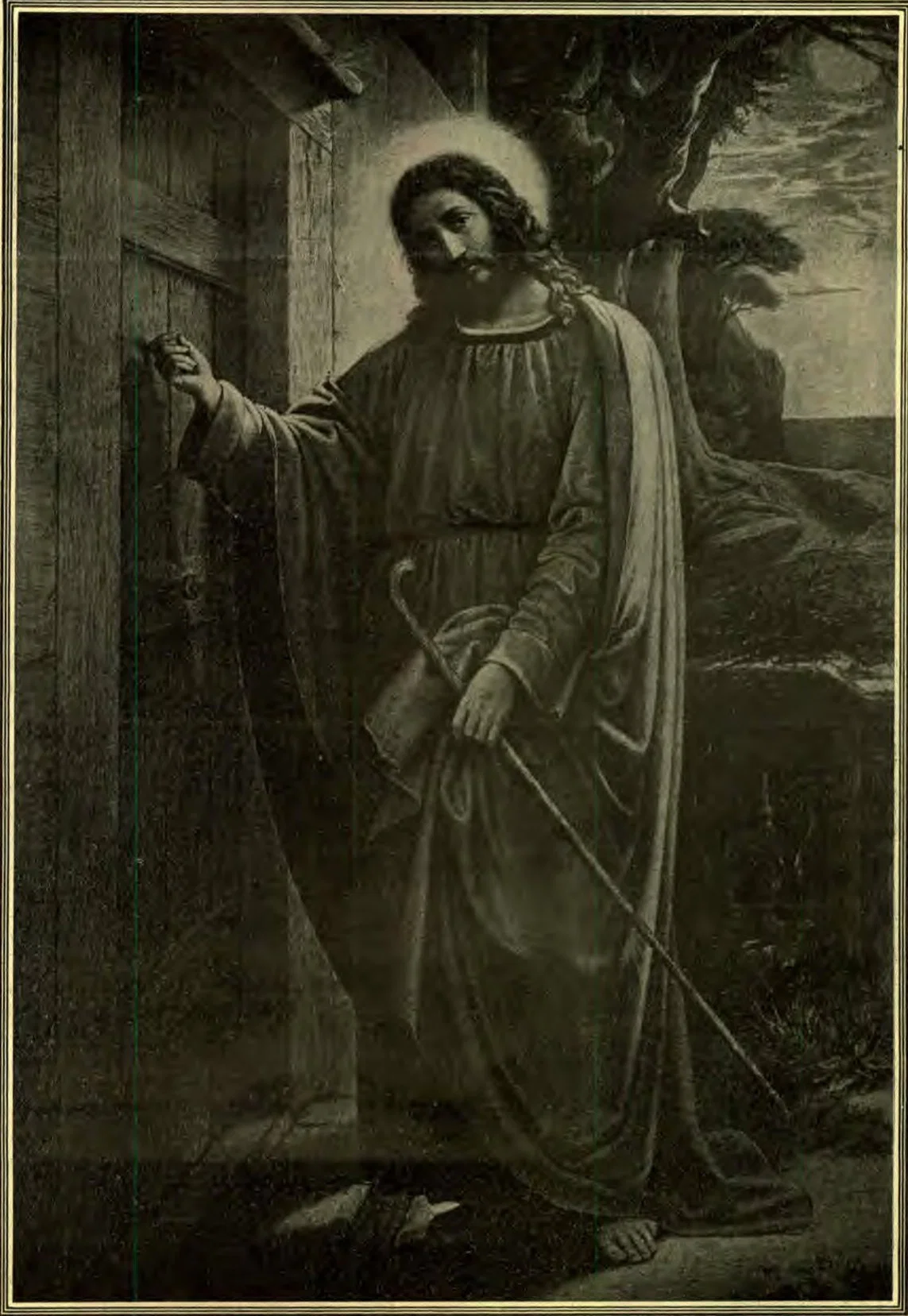
“BEHOLD, I STAND AT THE DOOR, AND KNOCK”
In his teaching, Christ did not conform to the practises of the great men of the world, or of the rabbinical teachers. Their teaching made dark and intricate that which was plain. They made a show of possessing great knowledge, knowledge which the common people could not comprehend. But their wisdom was foolishness. Christ’s knowledge was great, his wisdom deep; but it was without pretense. It found expression in words beautiful with the grace of simplicity, yet clothed with dignity and power.
Christ, the author of truth, did not disdain to present truths that were old and familiar. The great purpose of his mission was ever kept in view. When this purpose could be served by the repetition of familiar truths, he employed them. By unsanctified minds, many of these truths had been disconnected from their true position, and had been employed to strengthen error. Christ recovered and replaced them as links in the great chain of redemption.
Many precious gems of light had lost their luster; they were buried beneath a mass of tradition and superstition. As the author of truth, Christ was able to distinguish every precious gem. His hand removed the rubbish of false teaching, and recovered the lost treasures. He reset them in all their original freshness and beauty in the framework of the gospel, and commanded that they should stand fast forever.
In his teaching Christ reached the minds of men by the pathway of their familiar associations. He linked his lesson with their most hallowed recollections and their tenderest sympathies. His illustrations were drawn from the great book of nature and from the treasury of household ties and affections. The simple lily of the field in its freshness and beauty was presented to the people by the great Master artist. With the common duties of life he bound up the most precious treasures of divine truth. The regenerating power of his grace was represented by figures that all could comprehend. Thus he made truth and light a part of the daily appointments. Everything connected with the common routine of life was invested with a solemn dignity, and shown to be related to eternal interests.
Christ taught the people that all true knowledge is divine, and that, acted upon, it will lead heavenward. In all his teachings he suggested to his hearers a new train of thought, in harmony with the transforming principles of truth. By meeting the people where they were, he carried them with him to a higher plane of thought and life. Their hearts were prepared to receive the rays of light shining from the Light of the world.
Though Christ had taken upon himself human nature, yet his divinity flashed through humanity. In all his education and discipline his superiority was revealed. In their simplicity the lessons which fell from his lips possessed a power and attractiveness which none of the teachings of the world’s great men could equal. “The common people heard him gladly,” and the testimony borne to his teaching was, “Never man spake like this man.” Mrs. E. G. WHITE.

His Great Love

Like a cradle, rocking, rocking, Silent, peaceful, to and fro, Like a mother's sweet looks dropping On the little face below, Hangs the green earth, swinging, turning, Jarless, noiseless, safe, and slow; Falls the light of God's face bending Down, and watching us below.
And as feeble babes that suffer, Toss, and cry, and will not rest, Are the ones the tender mother Holds the closest, loves the best, So when we are weak and wretched, By our sins weighed down, distressed, Then it is that God's great patience Holds us closest, loves us best.
O great heart of God! whose loving Can not hindered be, nor crossed, Will not weary, will not even In our death itself be lost,— Love divine! of such great loving Only mothers know the cost,— Cost of love which, all love passing, Gave a Son to save the lost.
— Selected.

Ashamed of Mother

In a small town quite a number of years ago, occurred the incident which I am about to relate. It is a true story; and we think carries with it a moral which many of our boys and girls of to-day may well apply to themselves.
A singing-school had been in progress for some time, and a concert was to be held to close the exercises. The professor who had conducted the school was a fine musician, and had for an assistant a young woman who was an accomplished organist and also a good singer. The young people composing the school were to take part in the concert exercises, and their relatives and friends assembled to see what progress had been made.
Among those who had been learning to sing was a girl, about sixteen years of age, Jennie Rowe, who especially admired Miss Burton, the teacher's assistant. During the evenings they had been together, she became somewhat acquainted with her.
While Jennie was enjoying the singing-school and the social intercourse of young friends, her patient, careworn mother had stayed at home, and toiled far beyond her strength for the comfort of her family. She was an earnest, Christian woman, and cared less for the outward show of the body than for the inward adorning of the mind.
On this occasion, however, she came with others to listen to the music, having a feeling of pride in the musical talent of the dear daughter for whom she had toiled since earliest infancy. At this time, unlike more fashionable ladies, she wore a plain bonnet, while all others wore hats or other headdresses of a later style.
The singers had already arrived, and had taken positions on the rostrum near the organ. Meanwhile the audience was coming in; and as Miss Burton and our young friend were chatting together, she turned, and suddenly said, “Isn't that a funny-looking old woman sitting over there with such a queer bonnet on?”
Alas for Jennie! Instead of feeling proud of the dear mother, and owning their relationship at once as a rebuke to her newly formed acquaintance, she joined in the witticisms of her friend, and, like another Peter, acted, if she did not say, “I know not the man.”
But the voice of conscience long reproved her for her sin; and in after-years, by kind and loving words and deeds, she strove to make amends for the shameful denial of that evening.
Dear young friends, are you ashamed of your quiet, godly, old-fashioned mother? Would you rather not be seen with your gray-haired, “home-spun” father? If so, you are unworthy of such good parents. You should thank God every day for giving them to you, and on every occasion possible you should let them know that you feel proud of them. Both have toiled long and hard for you. They have cared for you in sickness and in health, when other friends would have forsaken you. They have prayed for you, and loved you—how much you may never know.
Their hands have grown hard and rough toiling for you. Their hearts have ached when you did wrong, and they feared their hopes for you would be disappointed. They have denied themselves many comforts that they might give you superior advantages. Now will you, can you, be ashamed of them because they are old-fashioned, or have not had the privileges granted you? Or, will you stand by them, love and honor them—yes, be proud of them, as you are of no other friends on earth?
It is a sign of the times in which we are living that persons will be proud, disobedient to parents, unthankful, and unholy. Perhaps all who read this may not be of that class that are disobedient; but an examination may show that we are not as thankful as we should be.
Let us, then, show that love for our parents that we will wish we had when the time shall come to us, as it has to many, that we shall look on the patient face with the tender eyes closed forever, and see the hands folded to toil for us no more. May we have no sad memories to make more bitter the loss of father or mother. Besides this, a record is kept in heaven, and we shall soon have to meet all these things. May God help us never to be ashamed of our parents, but to honor and respect them.
VESTA J. FARNSWORTH.

Wayside Chimes

LIFE is a work; begin it. Life is a battle; win it.
Life is a pure heart; shield it. Life is a scepter; wield it.
Both are God’s lesson; learn it. Death is his good rest; earn it.
— Baltimore American.

Out of the Mouth of Babes

MARGARET and Roger had just returned home from Bible kindergarten, conscious, as only children can be, of urgent calls for food from an undefinable somewhere. Mealtime was at hand, and their appetites were so soon met with wholesome bread, that the gratitude of four-year-old Margaret found spontaneous expression in the following beautiful lesson:—
“Papa, this bread gives me life, doesn’t it.” [Not interrogatively, but as a positive statement of her personal experience.] “God gave the life, didn’t he, papa?” To which papa added:—
“Yes, through the wheat.”
“Then it is God’s life I get, isn’t it?” she still persisted.
“Yes,” I answered, and to carry the lesson further, continued:—
“The wheat is planted, or buried, in the ground, and dies, or changes its form, to be raised each year, by God, to its best life—that of giving life. So, children, if when we die, and are buried, we have good seeds in our hearts, we also are raised to our best life,—eternal life,—when Jesus comes again,” all of which both children seemed to understand, as their closely following assents surely testified.
Papa and mama had additional reason that day to glorify God for a verification of Matt. 21:16: “Out of the mouth of babes and sucklings thou hast perfected praise.” F. M. KELLOGG.

Word-Criminals: Slang and Its Corrupting Influence

VI—Word-Criminals

I HAVE sometimes been thrown into the company of persons whose appearance, whose language, whose whole make-up, was degenerating, and who dragged me down to a lower plane of manhood. I am sure this has been true with you also. We finally all learn what these persons are, and avoid them. But there is danger from another source.
You may be surprised to know that there are, scattered among the virtuous, law-abiding word population, a host of the most pernicious word-criminals imaginable. Their very birth was disreputable; for they originated among groups of lying, lounging, gossiping loafers, who while away their tedious hours in the saloon, the gambling room, on the empty dry-goods boxes, or waiting for trains at the railway station.
The only object of their creation was to cause a burst of laughter, thereby winning for some one a little cheap notoriety, and making somebody else feel confused or embarrassed; for you know that the class of persons I am describing can not laugh except at the expense of others. Words born in such a way can not help being as vile and vicious as their progenitors, yet they are turned, reeking with the atmosphere of the idle, gossiping crowd, upon an unsuspecting world of young people.
Many a boy or girl, conscientious and well-meaning, is lured into patronizing these leering vagabonds, because of their boast of being all the fashion, the favorites of everybody; and they are quickly drawn into the circle of your acquaintanceship, while the respectable word whose place is thus usurped, is thrust out-of-doors.
So, my young friends, since you long to banish iniquity from your thoughts, since you love honor and truth more than vice and folly, avoid, as you would the plague, these vicious degenerates. Don’t call anything but a young goat a “kid.” Don’t “run a thing into the ground,” when you overdo it. Don’t add anything to the sin of a vain display of your possessions by calling it a “splurge,” or a “swell” affair.
These are enough to illustrate what I am talking about. You may not habitually use any one of them, and still regularly use a hundred others. Some are seen to be wicked at a glance, others disguise themselves with a sheep’s coat; but you may test them by the dictionary. They are labeled as “vulgarism,” “cant,” “slang,” or are ignored altogether, as not worthy a place among words.
Now as you thrust these evil associates from you, they will persistently compete for a place in your affections. They will unexpectedly step in front of the better word you have chosen, and completely hide it, and leave you confused and stammering. But that need not discourage you. That is exactly the way everything wicked behaves. You put the good in the place of the bad only by practise. Doing good does not become natural without practise, and a strong Christian character is not acquired except through practise. But persevere; strike one after another of those mischievous words from your list of acquaintances, supplying the vacancy with the respectable one, and by and by there will be nothing in your words—as I trust there is nothing now in your actions—suggestive of evil or ugliness.
L. T. CURTIS.

Obedience as the True Test of Love

OBEDIENCE is the true test of our love for God. “If ye love me,” he has said, “keep my commandments.” A love that does not obey, a service that does not serve, is of no value in the eyes of our Father.

Truganini: Kidnapping and Cruelty in Van Diemen's Land

Truganini
THE first settlement in the island of Van Dieman's Land, or as afterward named, Tasmania, was made in 1802; and from the very outset the native population was doomed. The whites, many of them convicts, shot down the natives on sight, with no more compunction than in shooting deer.
About the year 1830, Truganini, a dusky girl of about twenty years, was kidnapped by a band of government sawyers. She was the daughter of Chief Mangana. Her mother, at the time our story begins, had been killed by the whites, her sister had been carried off by a band of sealers who used to make the black girls go with them to do their rough work, flogging them severely for the merest trifles. Her uncle was shot by a representative of the government.
When these sawyers took her captive, they went in a boat to Bruni Island. They allowed two of her countrymen to accompany them at the start. One of them, Parawema, was her lover, and he was set upon keeping with her. When in mid-channel, these two young men were cruelly thrown overboard, but, being vigorous swimmers, they soon caught the boat, and put their hands on the side to climb in. Here comes the part that is almost too horrible to tell. We have often read of the terrible things inflicted upon whites by savage natives to whom was being brought the gospel of Jesus, and it is but right that we should face the actual facts of Anglo-Saxon cruelty against inoffensive heathen. As the two young men grasped the boat, the inhuman woodcutters took their axes and chopped off the hands of the swimmers. The victims fell back into the water helpless, leaving only crimson stains to mark the places where they sank. Truganini thus saw her affianced husband heartlessly murdered before her eyes, while she was helpless to assist him in any way. Under such circumstances many would have developed eternal hatred for the people who had thus dealt with her. But not so with the poor, ignorant, heathen woman. She seemed to have a slip of the golden rule tree firmly rooted in her heart.
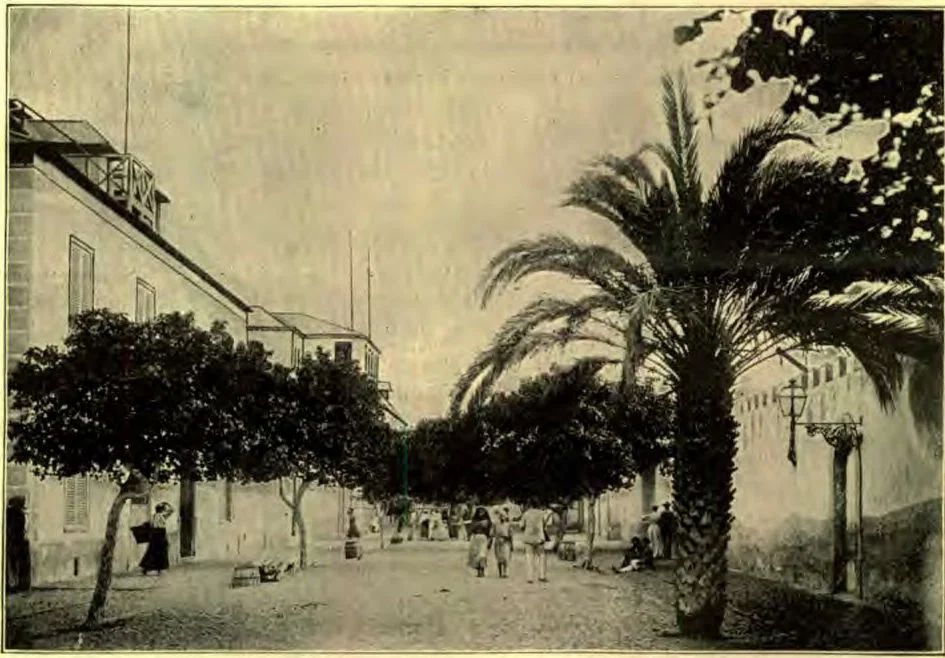
A STREET IN ASUNCION, PARAGUAY
Some time after this, for the protection of both whites and natives, the government decided to gather together all the Tasmanians, and transport them to an adjacent island to live by themselves. But there were various tribes, many of them in a state of great fear and savagery as a result of what they had experienced. They trusted no one, especially of the whites, and it was almost impossible to get into communication with them. A Mr. Robinson went forth among them as a missionary, unarmed, to disarm suspicion, and to get them together. Truganini went with and ahead of him as an assistant in this. She learned the different dialects of the tribes, and became an invaluable help in the work. She saved Robinson's life on one occasion, and took her life in her hands many times as she went from tribe to tribe on her mission of mercy.
But the poor natives rapidly died off. Strange as it may seem, she was the last surviving member of the race. Her death took place in America's centennial year, 1876. Her remains were followed to the grave by the governor and representative men of the city of Hobart, where she died. We can not help thinking that when some of every nation, kindred, tribe, and people shall appear before the Judge of all the earth in the first great resurrection day, Truganini may be there as a representative of the lost Tasmanian race. H. E. SIMKIN.

Paraguay and Uruguay

PARAGUAY is one of the most fertile and beautiful portions of South America. The northern part is mountainous; there are also numerous savannas and wooded plains. Asuncion, the capital, was founded in 1536, and stands on the side of a hill. The houses are mostly low, and built of brick and adobe. Some were built nearly three hundred years ago.
The lower classes in Paraguay have no word for home, and the houses are usually called “ranchos.” The rancho is a thatch-roofed mud house, and every nook and corner is generally made use of. Though the Paraguayans are very superstitious, being great believers in witchcraft, they are an orderly and law-abiding people. They are fond of tobacco, and the women use it as much as the men. They are also great drinkers of mate, sometimes called Paraguay or Jesuit tea. The latter name is given it because it was the Jesuits who first taught the people to cultivate it. When they came to Paraguay, they found the shrub growing wild. Now the people are so fond of it that they frequently rise in the middle of the night, kindle a fire, and drink from half a dozen to a dozen cups of the steaming beverage.
The population of Paraguay numbers about four hundred thousand, and the principal language is the Guarani, an Indian tongue. This very fact is an impediment to educational progress in Paraguay, because the use of Guarani is prohibited in the schoolroom. Therefore little progress can be made until the children acquire sufficient Spanish to enable them to understand the teacher.
Uruguay is southeast of Paraguay, and east of Argentina. Though the country is fertile, it is little cultivated. It has an area of about seventy-two thousand one hundred and seventy-two square miles. The country’s wealth is obtained from its pasturage, which supports large numbers of cattle and sheep. Barley, wheat, and maize are cultivated. Pears, quinces, apricots, grapes, and peaches are some of the fruits.
There are few railroads in Uruguay, and bridges are rare. Montevideo, the capital, is a very attractive city. It is pleasantly situated, and the streets are always swept by cool sea-breezes. The mountain which gives to Montevideo its name is over five hundred feet high, and can be seen twelve miles out at sea. A lighthouse stands on the summit.
Uruguay has less territory than Paraguay, but more people. The population is about seven hundred and eighty-seven thousand.—Bible Echo.

The Water-Buffalo of Sumatra

THE most useful animal in this island world is the water-buffalo. He bears all the heavy burdens, plows the rice fields, and gives his flesh as food, requiring only the cheapest food himself,—grass and cornstalks. He is very fond of the water.
While taking our walks across the fields, we often see a huge head and horns apparently floating on a pool of mud; but we know it is only the water-buffalo taking his frequent bath. When we meet such a big fellow in the paths, we feel a little bit timid when he levels his nose at us, snorting and snuffing, trying by that means to ascertain whether we are friends or foes. Generally the animals are quiet and patient, but recently a young buffalo was made quite mad by being compelled to stand long in the sun without water.
Not long ago a lady wearing a red garment was walking in the street with her husband, and met a buffalo. He attacked them, throwing the man into a thorn bush, and stepping on the lady’s head. The man arose and grasped the animal by the horns, while his wife ran into the house. The enraged buffalo escaped, followed her into the house, knocking down an aged man upon the porch, and pushed his way into the bedroom, where the woman had run for safety. After doing considerable damage to the furniture, he was finally shot by a soldier from the window.
We have often wondered to see these big animals, with their heavy bodies and short legs, climbing steep and slippery mountain paths. They usually move very slowly; but it is said that tigers fear them, and are killed by them. The name Kerbau (“buffalo”) is given to a great gorge, or washout, here—Kerbau Ghat. The dialect of this mountain country is called after this animal, and the native houses are built with roofs peaked to resemble the horns of the kerbau. So you see he has his honors as well as his labors and sacrifices.
The carabau of the Philippines is the same animal, and is called by practically the same name.
CARRIE L. MUNSON.
Fort do Kock, Sumatra.

A Curious Old Clock

ONE of the most remarkable clocks in the world is in the beautiful cathedral at Wells. It is believed to have been removed from Glastonbury at the time of the dissolution of all religious houses in 1529, having been made in 1325 by Peter Lightfoot, who was then one of the monks at the abbey, and whose name is inscribed upon it. This is claimed to be the oldest self-striking clock now in existence. The external dial is on the western buttress, facing the north porch, the time being denoted by the usual hour and minute hands. Immediately above is the motto, “Ne quid pereat” (let nothing be lost), which separates two quaint little knights or “quarter Jacks” clad in fifteenth-century armor, with large helmets on their heads, who stand on small battlemented brackets on either side, and strike the quarters simultaneously with their halberds on the two bells suspended between them. The interior face of the clock, in the north transept, is still more elaborate and complicated. This is more than six feet in circumference, and comprises four distinct parts; old English figures mark the twenty-four hours of the day on the outer circle, the minutes are clearly depicted on the second circle, while the age of the moon is shown on a third, and within the center smaller circle is the form of a woman surrounded by the inscription “Sic peragrat Phoebe” (thus the night goes round). Clouds and stars are represented on this unique astronomical dial, which is guarded by four angels.—Selected.

“Life Is a Sheet of Paper White,”

PURE as the page whereon you write Be all the words you send — Stars of remembrance in the night Of absence — to your friend.
And whether it be rhyme or prose, So fashion what you say That were it written on a rose, More sweet would be the day.
— The Youth’s Companion.

Thoughts That Help

There are no experiences recorded in the Bible but what might be ours; no promises made but what we can claim; no power given to any but what is freely offered to us.
In 1898 this sentence was published as a part of a message to the people of God: “Our great peril is in regarding the Lord’s plans with cool indifference.” The Lord has given a very definite call to our young people to organize themselves into bands of workers. We greatly fear that this is one of the plans that some are regarding with “cool indifference.”
How few people are habitually kind. Yet there is wonderful power in kindness. Kind words in the morning, to lighten the burdens of the day; kind words at night, for we know not that we shall have another morning; kind acts to the suffering, for kindness lightens affliction; kind tears for the erring, for it is better to grieve than to blame; kindness toward all, for kindness is needed by all.
We must have a place in the building fitly framed together and growing “unto an holy temple in the Lord.” Much scaffolding and waste timber are used by the workmen in erecting a house, but this is all thrown aside when the house is completed, and is not a part of the building. We may now have some part to act in the work, but unless we become a part of the building itself, we shall be cast aside as useless when the building is finished.
The masses of the people are ready to extend honor almost to the point of worship, to a man who has achieved victory in the nation’s battles. Because of this, many boys are ambitious to become soldiers. There is a warfare in which brave soldier boys are badly needed. But the fight is not against “flesh and blood,” but against “the rulers of the darkness of this world.” The Captain furnishes the armor. A breastplate, a shield, a helmet, and a sword are all ready for you. You must be prepared to “endure hardness as a good soldier,” and “war a good warfare.” Just as surely as you continue in the service until the crown of the victorious will be yours. The Young People’s Societies are recruiting stations where you may enlist, and enter at once into active service. MRS. L. FLORA PLUMMER.

Missouri Tract Society Reports: Kansas City, Joplin, St. Louis

Missouri

There is a good Society of twenty-five members at Kansas City. They are using “Patriarchs and Prophets” as a text-book for study. The members are arranging for a large supply of the new tracts, and will engage in the work of circulating them. They have also undertaken to establish a Home Department of the Kansas City Sabbath-school, and are visiting those who can not attend the school regularly, and supplying them with the Home Department report blanks and envelopes. They expect to have a good report in this line at the close of the quarter.
The membership of the Society at Joplin is thirty-two, a half dozen or more joining during the last quarter. Meetings are held each Sabbath afternoon. The INSTRUCTOR lessons are used in the meetings. The children of the Society have sold many papers, the proceeds of the sales being used in support of the church school work. The attendance at the meetings is excellent. The Society is planning a tract campaign.
At St. Louis the membership is twenty. Meetings are held on Sabbath afternoons for study, and on Wednesday afternoons to sew. A few books and tracts have been sold, and some Christian Help work has been started. The secretary says: “All seem to be interested in the work of the Master. We hope we can do more the coming quarter than we have yet done.”

A Timely Exhortation

BROTHER R. C. PORTER, writing in the Workers' Record of a recent date, sends a stirring appeal to the Young People's Societies in Kansas. It is so good for all that we quote a few paragraphs from his article:—
“We have as our motto, ‘The Advent message to all the world in this generation.’ We believe we have reached the last generation; that we, and our friends among whom we associate, will see the outpouring of the Spirit in the latter rain, and witness the seven last plagues, when a thousand shall fall at our side, and ten thousand at our right hand. If faithful, they shall not come nigh us; but if unfaithful, we shall share in the plagues, and if not swept away by them, fall by the brightness of the coming of the Son of man. But we do not want to fall under these judgments. We have fallen in love with Christ, and we want to share his company here, and associate with him in eternity. Christ is interested solely in one thing in this earth, and that is the redemption of his people. If we would keep his company, we must go into the world carrying the gospel. Then he says, ‘I am with you alway, even unto the end of the world.’”
“Have you read carefully the Signs of the Times of January 7? Will the leaders of our Young People's Societies each procure a copy, and read before the Society the account of earthquakes, storms, wrecks, and terrible tidal waves reported in 1902? Is it not time we were bringing more zeal into our work? These calamities are among the signs that were immediately to precede the coming of Christ. What more do we want to see in their fulfilment?”
“I wish we could circulate copies of the Signs, Sentinel, Life Boat, tracts, and books in such quantities as our times demand. The fact that our literature stirs the enemy is evidence that it is effectual in winning souls. Let us be an earnest missionary society; not in name, but in fact. Not at last weighed in the balances and found wanting, but welcomed with ‘Well done, good and faithful servant.’”

St. John, New Brunswick

THE Society has fifteen members, two of whom joined during the last quarter. This little company has been very active in missionary work. They report the sale of eleven copies of “Best Stories;” two hundred and ninety copies of the Life Boat, five copies of “Christ’s Object Lessons,” five copies of Good Health, one copy of “Steps to Christ,” and twenty yearly subscriptions were taken. The report also says: “The general interest has been good. The children have worked faithfully in helping distribute the Life Boat, and take an interest in doing it.”

Tract Societies Organized in Texas at Keene and Dallas

Texas

THERE are two Societies in Texas, both having organized recently. The one at Keene has a membership of forty-eight. Thus far Christian Help work and the distribution of literature have occupied the members principally.
At Dallas there are ten members. Plans have been laid for the distribution of literature, and four dollars was appropriated for that purpose. A good opening for a missionary Sabbath-school is presented, and such a school will probably be organized soon.

THE WEEKLY STUDY

The Tarrying Time

(March 22-28)
THE period of waiting after the disappointment of advent believers in the spring of 1844 is known in the history of the movement as the “tarrying time.” Take it and the lessons it has for us as the study for this week.
Basis of Study.—“Rise and Progress,” chapter V; “Great Controversy,” chapter XXII, first portion, down to the story of the “Midnight Cry.”
Scripture Portions.—Matthew 25, parable of the ten virgins; Hab. 2:1-4; Heb. 10:36-39; Eze. 12:21-25, 27, 28.
The lessons of this tarrying time are full of meaning for us. Because we had not done the work of carrying the third angel’s message to the world, there came in a long delay, and many are inclined still to say, “My Lord delayeth his coming.” Look up scriptures emphasizing patience as a characteristic to be developed under the message of the Lord’s coming.
The practical lesson as to the oil in the lamps is a good foundation for a testimony meeting. The foolish virgins set out to meet the bridegroom. But “they had moved from impulse. Their fears had been excited by the solemn message, but they had depended upon the faith of their brethren. . . . When trials came, their faith failed, and their lights burned dim.” Note how this was fulfilled in the “tarrying time” of 1844 and remember that those experiences are to be passed over again in the final work now upon us. This is why the Lord tells us to “call to remembrance the former days.” We must not be ignorant of these early advent experiences. Next week we will consider the “Midnight Cry.”
W. A. S.

Question Hints

(To be given to different members, and answered in the meeting)
WHAT were the characteristic features of the tarrying time? See Matthew 25. Do the same characteristics apply to our time? How are we to guard against them?
Give texts showing that the disappointment of 1844 was a direct fulfilment of prophecy.
What characteristics, that mark the work of God in every age, were seen in the lives of the believers of 1844? See “Great Controversy.” What should we now be doing?
Continue reading: Our Rabbit Neighbors