It seemed like a hard day for poor Bunny when men settled up the country, brought in fences of all kinds, cut down the trees, mowed off the hazel brush, and plowed the fields; but she has learned just how to make the best of circumstances as she finds them. If her blackberry briers have all been mown down, she will sleep in the brush pile; and when that is gone, she very wisely sleeps in the hedge fence that man has so carefully set out and tended. Here she is usually safe, and that is the reason almost all the rabbits in the neighborhood are to be found along the hedge fences. When a dog comes near, all Bunny has to do is to dodge through the fence, and run along on the other side; and if, after wasting a great deal of time, he happens to get over where she is, she simply jumps back again, and is safe.
If there are no hedge fences, she has carefully followed along every other fence in the neighborhood, and knows just where a dog can go, and where he can not come. Two years ago an old rabbit lived all winter long within twenty-five yards of my father's house, and the house dog chased her two or three times every day; but she always led him into the wire fence, and while he was hanging on the barbs, and whimpering, and trying to get through, and scratching himself, she would get safely away.
We may rest assured that there is not a hollow tree, nor a hole in the ground, nor a place where she can get under a hay-stack or under a barn, within a mile of her home, that Bunny does not know all about, and just how to reach it in the shortest possible time. No one knows any better than she that a dog can follow her track by the scent; so she never goes anywhere without running around in circles every little while, and so crossing her track that the dogs will have trouble in following it.
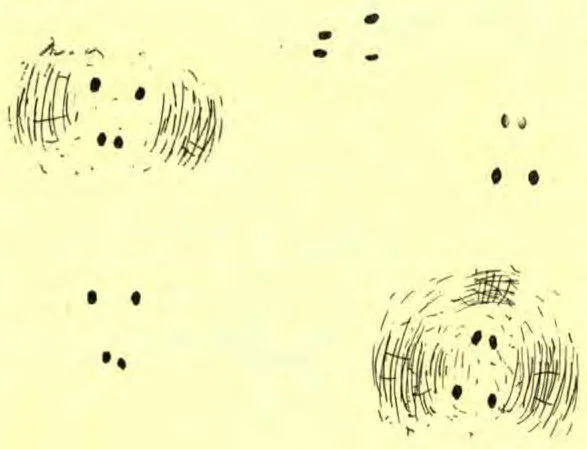
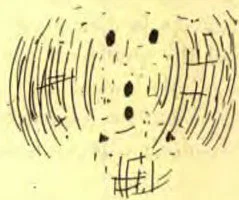
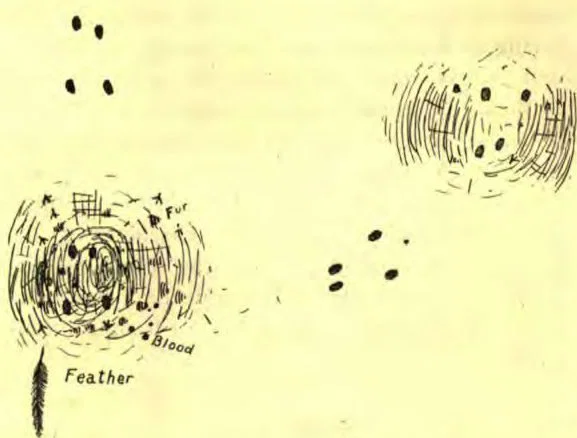
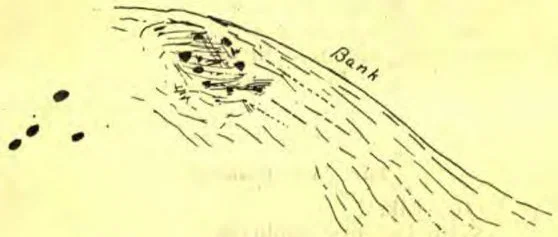
When you go into the woods, and see a rabbit track running right along in a straight line, without any break, you may know that the rabbit that made it was in danger, perhaps was being pursued by some enemy, and was escaping as fast as her little legs could carry her. If you do not see the tracks of a dog or some other animal after you have followed this track for a little distance, you are quite safe in concluding that she was fleeing from some bird. The accompanying illustration will tell you, better than I can describe it, a story that I found written in the snow about a year ago.
I was walking through a large cemetery when I noticed tracks that showed that a rabbit had been running for dear life; and I followed them, to see what it could mean; for there were no other tracks in sight. After I had gone about two hundred yards, the tracks suddenly changed direction, as if poor Bunny had made a wild leap to one side, and just where she had made this side leap, were marks in the snow, like the ones you see in the picture. Then I knew that some bird had been after her, but for the life of me I could not tell what; so I followed the tracks back and forth, in and out, for a few more rods. Every little while there were tail- and wing-marks in the snow, and at last I saw that the trail was beginning to be marked by drops of blood. Two rods farther on there was a place where the snow was all mashed down, and scattered over with tufts of fur and drops of blood; but Bunny had got away; for the track led on, showing more desperate leaps than ever. As I was turning to follow the track, I picked up the feather of a crow, and saw that what I had surmised was true; for a hawk would have borne the rabbit away at once.
Bunny ran about twenty-five yards farther, and there I saw evidences of another tussle. Carefully comparing the tracks in the snow, I saw that there had been more than one bird. Again Bunny escaped, and ran down a bank. I followed a little farther, and saw where the tracks ended, to go on again no more. Plainly, her pursuers had devoured most of the unfortunate rabbit where they had killed her, and then some other bird had come along, and borne the carcass away. Crows seldom do this.
I returned to my room to get my note-book and pen, so I could make a sketch of what I had seen. As I drew near the place, an hour later, I glanced up to the top of a tree that stood just over the spot where poor Bunny had been eaten, and there sat three black crows. To me they looked like three murderers, and they seemed to feel guilty; for as soon as they caught sight of me, they flitted away like evil shadows.
On the Western plains, where there are no good places to hide, the rabbits have grown larger, and have much longer legs. We call them jack-rabbits there, and they can run like the wind. It is very seldom that either a dog or a horse can catch a jack-rabbit as he bounds away across the prairies. This kind of rabbits could not run well among the brush of our Eastern States; for they would be constantly knocking themselves down. So, as civilization has gone westward, and the country has been planted with timber and brush, the jack-rabbits have gone before it. Now they are scarce in Iowa, and are not found at all east of the Mississippi River.
But the jack-rabbit is not left entirely without protection. On the Western prairies grows the soap-weed, or “Spanish bayonet.” Its spear-like leaves project in every direction, and form a bulwark which no wandering coyote is anxious to investigate. Under these the rabbits of the prairies sleep as confidently as their cousins under the gooseberry bush farther east. Where6it is too dry for the soap-weed, the cactus thrives; and under the shelter of a clump of “prickly-pears,” he rests secure from danger.
High in the Rocky Mountains, where the soft, dry snows of perpetual winter lie deep, there is still another rabbit, which God has made to dwell there in safety. Were the ordinary rabbit to run over these loose snows, he would sink in so deeply that he would be an easy prey to his pursuer; but here we have the “snow-shoe rabbit,” whose feet are widened out, and padded with long, stiff hair, until he races over the fleecy snow without fear of sinking. Men have made them snow-shoes to travel in these regions; but the great Father of all, who knows the needs of every one of his creatures, has made these innocent creatures to live among the rocks, and has so equipped them that they may dwell there in safety.
I have given only a little sketch of this most common and interesting little “neighbor.” If the children will get out in the open air, and use their eyes, they will learn much more of interest that I have not even mentioned; and it will bring health to their bodies, joy to their hearts, and wisdom to their minds.
Tom’s Discoveries
Tom was on the porch one summer evening with his father and Mr. Adams. That is, he was there bodily, but his thoughts were traveling up and down the world. Suddenly he was brought back by a question which his father asked Mr. Adams, who was one of the most successful men of their little city, and a prince of gentlemen besides.
“Adams,” said Tom’s father, “tell me, if you will, what you believe to be the secret of your success.”
Mr. Adams hesitated. “Well,” said he, “that’s a hard question. No doubt a great many things contribute to a man’s success, and at best a man can hardly credit his prosperity to himself. But,” he continued, “if I were to name one thing that has helped me more than others, I should name courtesy. You see, I found out very early that business is all the better for a touch of friendship. Men like to be treated well, and there is nothing that so quickly opens a man’s heart and inspires his confidence as the habit and the heart of a gentleman. Of course, when I have won his confidence, I try to be worthy of it. But whether I succeed in doing business with a man or not, I find that I can always afford to be courteous. In fact, I have often thought of moving an amendment to the old saying, ‘Not only honesty, but courtesy also, is the best policy.’”
It was good for Tom to hear that conversation; it increased his own equipment for winning success in the days to come.—Selected.
First Lessons in Geography
By Floyd Bralliar
Lesson XL
SOUTH of the great Sahara Desert stretches a vast country, which is as large as the Sahara Desert, or perhaps even larger, known as the Sudan. It is a well-watered region, lying wholly in the torrid zone; hence it is very fertile. There is no boundary between the Sudan and the Sahara Desert, but as one approaches the region where the rainfall begins, the desert sands diminish, and he passes gradually into the country of the blacks. Sudan means “black,” and it is in this country that the most civilized and powerful tribes of the black race live. In this region are found many large animals, especially lions, elephants, and giraffes. The giraffes are the tallest living animals, sometimes standing twenty-two or twenty-three feet high. They feed mostly on the leaves of trees.
The inhabitants of this region live in large tribes, and they own great herds of cattle. They plant grain, and also raise a great deal of cotton, from which they manufacture cotton cloth. They also tan very fine leather. Each of the great tribes is ruled over by a king. There are a few large towns, which have markets in their streets. These are the centers in which the Arab merchants gather together the products of the country, and prepare them for exporting to other countries. They send out a great deal of wax, oil, ivory, etc.
The Kongo River rises in the Sudan country, and flows southwest into the Atlantic Ocean. The country drained by this river is known as the Kongo country. Just east of the Kongo country are the great lakes of Central Africa. Name three of them. The Kongo Free State occupies most of the basin of this river. It is covered with dense forests, and its rivers are filled with crocodiles, alligators, and hippopotamuses, while lions, elephants, leopards, and other large beasts range through its jungles. Thousands of pounds of ivory, taken from the elephants’ tusks, are exported from this region every year. Many of the trees of this region yield rubber, which is also one of the great sources of wealth.
The climate of this country is damp and hot, and white men find it hard to live here on account7of the African fevers. The region is thickly populated, containing many millions of people, few of whom have ever seen a white man. Traders from the various countries have gone there in search of wealth, and now the steamers make regular trips on many of the rivers. A great deal of the merchandise, however, is carried on the backs of the natives for hundreds of miles.
The people of the Sudan are mostly Mohammedans, while those of the Kongo country are heathen. Missionaries have been entering this country for the past few years, and they find the people quite ready to receive the gospel of Christ. The children and young people seem especially desirous to learn the new religion as well as to learn how to read and write. If men can go there for the love of gold, how much more readily we should go to carry the glad tidings of salvation to these millions of people for whom Christ has died! They make stanch Christians, and we shall yet hear of many preaching the gospel to their own people. The cost of living here is very slight.
The people live in villages, and speak many different languages. The missionaries who go there must first learn the languages, then translate the Bible into these languages, and teach the natives to read it. They often find two or three different languages spoken within a distance of ten miles.
REVIEW.—Where is the Sudan? What does the word “Sudan” mean? What kind of climate has the country? What animals are found there? To what race do the people belong? How does the Sudan compare with the Sahara Desert in size? How do the people live? What do they raise? What are their exports? Where is the Kongo Free State? By what river is this country drained? What is the religion of the people of the Sudan? Of the Kongo Free State? How is the gospel received here? Tell about the language of the Kongo country.
FLOYD BRALLIAR.
Two Strange Dreams
WHILE Polly May was fast asleep,
Curled up in grandma's chair,
And dreaming of a lovely doll,
With curly golden hair,
All dressed in white, just like a bride,
With slippers and a fan
And handkerchief, her little foot
Went sound asleep, began
To dream of knives, and needles, too,
And prickly thorns, and strings
Too tight, and pins, and little wasps,
And nettles full of stings.
And so, though Polly May's own dream
Was pleasant as could be,
Her poor, unhappy little foot
Soon woke her up, you see.
— Selected.
The New Umbrella
By Agnes Lee
Oh, Ella!
With her first umbrella!
She walked abroad like any queen,
She held it proudly for display,
Admired its handle, stroked its sheen.
Was ever a little girl more gay?
Dear Ella!
Such a small umbrella!
Once in the rain-swept market-place
I met her. Dripping were her curls.
She looked, despite her sunny face,
The most forlorn of little girls.
“Why, Ella!
Where’s your new umbrella?”
Said I; “the storm has drenched your hair.
Just see your frock! Just see your hat!
And what is this you hug with care,
A broom, a fiddle, or a cat?”
Oh, Ella!
With her first umbrella!
She looked at me and shyly spoke,
The raindrops pelting on her, yet:
“I have it here beneath my cloak,
Because, you see, it might get wet.”
— Agnes Lee.
Little Boys and Little Sheep
Joe came home with his clothes, and even his little curls, all wringing wet.
“Just knew the ice wasn’t strong ’nough!” he grumbled.
“Then why did you slide?” asked aunty.
“’Cause all the other boys did,” said Joe; “so I had to, or they’d laugh.”
His aunt gave him dry clothes, sat him down behind the stove, and made him drink hot ginger tea. Then she told him a story.
“When I was a little girl, Joe, my father had a great flock of sheep. They were queer things; where one went, all the rest followed. One day the big ram found a gap in the fence, and he thought it would be fun to see what was in the other field. So in he jumped, without looking where he was going, and down he tumbled to the bottom of an old dry well, where father used to throw stones and rubbish. The next sheep never stopped to see what had become of him, but jumped right after, and the next, and the next, although father tried to drive them back, and Watch, the old sheep-dog, barked his very loudest. But they just kept on jumping and jumping, till the well was full. Then father had to pull them out as best he could; and the sheep at the bottom of the well were almost smothered to death.”
“My! what silly fellows!” exclaimed Joe.
Then he looked up at his aunt and laughed.— Youth’s Companion.
Loving Disagreeable Tasks
QUITE a young girl one day exclaimed, “I love to make myself do what I don’t want to do.” In that seeming paradox there is a world of wisdom. There are a great many duties that we have to perform that are distasteful. We can sulk when we do them, and groan because they are so unpleasant; or we can do as that young girl did, loving to make ourselves go through with them, and so get some real good and enjoyment out of them. It would be vastly better if we all loved to make ourselves take up the tasks that we are inclined to shirk. Of that girl, now a young woman, people frequently say, “Isn’t she a splendid young lady!” Her fine character is due largely to resolutely going at the things needing to be done from which she naturally shrank, and doing them with a song instead of a sigh.—Well Spring.
Little Words
“Yes, you did, too!”
“I did not!”
Thus the little quarrel started,
Thus, by unkind little words,
Two fond friends were parted.
“I am sorry.”
“So am I.”
Thus the little quarrel ended,
Thus, by loving little words,
Two fond hearts were mended.
—Selected.
Which Are You?
THERE are two kinds of people on earth to-day;
Just two kinds of people; no more, I say.
Not the sinner and saint; for ’tis well understood,
The good are half bad, and the bad are half good.
Not the rich and the poor; for to count a man’s wealth,
You must first know the state of his conscience and health;
Not the humble and proud; for in life’s little span,
Who puts on vain airs is not counted a man.
Not the happy and sad; for the swift-flying years
Bring each man his laughter and each man his tears.
No; the two kinds of people on earth that I mean
Are the people who lift, and the people who lean.
Wherever you go, you will find the world’s masses
Are always divided into just these two classes.
And oddly enough, you will find, too, I ween,
There is only one lifter to twenty who lean.
In which class are you? Are you easing the load
Of overtaxed lifters who toil down the road?
Or are you a leaner, who lets others bear
His portion of labor, and worry, and care?
He turneth rivers into a wilderness,
And water-springs into a thirsty ground;
A fruitful land into a salt desert,
For the wickedness of them that dwell therein.
He turneth a wilderness into a pool of water,
And a dry land into water-springs.
And there he maketh the hungry to dwell,
That they may prepare a city of habitation,
And sow fields, and plant vineyards,
And get them fruits of increase.
He blesseth them also, so that they are multiplied greatly;
And he suffereth not their cattle to decrease.
Again, they are diminished and bowed down
Through oppression, trouble, and sorrow.
He poureth contempt upon princes,
And causeth them to wander in the waste, where there is no way.
Yet setteth he the needy on high from affliction,
And maketh him families like a flock.
The upright shall see it, and be glad;
And all iniquity shall stop her mouth.
Whoso is wise will give heed to these things;
And they will consider the loving-kindnesses of Jehovah.
Questions
What change can God make in the rivers? In the water springs?
Into what is he able to turn productive land?
What will lead to such a change from the natural order of these things?
On the other hand, what changes can he make in the wilderness and in the dry land?
For whom are these changes made? For what purpose?
In what work will those engage who have been so bounteously provided for? With what result?
What temporal blessing is bestowed upon them?
Into what experience are they next brought? Through what means?
What classes are included in this experience?
What lesson does he then teach those who would trust to their own way?
What blessing is bestowed upon the needy? How far does this blessing reach?
Who will recognize these blessings? How will they regard them?
What effect will this have upon those who do iniquitously?
How will the wise receive these lessons?
To what will their attention be directed?
Notes
While verses 33 to 37 show God’s marvelous power to provide for his people, even in solitary places, an experience which awaits every faithful child of God before the final triumph of his work, there is no doubt that they also refer to the wondrous provision he has made for his people in the new earth, when the desert shall rejoice and blossom as the rose. Isaiah 35; also 65:17-25.
Verses 38 to 42 are a wonderful commentary on that familiar verse, Rom. 8:28. Everything is in the hands of God. If there is prosperity, it comes from him; if there are reverses, he permits them. God deals with man in the best way that will cause him to recognize his Creator. The righteous see these things, and rejoice now, and the time is coming when even the mouth of the wicked will be led to acknowledge the wisdom of God. Then it will be too late to accept his mercy, which is still offered. “To-day if ye will hear his voice, harden not your hearts.” “Behold, now is the day of salvation.” This Sabbath should be the time when we submit our all to God, if we have not done so before, accepting everything that he sends as from the hand of a loving heavenly Father. The result, verse 43. See also 1 Cor. 13:12.
MEMORY VERSE: “Thou leddest thy people like a flock by the hand of Moses and Aaron.” Psalm 77:20.
When God sent Moses with a message to his people in Egypt, he told them his name: I AM THAT I AM. In all their experiences when he led them through the wilderness, they were learning the meaning of this name, for they were finding out what he is.
In the pillar of fire he shone forth as the one who is the Light of the world, and in the refreshing cloud they saw him as the One who gives the dew and rain to freshen and sustain the earth.
At the Red Sea when there was no way of escape that they could see, he revealed himself as the way—the right way, the only way of escape and salvation, safe to tread even though unseen.
Then when they hungered, he spread a table for them in the wilderness, that they might learn to know him as the Bread of Life—the Word by which all things are fed.
They thirsted not when he led them through the desert, because he was with them as the smitten Rock, from which came “the fountain of living waters.”
And when Amalek came against them, through the rod of God in Moses’ hand, they learned of him as their defense and victory, who, if they were faithful, would cause them always to triumph over all their enemies.
Questions
1. By what name did God make himself known to Israel? Ex. 3:13, 14. How did he teach them the meaning of this name?
2. What did the pillar of fire show him to be? What did the pillar of cloud teach them of him? Tell what the pillar of cloud and fire did for them.
3. Describe the deliverance of the Israelites at the Red Sea.
4. Who were their pursuers, and what became of them? What did they learn of God through this experience?
5. Why did God suffer the people to hunger?
6. When he spread a table for them in the wilderness, where nothing grew, what was he teaching them to know?
7. How did he quench their thirst?
8. What did the smitten Rock represent? What comes to us from the Rock Christ Jesus?
9. Who came and fought against them at Rephidim?
10. How were they delivered? What did this show Christ to be?
11. What did God give to the people at Mount Sinai? Where did he afterward write this law?
12. Where has God promised to write it, if we will let him? How does God give his law into our hearts and minds?
The Wise Man and His Two Pupils
A WISE man in the East had two pupils, to each of whom he gave one night a sum of money and said: “What I have given you is very little, yet with it you must buy at once something that will fill this dark room.”
One of them purchased a great quantity of hay, and cramming it into the room, said: “Sir, I have filled the room.”
“Yes,” said the wise man, “and with greater gloom.”
The other, with scarcely a third of the money, bought a candle, and lighting it, said: “Sir, I have filled the hall.”
“Yes,” said the wise man, “and with light. Such are the ways of wisdom, for she seeks good means to good ends.”
Just Loved Me
Two little four-year-olds were at play on the lawn when the tiny girl slipped and fell. In a moment her small companion had helped her to her feet again, and stood with an arm about her until her sobs ceased.
“What did little cousin do for you when you were hurt?” asked the mother a few minutes later.
“Nuffin’; he just loved me,” answered baby, the tears still standing in her blue eyes, but the comfort of the tenderness she had received shining through them. “He just loved me over it.”
Oh, the divine wisdom of the treatment! There are so many falls and hurts where older people feel called upon to bring reproof, advice, warning, wise-sounding platitudes instead of the blessed love that would heal and strengthen. Many a weakness, many a slip, many a wound, grows into permanent scar and deformity for lack of the balm of sympathy and tenderness. Many a warped life and embittered heart might be saved if only there were some one to “love it over” the hour of hurt and danger.—Selected.
How Time Is Made
By Clifford Howard
For hundreds of years, people had very strange and uncertain ways of telling time; for they did not have any clocks or watches to mark the hours. In fact, they did not even know anything about hours or minutes, but reckoned time merely by days and months and years.
After the world had gone on for a long while with its days, months, and years, the day and night were finally each divided into twelve parts, or hours. It mattered not how long or how short the daylight part was, it was divided into twelve hours just the same; for the hours were lengthened or shortened to suit the length of the day in the various seasons of the year. In some of the long summer days each hour had seventy-five minutes, while in the short winter days, when the hours had to be crowded so as to get them all in between sunrise and sunset, each hour had only forty-four minutes.
These hours were measured by sun-dials and hour-glasses and candles and other curious timepieces, which were about as changeable and uncertain as the hours themselves. Of course when clocks were invented, such things went out of use; for clocks were so much more accurate and reliable, and would keep on recording the time without having to be watched continually to see that they did not stop or run out.
At first clocks were crude affairs, and were not much to be relied upon. They could not well be made for house use, and were chiefly placed in the towers of churches and town halls. Each morning and evening the clock bell would ring at a certain hour, so that all within sound of its deep note could keep track of the time, and, if they were fortunate enough to have a clock at home, could set it to agree with the town clock, which was more likely to be correct than their own. But now Uncle Sam does a similar service for the people all over this great country by sending at noon each day an electric signal which enables them to set and regulate their clocks and watches. The work is done by officers and clerks in the United States Naval Observatory at Washington, where they make careful calculations, and look after the great clocks that regulate the time of the country. Some of the college observatories also furnish several portions of the country with standard time, much in the same way as does the Naval Observatory.
Until a few years ago each town and city had its own time; for, as you know, time is reckoned by what are known as meridians of longitude—imaginary lines running north and south on the earth's surface. You all remember these lines running up and down across the maps in your geographies. Now when the sun is directly over one of these lines, it is noon at all places that happen to be on that meridian, but of course places lying east and west of this would each have a different meridian, and therefore a different time.
This was good enough before the days of the railroad and the telegraph, but now it would be a tremendous bother if each place were to use its own local time, and so we make use of a system called standard or railway time.
According to this plan, the country is divided in such a way that there are only four different times in the entire United States, each exactly an hour different from that of the adjoining divisions. Thus when it is twelve o'clock at New York, it is eleven o'clock at Chicago, ten o'clock at Denver, and nine o'clock at San Francisco. These different standards are called Eastern Time, Central Time, Mountain Time, and Pacific Time, and the time of all places in any one of these divisions is precisely the same, no matter what their local time may be.
In Europe some of the countries calculate their time from the meridian that passes through Greenwich in England, but the United States calculates from the meridian that is seventy-five degrees west of Greenwich. When the sun is directly over this meridian, it is said to be noon at Washington, Philadelphia, New York, Boston, and all other towns and cities in the Eastern division.
Strange as it may seem, Uncle Sam does not make use of the sun for reckoning time, but turns his attention to some of the regular steady-going stars, or “fixed stars,” as they are called. Every clear night an astronomer with a big telescope looks at certain of these stars, and makes his calculations, from which he can tell just when the sun would cross the seventy-fifth meridian. One of the great clocks in the observatory is called the transmitter, because it transmits, or sends out, the signal that keeps standard time. This clock is set and regulated by the star-time, and then every day at three minutes and fifteen seconds before twelve, a switch is turned on, and the beats of the pendulum of this clock are sent by electricity over the wires to the telegraph offices in Washington and New York. When the telegraph operators hear this sound on their instruments, they know that the noon signal is about to be sent out, and they at once begin to connect the telegraph wires with other towns and cities, until in a minute or two the “tick, tick” of the clock at Washington is heard in hundreds of telegraph offices. The beats stop at ten seconds before twelve, as a notice that the next “tick” will be the noon signal, and so as to give the operators time to connect their wires with the standard time-balls and clocks.
There are time-balls in a great many cities—usually on top of some prominent building, where they can easily be seen. The one at Washington is on the roof of the State, War, and Navy Department Building, at the top of a high pole, ready to drop the instant the signal comes over the wire. In the government offices at Washington and in many places in other cities there are large clocks connected with the observatory by electricity. These are so arranged that when the twelve-o'clock signal is flashed over the wires, the hands of each one of these clocks spring to twelve, no matter what time the clock may show; in this way hundreds of clocks are set to the correct time each day.
Well, the moment the sun is supposed to cross the seventy-fifth meridian, the telegraph instruments give a single tick, the time-balls drop, the clocks begin to strike, and everybody in the district knows it is twelve o'clock.— Clifford Howard, in St. Nicholas.
The Songs of a Year
By Elizabeth Rosser
“Spring is here!” the bluebird sings,
With the sky-tint on his wings;
Hark! his heart is in that flood,—
“Spring is here, and God is good.”
“Summer’s here!” the thistle-bird
Makes his merry music heard,
Caroling in joyous mood,
“Summer’s here, and God is good.”
“Autumn’s here!” the black rooks cry,
As across the fields they fly
To their home within the wood,—
“Autumn’s here, and God is good.”
“Winter’s here!” the chickadees
Chirrup from the snowy trees,
As they seek their scanty food,—
“Winter’s here, and God is good.”
So in happy days of spring,
Mid gifts that fall and summer bring,
While snow-drifts lie on field and wood,—
Let me sing ever, “God is good.”
ELIZABETH ROSSER.
Cosmic Mist in Sumatra
By Carrie L. Munson
WE have not seen the sun clearly for two weeks, owing to the ashes and mist from the volcanic eruptions in the Island of Martinique. Our own volcano and hills, which are so near to us, are not visible. The ships sailing about these waters are compelled to stop often because of the mist and fog. If we put out a plate in the rain, we get a sediment of fine ashes. It is hard to believe that an eruption so far away could so strongly affect this country.
CARRIE L. MUNSON.
Fort de Kock, Sumatra,October 19, 1902.