Your ShelfYour Projects

The American Sentinel, Vol. 7, No. 16

WHETHER men were actually forbidden by the ‘Blue Laws’ to kiss their wives on Su
Earlier text: WHETHER men were actually forbidden by the ‘Blue Laws’ to kiss their wives on Su

The Christian Religion Not a Part of the Common Law of the Land.

The Sunday closing of the Kentucky exhibit at the World's Fair, by the Legislature, seems to have become an accepted fact, and it does not seem to have occurred to the honorable legislators that this matter is one not within their province.
The writer would respectfully suggest that the Legislature of Kentucky can not, constitutionally, make any law upon any religious matter whatever, the Constitution of the State declaring that “no preference shall ever be given by law to any religious societies or modes of worship.” Now, the keeping of Sunday as the Christian Sabbath is a part of the mode of worship of Christians, in contradistinction to the modes of worship of the Jews, of the Seventh-day Baptists and Adventists, of the Mohammedans, and of the Chinese, who worship their God in Chinese fashion. Any law, therefore, made to enforce the observance of the Christian Sabbath, is a law made to “give preference” to the Christian mode of worship, and must of necessity be unconstitutional.
“But,” some may say, “the Christian religion is a part of the common law of the land. Learned judges have so decided; and by their decision we must abide.”
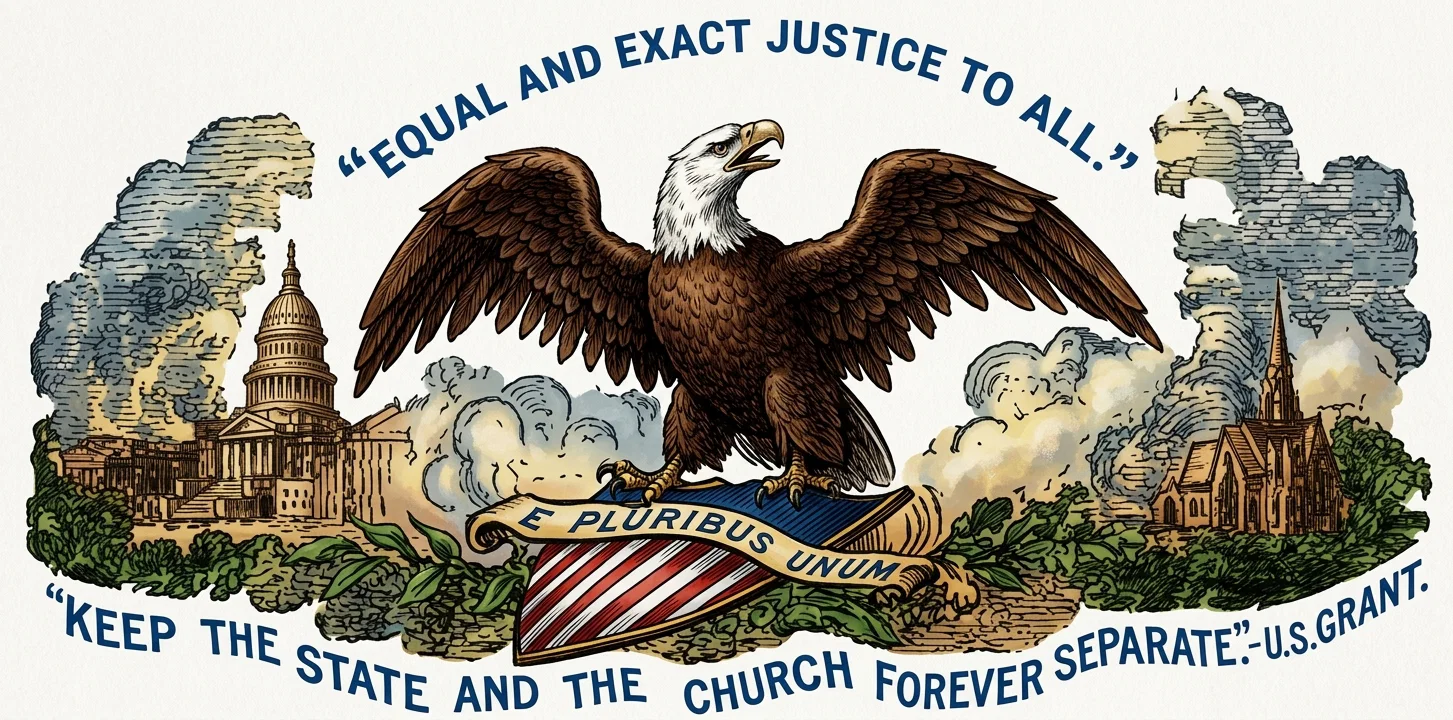
If this were so, of course, the Legislature could properly pass any laws it pleased in regard to religion. But if the learned judges had taken the trouble to look a little beyond the narrow groove of their statute books, they would have found this idea all a mistake, and that it grew out of the fact that the old English laws were engrafted upon her Colonies, and the old common law of England remained the common law of most of the States after their independence had been achieved. And Blackstone says that “the Christian religion is part of the common law of England.” But America is not England. We do not live under a monarchy, nor have we an established church; but on the contrary we repudiated kings, queens, and nobility, and founded our Republic distinctly on the idea of the total separation of Church and State.
The first impulse given to the American Revolution was by the electric eloquence of Patrick Henry in his defense of the people of Virginia against the payment of the tax to support the clergy of the Church of England. And not only Henry, but Washington, Jefferson, Madison, Adams, Franklin, and every other true American concerned in the formation of the American Government, advocated total separation of Church and State; and many of them have left on record, in their writings, evidence of the same. In the Federal Constitution, the instrument of their making, they say:
“No religious test shall ever be required as a qualification to any office or public trust under the United States.”
And, “Congress shall make no law respecting an establishment of religion, or prohibiting the free exercise thereof.”
And nearly every State in the Union has the same provision against religious legislation as has the State of Kentucky, their Constitutions all being in accord with the Federal Constitution, in that matter.
Doubtless the reason the States failed to erase the old laws from their statute books, was, simply, that all laws in conflict with the Constitutions of the several States and of the United States became null and void and of no effect, and it was never dreamed that they could, a century later, be revived, and used as an engine of oppression for a free people. So dear, then, was Liberty, it was supposed the American people would always cherish her and adore her very footprints.
If the learned judges aforesaid had looked into the history of their country, they would have found in the treaty of Tripoli, made in 1796, when General Washington was President, and signed by him, this declaration:—
THE GOVERNMENT OF THE UNITED STATES IS NOT IN ANY SENSE FOUNDED ON THE CHRISTIAN RELIGION.
This shows plainly that the Christian religion was not then “a part of the common law of the land.” And by what process it has since become so would be difficult to define.
If the learned judges had looked into the writings of Madison they would have found ample proof of repudiation of anything looking to the establishment of it by law in the remotest manner. Space forbids quotations, but this one sentence is so striking it will be its own excuse:—
Who does not see that the same authority which can establish Christianity, in exclusion of all other religions, may establish, with the same ease, any particular sect of Christians, in exclusion of all other sects?
And the ideas of Madison, of Washington, of Jefferson, and of all good and true men, prevailed over the few relics of monarchy left in the country, and the new dispensation abolished the old laws of tyranny and proclaimed freedom to man everywhere in this broad land—freedom of speech, freedom of thought, freedom of action—entire freedom so long as he did not trespass on his neighbor's rights.
Now, which shall prevail? which is most valid? the separation of Church and State, as decreed by the our American lawgivers, or the union of Church and State derived from the English monarchy where the Christian religion was “a part of the common law of the land”—handed down through the ages from Constantine, who first forced the early Christians into the giving up of their rightful Sabbath, and who first corrupted the early Church by uniting it to the State—making religion a part of the law of the land and forsaking the teachings of Jesus Christ, the first great expounder of separation of that which is God's from that which is Cæsar's?
Shall General Washington or Constantine be our prototype? Shall Washington, Jefferson, Madison, and the Constitution remain our authorities in this matter, or must we bow down to the verdict of the “learned judges,” and meekly accept their antiquated opinions derived from musty old English monarchical laws as our rule of action?
The truth is, religion is a matter of faith, law a matter of reason; religion is between man and his God, law is between man and man; religion is purely spiritual, and belongs to the individual; law is actual and belongs to the community; religion looks to the preservation of man's happiness in the next world, law looks to the protection of his rights in this world. They are entirely separate and should be kept so, in the interest of the purity of each.
The Legislature has no right to make any law in respect to any religious observance. It is a matter of comparatively small importance whether the exhibit be open or closed on Sunday; that might well be left to the Commissioners to decide; but it is of paramount and vital importance that there should be no legislation at all upon such a subject—that the Constitution be not violated, oaths of office not broken, a dangerous precedent not established.
Those men who disregard, or are ignorant of, the plain teachings of the history of their own country, are taking upon themselves a fearful responsibility in acting as lawgivers and advisers, and would best pause lest they aid in casting the most precious jewel of liberty, freedom of opinion, out upon the raging waves of passion and prejudice never to be again restored. For there is no tyranny like religious tyranny, and once admit that religion can be controlled by law, or that it can control law, and freedom is gone—freedom of religion is gone if law can control it, and freedom of the citizen is gone if religion is to control the law.—“Kaintuckee,” in Henderson (Ky.) Sunday Reporter.

How Many Things Can Be the Chief Cause of the Evils of Our Day?

In listening to the lectures and reading the statements of reformers, and those who would have us believe that they are reformers, we are often told of certain things that they positively affirm are the causes of all the evils in the land. For instance, the temperance reformer says that intemperance is at the bottom of every evil, and that if the whiskey curse were blotted from the land, sin and wickedness would be reduced to a minimum. For this statement there is a large amount of evidence, and the writer is not disposed to doubt it in the least. In fact the history of our race shows that the first sin ever committed was upon the point of intemperance, or what is the same, indulging the appetite in things that were forbidden, and wrong. And statistics are not wanting to show that much of the misery recorded on the pages of this world's history can be traced, either directly or indirectly, to intemperance.
But another, who would have us believe that he has an important reform movement to look after, tells us that all the crime and misery in the world is because men do not observe the Sabbath, and therefore we should have strict Sunday laws, compelling them to observe it. In a recent lecture upon this point, Rev. C. S. Royse, Field Secretary of the American Sabbath Union, in Minnesota, stated that the large number of divorces in Iowa was because the men didn't keep the Sabbath, and hence were not at home with their wives a sufficient amount of time to get acquainted with them to rightly love them and remain loyal to their marriage contract. He said that in Paris, men die very young because they don't keep the Sabbath.
Now, it would seem that before men make such statements they should fortify themselves with statistics that would show conclusively that such is the case. Missionaries tell us that the marriage contract is observed more sacredly among heathens who know nothing about Christianity, or the observance of any day as a Sabbath, than it is in the most refined community of Christian society. Now if the heathen adheres to the marriage vow without any Sabbath at all, why is it that a disregard of the Sabbath in more enlightened countries would cause the men to seek divorces from their wives? And again, many of these heathen nations that observe no day as the Sabbath, are among the strongest men physically, and live to a good old age. Then why is it that men in France who, like the heathens, observe no Sabbath, should be short-lived, and physically weak, when the heathens, under the same conditions with respect to Sabbath rest, are physically strong?
The writer would not be understood, to argue that Sabbath rest is not beneficial. I believe in observing the Sabbath, and have carefully regarded it all through life, and have found it an incalculable blessing. But the fact that it is such a blessing to those who observe it religiously, is no reason why it should be enforced upon those who do not wish to regard it, and the evidence is still wanting to show that the individual who works seven days in the week will not live as long, and be as healthy as the man who only works six days, provided the individual who works all the week does not abuse himself by any form of dissipation, such as is quite common in France, and will take the amount of rest that nature requires every night. Night is the time which God gave men in which to rest, and while wrapped in slumber, the tissues of the body are built up and strengthened for the labors of the following day.
But it is a noticeable fact that when a man has a theory to uphold, and especially when that theory is one not well grounded in principle, what he lacks in argument, he endeavors to make up in strong assertions which, however, do not bear close scrutiny. A. O. TAIT.

Which the Dying Cause?

MR. F. W. WARE, Secretary of the American Sabbath Union for the State of Michigan, in his paper for February and March, says:—
The Seventh-day Adventist papers are guilty of shamelessly and continuously insulting public intelligence by saying that those who are laboring to enforce laws enacted for the protection of the Sabbath from ordinary labor and noisy sports are trying to make men religious by law. . . . The Seventh-day Adventists ought to be ashamed of their course in this matter. . . . It is a poor and dying cause that is compelled to resort to such things.
One of two things must be true: this religious organization known as the American Sabbath Union, in its efforts to secure and enforce Sunday laws is either trying to make men religious by law, or it is not trying to make them religious at all, for this is its sole work, aim, and object, the enforcement of Sunday observance by law. If it, a religious organization, is not trying to make men religious, we would advise it to turn its attention to its legitimate and consistent line of work. There is little question, however, as to what it is trying to do. The modus operandi is the questionable feature in the case. It may be observed further that it must be a poor and dying Sabbath that is compelled to resort to law for protection and existence. In a lecture delivered in Battle Creek, Michigan, March 6, 1892, Mr. Ware attested this fact by saying:—
It was recognized about twenty-five or thirty years ago by the church that the American Sabbath was very fast passing out of our hands. . . . The churches which generally take the lead in moral reforms . . . saw as far back as that time that unless something was done more than ordinary, the American Sabbath, our Christian Sabbath, would soon with us be a thing of the past.
The “dying cause” is on the other side of the question from that which Mr. Ware would endeavor to make it appear.
W. A. COLCORD.

A Greater (?) than Joshua.

The Mail and Express, of April 9, contains a sermon by Rev. David Gregg, of the Lafayette Avenue Presbyterian Church, Brooklyn, from Ex. 23:12: “Six days thou shalt do all thy work, and on the seventh day thou shalt rest,” etc. In its personal comment the Mail and Express says of Dr. Gregg, “His sermons always show that scholarship which is so prominent a characteristic of the man,” and in the course of the sermon quotes him as saying:—
We have spoken of the abolition of the Sabbath in California. One reason for its abolition there is the wrong views which are scattered broadcast in California. The Seventh-day Adventists have their stronghold there. They insist that the seventh day must be observed, or no day, and so are hand in glove with the infidel in destroying the Sabbath. This is an illustration of the power of wrong views, and of the church defeating itself because of wrong views. There is no proof, and, consequently, no certainty, that the seventh day of creation, which Adventists claim, and the seventh day of our almanac are one and the same day. Besides this, the whole controversy about the seventh and the first day can be settled in a simple way. Here is a man who believes in the first day of the week as the Sabbath, and here is a man who believes in the seventh day of the week as the Sabbath; let them turn themselves back to back and start around the world. When they meet at the point opposite the starting point on the other side of the world, they will find that one has lost half a day, and the other has gained half a day and that they are keeping precisely the same Sabbath. Let them turn around and come back the same way and they will have the same Sabbath when they get home. Simply crossing over what is known by navigators as the Sunday line at 180 degrees changes the day, either backward or forward.
Certainly there is a greater than Joshua among us, for while at his behest the sun stood still, it yet continued to be the measure of the day, but Dr. Gregg is able to ignore the office of the sun in day-making entirely.
In the whole paragraph there is not a single correct statement, as applied to the Sabbath or Seventh-day Adventists, and on every point mentioned any intelligent man could set himself right with a moment’s thought, or a few moment’s investigation. Such “scholarship” as this reminds one of the wise remark of the humorist, that he would rather not know so much, than know so many things that weren’t so.

They Mistake It for Christianity.

THE Sun has received copies of the Chinese cartoons, ridiculing Europeans and Christian missionaries, which are now circulated in great quantities throughout China. Of these it is said:—
They are distributed freely among the people, as religious tracts are distributed with us, and the money for the purpose is furnished by individuals and associations, animated by a spirit of patriotism as they regard it. The movement is a veritable Chinese propaganda with the purpose of preserving the native religion and customs and protecting them against the invasion of Christianity and all European influences. A totally vicious character is ascribed throughout to the Christians. They are represented as guilty of the grossest immorality and the most horrible and revolting crimes, gouging out eyes and inflicting the most cruel tortures. This atrocious assault upon Christianity is the more remarkable because it is made by the representatives of everything that stands for civilization and high intellectual cultivation in China. It is the work of men of letters, men of a really lofty scholarship, measured by any standard we may apply. That such men, whose ordinary concern in life is with philosophical speculations, high political economy, statesmanship, should stoop to expedients not only absolutely depraved but of childlike imbecility, is something that does not readily explain itself.
On the contrary it does quite readily explain itself. These educated Chinamen know Christianity from the same point of view from which such men as Thomas Paine, Robert Ingersoll and the scores of writers for various infidel, atheistic, and “free thought” journals know it. Much of the published thought of these men of intellect and learning is as grossly repugnant to the religious sense of the experimental Christian, in proportion to the civilization from which it emanates, as the vulgarities of these Chinamen. Not only is this not surprising, but on the contrary it would indeed be surprising if just this use were not made of the terrible facts in the history of professed Christianity. The history of Christianity as it is now written, read, and understood throughout the world, is not the history of the gospel of Jesus Christ, but quite the contrary. The saddest, bitterest, most utterly hopeless fact, that the true Christian has to deal with in this world, is, that Christianity, so-called, as, led by the great deception, it has made itself known to men, is in reality the most deadly enemy and dangerous foe of the Christianity of the gospel pure and undefiled.
W. H. M.

Which Side?

THE Voice “straddles the fence” on the question of Sunday newspapers in the following ingenious but not wholly uninteresting manner:—
The Sunday newspaper might be put to considerable inconvenience if the ruling of Judge Clark, of Atlanta, Ga., holds good throughout the courts. The decision was that advertising in a Sunday newspaper is not legal and contracts for it can not be enforced. The Sunday newspaper lives on its advertising. Bereft of an income from this source, it would be snuffed out of existence too quick to preach its funeral sermon, or sing its requiem. But we don’t believe that it is predestined to die that way. A ruling of this kind, if it prevails in the higher courts, would cause some inconvenience, and probably some loss, but newspaper publishers would probably meet the case by requiring cash in advance for all future advertising. It has always been a marvel to us, by the way, to see the enemies of the Sunday newspaper trying to starve it out by refusing to buy copies of it. The only way to starve it out would be by refusing to trade with those who advertise in Sunday newspapers. It would be an interesting thing to find out how many pillars of the Church such a boycott would hit! But if carried out on an extensive scale, how it would set the fires of indignation and apprehension glowing in the offices of the daily newspapers!
It would be interesting to know just what the Voice thinks about laws that countenance dishonesty in the interests of Sunday sacredness; but the foregoing is all that it has to say upon the subject.
SUNDAY reformers are accustomed to say, that the keeping of any day in seven meets the demands of the divine law. Those who observe the seventh day meet all God's demands according to this logic. But these same Sunday reformers add that “the civil law can not recognize two days,” and hence it must compel the minority to refrain from work on Sunday, and it can not protect them in observing the Sabbath. Such a position is inconsistent and un-Christlike. It measures the duty of the State by the choice of the majority.—Sabbath Outlook.
SAM SMALL has been expressing himself, in Chicago, on the Sunday-closing of the World's Fair. He threatens it with bankruptcy if it opens on Sunday. He also said: “In 1888 the Republican Party, in its first convention in Chicago, placed in the first paragraph of its platform a recognition of Almighty God, by thanking him for what he had done for the country in general, and for the Republican Party in particular, and the 5,000,000 of people who voted that ticket voted for that clause as well as the rest. Submit the question whether or no this is a Christian people to a general vote and it will carry by an immense and overwhelming majority. At the Paris Exposition America, England, and Canada had their exhibits closed on Sunday, and had marines stationed to enforce the national respect to God's law.”
What can be expected from one who holds as superficial a view of religious life and truth as this?
An additional $50,000 has been appropriated for the American Museum of Natural History on condition that it be open to the public Sunday afternoons and two evenings each week. The Mail and Express thus bewails this action:—
“The condition requiring the Museum to be kept open on Sunday afternoons is pernicious in tendency and the offspring of an unwise and unsound public policy. The Sabbath of Continental Europe, with its fetes, its theaters and operas, its parades and concerts, its public galleries and varied places of general entertainment, is a very different day from the Sabbath contemplated and preserved under American institutions. Here it is a day of consecrated rest and worship. There it is a day devoted to frivolity and hilarity, to say nothing of the baser forms of vice which its customs generate and foster. Any step which tends to change the sacred character of the day with us is a step in the wrong direction. This condition of the additional appropriation does this very thing; it tends to secularize the Christian Sabbath, and it is to be deplored that it has received legislative sanction. It would have been practicable to get the appropriation without this wretched selling of Sunday. Has it got to this, that Christian institutions will be obliterated for money?”

NATIONAL

Religious Liberty Association
DECLARATION OF PRINCIPLES.

We believe in the religion taught by Jesus Christ.
We believe in temperance, and regard the liquor traffic as a curse to society.
We believe in supporting the civil government, and submitting to its authority.
We deny the right of any civil government to legislate on religious questions.
We believe it is the right, and should be the privilege, of every man to worship according to the dictates of his own conscience.
We also believe it to be our duty to use every lawful and honorable means to prevent religious legislation by the civil government; that we and our fellow-citizens may enjoy the inestimable blessings of both religious and civil liberty.

OFFICES:

43 Bond St., New York City. 1025 T St., N. W., Washington, D. C. 28 College Place, Chicago, Ill. 12th and Castro Sts., Oakland, Cal. 267 West Main St., Battle Creek, Mich.
R. C. PORTER — PRESIDENT. A. F. BALLENGER — SECRETARY.
THE Christian Statesman has discovered that Wyoming has a Sunday law. This leaves only Idaho and California without such statutes.
The Des Moines, Iowa, Conference of the Evangelical Church, at its session just closed, passed a strong resolution against opening the World's Fair on Sunday.
The Mail and Express remarks that “all the States will undoubtedly sooner or later direct that their exhibits at the World's Fair be closed on Sunday in obedience to the Christian and law-abiding sentiment of the country.
BAKERS' Union No. 90 has reported to the New York Federation of Labor that the bakers in one of Dennett’s coffee and cake saloons were compelled to attend prayers or pay fifty cents fine for each omission. Such things as this are but a natural outgrowth of the fast growing determination to enforce religious observance.
THE Idaho World says: “The preachers of Idaho have formed a combination and will circulate their petitions asking that the World’s Fair be closed on Sundays.” The World adds: “No true American citizen who has any conception of what kind of a link for a proposed long and strong chain he will be helping to forge by signing it, will put his name to such an un-American and unpatriotic request.”
THE pertinacity with which the advocates of enforced Sunday closing of the Exposition mean to continue their efforts is shown by this from the Christian Statesman: “It would not be too late even if Congress or the Commission should decide adversely, for the decision might be reversed. It would not be too late even if the Fair had begun with Sunday opening, for a sufficient protest would close the gates.”
There will be no truce offered by these people, and by and by no quarter given.
LONG ISLAND CITY has opened its baseball season with a police raid on the players who had gathered to the number of several hundred, Sunday April 11, in the vacant lots between Astoria and Hunter’s Point. Sunday baseball is to receive special attention from the authorities of Long Island City this summer. It will soon be found throughout the whole country that zealous police attention to Sunday desecration is an easy way to gain approbation and conceal the lack of enforcement of legitimate law.
THE Directors of the World's Fair have been memorialized on the Sunday-closing question by the International Federation for the Observance of Sunday. The document begins:—
To the Directors of the World's Exposition at Chicago:
Mr. President and Gentlemen: Permit us, Continental Europeans, to address you in the name of the Association which we represent and their numerous adherents, in favor of closing, on Sunday, the great Exposition which you are preparing for next year.
The memorial is quite long and takes the remarkable religious ground that enforced freedom from labor on Sunday is religious liberty.
The Christian Statesman thus welcomes an assistant in the advocacy of religion. “Do our subscribers think it square dealing for the former editor of the Christian Statesman, after signing a promise not to issue a rival paper, to bring one out, of almost the same name, in the same place, through his son? One of our mailing lists, a most valuable part of our property, was not turned over to us, being “among the missing” when the transfer was made. If our subscribers are generally getting samples of the above or any other paper we ought to be so informed. The new paper is not authorized by the National Reform Association.”
The management of the Christian Statesman seems to find it true, that uneasy lies the head that wears the editorial quill behind its ear.
At the Methodist Conference recently held at Chillicothe the following was passed regarding the World's Fair:—
Should said Exposition be opened on the Sabbath day, contrary to the solemn protest of the Christian citizens of this country, we pledge each other that we will not attend said Exposition on any day of the week, and will induce our people to follow our example in this regard.
That is to say if we can't have things our own way, we will resort to boycott. We wonder if Christ ever used any such methods in his work while upon earth? If not, then, is the boycott a method that it is proper for Christians to use? Of course it is the privilege of any one to stay away from the Fair, but why should Christians resolve so much about it? Why not depend on winning the world to Christ, relying upon his power for aid, and let the United States run its Fair to suit itself?
As a sequel to the hearings before the World’s Fair committees, in the House and Senate, on the Sunday-closing of the Chicago Exposition, some account of which is given in another column, there appeared among the church notices of the Washington Evening Star an advertisement of the presence of Rev. Dr. Herrick Johnson, of Chicago, in the city, and that he would preach in two different churches on the following Sunday. The notice continued, “Dr. Johnson visits Washington by the request of the American Sabbath Union, to urge the importance of united effort for the sanctity of the Sabbath, especially in view of its threatened desecration at the Columbian Exposition.”
THE story will be remembered of the careful father who flogged his son severely for profanity, but the son afterwards proved that he had actually said nothing at all, whereupon the father assured him that it didn’t make any difference for he thought damn anyway and he ought to be whipped for that. This has found its parallel in the decision of a Washington Judge, as reported in the Post, Washington, D. C:—
You haven’t any right, even in conversation, to repeat profanity. It is just as much an offense against your Maker and the law as if you originated the oath, said Judge Kimball yesterday in passing sentence upon William Lyddane. Mr. Lyddane endeavored to excuse himself for using certain words of profane nature on the ground that he was engaged in a religious discussion and had simply quoted them. He was fined $5.
Beyond this it is not more than half a step to that paternal oversight which would discern the thoughts and intents of the heart.
A CORRESPONDENT in Vermont sends us the following:—
Rev. Mr. Bates, pastor of the Congregationalist church at Randolph, Vermont, after preaching a sermon on the “Sabbath question,” April 3, 1892, made the following remarks in substance:—
“I have spoken upon this subject because I have been requested to, as also have the other ministers of our denomination throughout the land.
The object of bringing up the subject is to put before the people the importance of a day of rest, and the need of our exerting our influence in favor of closing the World’s Fair on Sunday. I am inclined to think that this is a needless precaution, as I do not believe that the people of this enlightened land will allow such an outrage. But if it is decided against us, next summer will witness one of the greatest revolutions which our country ever saw. We will have a new set of congressmen, and if need be, a ruler over them, as in ancient times, who will order and compel them to enact such laws as are for the interest of the people.”
And this minister only expresses the general sentiment of the ministers of the leading churches. They are determined to rule or ruin. Possibly they will yet do both.
WHEN the Italian troops took possession of Rome the percentage of illiteracy in the papal city was ninety per cent. Now it is forty-five.
DR. McGLYNN said that he would propose an amendment to the amendment making it provide that no State shall “use its property or credit, or any money raised by taxation, or authorize either to be used for the purpose of founding, maintaining, or aiding, by appropriation, payment for services, expenses or otherwise, any institution or undertaking not wholly under governmental control.”
UPON this matter of “unsectarian religious instruction,” the Catholic Review of the 10th inst., says:—
Indian Commissioner Morgan has purchased Protestant hymn-books and copies of the Protestant version of the Bible for the “non-sectarian” public schools which he has established for the Indians. Rev. Father Van Gorp, S. J., of Spokane, was in Washington, D. C., a few days ago, and he is reported to have said: “The Indians in the Northwest are better cared for, so far as rations are concerned, since the late uprising which cost the Government so much money. The cause of Indian education is not so bright as could be wished for, owing to the many difficulties the missionaries are compelled to encounter. Even the Indian Bureau, in spite of its advocacy of non-sectarian schools, seems to realize the necessity of some kind of religious education as among the articles purchased for what are called “non-sectarian” Indian schools are Bibles and hymn-books. The purchase of the latter justifies the conclusion that religious services form a part of the curriculum of the Government schools, especially as the superintendents are generally ex-Protestant preachers.” Morgan’s “non-sectarianism” is of the sort that would satisfy John Jay, Elliott F. Shepard and the other bigots of the proposed Sixteenth Amendment to the Constitution.
The fact is, there is and can be no such thing as unsectarian religious instruction. When Commissioner Morgan puts Protestant Bibles and Protestant hymn-books into the hands of the Indians, and instructs them in accordance therewith, he is, from a Roman Catholic standpoint, giving them sectarian instruction. The proper course for the Government to pursue would be for it to give the Indians a purely secular education, and leave the rest to be done by missionary enterprise, and by anybody who would do it, putting no obstacles in the way and offering no inducements to the work, simply affording equal protection to all from violence. The only real service that civil government can render the religion of the Lord Jesus Christ is to let it alone, merely affording those who profess and teach it the same protection that it affords to other citizens. When civil government does less than this it comes short of the purpose of its institution, namely, the protection of the natural rights of the individual; when it attempts to do more, it invades the sacred domain of conscience and corrupts the religion which it fosters. To be pure the religion of Christ must be absolutely separate from, and independent of, civil government.
THE Anti-Poverty Society of this city, about which so much was said and written three or four years ago, still holds its meetings on Sunday evenings at Cooper Union.
A FEE of ten cents is charged for admittance to the Anti-Poverty meetings, and to secure a really good seat requires an additional fifteen cents. In this the Anti-Poverty Society is not singular; the entirely unique feature of these meetings is, that, notwithstanding the charge made at the door, a collection is regularly taken up in connection with the opening exercises.
Dr. Edward McGlynn, the excommunicated priest, stands at the head of the Anti-Poverty Society, and at the regular meeting Sunday evening, April 10, seeming to see the incongruity of taking a collection after charging for admittance, he remarked that the collection was the “one feature of the meetings which entitles them to the character of semi-religious gatherings, and justifies the holding of them on the holy day.”
IN the recent Pittsburg Sunday Convention, Mr. Crafts dramatized quite effectively, and greatly to the disadvantage of the butt of his ridicule, the boast that “the Sunday paper has come to stay.” The incident suggested to the writer, who was present, another drama, in two scenes, thus:—

SCENE I.

Mr. Crafts on the “reform” lecture platform exhibiting an oriental saw, and saying: “It was such a saw as this that Christ laid down at the close of his week’s work on Saturday evening, saying, ‘The Sabbath was made for man.’”

SCENE II.

Mr. Crafts in the editorial chair of the Christian Statesman: “Reformers should be accurate.”
Accurate in what? In statements of fact? or in counting the cash received for Sunday evening “reform” lectures? The editor of the Statesman has quite a reputation for accuracy in the latter particular. Scene I. is a sample of his performances in the other matter. This great apostle of compulsory Sunday-keeping would gladly have the people think that Christ worked on Saturday, the seventh day of the week, and rested on Sunday, the first day of the week, but he himself knows better; and, unfortunately for his cause, the people also know better. The oriental saw and the designedly careless statement are to that extent a failure. They are, however, valuable as a sample of “reform” methods as exemplified by the founder of the American Sabbath Union, its whilom Field Secretary, and now boomer-in-general of “the whole circle of reforms.”
It is stated that Rev. G. W. Todd, of Topeka, Kansas, has taken the initiatory steps for the organization of what he calls a People's church. It is said to be Mr. Todd's idea to organize, in the large towns, People's churches, at which laboring men can assemble and discuss what he terms, “moral and political questions.”
This wording would accomplish all, and more, the Doctor thought, than was claimed for the amendment as it has been proposed by the Association for the Protection of American Institutions. As it now reads, the speaker suggested, it has the appearance of hostility to all religion, while at the same time it leaves a loophole for so-called “unsectarian religious instruction,” under Government patronage and support; and in the latter suggestion Mr. McGlynn was clearly right. It is certainly not the design of the promoters of this proposed amendment to make any wider separation between Church and State than now exists. On the contrary, their amendment is aimed at Roman Catholics, and is designed to exclude from the public crib all the institutions of that church, without in the least interfering with the giving of “unsectarian religious instruction” at Government expense.
DR. MCGLYNN'S subject on the occasion of the meeting referred to, was the proposed Sixteenth Amendment to the national Constitution, which provides that no State shall—
use its property or credit, or any money raised by taxation, or authorize either to be used for the purpose of founding, maintaining, or aiding, by appropriation, payment for services, expenses or otherwise, any church, religious denomination or religious society, or any institution, society or undertaking which is wholly, or in part, under sectarian or ecclesiastical control.
The speaker did not confine himself very closely to his subject; but enough was said to make it clear that he was opposed to the proposed amendment, as it now stands; but only, he said, because it was not broad enough.

You have reached the end of this edition.

The American Sentinel · April 21, 1892