“For this cause I Paul, the prisoner of Christ Jesus.” Verse 1.
2. In whose behalf was he a prisoner?
“In behalf of you Gentiles.” Verse 1. Note 1.
3. What did he imply that they had heard?
“If so be that ye have heard of the dispensation of that grace of God which was given me to you-ward.” Verse 2. Note 2.
4. What was made known to him by revelation?
“How that by revelation was made known unto me the mystery as I wrote before in few words.” Verse 3. Note 3.
5. What might they understand as they read his letter regarding this?
“Whereby, when ye read, ye can perceive my understanding in the mystery of Christ.” Verse 4. Note 4.
6. Had this mystery always been revealed? Are there fuller revelations?
“Which in other generations was not made known unto the sons of men, as it hath now been revealed unto His holy apostles and prophets in the spirit.” Verse 5. Note 5.
Notes
1. “For this cause.”—The apostle refers back to what had been previously said. He had just told these Gentile believers that they were built into the household of God, members of the commonwealth of Israel, no more strangers to the covenants of promise. This is a part of Paul’s preface to the wonderful prayer that he has for them. “The prisoner of Christ Jesus.”—Paul’s earnest desire for the Gentiles led to the enmity, jealousy, and hatred of the Jews, and this led to his imprisonment. However, he does not look upon it as something which he should hold against the Jews, but a part of the work of the Lord Jesus Christ who called him. He was told, in the very beginning of his call, of the things that he must suffer for Christ’s sake, and those were a part of the things which God had appointed, so that while he was a prisoner, he was a prisoner in connection with his work and in behalf of the Gentiles. How blessed it is to so regard the afflictions and trials which come to us. If we look upon them as God’s appointment, we will find blessing in them. If we look upon them as perplexities and trials which we in no wise deserve, and which some evil-minded person has brought against us, they will cause endless trouble and worry. Rather, let us take them as from the Master—prisoners in behalf of His blessed cause. The apostle preferred to preach to the Jews. He longed to go back to Jerusalem, as we are told again and again in Acts, but God saw in him a chosen vessel, one that could be used mightily in giving light to the Gentiles, and this the apostle ever keeps before him.
2. “If so be that ye have heard.”—Just a gentle reminder that he had told them of these things. The dispensation of the grace of God.—That is, the divine arrangement, or the disposition, the way in which God’s grace had been revealed, dispensed, and poured out upon the children of men. Of this he tells us all through the first part of his epistle. Doubtless he had given it to these brethren in Ephesus in great detail while he labored among them. He has also given instruction concerning this in his epistles to the Colossians, Philippians, and elsewhere. God had granted to him a dispensation, or stewardship. Paul himself was to be among those, preeminently, who should dispense, or spread abroad, the news of the blessings of the grace of God. And this, in a measure, is given to every one according to his ability.
3. “By revelation.”—The apostle did not receive his gospel through Jesus as He walked here in the flesh, nor did he receive his mission from the other apostles. He informs us in Galatians, the first chapter and the 11th and 12th verses: “For I make known to you, brethren, as touching the gospel which was preached by me, that it is not after man. For neither did I receive it from man, nor was I taught it, but it came to me through revelation of Jesus Christ.” The Lord Himself, he tells us, appeared to him as one born out of due time. 1 Cor. 15: 8. He, like others, had seen the Lord. An abundance of revelations and visions was given unto him. The whole plan and scheme of God’s gospel, as taught in all the prophets of the past and fulfilled in our Lord Jesus Christ, was opened before the apostle.
4. “The mystery of God.”—Not a mystery in the sense in which secret society people held mysteries, then or now, but the mysteries which God reveals to all those who will come into fellowship and harmony with Him—the mystery of the gospel, as stated in Ephesians the 6th chapter and 19th verse, “The secret of the Lord is with them that fear Him.” What this mystery included, or involved, to the Gentiles we will learn in our next study. Let it suffice here to say that it embraced the gospel of Jesus Christ.
5. “Not made known.”—Not always had this fulness of the gospel been known, yet it had been known sufficiently so that souls could embrace it and live. That has been demonstrated in every generation by the believers in God, and in His plan to save. Righteous Abel was a witness of his generation as against Cain the unbeliever. Enoch witnessed for God during the time which he lived. Noah witnessed, Abraham witnessed, Melchizedek, Jethro, Moses, and all the believers in Israel. Balaam, the wise men who came from the east,—all the good of all the ages past,—were witnesses to the effectiveness of the plan of salvation, dimly tho it were revealed in type and shadow and promise. But the abundance of that revelation did not come until our Lord manifested it in the flesh, showing in His own life the power of God to save and to keep mankind from sin in a world of sin,—that the Seed of the woman could live above all environments,—that is the mystery of godliness, God manifest in the flesh. 2 Tim. 3: 15. It had been revealed dimly before, even as the moon reflects the light of the sun, but when the Lord Jesus came, He revealed it in far fuller measure; and the weakened, wicked world needed the greater, the brighter, the clearer revelation. But this will be revealed,—that in the last great day it will be seen that there has been light enough, always, for men to come to the true light if they would but receive it. Yet there is more of the light of God. For, “the path of the just is as the shining light, which shineth more and more unto the perfect day.” Even unto the end of this world’s probationary period, floods of light will be poured out upon God’s people. Blessed is the man who by fresh supplies of life keeps the wine-skin of heart and mind fresh and expansive to the new wine of God’s truth.
Knights of Columbus and the Y. M. C. A.—
Photos by Clinedinst, Washington, D. C.
Some time ago it was intimated that the Y. M. C. A. were opening their doors to Roman Catholics, and certainly from the news that was given, it did look that way; but “The Western Watchman,” of February 20, 1913, prints a letter from the secretary of the local branch in Utica, in reply to the question whether Catholics were allowed to vote or hold office in the Y. M. C. A. This secretary said, “Of course you understand the Y. M. C. A. is a Protestant organization. It has never been suggested as being otherwise, but its membership is open to any man of moral character, regardless of creed or11nationality. The Association concedes to every man the right of religious choice. The right to vote and hold office is limited throughout the country to members of evangelical churches. The term ‘evangelical’ is held by some to include the Catholic as well as Protestant churches, but the intent of the constitution, as I understand it, when originally adopted was to avoid any possibility of controversy by limiting the matter of voting and holding office to members of Protestant churches.” This, of course, does not settle the matter, nor is the opinion of this local secretary the opinion of the whole body. The danger is that in these days of utter disregard of constitutions the Y. M. C. A. may be made open, in the fullest sense, to Roman Catholics.
Menaces against Asiatic Turkey
Copyright by Harris & Ewing
THE “Literary Digest” of March 15 has an article entitled “German Designs on Asiatic Turkey.” First of all is Russia, who has long had an eye on Armenia, and seemed to be only waiting an opportune moment. We are told:
“The number of troops in the Trans-Caucasus has been gradually increased, and rumors were heard that Russia was preparing to take a decisive step when there came a warning from the direction of Germany. Baron von Wagenheim, the German ambassador at Constantinople, made a speech in the course of which he said that Germany is very firm on the principle of the integrity of Asia Minor. The Russian press, which had apparently been preparing the public for eventualities by publishing articles about Armenia, telling how the poor Armenians were being oppressed and persecuted by the Turks, and intimating that Russia might have to ‘liberate’ them from under the Turkish yoke, are painfully disappointed.”
The “Novoye Vremya” of St. Petersburg says editorially:
“Asia Minor, maybe, really needs the recognition of the principle proclaimed by the German diplomat. At the time when Austria-Hungary was preparing to take the European provinces of the Ottoman Empire, and Italy to take her African colonies, Germany quietly established herself in Anatolia [Asia Minor] and Mesopotamia. She has taken possession of the Anatolian ports, has traversed all of Asia Minor by a through line of railroad, has obtained concessions for the development of the mineral resources of the country, and has taken into her hands the Turkish commerce, finances, and credit. The sovereign authority over Anatolia belongs to the Turkish government, but the material bases of that authority are gradually passing into the hands of the subjects of the German emperor.”
The “Literary Digest” remarks that the wisdom of the kaiser is well shown in his bloodless conquest. His bankers, engineers, and merchants are gaining control of the market, communications, and finance of that favored region, and however disinterested Germany appears to be in crying “Hands off Asiatic Turkey,” the Russian writer intimates that he merely means others’ hands. Thus we read:
“Anatolia will soon differ little from, let us say, Posen. The railroads, lands, industrial concerns, the large import and export trade, lastly, the most profitable branches of agriculture, will be under the supreme control of German financiers, back of whom, like a solid stone wall, stands German diplomacy. To the natives is left the respectable but not very profitable position of common laborers. In German mines, on the railroads, in factories, and especially on cotton plantations in Mesopotamia, the ‘sovereign’ nationality will find its daily subsistence. All the rest will go as compensation to the new masters for their cultured guidance of the development of the natural resources of the country of which its ancient inhabitants could not take advantage.”
The Turks themselves seem to be thoroly in harmony with Germany, and their national pride seems to be gratified; but the Russian editor still feels that all this is for Germany and not Turkey. He continues:
“The integrity of Asia Minor! That sounds noble! The Turks can not but welcome this generous call, and will hasten to grant to those who voiced it a dozen more concessions by which Anatolia will become enslaved to them for many years.”
“Baron Wagenheim does not conceal the motives that lead him to advocate the principle of the integrity of Asia Minor. With the clumsy bluntness of strong people he says: The integrity of Anatolia must not be violated because there are concentrated there numberless interests of the German people. In the partition of the Ottoman Empire, Germany must not be left out. All the members of the Triple Alliance must have their share. Austria received Bosnia and Herzegovina, and will yet receive Albania; Italy received Tripolitania and Cyrenaica and will also receive, maybe, a few islands; Germany must get Anatolia at her exclusive disposal. Sacred justice demands that.”
More than this, the “Novoye Vremya” believes that the Triple Alliance (Germany, Austria-Hungary, and Italy) is leading Turkey by the nose, and leading her to exhaustion and ruin, in order that the spoil may be more easily divided, and intimates that it is like the bull in the Spanish corrida. He is given the final stab between the shoulder-blades after he has been incited to wear himself out. The Russian newspaper declares that all this encouragement to Turkey to fight on to retain possession of her European territory is not with the expectation that it will be retained, but that Turkey may the more certainly exhaust herself, and so leave her Asiatic possessions as the easier prey. It further says:
“The new Turkish government tries by all available means to retain a large part of her former European possessions. The Triple Alliance renders it all possible assistance in that direction, encouraging it to further resistance, i.e., to the final exhaustion of the Turkish strength. . . . The longer the Balkan war, or even the uncertain state of affairs, lasts, the more of the natural riches of the falling empire will be acquired by the Austro-German financiers at a low price. . . .”
“The Reichspost (Vienna) goes further than Baron Wagenheim. This Austrian newspaper asserts that the German government has informed Russia that it will regard as a cause for war any Russian advance, be it in Armenia or on the Black Sea. . . . To make such a statement, Germany ought to base it on some real facts of Russian policy, but such facts do not exist.”
But of the outcome we are certain. Turkey, long ago the prey of the nations, has been sliced down until but little is left in Europe, and she is thoroly honey-combed in Asia.
Patriotic Women of Turkey
REGARDED a creature on the lower plane, despised and degraded as she is, Turkish women have had little to say regarding conditions in their own land. Just recently, however, at a meeting in the hall of the University of Constantinople, there were seven women speakers, the greatest of whom seems to be Halede Hanum, the first Turkish graduate of the Constantinople American College for girls, a distinguished writer and educator. Quoting from a former ruler, “For the Turkish race I slept not at night, I rested not by day, I worked for my people till death,” she said, “Let us each, in our measure, adopt these words of our great ruler.” She declared that the nation itself is not patriotic, that “the supreme need is a burning patriotism. For a nation to exist and preserve its existence over against other nations it is essential that it be ardently patriotic. It was this love of race which first made the Turks a great nation. It is our loss of this sentiment which has lessened our historical renown and laid us low. It is this love of race among our enemies which has made the Bulgarians, who were our milkmen, and I don't know what else, half a century ago, yes, even till yesterday, a nation that has won the respect of Europe. The race of conquerors, a ruling race, is now trampled underfoot by them.” She points, then, to other nations that have suffered great defeats, and urges her own nation to rise above the discouragement and fight for freedom. Here is another passage from her speech:
“Come nearer home. Look at the Greeks. For hundreds of years they were our subjects, without independence or a country of their own; their chief city like a dirty stable. Look at them now. Their little Athens is a city much cleaner and more beautiful than Stamboul.”
She closed with a very stirring appeal for the Turkish race, and at the close of her address gave her jewels, earrings, finger rings, bracelet, and watch, for the national defense. Her example was followed by the women present, and nine boxes were filled, the Literary Digest tells us, as well as three boxes for the work of the Red Crescent Society. Yet, poor woman, her appeal comes too late. When a nation outlives its usefulness, its purpose in God's order, it is doomed, and Turkey has evidently passed that stage. Then, too, this war is not over the race question so much as the religious question.
The Priests.
Photo by Clinedinst, Washington, D. C.
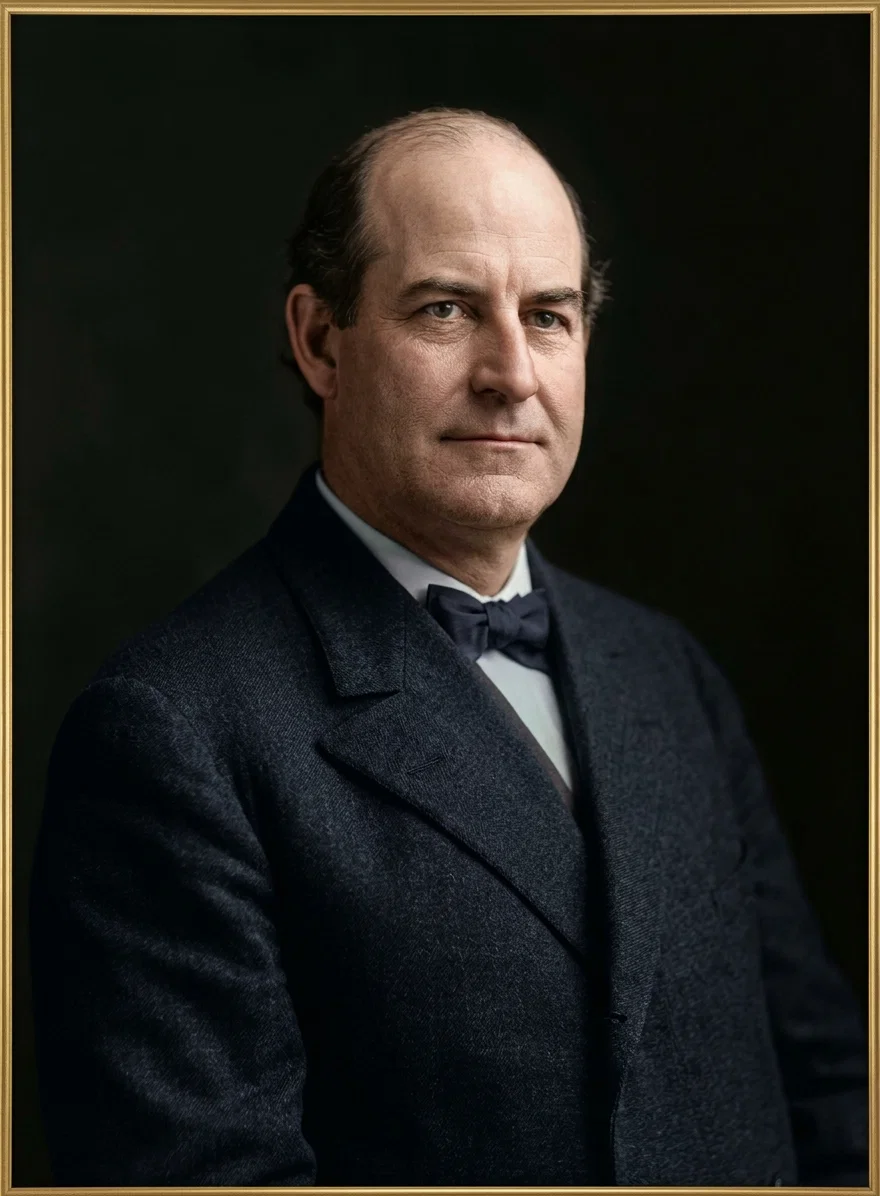
Albert Sidney Burleson, of Texas,
Postmaster-General
The Western Watchman of February 6 has a pretty sharp editorial anent its young priests. It says that at the Saturday evening and Sunday evening public balls in Catholic halls, for Catholic churches, “the ever-changing tactics of the devil have brought in the young priests who stand12at the door to invite people in.” “The jingle of the nimble nickel has such a charm for some of our clergy, especially our young ones, that they scarcely close the doors at the churches on Sunday afternoon before the ushers are hurried to the school halls, and the dimes continue to pour in, not now for the divine service, but for the ball. . . . And these public balls for the benefit of the churches are advertised every day in The America, edited by a knight of St. Gregory, and this is an abomination doubly abominable. . . . These young father confessors do not look very well making change at the church doors in the morning, and they seem awfully out of place calling on all who pass to come in and join in the ‘bunny hug.’ These young men look like sports, but they are priests. They wear short coats scarcely covering their hips, while the law of the church requires them to wear long coats reaching to the knees. But they are priests. They smoke cigars on the streets and in front of their dance halls, where such smoking is strictly forbidden. But they are priests.” And so on, and so on. The pitiful thing is that such men as that should be wearing priestly garments in any way. Think of it! Spiritual leaders and advisers!
Raising 167 Bushels of Corn on One Acre
Among the worthy organizations that are working for the improvement of farm crops is the Texas Industrial Congress, 906 Commonwealth Building, Dallas, Texas. It has just sent out to the press of the country the story of how young Alford Branch, the winner in a state-wide contest, raised 167½ bushels of corn on a single acre of land in Texas. Mr. Branch began by plowing his land in the fall with a two horse plow, cutting about six inches deep. He followed this plow with a “bull-tongue” subsoiler that cut ten inches further into the soil, but did not turn any of this earth to the surface. This thorough work with the soil prepared it to store up the winter moisture and to take care of the roots of the corn. He selected the best seed that could be obtained, and kept the soil carefully cultivated after planting, but cultivated shallow so as to keep a very fine surface on top, after the “dry farming” idea. This method of cultivation prevented the escape by capillary attraction of the stored up moisture. The Texas Industrial Congress is authority for the statement that the young man raised more on this one acre than was raised on ten acres of the same soil on the same farm, but that had been tended in the ordinary way. The average yield of corn per acre in Texas for the last ten years has been 19 bushels; the general average of all who engaged in the contest with young Branch was 51 bushels per acre. This shows what intelligent study can do to increase the farm outputs, and the Industrial Congress proposes to distribute $10,000 in prizes this year in order to stimulate interest in brain work on the farm.
Moral Degeneracy and Surgery.
By Editor
Photo by Clinedinst, Washington, D. C.
James Clark McReynolds, of Tennessee,
Attorney-General.
Some time ago we made a note regarding the cure of criminal tendencies in an individual by surgery, in Dannemora (New York) prison. Some time ago the prisoner was paroled because he was thought to be cured of his criminal tendencies. The surgical operation seemed to bring about a great change. But the first week in January, of the present year, the paroled prisoner was found guilty of a series of burglaries, showing that the improvement was only temporary, or that the operation and his subsequent good conduct were steps in a scheme to secure his release from prison. The Journal of the American Medical Association says, “There is no trustworthy evidence to show that changes in moral character, independent of mental deterioration, result from pressure on the brain. Sensational announcements of improvement in such cases after surgical intervention, like those that used to be made after various surgical procedures in epilepsy, need to be controlled by the subsequent history of the case. Immediate improvement in such cases is usually mental rather than physical, and successes reported before many years have tested their permanence, are liable to produce false impressions.” Which brings us again to the great thought that there is only one sure way to cure unmoral tendencies, or to change the heart of men, and that is through the regenerative power of Jesus Christ.
Alcohol and Racial Degeneration
(From the Journal of the American Medical Association)
Observations Substantiated by Properly Controlled Experiments on Lower Animals
For this purpose Professor Stockard, of the Cornell University Medical College, New York, has undertaken a study of racial degeneration in lower animals treated with alcohol.
In Stockard’s experiments, alcoholic treatment was given to guinea-pigs by an inhalation method. Alcoholic males were then mated with normal females. In the maternal test, alcoholic females were paired with untreated males. The outcome of these investigations has been convincing in their demonstration that alcohol may affect the offspring through either parent. Though the animals were never completely intoxicated, they were in a state of chronic alcoholism. Nine matings of normal animals, in the same group, gave nine living litters of seventeen vigorous individuals. Out of forty-two matings of alcoholized animals only seven young survived, and five of these were runts. In the paternal tests, there were abortions, still-born litters, and early deaths; the maternal test resulted much the same. When both parents were alcoholic, in most cases the matings resulted in no offspring, very early abortions, or still-born litters. The single offspring born living, from fourteen matings of alcoholic parents, died in convulsions at an early age. In general, the deaths of these unhealthy young followed symptoms of nervous disorders.
Harvard’s Youthful Doctor of Philosophy
It is worthy of a news note that there is a youth of eighteen who was given the degree of doctor of philosophy at Harvard University this spring. He is not a freak either. Besides his studiousness and scholarly accomplishments, he is a sturdy youth and an athlete. He entered Tufts’ College at eleven years of age, and graduated when he was fourteen. He specialized in philosophy and mathematics. He knew his alphabet at eighteen months, and at three could read and write. At six he had mastered arithmetic, algebra, plane and solid geometry, at eight he read books in Latin, German, French, and Russian. At nine he was solving problems in trigonometry and calculus, an expert in chemistry at twelve. His name is Norbert Weiner. If he is not spoiled before he is twenty-five it will be a great wonder.
Suffragette Violence in England
The suffragettes in England have brought things to the place where many of the leading men of the government say that their nation is facing mob rule. The women are put in jail for breaking up property and for other misdemeanors; and after being jailed, they refuse to eat, and resort to various exposures so that they may take cold, sicken, and die. Efforts have been made to pry open their jaws and force food upon them, for it was evident that they would starve to death in jail; and that is the very martyrdom that some of them are seeking. Members of Parliament express the fear that lynch law will be invoked unless something can be done to stop the work of the fanatics among the women. Most people have deliberately come to the conclusion that the average woman is as intelligent as the average man, and that she is fully as capable of voting. It is difficult to see how those who have pleasant memories of their mothers and sisters could believe that the female part of humanity belongs to some kind of inferior order of creatures. But all such questions as this are placed in the background by the rioting and violence that is being stirred up by the discussion. Reforms of many kinds have been freely discussed for the relief of the people. But poverty and misery of every kind go on increasing. It is thought by many of the reformers that, if the women can only be allowed to vote, we will soon have a great betterment of conditions. These discussions have continued until the whole of society is inflamed and ready at the slightest provocation for almost any violent outbreak. The people have been educated to believe that they are greatly wronged; and they stand ready to take matters in their own hands. Violence and anarchy are coming more and more to be the order of the day, and these conditions will continue to get worse and worse.
Underpaid Women Workers in Chicago
The condition of working women in Chicago has stirred the country. Acting Governor Barrett O'Hara, of Illinois, has taken the initiative and sent an appeal to the governors and legislatures of forty-seven states to join Illinois to stamp out the slavery. He declared: “There are 50,000 women and girls working in factories and department stores for less than $5.00 a week.” Of these women he says that they are absolutely underfed, and the majority of them since they became wage-earners do not know what a full meal means. Half of them are living on two meals a day, and these meals of the ten- or fifteen-cent variety, and many of them have to depend for clothes on what more successful friends are willing to give them of cast-off garments. He found on investigation that much of this despicable traffic in white slave labor is interstate; rings existing in Chicago worked hand in hand with similar rings in all the other states. He pleads for the cooperation of the other governors. We hope it may be granted.
The Powers and Turkey
One of the latest despatches given out from the diplomats who are considering the disposition to be made of the Balkan-Turkish controversy proposes to leave but a very narrow strip of land in the possession of the Turks in Europe. The despatch is quite brief and is as follows:
“The garrison at Adrianople has offered to surrender, on condition that the Turkish soldiers are allowed the honors of war and are permitted to keep their arms. The Bulgarians have refused to accept these conditions.”
“The European powers have decided practically to ignore the demands of the Balkan allies, and to consider their reply as tantamount to an agreement to accept the proffered mediation.
“The powers in their reply will congratulate the allies on agreeing to mediation, and will propose that the frontier line be drawn from Enos, on the Sea of Marmora, to Midia, on the Black Sea, instead of from Redoste to Media, all the territory to the west of the proposed line, with the exception of Albania, going to the allies.
“The note will declare that the question of an indemnity can not be entertained, and will remind the allies that Albania and the Aegean Islands are in the hands of the powers for final settlement.”
The “powers” are watching the fight very closely; and they finally decide what shall be retained by Turkey and what shall go to the “allies” who are waging the war against her. There can be no appeal from the decision of the “powers,” because they are supreme in that part of the world. But any one ought to be able to see the jealousies that have arisen among them, and the time can not be long delayed when they will reach the crisis that will soon bring the world to face the Armageddon that is prophesied.
Assassination of King George of Greece
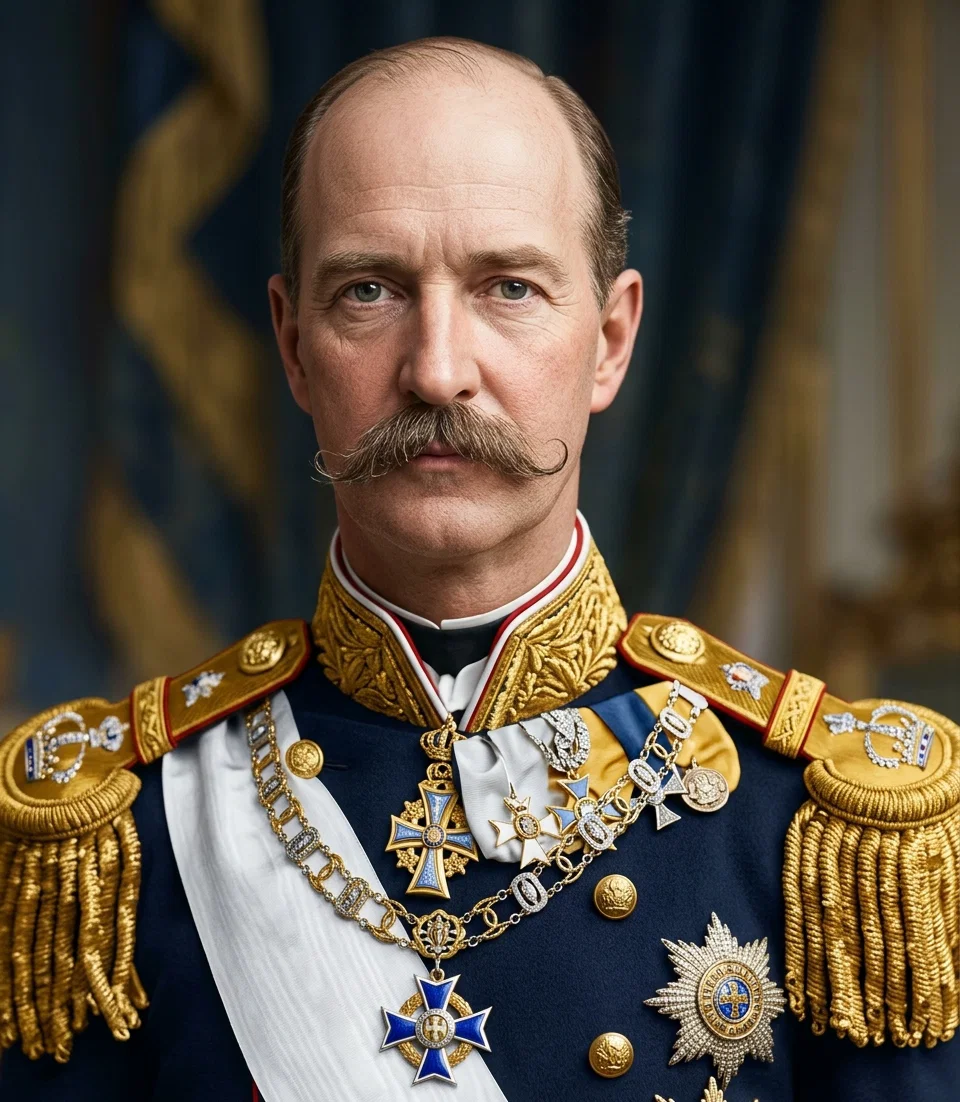
King George, of Greece, was assassinated while taking a walk in the streets of Saloniki on March 18. The deceased monarch was in his sixty-eighth year, and had ruled Greece for fifty years, having been crowned king in 1863. Crown Prince Constantine XIII has succeeded to the throne. The late monarch was very much loved by his subjects, and his death is causing general sorrow. The widow of the late King Edward of England is his sister, and the mother of the Czar of Russia is another sister. The new queen of Greece is a sister of the Emperor of Germany. It is very interesting to know how these royal families of the Old World are interrelated.
The Late King George of Greece
Moslem Unrest
The Missionary Review of the World says that the Balkan war has greatly incited the Mohammedans of the Indian Empire. In a large meeting of Moslems in Calcutta, speakers declared “that the Christian nations have joined hands to rob the Moslems of all their possessions, that the believers in the Bible are always the enemies of the believers in the Koran, but that they are unable to extinguish the fire which Mohammed has started, and that some day the cry, Allah Akbar, once heard before the gates of Vienna, will be heard again in the uttermost parts of the earth.” This same spirit, we are told, is spreading to other lands, with a certain anger toward the British government for not coming to the aid of the Moslem cause. The article closes by saying that “the activity and unrest are some proofs of the fact that Moslems throughout the earth are beginning to feel their oneness in religion and in politics.”
We Are Glad
By Editor
All true Americans and lovers of liberty ought to be glad that President Wilson has had the courage and sympathy to recognize the Chinese republic, and refuse to lend or authorize government funds to sustain the American bankers in joining bankers of other nations in throttling the young republic, or in placing a mortgage upon its finances. Among other good things the President said:
“The condition of the loan seems to us to touch very nearly the administrative independence of China, and this administration does not feel that it ought, even by implication, to be a party to those conditions. . . . The responsibility on the part of the government, implied in the encouragement of a loan thus secured and administered, is plain enough, and is obnoxious to the principles upon which the government rests.”
“The government of the United States is not only willing, but earnestly desirous of aiding the great Chinese people in every way that is consistent with their untrammeled development and its own immemorial principles. . . . Our interests are those of the open door—a door of friendship and mutual advantage. This is the only door we care to enter.”