The Youth’s Instructor, Vol. 29, No. 37.

SOMETHING ABOUT DR. LIVINGSTON

The Youth’s Instructor

Sep 14, 1881

S. D. A. Publishing Association · Battle Creek, Mich. · Sep 14, 1881

SOMETHING ABOUT DR. LIVINGSTON.

ALL of the readers of the INSTRUCTOR have heard of Dr. Livingston, the great African explorer,—how he went into the heart of Africa, miles and miles beyond any place where white men had ever been, and how he laid down his life for his great undertaking. You have heard how fond the natives were of him, and how they staid by him to the very last. You may like to hear just how it was that he gave up his life in that far-off land.
I suppose you all know that Dr. Livingston died on May-day morning, 1873. He had been very ill since October. He marched slowly, on account of sickness. The swollen rivers and marshy ground hindered him. At Christmas he came to the River Chambézé, and offered this thanksgiving: “I thank the good Lord for the good gift of his Son, Jesus Christ our Lord.” As they went on, the weather grew worse. The country was so flooded that they could only distinguish the rivers from their banks by the currents. There were long stretches of grass and sponge, with great elephant-holes. Besides all this, they were very hungry, for the natives refused them food. Once a mass of furious ants attacked Dr. Livingston in the night, driving him out of the hut. Notwithstanding all these trials, he wrote on his last birthday, March 19, 1873, “Thanks to the Almighty Preserver of men for sparing me thus far on the journey of life. Can I hope for ultimate success? So many obstacles have arisen! Let not Satan prevail over me, O my good Lord Jesus!”
On the 21st of April he was much worse. He tried to ride, but could not sit up; so Chumah and Susi, his faithful attendants, made a palanquin, which they called a “kitanda,” to carry him on. April 29 was the last day he traveled. He told Susi that morning to take down the side of the hut to bring in the kitanda, because he was too weak to walk out to it, and the door was too narrow to admit it. That day they crossed a river, then a swamp; and, when they came to a dry plain, he would beg them to lay him down.
At last they reached Chitambo’s village, in Ilala, and laid him under the eaves of a house in a drizzling rain, till they could build a hut for him. The next day he did not try to move. He asked a few questions concerning the country, especially about the Luapula. His servants knew the end was not far off.
About four o’clock that night, the boy who lay at his door called to Susi that their master was dead. The candle was burning, and they saw him kneeling at the bedside. He had died while at prayer, on his knees, in the attitude he always wished to take when praying to God. He had found that the usual way of conducting the Episcopal service,—by the reading of prayers,—did not give ignorant people any idea of a Supreme Being; so he always kneeled, and prayed with his eyes shut. Always in his travels he aimed at two things,—to teach some of the truths of Christianity, and to rouse the natives to feel the awful guilt of the slave-trade.
The curiosity of the people was very great. “Do people die with you?” asked two intelligent young men. “Have you no charm against death?” “Where do people go after death?” Dr. Livingston told them of the Father, and that he hears the prayers of his children; and they thought this was natural.
After the death of Dr. Livingston, his faithful servants, Susi and Chumah, embalmed the body, and carried it to the coast. It took nine long months, and they encountered innumerable difficulties; but they persevered, and the remains now lie in Westminster Abbey.

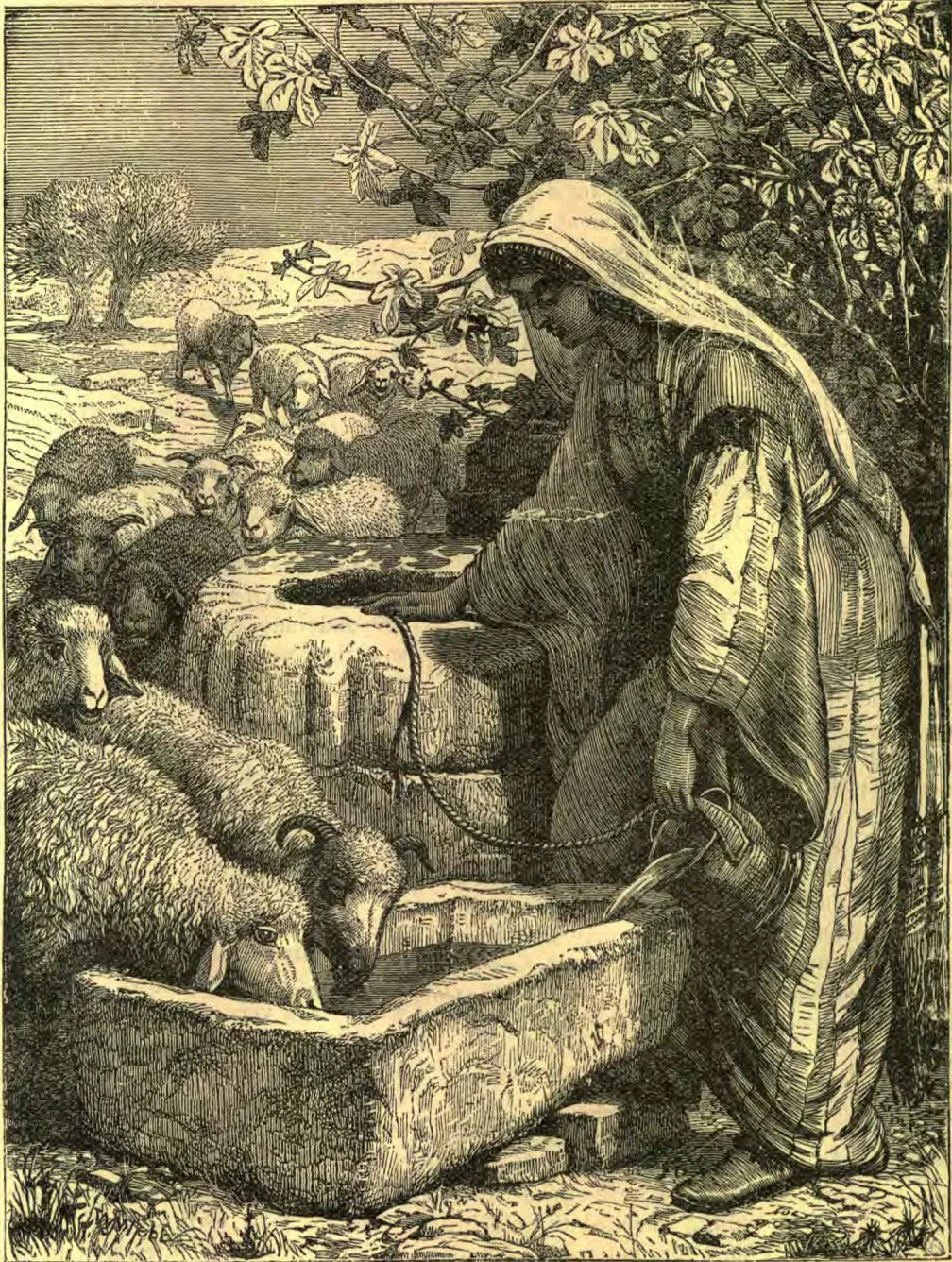
AT THE WELL.

THE morning in its glory breaks O’er Chaldean hill and plain, And the traveler springs from his grassy bed To haste on his way again. But his heart is sad, and his eye is dim; For his thoughts are far away, Where, fair and bright in the morning light, The home of his childhood lay. He looks on the picture painted there, Till his heart seems rent in its wild despair,—
The mother bowed with her secret grief, The trembling, white-haired sire, The brother cruelly betrayed, Veiling a murderer’s ire— He sees his flocks in another’s care, Henceforth he is counted a stranger there.
Now the angel vision memory brings, And he lists to the words of peace, Till the shadows flee, and his troubled soul Exults in a glad release. God hath closed the past like a sealed book; Let the exile now to the future look.
But how will they greet him,— the stranger kin? He comes with no menial band, No laden camels—his earthly store Only a staff in hand. “I will be with thee”—the promise given; He calmly trusts to the pledge of Heaven.
Lo, shepherds grouped ’neath yon palm-tree’s shade, With their flocks by a cooling well; To his earnest queries the quick reply, “Thy kinsmen among us dwell; Yonder their flocks.” Why, with eager feet, Springs he now that girlish form to meet? ’Tis the same glad step, the speaking eye, Of her who hath loved him from infancy. With tears and smiles is the greeting said, But the stranger’s heart is comforted.
Henceforth, through the weary years of toil, That face his light shall be, That gentle voice fall on his ear Like sweetest minstrelsy. Ah, despite his mercies requited ill, Our Father loveth his children still!
And the maiden in duty’s daily path Hath found life’s sweetest bliss,— God’s love and the love of a human heart, Fountains of happiness,— For the richest blessings of life befell As she led the sheep to her father’s well.
M. A.

SWEEP THE CORNERS.

“Did you sweep the corners?”
“Now, mother, what is the use of being so particular? The room looks just as nice as it can look. Who’s going to move étagères and table, and poke behind the piano to see if there’s a few grains of dust there?”
“Have you never swept the corners since you volunteered to take entire charge of the parlor, Amy? You know I have been shut up in my room and have trusted entirely to you.”
“Not exactly; Mrs. Strongmore, who lectured so delightfully, you know, says women waste so much time in puttering. She says it’s a great thing to learn just how much housework and sewing is necessary to enable one to get along, and then we shall save the rest of the time for higher pursuits; and that is so much gain.”
“Perhaps, if it really saves time; let us see how it is in this case. Move that stand, dear, and put your broom into that corner.”
“Why, mother, there are myriads of black, fuzzy little things, crawling away, and—why it’s too bad, they have eaten all the pattern off of that corner of our pretty carpet!”
“That is what I feared! It is the Buffalo moth, or carpet bug, and having once made a lodgment, they will run along every seam of the carpet; nothing can save it but taking it all up and having it thoroughly cleansed. It is too bad, but it never would have happened if you had swept the corner faithfully. Which way do you think would have saved the most time?”
“Mother, I was so disgraced to-day. I wore my new cambric to the Sunday school picnic, and when I was swinging one of the children, the whole sleeve ripped right down and left my arm bare. It was especially mortifying because I had just been telling the girls how I had made it all myself on my new machine.”
“Softly, my daughter; did you take a needle and fasten all the threads as I suggested?”
“Why, no; that would have taken so much time, and I wanted to make the whole dress in two days, which I did.”
“Did you save much time by that proceeding?”
“No, mother, of course not; I see what you mean. It’s another case of not sweeping the corners, I suppose?”
“My dear, I wish I could impress upon you now the importance of doing things thoroughly, and not slighting the parts of work that do not show at first sight; duty and policy are alike concerned in faithfulness to the corners. My gardener made me a flower-bed on the lawn once, but I hardly got it filled with beautiful flowers when the quick-grass came up so thickly between them that it took more time than I had to spare to pull it out, and when I at last had recourse to him, he acknowledged that he had only turned the sod over, not taking the time to pick it out.”
“Last spring there was a terrible accident in New York; part of a great building filled with people gave way, destroying much valuable life and property. Why? Because somebody had not been careful of the corners, the unseen parts of the building, where the strain came; and this want of faithfulness rendered the whole thing unsafe. Only two months before that, occurred the destruction of the Tay bridge in Scotland, which thrilled the public with indignation; a whole train of cars, with their crowd of living freight, precipitated at once into the raging flood and disappeared, because of the unfaithfulness of contractors, workmen, every one concerned in those parts of the work whose unsoundness could not be detected except by actual experiment.”
“And when we come to things not tangible, the principle is just the same; carelessness about the corners, the out-of-the-way trivialities of school-boy lessons have sometimes cost a man his standing and success in life. Have you forgotten a certain girl graduate, whose percentage was woefully lowered by the absence of capitals and commas in an examination in metaphysics? There are young men and young women to-day who are deliberately laying the foundation of future wretchedness and failure by neglect of the little corners of habits of strict honesty, perfect truthfulness, making the most of the minutes, etc., etc. Think, my child, of the eye that never slumbers looking down into the corners of our rooms, our work, our pursuits, our habits, our lives; remember that He has commanded us to be faithful in the few things committed to our care. That he may find no accumulated dust anywhere—Sweep the corners.”—M. E. Winslow, in Observer.

THE GYPSIES.

(CONCLUDED FROM LAST NUMBER.)
In regard to the morals of the gypsies, but little need be said; it is a strange medley of evil and good, with a large preponderance of the evil. One writer says their principal faults are childish vanity, professional cunning, indolence, and a bad temper. It is said, however, that a gypsy parent never chastises a small child; but the grown-up son will take the severest castigation from the hand of his father without a look of resentment.
The gypsies assent outwardly to the religion of the country where they are, whether Christian, Jew, or Mahometan. In their own language, which is a very strange one, there is no word for God, soul, or immortality. Mr. George Borrow spent several years among the Spanish gypsies, studying their character, language and ways. He says one of their sayings is, “Never pay any debts except those owing to your own kindred.” This Mr. Borrow was so interested in this strange people that he translated the Bible into their vernacular, which is called the Gitano Version. It is now published by the British Foreign Bible Society. The gypsies believe in the doctrine of transmigration of souls, and for this reason will not eat eels, and various other animal foods.
There is no literature in the gypsy tongue worthy the name: they have no alphabet, and no ideas of education,—a few rude ballads, some clannish dance songs, and a tangled mass of foolish tales being their heritage in this respect.
Their language is supposed to be a near relation of the old Hindoo Sanskrit, but like the Jews, they have adopted many words and terms into their vocabulary from all the peoples where they have wandered. Here is a stanza from one of their ballads, which sets forth a leading trait of this people:—
“There runs a swine down yonder hill, As fast as e’er he can; And as he runs, he crieth still, ‘Come, steal me, gypsy man.’”
In their own dialect, this would read,—
Paraquel luchipen abajo Abillela un ba lichoro, Abillela a goli goli, Ustilame Caloro.
The gypsy in his language would count ten thus:—
Yek, dui, trin, shtār, panch, shōb, efta, 1 2 3 4 5 6 7 ochdo, ennia, desh. 8 9 10
Not long after the gypsy hordes deluged Europe, very severe edicts were passed against them by different kingdoms. Being regarded as “wicked heathen and traffickers with Satan,” different governments vied with each other in taking the severest measures to rid their realms of such a terrible nuisance. They were whipped, imprisoned, banished, hanged, drowned, and degraded in a variety of ways; but like the frogs of Egypt, there they were still.
At a later period, efforts were made by some of the German sovereigns to have them live in fixed habitations, become cultivators of the soil, and have their children educated. By a royal edict they were called Neubauern, that is, “new peasants.” But these humane efforts were ineffectual in reclaiming these Ishmaelites from their strange life. Efforts were likewise made in England, nearly fifty years since, by a kind clergyman, to have them become civilized, and dwell in fixed residences, but with comparatively little effect. They still continue their nomadic life, and live in tribes as before. Even gypsy children brought up in Christian families, far from their clan, seem driven by some mysterious impulse to run away from their civilized homes as soon as a favorable opportunity presents itself.
The gypsies abound in royal titles, as queens, dukes, counts, etc. No later than 1878, Queen Victoria was received at Dunbar, Scotland, by a gypsy queen, of the Reynolds clan, “dressed in a black robe, with white silk trimmings, and over her head a yellow handkerchief.” This gypsy queen had her attendants, who were attired in “purple velvet gowns and scarlet coats.” During the same year, Matilda Stanley, the gypsy queen of the United States, was royally buried at Dayton, Ohio, by her followers.
Much more might be written about this strange people. But we close, by advising the reader never to deal with the gypsies, nor to encourage them in their unlawful life by allowing them to practice their sooth-saying arts for his benefit.
G. W. AMADON.

THE CRICKETS.

Pipe, little minstrels of the waning year, In gentle concert pipe! Pipe the warm noons; the mellow harvest near; The apples dropping ripe;
The tempered sunshine, and the softest shade; The trill of lonely bird; The sad, sweet hush on Nature’s gladness laid; The sounds through silence heard!
Pipe tenderly the passing of the year; The summer’s brief reprieve; The dry husk rustling round the yellow ear; The chill of dawn and eve!
Pipe the untroubled trouble of the year; Pipe low the painless pain; Pipe your unceasing melancholy cheer; The year is in the wane! —Kimball.

HUMILITY A TEST OF TRUE SERVICE.

“I NOTICE,” said the Stream to the Mill, “that you grind beans as well and as cheerfully as fine wheat.”
“Certainly,” clacked the old Mill. “What am I for, but to grind? and, as long as I work, what does it signify to me what the work is? My business is to serve my master; and I am not a whit more useful when I turn out fine flour than when I make the coarsest meal. My honor is not in doing fine work, but in performing any that comes as well as I can.”

Striving for Truthfulness and Charity in Speech

STRIVE to be correct and truthful in everything you say, remembering that a little lie or a little uncharitableness is no better than a little theft.

HALF-HOUR READING.

It is not in the power of everybody to command many hours a day for the study of books. But most people can spare a half-hour, and if that be given faithfully to consecutive reading, it will tell in mental discipline and acquisition at the end of three months. Many a morning which the lady in her leisure, or the young girl in her vacation, devotes to fanning herself, or to making useless articles of ornamental needle-work, might be agreeably spent over a good book. Companionship with standard authors is really an introduction to the best society on earth. There would be less temptation to frivolous gossip, less danger of unkind criticism, and less indulgence in morbid and melancholy moods, if the mind were fed with good food, and stimulated by the strong thoughts of the great and wise. Try it.—Am. Baptist Pub. Society.

THE DIFFERENCE.

MEN send their ships—the eager things!— To try their luck at sea, But none can tell, by note or count, How many there may be. One turneth east, another south— They never come again, And then we know they must have sunk, But neither how nor when.
God sends his happy birds abroad— “They’re less than ships,” say we— No moment passes but he knows How many there should be. One buildeth high, another low, With just a bird’s light care— If only one, perchance, doth fall, God knoweth when and where.

SCENES IN THE LIFE OF CHRIST.

LESSON 34.—SERMON ON THE MOUNT.—CONCLUDED.

“LAY not up for yourselves treasures upon earth, where moth and rust doth corrupt, and where thieves break through and steal; but lay up for yourselves treasures in heaven, where neither moth nor rust doth corrupt, and where thieves do not break through nor steal; for where your treasure is, there will your heart be also.”
“Judge not, and ye shall not be judged; condemn not, and ye shall not be condemned; forgive, and ye shall be forgiven; give, and it shall be given unto you; good measure, pressed down, shaken together, running over, shall men give into your bosom. For with what measure ye mete, it shall be measured to you again.”
“And why beholdest thou the mote that is in thy brother’s eye, but considerest not the beam that is in thine own eye? Or how wilt thou say to thy brother, Let me pull out the mote out of thine eye; and, behold, a beam is in thine own eye? Thou hypocrite, first cast out the beam out of thine own eye; and then shalt thou see clearly to cast out the mote out of thy brother’s eye.”
“And as ye would that men should do to you, do ye also to them likewise.”
“For a good tree bringeth not forth corrupt fruit; neither again doth a corrupt tree bring forth good fruit. For every tree is known by his own fruit. For of thorns men do not gather figs, nor of a bramble bush gather they grapes. A good man out of the good treasure of his heart bringeth forth that which is good; and an evil man out of the evil treasure of his heart bringeth forth that which is evil; for of the abundance of the heart his mouth speaketh.”
“And why call ye me Lord! Lord! and do not the things which I say?” “Therefore whosoever heareth these sayings of mine, and doeth them, I will liken him unto a wise man which built his house on a rock; and the rain descended, and the floods came, and the winds blew, and beat upon that house; and it fell not, for it was founded upon a rock. And every one that heareth these sayings of mine and doeth them not, shall be likened unto a foolish man, which built his house upon the sand, and the rain descended, and the floods came, and the winds blew, and beat upon that house; and it fell, and great was the fall of it.”
“And it came to pass when Jesus had ended these sayings, that the people were astonished at his doctrine; for he taught them as one having authority, and not as the scribes.”

QUESTIONS.

1. What did Jesus say about laying up treasures? Matt. 6:19, 20.
2. Why should our treasure be laid up in heaven?
3. How do people lay up treasure upon earth?
4. How may we lay up treasure in heaven?
5. To whom had Jesus, in the first part of his sermon, promised heavenly riches? Matt. 5:3, etc.
6. What is it to have the heart upon earthly treasures?
7. What is it to have the heart in heaven?—It is to love God, and care more for the things of heaven than for the things of earth.
8. What does Jesus say about judging other people?
9. What seems to be meant by judging?—Accusing people of having bad motives, or condemning them hastily.
10. What did Jesus say about giving and forgiving?
11. What does our Lord probably mean by saying, “With what measure ye mete, it shall be measured to you again”? Matt. 5:7; 6:14, 15.
12. How does Jesus show that we ought not to be looking at the faults of others when we have greater faults of our own?
13. What does he mean by saying, “First cast out the beam out of thine own eye; and then shalt thou see clearly to cast out the mote out of thy brother’s eye”?
14. What rule did Jesus give for our conduct toward others? Luke 6:31.
15. What is this rule called, on account of its excellence and value?—The golden rule.
16. How is every tree known by its fruit?
17. How did Jesus show that good men may be known from wicked men as well as a good tree may be known from a bad one?
18. What question did Jesus ask? Luke 6:46.
19. To whom did Jesus compare those who hear these sayings, and do them?
20. To whom did he compare those who hear these sayings, and do them not?
21. How did the people feel when they heard Jesus talk as he did?

NEW-TESTAMENT HISTORY.

LESSON 47.—JESUS VISITS CÆSAREA PHILIPPI.

“And he cometh to Bethsaida; and they bring a blind man unto him, and besought him to touch him. And he took the blind man by the hand, and led him out of the town; and when he had spit on his eyes, and put his hands upon him, he asked him if he saw aught. And he looked up, and said, I see men as trees, walking. After that, he put his hands again upon his eyes, and made him look up; and he was restored, and saw every man clearly. And he sent him away to his house, saying, Neither go into the town, nor tell it to any in the town.”
“And Jesus went out, and his disciples, into the towns of Cæsarea Philippi; and by the way he asked his disciples, saying unto them, Whom do men say that I am? And they answered, John the Baptist; but some say, Elias; and others, One of the prophets.”
“He saith unto them, But whom say ye that I am? And Simon Peter answered and said, Thou art the Christ, the Son of the living God. And Jesus answered and said unto him, Blessed art thou, Simon Bar-jona; for flesh and blood hath not revealed it unto thee, but my Father which is in heaven. And I say also unto thee, That thou art Peter, and upon this rock I will build my church; and the gates of hell shall not prevail against it. And I will give unto thee the keys of the kingdom of heaven; and whatsoever thou shalt bind on earth shall be bound in heaven; and whatsoever thou shalt loose on earth shall be loosed in heaven.”
“Then charged he his disciples that they should tell no man that he was Jesus the Christ. From that time forth began Jesus to show unto his disciples how that he must go unto Jerusalem, and suffer many things of the elders and chief priests and scribes, and be killed, and be raised again the third day. Then Peter took him, and began to rebuke him, saying, Be it far from thee, Lord; this shall not be unto thee. But he turned and said unto Peter, Get thee behind me, Satan; thou art an offense unto me, for thou savorest not the things that be of God, but those that be of men.”
“And when he had called the people unto him, with his disciples also, he said unto them, Whosoever will come after me, let him deny himself, and take up his cross, and follow me. For whosoever will save his life shall lose it; but whosoever shall lose his life for my sake and the gospel’s, the same shall save it. For what shall it profit a man, if he shall gain the whole world, and lose his own soul? Or what shall a man give in exchange for his soul? Whosoever therefore shall be ashamed of me and of my words, in this adulterous and sinful generation, of him also shall the Son of man be ashamed, when he cometh in the glory of his Father with the holy angels.”
“And he said unto them, Verily I say unto you, That there be some of them that stand here, which shall not taste of death, till they have seen the kingdom of God come with power.”

QUESTIONS.

  1. On which side of the Sea of Galilee were Jesus and his disciples, as we left them in our last lesson?
  2. What admonition had Jesus just been giving them?
  3. How did they at first misunderstand him?
  4. What did he really mean to teach them?
  5. To what city did they next go? Mark 8:22.
  6. Where was it situated?
  7. Who was brought to him there?
  8. What course did Jesus pursue with him?
  9. What admonition did Jesus give the man as he sent him away?
  10. Whither did Jesus go from Bethsaida?
  11. In what direction must he have traveled?
  12. On which side of the Jordan?
  13. What is the distance between the two places?—About twenty-five miles in a direct line.
  14. Give some account of Cæsarea Philippi.
  15. What question did Jesus ask his disciples as they were journeying?
  16. What did they say in reply?
  17. Who answered when Jesus said, “Whom say ye that I am”?
  1. Repeat the words of this bold disciple.
  2. How did Jesus reply?
  3. On what did Jesus say he would build his church?
  4. Who is meant by this rock?—Probably Christ. Psalms 118: 22; Isaiah 28: 19. See also Spirit of Prophecy, Vol. 2, pp. 272-4.
  5. What does the Saviour mean by saying that the gates of hell shall not prevail against his church?—That the counsels and powers of darkness shall never be able to wholly overcome his people.
  6. What seems to be taught by verse 19?—That Peter and the other apostles should be so inspired that their decisions should be according to the mind of the Spirit of God.
  7. What charge did Jesus give his disciples? Verse 20.
  8. From that time forth, what did Jesus begin to show unto his disciples?
  9. How did Peter then incur the displeasure of his Master?
  10. What did Jesus say to him?
  11. When he had called the people and his disciples to him, what did he say those must do who would follow him?
  12. What did he say about the saving and losing of life?
  13. What did he say about risking the loss of the soul for the sake of gaining the world?
  14. What did he say of those who should be ashamed of him in this life?
  15. To what must he have referred when he said that some who were standing there should not taste death till they had seen the kingdom of God come with power?—To the transfiguration, which was about to take place.

NOTES

Judge not that ye be not judged.— “ ‘To judge’ here does not mean exactly to pronounce condemnatory judgment, nor does it refer to simple judging at all, whether favorable or the reverse. The context makes it clear that the thing here condemned is that disposition to look unfavorably on the character and actions of others, which leads invariably to the pronouncing of harsh, unjust, and unlovely judgments upon them. No doubt it is the judgments so pronounced which are here spoken of; but what our Lord aims at is the spirit out of which they spring. . . . It is the violation of the law of love involved in the exercise of a censorious disposition which is here condemned. And the argument against it,—‘that ye be not judged’—confirms this,—that your own character and actions be not pronounced upon with like severity; i. e., at the great day.”—Comprehensive Commentary.
Houses built upon a rock.— “Jesus closes the sermon on the mount by a beautiful comparison, illustrating the benefit of attending to his words. It was not enough to hear them; they must be obeyed. He compares the man who should hear and obey him, to a man who built his house on a rock. Palestine was to a considerable extent a land of hills and mountains. Like other countries of that description, it was subject to sudden and violent rains. The Jordan, the principal stream, was annually swollen to a great extent, and became rapid and furious in its course. The streams which ran among the hills, whose channels might have been dry during some months of the year, became suddenly swollen with the rain, and would pour down impetuously into the plains below. Everything in the way of these torrents would be swept off. Even houses erected within the reach of these sudden inundations, and especially if founded on sand, or any unsolid basis, would not stand before them. The rising, bursting stream would shake it to its foundation; the rapid torrent would gradually wash away its base; it would totter and fall, and be swept away. Rocks in that country were common, and it was easy to secure for their houses a solid foundation. No comparison could, to a Jew, have been more striking.”—Barnes’ Notes.

NOTES ON THE LESSON.

Bethsaida, house or place of fishing. There are thought to have been two towns by this name, one on the west and the other on the east side of the Sea of Galilee. The former, on the western shore of the lake, not far from Capernaum, was the city of Philip, Andrew, and Peter, and was frequently visited by Christ; but it seems very probable that the Bethsaida referred to in this lesson as the scene of the miracle was on the other side of the lake, as Jesus would naturally pass through it on his way to Cæsarea Philippi. In Mark 8:13 it says that “he left them [the Pharisees who had been perplexing him with vain questionings], and entering into the ship again, departed to the other side.” As they come to the other side of the sea, he reproves the disciples for their want of faith, as related in verses 14–21; and in verse 22 it says, “And he cometh to Bethsaida and they bring a blind man unto him,” etc. This town was situated at the head of the lake, just east of where the Jordan enters the sea. In the time of Christ this city had just been rebuilt and greatly beautified by Philip, the tetrarch, who made it his capital and renamed it Julias, though it was still known as Bethsaida.
Coasts of Cæsarea Philippi.—The word coasts—now usually applied to land in the vicinity of the sea—here means borders, or regions. There were two towns in Palestine called Cæsarea. One was situated on the Mediterranean, north of Joppa; and the other was the one mentioned in this lesson, to which Jesus and his disciples came. This city lay near the northern borders of the tribe of Naphtali, at the foot of Mount Hermon. A town, Baal-gad, had stood here for many years, and Herod the Great had built here a grand temple of white marble; but this town, like Bethsaida, had been greatly enlarged and ornamented by Philip, and named Cæsarea in honor of the emperor, Tiberias Cæsar. To distinguish it from the other Cæsarea, the name of Philip was added to it; and it was called Cæsarea Philippi, or Cæsarea of Philip. “The worship of the shepherd god Pan, to whom a cave out of which burst the waters of the Jordan, was sacred, had given its second name—Panias—to the place.” It was one of the loveliest spots in the Holy Land; and from the spur of Lebanon, on which the town stood, the view ranges all over northern Palestine, from the plains of Phœnicia to the hills of Samaria. “The chief source of the Jordan still bursts in a full silvery-clear stream from a bottomless depth of water in the old cave of Pan, at the foot of the mountain.” The town is now called Banias, or Panias, and contains about two hundred houses, inhabited chiefly by Turks.
Simon Bar-jona is the same as Simon, the son of Jona. Bar is a Syriac word, signifying son.

THE HARD LESSON.

Ned Mason was a cross boy, and cross boys are always getting into trouble. He snarled when his mother asked him to do anything for her. He scolded when he had to get up in the morning, when he had to go to school, when he had to work, when he had to go to bed at night; and so most of the words that fell from his lips were cross words.
’T was even thought that he scolded in his sleep, for he had the same cross look upon his face when he woke in the morning as when he went to bed.
But these angry words of his were not the worst of his evil doings. He had a way of tormenting innocent creatures, to make them as unhappy as he was himself. He would put pieces of broken glass where the cattle would step on them and cut their feet. He would tie tin pails to the dog’s tail, and throw pepper into the cat’s eyes.
All these cruel things he delighted to do, and seemed glad when he saw the poor animals writhing with the torture that he had inflicted.
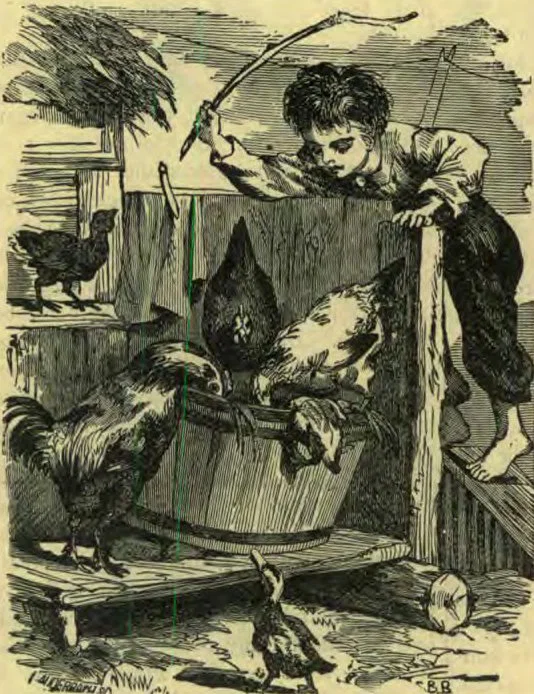
One day, when he was in one of his very cross moods, he climbed up and looked over into the yard where the fowls were drinking, and said,— “I’ll fix you.” Down he clambered and got a stick, and creeping up again slyly, he gave the harmless little creatures a terrible blow across their backs.
The hen and chickens fell off the tub, and ran limping away, crying out with pain. But the cock had no idea of taking the attack so meekly. He flew up into Ned’s face, and pecking at him, struck a blow with his sharp beak into his left eye, which destroyed the sight of it entirely, and disfigured him for life.
In one sense this was a sad misfortune, but in another it was one of the best things that ever happened to cruel Ned. For while it destroyed one of his outer eyes, it opened the inner vision, so that he was able, forever afterward, to see the rights of others more clearly; and from a surly, passionate boy, he grew to have self-control, and to treat others more as he wished to be treated himself.—E. M. B.
Continue reading: REMEMBER THE SABBATH