Your ShelfYour Projects

Review and Herald, Vol. 80, No. 32.

A New Book
Earlier text: The International Buddhist Society

Christian Life, Moment by Moment

MOMENT by moment the Christian lives. If we gain a victory to-day, that is no proof that we shall gain another to-morrow. It is a proof of the power and goodness of God, who ever lives to bless; but if we reap the benefit of his mercy in the future, it can only be by continual yielding and consecration. Our breath moment by moment is an evidence that God is with us; but the breath that we breathed yesterday will not profit us to-day; we need a fresh supply. Much less can we be benefited by that which somebody else has breathed. So for a person to base his confidence on the fact that he belongs to a denomination that at some time in the past had marked evidences of the presence and power of God, is to build his hope for bread to-day on money that was spent last year. It is a grand thing to have entrusted to us the ark in which are the oracles of God; but we may have this, and still be accursed captives of sin. Far better is it to have our own hearts the temples of the Holy Spirit of truth.—Selected.

Temptations Necessary

Jesus had the highest sign of approval that heaven could bestow, and then followed the temptation. In this world it is necessary that for a season we be “in heaviness through manifold temptations,” in order that the trial of our faith may be found unto praise and honor and glory. 1 Peter 1:6, 7. “My brethren, count it all joy when ye fall into divers temptations; knowing this, that the trying of your faith worketh patience. But let patience have her perfect work, that ye may be perfect and entire, wanting nothing.” James 1:2-4. Therefore “it became him, for whom are all things, and by whom are all things, in bringing many sons unto glory, to make the Captain of their salvation perfect through sufferings. For both he that sanctifieth and they who are sanctified are all of one; for which cause he is not ashamed to call them brethren.” Heb. 2:10, 11. Jesus, having taken on him “the form of a servant,” must needs pass through all that the lowest servant has to endure. Having taken human flesh, he must bear all the infirmities of the flesh, and it was for that purpose that he came. Temptations are necessary to keep us humble, and to teach us our dependence upon God. Let the sorely tempted one remember from the experience of Christ that temptations do not prove that he is not a son of God. Remember, too, that the Spirit of God led Jesus into the wilderness of temptation. “In that he himself hath suffered being tempted, he is able to succor them that are tempted.” Heb. 2:18. “The chastisement of our peace was upon him; and with his stripes we are healed.” Isa. 53:5. His victory is our victory, for it was our sins that he bore. Therefore if we keep in mind his temptations, his trial and his victory, we may save ourselves much trouble. “This is the victory that hath overcome the world, even our faith.” 1 John 5:4, R. V. The chief temptation that Christ had to endure, the one that was twice repeated, was to doubt that he was really the Son of God. Do not make the mistake of considering this a light matter. It was a life and death struggle, and Jesus was sorely tempted to doubt the words that he had heard at his baptism, “This is my beloved Son, in whom I am well pleased,” and to doubt his mission. After forty days of fasting in solitude, seemingly forsaken by both God and man, and seeing no face but those of the ravenous beasts, doubts would very easily be suggested. But he did not yield to them. By his victory, we may repel the temptation as soon as it is presented. Remember that he “was in all points tempted like as we are” (Heb. 4:15), and that no temptations came to him but such as are common to men. But every temptation came to him that ever comes to any man. Do not forget, therefore, that no man ever has a feeling of despondency or doubt that did not oppress the Lord Jesus. Read the twenty-second psalm, and you will see something of what he passed through, and how he came out. Just as surely as he passed through the struggle a conqueror, may we also, even though we have many times been overcome by the tempter, be “more than conquerors through him that loved us.”—Present Truth.

Not Beyond Help

CLARENCE SANTEE
In these days when the judgment work is drawing to a close, and when the destiny of all hangs upon a short work, there is a tendency on the part of many conscientious persons to believe that they have sinned too long, and that their cases are hopeless. This was Satan’s last great lie when some of the angels who had joined him in rebellion were about to turn again to God. We read, “But Lucifer had another deception ready. The mighty revolter now declared that the angels who had united with him had gone too far to return; that he was acquainted with the divine law, and knew that God would not forgive. . . . So far as Satan himself was concerned, it was true that he had now gone too far to return. But not so with those who had been blinded by his deceptions. To them the counsel and entreaties of the loyal angels opened a door of hope; and had they heeded the warning, they might have broken away from the snare of Satan.”—“Patriarchs and Prophets,” pages 40, 41.
There is no soul who desires, truly desires, to live a better life, who has gone too far in sin to return to God, and have the snare of Satan broken. Let me ask, What is the unpardonable sin? Consider with me one text that gives an idea of what it is: “Keep back thy servant also from presumptuous sins; let them not have dominion over me: then shall I be upright, and I shall be innocent from the great transgression.” Ps. 19: 13. “Presumptuous sins” are known sins persisted in, in this way presuming on the mercy of God. He says, “Let them not have dominion over me.” To have dominion presupposes the fighting of a battle; the victory has been won; the vanquished has laid down his arms. It is not necessary that a man be as strong as his antagonist, to contest the dominion. As long as he resists, the dominion is not assured. And as long as presumptuous sins do not have the dominion, the Spirit of God says that we are “innocent from the great transgression.” “The great transgression” must be the very unpardonable sin. It does not refer to different sins, but it is “the great transgression,”—one that towers above them all. It is the climax.
Then I will say again to that one who still longs for the better life, You are not beyond hope. You have not yet surrendered all. The dominion is not yet assured. If you have done that which would cause you to be pushed out as unfit for companionship, the pure and holy angels will still be with you. Did they see you do the wrong?—Yes, but they are not prejudiced against you. If you are willing to turn, they will help you. God has promised, “Thine ears shall hear a word behind thee, saying, This is the way, walk ye in it, when ye turn to the right hand, and when ye turn to the left.” Isa. 30: 21. This voice will always be heard “behind thee,” because the Spirit of God will call the erring one back to the place where he left the right way. Many undertake to step into the way farther on, leaving the past sin uncorrected, but it will not bring success, nor the peace of God. Return and take up the duty at the point where the Spirit calls, and you will again be in harmony with it.
While none need feel that their case is hopeless, yet this does not warrant delay. If sins persisted in will finally bring us to “the great transgression,” then every step in that course is one step nearer the last one. To-day, there is assurance and hope, and that is all the time with which we have to do. That the final limit in every case will very soon be reached, is evident to all who will with an unprejudiced mind consider the evidences that the Lord has given. Think of some of these. In Matt. 24: 29 the Lord speaks of signs which were to herald his coming. He speaks of the sun and moon being darkened, then the stars falling, then the shaking of the powers of heaven. The shaking of the “powers of the heavens” is spoken of in this place, also in Luke 21: 26, 27, in close connection with Christ’s second coming.
The Lord says, “Yet once more I shake not the earth only, but also heaven.” Then this occurs but “once more.” This will occur in close connection with Christ’s second coming, and after probation has closed. “And the seventh angel poured out his vial into the air; and there came a great voice out of the temple of heaven, from the throne, saying, It is done. And there were voices, and thunders, and lightnings: and there was a great earthquake. . . . And every island fled away, and the mountains were not found.” Rev. 16: 17, 18, 20. Another writer says, “The Lord also shall roar out of Zion, and utter his voice from Jerusalem; and the heavens and the earth shall shake.” Joel 3: 16. “The powers of heaven are the sun, moon, and stars. They rule in the heavens. . . . The powers of heaven shall be shaken at the voice of God. Then the sun, moon, and stars will be moved out of their places. They will not pass away, but be shaken by the voice of God.”—“Early Writings,” first part, page 53.
The signs in the sun, moon, and stars are to be the special signs of the nearness of the close of probation, with the added statement, as recorded in Luke 21: 25, 26, that after the falling of the stars, there would be seen “upon the earth distress of nations, with perplexity; the sea and the waves roaring; men’s hearts failing them for fear, and for looking after those things which are coming on the earth.”
We have seen all these, and to what point do they bring us? We read in Matthew: “Now learn a parable of the fig tree; when his branch is yet tender, and putteth forth leaves, ye know that summer is nigh: so likewise ye, when ye shall see all these things, know that it [“he,” margin] is near, even at the doors.” Mark also says that these signs will be evidence to us that “it is nigh, even at the doors.” What occurs when he is “at the doors”?—He comes in to see the inmates. “And when the king came in to see the guests, he saw there a man which had not on the wedding garment.” He comes in to see if we have a wedding garment, which garment is a righteous character. Rev. 19: 8.
Then can we not see that this coming in means the coming to our names in judgment? In James 5 we read of the labor troubles, the strikes, and the disagreements between the rich and the poor. Then after admonishing his brethren to then “be patient,” the apostle adds, “Grudge not one against another, brethren, lest ye be condemned: behold, the judge standeth before the door.” Verse 9.
From this we see that when he stands before the door, it is as a “judge.” This is also evident from the fact stated, that if the heart then is found with grudges and hardness, the coming in will be to condemn. It is also evident that he is speaking of the judgment of the living, as he speaks to those who can exercise emotions, can carry grudges. The dead are unconscious and can not do these things. Eccl. 9: 5, 6.
Then we are again brought to the conclusion that, while there is hope for every soul who desires life, there is no time to loiter, and thus presume on the mercies of God; for in so doing, every step shortens the distance, and makes one step less, to the unpardonable sin. Some have already been long in the path of “presumptuous sins,” knowing the right, yet risking disobedience. The path for all is very short to a final decision, and some will make that decision before others.
There is but one way. Do what the Lord points out as duty to-day, just now, and the outcome will be blessed of God; for he will send every angel out of heaven rather than let one soul be defeated who will trust in him.

Peter’s Temperament and Past Sin

“PETER’S temperament made Peter’s past sin possible. There is an ebb and flow in every noble nature.”

“Smile, Woman, Smile!”

My dear, dead mother scarce would recognize This haggard face; these dreary, mirthless eyes; The anxious brow, beneath the graying hair, Once glossy brown, her pride and special care. Friends of my youth would startled gaze To see the changes—less of time and place Than circumstance. A lonely, bruised heart, And weary, painful days, all bear a part In changing her whom they of yore Called “Sunshine-maker”—now, alas, no more Courted and praised for bonnie, blithesome ways, As in the old and happy girlhood days.
Smile, woman, smile! What if thy heart be sore, Burdened and sickened, saddened to the core? Smile, woman, smile! For friends de- part When faces shadow forth the tingling smart Of secret suffering. Smile, woman, smile! Expected ’tis of thee To set thy griefs aside. Know, friends do flee From saddened faces such as thine, nor care To linger but to have thee share—nay bear Their sorrows.
Smile, woman, smile! For Jesus knows; and in a little while Love, rest, and home—where lonely wand’ rings cease— Where friendship deepens, and where joys increase— Where pain and sadness are fore’er un- known— Where no tears fall, before God’s great, white throne— Heaven’s bliss shall amply make amends to thee For all the ills and grief which now must be! —Helen A. Steinhauer, in The Pathfinder.

Christian Sociability

MRS. L. D. AVERY-STUTTLE
How shall we promote Christian sociability?—By being sociable. Even the dumb animals—horses and dogs and kittens and birds—are sociable: the Lord made them so. Why?—because he loves sociability. He himself is a social Being. How do I know?—Witness the creation of the new earth, when the “morning stars sang together, and all the sons of God shouted for joy.”
Do we realize that the name the Most High gives himself is Love? Do you remember how often the Creator came on a visit to Adam and Eve in the garden? Does he not love to see his creatures sociable? Has he not said that we must not forsake the assembling of ourselves together, and that we must not forget to entertain strangers?
“Yes,” some one says, “I always try to entertain my friends, and I even feed a tramp sometimes.” “Blessed is he that considereth the poor.” But to “consider” anything, we must think upon it. How many kindly thoughts do we bestow upon the poor? How often through the day do we speak a word of kindness to some struggling heart?
Sister A is a new neighbor, and we have not been formally introduced; so, when we meet her on the street, though we know well enough that she is our near neighbor,—perhaps a sister in the church,—we are suddenly so interested in the tops of the trees, or the grass in the street, that we fail to see her at all, while, mayhap, her poor heart is weary to breaking, with cares so heavy and responsibilities so great that a single smile or a word of cheer might give fresh courage to a breaking heart, and make the world look brighter all the day long.
Sisters, let me tell you a secret: It pays, O it pays, to be courteous. The apostle knew what he was talking about when he said: “Be pitiful, be courteous.”
It is quite easy for us to be pitiful if any one has a misfortune, but did you never notice how hard it is for some people to be courteous to others who are in the same business that they are in, especially if these others are successful? Some of the saddest moments of my life have been spent in wondering why some who write such fine poems or such logical prose fail to recognize the genius of some other perhaps equally as gifted as themselves; or why a naturally kind-hearted doctor seems wholly blind to the talents and success of his brother physician.
Ah, we have all seen it, and I suppose we all have the cruel demon of envy to suppress in our own hearts. We may be sure that the disposition to criticize and speak words of scorn concerning another, is from the earth, earthy.
O my sisters! let us be loving to one another. A friend once told me that a certain sister of the church had always so held herself aloof that my friend really supposed that the lady felt nothing toward her but the coldest indifference. One day my friend had occasion to call upon her. In the course of the quiet conversation, what was my friend’s surprise to notice a look of glorified tenderness stealing over the calm face, as she said: “My friend, you may think it strange of me, but I want to tell you before you or I shall die, how much I love you!” You can imagine the effect. God bless the noble natures who break through the ugly crust of conventionality, and reach out after poor, lonely hearts hungry for a word of cheer.
“But we don’t know,” says one, “who these lonely, unfortunate people are.” Then do as Job did,—search them out. How many of us do that?
In a crowded city last winter, there lived a poor woman,—so poor, so weary, so sick, so destitute,—all alone. When her landlord demanded the overdue rent, her heart grew numb and faint. The few dollars which were due loomed up to her feverish imagination like a mighty mountain. Did she have any friends?—O, I suppose so! but they had not done as Job did. They had neglected to search her out. One morning the landlord rapped loudly on the door of the little room, intending to turn the poor creature into the cold streets. His knock was unanswered. He pounded again with his heavy stick. Had the woman gone? Had she the audacity to run away without paying him? The door was broken down with no further delay, and the landlord peered into the little room. There, on a miserable bed, covered with a thin old shawl, was the frozen body of the poor tenant. The sightless eyes, in which there seemed to lurk a pitiful appeal to humanity, were turned to the plasterless wall. The death angel had ejected the friendless tenant. Let us hope there will be room in some of the golden mansions for the poor creature who had no pity shown her here.
Let us seek to promote sociability in the church. The minister of the gospel should consider the world his parish, and never wait for a formal introduction to his parishioners.
O! let us love human souls, for whom so great a price was paid! and let us not be so fearful lest somebody may discover that love. Believe me, O believe me! instead of detracting from our dignity, it will add thereto.
Let us find out the sorrows and discouragements of the young, and the griefs of the aged; for in finding them, our own will surely vanish or become lighter. Let us not wait for them to guess of our love and sympathy. Do you remember that the angel Gabriel once undertook a great journey,—a distance so vast that the mind of man stands appalled before its immensity,—and all this, to tell a simple-hearted, honest man that he was “greatly beloved”? Wonderful occasion! blessed, thrice blessed messenger!
Did any one ever do you a favor, and then, when prosperity came to you, did you fail to recognize him? Perhaps he is in trouble; once, he befriended you when everybody seemed “down on you.” Has your memory become so defective that you do not remember him? Shame! Shame! A case in point: A very dear friend, a kind-hearted old lady of over eighty-six years, a widow, saw one day upon the streets of Chicago a poor, ragged lad. That blessed white-haired mother in Israel made her way to him, asked him several questions, and learned that he was penniless and alone. He was nothing to her; she had never seen him before; she was poor herself, but she had a heart in her bosom,—a motherly heart. God bless the precious, motherly women! Well, she took the wanderer home, fed him, bought him a neat suit of clothes, and found him a situation. “Made a man of him,” you say. No; he has the disposition that is the curse of the world. He is a prosperous man to-day. But when he meets his benefactress on the streets of Chicago, he does not recognize her! Again we cry: “Shame, shame!” and all the voices of nature echo it.
One day I felt lonely. My heart beat heavily with sadness and disappointed hopes. It seemed there was no good I had ever done or could do. In the midst of a sad reverie the mail carrier brought me a kindly message from an entire stranger, who lived away in the mountains of far-off Switzerland. It was a simple acknowledgment of a grateful soul to whom a message from my poor pen had brought a benediction. I was not lonely any more that night. It seemed that, after all, I had not lived in vain.
God bless the men and women who will remember the Bible injunction, “Honor to whom honor is due.” How glad should those be in whose heart there rankles no memory of love withheld and appreciation unspoken to those who have fallen by the way, and whose ears are forever deaf to their words of sorrow. The mission of giving a word of cheer, of manifesting a hearty good will toward all, and of breaking down the icy walls of reserve, is a work of which an angel might be proud.
Let us seek out the little ones. God bless them! When I look into their sweet eyes, I can not wonder that “of such is the kingdom of heaven.” Let us pay more attention to these lambs of the fold. They will respond in a thousand sweet ways that will melt the frost out of our cold, icy, reserved natures. And it shall come to pass that “instead of the brier shall come up the myrtle tree,” and we shall no more cry, “My leanness, my leanness!” and the blessing of Him who has said, “Love one another,” shall be ours.

“Be Not Afraid, But Speak”

A YOUNG lad went to work in a foundry, where the men used often to swear in their conversation. For a few days the lad feared to remonstrate with them, but having heard a sermon on the text quoted above, he resolved to be brave, and speak out. On the Monday morning he quietly said, “Please excuse me, I am only a boy, but I should be so glad if you wouldn’t swear. I think you would soon find it easy to talk without doing so, and it would please God.” Instantly one of the men exclaimed, “Three cheers for Charlie. Then all will join me in doing as the plucky little chap wishes, say ‘Aye, aye.’” And every man in the room shouted, “Aye, aye.”—Selected.

“The Church School Presents ‘a Heaven to Go to Heaven In’”

M. BESSIE DE GRAW
This was the thought presented by Elder Haskell in his lesson before the students of the summer school at Berrien Springs, Monday evening. The statement is a striking one, and we listened intently to the development of the thought. “There will be families in heaven,” said Elder Haskell. “There will be no births there, but there will be families. God is the Father, and Christ the elder Brother, of all those who are saved. This is but carrying out God’s original plan, for at creation all created beings constituted the family of God.
“When sin came into the world, this part of the family was separated from the rest. Christ was born into a family, that he might show to the world that God wants to save families. The family of Christ will be brought together in the new earth, and will be made up of those who are bound together, not by fleshly relationship, but by the blood of Christ. This thought is taught all through the Word of God. Thus God would restore families, and he has chosen the Christian teacher to co-operate with parents in the building up of Christian families. This is the way the Christian school presents a heaven in which we may go to heaven.
“In the sixty-eighth Psalm we read, ‘God setteth the solitary in families.’ We may be without family relationship on the earth, but if we are Christ’s, when we reach heaven we shall have a place in some family. No person will be saved independently of other people. We shall belong to the family of the one who has had the greatest influence on our lives. Every one who is saved will have children. These will be children in the faith.
“Do you want to know how the families will be made up in heaven? We are told in the eleventh chapter of Deuteronomy. In verses 18-21 the Lord tells us to teach the law to our children. We are to teach them when sitting in the house, and when walking by the way, that our days may be ‘as the days of heaven upon the earth.’ Thus when we teach God’s law to our children, heaven will begin upon earth, and it will make our families like heaven.
“If our children had early been taught in this way, they would not to-day be drifting into the world. Parents have missed an opportunity to establish a heaven upon earth. There is but one remedy, and God has told us what this is. We are to gather in, not only our own children, but the children of our neighbors, and teach them God’s truth. The only way this can be accomplished is by greatly increasing the number of Christian schools. The teacher in the Christian school should consider herself a missionary just as truly as if she were in India or Africa. This is what God has said, and when we so teach, the school will be a little heaven upon earth. I know, of no more joyous place on earth than a home where the father and mother and children are bound together by the blood of Christ. I have had parents come to me, saying, ‘I have little influence over my boy. Will you not do what you can for him?’ When parents acknowledge that they have lost their influence over their children, some one else must become the father of those children, and in heaven they will belong to the one who leads them to Christ.
“Every Christian teacher goes into the schoolroom to supplement the work of parents. Teachers and parents should unite for the salvation of the children. It is because God has given this plan that I say that the Christian school presents a heaven in which we may go to heaven.”
The lesson impressed itself strongly upon the minds of those who are preparing to teach. Can there be any higher calling? Can it be questioned whether the work of the Christian teacher has anything to do with hastening the coming of Christ? God is making up that family for heaven, and it makes us as teachers feel that we want to live very close to the Saviour’s side, that we may be instrumental in bringing to the birth thousands of children who shall make up that heavenly family.

Where's Mother?

BURSTING in from school or play, This is what the children say; Trooping, crowding, big and small, On the threshold, in the hall— Joining in the constant cry, Ever as the days go by— “Where’s mother?”
Mother with untiring hands, At the post of duty stands; Patient, seeking not her own, Anxious for the good alone Of the children as they cry, Ever as the days go by— “Where’s mother?”
—Selected.

The Trifles That Have Made the Saints

“A TONE of pride or petulance repressed, A selfish inclination firmly fought, A shadow of annoyance set at naught, A measure of disquietude suppressed; A peace in importunity possessed, A reconciliation generously sought, A purpose put aside,—a banished thought,— A word of self-explaining unexpressed,— Trifles they seem, these petty soul-restraints, Yet he who proves them so must needs possess A constancy and courage grand and bold; They are the trifles that have made the saints. Give me to practice them in humbleness, And nobler power than mine doth no man hold.”

Cuba—an Unentered Field

W. A. SPICER
There is a wide open door for our work in Cuba. I could plainly see this from the few days spent in the island on my homeward trip from the West Indies last winter. This “Pearl of the Antilles,” the largest and most populous of the West Indies, lies about ninety miles off the Florida reefs. For years we have heard the din of the furious struggle for political liberty which has been desolating that fair land. The struggle began in earnest just about the time that our message was rising. Now it is ended in the independence of the island from Spanish rule, and apparently the country is settling down to an era of peaceful, industrial development. Now is our time to go in with the message of soul-liberty by the gospel of Jesus Christ.
A CUBAN ROAD
A CUBAN ROAD
I entered Cuba by the extreme southeastern port of Santiago, making the trip across from Jamaica in a little trading schooner. There is a stirring of new life and enterprise in this region, and doubtless the little sailboat will ere-long give place to a coasting steamer, and Cuba will be brought into closer touch with the islands to the southward. We were glad enough to glide into the beautiful bay of Santiago, after two days and a half of tossing about on the Caribbean. Morro Castle Fort, built high in the rocks at the right of the entrance, guards the narrow channel. It was down this passage that Cervera’s fleet made its dash for the open sea in the late war. All about are memorials of war time, suggesting how ready the children of this world are to pour out treasure and the life’s blood in fighting for the things of this world. Even more ready should be the children of the kingdom to pour out the choicest treasures and to endure hardness in the glorious service of Christ our leader. And here is a country close to our shores, where we have not as yet made any conquests for the third angel’s message.
It was a beautiful passage down the spacious Santiago Bay, with its wooded shores and rocky headlands. At the head of the bay, the city of Santiago forms a crescent around the water front, and runs back upon the hills. Considerable shipping rides in the harbor; for the province of Santiago is rich in minerals, and in timber and agricultural resources.
As our boat furled sails and dropped anchor off the city front, we were surrounded by boatmen soliciting patronage and driving bargains, in broken English.
A great impetus was given to the learning of English by the American occupation of Santiago, and no doubt within a few years it will be very commonly spoken by the younger generation. Santiago is a Spanish town. The old town, with its narrow, crooked streets, and walls of bluish tint, reminds one of pictures of old Seville. General Wood and his American soldiers made a new city out of it, the people tell us. Formerly it was a fever hole, the streets unpaved and muddy, and the pigs rooting about beneath the windows, these scavengers representing about the only sewerage system for the large town. Now the main streets are paved, and the whole aspect is one of neatness and thrift. The city has a population of forty thousand.
Strange tales the crooked little streets of the old town could tell if they had voice, for Santiago was the second city founded by the Spaniards in the new world. It was planted by the son of Columbus, on the second expedition of the Spanish fleet. The old plaza, or square, round which the ancient town was built, is still the heart of the city. These plazas are the breathing places for the people in the tropics. On the evenings when the band plays in the Plaza de Almas, half Santiago, apparently, comes out to promenade up and down, and round and round the square, or to sit on the benches and mounted cannon in the little park in the center of the plaza. It is a gay, thoughtless crowd, intent on merely passing away the time. There is nothing rude or boisterous about it; the people are polite, well dressed for the most part, and characterized by an air of grace and natural culture. Whether Spanish, Cuban, or creole, the easy manners of old Spain cast a pleasant spell over the evening crowd.
The stores do a thriving business late into the night. The leading shopkeepers are Spaniards, who make their money in Cuba, and then retire to Spain to spend their days. It takes a practiced eye to distinguish between the Spaniards and the Cubans of pure blood.
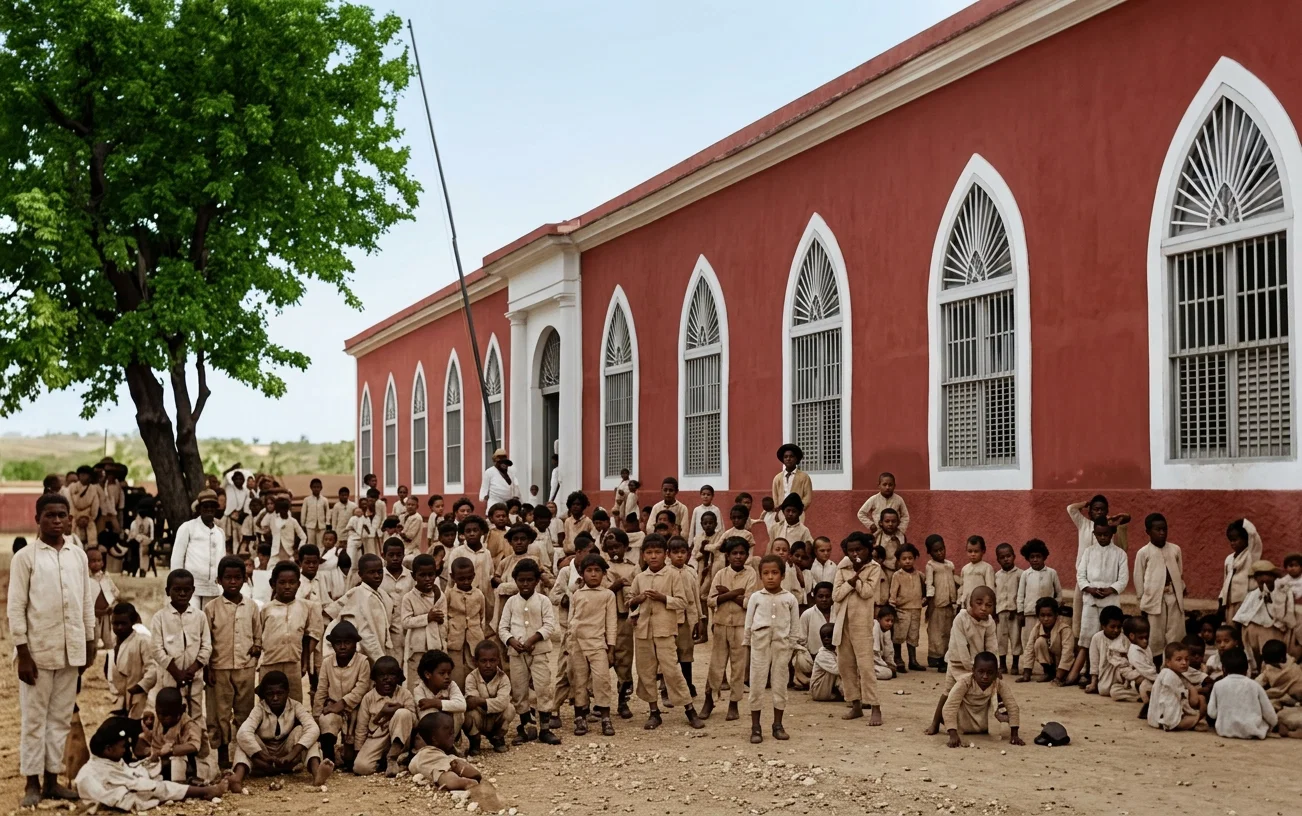
BOYS’ ORPHANAGE SCHOOL, SANTIAGO
The latter are the descendants of the old Spanish settlers of Cuba, generations ago, who have lost all connection with the home land. These white Cubans compose the mass of the population. The negro population, originally brought in as slaves, form about one third of the inhabitants. The American hotel proprietor gave the negro population a good name for sobriety and industry under proper conditions. The industries of the country have been ruined by revolution for so many years that this creole element has learned somewhat turbulent ways. They formed the bulk of the revolutionary forces, inasmuch as they could hold out indefinitely among the hills and forests, and so sustain the guerrilla warfare.
Santiago is the chief seat of the Romish Church in Cuba. The great cathedral of San Pedro, with its square towers, flanks one side of the central plaza. I did not find it open while in the city. The attitude of the Spanish clergy during the fight for independence alienated the sympathies of the people to a great extent, and while on Sundays there are considerable numbers of women attending service, the church apparently has little influence over the masses of the population. The situation gives perfect liberty for the Protestant missionary. There is a Baptist church in Santiago, and the Methodists have just begun operations. The minister now holds services in his own house. Various denominations are beginning in Cuba, just as we have to begin in new places, by house-to-house work and cottage meetings. Then follow the little chapel and the school. I was told that advance guards of the Salvation Army had held street services in the city. They were allowed to do so freely, and sometimes the singers were invited into the private houses of the citizens to sing the gospel songs. We have so long associated Cuba with the repressive power of Roman ecclesiasticism that one can hardly understand that now the shackles are broken, and there is perfect liberty to preach the gospel of free salvation.
A school system is being rapidly built up by the government. Santiago was just finishing a thirty-thousand dollar high-school building when I was there. Spanish is, of course, the language of the schools, and yet I was told that English is given a place in many of them. Apparently the Cubans have yet to form the reading habit. I saw no bookstore in all my wanderings about Santiago. A fellow traveler also remarked upon this peculiarity. No doubt there are book-supply depots, but they are certainly not conspicuous. Romish domination has not encouraged education, and a large percentage of the people can not read. Already, however, the change has begun, and we ought to have at least one or two workers distributing good Spanish and English literature in the cities and country districts of Cuba.
Many Americans are going into the province of Santiago, establishing stock raising, agricultural, and other industries. The currency of the province is our American money almost altogether. The people prefer it to the Spanish silver, which is still used in the western provinces. A splendid military road runs over the hills westward from Santiago, and now that the farmers are recovering from the desolations of war time, the mule and ox wagons come lumbering into the cities with farm and garden produce. The palms along the roadways indicate the tropics, and yet the heat in Cuba is not intense, and the nights are cool. The climate is not at all a severe one. Though the Cubans preserve a light and trifling exterior, they at any rate have known how to suffer long and stoically amidst the throes of revolution; and one sees abundant evidence of a warm-hearted hospitality and spirit of comradeship, which shows that there is a gentle, earnest, loving side to these Cuban peoples. I must speak later of the central and western provinces.
Continue reading: World-Wide Missions—The Opportunity