The Youth’s Instructor, Vol. 48, No. 34.

THE MANIA FOR GOLD

The Youth’s Instructor

Aug 23, 1900

Review and Herald Publishing Company · Battle Creek, Mich. · Aug 23, 1900

THE MANIA FOR GOLD
Man’s intense greed for gold is well illustrated by the almost superhuman efforts that he will put forth to secure this valuable metal from its hiding-place in the earth. In the early days, when gold was first discovered in California, the long wagon-trail across the American continent was almost literally marked out by the graves of those who failed to complete the perilous journey. Modern methods of travel have reduced to a minimum the majority of these old-time difficulties; yet many of the gold-hunters who fearlessly wound their way a few years ago to the then almost unknown Klondike region suffered untold privations.
This year the procession of gold-adventurers has been directed toward Cape Nome, in the far-away North, near our Russian neighbor; so that what, a little more than a year ago, was nothing but a bleak beach now has a population of forty or fifty thousands. If newspaper reports are to be fully credited, oranges are selling there for a dollar apiece, and other foodstuffs in proportion. Nothing is cheap except whisky; and that sells at twenty-five cents a drink. But whisky is costly, even when given away. Almost every day there are some who become heart-broken as a result of their unsatisfied ambitions, and end, by their own hands, their sad career. Murders are common. When men will face such difficulties to secure precious ore, the luster of which will perish, how much more ought we to be willing to pass through in order to win for the Master those precious jewels that are to shine brighter and brighter throughout all eternity.
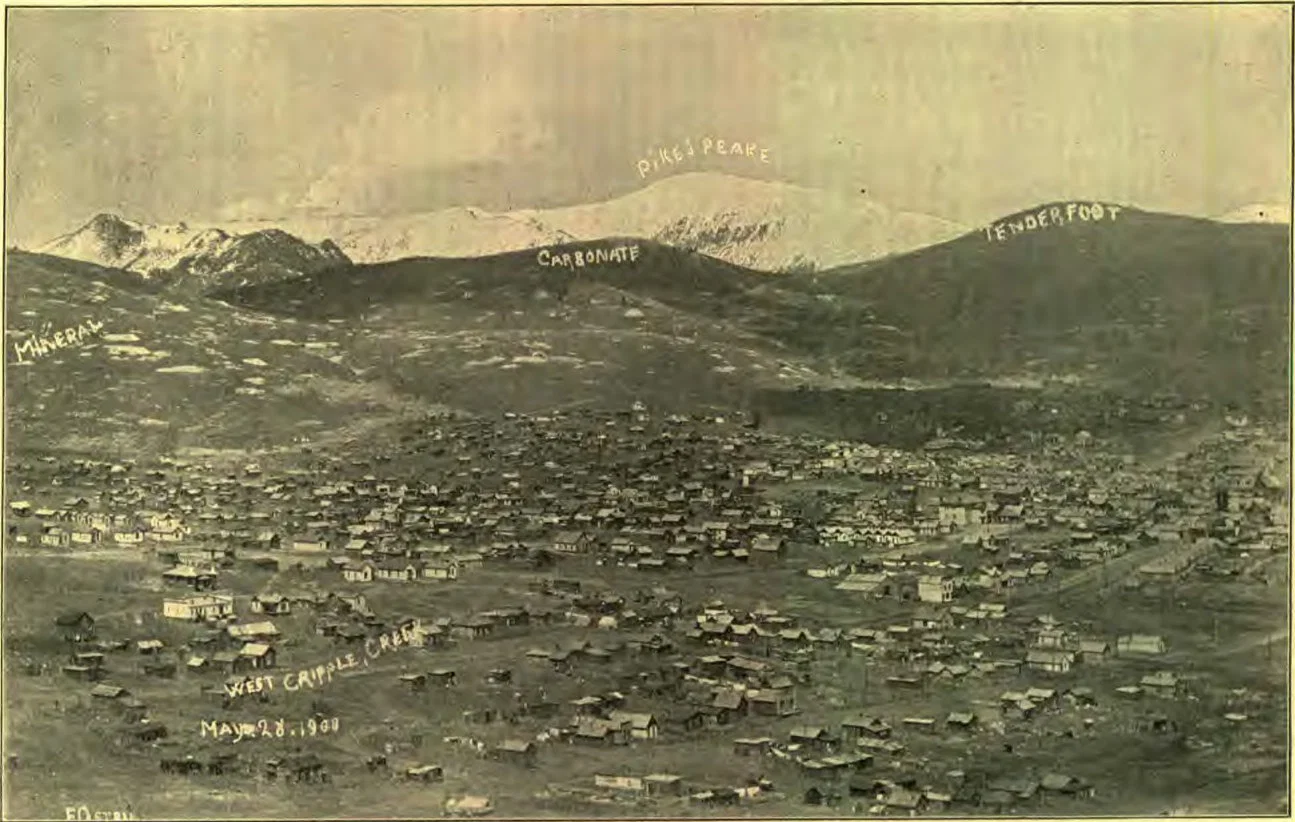
In addition to these gold-fields, which, under ordinary circumstances, are more or less temporary in the value of their output, there are others that seem to be permanent in character, and can be worked year after year, and still yield more and more valuable returns. This is apparently the nature of some of the mines in the famous Cripple Creek district, in the State of Colorado.
Although it is but a few years since gold was found there in paying quantities, this city with its suburbs already contains about fifty thousand inhabitants. The valley in which it is situated is about ten thousand feet above the level of the sea. Immediately overlooking it, on one of the mountain peaks, is the highest incorporated village—twelve thousand feet above sea-level—in the United States. Owing to the unusually rich gold finds that have been made in this vicinity, thousands of prospectors have literally honeycombed the mountain-sides with prospect-holes. As the average expense of sinking one of these is about five hundred dollars, it has been estimated, by those competent to judge, that more millions have actually been expended in searching for gold in the Cripple Creek region than have been secured from these remarkably well-paying mines.
After noting the great perseverance manifested by these men in their constant search and earnest endeavors to find gold, the admonition to “search for truth as for hid treasures” has a new meaning to me. Under ordinary circumstances, miners do not expect to find gold lying on the surface, ready to be scooped up with a shovel. They are willing to wear out their lives in dark tunnels in order to secure it. Is it not possible that in our Bible study we expect to get its valuable truths by simply skimming over a few chapters each day, and a few more on the Sabbath, instead of putting our minds to the task of sinking our shaft deep into the mine of truth?
DAVID PAULSON, M. D.

THE DIFFERENCE BETWEEN CHARACTER AND REPUTATION

CHARACTER is what we are: reputation is what others think of us. Character is what the sinless eye of God beholds: reputation is what the sinful eye of man recognizes. The enemy of the soul, and his evil agents upon earth, may smirch or ruin our reputation, but they can never rob us of our character; for character represents that truth—that part of our experience—which we have made our own, a part of our very selves.
Our character is the harvest of the seed-sowing of life: our reputation grows out of what we have done that pleases the world. A good and noble character is the result of what we have done to please God. Reputation is made out of human estimation, and, like the dew of the morning, is soon gone.
Character is built of eternal truth and living principles; and if developed by the Spirit of God and the word of truth, it will endure forever. Every good principle revealed to us by the Spirit of God is a living brick, that may be at once placed in the character-structure that every youth is daily building.
God estimates our real moral worth by the character, by the inward adorning, by the ornament of a meek and quiet spirit, which is in his sight of great price. Jesus of Nazareth was a man of but small reputation in the eyes of other men; and yet he developed the master character, which became the wonder of the universe, and the pattern and example of us all.
Not infrequently character is won at the expense of reputation; and yet we should be careful that we do nothing to cause the world unnecessarily to think or speak evil of either us or the cause we represent.
“Finally, brethren, whatsoever things are true, whatsoever things are honest, whatsoever things are just, whatsoever things are pure, whatsoever things are lovely, whatsoever things are of good report; if there be any virtue, and if there be any praise, think on these things.” Phil. 4 : 8. W. S. SADLER.

Our Gifts Are Valuable as Far as Our Hearts Go

“Our gifts are valuable just as far as our hearts go with them.”

IF—?—?—?

You can fill in many questions behind this little monosyllable, but they must all relate to earthly things. God’s ways and God’s promises do not admit of any questioning or probability. His ways are right, and all his promises are sure.
Through being circumscribed by human weakness, and so much accustomed to human failure, we readily conceive of God’s plans and the divine promises as being of like character with what we do and say. Yet the difference is great. We can speak, and in that speaking lie, but it is “impossible for God to lie.”
Man may take the sweetest words of his language, and by them deceive, wound, and destroy; but God can not be deceived, neither does he ever deceive the children of men. “If” and “but” come into God’s plan only so far as man’s will is concerned—“If ye be willing and obedient, ye shall eat the good of the land.”
All God’s promises are “yea and amen” in Christ Jesus, and he who steps up and meets them in Christ Jesus will find them “true and righteous altogether.” There is none of the frail possibility connected with them that links so many “ifs” with all human planning. We paint our brightest dreams, and for a moment hide in their cloud of transfiguration, but only to waken and find before us the limitless proportions of the “if” that stretches between us and their realization.
The following story is told of an old believer, and her faith in the promises of God:—
“One known as ‘Old Nanny’ dwelt in a lonely cottage in the Highlands. She was poor and bedridden, but ‘rich in faith.’ A young minister was accustomed to visit the old saint, more for what he could learn from her than for anything he was able to communicate. One day, wishing to try her faith, he proposed this startling question: ‘Ah, Nanny, but suppose that after all your praying and all your trusting, God were to cast you off at last! What then?’
“The old woman raised herself on her elbow, looked him steadily in the face, and said: ‘Eh! mon, is that a’ the length ye got to yet? Why, mon, God wad be the greater loser. Poor Nanny would lose her soul, to be sure; and that wad be a sair loss indeed, but God would lose his character! He knows I’ve just hung up my soul and all my hopes upon his ain precious promises; and if they should be broken, the whole universe wad gang to ruin.’ And then, sinking her voice, she said, ‘God wad be a liar! and dinna ye ken that canna be?’”
No! God can not lie. His position, responsibility, and character make such a thing impossible. And when human faith grasps this conclusion, God can honor such faith by revealing the power of his wonder-working hand. Faith speaks thus: “It must be, because God has said so.”
Do not let the enemy trifle with your soul by whispering possibilities when God has spoken. When the Lord says, “If we confess our sins, he is faithful and just to forgive us our sins, and to cleanse us from all unrighteousness,” the settlement of this thing depends entirely on our compliance with the will of God. When true confession is made, the sin must be forgiven, not because of how we may feel about it, but because God is faithful and just in all his promises, and he has said so.
There is no “if” from God’s side of the question; it only touches the human side. “If ye be willing and obedient, ye shall eat the good of the land.” God makes no provision for failure in any of his promises; they can not fail. We may fail to receive their fulfillment, but only because, like doubting Israel, we fail to believe. G. C. TENNEY.

DO YOUR BEST

LAST spring I dropped some morning-glory seeds at the foot of a dying maple in our front yard, thinking what a thing of beauty that old tree trunk would be when the clinging vines and lovely blossoms should cover it with foliage and color.
But a press of other duties kept me from enriching and moistening the ground, and training the vines to climb; so they were left to do the best they could, without care or attention.
One morning not long ago I looked out, and my eyes rested upon a cluster of bright-colored flower-bells nestling at the foot of the old maple. They were small, it is true; but they looked so fresh and bright that instantly the thought came, “Doing their best just where they are!” They might have said, “We can not amount to anything. The soil given us is poor, and we can never climb this tree without a helping hand; so what’s the use of trying?” Instead, they grew the best they could. This morning I stopped to admire a cluster of ten or more smiling up from the grass at the foot of the tree; and as I passed into the house, it was with a feeling of good cheer in my heart that I thought of the power and goodness of Him who made the flowers, and has given to each its own lovely tint.
Dear young reader, do you see any lesson in what I have written? I hope you do. Perhaps some of you may be compared to those neglected flowers. Are you doing the best you can? Or are you, just because your surroundings are not all you wish for, settling down to a do-nothing life? If you make a success of life, you must do your best in whatever condition you may be placed. You may think you have talent for something higher and nobler than your present occupation. Perhaps you have; but let me tell you that the surest way to develop your talent is to do your best just where you are. If it be shining shoes, or sweeping an office, or cleaning sidewalks, or sawing wood, or doing the endless, new-every-day duties that fall to the lot of many a loving daughter and sister, put your best efforts into the work. Boys and girls who look for the “soft snap,” who seek the easy place, are sure to fail of success.
In whatever condition you may be placed, do your best, and you will rise to a position of usefulness. MRS. M. C. Du Bois.

Positions of Our Planets

ASTRONOMICAL STUDY — NO. XI

Positions of Our Planets
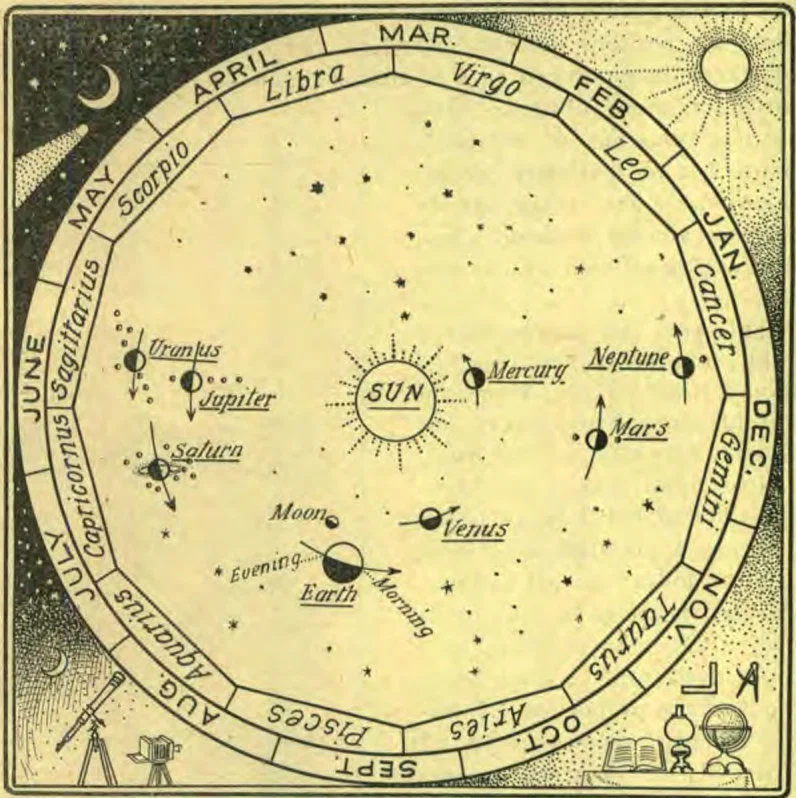
In the diagram given in this article we have a comprehensive view, which a moment’s study will enable all easily to understand, of one of the most wonderful manifestations of God’s power and goodness presented to the mind of man by the material universe,—the wonderful mechanism of our solar system.
Last week we studied the beautiful planet Saturn, and expected this week to make a special survey of its wonderful rings and moons, the former being that which especially distinguishes that world above its fellows as a place of beauty; but as we shall soon enter upon a new month, and are in so favorable a position to study the different worlds that adorn both our morning and evening sky, we will turn our attention to Saturn’s solar brothers and sisters this week, and look at the family as a whole. Let none forget the position of this planet, however, nor neglect to look for it each evening, and watch its onward march among the stars shining in purity beyond.
Now for the diagram. Let us see if we can understand it. If so, we can understand the manner in which all our worlds mark out their yearly courses around their common center, the sun; and we shall, I trust, be drawn nearer the great heart of Him who so loved this one small world that he gave his only begotten Son, that whosoever believes on him should not perish, but have everlasting life. Remember that, as presented in the illustration, the sun is in the center of our system; and all the planets travel around the sun, just as does our earth, each making its own year, which differs in length with each planet, according to the time it takes each to make the journey. Our earth requires three hundred and sixty-five days to get once around; Mercury, which, as you will see by the diagram, is much nearer the sun, gets around, and so completes its year, in eighty-eight days of our time; Venus, which is somewhat farther away, yet still nearer than we, gets around in two hundred and twenty-four days of our time. The planets that are farther from the sun than we,—Mars, Jupiter, Saturn, Uranus, and Neptune,—all having farther to go to get around to their starting-point in the heavens, have longer years than do we.
You will notice that they are all journeying around the sun in the same direction as we, and in fact all swinging in about the same level. We say “about;” for we understand that we are writing for common people,—such as heard our Saviour gladly, and would be glad to understand some of the riches of his creative work if our scientific friends of this world’s fame would only tell the beautiful story in language that all could understand.
If it is pleasant just after sundown this evening, as the first stars begin to appear, stand facing the south, the chart squarely before you, the top to your right and the bottom to your left. Imagine yourself standing, in the diagram, on that part of the earth marked “Evening,” just where the earth is rolling out of the light of day, away from the sun, toward the east. Notice how correct the diagram is. This leaves the sun just sinking over the western hills, as is the fact, and exactly as illustrated in the sketch. Now look directly before you, toward the south, and a little to the west, and you will see Jupiter and Saturn shining forth exactly as presented in the illustration. Uranus you will not discern, as it is so far away; but it is there, just as illustrated, still farther beyond Jupiter. The moon may bother you for a few evenings; but it will soon pass on to the east, and then we shall see these beautiful worlds shining silently on in the path where God has placed them. What a wonderful sight,—Sun, Earth, Moon, Jupiter, and Saturn, all witnessing to the power that directs their majestic march along the great highway over which the foot of fallen, mortal man has never trod!
But where is Mars? Where is Mercury? Where is Venus—that beautiful star which so richly emblazoned our western evening skies all last winter? Are these gone forever?—No, indeed. They are only somewhere else in God’s great universe. Let us look them up. To-morrow morning, a full hour before daybreak, we will arise, and behold the beauties of the eastern heavens. Take your diagram; stand facing the south, with the top of the diagram to your left and the bottom to your right. This will bring the sun to your left, or toward the east, where the real sun will soon appear. Now imagine yourself on that point of the earth in the diagram marked “Morning,” just where the darkness is about to merge into daylight; and what do you see in the eastern heavens? There are Mars and Venus, shining in all their glory as morning stars. We shall be a little too late to catch Mercury, for reasons given in our study on that planet. Neptune is also in that part of the heavens, but so far away that the naked eye can not discern it.
Now watch these planets, and study your diagram; and if time will admit, next month we will have another figured out. Then by comparing the two, we shall see just how far each one of the worlds has moved on in its circuit around the sun, and so be enabled to understand something of the changes continually going on in our great solar system.
DR. O. C. GODSMARK.
801 5th St., Milwaukee, Wis.

21 — Coneflower

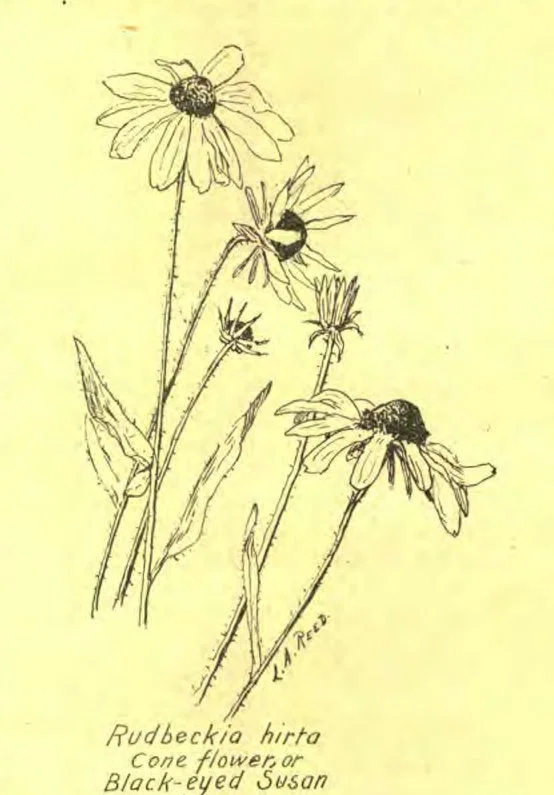
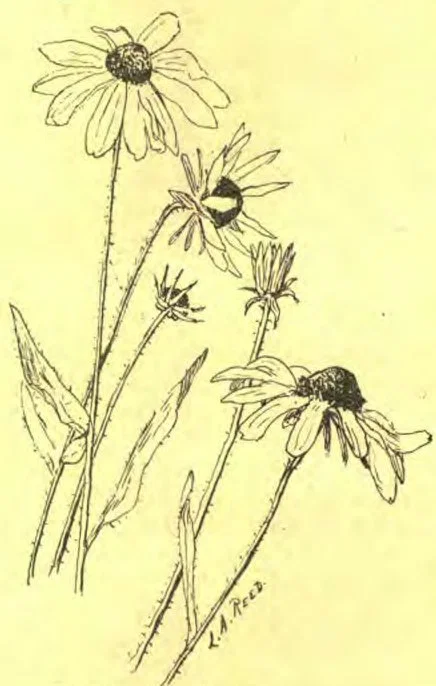
ALONG the railroad tracks in Illinois, especially on the side of embankments, you will notice whole beds of large yellow flowers with a madder-brown center. These are coneflowers, and are a distinctively Western flower. At one time, as we are told, they were never seen in the East. But the seeds of the coneflower, hidden in clover seed, were carried East, and the plant is now as much at home there as on our Western prairies.
This flower is also called Blackeyed Susan. The ray-flowers are a brilliant, deep yellow, and are often nearly two inches long, though usually they are shorter. The disk-flowers are a dark-brown. You might not suppose that each so-called flower is really many flowers, but such is the case. Each yellow ray, or strap, is a flower, and each one of the brown tubes in the center is also a flower; the yellow ray-flowers are for show; the brown disk-flowers produce the seed.
“Blackeyed Susan, or Susie, as her playmates call her, is a beautiful, wild country girl, with a striking brunette face, and a gown of yellow and black, which fairly makes the meadows dance with life and gaiety. Perhaps she lacks that wealth of charm which cultivation gives, and is rather careless in choosing her companions. . . . Her manner of growth is certainly ungraceful, and her leaves and stem are rough and uncouth.”
Rudbeckia hirta
Cone flower or
Black-eyed Susan
Rudbeckia hirta Cone flower or Black-eyed Susan
Another name for the coneflower is “nigger-head,” doubtless in allusion to the dark-brown, cone-shaped center. The stem is sometimes brownish, stiff, and rough to the touch. The plant is from one to two feet high, grows in dry soil, and in meadows, and blooms from the middle of June until August.

22 — Oxeye Daisy

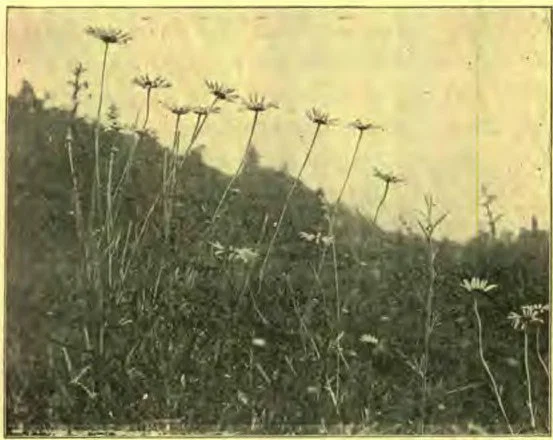
Another composite is the Oxeye Daisy. The illustration shows it fairly well. I found this bunch in a horse-pasture. The flowers are large and showy, though not so large as the coneflower, with white rays and yellow disk. Like all composites, each one of the white rays, and each one of the yellow tubes in the center, is a flower. This is why they are called “composites,”—each so-called flower is composed of many flowers.
This plant belongs to the Chrysanthemum family. The leaves are quite like many chrysanthemums, but the flower-heads look little like our cultivated ones. A. Gray calls this plant a “pernicious weed,” and says it is too abundant.

23 — Mayweed

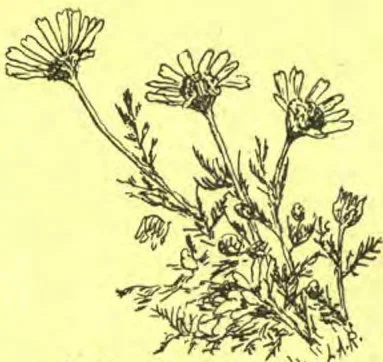
In the East a small flower something like the oxeye daisy in outward appearance is known as Mayweed; in the West it is called Dogfennel. Its leaves are very finely divided. It is found almost everywhere along waysides. It has a very rank odor, and is so well-known that it needs no further description.
There seems to be some difference of opinion as to whether or not it belongs with the Camomiles. The older editions of Gray’s botany place it by itself, under the name Maruta; but I notice that the later books place it with the Camomiles. L. A. REED.

Keeping the World in Its Proper Place

It is true that the things of the world have their proper place; but this is not the place usually allowed them—the first, the best, and, as too often happens, the only place. Kept in their proper sphere, they will never in the least interfere with the keeping of the law of love in spirit and letter, nor with the carrying of the gospel message to “all the world.”

TO A BLUET

With the southern wind swaying you, sweet, And the weeds pressing close to your feet, With the dust of the road in your eye,— What say you, blue bit of the sky?
God planted you there; so you grow Just as bright and as blue as you know He meant you to be; you are glad, And nothing you see makes you sad?
Sway on! I must leave you, and yet, Little bluet, I will not forget The message I read in your eye, You tiny blue bit of the sky!
— Young People’s Weekly.

Realities of the Invisible: Faith and Hope

REAL things are seldom seen. Thought, faith, hope, love,— the only lasting realities,— belong to the invisible. Sight-walking is but a morning exercise, while walking by faith is a constant journey.—Anon.

DISSIMULATION EXPOSED

(September 1, 1900)
Lesson Text.—Gal. 2:11–16.
Memory Verse.—Gal. 6:1.

SUGGESTIONS FOR STUDY

In this lesson we finish the narrative part of the epistle, and come to the argument in which Paul sets forth the gospel in its beauty and clearness. From now on we shall need to study more carefully and earnestly, if possible, than on previous lessons. Study the text for yourself first, before seeking aid from lesson notes, commentaries, or any other source. The Lord wishes to teach every one who studies his word. Then look to him first, last, and all the time in your study. For an account of the origin of the enmity between the Jews and the Samaritans, see “Great Empires of Prophecy,” pages 132–134. This gives an excellent idea of the feelings of the Jews toward all Gentiles.

QUESTIONS

1. To what place did Paul and Barnabas return after the council at Jerusalem? Acts 15:35. Who came from Jerusalem to Antioch later? What did Paul do after Peter came? Why? Gal. 2:11.
2. How did Peter at first treat the Gentile brethren? How did he afterward treat them? Why did he thus change his treatment of them? V. 12.
3. Who else took the same course that Peter did? How was Barnabas affected? What does Paul call such a course of action? V. 13; note 1.
4. What did Paul see in the course Peter was taking? What did he do? What question did he ask Peter? V. 14; note 2.
5. What experience had Peter had in preaching the gospel to the Gentiles? Acts 15:7. How, on this occasion, did God work for them? V. 8. What difference did God make between Jews and Gentiles? V. 9. How, then, was Peter departing from the truth of the gospel? Note 3.
6. What were Peter and Paul by nature? What were they not? Gal. 2:15. Then because they were Jews, were they not sinners? Rom. 3:23. Were they naturally any better than Gentiles? Note 4.
7. How are men not justified? How are they justified? Knowing this, what had Paul and his Jewish brethren done? Why had they believed in Jesus? How were they not justified? Why not? V. 16.
8. How can one be justified whose works are not perfect? Rom. 4:5; note 5. Could not this be done partly by work, and partly by the grace of God? Rom. 11:6; note 6.

NOTES

1. A dissembler is defined as “one who disguises his opinions.” To dissemble would be to act contrary to what one believes or thinks. When Peter ate with the Gentiles, he was acting according to the light that God had given him. He changed his course for fear of what others might say or think.
2. Paul rebuked Peter before them all. They were departing from the truth of the gospel; and Paul, as a faithful minister, gave a timely warning. It is often much easier to let a wrong pass than faithfully to reprove it. But there should be no harshness in giving reproof. We are to restore the faulty one in the spirit of meekness. We need much of the Spirit, in order to be faithful yet kind.
3. The Lord had taught Peter that he was not to call any man common or unclean. Acts 10:28. Peter had eaten with these Gentiles in Cæsarea. Acts 11:2, 3. He did the same when he first came to Antioch. Then, for fear of criticism, he made a difference between men where the Lord had “put no difference.” In this he was showing respect of persons.
4. The Jews, as the chosen people of God, were highly favored. But they needed to be saved from sin as much as any other people. To be outwardly connected with God’s people and his work, does not change the heart. We may belong to the church, profess to keep all the commandments, and to be looking for the Lord to come; yet all this is of no avail unless we are saved by the power of God through faith in Christ.
5. Only he who has kept God’s law perfectly, who has not one sin to answer for, could claim to be righteous on his own account. Judged in this way, both Jews and Gentiles are sinners, in need of Christ’s righteousness by faith.
6. This verse (Rom. 11:6) makes it plain that righteousness must be either all of works or all of grace. The Jews had shut themselves away from the Gentiles, as if they thought themselves naturally better than other men. And so some, who professed to accept Christ, still thought it necessary to salvation to observe the rules that forbade them to mingle with the Gentiles. But these rules were of man’s own contriving. God had never given them any such law. Therefore it was not “according to the truth of the gospel” for Jewish Christians to refuse to eat with Gentile Christians.

SIN AND ITS REMEDY

(September 8, 1900)
Memory Verse.—Rom. 6:11.

SUGGESTIONS FOR STUDY

None of the texts in this lesson are found in the book of Galatians; but we shall need them in our further study of Galatians, for the additional light they furnish. And they are given thus together, that we may become familiar with them. Study them carefully, and learn what each one says, and where it is found.

QUESTIONS

1. How did sin enter the world? What came as the result of sin? How many were affected by sin and death? Rom. 5:12.
2. Are Jewish sinners better than Gentile sinners? How many are under sin? Rom. 3:9.
3. How many have sinned? In sinning, how have they come short? Rom. 3:23; note 1.
4. To whom does the law speak? When the law speaks, how will it silence all? Rom. 3:19; note 2. How, then, can no man be justified? What knowledge does the law bring to men? V. 20.
5. How is the righteousness of God manifested? What bears witness to it? V. 21; note 3. By what means is it manifested, or revealed? Unto whom is it brought? V. 22.
6. How and in what measure are we justified, or made righteous? V. 24.
7. What question is asked concerning sin and grace in Rom. 6:1? How is the question answered? In what condition are those who are partakers of God’s grace? How, then, can they not live? V. 2.
8. When we accept Christ, what becomes of our old man of sin? Why must the old man be crucified? V. 6. Who is freed from sin? V. 7; note 4.
9. Why was Jesus Christ manifested? 1 John 3:5. How may we be kept from sinning? What is said of those who continue to sin? V. 6.
10. What relation exists between the sinner and the devil? Why was the Son of God manifested? V. 8.
11. What was Paul’s experience at one time, without the law? What experience did he have when the commandment came? Rom. 7:9. What did he learn about the law? V. 10. What did sin do to him? V. 11.
12. What is the relation of Christians to the law? What is their relation to Christ? What is the result of this union with him? V. 4; note 5.

NOTES

1. All, by sinning, have come short of God’s glory. The glory of God is his character. Compare Ex. 33:18 and 34:6, 7. Anything that comes short of this perfect character is sin, because it is imperfect. Sin, then, covers more than outbreaking acts of iniquity. Every failure to do as Jesus would do in our place is sin.
2. In this text “under the law” reads literally “in the law;” that is, within its range. And because all have broken it, all stand guilty before God, under its condemnation.
3. To make manifest means to reveal, or cause to appear. God imparts to men his own righteousness, apart from their own efforts to keep the law. Yet it is the same righteousness that the law demands; for the law bears witness to it. And it is brought to us “by faith of Jesus Christ.”
4. The sinner is described as dead in sins. Col. 2:13. That is, dead to all works of righteousness. He who has been made alive in Christ is dead to sin. And he no more does those things to which he is dead than a dead man continues to walk and talk.
5. The law condemns the sinner to death. But Christ died for us, and we accept his death, and die with him. And while we thus remain dead to the law, its claims are met, and it can not condemn us. Then as Christ rose from the dead, so we “rise to walk in newness of life.”

HOW ABOUT THE TUCKS?

We were standing in the laundry one bright morning not long ago waiting for our linen, when we noticed a fresh young girl unroll a package, asking, as she did so, “How soon can you have these white muslin waists done?” “Friday, sure,” answered the smiling Chinaman, reaching his long fingers for the bundle. But as the paper fell to the floor, and the dainty fabrics were more exposed, his quick eyes caught sight of rows of elaborate tucking, he lifted his hand in protest, and, drawing back, refused utterly to touch the garments. And though the young girl assured him that “they really do up nicely, mother say,” he only shook his head obstinately, and turned back to his irons, saying, “Melican lady do, Chinaman no do.”
Blushing and discomfited, the girl was obliged to seek elsewhere for the laundering of her waists, and we went down the street thinking. And how many tucked white waists were out that morning! It seemed as if one young woman out of every three had one on. Who irons them all? we thought. Is it mother? Does she find them easy to arrange? or was the Chinaman right?—Young People’s Weekly.

Schooling for Grandeur in Lonely Hours

I KNOW OF NO kingly soul that has not been trained for sovereignty in long and lonely hours. Moses, Paul, and John had their meditative years. It is God's way of schooling for grandeur.—Anna Robertson Brown.

THE YOUNG VINES

There was mourning in the vineyard; for the Husbandman, pruning-knife in hand, walked among the Young Vines, and many of their tender Branches lay withering on the ground.
“Be patient,” said the Old Vine, which grew by the wall; “the Husbandman knows what is best for us; and although it gives us pain to part with our Branches, we shall bear the more Fruit on account of the pruning.”
“Fruit! What is Fruit?” asked the Young Vines. “It is cruel to rob us of our beautiful Branches.”
And then the Blossoms came. But the Vines mourned as before; for the Husbandman walked among them, and here and there he nipped out the Blooms.
“Our Blooms, our beautiful Blooms!” cried the Vines; “why is the Husbandman so cruel, so wasteful?”
“Be patient,” again said the Old Vine. “Our Fruit will be better for the pruning.” “Fruit?” We do not know what Fruit is. Alas for our Blooms!”
But in October, when the Young Vines were full of Purple Grapes, there was no mourning; for they rejoiced as the Husbandman, basket in hand, walked among them, gathering the rich Clusters. AUNT BETTY.
Continue reading: THE TWO ARMIES