The Youth’s Instructor, Vol. 67, No. 21.

The Greatest Text

The Youth’s Instructor

May 27, 1919

Review and Herald Publishing Assn. · Takoma Park Station, Washington, D. C. · May 27, 1919

The Greatest Text

God—
so loved—
the world,—
that he gave—
his only begotten Son,—
that whosoever—
believeth—
in him—
should not perish,—
but—
have—
everlasting life—
The greatest lover
The greatest degree
The greatest company
The greatest act
The greatest gift
The greatest opportunity
The greatest simplicity
The greatest attraction
The greatest promise
The greatest difference
The greatest certainty
The greatest possession
— Sunday School Times.

A Vanished Nation

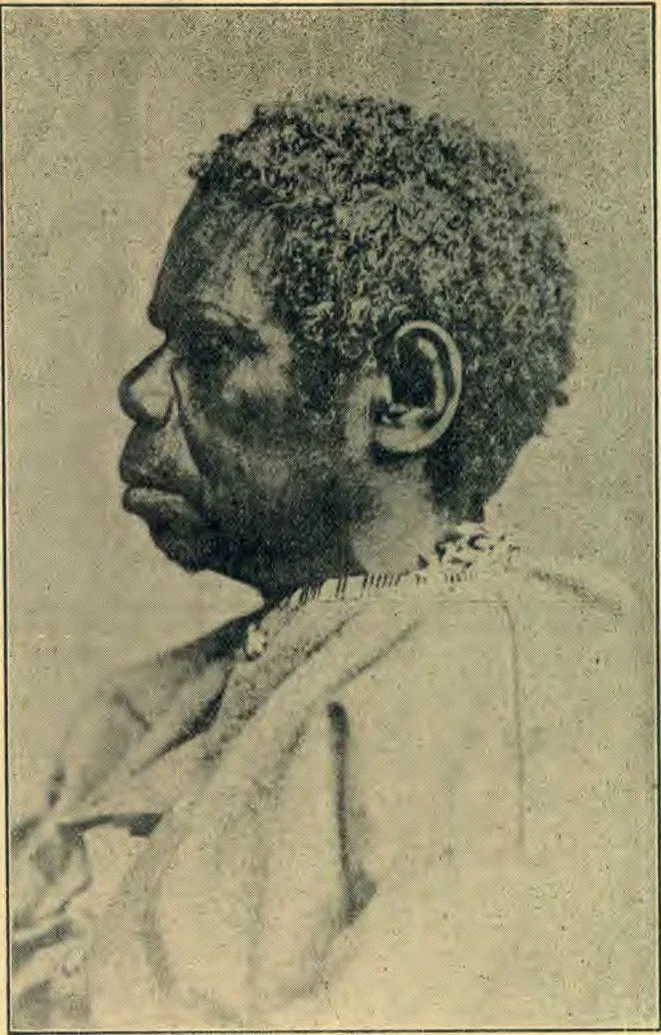
It is surely a distinction to have been the last surviving member of a nation or race. This was the distinction that came to Trucanini, daughter of a Tasmanian chief, who was the last of the Tasmanian aboriginals.
The Tasmanians were evidently the most energetic and spirited of the Australian aborigines when the Dutch, French, and British navigators began to touch these Australian shores. They resented the coming of the settlers into their old hunting grounds of Tasmania, and the story that always has repeated itself in every land followed — injustice on the part of some of the invaders, then savage reprisals and border warfare.
In the early decades of the nineteenth century one governor of Tasmania conceived the idea of forming a cordon of troops and armed settlers across one portion of Tasmania to inclose the tribes — men, women, and children — and catch them all or drive them into the sea. The net result was one old man caught, and one child.
Trucanini, Last of the Tasmanian Aborigines
Then it was that a Christian bricklayer, a Wesleyan, came forward and volunteered to go out alone and bring these people in. He loved them for their deep need, and at last his pleas secured attention. So this artisan missionary, George Robinson, began his mission in 1830. He had already learned much of their language. He believed they could be helped. He said: “No language can do justice to the intense anxiety manifested by the adult aboriginals for learning; it must be seen to be properly comprehended.”
In his five and a half years’ work, Robinson walked four thousand miles, seeking out the tribesmen in the wilds, and pleading with them to give over their ways and come in and be assigned living quarters within the young colony.
He risked his life continually in reaching those in the remotest fastnesses of the mountain and bush.
Providence provided him a helper in Trucanini, the chieftain’s daughter. She was drawn to espouse Robinson’s cause, and with her husband gave herself to the mission without reserve.
  • (Concluded on page twelve)
  • (Concluded from page two)
She was the strong character, the husband doing little. She was gifted as a linguist, the record runs, and quickly mastered the different dialects. She was Robinson’s interpreter, and advance courier in approaching the wilder people. She risked her life for her master, and saved Robinson’s life on one occasion when he was escaping from hostile natives and was drowning in the Arthur River.
Robinson brought in remnant after remnant of the tribes, until they had all surrendered — a pitifully small remnant to have made so much trouble. They were put on Flinder’s Island, but many died of what the surgeon said was nostalgia — plain homesickness. The remnant were removed to the Tasmanian mainland, gradually to go down with degradation and disease.
At last only Trucanini survived. Then, in 1876, at about the age of sixty-five, she passed away. History says: “With her remains the grave closed over the last aboriginal inhabitant of Tasmania, and in her death a nation became extinct.”
Does it not bring a sense of loss and a feeling of sadness to the heart to think of a nation’s perishing in our own generation, beyond the sound of the message that God raised up in 1844 with its call to every tribe and tongue?
The aboriginals of the Australian mainland are a decreasing race, apparently, but thank God, the message is among them and the first fruits have appeared. There is no tribe so remote today that we may not see the advancing frontiers of the Advent Movement pushing on to reach it.
W. A. Spicer.

Washington to New York in Ninety Minutes by Airplane

The trip from Washington to New York City, which usually requires six hours by fast express, has been made in ninety minutes by airplane.
More than one million barrels of flour was recently purchased for export to Europe, from millers of the Pacific Northwest, by the United States Government, through the Food Administration Grain Corporation.
Mother’s Day was also made Son’s Day this year by the Department of Labor. This was done by making a special campaign throughout the country on that day to secure employment for discharged soldiers.
Sir Eric Drummond has been appointed secretary of the League of Nations at a salary of $25,000 a year. The first annual meeting of the league is expected to be held next October in the White House, Washington, D. C.
More than half of England’s cotton mills were during the war converted into munition and aeroplane factories, and during the period of readjustment that country is likely to have more than it can do to supply its home needs and meet the demands of its colonies overseas.
The Armenian national conference, which has been in session in Paris for several weeks, has finished its work and adjourned, after drafting the program of Armenia’s claims, estimating the damage suffered by Armenians in the war and appointing a commission to establish the principles upon which the future Armenian state shall stand. In addition, it selected a new national delegation to work with the other Armenian delegations in matters relating to Armenian interests. The keynote of its policy is the motto to be adopted: “An integral Armenia, free and independent, within its historic limits.”

TOO LATE

EUGENE ROWELL
I failed to do my duty once; And after twenty years I came to bring a recompense, And offered it with tears. But one I'd wronged was in the grave, And one beyond the sea; And one, because of ruined life, Turned harshly from my plea.
So do your duty now, boys; Today is always best. A duty shirked will follow you And mar your work and rest. But duty done will keep you square With every man you meet; For duty done is victory, But duty shirked, defeat.

The Power of Thought upon Character

GEORGE W. SPIES
As he thinketh in his heart, so is he: Eat and drink, saith he to thee; but his heart is not with thee.” Prov. 23:7. It is impossible to overestimate the power of our thoughts upon us in the development of character. No other influence or agency can bring about so powerful a transformation in the individual as the thoughts which he is continually thinking.
The passage of Scripture just quoted describes a deceitful man. His words represent one state of mind, an assumed state; while his unuttered thoughts describe quite another state, namely, his actual mental condition. Apparently, he would generously share with you his unstinted hospitality; but in fact, he would grudge you even the meager morsel which you might eat at his well-filled table. His words may be smoother than oil, while his thoughts may be those of the assassin. But it is by his thoughts, which describe his actual mental condition, that the Lord determines the character of the man. “As he thinketh in his heart, so is he.”
An important psychological law is here brought to view. The thoughts which we harbor, the purposes and meditations which we cherish, determine the manner of person we are or shall be. They stamp their impress upon our character. We are unconsciously molded by the mental processes which we encourage, by the thoughts which we invite and foster. Like the brand upon the brow of Cain, the very countenance eventually bears witness to the thoughts we think. Isa. 3:9. And sooner or later this habit of thinking, whatever it may be, will manifest itself in our words and actions.
It therefore follows that an individual may, by persistently controlling his thoughts, become the arbiter of whatever destiny he may desire. He may think himself into being a saint or a sinner; a child of God or an emissary of the devil. And this tremendous difference between the two, both as to character and as to their ultimate destiny, is due, in the former case, to the simple process of controlling the thoughts and directing them into proper and legitimate channels; and in the latter case, to allowing these thoughts to roam at will over the broad and fertile field of carnal desire. For, as already shown, “as he thinketh in his heart, so is he.”
The power of thought in the development of character is recognized in the Scriptures, which, accordingly, seek to direct us in the selection of our thoughts.
After enumerating the desirable qualities, honesty, justice, purity, loveliness, and similar virtues, the inspired writer bids us “think on these things.” Phil. 4:8. Only one result is possible to the individual who persistently carries out this instruction. He must and will of necessity become an honest, just, pure, lovely, Christian character. The possession of such a character, therefore, is not a matter of natural inheritance. It may be acquired by any one who is willing to pay the price for the same. It necessitates “bringing into captivity every thought to the obedience of Christ.” 2 Cor. 10:5.
Not our outward acts merely, but our inmost thoughts as well, are to be surrendered to the benign influence of the Spirit of God. Says the prophet Isaiah, “Let the wicked forsake his way, and the unrighteous man his thoughts; and let him return unto the Lord, and he will have mercy upon him; and to our God, for he will abundantly pardon.” Isa. 55:7. It is impossible for the wicked to return unto the Lord and find mercy and abundant pardon, as long as his thoughts are not subject to the Spirit of God. And no healthy Christian experience is possible until this surrender is made. After it is made, God directs our thoughts by his Spirit.
The world in the days of Noah was deluged by a flood of waters, because “every imagination of the thoughts of his [man’s] heart was only evil continually.” Gen. 6:5. “As it was in the days of Noah, so shall it be also in the days of the Son of man.” Luke 17:26. As men thought then, so men are thinking now. And a deluge of fire awaits this present evil world because the thoughts and imaginations of men are only evil continually. But no individual, whose thoughts are allowed to dwell upon the low, sensual things of earth, can possibly attain to a healthy Christian experience. To become godlike, an individual must think the thoughts of God. For “as he thinketh in his heart, so is he.”

The Red Triangle Work

It is so easy to find fault that anybody can do it if given half a chance, and many if given no chance at all. It is so easy that even if the occasion offers some opportunity for dissatisfaction people do not stop to consider the circumstances that are responsible for the unsatisfactory condition. They do not consider whether those apparently at fault are battling with conditions they are powerless to remedy, and so need the faultfinder’s sympathy rather than his criticism in their efforts to serve him.
The war experience of the Young Men’s Christian Association is perhaps as pertinent a general illustration of this fact as can be cited. Of course everything was not altogether satisfactory at the triangle huts, but the Y. M. C. A. made an honest and heroic effort to serve the soldier boys. The boys are free to tell their side of the story whenever they find occasion to do so, why not hear the Y. M. C. A. version of this stupendous phase of the great war service?
The transportation and distribution of 100,000,000 pounds of supplies at a cost of nearly $25,000,000, the providing of pianos, Victrolas, books, and movies for entertainment at many places, was no small task. Mr. Frank W. Ober summarizes this great work, given over by the Government to the Y. M. C. A., in the following words:
“With high purpose the association took on the canteen service in France. It had always been a sore spot and an embarrassment to the army. We did not fully know what we were undertaking nor the difficulty of service in the whirlwind of war—the cataleptic fury of war, the 4,000 miles of transport, the mêlée of camps, the mutations of personnel, the insatiable and unreasonable demands of soldiers, and the knowledge that the post exchange was always the popular grouch of men to whom grouching was a habit. Think of running a thousand Butler stores, or following circus tents from town to town with lemonade stands and chocolate bars, or of rivaling all of the United cigar stores, or of marketing the output of five chocolate factories! Or of setting up grocery stores in the face of mobs under martial law in a mining camp—all to be supplied by trucks over shell-swept roads!

Two Thousand Cups of Chocolate on Call

“Quite a task for a noncommercial, nonmilitary organization to innocently undertake overnight! A Jim Hill or a McAdoo might have hesitated. That the association has come out of it fifty per cent creditably is a miracle, yet 22,000 to 100,000 men have been served every week over single counters, and still men keep coming. The first call on arriving in town has been for the Y. M. C. A. canteen. We saw a queue of 600 men in one place waiting to be served when the supplies arrived. Sometimes when the army stores gave out, 2,000 cups of chocolate were furnished on call. Men and women have broken under the attempt to do the impossible 4,000 miles away from home.
Yesterday we viewed the wrecks of huts conducted by the British in Ypres and Dickebush—that most awful cataclysm of the war. Here 87 huts where men had ministered in the acme of frenzied devotion to their fellows were completely destroyed. On every side were gaping shell holes. They had lived amidst the diabolism and carnage, and thought the service fully worth the risk of their lives. True, they had been so occupied that there was scant time for preaching, yet their acts spoke a Christ-kindness. Impotent to get the goods up despite the Herculean efforts of the transport drivers, our men smarted under the criticism of failure to meet the wants of men to the full.
“And feeling that the canteen has supplanted the higher purposes of maintaining morale, it may not be strange that the Regional Association secretaries in France raised the question if the canteen service was worth while and if it could not be abandoned. Yet they stayed to see it through. As we write, enough transportation cannot be secured, even in armistice days, to half meet the demands. Our men were misunderstood by soldiers who could not be assured that the association had not taken on the business to make money. They have been charged with graft, although the prices were usually less than in the home cities. This sacrificial work may have been mistakenly undertaken and in cases inefficiently conducted, but in the end it will be found a credit to the enterprise and devotion of those who took it on.

Dissatisfaction at Home—to Be Expected Abroad

“Can any man run a hotel at home without dissatisfaction on the part of some? The association at Coblenz, operating as the headquarters of the Army of Occupation, runs ten hotels and restaurants serving thousands of meals a day—every meal offering a chance for complaint because of a cold plate, a hair in the soup, or the discourtesy of a servant. And how about clean sheets and towels for 2,000 men a day? Or finding fault with the ‘shows’ every night for 36,000 men in this town, or the continuous movies at one of its commandeered theaters, or picking flaws in the running of the 36 canteens conducted for the insatiable, restless troops about this city? Or finding a chance for comment in the scores of games of baseball or basketball; or the educational program, already serving 2,000 men? Yet these men seemed happy. The streets were empty and the buildings were crowded. These ten hotels, and the restaurants, theaters, and 36 canteens were commandeered by the Government and given over to the association for army service. The association equipped and manned them.
“Business began when the troops entered Coblenz. We found the vast building, the ‘Festehalle,’ which we visited the other night, seething with 4,000 vigorous men. An orchestra played constantly in one hall seating 1,000 men, a show was on in the big hall seating 2,500 more. The American Library Association gave out 300 books a day, some 100,000 francs were deposited for sending home. In another building 2,100 meals were served, with ‘pie à la mode’ galore! The 36 association centers had more than 15,000 guests every day in Coblenz alone. Think of the task of calling together 400 secretaries, thirteen groups of entertainers from overseas, and rushing them to the Rhine within a few days, not to speak of engaging and organizing this force of capable secretaries and a force of 300 local foreign-speaking helpers.
“Coblenz is also the center for association service with the 300,000 troops of occupation located in over 300 points and towns. Think of the supplies needed for the canteens alone! In ten days 78 carloads were received and sent out by the 100 automobiles. In the equipment were 100 pianos, 350 Victrolas, and 400 musical instruments. There have been sent out 50,000 books and 20,000 magazines, and 4,500,000 sheets of writing paper. The program offered was so full and compact that a lecturer could not be squeezed in for two weeks!”
In view of the almost incomprehensible work that the Y. M. C. A. attempted for the soldier boys, surely it is hardly praiseworthy for those for whom the service was undertaken and maintained, much less for those who were allowed to remain at home, amid plenty and comfort, to find fault because of inadequacies of service at certain points. Should we not the rather express appreciation for the miracle accomplished and forget the small inefficiencies that all regretted but none could prevent? F. D. C.

Arguments Against the Bible as History

The Spade as Teacher — No. 1

THOUSANDS of books in our libraries are there through the knowledge given to the world by the spade. A hundred years ago there was no authoritative history of Assyria, Babylon, or ancient Egypt. People talked freely of Nineveh, Babylon, Ur of the Chaldees, of the Hittites, and of ancient Egypt; but they were dependent upon the Bible for their knowledge, together with “several ancient compilations of uncertain value.” But the Bible was the only authoritative book in the world that gave historical data concerning these peoples and kingdoms.
At this time the oldest authentic profane history known was the history of Greece and Rome, dating back to four or five centuries before Christ. Mythological history ran back of this time by several centuries but it was not reliable. The Bible, therefore, stood alone in offering to the world bona fide information reaching back thousands of years before there was authentic profane history. Its statements could not be proved to be true or untrue by the statements of other reliable writers. None such were known to the world a hundred years ago.

Arguments Against the Bible as History

This state of affairs made the Bible to be regarded by the worldly wise as a mere creation of the Jews to praise those of their own race or ancestry. As examples of their boastful reasoning we quote from Dr. Ira Price, in his interesting work “The Monuments and the Old Testament:”
“In Genesis, chapter fourteen, we find that, in some distant age, four kings of the East had conquered, and held in subjection for twelve years, the five kings of the cities of the plain. In the thirteenth year these kings of the West rebelled against their Eastern masters. In the fourteenth year these Eastern lords planned and executed a great campaign against the West land rebels, conquering and capturing and plundering their former subjects. Now, this is a most unlikely story. There is no evidence outside of the Old Testament that any such great kings of the East ever lived, no evidence that the West ever suffered such a disastrous defeat at the hands of any rulers at that distant day. In fact, the whole story seems to be the invention of some enthusiastic Jew to laud the military ability of Abraham, and to explain the origin of the tithe and of Melchizedek.
“‘Another case also should be mentioned,’ says the critic. ‘Who were the Hittites? They are frequently mentioned in the Old Testament, and sometimes as being a powerful people; but is there any extra-Biblical evidence that they ever existed? Not one scrap. They are simply one of the mythical peoples with which the Old Testament is filled, and are introduced merely to magnify the vast administrative ability of David and Solomon in commanding and using foreign peoples in their armies and in their service.’
“‘There is one name in Isaiah (chapter 20:1) which well illustrates my point. Sargon is mentioned as king of Assyria. Other kings of Assyria are given in other passages, but the writers have been extremely consistent and very shrewd in their introduction of these mythical monarchs. This case in Isaiah is unique. The name is not mentioned again in the Old Testament, neither is it found in any other literature. Now, it is manifestly absurd to say that such a name is anything but a myth, or a scribal error.’”
But the author of the Bible made no answer. He just waited. He knew the proofs for the vindication of his Word that some day would be given to the world through spade and monument; and he knew, too, that the Spirit of God demonstrated its truthfulness all the way along to every true believer. “If any man will do His will, he shall know of the doctrine.”

The Bible Vindicated

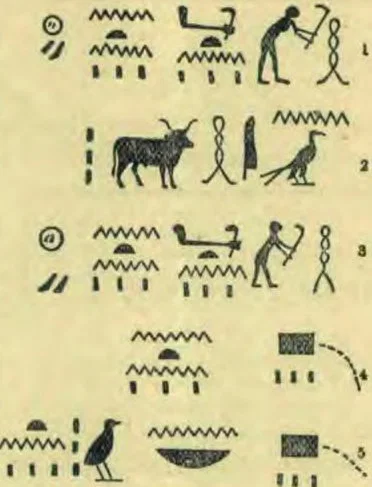
Finally, after long waiting, the Lord, as it were, said to the world, Now take your spades and go to work. For centuries you have questioned the reliability of my Word; now unearth the proofs of your own shortsightedness and unreliability and of the truthfulness of my Word. In response to the decree the archeologist began his work. Men had often noted that the great monuments, temples, and other ruins of Egypt carried on them peculiar ornamentation. They wondered whether this might not be a kind of picture writing, giving information in a language to which the world had lost the key. But why wonder? There was no key to the dark millenniums of the past. Yes, there was, and in God’s providence the time had come for it to be found.

The Finding of the Key

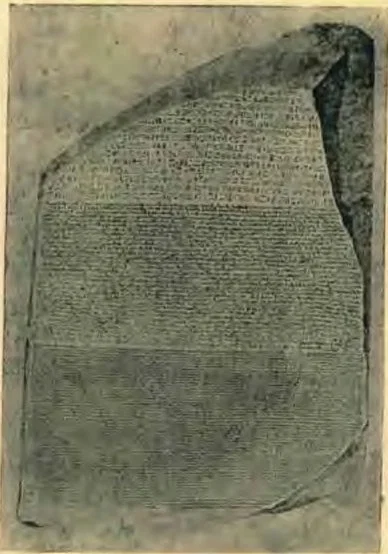
Indirectly the world is indebted to Napoleon Bonaparte for the finding of this key. Napoleon coveted Egypt. Therefore in 1798 he invaded the Nile country with an army. Among the strong corps of eminent scholars and artists which accompanied the expedition was Boussard, a French engineer. It was he who found the lost key to Egypt’s past, in 1799, while digging near Rosetta, at the mouth of the Nile, near Alexandria. It was a black granite stone, 3 feet 9 inches by 2 feet 4½ inches, and 11 inches in thickness, containing inscriptions in three languages, one of which was Greek. This was easily read by Greek scholars, but the other two no man could read. However, the stone was carefully cherished; and when terms were made with the defeated French army, it, with other important archeological treasures, was turned over to the British.
The two unread inscriptions on the Rosetta stone aroused the curiosity and interest of scholars, and for twenty years men tried heroically but vainly to decipher them. In 1818 a French scholar, who understood the Coptic language, began the study of the Rosetta stone. “No one at that time realized that the Coptic was descended from the ancient Egyptian, and was still preserved as the sacred language of the Egyptian church, as Latin is the ecclesiastical language of Roman Catholics.”
By most painstaking effort this eminent scholar finally succeeded in deciphering the long-forgotten writing of ancient Egypt. He published his discovery in 1822, less than one hundred years ago. “Thus the door to the historical and literary treasures of ancient Egypt was unlocked, and from that time to this the study of Egyptian inscriptions and documents has gone steadily forward.” Universities now offer courses in Egyptology, their knowledge going far back of the first mention of Egypt in the Old Testament.
The Spade as Teacher — No. 1
The critics were astonished, and said, “Well, if Egypt existed so long ago, perhaps the Hebrews really did exist, for they are represented as living in a much younger age.” The Bible was coming into its own. The information of spade and imperishable monument could not be refuted. As concrete illustrations in this connection of the way infidels have been answered and the accuracy of the Bible has been emphasized by the findings of archeology, I quote from “All About the Bible,” by Sidney Collett:

Biblical and Assyrian Records Harmonize

“For many years there were great questionings as to the accuracy of 2 Kings 18:14, where the Holy Spirit records that the king of Assyria made Hezekiah, king of Judah, pay a tribute of ‘three hundred talents of silver and thirty talents of gold.’ When the Assyrian records of this transaction were discovered,—the accuracy of which no one questioned, being Sennacherib’s own account,—the amount of tribute was there stated as eight hundred talents of silver, not three hundred as in 2 Kings 18:14; while the number of talents of gold was the same as the Scripture record, thirty. For some time it was felt that there was no way of reconciling the different figures, and therefore one or other of them must be wrong; and of course, as usual, the inspired record was condemned. Nothing but a little patience was, however, needed, for we now know by more recent discoveries that the difference in those figures, far from proving the existence of a mistake in either record, constitutes a most remarkable testimony to the accuracy of both; for while the standard for calculating talents of gold was the same in Judea and Assyria, that for the talent of silver was quite different. In fact, it took exactly eight hundred Assyrian talents of silver to equal three hundred Hebrew talents—just as it takes twenty shillings to make an English pound, while a Turkish pound only represents about eighteen shillings. And thus, in what was supposed to be a mistake, the minute accuracy of the Word of God was demonstrated. . . .”

Whence Came the Gold the Israelites Borrowed?
“The question has often arisen in many minds as to how the Israelites became possessed of so much gold and silver, as was required for the furniture and appointments of the tabernacle. (See Exodus 25.) Was it likely that the Egyptians either could, or would, allow the Hebrews to carry away the immense quantity of treasure which was required for such purposes? to say nothing of the immorality on the part of the Hebrews in ‘borrowing’ that which they never intended to repay! “As to this latter question the Revised Version shows that the word is not ‘borrow’ at all, but simply ‘ask.’ “‘Every woman shall ask of her neighbors.’ Ex. 3:22. “‘Let them ask every man of his neighbor.’ Ex. 11:2. “‘And the children of Israel did according to the word of Moses; and they asked of the Egyptians jewels of silver, and jewels of gold, and raiment: . . . so that they [not ‘lent’ them, but] let them have what they asked.’ Ex. 12:35, 36. “So that there was no immorality at all; it was a perfectly straightforward transaction.”
“As to their willingness to part with such wealth, we must remember that there were those even among the servants of Pharaoh who ‘feared the word of the Lord.’ Ex. 9:20. It is, therefore, most natural to assume that many of them would sympathize with the Hebrews in the merciless treatment to which they had so long been subjected at the hands of the Egyptian authorities. Indeed, we are distinctly told twice over that ‘the Lord gave the people favor in the sight of the Egyptians’ (Ex. 11:3; 12:36); while many more, after the terrible experiences of the plagues which had devastated their land and darkened their homes, would be only too anxious to offer some substantial gifts in the superstitious hope that the God of the Hebrews might be thereby propitiated, his wrath appeased, and their land saved from further plagues.”
“All this, however, seems reasonable enough to an impartial mind; but there still remains the far more practical question. Was gold and silver really so plentiful at that time in Egypt as to make such a thing probable or even possible? For it must be acknowledged that the quantities of these precious metals carried away by the Hebrews must have been enormous. The gold used in the construction of the candlestick alone (Ex. 25:31, etc.) represented in our money over $25,000.”
“This difficult question has, however, at length been answered, in the providence of God, in a way which leaves no possible room for doubt, by a discovery made by Mr. Theodore M. Davis as recently as February, 1905, which the Times describes as ‘the most important discovery ever made in Egypt!’”
“On Sunday, February 12, Mr. Davis, in his excavations, came upon a royal tomb of the eighteenth dynasty,—the time of the Exodus,—which, when entered, was found to be full of treasures of priceless value. The contents were examined in the presence of the Duke of Connaught and Professor Maspero, the chief feature of which was the lavish quantity of gold and silver—‘gilded masks,’ ‘a chariot broad enough to hold two persons . . . encrusted with gold,’ plaster heads coated with gold, ‘a box stool resplendent with gold and blue enamel,’ ‘gilded handle of a mirror,’ a figure of a female slave offering a princess a golden collar; while an inscription tells us that the gold had been brought from ‘the lands of the south.’”
“The Times article then goes on to say that this discovery ‘has revealed one striking fact—the ostentatious, not to say vulgar, display of wealth which distinguished Egyptian society in the later days of the eighteenth dynasty.’ We had learned from the Tel-el-Amarna tablets that Egypt was at that time the California of the civilized world—a land where, as the correspondents of Pharaoh reiterate, ‘gold is as plentiful as dust,’ and in the profusion with which the precious metal has been lavished on the contents of the newly discovered tomb their words receive a striking illustration. There was nothing, however mean or insignificant, which was not literally plated with the gold of the desert mines.”
“In the light of this new discovery, how easy it is to understand the Egyptians giving to the Hebrews great quantities of gold, etc., at a time when that precious metal was ‘as plentiful’ in their land ‘as dust’!”
The Rosetta Stone
The Rosetta Stone

Further Findings Silence the Critic

The archeologist has also found abundant evidence of the existence of the Hittites, to which fuller reference will be made later. He has found the royal palace of Sargon, whose existence critics scouted; and it is now conceded that the kings mentioned as taking part in the great Elamite campaign spoken of in Genesis 14, have been identified. Amraphel, king of Shinar, being Hammurabi, king of central Babylonia; Arioch, king of Ellasar, being Rim-Sin, king of Larsa of Lower Babylonia. Dr. Price says: “We have more than a dozen dedicatory inscriptions of Rim-Sin. Chedorlaomer, king of Elam, is identified as Judur-Lagamar, the Elamite prince.” Tidal, king of nations, has not been definitely identified, but he is regarded by some authorities as the king of Gutium or of Kurdistan.
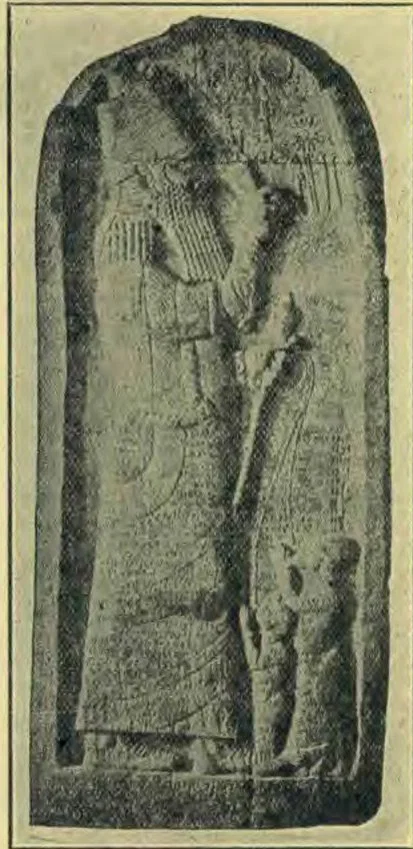
So late as 1916 a research expedition sent out by Harvard University found the burial place of Tirhakah, king of Ethiopia, mentioned in 2 Kings 19:9. So far as the history of Egypt and Ethiopia is concerned this name had been lost to view; but the Bible record is thus confirmed by the recent excavation. He it was who was ruling in Egypt when Esarhaddon, the Assyrian, marched into Egypt with his army about 600 B. C., and made the land of the Pharaohs an Assyrian province. An Assyrian tablet represents Esarhaddon as holding the thongs which are passed through the lips of Tirhakah and of Baal, king of Tyre, as they kneel before him, signifying their submission to his rule. (See cut on preceding page.)
Any good history of Egypt will reveal the wealth of knowledge that has been given to the world by the archeologist, who has found that the Egyptians wrote an extensive history on temple walls, tombs, tablets, and monuments. F. D. C.
The Peculiar Egyptian Writing
The tablet represents the submission of Tirhakah, the smaller figure, Ethiopian king of Egypt (2 Kings 19: 9), and of Baal, king of Tyre, to Esarhaddon, king of Assyria.
Continue reading: The Great Protector