The Youth’s Instructor, Vol. 43, No. 48.

MRS. E. G. WHITE

The Youth’s Instructor

Nov 28, 1895

S. D. A. Publishing Association · Battle Creek, Mich. · Nov 28, 1895

MRS. E. G. WHITE

CHILD LIFE OF JESUS.—NO. 2.
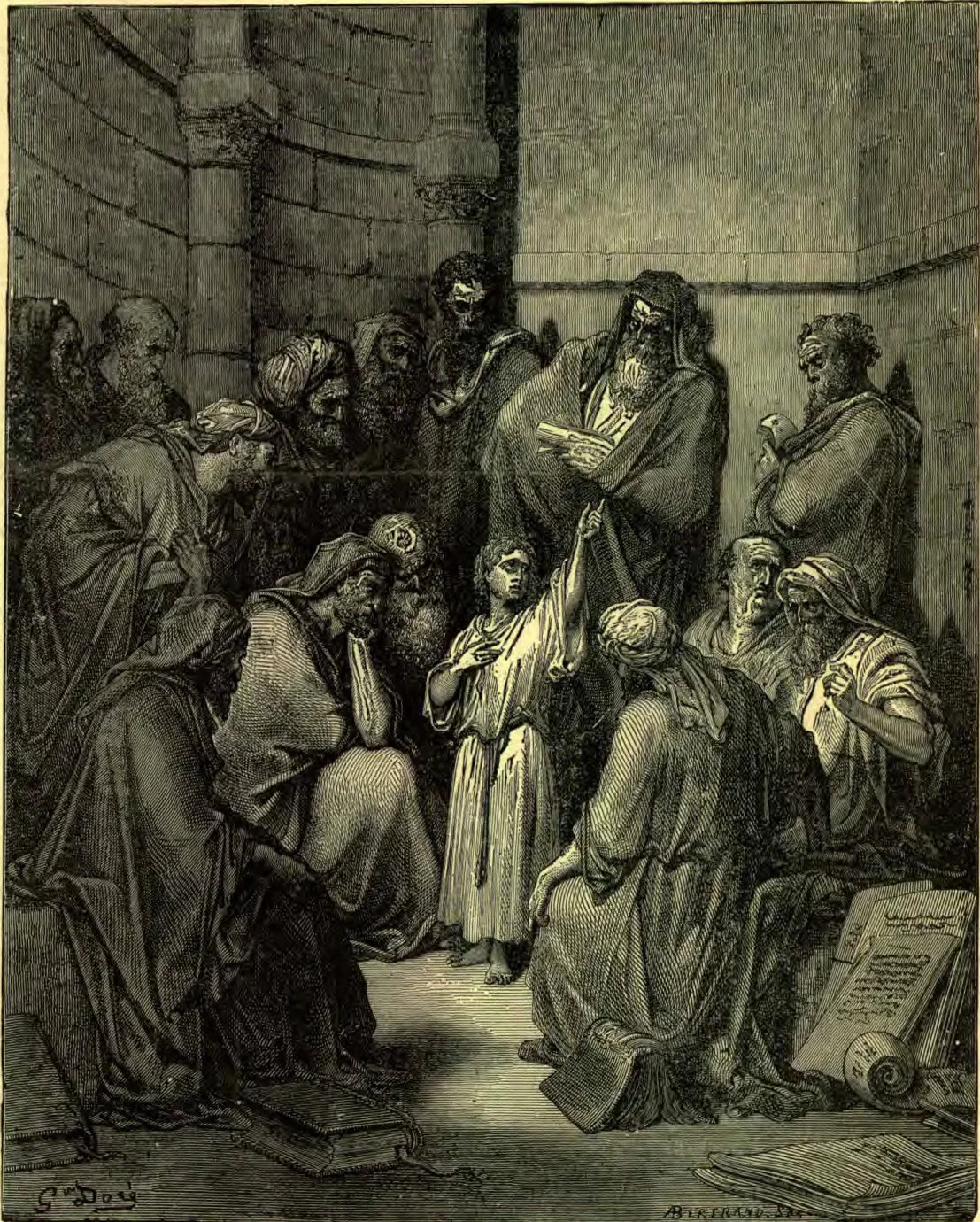
It is written of Jesus in his childhood, “The child grew, and waxed strong in spirit, filled with wisdom; and the grace of God was upon him.” Every year his parents went to the city of Jerusalem to attend the feast of the Passover, and in his twelfth year Jesus went with them to the city. When the feast was over, the parents, forgetting all about Jesus, started on their road home with some of their relations, and did not know that Jesus was not with them. They supposed that he was in the company, and went a whole day’s journey before they found out that he was not there. Frightened as to what had become of him, they turned back to the city, and for three days they sought him with great anxiety. “And it came to pass, that after three days they found him in the temple, sitting in the midst of the doctors, both hearing them and asking them questions.” The doctors were very learned men, and yet they were astonished as they heard Jesus asking wonderful questions, and saw that he had a good understanding of the Scriptures. His parents also listened in amazement, as they heard his searching questions. Jesus knew that God had given him this opportunity to give light to those who were in darkness, and he sought to do all in his power to open the truth to the rabbis and teachers. He led these men to speak about different verses in the Bible telling about the Messiah whom they expected to come. They thought that Christ was to come to the world in great glory at this time, and make the Jewish nation the greatest nation on the earth. But Jesus asked them what the Scriptures meant when they spoke of the humble life, the suffering and sorrow, the rejection and death, of the Son of God. Though Christ seemed like a child that was seeking help from those who knew a great deal more than he did, he was bringing light to their minds in every word he spoke. He repeated the scripture in such a way as gave them clear light in regard to the Lamb of God that taketh away the sins of the world. He made the truth shine out like a light in a darkened place.
AMONG THE DOCTORS.
AMONG THE DOCTORS.
While Christ was teaching others, he himself was receiving light and knowledge about his own work and mission in the world; for it is plainly stated that Christ “grew in knowledge.” What a lesson there is in this for all the youth of our day! They may be like Christ, and by studying the word of God, by receiving the light that the Holy Spirit can give them, they will be able to give light to others. As they teach others of the grace of God, God will give them new grace from heaven. The more they try to teach others about the riches of Christ, the better understanding will they have of the plan of salvation, and the more richly will the grace of God abide in their own hearts. If the youth will remain as humble as did the child Jesus, they will become light-bearers to the world.
The wise men were surprised at the questions that the child Jesus asked. They wanted to encourage him in studying the Bible, and they wanted to see how much he knew about the prophecies. This is why they asked him so many questions. Joseph and Mary were as much surprised at the wise answers of their son as were the wise men themselves. When there was a pause, Mary, the mother of Jesus, came up to her son, and asked, “Son, why hast thou thus dealt with us? Behold, thy father and I have sought thee sorrowing.” Then a divine light shone from Jesus’s face, as he lifted his hand and said, “How is it that ye sought me? Wist ye not that I must be about my Father’s business? And they understood not the saying which he spake unto them.” They did not know what he really meant by these words, but they knew he was a true son, who would be submissive to their commands. Though he was the Son of God, he went down to Nazareth and was subject to his parents. Though his mother did not understand the meaning of his words, she did not forget them, but “kept all these sayings in her heart.”
At the age of twelve, the people saw that the Holy Spirit was resting upon Jesus. He felt something of the burden of the mission for which he had come to our world. His soul was stirred into action. As one who would learn, he asked such questions as would flash light into the minds of those with whom he was talking. He helped them to understand the true meaning of the prophets, and showed them what the mission and work of the Messiah would be. The Jewish people had wrong ideas about the Messiah and his work. They thought that when Christ came in their day, he would do grand and wonderful things, that he would set them above all other people. They were looking for the glory that will be seen when Christ comes the second time, and did not study the Bible so that they could know that he was to come the first time in a very lowly way. But Jesus asked questions about the scriptures that pointed to his first appearing, that flashed light into the minds of those who were willing to receive the truth. Before he had come to the earth, he had given these prophecies to his servants who had written them down, and now as he studied the Bible, the Holy Spirit brought these things to his mind, and showed him the great work that he was to do in the earth. As he grew in knowledge, he imparted knowledge to others. But though he was wiser than the learned men, he did not become proud, or feel that he was above doing the most humble toil. He took his share of the burden, with his father, mother, and brethren, and toiled to help support the family. Though the doctors had been amazed at his wisdom, he obeyed his parents, and worked with his own hands as any toiler would work. It is stated of Jesus that as he grew older he “increased in wisdom and stature, and in favor with God and man.”
The understanding that he obtained from day to day, that showed him how wonderful should be his mission in the world, did not lead him to neglect the humblest duties. He cheerfully took up the work that children and youth who dwell in humble households are called upon to do; for he knew what it was to be pressed by poverty. He understands the temptations of children, for he bore their sorrows and trials. Firm and steadfast was his purpose to do the right; though others tried to lead him to do evil, he yet never did wrong, and would not turn away in the least from the path of truth and right. He always obeyed his parents, and did every duty that lay in his path. But his childhood and youth were anything but smooth and joyous. His spotless life aroused the envy and jealousy of his brethren; for they did not believe on him. They were annoyed because he did not act in all things as they did, and would not become one with them in doing evil. In his home-life he was cheerful but never boisterous. He ever seemed like one who was seeking to learn. He took great delight in nature, and God was his teacher.

MRS. E. G. WHITE

THE DEW OF ISRAEL.

“I WILL be as the dew unto Israel.” Now, scholars tell us that the kind of moisture that is meant in these words is not what we call dew, of which, as a matter of fact, there falls little or none at the season of year referred to in my text, in Palestine, but that the word really means the heavy night-clouds that come upon the wings of the southwest wind, to diffuse moisture and freshness over the parched plains, in the very height and fierceness of summer.
The metaphor of my text becomes more beautiful and striking if we note that, in the previous chapter, where the prophet was in his threatening mood, he predicts that “an east wind shall come, the wind of the Lord shall come up from the wilderness”—the burning sirocco, with death upon its wings—“and his spring shall become dry, and his fountain shall be dried up.” We have, then, to imagine the land gaping and parched, the hot air having, as with invisible tongue of flame, licked streams and pools dry, and having shrunken fountains and springs. Then all at once there comes down upon the baking ground and the faded, drooping flowers that lie languid and prostrate on the ground in the darkness, borne on the wings of the wind, from the depths of the great unfathomed sea, an unseen moisture. You cannot call it rain, so gently does it diffuse itself. It is but like a mist; but it brings life and freshness, and everything is changed. The dew, or the night mist, as it might more properly be rendered, was evidently a good deal in Hosea’s mind; you may remember that he uses the image again in a remarkably different aspect, where he speaks of men’s goodness as being like a morning cloud, and the early dew that passes away.
The natural object which yields the emblem was all inadequate to set forth the divine gift which is compared to it, because, as soon as the sun has risen, with burning heat it scatters the beneficent clouds, and the “sunbeams like swords” threaten to slay the tender green shoots. But this mist from God, that comes down to water the earth, is never dried up. It is not transient. It may be ours, and live in our hearts. The prose of this sweet old promise is, “If I depart, I will send him unto you.” If we are Christian people, we have the perpetual dew of that divine Spirit which falls on our leaves and penetrates to our roots, and communicates life, freshness, and power, and makes growth possible—more than possible, certain—for us. “I”—myself, through my Son, and in my Spirit—“I will be”—an unconditional assurance—“as the dew unto Israel.”—Alexander Maclaren.

“THE CHIEF CORNERSTONE.”

On one of the principal streets running at right angles to Lincoln Park, Chicago, there is a fine building in process of erection. As I pass this daily on my way to and from my school, and note the gradual rise brick by brick, thoughts have come to me which I believe contain both truth and beauty, and which even young readers may appreciate.
Piled high on the ground between the pavement and the sidewalk are three or four different kinds of brick, heaps of sand, lime for mortar, and various other building materials.
Through the open doors and windows may be seen the rough, unfinished inside; but the already finished outside is rich in its architectural beauty. The inside when completed will no doubt equal it in beauty, but at its present stage it brought vividly to my mind these words of Longfellow:—
“In the elder days of art Builders wrought with greatest care Each minute and unseen part; For the gods see everywhere. “Let us do our work as well, Both the unseen and the seen— Make the house where God may dwell Beautiful, entire, and clean.”
To paraphrase the first stanza would be to say the ancients were extremely solicitous to build such temples as they considered their deities would approve; hence their designs were worked out with greatest care and precision in “each minute and unseen part.”
From the words of Holy Writ we learn that our bodies are temples of God,—buildings where no heathen deity, but God, the Creator of the heaven and the earth, may dwell. The relation of the building up of such a temple and the construction of the edifice before referred to is to me the chief point of interest.
The architect has worked up the plan in imagination. The workmen are taking up and placing brick upon brick, each one having a distinct place, and without which the beauty of the whole would be marred. So our words and acts, each single one, fills a place in the character we are building; and the nature of each will determine whether the character shall be beautiful or otherwise. In a measure they reveal the inward thoughts; but appearances are sometimes deceitful, the present stage of this building being a good illustration,—a handsome exterior, but very unpolished and incomplete inside.
The nature of our thoughts and motives reveal the inside which God only knows. “Man looketh on the outward appearance, but the Lord looketh on the heart.” He “sees everywhere.” We can hide nothing from him, and he does not dwell where “each minute and unseen part” is not carefully wrought. He is our Great Architect, and has given us the plans and specifications for our building. These are found in the word of God. He also furnishes the material for working out his designs; and although there are drawbacks in the way of fitting the material together according to “plans,” he has provided also a living pattern, Christ, the chief Cornerstone.
If we take him for the foundation of our building, we may be “fitly framed” and complete in finish, both inwardly and outwardly.
LORETTA REISMAN.

THE BEAUTY OF THE OLIVE.

“His beauty shall be as the olive-tree.”
Anybody who has ever seen a grove of olives knows that their beauty is not such as strikes the eye. If it were not for the blue sky overhead, that rays down glorifying light, they would not be much to look at or talk about. The tree has a gnarled, grotesque trunk, which divides into insignificant branches, bearing leaves mean in shape, harsh in texture, with a silvery underside. It gives but a quivering shade, and has no massiveness nor sympathy. Ay! But there are olives on the branches. And so the beauty of the humble tree is in what it grows for man’s good. After all, it is the outcome in fruitfulness which is the main thing about us. God’s meaning, in all his gifts of dew, and beauty, and purity, and strength, is that we should be of some use in the world. The olive is crushed into oil, and the oil is used for smoothing and suppling joints and flesh, for nourishing and sustaining the body, as food, for illuminating darkness, as oil in the lamp. And these three things are the three things for which we Christian people have received all our dew, and all our beauty, and all our strength—that we may give other people light, that we may be the means of conveying to other people nourishment, that we may move gently in the world as lubricating, sweetening, soothing influences, and not irritating and provoking and leading to strife and alienation. The question, after all, is, Does anybody gather fruit off us, and would anybody call us “trees of righteousness, The planting of the Lord, that he may be glorified”?—Exchange.

TROUBLOUS TIMES.

A REVIEW of the condition of things in many parts of the world reveals the fact that there is an unsettled condition in many countries which is so acute as utterly to forbid the hope of a better day until the storm-clouds shall have burst, and the political atmosphere shall be cleared.
The Turkish empire still stands, but upon what supports, can hardly be told. It looks now as though it will not be allowed to reform if it wants to do so. The Armenians know they have reached the time of their opportunity, and that if they rise in insurrection, and the Turkish government puts them down, the event will be heralded to Christendom as Christians being made targets for Mohammedan bullets! On the other hand, if they are allowed to proceed, the Turkish empire must be broken up. This condition of Turkey calls for increased expenditures, and as the empire is practically bankrupt, there is another increased strain upon the already sinking empire. A loan of a million and a half pounds has been secured, but what is such an insignificant sum of money to sustain an army in a thousand places, which are menaced at the same time by insurrection? Pressed on every side, the Turks, naturally warlike and by religion fanatics, are getting more ugly every day. At the time of the Crimean war the world was astonished at the sight of Turkey declaring war upon Russia, and actually winning many victories; and if worst comes to worst, it is possible that the sultan in sheer desperation may unfurl the green standard of Mohammed, which has not been displayed for centuries, summon all believers in Islam to a jehad, or holy war, and if he goes down, do it fighting to the last! There is an awful power in the valorous fanaticism of a warlike people like the Turks, as Europe has experienced in the past many times, and may do again before the Turk crosses the Bosporus to “plant the tabernacles of his palace between the seas in the glorious holy mountain.”
THE great powers on the continent of Europe continue to watch each other. They occupy toward each other a very similar relation to that of Red Murdoch to Fitz-James, when—
“Jealous and sullen, on they fared, Each silent, each upon his guard.”
The emperor of Germany has lately sworn in some more new recruits. A Mennonite refused to fight, and was promptly thrust into a dungeon. The emperor has no use for a man with such a conscience; but he allowed an army chaplain to tell the troops that they must watch upon the Weser as well as upon the Rhine! This was aimed at Russia as well as France, and the Russian ambassador at Berlin immediately telegraphed the speech to his royal master, the czar. These little straws show how the wind blows, and they will be remembered when the great war occurs, which seemingly cannot long be delayed.
IN the far East there is yet no settled state of affairs. The Japanese are pushing the conquest of Formosa, and have, apparently, nearly succeeded, and at the same time they are preparing for a struggle with Russia. Japan has not yet evacuated Port Arthur, and she refuses to leave Corea. Undoubtedly she is confident of the support of Great Britain, whose premier, Lord Salisbury, at a late banquet, referring to affairs in the East, said that England was prepared to hold her own either in war or in commerce. China is in a deplorable condition. She is obliged to pay a large sum to Japan, and she has a rebellion of her Mohammedan population in the northeastern part of the empire, which the government seems unable to put down. If it goes much farther, Russia will probably be called upon to put it down. Then the people of China will be told that the Son of Heaven (the Chinese emperor) ordered his vassal, the czar, to chastise the rebels, and meanwhile Russia will get another hold on the empire. China lies between England and Russia; and between these two mighty powers she will need to struggle hard to maintain an independent existence.
ON the American continent there are two vexed questions which may lead to stirring events,—the Cuban and the Venezuelan questions. Public sentiment here is evidently rising to that pitch that Congress will be compelled to take a strong position in regard to both of these questions, though one may embroil us in difficulty with Spain and the other with England. But our country is not in a condition to go to war without getting greatly into debt. The deficit in the treasury grows larger, the volume of business not being sufficient, with the present tariff rates, to yield enough revenue to support the government with the demands now being made upon it. Worst of all, we shall soon be in the whirl of another presidential election. Whether right or wrong, everything is liable to be unsettled once in four years. Business prosperity, under such conditions, is well nigh impossible.

EXAGGERATED NATIONAL VANITY.

ABOUT every nation has a full supply of national vanity. The people of every country think their country the best and their people the bravest. The people of this country are no exception. Years ago Dickens caricatured the American Congressman who held that his country was able to make war on the universal “yearth”! It would seem from the current news that we have Congressmen now who entertain a similar opinion. A Chicago newspaper has sent letters to all the men who will compose the next United States Congress, asking them their idea of the “Monroe doctrine,” and if it should be enforced by war. Nearly every one of these men replies that he believes in upholding the principles of the Monroe doctrine,—that European powers shall make no more accessions to their territory on the American continent, and that this government should go to war, if necessary, to sustain it.
But one representative elect, from California, goes farther. He wants war with England, and says that “thirty days after war is declared, there would be no British possessions remaining in North America!” That the people of California have elected a man with so little judgment that he will make such a statement, is, to say the least, very remarkable. It is exactly on a level with the threats of certain excitable Spaniards in Cuba, that after they have defeated the insurgents, they will take Florida, land an army in New York, etc. There can be only one reason that would lead the Californian representative to make such a rash statement. He evidently believes that all, or a majority, of the Canadians are longing for annexation to the States. If he should visit Canada, he would find his illusion would be very speedily and rudely dispelled. Very few of the people of Canada care to become part of the United States. They now have a representative government, and they are a happy, prosperous, and loyal people. Canada is not now in feeling what it was twenty-five years ago. Before the civil war in the States, Canada was almost an annex to this country. Now there is an entirely different feeling. Sir John Mc Donald, one of the greatest statesmen of the present age, welded the provinces together, and created a strong national sentiment. Canada is now a nation with a national character and a national spirit. True, she has a small population compared to the States, but she would make no mean antagonist. We are acquainted with people in Canada, whose ancestors fought on the patriot side at Bunker Hill. These descendants of American patriots would now as quickly resist the attempts of the United States to invade their country as did their revolutionary sires resist the invasion of Great Britain in 1776. The idea that the United States could conquer Canada in thirty days is the sheerest nonsense. That length of time would not suffice to put a respectable army upon the border. Five million people, mostly of Scotch and English parentage, would not be easily subdued. Canada is better prepared for war at the present time than the States. She has a good militia, strong fortifications, some of which are veritable Gibraltars, a stalwart people, and a good currency. Besides all this, she has the backing of England. We do not say that the United States could not take Canada in time; but we do say that a long and bloody war would result if such an attempt should be made. Happily for both countries, such harebrained enthusiasts as the Californian representative are scarce. We want no war with England, nor does England with us; and it would be a deplorable thing should such men stand at the head of the affairs of our nation.

ENGLAND TO THE RESCUE.

THE latest news from Europe in regard to Turkey is of intense interest. The disorder in all parts of the Ottoman empire continues unabated, and armed conflicts between the Armenians and the Turks, generally resulting in the success of the latter, are of frequent occurrence. Some of these have been of such magnitude that they have received the name of massacres. In some places the better class of Turks have befriended the Armenians, and sheltered them in their mosques. The tension has been growing so acute that the powers were upon the point of interfering, and a grand naval demonstration was being arranged to bring Turkey to terms, in which England, France, and Italy were to be the principal actors,—when, presto! change! England refuses to go ahead, and declares that Turkey must not now be coerced, and that the integrity of the Ottoman empire must be maintained. This is done upon the representations of Sir Philip Currie, English ambassador to Turkey, who has lately visited England to confer with the government. He represents that the Turkish government is doing as well as it can, and that the blame for the conflict rests with the Armenians as well as with the Turks. The fact is, the Armenians have lately lost sympathy by their numerous seditions. An Armenian suffering unjustly is an object of pity; an Armenian fighting and butchering like a Turk, is not well calculated to excite sympathy. Anyway, England is to stand by while the “sick man” is given another chance to reform and do better. M. E. K.

A CHEAP TELEPHONE.

Many of the present-day inventions are becoming very common. Yet patents and corporations make many of these useful things so expensive that but few can enjoy them as they would desire.
Telephones have become very useful instruments, and since the prices have been somewhat reduced, they are found in nearly every business house of our cities and towns, and in many private residences. This instrument has been so improved that it can be used for long distances. You can now step into a telephone office and talk with individuals hundreds of miles away, and be understood as well as though you were sitting in the same room and conversing. This is indeed wonderful.
Boys and girls sometimes take an interest in studying these wonders, and in trying to imitate these wonderful inventions. I lately read how a cheap telephone could be made that would connect houses two hundred yards apart so that a conversation could be carried on very successfully. As some of our readers may be interested in making one, we will give the directions as we have have read them:—
“To make a good and serviceable telephone from one house to another requires only enough wire and two cigar boxes. First, select your boxes and make a hole about half an inch in diameter in the center of the bottom of each, and then place one in each of the houses you wish to connect; get then five pounds of common stove-pipe wire, make a loop in one end and put it through the hole in your cigar box, and fasten it with a nail; then draw it tight to the other box, supporting it, when necessary, with a stout cord. You can easily run your line into the house by boring a hole through the glass. Support your boxes with slats nailed across the window, and your telephone is complete.”
If any of our readers try this experiment, and succeed in holding a conversation with some friend many rods distant, we hope they will also remember that they may have a connection with heaven, much more complete than any human invention. By this connection God hears every word we say. Jesus said, “I say unto you, That every idle word that men shall speak, they shall give account thereof in the day of judgment.” Then let us endeavor so to speak that we may not be ashamed to meet our words in that day.
J. H. D.

THE PURE IN HEART.

“BLESSED are the pure in heart: for they shall see God.” God is pure; there is in him no impurity, no unrighteousness. The object of God in the gospel is to bring us to be like himself, so that we may be with him where he is. God cannot look with complaisance upon sin; for we read, “Thou art of purer eyes than to behold evil, and canst not look on iniquity.” Hab. 1:13. So it is a pleasure to God when evil is banished from the heart. Purity can come only by the destruction of sin. St. Paul speaks of the body of sin being destroyed, that we henceforth should not serve sin. But sin will never be destroyed in us; in other words, we shall never cease to sin, until we shall come to look at it as God does. Then we shall mourn because of our sins; then shall we take the steps that lead from sin to holiness, from defilement to purity.
Purity of heart means the forgiveness of sin; but it means more than this. A long course of sin has left its impression upon the heart and mind. We have seen roads in which deep ruts had been worn by thousands of successive wagons passing over it. So our minds are affected by successive acts of sin through our past lives. We recognize the sin, repent before God, and are forgiven; but the effects of sin are still there in the mind and in the body.
But the Lord does not leave us there, though it is to be feared that many stop there in their religious experience. The Lord wants to see those old grooves, made by sin in our minds, eradicated, and other impressions made there. To do this he furnishes divine aid. His Holy Spirit makes upon our heart impressions for good, and as far as we receive the new impressions, the old ones are removed. So it is left for us to say whether this work of removing the effects of sin shall occupy a long or a short time. The first step is to cease to do evil. The marks of sin will then grow no deeper, and the new impressions received will take their place. The mind should be stored with the word of God. When the word of God is studied so that it becomes a part of our very life and being, the heart becomes changed by it. We shall love those things the Word sets forth as lovely, and hate that which the same Word regards as hateful.
The expression, “pure in heart,” means far more than a fair exterior and perfectly correct outward conduct; it means that there will be no contradiction between the heart and the life. The good actions are not strained. The fruit is borne, not fastened on artificially. Sin is abhorred; its presence is distasteful in the extreme. The heart has become like the heart of God, hating evil, loving and commending good.
It is easy to see how that, of persons with such hearts, it can be said, “They shall see God.” Let us not place the application of these words of comfort entirely in point of time to the future state. The pure in heart see God now. They see his character, his plans and purposes. They recognize his hand in everything. Their joys and their sorrows, their experiences of all kinds, are of God. They walk as in his presence; they are continually comforted by the knowledge that he is near them.
They will also see him when he comes in glory; and as he has been a joy to them as seen by faith, he will be an exceeding great joy when seen with immortal eyes. “And it shall be said in that day, Lo, this is our God; we have waited for him, and he will save us: this is the Lord; we have waited for him, we will be glad and rejoice in his salvation.” Of God’s people it is written that “they shall see his face; and his name shall be in their foreheads.” Heaven, where God and angels have their home, and where Jesus lived before he came to earth, will be a glorious sight to the children of God, accustomed as they have been to the sad scenes of this earth. The earth redeemed from sin and the curse will present such an aspect of beauty that, as in the beginning, the sons of God will shout for joy; and the city of God, of which glorious things have been spoken, will present such a scene of splendor as its gates open for the redeemed throng, that we cannot now even imagine what it will be. But all these scenes will not equal the sight of the face of our dear Redeemer. “They shall see his face!” Blessed promise! Seeing that face will be more to the redeemed than the sight of the gates of pearl or streets of gold. The patriarch Job, looking forward to the time when he should see the Lord, said, “Whom I shall see for myself, and mine eyes shall behold, and not another.” We must seek him for ourselves here, and we shall see him for ourselves there. “Blessed are the pure in heart: for they shall see God.”

A BIBLE STUDY.

THE NATURAL MAN.

I Cor. 2:14.—“Receiveth not the things of the Spirit of God.” The fruit of the Spirit is “love, joy, peace, long-suffering,” etc. Gal. 5:22. The natural man does not enjoy these graces. He is fully set to do evil. Eccl. 8:11. He constantly seeks selfish interests. If some one wrongs him, he studies how he may be revenged.
Rom. 8:5.—The works of the flesh. These can be seen by reading Gal. 5:19-21. A few of them are, “Hatred, variance, emulations, wrath, strife.” Do you have any of these in your nature? If so, you have the natural heart, and cannot please God. Rom. 8:7. The carnal mind cannot be subject to the law of God. Not to be subject to the law is to transgress it, which is sin. John 3:4. The natural man must be in the service of the devil. The affections are set upon this world. James 4:4. This is true of every one who is minding the things of the flesh. Then the works of the flesh can be summed up as, (1) Carnal; (2) Transgression of God’s law; (3) Are of the devil. Such individuals have little interest in the things of God. They find no pleasure in the study of the word. If they read the Bible, they do not understand it. They wonder why others become interested in the study of it.
I. Cor. 2:14.—They are not spiritually minded. “The natural man receiveth not the things of the Spirit of God: for they are foolishness unto him: neither can he know them.” His eyes are closed, and Satan continually hardens his heart. Soon, like a noted infidel, he will be led to say, “This life is but a narrow vale between the cold and barren peaks of two eternities.” If called to meet death, he must say as did the skeptic Hobbs, “Death is like taking a leap from the top of a cliff in the dark.”
Rom. 6:23.—The wages of sin. “The wages of sin is death.” As long as we walk according to the flesh, we are on the road to death. We know not how soon we may reach the end of that road. Now is the time to turn back. (Read Eze. 18:30, 32; 1 Thess. 1:9; Acts 26:18, 20.)

GODLIKENESS

We once read of a man who had been deeply offended by another, and speaking to a friend of the great affront he had received, he said: “Do you not think it would be manly to resent such an insult?” The friend replied, “Yes, I think it would be manly to resent it; but it would be godlike to forgive it.” If any one has done us an injury, which we are tempted to resent, let us remember that a resentful and unforgiving spirit is human. It is of the earth, earthy; but it is like God to forgive. Which is better, to be like man, or to be like God? M. E. K.

LESSON 11.—THE RIGHT OF DISSENT.

(December 14, 1895.)
1. What must be the relation of the church to the state before there can be religious persecution? (See note .)
2. To whom are all accountable in religious things? Rom. 14:4, 12; 1 Cor. 7:23.
3. Therefore, when men attempt to control us in religious matters, what have we a right to do?—To dissent.

LIBERTY VS. TOLERATION.

4. What is the meaning of the word “toleration”? (See note .)
5. What may the government do which grants toleration?—It may prohibit and compel. (See note .)
6. What kind of rights do we exercise in worshiping God?—Natural rights.
7. From whom do such rights come?—From God.
8. Can the state, then, properly interfere in the exercise of such rights?
9. What is the province of the state?—To protect men in their rights. (See note .)
10. How are governments controlled?—By majorities.
11. Are the majority right on religious questions? Matt. 7:12, 13. (See note .)

A WRESTING OF SCRIPTURE.

12. What did the Lord call Nebuchadnezzar, king of Babylon? Jer. 27:6.
13. When commanded to bow and worship a great image which Nebuchadnezzar had erected, what did three of his subjects say? Dan. 3:16–18.
14. Who were these? Dan. 3:12.
15. Was their course in harmony with the commandment of God? Ex. 20:4–6.
16. How did God interpose, thus showing his approval of their course? Dan. 3:28.
17. What did Daniel do when forbidden by a Medo-Persian decree to worship the God of heaven? Dan. 6:10.
18. What argument did his persecutors bring to bear on the king to secure his condemnation?—That it was the law, and must be enforced. Verses 13–15. (See note .)
19. How did God show his approval of Daniel’s refusing to obey the law? Verse 22.
20. What prohibitory command did the Jewish Sanhedrim place upon the apostles? Acts 4:17, 18.
21. In direct conflict with this, what did the angel of the Lord command them to do? Acts 5:19, 20.
22. What are we to conclude, therefore, respecting the authority of earthly governments?—That they have no right whatever to intermeddle in religious things.
23. What scripture is sometimes cited to show that we are under obligation to obey whatever laws men may make? Rom. 13:1.
24. What would such an application of the scripture imply? (See note .)
25. What must we, therefore, conclude?—That there is a limit to the rightful authority of the “powers that be”; that they have not the right to require men to do wrong.
26. In any case, therefore, of a conflict between the laws of men and the word of God, whom should we obey? Acts 4:19, 20; 5:29. (See note .)

NOTES.

Sabbath-School Hints.

Frequent reviews are great helps in fastening the thought of the lesson in the mind.
Do not wait until you go to the class to review the past lessons. Take some time to meditate, and urge the mind to follow the train of thought back through the past lessons.
Another good way to conduct home reviews is to have a general conversation on the subject at breakfast or dinner time. If the conversation is entered into heartily, it will serve two purposes; it will aid in the digestion of the food and of the lesson subject-matter.
When you have a conversational review, be sure to bring up all important thoughts in the subject, and so direct the conversation that there will be a close connection of one part of the subject with another. Sometimes it is good to follow the questions, but generally it is better to carry the line of thought without depending upon any formal line of asking questions.

The Use of Helps.—

There is no danger in using helps in the study of the lesson if they are not used in the place of the Scriptures. There are some general helps that every Bible student should have at his side when studying the Bible: (1) A good English dictionary; (2) A good Bible dictionary; (3) Cruden’s Concordance.
Look up every word used in the lesson, of which you do not already know the exact meaning. When a text is used in a connection that seems to be questionable, do not pass it until you have looked up all parallel texts that show its proper use.

Individuality of Mind.—

While we are to show proper respect for the lesson writer, and refrain from public criticism of the same, we must not give ourselves up for other people to do our thinking for us. All humanity is weak and liable to err. For this and other reasons we may safely conclude that no Sabbath-school lesson is inspired. The Scriptures, only, are inspired. We must each earnestly seek the Lord for divine guidance, that we may understand his thoughts as revealed in his word.
J. H. D.
Continue reading: Plato on the Qualities of Worthy Employment