The Youth’s Instructor, Vol. 43, No. 48.

MRS. E. G. WHITE
Earlier text: MRS. E. G. WHITE

Plato on the Qualities of Worthy Employment

An employment, the satisfactory pursuit of which requires of a man that he shall be endowed with a retentive memory, quick at learning, lofty-minded and graceful, is the friend and brother of truth, justice, fortitude, and temperance.—Plato.

Truth and Falsehood in Open Encounter

THOUGH all the winds of doctrine were let loose to play upon the earth, so Truth be in the field, we do ingloriously, by licensing and prohibiting, to misdoubt her strength. Let her and Falsehood grapple: who ever knew Truth put to the worse in a free and open encounter?—John Milton.

NEVER ALL DARK.

“It is dark,” said baby Nell; “The sun has gone away.” “But God will send the stars to us,” Said little sister May. “He never lets it be all dark ’Cept for a little while; And then I guess he hides his face So we can’t see him smile!”
Dear child, what comfort comes to me Through these few simple words! Sweeter they are than melody Of early singing birds. ‘Never all dark,’ I softly say, “But for a little while; And then, somewhere behind the cloud, There gleams a hidden smile.” — The Dayspring.

OPEN AND SHUT EYES.

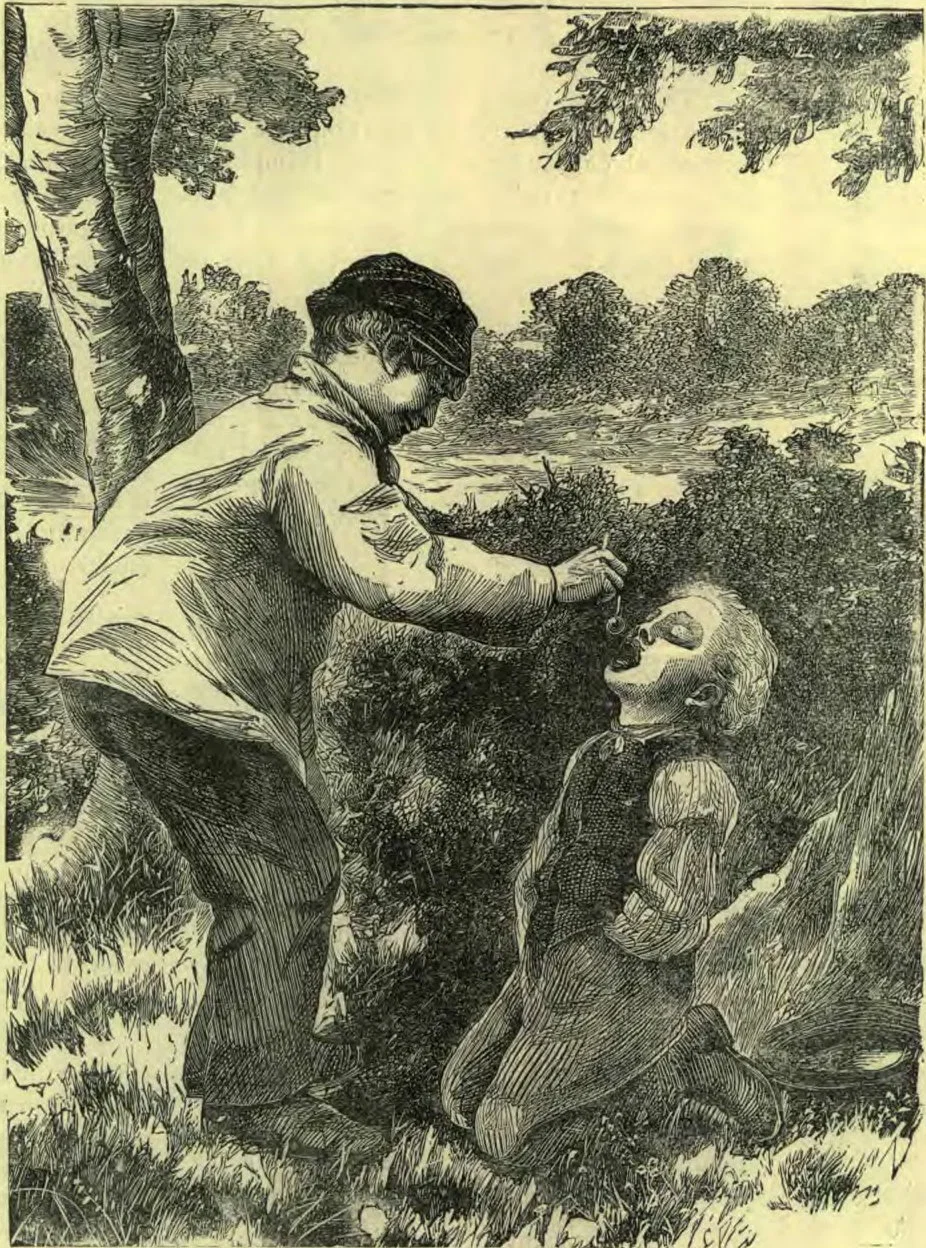
“Open your mouth and shut your eyes, And I'll give you something to make you wise.”
What child or grown person is there who has not repeated the above lines, or had them repeated to him? Sometimes something real nice to eat is dropped into the mouth, but again mischief prompts that some very disagreeable substance, perhaps a gritty pebble, is dropped into the opened mouth. It is well to know who it is that makes the proposition; for a kindly-disposed person will rather give an agreeable than a disagreeable surprise. When the old bird lights on the edge of the nest, the little birdlings are not afraid to open their mouths, for they are sure that their mother will give them what is proper food for little birds to eat. It is always the safest for people to see and know what they put into their mouths.
There is one general truth which we can draw from this idea. We should go through the world with our eyes open. We should never, as it is sometimes said, “go it blind.” There are many people who do business in a way that reminds one of the child opening his mouth and taking whatever is offered. They buy what they do not really need because they think it is cheap; they go to the store to buy five dollars’ worth of goods, and come home ten dollars in debt for goods they would never have thought of taking had they not been urged to do so by the open-eyed merchant. Sometimes, like the child in the rhyme, they are wiser afterward by seeing how foolish they have been; but many go on all through life in this way. They are too lazy or indifferent to do their own thinking, calculating, and planning. They both buy and sell at prices fixed by some one else. So there are thousands of open-eyed and shut-eyed people, and the open-eyes generally get along much the best.
“Open your mouth and shut your eyes.”
It is a good plan for children to cultivate the habit of observing things, to see how much they can remember. When you pass a store and look into the windows, try to remember the different objects you saw there. In this way the memory may be strengthened. It is remarkable how a little practise of this kind will strengthen the memory, so that many objects may be seen and retained at a single glance. A good farmer boy always counts the sheep when he passes the flock, unless the flock is so large he cannot do so. He keeps his eye open for rails off the fence, or gaps where the stock may get through. By such close attention he may save much trouble and much property from being destroyed. Washington said: “Eternal vigilance is the price of safety.” This was said in reference to war; but it is equally true that constant watchfulness is necessary to success of any kind.
If our readers are Christians, as we trust they are, they will need to be very watchful, or they will be taken by surprise, and say and do naughty things. Satan will blind their eyes and make them think that what he suggests that they should do will be harmless. He is ever ready to suggest evil thoughts, which almost surely lead to evil actions. If we should be careful what we take into our mouths, we should surely be careful what we receive into our minds. There is good, healthful food for mind and body; and there is as great danger of poisoning the mind as the body. When you see children ready to swear, fight, and do all sorts of naughty things, you may be sure that their minds have been poisoned. Such children make dangerous associates, for they are liable to poison others. Children will do well to heed the Saviour’s words, “Watch and pray, lest ye enter into temptation.” Keep the eye fixed upon Jesus, the heart open to receive the suggestions of his spirit and closed to the enemy, and your lives will be as sweet and pure as budding blossoms constantly enlarging to a more radiant beauty. M. E. K.

THE STORY THE BUTTONS TOLD.

Mrs. Burton was just finishing a dress for her little daughter. “Now I must have four buttons for the yoke,” she said. So, taking down her button-bag, she emptied the contents into her lap. “Here, these are what I want;” and she laid four little buttons on the table at her side. Then she gathered the rest from her lap, and put them away. She had not noticed that one had quietly rolled off the table to the floor, neither did she hear a little voice call: “Billee, Billee, where are you?”
“Down on the floor, behind the curtain.”
“Why?”
“’Cause I don’t want to be sewed on a little girl’s dress.”
“No; neither do I. How Sally used to jerk us open and say: ‘Hateful buttons’!”
“Hush! Don’t talk so loud. I’ll come.”
Mrs. Burton thought her foot must have touched the table, for another little button rolled down on the floor.
“Bobbie, O Bobbie, where are you?”
“Down here with Billee.”
“I want to come down. Don’t you remember how Sally’s hair used to catch on us, and she nearly pulled us to pieces, wishing there never were any buttons?”
“Yes; and how she used to bang the doors!”
“Yes, indeed.”
“Suppose we all hide, so we can’t be sewed on. It was much more fun in the bag, if it was dark.”
Just then the door opened.
“Why, Jessie, are you home from school?”
“Yes, mama dear; didn’t you know it was time? I had good lessons, too,” she added brightly, as she gave her mother a kiss.
She took off her hat and put it away, and, unbuttoning her coat, said: “Aren’t these nice big buttons, mama? I always like to button and unbutton them. And how pretty my dress is! Are these the buttons you are going to put on? They were on Cousin Sally’s dress, weren’t they? There are only two here on the table. Will it need only two? Goody! There’s the lunch bell. Come on, mama dear,” and Mrs. Burton and Jessie went out together.
“Billee, O Billee, did you hear that?”
“Yes; I don’t believe she’d act that way!”
“I don’t, either. Did you notice how gently she talked?—not one cross word! Billee!”
“What?”
“I’d like to be on her dress.”
“So would I. Let’s get up again.”
And when Mrs. Burton came back, she found all the little buttons in a row on the table.— Central Presbyterian.

THE NORTH AMERICAN PIGEON.

(Conclusion.)
In May, 1880, I visited the last known nesting place east of the Great Lakes. It was on Platt River, in Benzie county, Michigan. There were on these grounds many large white birch trees filled with nests. These trees have manifold bark, which when old hangs in shreds like rags or flowing moss, along their trunks and limbs. This bark will burn like paper soaked in oil. Here for the first time I saw with shame and pity a new mode for robbing these birds’ nests, which I look upon as being devilish. These outlaws to all moral sense would touch a lighted match to the bark of the trees at the base, when with a flash more like an explosion, the blast would reach every limb of the tree; and while the affrighted young birds would leap simultaneously to the ground, the parent birds, with plumage scorched, would rise high in air amid flame and smoke. I noticed that many of these squabs were so fat and clumsy they would burst open on striking the ground. Several thousands were obtained during the day by that cruel process.
That night I stayed with an old man on the highlands just north of the nesting. In the course of the evening I explained to him the cruelty that was being shown to the young birds in the nesting. He listened to me in utter astonishment, and said, “My God, is that possible!” Remaining silent a few moments with bowed head, he looked up and said, “See here, old Indian, you go out with me in the morning, and I will show you a way to catch pigeons that will please any red man, and the birds, too.”
Early the next morning I followed him a few rods from his hut, where he showed me an open pole pen, about two feet high, which he called his bait bed. Into this he scattered a bucket of wheat. We then sat in ambush, so as to see through between the poles into the pen. Soon the birds began to pour into the pen, and gorge themselves. While I was watching and admiring them, all at once to my surprise they began fluttering and falling on their sides and backs, and kicking and quivering like a lot of cats with paper tied over their feet. He jumped into the pen, saying, “Come on, you redskin.”
I was right on hand by his side. A few birds flew out of the pen, apparently crippled, but we caught and caged about one hundred fine birds. After my excitement was over, I sat down on one of the cages, and thought in my heart, “Certainly Pokagon is dreaming, or this long-haired white man is a witch.” I finally said, “Look here, old fellow, tell me how you did that.” He gazed at me, holding his long white beard in one hand, and said with one eye half shut and a sly wink with the other, “That wheat was soaked in whisky.” His answer fell like lead upon my heart. We had talked temperance together the night before, and the old man wept as I told him how my people had fallen before the intoxicating cup of the white man, like leaves before the blast of autumn. In silence I left the place, saying in my heart, “Surely the time is now fulfilled, when false prophets shall show signs and wonders to seduce, if it were possible, even the elect.”
I have read recently in some of our game sporting journals, “A war-whoop has been sounded against some of our western Indians for killing game in the mountain region.” Now if these red men are guilty of a moral wrong which subjects them to punishment, I would most prayerfully ask in the name of Him who suffers not a sparrow to fall unnoticed, what must be the nature of the crime and degree of punishment awaiting our white neighbors, who have so wantonly butchered and driven from our forests these wild pigeons, the most beautiful flowers of the animal creation of North America.
In closing this article I wish to say a few words relative to the knowledge of things about them that these birds seem to possess.
In the spring of 1866 there were scattered throughout northern Indiana and southern Michigan vast numbers of these birds. On April 10 in the morning they commenced moving in small flocks in diverging lines toward the northwest part of Van Buren county, Michigan. For two days they continued to pour into that vicinity from all directions, commencing at once to build their nests. I talked with an old trapper who lived on the brooding grounds, and he assured me that the first pigeons he had seen that season were on the day they commenced nesting, and that he had lived there fifteen years, and never known them to nest there before.
From the above instance and hundreds of others I might mention, it is well established in my mind beyond a reasonable doubt, that these, as well as many other animals, have communicated to them by some means unknown to us, a knowledge of distant places, and of one another when separated, and that they act on such knowledge with just as much certainty as if it were conveyed to them by ear or eye. Hence we conclude it is possible that the Great Spirit in his wisdom has provided them a means to receive electric communications from distant places and with one another.—Chautauquan.

BULGARIA

From Rustchuk I came by rail across Bulgaria to Varna, the chief port of Bulgaria on the Black Sea. The whole country is agreeably rolling, and has a fertile soil. All the way there was a continuous stretch of large fields of corn and wheat, interspersed with vineyards and forests. The grapes are of several varieties and of excellent quality.
Bulgaria’s greatest length from east to west is two hundred and seventy-five miles; its average width, one hundred miles; and its population about five million. Besides these, there are several millions of Bulgarians in Macedonia, who were the cause of the recent uprising there. The Bulgarians are Asiatics,—they have swarthy complexions, and dark hair and eyes,—and are the descendants of the Huns. Soon after the defeat of the Huns and the death of their great leader Attila, they retreated to the Volga on the frontier of Asia. Later, under the name of Bulgarians, they re-entered Europe, and crossed the Danube, where they still remain.
Their ancestors, the Huns, were for several centuries a powerful race, occupying the country now called Mongolia. It is claimed that the great Chinese wall was built to protect China from the Huns; but at the close of the third century B. C., they subdued China, and kept it under tribute for more than a hundred years. Their power then declined, but after four centuries arose again, and then the Huns occupied the large country now held by Russia. It was at this time, the first half of the fifth century, that the Huns, under Attila, broke in on the declining Roman empire.
At Varna I took the steamer for Constantinople. The harbor is in a small bay, quite exposed to the sea. The steamers lie out at anchor, and are reached by rowboats. The cargo of our steamer consisted chiefly of live sheep. These were brought out in rowboats holding about forty. At the steamer, a rope was passed about the horns or fore-feet of five or six sheep; and these, like a string of fish, were hoisted by a crane up over the steamer, and let down into the hold.
It was interesting to observe how patiently the sheep took this strange treatment. While being hoisted thirty or forty feet into the air, no resistance was made; not a muscle was moved; they meekly submitted. How different are sheep from other animals in this respect. Should half a dozen cats be strung up together by the tails, there would be a terrible fight, each thinking the others to blame for his misery; but their own efforts to free themselves would be more injurious to them than the original misfortune. So it is in life. The true Christian, who meekly and patiently submits to misfortunes, leaving the Lord who is over all to care for him, will suffer much less than the one that makes frenzied efforts to free himself from trials. There is real philosophy and practical benefit in being meek and patient.
A moonlight ride by steamboat on the Black Sea brought us from Varna to the Bosporus, a distance of one hundred and forty miles. The majority of the passengers were early on deck to scan the dim outlines of the shores as they rose above the horizon. First came to view the white tower of the lighthouse on the Asiatic shore; then arose the moderate but barren hills on both the European and the Asiatic shore. Soon the entrance to the Bosporus was visible; numerous vessels of all sorts were issuing from it like bees from a hive. And just as numerous were the memories thronging our minds,—memories of the many scenes that have since earliest times been here enacted! Some details about the Bosporus will be reserved for another time.
H. P. HOLSER.

THE LARGEST BLACK DIAMOND.

THIS diamond weighs thirty-one hundred carats, and is, therefore, the largest ever known. The stone was found in the Carbon district, the old diamond fields of Brazil. It is of the class known as “black diamonds,” or commercially as carbon, which are used in diamond drills and for similar purposes, their color not adapting them to ornament.
At the present time the stone is in the hands of the jewelry firm of Kahn and Company, of Paris, and the Brazilian government is negotiating for its purchase for the National Museum. The stone was offered to Messrs. Bishop and Company, but they declined to purchase it, as it is difficult to say how such an exceptionally large stone will turn out when cut into commercial sizes, and the price demanded was too great. The value is placed by experts at between thirty thousand and forty thousand dollars. The price paid for it by the present owners is somewhat uncertain, one account putting it at twenty-six thousand dollars, while another says that they paid nearly forty thousand dollars, or not far from its probable maximum value.—Scientific American.

HE BLAMED THE WATER.

A FARMER drove up to our mill door with a grist. He had a fine team of horses, but was a sickly, meager-looking creature. As he handed out his sacks of wheat, he came to a water bucket half filled with apples.
“Here, boys,” said he, as he passed the pail to the miller, “would you like some apples? I never eat them myself.”
I asked him why, and he replied that they always made him sick. So the half-dozen men about the mill devoured the ripe, golden fruit with a relish; for they had been taught that nothing was more wholesome than a good, ripe apple. I asked the man, who so kindly gave us what he could not use himself, why he thought he could not eat of the fruit. His answer was that it distressed him; but upon further inquiry I found that everything he ate distressed him to a greater or less degree. When asked what he lived upon, he said:—
“Principally salt meat, sausage, eggs, and white bread. But,” said he, “the water is bad where I live, and I guess my only recourse for better health is to sell out and move away.”
Noticing his sleek-looking horses, I remarked: “Do your horses drink the same water?”
“Oh yes,” said he. “They have no other.”
“I see that you use tobacco pretty freely,” I remarked.
“Oh yes; I couldn't live without that.”
“But,” said I, “your horses seem to thrive on the water. Do you think if they had to chew the tobacco that you do, and live on your diet, they would thrive, or would the water make them sick, too?”
“Well,” said he, “I hadn't thought of that.”
He went home, changed his diet, and left off tobacco; and now the water agrees with him to perfection, and he eats apples with impunity.—St. Louis Magazine.

SUMMER'S LEGACY.

THE pleasant summer days are o'er,— The lights and shades that seemed to thrill The soul of river, woodland, hill, To utmost bounds of sea and shore.
But thoughts that sweetened to the breeze, And blisses born of sunny hours, And hopes that blossomed with the flowers, And love that fruited with the trees,
Shall pass not, though the rose be dead, And winds be keen with autumn cold, And ripeness sink into the mold— The fragrance spent, the glory fled.
For every season's truest gain And richest promise is not found In fleeting favors of the ground, But treasured in the heart and brain.
The firmer will, the clearer eye, The purer passion,— these are left When sight and hearing are bereft, Unblest by earth or sea or sky.
And memory cheers us evermore,— A painter of the faded day, Smoothing the darker lines away, And gilding what was bright before.
So, though the coming winter bring Its carnival of ice and snow, For us the summer still will glow, The trees will wave, the birds will sing.
— John Hall Ingham, in Sunday-School Times.

A LINCOLN STORY.

WHEN Abraham Lincoln was a clerk in a dry goods store, he sold a woman a bill of goods, amounting to two dollars and six and one-fourth cents. He received the money, and the woman went away. On adding the items of the bill again, to make himself sure of correctness, he found that he had taken six and a fourth cents too much. It was night, but closing and locking the store, he started out on foot, a distance of two or three miles, for the house of his defrauded customer, and, delivering over to her the sum whose possession had so much troubled him, went home satisfied. This is a very humble incident, but it better illustrates the man’s perfect conscientiousness and his sensitive honesty, perhaps, than if it had been of greater moment.—Selected.

SETTLEMENT OF THE MANITOBA SCHOOL QUESTION.

THE contention between the Catholics and Protestants of Manitoba, Canada, over the public-school question, which has caused widespread agitation in that province and the whole Dominion, has at last been adjusted by mutual agreement. According to the Catholic Mirror, the following is the basis of the settlement: “The parochial schools are to be reopened, but they will be supported entirely by Catholics, and a special machinery of taxation will be used for this purpose. If any Catholics prefer to send their children to the public schools, they may, of course, do so; but those Catholics who send their children to the parochial schools are exempt from paying taxes for the public-school system.” The Mirror calls this settlement a compromise!
Perhaps from a Catholic point of view, this is only a compromise; but it would seem that the term “victory” would better describe it. The Catholic tax goes to support the Catholic schools, and Catholics cannot be compelled to help sustain the public schools! Whether these church schools will be under the inspection of the public-school authorities or not, we have not learned, but probably not. The only thing which the favorers of the public schools have gained is that Catholics shall have the privilege of sending their children to the public schools if they desire to do so. But it is very likely that the anathemas of the church would quickly fall upon any recreant Catholic who should prefer the public school. To our mind the Catholics of Manitoba have won a decided victory, and the public-school system of the province will surely suffer because of it.

WHICH WAS THE BRUTE?

As good (or bad) an example of human injustice as could easily be found was revealed in a remark made by a man who was recently run over on the street by a cabman.
The injured man was asked if he knew the cabman’s number, and answered:—
“No, I could n’t see; but I got even with the brute. Just as he was driving away, I hit his horse a fearful blow with my cane, and I shouldn’t wonder if it would lame him!”— Selected.

A MOUNTAIN RAILROAD IN INDIA.

A mountain railroad of great strategic value has just been completed by the British government on the Indian frontier. It runs through the famous Bolan Pass—in which so many English soldiers have perished—to the important post of Quetta. Ten years ago a railroad was opened from Sibi to Quetta, but this has proved a complete failure in consequence of frequent landslides. The new road runs over the old one at the start and the finish, but the sixty miles in the middle, which traverse the pass, constitute a short cut, and have been constructed in the face of extraordinary engineering difficulties. The highest point of the line is at Kolpur, 5,463 feet above Sibi, and seventeen tunnels, varying from one hundred to one thousand yards, have been cut through rock or clay where the foundation seemed surest. Of these tunnels, that through the Panir Hill was the most difficult and important. It is one thousand yards in length. If the tunnels on this line are important, the bridges are not less so, the main object to be achieved being the defeat of the Bolan River, which, when flooded, becomes a torrent, sweeping all embankments and bridges before it. There are many bridges of only a few yards in length, but the two most important are those called the Hanar and the Ocepur. These are each more than one hundred and fifty yards in length, and they are sixty-five feet above the river when in torrent, and are practically secure against the worst floods. To give an idea of the difficulty of the route, it may be mentioned that in the most difficult section of all—between Hirok and Kolpur—the Bolan ravine is crossed nine times in four miles.—Scientific American.

FOR MY MOTHER.

“Both arms must come off.”
There had been a sad and unfortunate accident, and the boy to whom these words were addressed had been one of the victims. Both arms gone, and he his mother’s only support!
“Doctor,” he said, after a moment, his white face eagerly upturned, “is there no way to save them?”
“I fear not. They are badly crushed and mangled.”
“No way?” he asked again.
“There might be a chance,” was the hesitating reply; “but it would be torture for you, and most probably you would have to lose them in the end.”
“Give them the chance, doctor,” said the boy eagerly, “and I will stand the suffering. I must have them for my mother.”
“You could not stand it, my boy,” said a second surgeon, looking down on him. “It is useless to try.”
“Save them for my mother, if you can,” was the reply. “I will stand the pain.”
Bravely he stood it, too, day after day and week after week, to the admiration of all who came in contact with him. It was not in vain, either, though they told him he would never have the full use of his arms.
“But,” he said brightly, “they’ll still be able to work for my mother.”
“I don’t know but they’ve been workin’ for my mother lately,” said a tall, rough-looking patient standing near. “I ain’t been near her for twenty years, but seein’ you go through all that sufferin’ an’ pain for yours has made me think a lot of mine. She were a good mother, too, a good mother. I’m goin’ home to her.”—Selected.

You have reached the end of this edition.

The Youth’s Instructor · Nov 28, 1895