The Youth's Instructor, Vol. LI, No. 44

A Trip Through Egypt — VI

The Youth's Instructor

November 3, 1903

Review and Herald Publishing Assn. · Washington, D. C. · November 3, 1903

A Trip Through Egypt — VI

Thebes
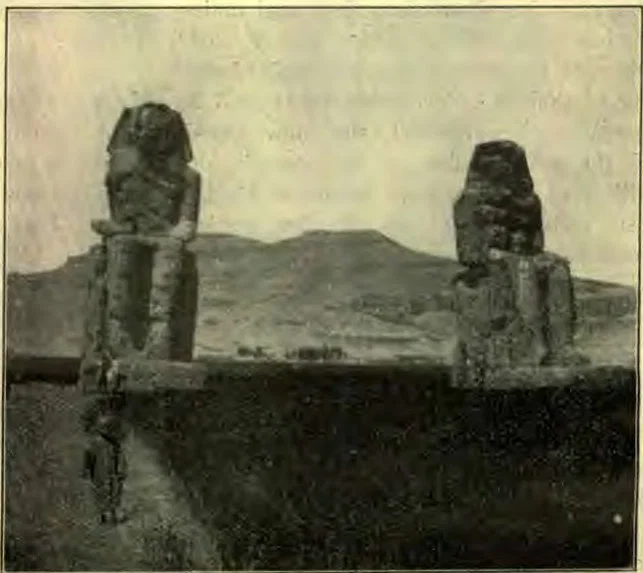
HAVING been told that we have seen the best of all at Karnak, we do not expect much of the ruins across the river, and are agreeably surprised to find so many things that are novel and interesting. Crossing the Nile at Luxor, we find first the Colossi of Memnon, two large sandstone statues. The northern one is celebrated for its long-lost vocal powers. It is related that after the mythological Grecian hero, Memnon, was killed at Troy, he appeared at Thebes in the form of this colossus, and when his mother Eos presented herself at sunrise, she was greeted with a plaintive musical note. The fact of the sound is established by many unimpeachable witnesses, and is variously described. Septimius Severus repaired the statue, and it has since remained silent. The sound is now thought to have been produced by the sudden heat of the rising sun expanding the stone, and causing numerous minute particles to be cracked off.
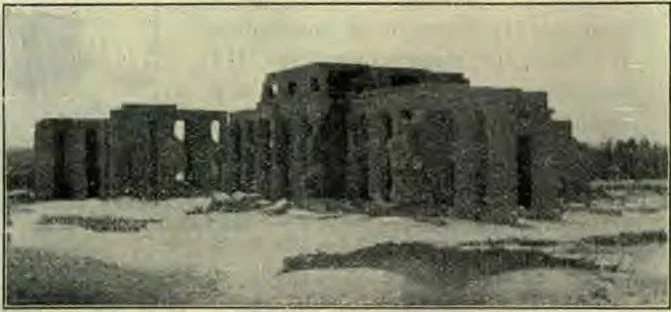
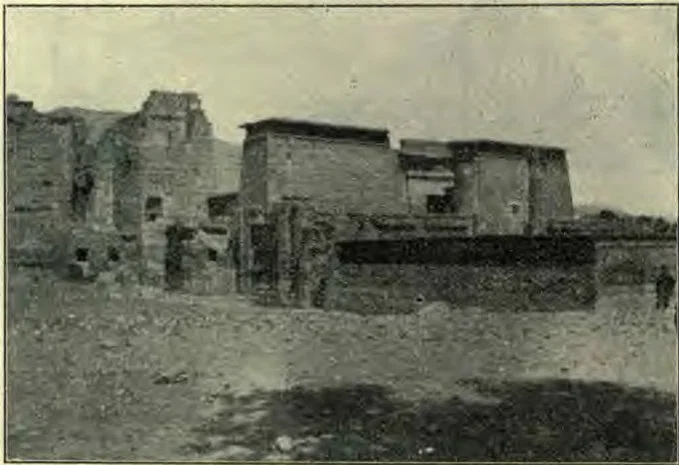
Near the colossi are the ruins of the Ramesseum, a large temple built by Rameses II. Some of the inscriptions recording his victories over the Hittites are very interesting. The large fallen colossus in the first court is a striking example of the sculptural and artistic skill of the ancient Egyptians.
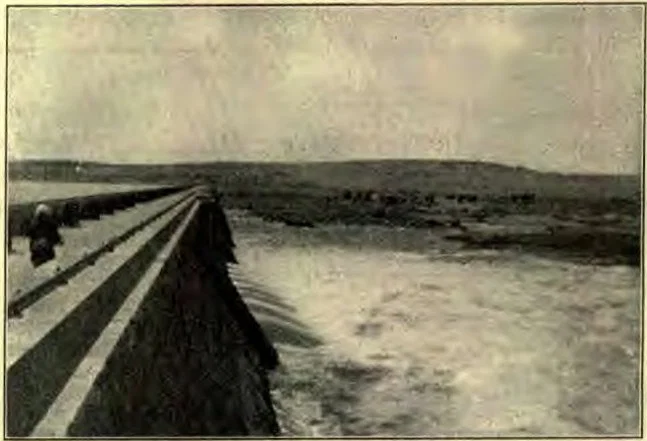
THE BARRAGE, ASSUAN
THE BARRAGE, ASSUAN
Passing the large temple of Seti I at Kurna, we proceed along the winding valley road that leads through the desert hills to the tombs of the kings. It appears that the Theban monarchs preferred excavating tombs for themselves in the rock of the Biban el Mulak to erecting immense pyramids as did the kings of Lower Egypt. The long, broad passages, sometimes leading for hundreds of feet down into the solid rock, terminate in large subterranean chambers, often magnificently decorated. These tombs are now lighted by electricity, which makes them easy of access. The tomb of Seti I is perhaps the most interesting. The inscriptions on its walls form a complete and graphic exposition of the old Egyptian religion,—especially that part which relates to the future state, or “underworld.” The vaulted roof is decorated with an astronomical and astrological charts, containing all the signs of the zodiac. The tomb of Rameses III also presents inscriptions of great variety and excellent execution, and is peculiar for its ten-sided chambers. In the principal chamber of the elegant and recently discovered tomb of Amenophis II, the sarcophagus still contains the mummy of the dead monarch, giving the splendid sepulcher a realistic air that is almost ghastly.
Tourists usually return from the tombs of the kings over the mountain road which descends in full view of the large temple of Der el Bahri, built by Queen Makare. The queen's brother, Thothmis II, who succeeded her, conceived the gallant design of erasing all mention of his sister from the inscriptions of the temple, and supplying his own name in their place. He succeeded so well that the original inscriptions were never entirely restored. This splendid temple is built up against a massive cliff, which, towering hundreds of feet above, completely dwarfs the comparatively insignificant ruins. So always do the works of God stand out in comparison with human productions.
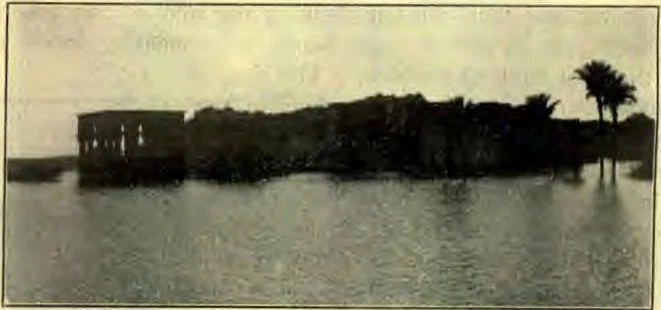
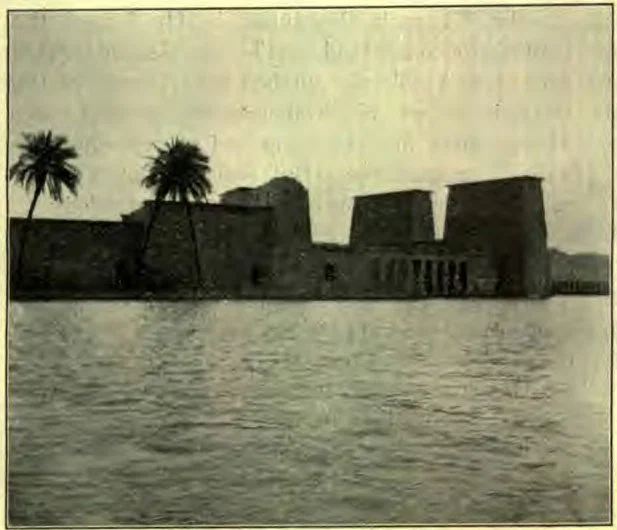
THE KIOSK AND TEMPLE OF PHILAE
The ascent of the mountain west of Thebes is impracticable for women, and not without danger for men; but it affords a splendid view, including all the temples and tombs of Thebes, Luxor, and Karnak, the broad, fertile plain which extends from Armant to Kons, with the Arabian desert in the background; while on a clear day, and with the aid of a good glass, even the pylons of Edfu, sixty miles away, may be discerned. Descending from this mountain, we may visit the small but elegant Ptolemaic temple of Der el Medina, in one of the chapels of which is the celebrated judgment scene, representing Osiris, god of the “Underworld,” sitting in judgment, surrounded by Horus, the dog-headed Anubis, and all the genii and demons of Hades in full array. While Ptolemy Philopater is offering incense to Osiris and Isis, Horus is weighing his heart in the presence of goddesses of truth, as the ibis-headed scribe, Thoth, records the verdict.
Before leaving Thebes, we should visit the large temple of Medinet Habu. On the high walls around this temple are related in glowing terms, and illustrated by means of immense figures in relief, the exploits and victories of Rameses III over the Libyans. In another place is a very interesting calendar of all the Egyptian festivals. The pylons and courts of this temple are fairly intact, but the sanctuary and its chambers are hopelessly in ruins, yet some of the reliefs still retain traces of the brilliant coloring for which they were once so noted.
After completing the rounds at Thebes, we find ourselves thoroughly fatigued, so we spend several days in resting and digesting what we have seen before starting on for Assuan.

Assuan

The journey from Luxor to Assuan is very trying. The railroad is a narrow-gage line, and the accommodations, even in the first class, are poor. In many places above Luxor the Nile Valley is so narrow as barely to give the railway a foothold between the river and the desert rocks. Leaving Luxor, we pass through the desert for a few miles, and then come in sight of the smokestacks of the extensive sugar works at Arment, on the west bank of the river. The slender minarets of Esneh, and the pylons of the temple of Edfu are soon passed, both being also across the river. At Selwa we enter a broad tract of fertile land, which, however, is uncultivated, being above the inundation line. Two hours more bring us to Assuan in the evening, after the hottest and dustiest eight-hours' trip we have ever experienced.
Leaving the station, we take a stroll up the wide, beautiful avenue which extends over a mile along the bank of the river; and we agree at once that Assuan is the most charming spot in Upper Egypt. The first cataract of the Nile is here, and the river channel is deep and narrow, divided by rocky, picturesque islands, whose tops are crowned with groves of luxuriant date-palms. From the largest of these islands, the Elephantine, shine the lights over the Savoy Hotel, stealing silently over the water, and leaving a shimmering, golden pathway across the river. The last pink glow of the fading sky lights up the ripples with a golden tint until the river looks like a “sea of glass mingled with fire.” The soft, spicy breeze, bearing the perfume from the purple shadows of the distant mountain, brings on a delicious, dreamy languor as the traveler drops into a seat by the shore, lost in silent yet ecstatic admiration of the exquisite and almost unearthly beauty of the landscape spread out before him.
The next morning we take the train for Shelall, on our way to visit the beautiful island of Philae, once fondly called the “Pearl of Egypt,” but now entirely under water. Our boat is rowed right into the sanctuary of the temple of Isis, and among the slender columns of the graceful Kiosk. The huge barrage which dams up the river two miles below the island has caused the water to rise about sixty feet, and under the influence of the moisture, the soft sandstone of the monuments is rapidly decaying so that in a few years Philae will be only a memory. Nevertheless, the view from the top of the great pylon of the temple of Isis is still very interesting. Immense black boulders rise picturesquely out of the water of the great artificial lake created by the barrage, while in many places the tops of the beautiful palm-trees that were but recently numbered among the glories of Philae, still appear flourishing above the ripples.
The cause of this state of affairs is worthy of attention. The object of the barrage is to enable the agricultural department of Egypt to control the annual inundation of the Nile, which has frequently caused serious loss to the whole country, so dependent on its rise, by its eccentric fluctuations. The barrage also provides for the irrigation of large, fertile districts hitherto useless because of a lack of water. It is simply an immense dam, the largest in the world, being about a mile and a half long, and eighty feet high. The top is twenty feet wide, and is traversed along its entire length by a narrow iron track, over which the visitor is pushed in little four-wheeled trucks, miscalled “trolleys,” operated by natives. The lower part of the dam is pierced by twenty-eight huge gates, opened and shut by hydraulic power, which control the flow of the river. The imprisoned water, dashing from these gates in a roaring smother of foam and spray, forms a magnificent spectacle. The barrage was begun about five years ago, the duke of Connaught laying the corner-stone. He was also present when the gates were first opened last winter. About ten thousand men were employed, and thirteen million dollars expended in its construction.
Traversing the ancient road on our way back to Assuan, we stop to notice a large prostrate obelisk of the finest Syene granite, entirely cut from the quarries, but never moved to its destined place.
THE RAMESSEUM AT THEBES
After visiting the Bisharin encampment, where about two thousand of the wildest Beduins live, we start back for Cairo, but with an impression of the magic beauty and mystic charm of Assuan in our minds that will never be forgotten.
GLEN WAKEHAM.

Dairy Products in the Tree Tops

In the English dairy shops you may buy eggs, butter, milk, and bread. Well, in Jamaica, one may gather a variety of all of these from the tree tops.
The egg is a fruit called the ackie. It grows on a large tree. A reddish, husk-like pod breaks open, and inside is a creamy yellow pulp which looks and tastes much like scrambled eggs.
Butter is supplied by the avacado, or alligator pear. Its meat is a yellowish pulp which spreads like butter, and tastes very like it, too.
The milk, of course, comes from the cocoanut, always at hand in the tropics. The meat of the nut is grated, and water is pressed through it, taking out the oily milk. It is so rich even after the process that it must be diluted still further with water. Cream rises on the milk if left standing.
The breadfruit-tree offers a much-used substitute for bread. When boiled and baked, it is a fairly eatable starchy food. The cultivated taste relishes it, but to the uninitiated it is a poor substitute for the baker’s loaf.
But it is a fact that one may shake down dairy products — of a sort — from the tree tops in Jamaica. It is a remarkably interesting little island.
W. A. SPICER.

G. B. THOMPSON

Perseverance—III

TEMPLE OF MEDINET HABU
Life is a quarry out of which we must chisel success. We can not fold our hands, and expect to accomplish anything. Josh Billings once quaintly said a person might as well sit down in a pasture with a milk pail and expect a cow to come up to be milked, as for success to come by foolishly waiting for something to turn up.
A young clergyman is said to have asked Dr. Bellamy how to succeed. The doctor replied, “Fill up the cask! fill up the cask! fill up the cask! and then if you tap it anywhere, you will get a good stream. But if you put in but little, it will dribble, dribble, dribble, and you must tap, tap, tap, and then you get but a small stream after all!” This is excellent counsel. There are many dribblers in every department of human endeavor.
Frequently people say, “O, I haven’t time to do this or that.” We each have all the time there is, and if we economize the time we do have, we shall be able to accomplish a vast amount of work. If the odds and ends of time are carefully gathered up each day, they will be sufficient in a little while to master some useful science, and transform many an ignoramus into a brilliant scholar. Elihu Burritt, while earning his living as a blacksmith, is said to have mastered eighteen ancient and modern languages, and twenty-two dialects. One writer says of him that he could be silent in forty languages. Mr. Burritt declared that he owed his success to “employing those valuable fragments of time called ‘odd moments.’”
The prodigious acquisitions of men, and the intellectual attainments of the world’s ripest scholars, are simply the harvest gathered from toil, and contending with many difficulties. If we but step behind the scene, and view the lives of men of brilliant genius—poets, orators, historians, statesmen, etc., we shall find them engaged in the hardest kind of toil. Matthew Hall, while a student of law, studied sixteen hours a day.
Gibbon began work each day at six. Hume wrote thirteen hours a day while preparing his history of England. Montesquieu, in speaking concerning a certain portion of his writings, said, “You will read it in a few hours; but I assure you it cost me so much labor that it has whitened my hair.” Harvey spent eight years in the most patient investigation and research before he announced to the world the theory of the circulation of the blood. Then it was denounced as a delusion, his friends left him, and abuse and ridicule were his portion for years. Dr. Jenner continued his observations and experiments for twenty years before he published his discovery of vaccination as a preventive of smallpox. Like Harvey, he was subject to social ostracism, and denounced as a crank; but he finally succeeded in establishing the truthfulness of his theory. Of the great blessing it has been to mankind, Cuvier wrote, “If vaccine were the only discovery of the epoch, it would serve to render it illustrious forever.” The same might be said of Sir Charles Bell, who for fifty years pursued his studies and investigations concerning the discoveries made regarding the nervous system. A nobleman on a certain occasion remonstrated with a sculptor concerning the price charged for a bust requiring only ten days’ work. The artist said, “You forget that I have been thirty years learning how to make that bust in ten days.” Newton is said to have written his “Chronology” fifteen times before he considered it complete enough to publish. Audubon, the ornithologist, leaving a large number of original drawings, representing years of research, in the care of a relative while he went away for a few months, returned only to find them all destroyed by rats, which had used them to make a nest for their young. Taking his gun and pencil, he went forth resolutely into the woods, and in three years had his portfolio refilled. Carlyle met with a similar experience with his first volume of the “French Revolution.” He loaned the manuscript to a friend, and by mistake the servant used it to kindle the kitchen fire. Years of toil were destroyed, and from memory, without notes of any kind, he was compelled to reproduce his valuable manuscript. But with a resolute determination he set about his task, and succeeded.
Great perseverance is needed in these days when the drama of earthly things is being finished. Souls are perishing for lack of knowledge. The young, who are strong, are needed to go forth, facing obstacles, and laboring for the salvation of their fellows. Men have put forth almost superhuman efforts in secular research. Can we not afford to put forth greater labors, and endure even much more sacrifice, to save souls?

G. B. THOMPSON

Mountain Lions at Arm’s Length

BEFORE the advent of the white man, there was no part of what is now the United States in which the puma was not at home. Nor was its habitat confined to these regions, but extended far into the colder portions of British America and across the isthmus in the south to the neighboring continent. The “panther,” “painter,” “cougar,” or “catamount,” as the creature was called in different parts of the country, was the most ferocious animal with which the pioneer had to deal until he came in contact with the grizzly of the Rocky Mountains and the Sierras.
Like most carnivorous animals, the puma is a coward, and the settlers had no fear of a personal attack unless it was wounded or driven to desperation by hunger. But the puma was fond of mutton and veal, and even poultry was not beneath his notice. The settlers could ill afford to raise domestic animals to satisfy his voracious appetite, and waged against him a relentless war of extermination. So successful was this war, that the creature has long since disappeared from all the settled parts of the country; but in the unsettled or sparsely settled mountainous districts, it is still found in moderate numbers. At the present time it is seldom spoken of by its true name, but is nearly always called “mountain lion.”
In neither habits nor appearance does the mountain lion resemble its African namesake. Its body is long and slender, its head being much larger and its legs much shorter in proportion to its size, than those of any other members of the cat family. But though its legs are short, they are as large around as a man’s arm, and so powerful that the jumping power of the animal is almost incredible.
Several years ago I was tramping through an unsettled portion of the Rocky Mountains, and one evening came upon a deserted cabin so clean and tidy that I concluded to spend the night there.
It was light the next morning before I opened my eyes; and when I did, almost the first thing that attracted my attention was a sound of rustling leaves just outside the cabin. I was wide-awake in an instant, intently listening for some sound that would tell me what kind of creature my early visitor was. The first thing that came into my mind was a picture of a doe grazing, and a fawn frisking about beside her. I listened for a few minutes, and as I could hear no sound except the irregular rustling of the leaves, I came to the conclusion that it could be nothing else, and got up very quietly, hoping to get a glimpse of them before they bounded away, as I knew they would on hearing the first sound.
Softly I opened the door and peeped out. There was nothing in sight; but the rustling of the leaves, of which there were many all around the cabin, still continued. I stepped out, and walked quickly to the end of the cabin from which the sound came, making no attempt to conceal myself, as I thought that my footsteps on the leaves would be heard. When I reached the corner of the cabin, I found myself within arm’s-length of two enormous mountain lions! They were stretched full length upon the ground, playfully cuffing each other, as two kittens sometimes will. Their long tails were lashing the ground almost at my feet,—so near that I could have stooped down and taken a tail in either hand.
I was so surprised that for a moment I was unable to move, and the lions were so intent upon their game that they did not notice me till I began a cautious retreat. Then one quickly turned his head and saw me. I did not wait to see what he would do, but darted back into the cabin, and shut the door.
As soon as I realized that I was safe from attack, my courage returned, and feeling sure that the lions were as badly frightened as I had been, I opened the door again and looked out. They were not to be seen, and I could hear nothing that would indicate their presence, so I stepped cautiously back to the corner of the cabin.
For a little distance the forest was quite open, and the trees were all of large size. About two hundred feet away was a patch of weeds where once had been a garden. Through these weeds I saw one of the lions stealing away like a cat that has been caught in some mischief. The other was not in sight.
When the big cat reached the other side of the patch of weeds, he stopped and looked back. Seeing me, he crouched still lower, and remained motionless till I started toward him. Then he moved on more quickly than before, but still in a crouching attitude. Thinking to give him a fright, I shouted, and ran after him. He raised up and ran swiftly for a short distance; then shot through the air like an arrow, landing upon the trunk of a fallen tree fully thirty feet away. Along this he ran a few steps, and another bound carried him out of my sight.
I made no attempt to follow the lions. Indeed, I had no reason to follow them; for I had gotten over the habit of carrying firearms, and had not yet acquired the habit of carrying a camera. Besides, mountain lions do not always run away, and I thought discretion the better part of valor.
J. EDGAR ROSS.

A Bit of House Decoration

THE house was a nest, probably the nest of a white-footed mouse, for it often uses the deserted birds’ nests in bushes and small trees. It was in this case woven by the mouse himself: a compact, long, round bag, a little like the Baltimore oriole’s pocket nest, except that his is far more loosely woven. It was placed on one side in the fork of a small tree, about seven or eight feet from the ground, and the little round entrance was at one end, so that it was roofed all the way. It was September when I found it, and, no doubt, had been made for the second or third brood.
The remarkable thing about it was that at its closed end was fastened a long vine covered with gauzy leaves, and looking very like the feathery tufts of the clematis when it is in seed. It looked like a novel bit of house decoration, but the clever little builder had a much more practical aim in view than adorning his dwelling, and that was the safety of his little ones. To any one approaching the nest from the rear, it looked for all the world like a vine climbing over the tree, and not a bit of the nest was visible. Of course, in front the bright-eyed little mother was always alert and watchful. I should like to have seen the building of the nest. The mass of feathery stuff was unbroken, and though it was light in weight, it was a large load for a mouse to carry. The white-footed mouse is rather an exception in liking tree nests. Most of the field-mice have little balls of grass, or burrows in the hay, or ground nests for their broods, and it is said that tree-sparrows sometimes take shelter during the cold winter nights in such places if they should chance to be deserted by the mice. So it is a fair exchange when the white-footed mouse finds a bird’s nest to his mind and adapts it to his family needs.—Selected.

Over Jordan

THERE’S a face I long to see In the holy heights above; There’s a hand that beckons me— ’Tis the hand of Him I love. Over Jordan is my mansion, Over there my home shall be, By the ever crystal river, By the glowing jasper sea.
Home and heaven is my song As I view the gates ajar When the singing angel throng Bear me to that land afar. Glorious day of hope’s fruition— I shall see him face to face; In the glory of his presence See the purpose of his grace.
All the pleasures earth could bring Then will seem but vanity, When I see the risen King, Who has died to ransom me. I am trusting in his keeping; I am singing all the day; And the blessing of his presence Cheers me all along the way.
Over Jordan is my home, Far beyond this tide of woe. To that land he bids me come, And I’m singing as I go. Over Jordan is my dwelling; Over there I soon shall be, In the paradise of Jesus, By the glowing crystal sea.
C. M. Snow.

Pass It By

Some one said a word untrue? Pass it by; Do not let it worry you— Pass it by; Just find something good to do, Keep life's pleasant things in view; Gray skies will give place to blue, If you pass it by, dear.
Some one said a word unkind? Pass it by; Just dismiss it from your mind— Pass it by; Place yourself secure behind Pleasant thoughts, and you will find Life's dark clouds with sunshine lined— If you pass it by, dear.
— Benjamin B. Keech, in Good Cheer.

Boastful Building

“Blow, O winds! Rise, O ocean! Break forth, ye elements, and try my work!” Such was the boastful inscription put upon the first Eddystone lighthouse built by the eccentric Winstanley. His challenge was accepted, and one fearful night the sea swallowed up the tower and its builder. The next one met a similar fate, the structure and its builder, Rudyard, perishing together. The third was erected by Smeaton, who built it all of stone, making it a part of its rock foundation, so that the lighthouse penetrates it as a tree penetrates the soil. Upon this lighthouse no vaunting inscriptions were placed, but on the lowest course were chiseled the words: “Except the Lord build the house, they labor in vain that build it;” and on the keystone, above the lantern, is the exclamation, “Laus Deo!” That structure still stands, a never-failing beacon-light to storm-tossed mariners. He who would build for eternity must not set about his task in any vainglorious, overconfident spirit. He must be careful as to his foundation, building firmly and deeply upon the Rock, Christ Jesus, and relying in trust and humility upon him who alone can enable one to reach a perfect result.—Well Spring.

Japan’s First Native Evangelist

Ten years before Commodore Perry’s fleet appeared in the Bay of Yeddo, and succeeded in opening the long-sealed gates of Japan to the outside world, Neesima Shimeta, destined to become a teacher among his people, was born.
When in his teens, having never seen a Christian nor heard of the gospel, Neesima had some conviction of His presence who is not far from any one of us, and of the vanity of idols. When he met in a Chinese book the words, “In the beginning God created the heaven and the earth,” he said: “This is the God for whom I am looking; this is the true God,” and secretly determined to know more of that God, even if he left all to find him. These words from the Bible, as he understood, were brought by an American, and to America he must go. To leave his country was unlawful, and punishable with death. But this he risked, concealed himself among some produce in a boat, and reached Shanghai and ultimately America, working his way as a sailor.
A prayer, which he committed to paper, after an Oriental usage, shows his state of mind. It was: “O God, if thou hast got eyes, please look upon me. O God, if thou hast got ears, please hear for me. I wish heartily to read the Bible, and I wish to be civilized with the Bible.”
The owner of the vessel in which he sailed, Mr. Hardy, of Boston, received him into his family. The sailors had called him Joe, so Mr. Hardy gave him the name Joseph Hardy Neesima. He provided a liberal education for him, giving him nine years in Phillip’s Academy, Amherst College, and Andover Theological Seminary. The elevation of his countrymen became his absorbing purpose. He was ordained to the ministry in 1874, in the Mount Vernon church, Boston. In response to his honest but earnest plea at a meeting of the American Board about this time, nearly four thousand dollars was pledged for the school which he proposed to establish in Japan.
After ten years’ absence, he arrived in his native land, November, 1874, “cherishing,” as he says, “in my bosom this one great purpose, namely, the founding of an institution in which the Christian principles of faith in God, love of truth, and benevolence toward one’s fellow men,” should “train up not only men of science and learning, but men of conscientiousness and sincerity.”
Back in Japan, he hurried to his aged father, and soon had the joy of destroying all the paper, wooden, earthen, and brass gods in the house. Priests and people flocked to hear the new preacher. Thirty men in his town took up a collection for purchasing Christian books for themselves. “I find here everything ready for the gospel,” he wrote Mr. Hardy.
Neesima was the first to carry the gospel to the interior. His bold utterances roused the governor, who visited Tokyo to consult the authorities. But while in America he had been connected with the Japanese embassy, and this had made him well known, and as a result he was left free to begin a movement leading to the formation of one of the most thoroughly Christian communities in Japan.
In November, 1875, he opened a school in Kyoto, which was the beginning of the present Doshisha College. There were eight pupils, in a room little better than a shed. Against much prejudice on the part of the people, the school won its way. He employed some foreign teachers, but taught daily in the school, besides acting in person in all the critical relations of his school with the government, where his utmost wisdom, patience, and skill were often taxed. With the students he was as a father or elder brother. In ten years there were two hundred and thirty pupils in commodious buildings.
Besides his school duties, he was kept busy in organizing the native missionary work and corresponding and journeying much for this end. A remarkable revival occurred in the Doshisha in 1884, during which the strain upon his health was such that he was compelled to leave the country for a while. “My heart burns,” he wrote, “for Japan, and I can not check it.” At this time he visited America again, and while seeking health and rest in Maine, he discovered that there was no Sunday-school in the village, and started one at once. After returning to Japan in 1886, he never failed to inquire about the little Sunday-school he had left in America.
On his return he formed a plan for the enlargement of Doshisha so that it might have the rank of a university. Not concealing his purpose to make it a Christian institution, he appealed for aid to non-Christian but influential men of Japan. He so won their confidence that he secured contributions amounting to nearly sixty thousand dollars. He also received a gift of one hundred thousand dollars from an American for this purpose.
In the fall of 1889 he was in Tokyo, working to interest leading men at the capital and secure funds for his large plans. He took a severe cold, and renewing his efforts too soon, was prostrated. His wife and other friends were summoned, and pastors, teachers, and students flocked from east and west to catch some farewell word. Maps were brought, at his request, to his bedside, and eagerly, almost with dying breath, he pointed out places which ought at once to be filled by the Christian teacher. To his wife he said, near the last, that he wanted no monument. “It is sufficient to have a wooden post, stating on it, ‘The grave of Joseph Neesima.’”
January 23, 1889, with the words, “Peace, joy, heaven,” on his lips, he entered into rest. A large tent was erected on the college grounds, for the chapel could not hold the four thousand persons who assembled at his funeral. The procession, a mile and a half in length, was formed in the heavy rain, the students acting as bearers. They had from the first insisted upon doing everything possible with their own hands, and had themselves prepared the grave. He could not be buried by his father in the Buddhist ground, for he was the very head of Christianity in Japan. Yet priests bore a banner in the procession, with the inscription, “From the Buddhists of Osaka.” A Japanese friend called Neesima, “The pole-star of our religion.”—Compiled.
Continue reading: Japan: Geography, Population, and Resources