The wonderful Japanese empire—that narrow, crescent-shaped chain of volcanic, earthquake-visited and typhoon-swept islands extending from Kamchatka to Formosa, between the twenty-second and fiftieth degrees north latitude—contains 159,590 square miles, and supports 44,312,429 people. These figures will be better understood if we note that east of the Mississippi, not including Wisconsin, there is abundant room for five Japanese empires, although there are inhabitants enough for only one; and this comparison is all the more remarkable because, owing to Japan’s mountainous character, not more than twelve per cent of her entire area is under cultivation.
Yesso, Hondo, Shikoku, and Kiushiu are the largest and most important islands. On the second named are the chief cities in the empire—Tokyo, the capital, with 1,325,295 inhabitants; Osaka, the commercial center; and Kyoto, the ancient home of the mikados.
The country is blessed with good roads, artistically built bridges, and deep, commodious harbors; rich and undeveloped mineral resources; a varied climate; useful forests of bamboo and mulberry- and camphor-trees; and a skilfully irrigated, thoroughly fertilized, and carefully cultivated soil that is divided into small farms—often neatly terraced in the hills and mountains—producing great crops of wheat and rice and millet, or of loquats and figs and oranges. Tea, silk, and rice are the chief exports.
Physically, the people of Japan are smaller and less perfectly developed than the average European. In color they resemble somewhat the American Indian. Among the noble classes the face is long and narrow, the forehead high, the nose sharp, and the eyes oblique; while among the common people one observes the plump, oval face, the flat nose, and the broad mouth.
Mentally, they are keen, intellectual, and very eager to learn. Those who come to this country to complete their education compare well with the brightest minds in our colleges and universities. Although they are imitative, and learned first of Corea, then of China, and lastly of Europe5and America, yet they manifest a certain originality in receiving, assimilating, and sometimes improving upon Western models and institutions. They do not slavishly follow their masters.
The Japanese excel us in their love of nature. The soft-tinted sky, the golden sunset, and majestic mountain, and the opening bud are noticed, admired, and appreciated by this gay, patriotic, and polite, though sometimes inconsistent, fickle, and deceptive race.
Nor are they any the less practical because of their susceptibility to the influences of the beautiful. Indeed, the story of Japan’s progress since the restoration of the emperor to absolute power in 1868 reads almost as a fairy tale. There had been a bloody revolutionary war; the shogunate—so powerful for centuries—had been forever destroyed; and Emperor Mutsuhito—young, able, and progressive—abolished feudalism, turned his eye to the nations of the West, and began to study their institutions, and to adopt many of their customs and laws.
To-day Japan is a constitutional monarchy, and her people have a voice in the government; the edicts against Christianity, which had been posted in different parts of the country in the seventeenth century, have been torn down; free schools are in every city and village and hamlet; magazines and daily newspapers are delivered even in the rural districts throughout the empire, for the many railroads and steamship lines make transportation cheap and easy; there is splendid telegraphic service; national and private banks do a lucrative business; a new and independent literature is arising; and on every hand may be seen evidences of the rapid progress that has been made among these isles of the Orient.
As in ancient Rome the individual was nothing, while the government was everything, so here man’s first duty is to the “heaven-descended mikado,” and his second to his family, especially his parents. The principle of loyalty is the very foundation stone of Japanese morality; absolute obedience to parents is of next importance.
Human life is lightly regarded. For the very slightest reasons a man will commit suicide; it is said that from seven thousand to ten thousand persons are guilty of this crime every year; and statistics show that a failure in the rice crop, or even so trivial a thing as uncomfortable weather will increase the number of victims who suffer a self-inflicted death.
In private and business matters the Japanese are often deceptive, unreliable, and lacking in promptness. The merchant sells his goods with reference to the amount he is able to extort from his unsuspecting customer, rather than according to their real value. Commercial integrity is at a low ebb, and this lack has very materially hindered the free and natural growth of interoceanic trade. However, the honesty always shown in conducting public affairs, and the uprightness generally displayed by civil officers in faithfully fulfilling governmental trusts, put to shame many a Western nation.
Shintoism is the early cult of primitive Japan. It is chiefly nature- and hero-worship. It contains no moral code. The Shintoist sees in the mikado the lineal representative of the “sun-goddess;” he follows the leadings of his own unaided conscience, and, save where his heart has been corrupted by foreign influences, he is sure to go right! This religion is very popular among the higher classes of society.
In A. D. 552 Buddhism was introduced. It absorbed rather than antagonized the old faith. The court favored it. For centuries it exercised a powerful influence in molding the character and shaping the destinies of the Japanese people, and to-day it is the most popular religion of the land. According to Buddha the chief end of life is total annihilation. This may be had by attaining to a sufficient degree of knowledge and enlightenment, and by passing through much self-discipline and purification, and countless transmigrations of soul.
The ethical-political system of Confucius has been received by large numbers of the people. According to him man’s first duty is to obey his prince; the second relation is that existing between father and son—the parent must love his offspring, while the child reverences his father; and next in importance is the law governing the marriage relation—the wife is merely the servant of the husband, and upon the merest pretense she may be put away. The results of the workings of this last precept will appear when it is realized that in Japan there are nearly one third as many divorces as marriages. Confucianism also teaches that the older brother is to be greatly respected by the younger children, and that kindness should be accorded to friends and strangers; but the latter term is not to be interpreted to mean “foreigners.” Upon these five relations existing between sovereign and people, parent and child, husband and wife, elder brother and younger, and friend and friend, hangs the moral law of the East.
But one of the most interesting of Japan’s religions is the indigenous and recently developed missionary faith known as Tenrikyo, which, interpreted, is, “Doctrine of the Heavenly Reason.” Omiiki, its founder, was born near the close of the eighteenth century. She was of humble parentage. When near forty years of age, she claimed to have two visions, and to be appointed by the gods to carry a new message to her people.
Tenrikyo teaches that man must worship the sun and the moon; that the gods sustain the same relation to man as parents do to their children; that neither prayer nor praise will meet with divine favor if the heart be impure; that the good should meet together to worship and receive instruction; and that it is the only true religion, and will one day be triumphant. In this last respect Tenrikyo materially differs from the other leading religions of Japan, for they are very tolerant one of the other. It is becoming more and more popular, and now numbers something like five million disciples.
In 1549 Xavier introduced Roman Catholicism; it was gladly received by all classes, and in less than sixty years there were more than one million native adherents. But trouble came. The Jesuits quarreled among themselves, were accused of plotting against the government, and were slandered by the Buddhist priests. Persecution arose, and the Christians were almost exterminated. The foreigners were either exiled or slain, and Japan practically barred her doors to intercourse with the outside world.
Since 1859 various Christian sects have been at work in trying to spread the gospel. Great obstacles have been met. Heathen religions, the troubles occasioned by the introduction of Christianity in the sixteenth century, the conduct of so-called Christian nations, the presence of Western skepticism, and the almost fanatical patriotism of the Japanese, have all had their weight in retarding the progress of Protestantism.
But during the very recent years there has been a remarkable change. Revivals have swept over Japan, and hundreds have been converted. These revivals have reached the colleges and higher institutions of learning, and a great many young men and young women are having their attention called to the gospel. We see in this a preparation for the closing message, which must soon reach every part of that empire.
It is time for us to press forward. We must study the methods of our brethren who have gone before us, and seek to profit by their experience. That which is necessary is the mighty power of the Spirit of God. We need it. Japan needs it. The whole world needs it.—Missionary Magazine.
A Letter From Centralia California
Dear Friends: The Centralia Society of Young People was organized January 24, 1903. We are glad to report a prosperous existence during the last six months,—profitable not only for us, we trust, but also for those in whose behalf we have put forth our efforts.
Our membership, which was but fourteen at the organization, has steadily increased until, at this writing, it is twenty-three. Perhaps this will seem small to those who are themselves members of Societies whose membership is much larger, but our district is one in which the people are very much scattered, and consequently the young people belonging to our church are “few and far between.”
Our object is the same that animates all our Societies,—the accomplishment of all the good we can by practical missionary work, and the fitting of ourselves for greater usefulness as the way opens.
We include a report of what has been done:—
Papers given away ........................ 96
Pages of tracts distributed ............... 820
Books loaned .............................. 6
Subscriptions for papers .................. 9
Papers sold ............................... 28
Letters written ........................... 3
Yours fraternally,
CENTRALIA YOUNG PEOPLE’S SOCIETY.
Two-minute reports from Japan, British Virgin Islands, Mexico (Review, September 24), Society Islands, Nyassaland, Sumatra (Review, October 1), Gwelo, The Gambier Islands (Review, October 8).
Closing Exercises.
Prayer for our work and workers in Japan and other needy fields. Remember also the two new workers, nurses, just landed in Japan, and the party of six recruits for our Inland China Mission, that the power of God may attend their labors from the beginning.
Son of consecration.
Some Japanese Children We Have Known
By F. W. Field
When we first moved into our new home in Tokyo, we had for near neighbors a family in which there were several children. The house they lived in is like many ordinary Japanese houses, one story high,—or low, rather,—unpainted, with the roof covered with tiny shingles. We can look right into the side window whenever the sliding screen covered with white paper is pushed aside. The floor is covered with the ever-present thick mats of straw, called tatami. It is one of the joys of small children in Japan to tumble about on the matted floors. Another great joy is that there are so few things to get broken or out of order; for a Japanese house is almost destitute of what we call furniture. A few pictures on the walls, an ornamental vase or a potted plant, some sprays of flowers in a bamboo vase,—such are the simple but tasty furnishings.
But I must introduce these children to you. The eldest is a sturdy school-boy, Hidechan by name. All Japanese names have a meaning, and Hide means “illustrious.” His younger brother’s name is Yuchan, “heroic.” Their little sister is called Matchan after the matsu, or “pine tree.” Boys’ names often express some manly virtue; while girls are commonly named after trees, flowers, and other natural objects. Hana, meaning “flower,” Kiku, “chrysanthemum;” and Haru, “spring,” are common names of girls. The suffix chan noticed in these children’s names, is a title of respect, like our Mr., Mrs., Master, etc., only the same title is used for all, men and women, boys and girls. But chan is the childish pronunciation of san, the form applied to grown people, following the family name.
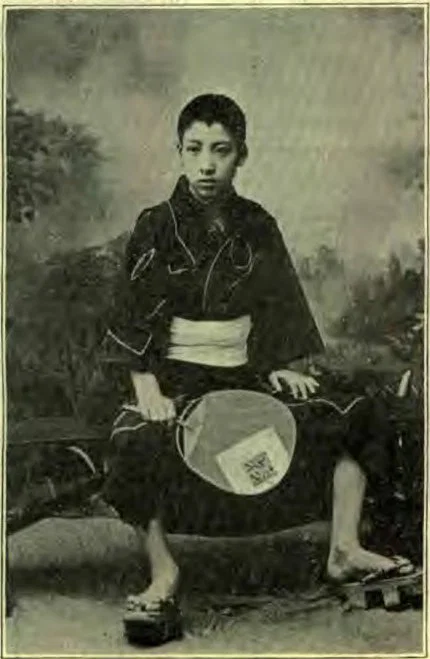
JAPANESE YOUTH
Hidechan was fourteen, and was just entering the “middle school,” the grade corresponding to the American high school. Whenever I asked Yuchan his age, he would shyly lay three fingers of his right hand in the palm of his left; then if I didn’t seem to understand, he would say “yatsu,” which means “eight.” Matchan was in her fourth year. These children seemed small for their ages, for two reasons. In the first place, the Japanese do not reckon ages quite as we do. The birth of a child is celebrated on New-year’s day instead of the real birthday. Then, too, the year of the child’s life is given as the age, instead of the number of completed years. A Japanese baby, no matter how young, is said to be one year old. And another year is added on New-year’s day. So a baby born in December would be called two years old after the first of January.
The other reason why children in Japan seem small for their age is that the Japanese are considerably below the average of other nations in stature. One cause of this is the custom of sitting on their feet. For centuries this custom has prevailed, and it is believed to interfere with the development of the lower limbs, which are noticeably short, and often weak. Some of the more intelligent and educated Japanese are now adopting and recommending the use of chairs.
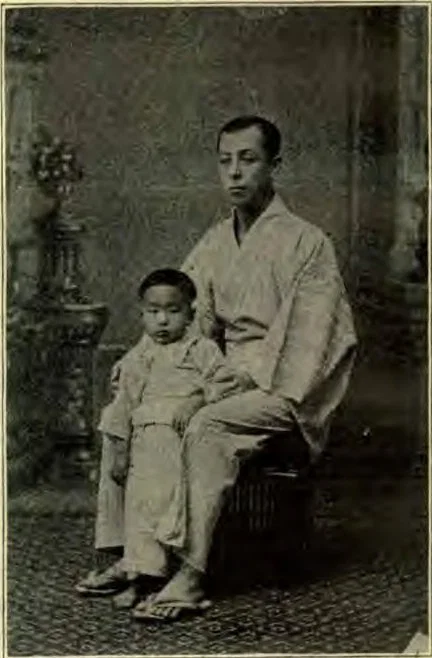
FATHER AND SON
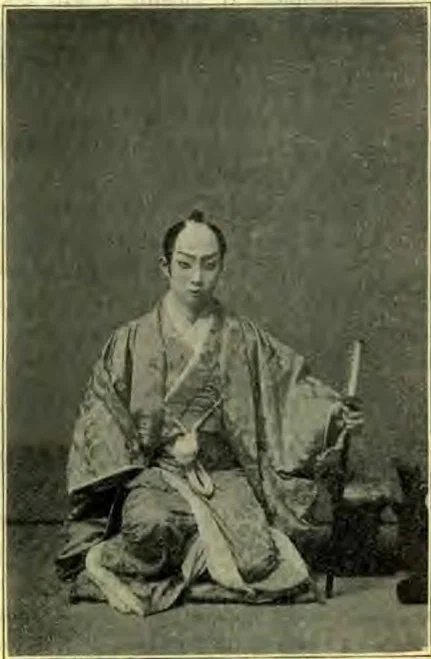
Hidechan and Yuchan always had their hair clipped close; and this is the common style for men and boys. Some old men still dress their hair in the old style, in which it was allowed to grow long enough to be tied in a round roll at the crown. This roll was then doubled on itself, and tied again, so that its end projected forward. Matchan usually had her hair clipped or shaved except on the crown of her head, where it was allowed to grow long enough to fall over her forehead and neck. Japanese babies have their heads shaved, with queer little tufts of hair left at the crown, temples, and nape of the neck, according to the fancy of their elders.
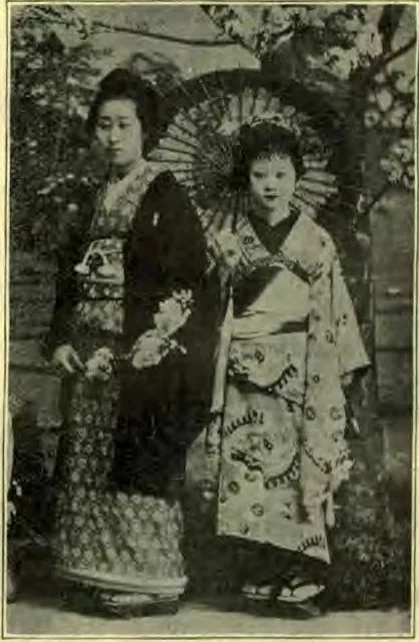
When Hidechan dressed for school, he looked quite like a “foreign” boy, with his neat suit of dark-blue jacket and trousers, leather shoes, and black cap with vizor. But about home the children all wore the native kimono, a loose gown open down the front, and confined at the waist by an obi, or sash, wrapped several times around the body. The lower part of the wide sleeve forms a capacious pocket. But boys, and girls too, often have their sleeves made without pockets; for, handy as these are, the wide sleeves are much in the way during work and play. Servant girls tie back their sleeves with a string passing under the arms, over the shoulders, and crossing on the back.
JAPANESE GIRLS
But I must not forget to mention the queer shoes worn by our little neighbors. A Japanese geta is made of a block of light wood, cut away on the under side so as to leave supports for the heel and the ball of the foot. The upper surface is flat. The shoe is held on the foot by two thongs, which are made fast at the same place at the front end, and then pass about halfway back, and fasten, one on each side. The foot is shoved under these thongs, which pass between the large and second toes, where the thongs unite in front. Such shoes can be put on or taken off without ever being touched with the hands, the wearer simply stepping into or out of them at pleasure. They are always removed when their owner enters a house. The more expensive geta have padded velvet thongs, and soles of woven rushes. Sometimes a little girl’s shoes have tiny bells underneath, which tinkle as she walks, reminding one of the old woman in the nursery rhyme, who had “rings on her fingers and bells on her toes.”
We soon became quite well acquainted with Yuchan, and he seemed to enjoy playing with the little foreign children. As he became better acquainted, he would come into our house; but he was always careful not to intrude, nor to come when he thought he might not be welcome. Little Matchan was more shy, as became her6age. Hidechan was at school much of the time, so we saw little of him.
ANCIENT STYLE OF HAIR-DRESSING
These Japanese children seem to be quite as amiable in disposition as most children in our own favored land. In fact, the children here are less quarrelsome than many little folks at home. Yuchan was generally cheerful and happy; but like other children he sometimes had a spell of pouting, or teasing his mother. He seldom cried except when hurt; and then his mournful cry of itai, itai (“painful, painful”), was quite pitiful. His little sister had more frequent spells of crying, from what cause we could not well decide. At such times every effort was made to divert her attention, and no harsh measures were ever used to drive away the evil spirit of sobs. It is quite a common theory with the Japanese that a child should not be punished when it is too young to reason. Consequently small children often give way to fits of anger and peevish crying without restraint.
But you will doubtless be interested to know something about the parents of our little neighbors. The father was a quiet, mild-mannered man, who dressed up in foreign clothes every day, and went away to his business. But when he returned, or had a day at home, he would don his native kimono, especially comfortable in warm weather. His companion was a model Japanese wife and mother. She was a very tidy housekeeper, and the tiny yard at the rear of the house was kept carefully swept with a broom made of bamboo twigs. In manner she was mild and gentle; never once, during the months they lived beside us, did we hear her speak in loud or angry tones. Even when the children were fretful and annoying, she corrected them with gentle firmness. And this quiet way is characteristic of the Japanese. Very likely much is due to their training in certain forms of politeness, the control of the feelings being considered a cardinal virtue, especially in women. But whatever may be the explanation, Yuchan’s mother, with her quiet self-possession, would certainly put to shame many a parent in Christian lands.
And yet these people are heathen. From our windows we could see the little household shrine on the wall in the farther room. At times we noticed that the two tiny lamps on the shrine were burning, showing that some special season of worship had come. Almost every Japanese home has its household shrine, and some have several. Besides these there are the public temples and shrines, dedicated to the emperors, and to other great men of the past, and to the various gods.
But the leaven of the gospel is working in Japan. Not long ago Hidechan called on us (the family removed to another part of the city some months ago), and one of our Christian boys had a good talk with him about Christianity. He said that he has a Bible, and promised to read it. There is much to be done to carry the gospel to this people. In closing I will ask that you remember this land in your prayers to the Lord of the harvest. F. W. FIELD.
Tokyo, Japan.
Never Mind
By Benjamin B. Keech
COME to me, my little man! tell me all about it,—do! Have they hurt your tender heart? is the world unkind to you? Never mind, my little man; wipe each grieving tear away; You just keep your purpose true; it will all come right some day.
In their blindness do they say words that pierce your gentle heart,—Cause you tenderly to grieve o'er each cruel, burning smart? Dry your tears, my little man, for it can not last alway,—You just keep your purpose true; it will all come right some day.
BENJAMIN B. KEECH.
A Little Indian Girl and the Crucifixion
“A MISSIONARY among the Indians tells of a poor little Indian girl who attended the mission school. She saw a picture of the crucifixion, and wished to know what it meant. The teacher told her as simply as she could the old but ever-new story of the cross. As she went on with the story, tears streamed down the face of the little girl, who did not speak for a while. Then her first words were, ‘Me never want to do bad any more.’ Her heart was so touched with the love of the Saviour who died for our sins that she resolved never to grieve him, but desired to please him perfectly. For the first time in her life she realized that her sin was against the loving Saviour. All real conviction of sin must have for its essence a clear conception that we are wronging God, grieving the divine heart.”
MEMORY VERSE: “I can do all things through Christ which strengtheneth me.” Phil. 4: 13.
Goliath of Gath was one of the last of a race of giants who were called “the sons of Anak” or Anakims, whom God cast out of the land of Canaan when he brought his people out of Egypt. It was these great giants who filled the hearts of the ten spies with terror, and caused them to bring the people an evil report of the land that God had promised to give them. In the days of Saul only a few of the giants remained. Goliath was nearly ten feet high—more than half as tall again as the tallest people we usually meet.
The promise of God to his people when he brought them out of Egypt was that no man should be able to stand before them, but that one of them should “chase a thousand, and two put ten thousand to flight.” So they need not have been afraid even of a man of Goliath’s size; for any single one of them would have been more than a match for him. However, for forty days there was not found a man of faith in Israel who dared to meet the giant in the strength of the Lord.
Every morning and every evening he came forth from the ranks of the Philistines and defied the armies of Israel. All the nations knew that God was with the armies of Israel, and it was he who had given them such wonderful victories. So when Goliath said, “I defy the armies of Israel,” he was defying Israel’s God, as David said, “The God of the armies of Israel, whom thou hast defied.”
No “accidents” happen to the children of God. There are no “chances” in their lives. There was one man of faith in Israel whom God could send forth to uphold the honor of his name and deliver Israel. That man was David, the anointed king. Saul was weak, helpless, and afraid, because the Spirit of the Lord had departed from him. David was strong in the Lord and in the power of his might, because the Spirit of the Lord was upon him.
At this time the people had opportunity to see the weakness of the king that they had desired to lead forth their armies. After testing the Israelites, to see if there were any among them that would trust him, God brought David to the camp. Jesse sent him to inquire after his soldier brothers; God sent him to deliver Israel. When David heard the boasting words of the giant, and saw the fear of the people, he was full of indignation, and of holy zeal for God, who was thus being dishonored before the heathen Philistines. It was not any pride or confidence in himself, nor desire for glory, that led him to go against Goliath. It was his knowledge of God, and his trust in his promises, and his desire that the Philistines should learn of his power, and know that there is a God in Israel.
Goliath’s trust was all in himself—in his great stature, his coat of mail, his heavy sword, and the shield that was carried before him. David cared for none of these things. He went forth with his simple sling and a few carefully chosen stones. And not even in these was his trust, but wholly in the God of Israel.
Goliath was prepared to meet the tallest and strongest soldier in the armies of the Israelites, and was greatly insulted when he saw a rosy-cheeked youth, not even armed. “Come to me,” he cried, “and I will give thy flesh unto the fowls of the air.”
David’s answer to the Philistine tells us the secret of his power. Goliath’s trust was in his sword, and spear, and shield. But David’s trust was in “the name of the Lord of hosts, the God of the armies of Israel.” “This day,” said he, “will the Lord deliver thee into mine hand; . . . that all the earth may know that there is a God in Israel.”
These words show that David had the victory before he went out against Goliath. “This is the victory that overcometh the world, even our faith.” David had faith in God, and therefore he had the victory, and by it he overcame the giant. He was able to say with confidence, “This day will the Lord deliver thee into mine hand.”
God guided David’s aim, and sent the stone to its mark. And when the Philistines saw the head of their great champion in the shepherd boy’s hand, they learned what David knew—that there is a God in Israel.
All the promises of God to his people are for us to-day. Let us believe them, and, like David, through God we shall do valiantly, and shall be able to say, “Though an host should encamp against me, my heart shall not fear.”
Questions
1. Where did the Philistines encamp against Israel? Who was their champion? Describe Goliath’s size and appearance.
2. What did Goliath propose? What did he do to the army of Israel? Whom was he really defying? How long did he have to wait for a man to fight with him?
3. What brought David to the camp? What state of things did he find there? How did he feel about it?
4. What did David say to Saul? Why was he not afraid of Goliath? What had God promised the Israelites when they came out of Egypt? What was it that kept them so long in the wilderness?
5. What weapons did David choose? Why would he not wear Saul’s armor?
6. What did Goliath think of David? What did he expect to do with him? In what did Goliath trust?
7. Tell how David answered the Philistine. In whom was all his confidence? What did he want all the earth to know?
8. Had David any doubt about the victory? What did he tell Goliath he would do with him? What is the victory?
9. In what simple way did David conquer Goliath? What did he do to him when he was fallen?
10. What did the Philistines do when they saw that Goliath was dead? How far did the Israelites pursue them?
VII—God’s Promises and Israel’s Failure
(November 14)
MEMORY VERSE: “What could have been done more to my vineyard, that I have not done in it? wherefore, when I looked that it should bring forth grapes, brought it forth wild grapes?” Isa. 5: 4.
Questions
1. To what high and exalted position did the Lord call the nation of Israel? Acts 13: 47.
2. What was to be their standing among the nations? Deut. 28: 13.
3. As long as Israel was true to God, how would other nations look upon them? Deut. 4: 6-8.
4. How extensive did the Lord intend that Israel’s influence should be, in case they proved faithful to him? Deut. 28: 1, 9, 10.
5. In demanding a king, what position did they in reality seek in comparison with other nations? 1 Sam. 8: 19, 20.
6. When Israel of their own accord had refused the high position to which the Lord had called them, whom did he choose to occupy it? Jer. 27: 6.
7. What relations were other nations to sustain to him? Verse 7.
8. What was to be the experience of any nation that refused to serve Nebuchadnezzar? Verse 8.
9. Through what agency was the light which God would have published to all the world through the nation of Israel brought to Nebuchadnezzar? Dan. 1: 19-21.
10. What proclamation did he make to all the world? Dan. 3: 28, 29.
11. What experience led him to make this proclamation? Read chapter 3.
12. What opportunity did Darius, the Mede, have to learn of the true God? Dan. 6: 3.
13. How did he improve it? Verses 25-27.
14. Through what experience was God’s servant compelled to pass before the knowledge of the true God was brought to the king? Daniel 6.
15. Even though Israel had failed to do their part in fulfilling the promises God had made, how did the Lord still use those who were faithful to represent his kingdom and gather out a people who would be called by his name? Note.
Notes
In order that they might be a light to all the world, God called his people to a position high above all other nations. But in their efforts to be like the nations round about them, they lost their high position. God had to use other means to bring the knowledge of himself to the world.
Before Nebuchadnezzar came to the point where he acknowledged the God of heaven, the few loyal servants of the Lord who stood before the king were placed on trial for their faith,—an experience which to them at the first must have seemed hard. And yet that very experience brought them nearer the Lord, for he walked with them in the fire. And through this same experience Nebuchadnezzar was led to recognize the God of the faithful young men. The same was true of Darius. Daniel was thrown into the lions’ den to open the eyes of the king, who was ready to acknowledge the true God as soon as he knew him. The lesson that we may draw from this experience is evident. The Lord did not allow his servants to suffer in bringing these great men to know him better. And yet only their intimate acquaintance with their Lord, gave these men the courage to stand true in the face of what portended most terrible bodily suffering.
Interfused
By Susan Coolidge
We can not lie every morning, and repent the lie at night;
We can not blacken our souls all day, and each day wash them white;
Though the pardoning blood availeth to cleanse the mortal stain,
For the sin that goes on sinning that blood was shed in vain.
We must buy and sell in the market, we must earn our daily bread;
But just in the doing these usual acts may the soul be helped and fed.
It is not in keeping the day's work and the day's prayer separate so,
But by mixing the prayer with the labor that the soul is taught to grow.
Then none may deem it wasted time, who stands in a humble spot,
And digs and waters a little space, which the hurrying world heeds not;
For the Lord of the harvest equally sends his blessed sun and rain
On the large work and the little work, and none of it is in vain.