The Roman Empire, in the days when it ruled the world, had a standing army of about four hundred and fifty thousand men. This army was distributed throughout the empire in a way to protect the interests of the Roman people and its rulers from both internal dissensions and external dangers. With the passing away of that empire great standing armies ceased to be provided for, the various kings of Europe being satisfied with a small army, and a levy en masse in time of war. The continuous wars of Napoleon Bonaparte again revived large armies both in France and the kingdoms against which Napoleon waged war; and when, at the height of his fame, that warrior set out for the conquest of Russia, he had an army under his command of over one million men. These were not all Frenchmen; and he actually led only about half that number into that region of storm and cold, from which but a few thousand returned.
For a long time France has set the pace for military matters for the other governments in Europe; and when Louis Napoleon revived the empire of his renowned uncle, he increased the French forces, and made what was supposed to be an army second to none in Europe. The brilliant victories it gained in the Crimean War with Russia and in the Italian campaign against Austria had the effect to make the emperor and people of France believe that the power of France was invincible, and, resting upon their former laurels and neglecting a thorough preparation, the nation in 1870 plunged headlong into that—to France—most disastrous war with Prussia. The French armies were both outnumbered and outgeneraled, and, after the first few battles, where they manifested something of their former enthusiasm and valor, they showed no heart for the war which desolated their country. Then followed the capitulation of Paris, and the peace by which France was not only compelled to pay an enormous indemnity to Prussia, but also to give up the two provinces of Alsace and Lorraine. At first, the representatives of France who negotiated this treaty refused to give up these provinces. They said, “Exact any sum you please, and we will pay it; but we will not give up a foot of French soil.” But their conquerors were inexorable, and both the money indemnity and the territory were taken.
I have been particular to mention this circumstance because to these harsh terms imposed by Germany in her hour of triumph and accepted by France in her weakness, may be directly traced the remarkable armament of Europe at the present time, which has so far exceeded that of all previous times. It would have been as easy for Germany at the close of the Franco-Prussian War to have made friends with France as it was for her to gain the friendship of Austria at the conclusion of her war with that power four years before. The French people were strongly inclined to throw all the blame of that war upon Louis Napoleon, and a generous treatment of France by Germany at that time would doubtless have insured peace and friendship between these two powerful nations. But Bismarck had not only resolved on the defeat of France, he proposed its humiliation. This he accomplished. But he has learned that humiliation is not necessarily destruction.
The rapid restoration of France from the results of the war has demonstrated anew the wonderful recuperative energy of the French people. It may be safe to defeat; but it is not always safe to unnecessarily humiliate a great and warlike nation; and there is no denying the fact that France has nourished a desire for revenge. Napoleon learned to his sorrow that it was dangerous to provoke a powerful nation, when, by his treatment of Queen Louisa, he so angered the Prussians that, “could Blucher have had his way, Napoleon would have been executed and Paris burned at the time it was occupied by the allied armies after Napoleon’s retreat from Leipsic.” Germany made the same mistake in her treatment of France, and the people of south Germany now very generally recognize this fact and deplore it.
In 1877, six years after the war ended, France had so far recovered from the effects of that war that Bismarck meditated the plan of provoking another war with France, which he was determined to reduce to a second-rate power. It is understood that the opposition of Crown Prince Frederick was strong enough to prevent the accomplishment of this purpose. The increase of the power of France led Germany to the alliance with Austria, and later with Italy, thus forming the Dreibund, or Triple Alliance. As this was as much of a threat against Russia as against France, these last-named countries by mutual interests have at last been drawn together in an alliance. The people and press in South Germany now frankly declare that a kind treatment and alliance with France by Germany at the close of the Franco-Prussian War would have prevented the fear of a Russian invasion, which now menaces Germany.
Such were the causes which have led to the excessive armament of Europe, which has gone on without a halt since the reorganization of the French army at the close of the war of 1870–71. For years it has seemed as tho all the nations of Europe were listening to one voice, and that that voice was saying, “Proclaim ye this among the Gentiles: Prepare war, wake up the mighty men, let all the men of war draw near; let them come up.” Joel 3:9. At the present time each one of the five great powers—Russia, Austria-Hungary, Germany, France, and Italy—can muster a much larger army than Napoleon commanded when he set out for the Russian campaign which ended in the retreat from Moscow. Turkey has an army of seven hundred thousand men, and is now raising money by popular subscription to arm every Moslem in the nation. Great Britain has an army of about half a million men. Spain has sent twice as many soldiers to Cuba during the last two years as Napoleon commanded at Austerlitz or Waterloo. Then all the smaller powers have caught the spirit, have increased their armies, and militarism was never so rampant before since the history of man. It has crossed the6ocean, and many are suggesting that the army of the United States should be increased to keep up with the growth of the country. Even the churches organize boys’ brigades, many of which are armed with real weapon.
The naval preparations have been kept fully abreast of the military preparation by land. Great Britain still maintains a supremacy in point of an effective navy. But she only does this by building many ships each year. France closely presses her, and the other nations follow hard after in the same line. Even the peaceful Hollanders have caught the infection, and will immediately build twelve armed cruisers and as many torpedo boats. These great armies and numerous ships of war are armed with weapons such as the world never saw before. One of these floating fortresses would have been sufficient to have ruled the ocean fifty years ago.
These immense preparations are all for war. The nations are on the stretch for more territory and more power. Turkey is to be divided, and that nation will get the most of her territory which is the best prepared to seize and hold the biggest portion. Hence there are jealousies, alliances, open and secret, feverish excitement, plots and counterplots. The nations are drawing near a vortex which they fear, but from which they can not now draw back. By diplomacy they only delay the final plunge which each one instinctively knows must at last be taken. Says the Lord, “And the nations were angry” (Rev. 11:18)—perfect description of the present situation. What they will eventually do in their anger is foretold in Joel 3:9–12. Evidently there will be a partition of Turkey in Europe by the powers, and, following that, a general war for the possession of the land of Palestine. The Catholic powers will struggle with Russia, representative of the Greek Church power, for the possession of the holy places. It will be a new crusade. But God will interpose. His work will then have been finished in the earth, the seven last plagues will be poured out, and Christ will come, the Destroyer of the wicked and all their vain hopes, and the Joy and Hope of his people. This is the meaning of the widespread call to arms that is sounding among the nations. This is the meaning of the message of the everlasting Gospel, which, in accumulating simplicity, power, and glory, is being preached to all the world as a witness to all nations. Rev. 14:6–12; Matt. 24:14. M. E. K.
“AM I READY?”
By Mrs. A. W. Head
Not a few who love our Saviour’s appearing are asking themselves, “Am I ready for his coming?” This is truly an important question, yet I think it is not for us to say at any time that we are ready.
We are exhorted by the Saviour to watch and pray that we may “be accounted worthy to escape all these things that shall come to pass, and to stand before the Son of man.” It is for us then to watch, and pray, that we fall not into temptation and be overcome by self-indulgence or the cares of this life. The Lord of the vineyard has also left to every man his work. “You have a work that no other can do.” By patient continuance in well-doing we are to form characters which will stand the test of the judgment. While we faithfully occupy our time and talents, angel hands keep an unerring record. Our thoughts, words, and deeds, are written in God’s book of remembrance. By that heavenly record we shall be judged, and accounted worthy; or—most solemn thought—should we prove unfaithful, our names will be blotted from the book of life, and we shall be cast out as wicked and unprofitable servants. We are in danger, for the powers of darkness are bent upon our destruction. “Wherefore let him that thinketh he standeth take heed lest he fall.” Say not, “I am ready,” but put on the heavenly armor, work, watch, and pray till the Master appears; and, “Finally, my brethren, be strong in the Lord, and in the power of his might.”
MRS. A. W. HEAD.
TIME TO SEEK THE LORD.
By Carrie Knight
“Sow to yourselves in righteousness, reap in mercy; break up your fallow ground; for it is time to seek the Lord, till he come and rain righteousness upon you.” Time to seek the Lord, time for the aged, for those in the prime of life, for the youth, and the child,—time to seek the Lord. Why?—Because the Lord’s coming is near, even at the door; because the storm of culminating sin is gathering. The clouds are growing darker and darker, soon to burst in fury upon the world. Time to seek the Lord?—Yes. The judgment work is fast hurrying to a close. We stand to-day upon the threshold of great and solemn events.
Do I hear you say, I am afraid I will not be accepted? “All that the Father giveth Me shall come to Me; and him that cometh to Me I will in nowise cast out.” John 6:37. I hear you say, But I am too great a sinner. Listen: “This is a faithful saying, and worthy of all acceptation, that Christ Jesus came into the world to save sinners, of whom I am chief.” 1 Tim. 1:15. How glad we should be that it is not to a favored class that Jesus offers mercy and says, “Come unto me”!
That same voice that, more than eighteen hundred years ago, was often heard speaking peace to the sinner, that bade the leper come near, speaks to us now, altho we may be the greatest of sinners. There is yet mercy for us. “If we confess our sins, he is faithful and just to forgive us our sins, and to cleanse us from all unrighteousness.” 1 John 1:9. He has promised to do it, and he will keep faith with us. Do you ask for proof of his mercy and goodness? “I lay down my life for the sheep.” Do you ask proof that he is loving? “I have loved thee with an everlasting love.” Would you be encouraged by instances of his readiness to save? Remember the leper, the sick of the palsy, the blind, and the lame, and the woman out of whom he cast seven devils. All these prove that “he is touched with the feelings of our infirmities.”
“Therefore we ought to give the more earnest heed to the things which we have heard, lest at any time we should let them slip. For if the word spoken by angels was steadfast, and every transgression and disobedience received a just recompense of reward; how shall we escape, if we neglect so great salvation?” Heb. 2:1-3. Then let us seek the Lord.
CARRIE KNIGHT.
SUNDAY KEEPING AND SABBATH KEEPING.
By W. L. Winner
The Papacy asserts that the church has power to command sin; that she can absolve from sin, in principle taking from God the Father the prerogative of judging. Protestants, generally, condemn this principle in all excepting the supposed sin of Sunday-breaking. They declare with vehemence that Sunday-sabbath breaking is sinful and exceedingly displeasing to God; and yet there is absolutely no scripture that would indicate such a thing. It is true that God is exceedingly jealous of his holy day, and the reader can find an evidence of the importance he attaches to its observance by his people, by reading the seventeenth chapter of Jeremiah in connection with the twenty-fifth chapter. The Sunday in those days was the high day of Baal worship. Indeed, in the beginning of idolatry to hero worship, following the days of Nimrod, who founded the first earthly kingdom, the god was denominated the “child of the sun,” and the day set apart for his worship, Sun’s day. And whenever, in all the history of God’s people, as recorded in the Bible, and as attested to by profane history, they left the true worship of God and his Sabbath, they espoused the Sunday with the idolatrous worship which it always accompanied. Thus the Roman Church as a system, the modern Babylon, has a system of worship that Protestants truly denominate idolatry. Under it, duties not specified or hinted at in the Bible, are commanded under penalty of sin. Christ is robbed of his prerogative as priest, and as head of the church. There is the worship of images and relics; the interposition of the priest, the pope, and the Virgin Mary between the sinner and Christ; the abolition of the second commandment; the changing the fourth, and the dividing the tenth—all helping to make up a system of religious teaching and practice anti-Biblical, and hence antichristian. And by her own acts and words, like the false worship of old, she has a day that is distinctly her day, and the badge of her authority.
Christ never condemned in the flesh, and consequently can not be a propitiation for violation of the multitude of things commanded by the Roman Catholic Church under pain of mortal sin; neither has he any righteousness to offer in lieu of Sunday-breaking. Pardon for a specific sin depends solely on the merits of Christ’s atoning sacrifice, and is clothing the sinner with Christ’s righteousness in regard to the particular commandment transgressed. Everybody admits that that is what is understood by pardon from sin in its comprehensive meaning. What is true of sin as a whole is true of each specific sin. All sin has been provided for in Christ’s atonement, and EVERY sin has its propitiation. Putting the matter in its plainest and only practical terms, the repentant sinner prays: “My dear heavenly Father, I have done evil in thy sight. I have desecrated thy holy day. I repent, and am exceeding sorry. Pardon, I pray thee, for Jesus’ sake, who died that I might live.” Christ, who knows all hearts, says, “Forgive him, Father, for his repentance and sorrow are sincere; blot out his transgression; cover his sin with my righteousness.”
Christ perfectly kept the Sabbath, the seventh day, the very day that commemorates the finished work of creation. His righteousness is inherent only in the fact that he rightly kept the right day according to the commandment. It is the only righteousness in respect to Sabbath observance that is provided, and the only pardon that can be granted must be for the desecration of the very day Christ observed, and no other. There is no pardon for Sunday desecration; there is no need for any. “Where there is no law there is no transgression.” “What saith the law?”—The tables of stone declare the “seventh day is the Sabbath.” Christ’s life says, “I have kept my Father’s commandments.”
The new covenant involved writing God’s law in the heart, and this covenant was sealed by Christ’s blood. Paul proved that after the death of the testator the testament is in force, and also that after a covenant be confirmed or sealed, no man disannulleth or added thereto. It is certain, therefore, that what is sinful now was sinful before and at Christ’s death. In reference to Sabbath desecration, God has not failed to reveal in the Scriptures his views regarding it. He will judge them of olden time for knowingly and wilfully breaking the fourth commandment. As true as God is true and changeth not, he will judge us for knowingly and wilfully doing the same; there is no escape from this logic; it is truth. God’s law is immutable; eternal. Christ’s life is the embodiment of righteousness. Examine it. What did he do? You are to be saved by it. It is to cover your nakedness. You must accept it by faith in order to be saved. Christ must live in you the same life. “Be not deceived; God is not mocked; for whatsoever a man soweth, that shall he also reap.” “Let no man deceive you; he that doeth righteousness is righteous, even as he is righteous.”
“Blessed are they that do his commandments, that they may have right to the tree of life, and may enter in through the gates into the city. For without are dogs, and sorcerers, and whoremongers, and murderers, and idolaters, and whosoever loveth and maketh a lie.” The Roman Church has many days that they call holy. Is it true that they are holy? Almost the whole world believes Sunday to be a holy day. Is it true? God only can make a day holy. Which day is it? It is not Sunday, the first day of the week. It is the day that was instituted in Paradise, when all creation was beheld, and pronounced “very good;” when Adam himself was still sinless. It is the day that was revered by patriarch and prophet from Adam to John the Baptist, and received the sanction of Jesus Christ, God’s only-begotten Son. It is the day upon the strict and true observance of which by our Saviour depended7the salvation of mankind. There is no choice of days in this matter. If we would be of that blessed throng who “do his commandments,” we can not omit one. James 2:10. Neither can we knowingly be of them that “loveth and maketh a lie.” Let us so live that we shall not be condemned in that thing which we do. Let us permit Christ to dwell within our hearts by faith, doing for us the will of God, as he has shown in his Word, and at last be clothed with that righteousness that he alone has, and only can bestow. W. L. WINNER.
JEWISH CUSTOMS AND TRADITIONS.
By F. C. Gilbert
(By an Israelite.)
The Sanctuary and Its Services.
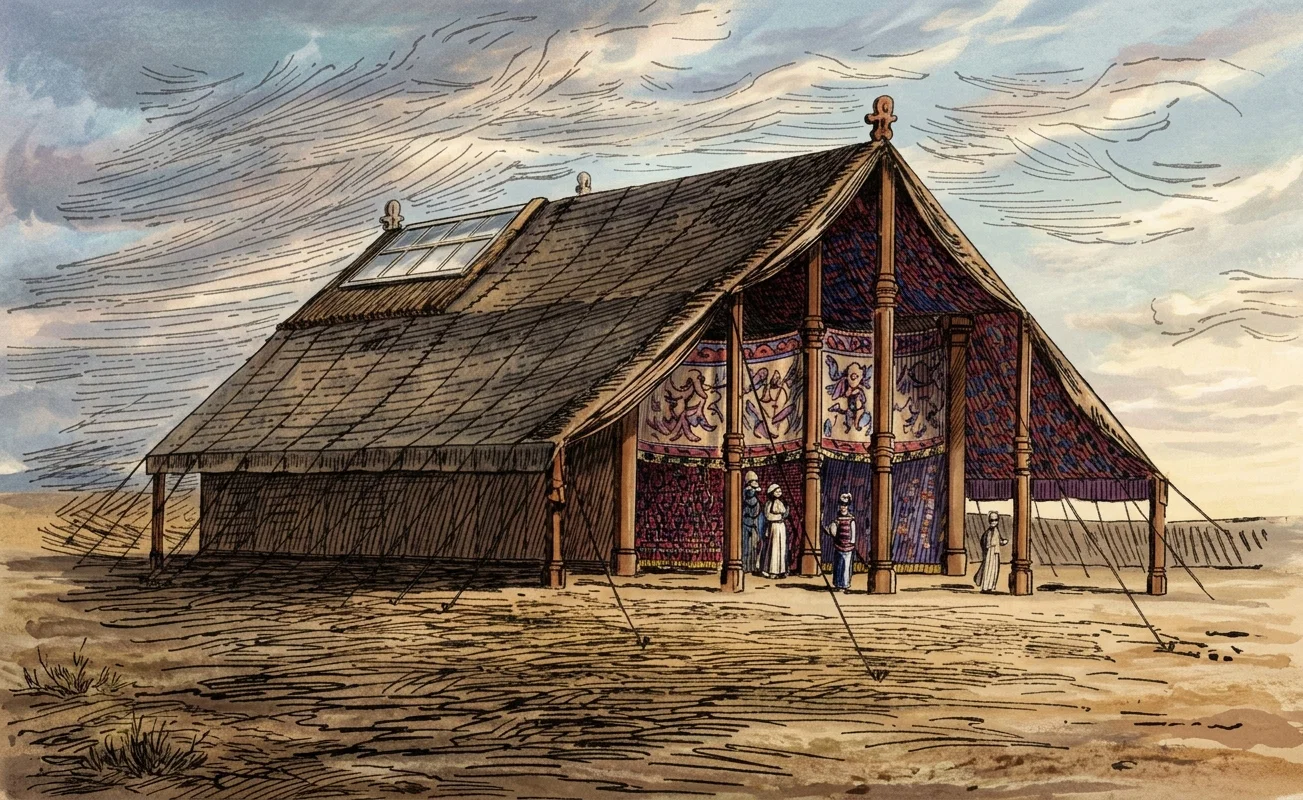
Not one word which Christ ever spoke was devoid of meaning. And how readily we apprehend that such must be the truth. For everything which Christ ever spoke was the word of the living God. We would expect, then, that when Moses received instruction for the erection of the tabernacle, there would be no part connected with it but what would have some great importance attached to it. For the temple, as a whole, was representative of Christ as entire. He tells us himself several times that he is the Temple of God, and we know that in him dwelt all the fulness of God's glory, even as the glory of God filled all the tabernacle. Peter also speaks of Christians being the tabernacle of God, and the bodies of men as God's earthly habitations in which his Holy Spirit dwells. See John 2:19-21; 2 Peter 1:13, 14; 2 Cor. 5:16; 1 Cor. 6:19.
The coverings of the sanctuary were four in number,—the beautiful covering of blue, purple, scarlet, and fine-twined linen, inwrought with cherubim, and worked with gold; then came the goats' hair covering; the third was the rams' skins dyed red; and, lastly, the outer covering was the badger skin. The first thing which attracts our attention is the variety of colors used in the first covering. O, how much they do tell us of that glorious Anointed One—his origin and work! On a clear, beautiful evening as we stand gazing at God's wonderful works in the heavens, and view the dome above us, what does the blue suggest to us but heaven's own canopy? Yes, this spread is to teach us that the Messiah of God was to be of heavenly origin, to come down from heaven. And is not that what the ancient prophets predicted of his birth, and whence he was to come? And did not the Master himself say: “I am from above.” “I came down from God.” “I am the Bread of God which came down from heaven.” “I came forth from my Father!” And this same truth is recognized by many of the writers of the Talmud; and it was this truth that caused the leaders in Christ's day to partly stumble. Yes, his name was “Immanuel, God with us.” Ah, blessed condescension on the part of the Eternal One, to send to us his most dearly beloved to declare to the children of men his great love!
We should remember, too, that what was true of these things in Christ's life is equally true in the lives of his devoted and faithful children. For he is our Example, and we are to follow in his footsteps. All things back there, coverings and all, were made after the pattern; and several times did God emphasize this fact upon Moses' mind: “See, saith he, that thou make all things according to the pattern showed to thee in the mount.” The children of God are not of this world; they are born from above, having their citizenship in heaven. “As he is, so are we in this world.”
As we think of the purple color, how forcibly we are reminded of His purpose in being born into the world. Asked Pilate at the Saviour's trial: “Art thou the King of the Jews?” “Art thou a king then?” Jesus answered and said: “Thou sayest that I am a King: To this end was I born, and for this cause came I into the world.” “Will ye therefore that I release unto you the King of the Jews?” And even in prose and poetry we find that writers have adopted this term to denote the regal state. Our Messiah is a King, as well as of heavenly origin. And one of the greatest Jewish Talmudists, in commenting on Jer. 23:5, says that that Lord referred to there is none other than “King Messiah.” Our Saviour is royal, and what a royal Helper, too!
And, dear reader, have you thought that Jesus, the Messiah, has made you his follower, of royal bearing? “But ye are a chosen generation, a royal priesthood, an holy nation, a peculiar people.” “Beloved, now are we the sons of God, and it doth not yet appear what we shall be; but we know that, when he shall appear, we shall be like him; for we shall see him as he is.” Well can we say, “I am the child of a King.” O most blessed and exalted privilege to be of heavenly regality, with the blessed and bright prospect in view of having a diadem placed on our brow! We shall sit with him upon his throne, and reign as kings and priests. O blessed privilege to be a Christian!
But it was quite essential, while these colors should be part of the tabernacle, that the scarlet, or suffering color, should not be omitted. Yes, the Saviour was to be a suffering Messiah, that he might bring many sons unto God,—yea, the Captain of our salvation was made perfect through suffering. And, Christian, do you expect to wear the golden crown by and by? You surely will, if you have the thorny one platted upon your brow now, that even the scarlet may appear as part of the material in the construction of the earthly tabernacle. And it is this suffering which will enable us to appreciate the glory which is to be revealed. Methinks the sweetness of the beyond could not be appreciated did we not have to endure the suffering here. Or, as the apostle states it, “Our light affliction, which is but for a moment, worketh for us a far more exceeding and eternal weight of glory.”
Doubtless every Bible reader is familiar with the significance of the fine-twined linen. The revelator tells us that the fine linen is the righteousness of saints. But how do the saints obtain righteousness? “And this is his name whereby he shall be called, THE LORD OUR RIGHTEOUSNESS.” And every fiber of the pure garment was woven in the loom of heaven, all the time being made according to the pattern. Yes, Christ worked out that beautiful garment of righteousness, and in it there contained no foreign material. See Isaiah 61, last two verses. Well may we crave with Paul that we might be found not having our own righteousness which is of the law, but being covered with the garment of His righteousness which is granted by His faith. For it is all of Him. And the more we keep our eyes fixed on the Pattern, the more will the work be perfected as He would have it done.
What a beautiful combination the Designer arranged for the innermost covering of the tabernacle! This canopy was visible to none on the outside world, but seen only by the priest who ministered within. How true this was with the Master's life when on earth! Few, ah, how few, saw his beautiful life within, or even understood him! Always misrepresented, maligned, misunderstood, betrayed, and even denied by his best friends! But God, who ministered in that spotless life, saw all the beauty and the glory which it contained; and to Him, who abode in the holy place of Jesus, the life was understood as it really was, beautiful and most glorious. And how often, Christian, is it in your experience that “no one can understand,” not one to enter into what you feel! Often misunderstood, misjudged, wrongly apprehended, misinterpreted in your intentions! Remember that to the world outside these things are not visible in their true light, and are hidden from their natural view. But God, who ministers in that soul, and Jesus, who abides in the sanctuary of your heart, sees all the combination of the colors which are being interwoven within, and he alone understands. Then, child of God, care not for the thought of mortality; fear not the misunderstandings of men; for they can not enter within to see the beautiful inner covering of the life, but rejoice with unspeakable joy, full of glory; for8He abides there and views all as they are, and to Him the curtain is a beautiful one.
The next covering which came upon the beautiful curtain was the goats' hair. How our minds retrospect the service on the day of atonement in the wilderness! How we see the people gathering on that day around the tabernacle, as the high priest takes the goat for the Lord's offering, that reconciliation may be made for the people, and that they might enjoy the oneness with God. Yes, the goats' hair surely speaks to us of the atonement which the blessed Master made for us himself, reconciling us to God by his death, giving his life for us, that his might be given to us. O, the atonement! What meaning is there wrapped up in that term? See him, the Lord of glory, willingly, yea, gladly, giving up his life of incomprehensible happiness and joy, surrounded with untold myriads of loyal subjects in the heavenlies doing him homage such as no earthly potentate ever dreamed,—to reveal to poor, fallen mortality the divine love that dwelt in the bosom of the Father. Yea, suffering shame, agony, and disgrace, that man might enjoy oneness with his Maker. Truly, “God is love!”
But that work did not stop there. He was willing to share it with His children, and give them the privilege of enjoying it with Himself. “And all things are of God, who hath reconciled us to himself by Jesus Christ, and hath given to us the ministry of reconciliation; to wit, that God was in Christ, reconciling the world unto himself. . . . and hath committed unto us the word of reconciliation.” What a thought! Reconcilers for God! Ambassadors for Christ! Intrusting into the hands of frail humanity the work of redeeming the race! Verily God has a right to feel confident in his own power, when he is able to work out the great problem of human salvation through instruments of clay, who have reached such a state of degradation. Exalted privilege to be a coworker with the Almighty God, and co-operator with the Saviour of men!
F. C. GILBERT.
“NOBLE SPORT.”
By Julia H. Duffie
We not infrequently read of noted individuals being fond of the “noble sport” of hunting; even in women of high rank in the old world this pastime is spoken of as being highly praiseworthy.
Webster defines “noble” as “that possessing eminence or dignity; above that which is low or mean; magnanimous, liberal,” etc.
No doubt it is sometimes necessary for those living in new countries to depend somewhat upon wild game for food, which of course necessitates hunting and killing it. Sometimes also wild creatures become pests, when it becomes proper to destroy them. Yet these excuses are often given when not valid, to justify the cruel work. The real motive power being a love for the business of pursuing, capturing and butchering defenseless animals.
But when those rolling in wealth, with all the luxuries of earth at their command, will make a business of raising deer and other harmless creatures simply for the pleasure of chasing them down with hounds and killing them, then it seems that the acme of cruelty and inhumanity is reached. “Noble sport,” indeed! If this be noble, pray what might be called ignoble?
A beautiful deer is grazing happily on the hillside, with her little speckled darling at her side, when a party of half a dozen men and women, mounted on swift horses, and preceded by a pack of pitiless, bloodthirsty hounds, catch the trail, pursue, terrify, agonize and kill the innocent creature. This is noble? An overwhelming force of the strong and powerful assailing the feeble, innocent and defenseless! O, shame, shame upon such “nobility”!
I can not think that those who thus lightly esteem innocent creatures can have any very exalted idea of the Creator. I can not think that those who have hardened their sensibilities by such a wanton, merciless practice can ever be tender, considerate parents, or have a proper estimate of any of the relations of life. The outdoor exercise, the horseback riding, and all that might be called ennobling if disconnected with the despicable business of “the chase.” That can only be degrading in the last degree. Cowardly fun would be a much more appropriate name for it than “noble sport.” It is noble to protect the weak, but cowardly to take the advantage of them unnecessarily.
The lower creation was given into man’s hands to use, but not to abuse. They are his to guide and protect, and how basely he betrays his lordship when he makes use of his power to harass and wantonly torture these beings which many times possess finer feelings than their human, or inhuman, persecutors. Will such ever hear the plaudit, “Thou hast been faithful over a few things; I will make thee ruler over many things”? It seems to me that they will more likely hear, “Give an account of thy stewardship; for thou mayest be no longer steward.”
What a comfort to reflect that there is to be a country where “they shall not hurt nor destroy;” where every creature shall maintain its proper relation toward every other creature, and where divine love shall rule over all. God speed the day! JULIA H. DUFFIE.
SHAME
Shame is a kind of social conscience. Shame is a secondary sense of sin. In shame our imagination becomes a kind of moral sense. In the present disorder of our souls we are all acutely ashamed of many things that are not the proper objects of shame at all; while, on the other hand, we feel no shame at all at multitudes of things that are most blameworthy, dishonorable and contemptible. We are ashamed of things in our lot and in our circumstances that, if we only knew it, are our opportunity and our honor; we are ashamed of things that are the clear will and immediate dispensation of Almighty God. And, then, we feel no shame at all at the most dishonorable things, and that simply because the men around us are too coarse in their morals, and too dull in their sensibilities, to see any shame in such things. And thus it comes about that, in the very best of men, their still perverted sense of shame remains in them a constant snare and source of temptation. A man of fine nature feels keenly the temptation to shrink from those paths of truth and duty that expose him to the cruel judgments and the coarse and scandalizing attacks of public and private enemies.—Alexander Whyte, D.D.
Life Without God Is Death
“It is suicide to try to live without God. The first step we take away from God, the Origin of life, is death; and as long as we are away from God we are in death, in a dying condition. Without God our thoughts, our desires, our words, our actions—all of which constitute our habits—are full of the poison of death.”
THE BOYCOTT AS A RELIGIOUS WEAPON.
By W. N. G.
A PRESS report says that at a recent meeting of “prominent divines” in New York City, a committee was appointed to consider the question, “Must the Sunday Paper Go?” The woman’s auxiliary of the National Sabbath Union has adopted the following resolution:—
“Resolved, That no member, in the future, shall purchase or read a Sunday newspaper; and that no goods shall be purchased of any firm advertising in the Sunday newspapers.”
It is expected that the boycott will be taken up by “the Endeavor Societies, the Epworth League, the Baptist Young People’s Union, the King’s Daughters, and numerous other church bodies.” Of course every individual has a right to subscribe or not to subscribe for any newspaper, and to patronize whatever business man or firm he may choose; but a conspiracy to injure men engaged in legitimate business is a crime in most States, and ought to be in all. As a religious weapon, the boycott is Roman Catholic in its origin and spirit. The Individual, a paper published in Pueblo, Colo., referring to another subject, incidentally notes the following historic facts, which are applicable here:—
“Pope Alexander III. commanded that no man should entertain or cherish heretics in his house or land, or traffic with them.” The Synod of Tours, under the same pope, passed the law that no man should presume to receive or assist heretics, not so much as exercise commerce with them in selling or buying. Also the Council of Constance, as expressed in Pope Martin V.’s Bull, shall not allow the heretics to have houses in their districts or enter into any contracts, or carry on commerce, or enjoy the comforts of humanity with Christians. These decrees were in a day when Rome could enforce their edicts by arms. The spirit still continues and is now enforced by mobs or socially. Priests hint to certain merchants that a paper is not acceptable to the church, and forthwith their advertisements are withdrawn.”
The religious boycott is a matter of prophecy. The apostle John, looking down through prophetic vision to the end of time, saw in the last days a power which appeared at first with “two horns like a lamb,” but eventually it “spake as a dragon.” These two horns are fitting symbols of the Republican-Protestant principles of the equality of man and the separation of Church and State, upon which our government was originally based. Of this power, or lamb-like beast, the apostle says:—
“And he doeth great wonders, so that he maketh fire come down from heaven on the earth in the sight of men, and deceiveth them that dwell on the earth by means of those miracles which he had power to do in the sight of the beast; saying to them that dwell on the earth, that they should make an image to the beast [the Papacy], which had the wound by a sword, and did live. And he had power to give life unto the image of the beast, that the image of the beast should both speak, and cause that as many as would not worship the image of the beast should be killed. And he causeth all, both small and great, rich and poor, free and bond, to receive a mark in their right hand, or in their foreheads; and that no man might buy or sell, save he that had the mark, or the name of the beast, or the number of his name.” Rev. 13: 13–17.
This prophecy is now in process of fulfilment in this country. The principles are being urged that will shortly lead to general religious enactments by the government enforcing Sunday observance and kindred measures, with the sweeping boycott penalties above indicated. The reader’s attention is now called to the warning message of the “third angel,” in chapter 14:9–12:—
“And the third angel followed them, saying with a loud voice, If any man worship the beast and his image, and receive his mark in his forehead, or in his hand, the same shall drink of the wine of the wrath of God, which is poured out without mixture into the cup of his indignation; and he shall be tormented with fire and brimstone in the presence of the holy angels, and in the presence of the Lamb; and the smoke of their torment ascendeth up forever and ever; and they have no rest day nor night, who worship the beast and his image, and whosoever receiveth the mark of his name. Here is the patience of the saints; here are they that keep the commandments of God, and the faith of Jesus.” W. N. G.