The Youth’s Instructor, Vol. 27, No. 9.

THE FIRST MIRACLE

The Youth’s Instructor

Feb 26, 1879

S. D. A. Publishing Association · Battle Creek, Mich. · Feb 26, 1879

THE FIRST MIRACLE.

MIRACLE is an event contrary to the established course of things, a supernatural occurrence. We read that when Jesus was upon the earth he performed many mighty miracles; he healed the sick, raised the dead, cast out devils, gave sight to the blind, and made the lame whole. The Record does not state the number of miracles he performed, but if it was proportionate to his good works, which John says would take more books than the world would hold to record, that generation had sufficient proof that he was of divine origin. They were without excuse.
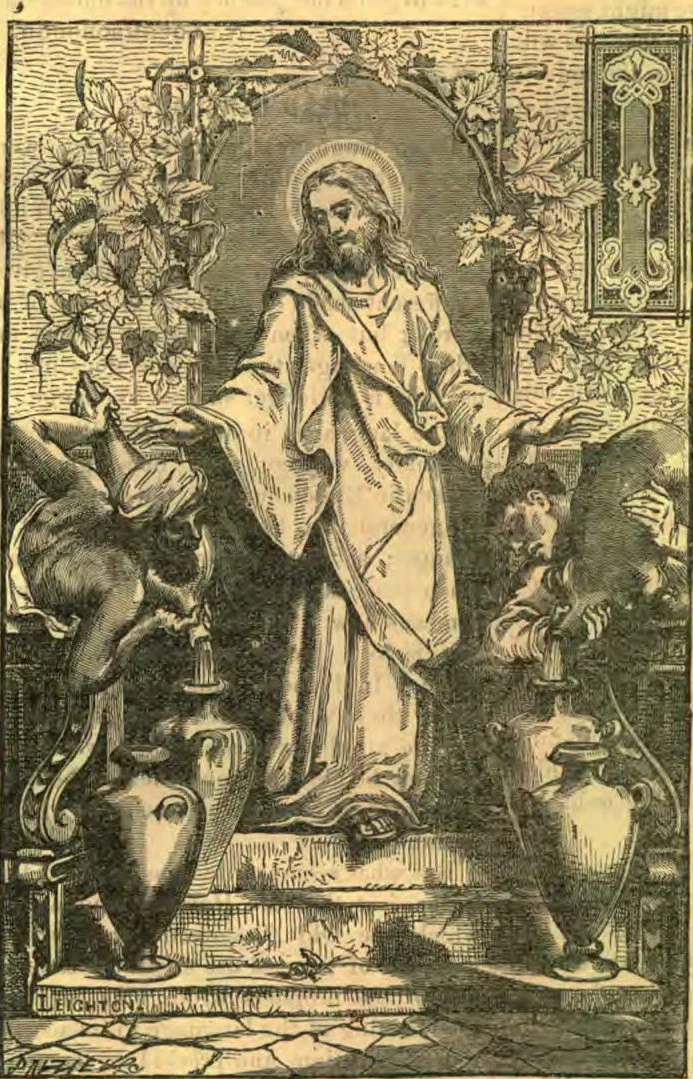
Christ’s first miracle was upon the occasion of the marriage at Cana in Galilee. The mother of Jesus was there, and both Jesus and his disciples were invited to the marriage. (Some have supposed that this was the marriage of John the evangelist, and that he was a near relative of the Lord.) There being more guests than were probably at first expected, before the end of the feast the wine was all gone. Mary mentioned this circumstance to Jesus, and also told the servants to do whatever the Lord told them. At the proper time for Jesus to work his miracle upon this occasion, he commanded that six water-pots of stone be brought and filled to the brim with water.
The accompanying engraving represents an entrance to an Eastern house. The servants, in obedience to the Saviour’s command, are filling the water-pots with water. Five water-pots are discernible, one is probably hidden by the Saviour’s garments. Immediately Jesus tells them to draw out from the pots and carry to the governor, or chief man of the feast. And they bare it. And when they did so, the water was changed to wine. John 2:7-9.
The governor was ignorant of what Jesus had done, but when he tasted the water which was made wine, he called the bridegroom to him, saying, “Why have you done contrary to the usual custom? Others, when they make a feast, set the good wine upon the table first, and after men have had enough, so that the taste is not so delicate, they offer that which is not so good; but thou hast kept the good wine until now.” This miracle convinced the disciples that he was the Son of God.
There is a story related of Dryden, the poet, that when he was a boy at school he showed a very fine genius; and having one day neglected his task, or committed some other fault, his master told him he should escape punishment, if he could manage to relate the miracle at Cana of Galilee in one line; and that he immediately replied,—
“The modest water saw its God, and blushed.”
This line is very beautiful, and worth your remembering. M. J. C.

BIBLE FIRST.

’T IS well nigh forty years ago: How time doth run! but still ’t is so— A good man sat beside the fire, While a beautiful child, who called him sire, Had just come in at the nursery door, And was playing beside him upon the floor. ’T was early morn; the father waits For breakfast,—they have laid the plates,— The daily paper takes to read, But the child climbs in his lap, with speed, And snatching the paper away, he cries— His blue eyes filled with a sad surprise— “No, no, papa, take the Bible first.” The father embraces the beautiful boy, With a loving pride and a trembling joy; He feels that an angel is hovering nigh; Too full his heart to make reply; But he goes to work, when the meal is o’er, With a lesson then learned, as never before. The sweet little Mentor death calls away; And while he bends over the beautiful clay, The father feels his child has been A messenger sent his soul to win. The lisping words still sound in his ears, As wealth comes in with the rolling years, And the “Bible first,” ’mid all his cares, Still uppermost in his heart he bears; The word of God as his rule of life, A helper and guide in the world’s rude strife.
—Advocate and Guardian.

Well-Spent Childhood Hours Build Lasting Character

SOME of the ablest men of this world owe more than half their success in life to the well-spent hours of their childhood. The foundation of character is laid in youth.

From Sea to Sea: Quartz Mills at Colfax

FROM SEA TO SEA.—NO. 2.

When we closed our talk last week, we were on the Central Pacific R. R., slowly ascending the Sierra Nevadas, in sight of the quartz mills in the distance. Having now arrived at Colfax, we will take time to examine one of these mills. Upon the outside we see men running car loads of rock which has been lifted up the shaft from the mines, into the upper part of the mill; and as we enter, we see men with heavy sledge-hammers breaking these rocks into pieces about as large as a man's fist. We are told that this rock is “gold-bearing quartz,” but we do not see much in it that looks like gold. Presently, we see one of the workmen throw aside a piece which is covered on the outside, and seems to be permeated through and through, with yellow specks about the size of a large pin head. Now we think we have seen some genuine gold; but to our astonishment we are told that “all which glistens is not gold,” and that that which looks to us so valuable is only “pyrites,” which, placed in the crucible of the refiner, will all turn to dross, and prove of no value whatever. In contrast with this, the workman shows us a dull looking piece of green rock, which we might esteem of but little value, and tells us that this will yield sixty or seventy dollars to the ton.
We pass down a few steps to see what is becoming of the broken rocks thrown into the great hopper above. Oh, what a racket! enough to deafen one! This noise is made by the stamp-mill and crusher. Here we see the rocks dropping from the hopper into a place arranged somewhat like the cylinder and concave of a threshing machine, only the massive teeth are many times larger and stronger. In this craunching, groaning machine the rocks are broken into pieces about as large as walnuts.
Before us is a row of eighteen upright shafts, with massive iron pestles at their bases. These pestles strike into huge iron cases. Into this great mortar and directly under these pestles, the small pieces of rock are being shoveled. A small stream of water runs through the iron mortar, and we are told that this is the stamp-mill, driven by a powerful steam engine, which is pulverizing the ore so that the gold can be separated from the rock.
We descend another story, where we behold a stream of mud and water running from the stamps into a huge tub. In this tub are upright paddles which are carried by machinery rapidly around the tub, somewhat as a woman stirs cream into butter in a crock. This stirring causes the heavy portion of the dirt containing the gold to sink to the bottom of the tub, while the water and light mud run off in pipes.
In the next story below is to be seen a great iron pan in which has been deposited a quantity of this heavy mud, after the water was drained off from it. Into this pan they have poured quite a quantity of quicksilver. This is called the amalgam pan. What is amalgam? It is a mixture of quicksilver with some metal; in this case the metal is gold. Quicksilver has great affinity for gold when brought in contact with it, and in the amalgam pan it picks up the gold, and separates it from the pulverized ore.
We next visit the retorting room where the amalgam is melted, and the quicksilver in the shape of blue fumes rises from the crucible, and the gold, in a crude state, can be cast into bars and sent to the refiners, where, by the application of powerful acids and intense heat, the dross is entirely removed from it. This refining process is usually done away from the quartz mills. There are gold refineries in San Francisco.
The process of retorting the quicksilver is very unhealthy, especially if the workmen breathe the fumes of the quicksilver. The retorting is usually done under a condenser, which is a huge iron like an inverted cup. Cold water runs over this iron, and as the fumes of the quicksilver strike the cold iron, it turns to drops of quicksilver, and runs down the sides of the condenser, much as steam turns into water as it strikes the cold lid of a tin boiler.
But the half hour that our train stopped for supper is up, and we must hurry back so as to go on our journey up the mountains.
J. N. LOUGHBOROUGH.

DEAD LANGUAGES.

DEAD languages are those which were once spoken by different nations, but have now ceased to be in general use. While any language is in common use, it is subject to changes, and each generation gives a different shade of meaning to some of its words; but when any nation adopts another language, the old one goes out of use, and is no longer subject to change.
The languages in which the Bible was originally written, were once generally spoken in Bible countries, but are not now in general use, hence are not subject to change; so that whatever a word meant when those languages ceased to be spoken, it means now. All will see how necessary this is to a proper understanding of the Bible. Had those languages continued alive, they would have been subject to change all the way along, and we should not now be able to know whether the Bible in its present form is the true word of God or not.
But what seems quite strange about this, is the fact that the Hebrew language, in which the Old Testament was written, went out of general use about the time the last of the prophets wrote, thus confining the meaning of the language to its acceptation at that time, and precluding the possibility of its corruption.
So with the New Testament. Soon after it was written in the Greek, that language ceased to be commonly spoken, and all its words were ever afterward to have the same meaning then attached to them.
In all this we can see the fulfillment of God’s word. Isaiah says, “The grass withereth, the flower fadeth, but the word of our God shall stand forever.” It shows, too, how careful the Lord has been to preserve the Bible to us free from corruption, that we may have faith in him, and confidence in his promises.
J. O. CORLISS.

WHAT IS YOUR COPY?

ANY of our little friends are learning to write, and they well know how necessary it is to have a good copy, and then to follow it carefully and patiently. If the copy is faulty, their writing will show the same defects; and no matter how perfect the copy, they will never succeed unless they study it closely, and then write every word over and over, until they can make it correctly.
We are all engaged in a work in which we need a good copy; a work far more important than learning to write. The word character signifies to engrave, or that which is engraved, and just as the engraver traces his design upon the metal, so every thought and word and action of our lives is making its impression upon our characters. If we would form a good character, we must follow a right example,—a perfect copy. Where shall we look for such an example?
We knew of one little boy who tried to find some one among his schoolmates whom he could imitate. But after thinking carefully for awhile, he sadly exclaimed, “There isn’t one of them that I can pattern after without copying a blot!” How many children, and grown people too, are copying a blot? That boy who is learning to take God’s name in vain, that one who thinks it manly to smoke because others do, the boy who hangs around street corners and catches the words and manners of loafers,—all these and many others are bringing a stain upon their characters, which, unless removed, will shut them from the society of the good and noble here, and from the kingdom of God hereafter. Even the best and noblest of human beings are not entirely faultless. We cannot safely imitate them in all things. But there is One whose example is a perfect pattern. In childhood, in youth, or in manhood, there is no blot, no blemish, upon the character or the life of Christ. It is right to emulate the good qualities of others, but never to follow them only as they are like Jesus.
We are to study the copy. The life of Christ has been given us that we may know how to live. And then every day we should try to imitate the copy, “To walk even as He walked,” and never be satisfied until our thoughts and words and actions are like those of the blessed Saviour.
Dear children, as you trace with care the lines in your copy-books, remember that greater work which you have to do, and strive earnestly to imitate the perfect Pattern, so that the Master, as he shall look upon your work at last, may pronounce it “well done.” M. A. D.

BIBLE LESSONS FOR YOUTH.

LESSON XXV.—THE FIRST COVENANT.

1. When the Lord called Moses up into the mountain, what did he give him for the people? Ex. 19.
2. To what did this message relate?
3. In what words did the Lord remind the people of the care which he had had over them? Verse 4.
4. What blessings did he promise to bestow upon them if they would, on their part, fulfill certain conditions?
5. What were these conditions?
6. In what words did he assure them of his power to confer these blessings?
7. What did the people say when Moses had presented to them the words of the Lord? Verse 8.
8. In making this covenant with God, what did the people promise on their part?
9. What did the Lord promise on his part?
10. Why were the people commanded to sanctify themselves against the third day?
11. In what way were the people made to understand that this mountain was a sacred place? Verses 12, 13.
12. What was seen on the mount on the morning of the third day?
13. What was heard?
14. How did this affect the people?
15. What caused these strange phenomena? Verse 18.
16. How did the smoke ascend?
17. What other effect was produced by the presence of God upon the mountain?
18. What was then heard from out the thick darkness?
19. What words were uttered by the voice?
20. How were the people affected by the awful majesty of this voice? Verse 19.
21. What did they say to Moses?
22. What did God give Moses, when he had called him up into the mount? Ex. 24: 1.
23. What did the people say when Moses came down from the mount, and told them the words of the Lord? Verse 3.
24. What had they covenanted to do, before they heard the voice of God?
25. How did they renew that covenant?
26. How was the covenant afterward ratified?
27. What did Moses say when he sprinkled the book and the people? Verse 8.

SYNOPSIS.

When the children of Israel had encamped before Mount Sinai, the Lord called Moses up into the mountain, and gave him a message for the people. This message was concerning an agreement, a covenant, which he proposed to make with them. He enumerates great blessings which he would confer on them if they would on their part fulfill certain conditions. He said to them, “Ye have seen what I did unto the Egyptians, and how I bare you on eagle’s wings, and brought you unto myself.”
After thus reminding them of all the care which he had had over them, he goes on, “Now therefore, if ye will obey my voice indeed, and keep my covenant”—these are the conditions, and now come the blessings—“then ye shall be a peculiar treasure unto me above all people: . . . . and ye shall be unto me a kingdom of priests and an holy nation.” Then, to show that he was able to bestow these blessings, he adds, “For all the earth is mine.” See Exodus 19: 3–6.
Moses came down from the mount, and presented the words of the Lord unto the people, and they said, “All that the Lord hath spoken will we do.” And Moses returned the words of the people unto the Lord, and thus they entered into a solemn covenant with God. They promised on their part to obey his voice, and on his part the Lord promised the blessings already mentioned.
And God told Moses to sanctify the people against the third day; for on that day he would come down in the sight of all the people on Mount Sinai. Neither man nor beast was to come near the mount on pain of death.
“And it came to pass on the third day in the morning that there were thunders and lightnings and a thick cloud upon the mount, and the voice of the trumpet exceeding loud, so that all the people that was in the camp trembled. And Mount Sinai was altogether on a smoke, because the Lord descended upon it in fire; and the smoke thereof ascended as the smoke of a furnace, and the whole mount quaked greatly.” The voice of God was then heard from out the thick darkness speaking the words of the ten commandments. Then the people were afraid, and stood afar off, and said to Moses, “Speak thou to us, and we will hear; but let not God speak with us, lest we die.”
After this, the Lord called Moses up into the mount, and gave him certain statutes and judgments by which the people were to be governed. Moses then came down from the mountain, and told the people all the words which the Lord had spoken; and they answered with one voice and said, “All the words which the Lord hath said will we do.” Before the commandments were given from Mount Sinai, the people had covenanted to obey the voice of God. Now they had heard that voice, and they renewed their covenant to obey it.
And Moses wrote all the words of the Lord, and rose up early in the morning and built an altar, and offered burnt offerings and peace offerings unto the Lord. And he took the book of the covenant, in which he had written the words of the Lord, and read in the audience of all the people, and again they said, “All that the Lord hath said will we do, and be obedient.” Moses then took of the blood of the offerings, and sprinkled it upon both the book and the people, saying, “Behold the blood of the covenant, which the Lord hath made with you concerning all these words.” Thus was this covenant ratified in the most solemn manner.
G. H. BELL.

LESSONS FOR CHILDREN.

LESSON IX.—THE WATERS OF MEROM.

In the northern part of the land of Canaan is a small marshy lake about six or seven miles long, called Lake Merom. The River Jordan flows from it to the Sea of Galilee, some ten or twelve miles below, and from that onward to the Dead Sea.
Near Lake Merom the king of Hazor and many other kings of the land gathered a vast army to fight against Joshua and the children of Israel. “And they went out, they and all their hosts with them, much people, even as the sand that is upon the sea-shore in multitude, with horses and chariots very many. And when all these kings were met together, they came and pitched together at the waters of Merom, to fight against Israel.
“And the Lord said unto Joshua, Be not afraid because of them: for to-morrow about this time will I deliver them up all slain before Israel: thou shalt hough their horses, and burn their chariots with fire.
“So Joshua came, and all the people of war with him, against them by the waters of Merom suddenly; and they fell upon them. And the Lord delivered them into the hand of Israel, who smote them, and chased them unto great Zidon.” “And Joshua did unto them as the Lord bade him.”
“And Joshua at that time turned back, and took Hazor, and smote the king thereof with the sword: for Hazor beforetime was the head of all those kingdoms. And they smote all the souls that were therein with the edge of the sword, utterly destroying them: there was not any left to breathe: and he burnt Hazor with fire. And all the cities of those kings, and all the kings of them, did Joshua take, and smote them with the edge of the sword, and he utterly destroyed them, as Moses the servant of the Lord commanded.”

QUESTIONS.

  1. Describe Lake Merom.
  2. Where is it situated?
  3. What river flows from it to the Sea of Galilee, and so on to the Dead Sea?
  4. Who gathered a vast army near Lake Merom?
  5. For what purpose?
  6. How is this army described in Josh. 11:4?
  7. What did the Lord say to Joshua at this time?
  8. Did Joshua wait for his enemies to begin the war?
  9. How did he come upon them?
  10. Who gained the victory in this battle?
  11. What was the chief city in all those kingdoms?
  12. What did he do to the people that dwelt in that city?
  13. What did he do to the cities of all the other kings that came out to fight against Israel?
  14. Who commanded Joshua to do this?

TO S. S. SUPERINTENDENTS.

THE position you occupy is one of the most responsible in the church. The Sabbath-school is the church nursery, the place to discipline the youth and prepare them to fill stations of usefulness in society and in the church, and finally to have a place in Christ’s everlasting kingdom. Then how important that their training should be correct; for “as the twig is bent, the tree inclines.” In order to be successful in this responsible position, you need the best assistance to be found, and I know of no better help (outside the Bible) than the weekly INSTRUCTOR.
The Sabbath-school should be made attractive and interesting to the children, so that they will delight to come; and there is nothing that will accomplish this like having a nice pictorial paper to distribute among them every Sabbath. This will cause them to look forward with delight to the Sabbath, when they expect to receive their paper.
We all have a responsibility in this work, parents and teachers as well as superintendents, and the Lord will hold each of us accountable for the manner in which we discharge our responsibility. Each school in the land should take enough INSTRUCTORS to supply every family that attends with at least one copy, and whenever children come into the school who are not of our faith, they should also receive a copy. This might interest them to come again, and they might induce their parents to come also.
Here is a grand field for missionary labor, and one that should not be neglected. Then there are families so far from any church that their children do not have the benefit of the Sabbath-school. These especially should have the weekly INSTRUCTOR, not only to read but to learn the lessons from, so as to have a family Sabbath-school each Sabbath.
Let every superintendent see that a club is ordered at once for the school. Don’t put it off till next week. Now is the time. Be persevering, and do not give up because some complain of hard times, scarcity of money, etc. Eternal life is worth more to our children than anything this world can afford. Do not let your eyes be blinded to the infinite value of eternal life; but be more earnest in your efforts to have your children obtain a moral fitness for Heaven than you are in securing for them food and raiment. J. N. AYERS.

LETTER BUDGET.

PARMA, MICH.
DEAR EDITORS: It is with pleasure that I tell you that I have been trying to keep the Sabbath a little over one year. I have been taking the monthly INSTRUCTOR, which I liked very much, but now I am taking the weekly. I find good instruction in it, which I am trying to follow. I have read the New Testament through, and now I am going to read the whole Bible through. I hope all my young friends will do the same. I am twelve years old. Yours truly, JAMES MANZER.
TEMPERANCE COLONY, CAL.
DEAR EDITORS: I live with my parents where I can go to Sabbath-school. I take your paper and like it very much, and would like to take it every year. I am twelve years old. I have five little brothers sleeping in death. I want to live so that I may meet them with the INSTRUCTOR family in the kingdom of God. Pray for me, that I may finally have part in the first resurrection. Yours truly, ANNA HUTCHINGS.
BERLIN, MICH.
DEAR EDITORS: We have received one of your weekly INSTRUCTORS, and like it very much. In reading over the letters of the monthly INSTRUCTOR, I saw that many of the writers wished it would come weekly. And so you have succeeded in satisfying their wishes. I think the INSTRUCTOR contains a great deal of good instruction. I go to school this winter, and like it very much. Yours truly, MARY STEPHENS.

“THAT’S HOW.”

Soon after a great snow-storm a little fellow began to shovel a path through a large snow-bank before his grandmother’s door. He had nothing but a small shovel to work with.
“How do you expect to get through that drift?” asked a gentleman who was just then passing by.
“By keeping at it,” said the boy, cheerfully. “That’s how.”
That is the secret of mastering almost every difficulty under the sun. If a hard task is before you, stick to it. Do not keep thinking how large or how hard it is; but go at it, and little by little it will grow smaller until it is done.
If a hard lesson is to be learned, do not spend a moment in fretting; do not lose breath in saying, “I can’t,” or “I don’t see how;” but go at it and keep at it—study. That is the only way to conquer it.
If a fault is to be cured or a bad habit broken up, it cannot be done by merely being sorry, or only crying a little. You must keep fighting until it is got rid of.
If you have entered your Master’s service and are trying to be good, you will sometimes find hills of difficulty in the way. Things will often look discouraging, and you will not seem to make any progress at all; but keep at it. Never forget. “That’s how.”

NOT TOO LATE YET!

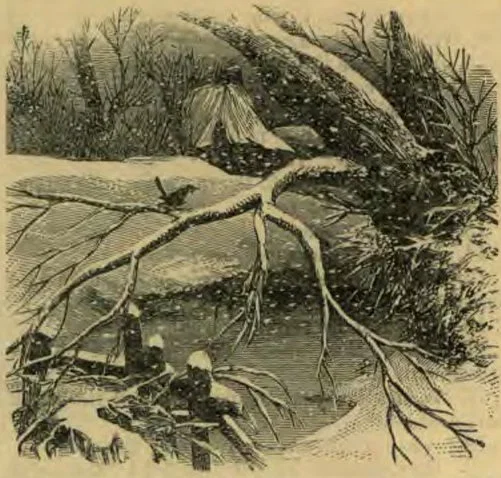
ALTHOUGH the snow and extreme cold have raged extensively this winter, yet on account of the fine sleighing it has thus far been quite enjoyable. When our January thaw set in, we felt that winter was broken, that in a little time the snow and cold would give place to the robin’s songs; but the change in the weather this month to cold again, suggests the following queries:—
“Will the winter never be over? Will the dark days never go? Must the buttercup and the clover Always remain under the snow?”
But the poet whispers a word of encouragement for us just now, for—
“The weariest month of the year, friend, Is the shortest and nearest spring.”
And it is almost gone too.
No doubt the great fall of snow has hindered our little friends in the work of canvassing; but the days are now becoming longer, so that what you have lost by being unable to travel on foot through the snow, you can more than make up in these long days. We want you, dear friends, to be supplying yourselves with the beautiful Bibles offered as prizes to canvassers. We think you can never secure such a nice Bible so cheap; and we think any other would never seem so precious to you as one earned in the good work of getting subscribers for the INSTRUCTOR. How many Bibles shall we be able to send out during the month of March? Read again the rare offer to canvassers, and buckle on the armor anew, determined to become possessor of one. It is not too late yet.
M. J. C.

A WASP’S NEST.

You have seen and admired it many a time, no doubt, but perhaps you have never seen the kind of which I am going to tell you. A dark brown wasp, with yellow bands across his jacket, and bright yellow feet, builds a round nest of yellow clay which is a very peculiar kind of structure. The grown-up wasp takes some wet clay and works it into a round pellet. Then with head and fore-feet it presses it down to the surface on which it is building. The inside of the round ball is smooth, and when the work is considered good enough, the wasp goes off and catches a small spider. This it stings in just such a way as to paralyze without killing it, and then it is dropped into the little house.
An egg is then laid beside the spider, and the wasp goes on catching spiders, until twelve or fifteen are snugly tucked away. Then a clay cover is made for the opening, and another room is built in the same way. What are the spiders for, do you say? For the new wasp to feed upon. The old wasp knows just how many it will take for the young larva until it is old enough to become a pupa. When the spiders are all eaten, the young wasp gnaws a round hole in the wall of its cell, and comes out to enter upon the active duties of a wasp’s life.—S. S. Advocate.

Little Hands and Little Feet for God

Little hands can work with meekness, Smallest things may please the Lord; Little feet can run with fleetness, Errands must be done for God.

WHAT THE SNOW-FLAKES DID.

Over the great broad prairie The snow-flakes, soft and light, Began in early morning To carpet the ground with white. Softly they flutter downward, And some of them paused to rest On two little threads of iron, That tie the East to the West.
But one little snow-flake whispered, “Alas! how small am I! On this cold, hard bed of iron What can I do but die?” Her sister snow-flake answered, “Yes, I know that we are small, But that needn't worry you, sister, We've nothing to do but fall!”
Then every listening snow-flake Went steadily on and on— Falling and falling and falling, Till the wintry day was gone— And then, why—the rails were hidden, And everywhere the eye Saw only the spotless snow-drifts Under the cold gray sky.
In vain the panting engine With snort and scream, essayed To pass, the tiny snow-flakes A giant barrier made! Came hurrying men and engines, While frantic whistle blew, Till at last eight “iron horses” The train in safety drew!
Now if every little snow-flake Had paused that stormy day, To muse and sigh despondent— To melt upon its way— They never could have wrought the chain That link by link they threw Around that monster engine, And held it captive too.
This story of the snow-flakes Is more than idle verse— It points you to a moral Which I need scarce rehearse: That any thought, word, action, However light and small, May aid you in your heavenward way, Or bind you here in thrall.

You have reached the end of this edition.

The Youth’s Instructor · Feb 26, 1879