FORGIVE and forget, it is better
To fling all ill feeling aside
Than allow the deep, cankering fetter
Of revenge in your breast to abide;
For your step o’er life’s path will be lighter,
When the load from your bosom is cast,
And the glorious sky will seem brighter,
When the cloud of displeasure has passed.
Tho your spirit swell high with emotion
To give back injustice again,
Sink the thought in oblivion’s ocean,
For remembrance increases the pain.
O, why should we linger in sorrow,
When its shadow is passing away,—
Or seek to encounter to-morrow,
The blast that o’erswept us to-day?
Our life’s stream is a varying river,
And tho it may placidly glide,
When the sunbeams of joy o’er it quiver,
It must foam when the storm meets its tide.
Then stir not its current to madness,
For its wrath thou wilt ever regret;
Tho the morning beams break on thy sadness,
Ere the sunset, forgive and forget.
—Robert Gray.
ALL ANIMAL ENERGY COMES FROM PLANTS.
By J. Howard Moore
J. Howard Moore, A. B., in The Vegetarian and Our Fellow Creatures.
ALL beings, whether phytophagous (feeding on plants) or creophagous (feeding on animals) are sustained by food compounds obtained directly or indirectly from plants. “All flesh is grass.” No animal can produce protoplasm, which is the physical basis of all life. This is a power of the plant and of the plant only. No animal can create starch or sugar or fat or proteid. The animal may, by the acids of its body, change food substances from one form into another, as proteids into peptones, starch into sugar, sugar into glucose, and starch or sugar into fat. These changes are superficial changes. They involve no synthetic or constructive process. They are affected by a slight shifting of the atomic elements, and are brought about generally in order to render the substances more assimilable, that is, in order to get them into forms in which they will readily strain through the membranes and permeate the cells and tissues of the body. No animal can create energy—more accurately, no animal can by molecular manipulation change kinetic energy into potential. All any animal can do is to dissipate the energy generated in the sunlit laboratories of the plant. . . . The energy of the engine is derived from the same source, for coal is “fossil sunshine.” Now, the plant is the natural receptacle for that part of the solar energy which shows itself in the phenomena of the organic life of the earth. The plant stores this energy in the form of potential compounds. It takes the simple binary compounds of water, carbon dioxide, or ammonia, and under the miraculous action of sunlight converts them into the exceedingly complex and unstable compounds of starch, sugar, oil, and proteid. The animal takes these compounds and by degrading them to their original binary beginnings, that is, by changing their potential energy into kinetic, derives its life and motion. The sun charges the plant, and the plant energizes the animal. An ear of corn or wheat is a battery of stored radiance, which the bodies of animals discharge in acts of kindness and crime.
The plant is, therefore, the natural food of the animal, and the plant kingdom is the exclusive source of all the life, thought, and activity of the animal world. When one animal makes a meal out of another, it simply reappropriates the energy which its victim has previously appropriated from the plant—it simply uses second-hand that which its victim has taken first-hand. The plant and the animal are mutualists. They co-operate with each other. The plant is fixed and passive. Its nature and organization adapt it to the storing of energy. The animal is detached and active. Its nature and organization make it a consumer of energy. The plant in the exercise of its natural functions creates that which is indispensable to the animal, and vice versa. The plant eats and drinks ammonia, carbon dioxide, and water, and produces proteid, starch, sugar, cellulose, and fat. The animal takes these products of the plant and gives in exchange, as the excrementitious products of its waste and decay, carbon dioxide, water, and urea. The plant and animal kingdoms are bound together by common interests and reciprocal necessities. They are not two separate and independent empires. They are the supplemental halves of the organic whole. And whenever any animal, instead of accepting the bounty and co-operation of the plant, turns round and swallows its fellow, it violates one of the oldest-established adaptations in nature.
It is, therefore, not only possible to find in the plant world the substances necessary to human life, but we necessarily find them there, for they are to be found primarily no place else.
Take a Tourist Car
—A Santa Fe tourist car—if you would enjoy your trip across the continent.
The cars are so comfortable, the route so interesting, the people so pleasant, the excursion manager so accommodating, the porters so obliging, and the meals so good, that you simply can’t help being satisfied.
Personally conducted east and west three times a week—Mondays, Thursdays and Saturdays—in Chicago, Kansas City, Los Angeles and San Francisco.
Folder giving full information furnished on request by any Santa Fe Agent.
MIND THE MASTER.
By Esther H. Trowbridge
[Esther H. Trowbridge, in Christian Advocate.]
Our noblest thoughts are those that start
In the deep fountain of the heart,
And wend along their hidden way,
Like brooklets on a summer’s day,
Till in the open fields they find
The broader rivers of the mind;
And there, within the mighty sweep
Of action, proud and strong and deep,
Those thoughts that in the heart were born
At first are lost, like stars at morn,
But finally their force intent
Returns, when brain and nerve are spent,
Asserting by a right innate
To rule our acts of love and hate,
And to declare to all mankind,
The heart is master of the mind.
THE TESTIMONY OF SCIENCE.
By Ambrose Bierce
A CAVE bat was describing the outside world. “It is a much larger cavern than this,” he said. “The walls are of onyx, the roof is of ice, the floor is probably silver. Gold stalactites depend from above and copper stalagmites rise below. We don’t know the exact age of these formations. There is a river that flows up-hill and has fishes that are parallelopipedons. They are believed to have eyes.”
“Fishes with eyes?” squeaked the other bats; “that is manifestly impossible!”
“Science has no answer to the caviling of ignorance. The bats there are seven feet long, cheerful in disposition and most amiably spotted with blue. They are very wise and do not die.”
“None of us has ever been out there, none of them has ever been in here,” cried a bat from the darkest and most distant chamber of the cave; “how is all this learned?”
“By the scientific method of inevitable inference,” was the reply. —Ambrose Bierce.
THE ELECTRIC AGE.
By Prof. E. L. Larkin
It is not possible to even imagine the advance now being made in electricity. The world is making history now before one's eyes, an epoch that will be looked upon in the future as one of vast import, and students will be taught the beginning of the electrical age, that begun in 1880, and got well under way in 1902. The history of past ages does not present such a general movement of mankind. Vast capital is being put into electric appliances daily; new plants are put in every day, new railways and new everything. The dynamo has been so much improved, that it is now almost a perfect machine. That is, it gives back more of the power put into it than any other mechanism. Electric ocean ships are in sight, and the ocean telephone also. A post-office is to be placed in the Atlantic. A ship is to be anchored, and will be supplied with spacegraphs, and grams can be sent from passing ships and letters mailed. Soon daily papers giving the news of the world will be printed at 5 A.M. on ocean liners.—Prof. E. L. Larkin.
Refreshing Sleep Comes after a bath with Glenn's Sulphur Soap
It heals while it cleanses. Its medicative qualities render the skin free from impurities. Prickly heat, burns, cuts, dandruff, submit quickly to its healing effects.
CAUTION:— Glenn's Sulphur Soap (the only “original”) is incomparable and wonderful in its remedial effects. Take no other.
At all drug stores, or mailed on receipt of 30 cents by THE G. M. CRITTENTON CO., 115 Fulton Street, New York
We Want Agents
for E-Z WASHING TABLETS. We offer a good commission to those who will put in full time canvassing for them. Easy to sell because they do all we claim for them. Easy to handle because we make the terms right.
A pointer from an agent: “The Washing Tablets duly received. Every one speaks in the highest praise of them. I hope to find many new customers. They certainly do all that you claim for them.”
Another: “I sold $2.60 worth in two and one-half hours. I can dispose of lots of them after I get well started.”
Agents’ samples and terms FREE for 2-cent stamp. Write to-day.
Address, ALFRED MALLETT, Nyack, New York
LESSONS BY MAIL ON MEDICAL ELECTRICITY OR HOW TO USE THE BATTERY
By G. L. Abell
By Prof. G. L. Abell, Member of the Board of Directors of the Electro-Medical Society of San Francisco
Learn how to use the battery and treat yourself. Many diseases are quickly cured by the proper application of electricity. The course embraces the treatment of every organ and part of the body. The lessons are written in plain language and are illustrated. Course, five dollars. Send for circular. Address,
PROF. G. L. ABELL
School of Chemistry and Electro-Therapeutics
36 Geary St., San Francisco, Cal.
I Can Sell Your Real Estate
By W. M. Ostrander
no matter where it is. Send description, state price and learn how. Est. ’96. Highest references. Offices in 14 cities.
W. M. Ostrander, 1900 N. A. Bldg., Philadelphia
THE NEW GOOD HEALTH BATH CABINET
ONLY $5
A portable appliance for stimulating the activity of the skin by hot vapor, causing profuse perspiration. Beneficial for “breaking up a cold,” “breaking chills,” relieving soreness of the muscles, rheumatism, inactivity of skin, diabetes, and disorders of the liver, kidneys, and other chronic ailments.
Full directions for use sent with each cabinet. Our cabinet is well made, and we guarantee satisfaction in every way.
THE NEW GOOD HEALTH BATH CABINET
Sold by the Good Health Publishing Company, is the only cabinet indorsed or used by the physicians of the Battle Creek Sanitarium. Order to-day.
Write for descriptive circulars with full information. Agents wanted to represent us.
GOOD HEALTH PUBLISHING CO.
Dept. A Battle Creek, Mich.
THE INDUSTRIAL FEATURES OF HEALDSBURG COLLEGE.
By M. E. Cady
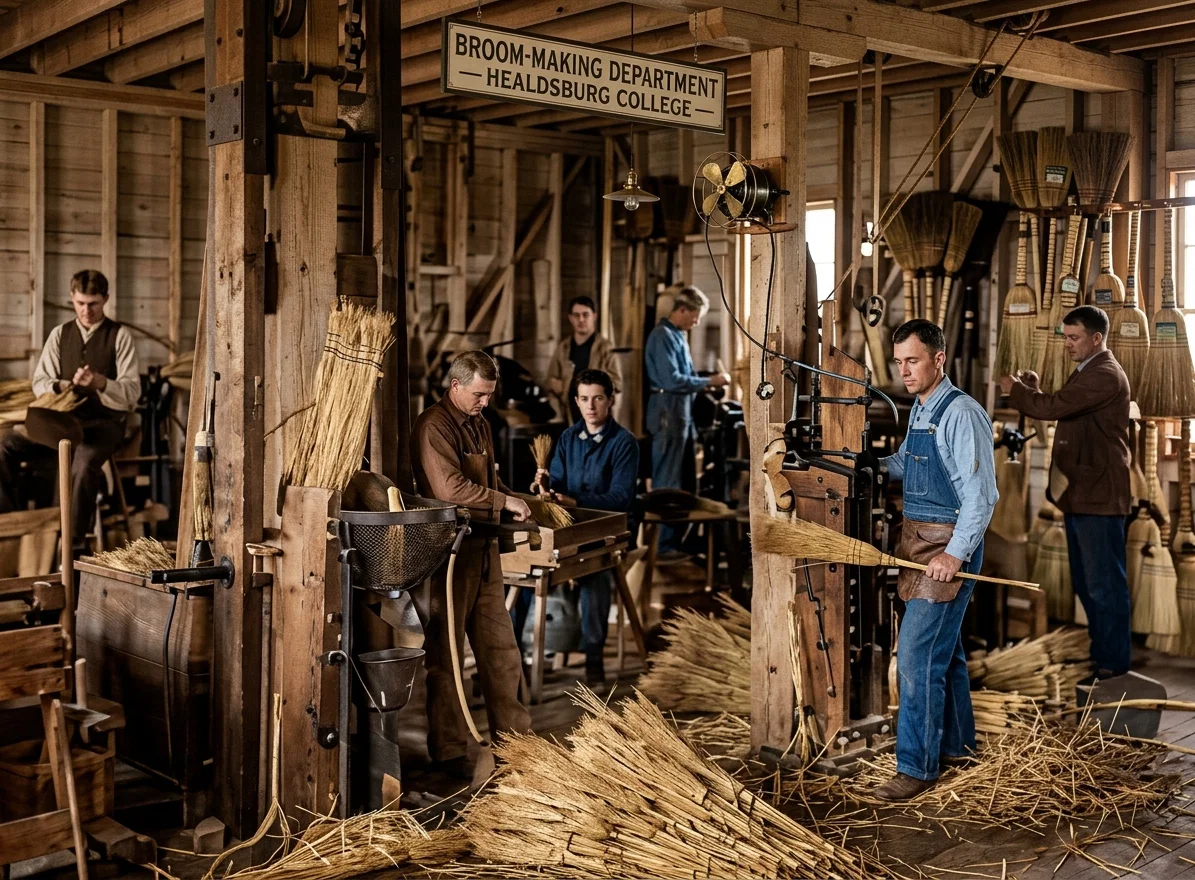
Broom Factory.
The Tent Factory.
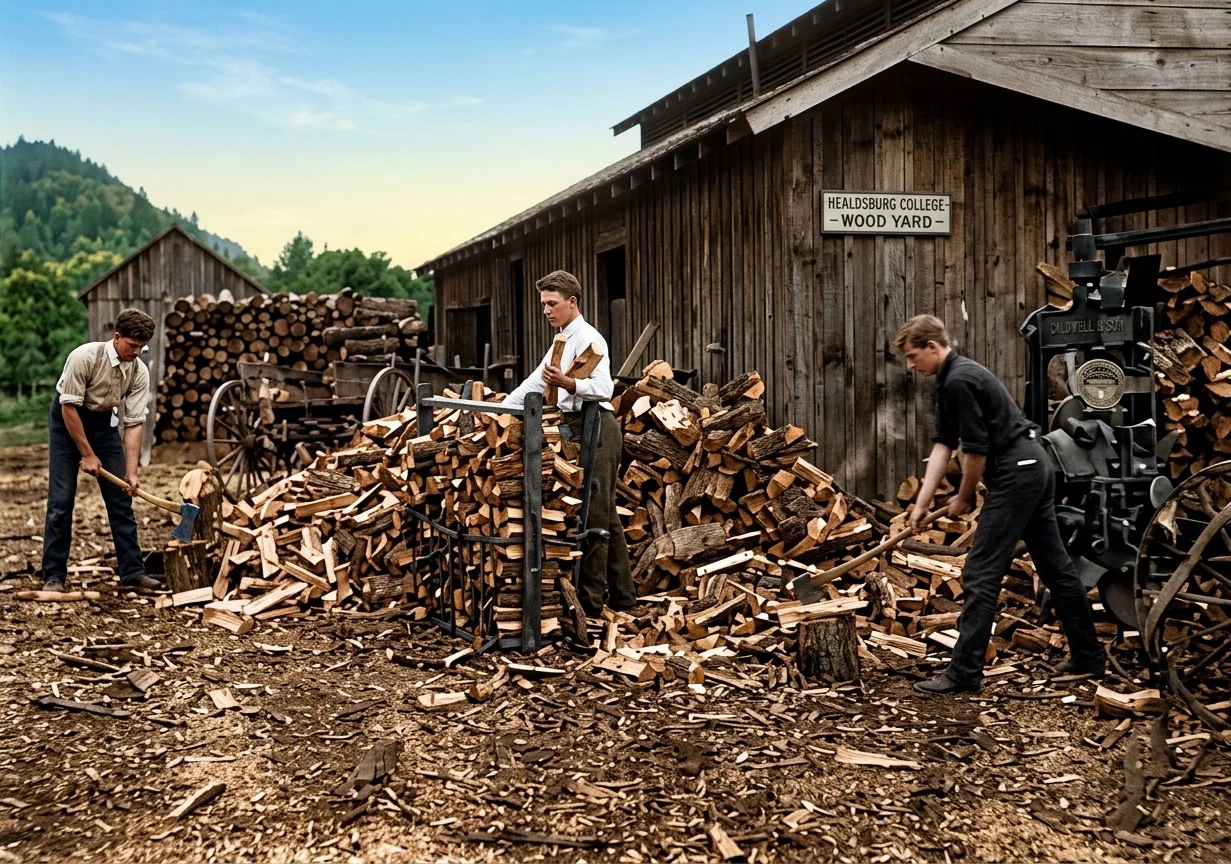
Wood Yard.
Fruit Canning Department.
During the past three years special attention has been given to the development of the industrial lines in connection with Healdsburg College, so that at the present time the following industries are being taught: Broom-making, tent-making, printing, carpentry, upholstery, cooking, hydrotherapy, dressmaking, plumbing, blacksmithing, painting, freehand and mechanical drawing. In addition to this the College is operating the largest wood-yard in the city, and as soon as consistent, harness-making, shoe-making, agriculture, floriculture, and horticulture will be added to the list of industries.
Plans are now being made to have the students cut the wood in the forest as well as to operate the wood-yard in connection with the College. Fifteen or twenty young men will be sent out into the forest to saw and cut the wood for a portion of the day and the remaining portion of each day will be spent in study and recitations. One or more teachers will accompany the students to give instruction in the different lines of education. At the present time there are over fifty students who are studying trades in the different industrial departments of the College. Those who live in the College Home are required to take an industrial study as a part of their regular program. This is not required of resident students, because of their having work to do at their homes; but they have the privilege of doing so if they desire.
The students are divided into two classes: Regulars and Industrials. Regular students are those who have sufficient means to pay all their expenses in school. The industrial students are those who are limited in means, so that a part or all of their expenses are met by labor. A full industrial student pays his entire way by labor, working fifty hours per week. A part industrial student is one who pays from $50 to $75 down on entering the school, and meets the balance by working thirty-six hours per week. The regular students attend school during the day from 7:45 A. M. to 1:10 P. M. The industrial students work during the day beginning their work at 7:30 A. M. and closing at 4:30 P. M. Their session for study and recitation begins at 5 P. M. and closes at 9 P. M. Holding an evening school for these makes it possible to keep the shops open during the day, for the unhindered transaction of business.
One of the special reasons for connecting the industrial lines with Healdsburg College is that students may not only know what is contained in books, but that they may be able to perform the practical duties of life; also there is placed before students with limited means, the opportunities and privileges of school, which otherwise they could never enjoy. Below are given four special opportunities which make it possible for young men and women who have push and perseverance to obtain a Christian education, fitting them for Christian service, the only service worth the rendering—
Opportunity Number One.
FOR DAY SCHOOL STUDENTS.
1. On payment of $75.00 persons may enter the College as regular students, and pay the balance of their expenses (from $75.00 to $100.00, according to cost of board, room, and tuition) by working for the College during the summer months. 2. The $75.00 must be paid on entering the College, and this amount with the labor performed during the summer will cover the expense of board, room, tuition, light, heat, and plain laundry. The expense of books, clothing, and other incidentals must be met by the student. 3. That the College may be properly secured those availing themselves of this opportunity must secure some one as sponsor who will make up any deficit, in case the student should fail to fulfil the conditions.
Opportunity Number Two.
FOR EVENING SCHOOL STUDENTS.
Hours 5:00 to 9:00 P. M. On payment of $50.00, and the willing and faithful performance of thirty-six hours' labor per week, the student will be entitled to board, room, light, heat, plain laundry, and tuition during the College year ending June 2, 1903. The expense of books, clothing, and other incidentals must be met by the student.
Opportunity Number Three.
FOR EVENING SCHOOL STUDENTS.
Hours 5:00 to 9:00 P. M. A limited number of persons who are able-bodied, and love to work will be admitted to the College and given sufficient work to pay their expenses as far as board, room, light, heat, plain laundry, and tuition are concerned. Fifty hours' work per week will be required of students who enter under Opportunity Number Three. Overtime will be allowed so that students can earn sufficient means to meet the expense of books and working clothes.
Opportunity Number Four.
Fifteen or twenty able-bodied, willing-hearted young men are wanted at once to cut wood a few miles distant from the College. The students will work at wood-cutting forty-five hours per week and attend the evening school from 4:00 to 9:00 P. M. each day. One of the College teachers and his wife will live with the students and the school will be conducted on the place. Students in this school will have opportunity to enjoy the Sabbath privileges with the Healdsburg Church each Sabbath.
The work in the trades is not all physical exertion, but at times the hammer and saw and other working tools are laid aside and the teacher takes time to explain by drawings upon the blackboard, and by other illustrations, the principles underlying the work they have in hand. The students are required to be intelligent regarding the trades they are learning. The young man who is learning to be a blacksmith will be called upon to make drawings illustrating the anatomy of the horse's foot so that he will understand where to drive the nails in the foot, and the proper adjustment of the shoe. He will study the principles underlying the forge, the bellows and the welding of iron, thus becoming an intelligent blacksmith. So of printing, painting, horticulture, etc., etc. There will be combined in the learning of each of the trades the physical and intellectual capabilities of the student.
From time to time the students will be required to write essays on different phases of their work.
Monthly examinations will be given, and they will receive standings in the industrial studies as well as in the book studies in the Collegiate Department. We are glad to say that the prospect is bright for the development of the industrial side of the educational work at Healdsburg College, and we invite young men and women who are desirous of obtaining such an education as herein set forth, and who are willing to consecrate all power and strength thus attained to a life of Christian service, to become students of Healdsburg College. We also invite all who are interested in moral, mental, physical, and industrial education,—the all-round practical education which fits for the practical duties of life,—to contribute of their means to establish new industries in connection with the College, and to enlarge and strengthen those already started. This will enable the College to furnish more work to students whose means are limited, and who must of necessity exchange honest labor for an education. For College calendar and further information please address Healdsburg College, Healdsburg, Cal.
M. E. CADY, President.
God Is Truth and Light
God is truth and light His shadow.—Plato.
AFTER HER TIME OF TRIAL.
It was expected that there would be those in China who would fail to stand the terrible trials which came to the native Christians there during the Boxer outrages, just as there have been professed Christians who have not stood the test, of recanting or suffering death, ever since the days of Christ. But there have been thousands in China, just as there have been thousands in other parts of the world, who have stood that supreme test of faith. Now that the times are less trying in China, many of those who recanted are coming back with repentance and contrition.
The Presbyterian missions in the province of Manchuria report the number of their converts who did not yield to the demands of the Boxers as 6,639; the number who did recant, but have since been received back, 3,300. It is probable that the proportion would hold good for the other denominations. The report states that “it is to the honor of the Chinese Christians that after a severe persecution, in which some lost their lives and many had to flee for safety, while fines were levied upon even those who recanted, and marriageable girls were kidnapped, so many have remained steadfast, and so many more have sought readmission into the churches, professing penitence for having denied the faith. Others are probably still waiting until it seems safe for them again to make open profession of their faith.” The way that the evangelical work and the medical work is being established in Heng-chow and the favor which it is meeting from the common people is indicated in the report of Dr. Griffith John of the London Mission Society, which is operating in that section. He reports that the work is opening up in that part of China in a wonderful manner. The Christian physicians have a great rush of patients. Bible classes have been organized, and these are well attended by the people on week nights as well as on Sunday. This work includes also a work of a preparatory nature for native teachers.
This changed attitude is heartily appreciated by the missionaries when they remember what their missions have passed through. One of these, in writing from Heng-chow, says: “It was interesting to visit the spot where our chapel stood before its demolition. There we found the bare ground and nothing else. There was not even a brick to be seen anywhere. The whole building had been completely destroyed, and everything in the shape of material had been carted away. We were told that such was the state of things at all our missionary stations in Heng-chow prefecture. The London Missionary Society had in that prefecture between twenty and thirty places of worship. All, without a single exception, were utterly destroyed. Orders have been given, however, to start the work of rebuilding, and we hope to see all our buildings up again before the close of the next year.” But the reception given this missionary on his return by the officials of Heng-chow was accompanied by a wonderful display of pomp and ceremony. All expressed their deep regrets for the riots of the past, and declared their indebtedness to the missionary because the indemnity required from them was so small in comparison to the damage done. This missionary declares that the time was never more propitious for the advancement of Christian work in this part of China.
A missionary reporting from his old station at Lin Ching has the following to say of the attitude of the people there since the practical suppression of the Boxer outbreak: “There are some notable changes in the attitude of the people, indicating a feeling of interest, mingled with some degree of shame. Our audiences have continued to grow in size and have shown much interest. On the part of the officials there continues to be the same anxiety lest the foreigner by some means meet with accident, so that, when traveling, they compel us to accept a guard, if possible. Those examined for baptism show a better knowledge than that usually possessed by candidates for baptism. But this does not tell all. To the west of Lin Ching there has been an uprising due to the attempt by the government to collect the tax with which to pay the indemnity. In consequence, thousands of troops have been sent to suppress the uprising. At last accounts they have not succeeded.”
Later reports than this show plainly that the spirit of Boxerism is not by any means suppressed. In some parts travel from place to place is very hazardous for foreigners or those known to be Christians.
The missionaries in China need the prayers as well as the financial support of Christians everywhere. Their lot is far from an easy one, but the harvest there is worthy of the efforts put forth in the sowing and reaping.
OUR WORK AND WORKERS.
BROTHER L. T. NICOLA reports to the Indicator that six adults were recently baptized as the result of labor at Campville, N. Y.
NOVEMBER 23 was the date set for dedicating the new house of worship in Kansas City, Mo. Brother A. G. Daniels, president of the General Conference, was expected to be present.
THE brethren at Joplin, Mo., have completed their new house of worship, and have moved the old house onto the same lot for church-school purposes. On the 9th ult. thirteen members were added to the church.
THE Second Seventh-day Adventist Church of Washington, D. C., has purchased a house of worship at the corner of 12th and M Streets, at a cost of $12,900. It was formerly owned by the Central Methodist Church. The membership is sixty-five.
A SABBATH-SCHOOL was recently organized at Fairview, Texas, by Brother H. Clay Griffin. The school is in charge of Brother J. F. Springer, formerly a Baptist minister. A four-acre plot of ground has been donated, along with other substantial pledges, for the erection of a house of worship.
A CAMP-MEETING was held in South Australia in October, which resulted in thirty souls being won to the Christian life. Brethren E. W. Farnsworth and W. A. Hennig were the ordained ministers present, both of whom went over from Melbourne. Brother Farnsworth reported back that he never had seen a larger percentage of really interested persons in a camp-meeting; so it was decided to continue with a series of tent-meetings.
FROM Laurento, La. under date of November 3, Brother S. B. Horton writes: “The Lord has worked marvelously here. We pitched tent here October 21, and have had a good attendance of Catholics as well as Protestants. We organized a Sabbath-school last Sabbath. About forty were present, mostly adults, many of whom have taken their stand for the truth. Among these are a Methodist preacher and his family who had previously opposed the work. Ground and funds are being furnished and promised for a meeting-house.”
NOVEMBER 8 eleven persons were baptized in the lake at Hiawatha Park, near Mount Vernon, Ohio. Ten of the number were students of the Mount Vernon Academy, at Academia.
A TEACHER in New Zealand writing of the tract lately printed in the Maori language, says: “There were Maori girls coming to see after school nearly every day this week for that tract, ‘Second Advent,’ asking for tracts for their fathers to read, and I have run out of them. They were so anxious to get them and the Little Friends. The most of them can read English. There is a glorious work among the Maori children here, I am sure, if we could only get the books.” Another says, “You will be glad to know that the Maoris appreciate their tracts.”
WRITING to the Welcome Visitor from Cincinnati, the 9th ult., Brother F. H. Henderson says of the SIGNS work: “Brother Granger and myself ordered fifty copies (twenty-five each). These we disposed of in various ways, and sold single copies at five cents each; and some on hearing of our work would often give us twenty-five cents for a single copy. Lastly we took out a few of the old Centennial Number, and started out to give them away; but quite frequently we were offered five, ten, and twenty-five cents, and one lady gave me thirty cents for a copy. I was often encouraged by words like these, ‘I am so glad that you are in our neighborhood distributing such good literature.’”
IN the Workers’ Bulletin we note an interesting letter from Sister Julia L. Atwood, who recently located at Quitman, Miss. She says: “An interest had already been awakened by a camp-meeting, at which the educational work received attention, and four hundred dollars was pledged toward an industrial school. The land was donated by the Mississippi Lumber Company, which runs a large sawmill in Quitman. We are located on this land, one hundred and sixty acres, which is valued at two dollars and fifty cents per acre. The schoolhouse is enclosed but not finished, as Bro. H. W. Pierce and my husband have been at work on it only since October 14. We live in tents and shall be glad when we can stay in the schoolhouse, for even in the sunny South the mornings and evenings are cool. The land is yet to clear, and I wish that some of our strong northern brethren with their heavy teams could have the privilege of helping to get the land ready for the fruit trees and vines which we hope to set out in February.”
“MASTER, SAY ON!”
By Frances Ridley Havergal
Master, speak! Thy servant heareth,
Longing for Thy gracious word,
Longing for Thy voice that cheereth;
Master, let it now be heard.
I am listening, Lord, for Thee;
What hast Thou to say to me?
Often through my heart is pealing
Many another voice than Thine,
Many an unwilled echo stealing
From the walls of this Thy shrine.
Let Thy longed-for accents fall;
Master, speak! and silence all.
Master, speak! I do not doubt Thee,
Tho so tearfully I plead;
Saviour, Shepherd! O, without Thee
Life would be a blank indeed.
But I long for fuller light,
Deeper love and clearer sight.
Resting on the “faithful saying,”
Trusting what Thy Gospel saith,
On Thy written promise staying
All my hope in life and death,—
Yet I ask for something more
From Thy love’s exhaustless store.
Speak to me by name, O Master,
Let me know it is to me;
Speak, that I may follow faster,
With a step more firm and free,
Where the Shepherd leads the flock,
In the shadow of the Rock.
Master, speak! Tho least and lowest,
Let me not unheard depart;
Master, speak! for O, Thou knowest
All the yearning of my heart;
Knowest all its truest need;
Speak! and make me blest indeed.
Master, speak! and make me ready
When Thy voice is truly heard,
With obedience glad and steady
Still to follow every word,
I am listening, Lord, for Thee;
Master, speak, O, speak to me!
—Frances Ridley Havergal.
PUBLICATIONS WANTED.
LATE clean copies of any of our denominational papers, also tracts, for missionary work. Address, post-paid, J. H. Grove, Cotton Town, Tenn.
SIGNS, Sentinel, and Pacific Health Journal, for missionary work. Address, post-paid, E. Walton, Huntsville, Ala.
LATE clean copies of the SIGNS, Review, Life Boat, Instructor, Good Health, Little Friend, or other of our English publications. Address, post-paid, W. F. Parker, Montezuma, Col.
WANTED
At once several young men to work in Food Factory and learn the Baker's trade. No one but consecrated Seventh-day Christians need apply. References must be furnished. 1628 E. First St., Los Angeles, Cal.