Review and Herald Publishing Company · Battle Creek, Mich. · Feb 15, 1900
“IF ANY OF YOU LACK WISDOM, LET HIM ASK OF GOD”
By Ellen G. White
TRUE prayer, offered in faith, is a power to the petitioner. Prayer, whether offered in the public assembly, at the family altar, or in secret, places man directly in the presence of God. By constant prayer the youth may obtain principles so firm that the most powerful temptations will not draw them from their allegiance to God.
The child Samuel was surrounded with the most corrupting influences. He saw and heard things that grieved his soul. The sons of Eli, who ministered in holy office, were controlled by Satan. These men polluted the very atmosphere that surrounded them. Men and women were daily fascinated with sin and wrong; yet Samuel walked untainted. His robes of character were spotless. He had no fellowship with the sins that filled all Israel with fearful reports.
In God there is strength; in him there is power. If we would take hold of this strength and power, we must not cease our watchfulness and prayer for a moment. We are safe only when we feel our weakness, and cling with the grasp of faith to our mighty Deliverer.
The world’s Redeemer spent much time in prayer. He loved the solitude of the mountain, where he could hold communion with his Father alone. We read: “And when he had sent the multitudes away, he went up into a mountain apart to pray: and when the evening was come, he was there alone.” “And in the morning, rising up a great while before day, he went out, and departed into a solitary place, and there prayed.” “He went out into a mountain to pray, and continued all night in prayer to God.” If Jesus manifested so much earnestness, how much more need for us to wrestle with God, and say, “I will not let thee go, except thou bless me.”
“Which of you shall have a friend,” Christ said, “and shall go unto him at midnight, and say unto him, Friend, lend me three loaves; for a friend of mine in his journey is come to me, and I have nothing to set before him? And he from within shall answer and say, Trouble me not: the door is now shut, and my children are with me in bed; I can not rise and give thee. I say unto you, Though he will not rise and give him, because he is his friend, yet because of his importunity he will rise and give him as many as he needeth. And I say unto you, Ask, and it shall be given to you; seek, and ye shall find; knock, and it shall be opened unto you. For every one that asketh receiveth; and he that seeketh findeth; and to him that knocketh it shall be opened. If a son shall ask bread of any of you that is a father, will he give him a stone? or if he ask a fish, will he for a fish give him a serpent? or if he shall ask an egg, will he offer him a scorpion? If ye then, being evil, know how to give good gifts unto your children: how much more shall your Heavenly Father give the Holy Spirit to them that ask him?”
In the place of bearing your perplexities to a brother or a minister, take them to the Lord in prayer. Do not place the minister where God should be. The minister of Christ is like other men. True, he bears sacred responsibilities, but he is not infallible. He is compassed with infirmity, and needs grace and divine enlightenment. He needs the heavenly unction, in order to do his work with success. Those who know how to pray, who know what are the invitations of the gospel of Christ, show dishonor to God when they lay their burdens upon finite men. It is always right to counsel together; it is right to converse together; it is right to make the difficulties that present themselves in any enterprise plain before your brethren and your ministers. But do not depend upon man for wisdom. Seek God for the wisdom that comes from above. Ask your fellow laborers to pray with you; and the Lord will fulfill his word, “Where two or three are gathered together in my name, there am I in the midst.”
The Lord does not say to us: If any man lack wisdom, let him go to his pastor or to his neighbor, and pray to him for help. Lay your burden on finite men, as weak as yourself, and seek their wisdom. He says: “If any of you lack wisdom, let him ask of God, that giveth to all men liberally, and upbraideth not; and it shall be given him. But let him ask in faith, nothing wavering. For he that wavereth is like a wave of the sea, driven with the wind and tossed. For let not that man think that he shall receive anything of the Lord.”
The Lord invites us to ask of him. Shall we turn from God’s wisdom, to ask of men? We can not obtain from men the help that comes alone from God, in whom is no variableness, neither shadow of turning. They may advise us to do what is best; but unless they receive their light from heaven, they can have no certain light to give us. The Lord is acquainted with our ignorance and darkness, and he bids us come to him, the source of all light and wisdom. “Come unto me,” he says, “all ye that labor, and are heavy laden, and I will give you rest. Take my yoke upon you, and learn of me; for I am meek and lowly in heart: and ye shall find rest unto your souls. For my yoke is easy, and my burden is light.”
Promises are estimated by the truth of the one who makes them. Many men make promises only to break them, to mock the heart that trusted in them. Those who lean upon such men lean upon broken reeds. But God is behind the promises he makes. He is ever mindful of his covenant, and his truth endures to all generations. “Blessed be the Lord, that hath given rest unto his people Israel, according to all that he promised: there hath not failed one word of all his good promise, which he promised by the hand of Moses his servant.”
The gift of God’s dear Son makes the promises ours of a surety. Christ clothed his divinity with humanity, and paid the ransom for man, and he desires that man shall rightly estimate the life thus provided. Man is to understand, by an experimental knowledge, the tender love of God for his creatures. God expressed his love in a wonderful way. He could not make man a partaker of the divine nature, until his only begotten Son, equal with the Father, should stoop to human nature, and reach man where he was. God did not withhold his Son. In Christ humanity touched humanity. In him man becomes a child of God, an heir to all the treasure of heaven.
The Lord is always the same. He keeps truth forever, and there is no unfaithfulness in him. We have confidence in our fellow men; then why are we so apt to distrust the promises of God? Christ declared that heaven and earth would pass away, but that not one word of God would fail. Why, then, do we not honor the Lord by believing his word, which is not yea and nay, but yea and amen in Christ Jesus? Why do we not come to our Heavenly Father as a little child comes to its earthly parent, and ask him for the things we need? Christ says: “If ye then, being evil, know how to give good gifts unto your children: how much more shall your Heavenly Father give the Holy Spirit to them that ask him?”
Let us not grieve the Spirit of God any more. Let us not show distrust of his word; for he alone is to be depended on. He is “the blessed and only Potentate, the King of kings, and Lord of lords.” He has a mighty arm; strong is his hand, and high is his right hand. He is a mighty God, who is able to do exceeding abundantly above all we ask or think. He is wonderful in counsel, the only wise God. If he is for us, who can be against us? “Trust ye in the Lord forever: for in the Lord Jehovah is everlasting strength.”
MRS. E. G. WHITE,
THE HIDDEN ROSE
“It has not bloomed,” I said, “though I have watched
The summer through. No rose, for all my care;
Nothing but leaves upon each thorny stem;
Leaves,—and I hoped to see rich blossoms there!”
But when the autumn came, with frosty hands
That plucked the leaves, and flung them far and wide,
A ruddy globe appeared to show me where
One single perfect rose had bloomed and died.
Then, poised upon the bare and briery branch,
The crimson sphere spoke to my soul, and said:
“Look closer ’neath life’s leaves, lest its sweet rose
You fail to find till all its grace is fled.”
— Selected.
HISTORY AND FIRST PRINCIPLES OF THE SCIENCE
By J. Edgar Ross
THE purpose of this series of articles is to give the reader a practical knowledge of the fundamental principles of all the common processes of photography. They are intended especially for beginners; so those who are more advanced in their study of this fascinating art-science will kindly pardon the minute details that may seem to them unnecessary. Some of the younger members of the INSTRUCTOR family may find the first three or four papers rather hard to understand; but they bear the same relation to what is to follow that a foundation has to a house, and should therefore be carefully read.
If it did not make such an unwieldy word, I should prefer to call photography a science-art; for it certainly was a science before it was an art. As a science, it is now nearly a century old; while as an art, it dates back but a few years.
The word “photograph” comes from two Greek words meaning “light” and “to write.” Photography is, therefore, the science, or art, of writing with light.
In the second year of this century an Englishman named Wedwood published a paper on the process of photography on paper sensitized with nitrate of silver. The same process—with great improvements, however—is the one by which nearly all photographs are printed at the present day. This method was not practical, but it gave impetus to research, and from time to time others added the knowledge gained by experiment and study, until, in 1839, there was published a description of the first practical process of photography. This has since been called the “daguerreotype” process, in honor of one of its inventors.
This process was simple but quite laborious. It gave a picture on a silver-plated copper plate, and in its day was considered something wonderful. It was necessary to secure a perfect polish on the plate, as upon it largely depended the beauty of the finished picture. This was the most difficult part of the work.
When the daguerreotype process first came into use, it was often necessary to expose the plate half an hour. By comparing this time with the quickest exposure practical at the present day, one can form some idea of the great advancement made in photographic science. An exposure of one five-hundredth of a second is no longer uncommon, and some shutters are said to work in less than half that time.
The daguerreotype was succeeded by one process after another, until wet collodion plates came into use. The wet-collodion process held its own for many years, and is practiced to some extent even at the present day.
The principles underlying the science of photography are the same to-day as they were in the days of Wedwood and Daguerre,—the same as they were on the day when God said, “Let there be light.” Man has been slow to grasp the truth that God has placed within his reach, slow to understand the laws that he established in the beginning. New discoveries are constantly being made in this science, as well as in all others. The principles underlying all branches of science will never be thoroughly comprehended by finite man; but those who, in this world, prove themselves worthy of eternal life will go on forever acquiring new facts, and gaining a clearer understanding of God’s eternal laws.
The corner-stone of photography is this: The action of light causes definite changes in certain substances. A newspaper that has been exposed to the sunlight for several days will be a different color from one that has been protected. If part of this paper had been exposed, and part covered with something that would have shut out the light, the result would have been a photograph,—a very crude one, to be sure, but a photograph nevertheless.
In actual practice we have, instead of the newspaper, a glass, celluloid, or paper support, on which has been coated a film of gelatin, collodion, or albumen, made sensitive to light with bromide or chloride of silver. Without going into the details of the chemical process, it will be sufficient to say that bromide and chloride of silver are prepared by adding the appropriate chemical to silver nitrate. Silver nitrate is pure silver dissolved in nitric acid. Light causes no perceptible change in bromide of silver; but after it has been exposed, it will, if brought into contact with certain other chemicals, be turned again into metallic silver. This is called the “developing process.” When exposed to the light, chloride of silver will slowly but quite perceptibly darken. This is the “print-out” process. To obtain the same results with each, the chloride would require an exposure of hours, while a small fraction of a second would be sufficient for the bromide. Negatives are made by the developing process; while the print-out process is principally used in making positives, or “prints,” as they are usually called.
Any flat object that may be seen by transmitted light—that is, light that comes through the object itself—may be photographed without a camera. For an example of this, place a piece of print-out paper on a board, a book, or anything that will serve as a support. On this lay a leaf, and cover both with a plain glass, which can be held in such a way as to insure perfect contact of paper and leaf. Now if this simple printing frame is held in the sunlight for a few minutes, it will be seen that a picture of the leaf has been printed on the sensitive paper. The picture will be like the original in size and detail; but where the leaf was dark, the picture will be light, and vice versa. For this reason the picture would be called a “negative.” If the negative is so treated as to make it insensible to further light, a second picture may be taken from it. In this second picture the positions of the light and dark parts will be again reversed, and we shall have a positive.
As commonly practiced, photography is a double process; but with one negative any number of positives may be obtained.
J. EDGAR ROSS.
ROSA BONHEUR
By W. S. Chapman
EARLY in the nineteenth century there lived in Bordeaux, France, a painter, Raymond Bonheur, an artist of fair ability, who won several first prizes for drawings in the city schools, in which he afterward became a drawing master. He afterward married one of his pupils, a charming and talented young girl, and an accomplished pianist. Being poor, as children came to them, the father was compelled to abandon painting as a pastime, and devote all his time to his duties as a drawing master, and the young wife to give music lessons, in order to support their family. Raymond Bonheur was, however, ambitious, and dreamed of a day to come when his paintings would be known both in Paris and at Rome. He even went so far as to plan two large paintings for the Paris Exposition, but the sudden death of his wife completely changed the whole purpose of his life. Abandoning all hope of preferment through art, he removed his family of four children to Paris, sending Rosa, who had been apprenticed to a dressmaker, into the country. This child afterward became famous as a painter, and procured for her father the position of director of the Girls’ Free School of Design at Paris, which he held until his death. Juliette, the daughter who assisted her father in the management of this institution, is spoken of as an artist of merit, especially as a painter of sheep. Not much is known of the sons,—August, a painter of cows; and Isadore, a sculptor,—but through the influence of their sister Rosa, several of their productions have been favorably received.
Rosa’s specialty, upon which rests her fame, was delineating animals and still life, Ruskin, lately deceased, declaring her to be “the greatest painter of animals of the nineteenth century.” To illustrate how, apparently, chance often shapes the destiny of individuals, Rosa Bonheur often told her friends how she came to devote her life to animal painting. Soon after her mother’s death, desiring to keep the other children quiet while her father painted, she engaged them to keep a litter of kittens from straggling off, while she attempted to draw them. Some years afterward, coming across this crude sketch, she was impressed with the naturalness of the pose of the kittens, and putting the picture on the easel, finished it. When exhibited, the critics pronounced it a masterpiece. The first picture she ever attempted was a bunch of cherries. Her first public success was a painting exhibited in the Salon in 1844, entitled, “Plowing in the Nivernais.”
Rosa Bonheur’s best-known picture, “The Horse Fair,” was first shown in 1853, and sold for eight thousand pounds. It was afterward sold to the New York merchant, A. T. Stewart, and at his death was purchased by Cornelius51Vanderbilt for fifty-five thousand dollars. Mr. Vanderbilt subsequently presented it to the Metropolitan Museum of Art, Central Park, New York City. This picture has been copied in every conceivable way, and is familiar to young and old of all countries. In order to obtain the material for it, the artist attended the horse-market every week for eighteen months. One day as she was sitting there, she felt a warm breathing on the back of her neck, and glancing around, saw a horse’s head right over her shoulder, apparently inspecting her work. Startled by her movement, the horse stepped aside, putting one foot into her paint box, thereby upsetting it; then, thoroughly frightened at the noise made by the falling tubes of paint, the animal dashed past her, overturning the easel, and tearing a great hole in the beautiful painting, thus making it necessary for the artist to do all her work over. Wonderful as this picture is, Rosa Bonheur considered another of her paintings, “The Tiger and the Hyena,” exhibited at the Exposition in 1867, as, par excellence, her actual masterpiece.
In 1858 Rosa Bonheur bought the property called “By,” in the forest of Fontainebleau, France, one mile from the royal palace. The emperor granted her permission to hunt in the surrounding forests, thus affording her facilities for studying the animals it contained. In 1865 the Empress Eugénie decorated her with the cross of the Legion of Honor, and in 1870 she was received into the Order of Leopold of Belgium.
Rosa Bonheur was never married. Suitors from all walks of life waited upon her, but to all she had but the one answer: “I am wedded to my art.” The Empress Eugénie schemed to marry her to the Duc de Grammont Caderouse, at that time considered the most eligible young man in all France. When the young painter realized the design, she discontinued visiting at the palace, and refused the gentleman permission to call upon her.
While in Paris, Rosa Bonheur dressed as did other women of her rank; but when at work at home, and when living in the country, she wore a pair of bloomers of her own design, fastened about the ankles, with an ordinary workman’s blouse for a bodice. This costume early obtained for her the nickname “The Little Hussar;” but she defended it as a necessity, as she had to follow plowmen in the field, work in slaughter-houses, attend cattle-fairs, and roam over forest and field in pursuit of studies and models. She was very faithful and painstaking, and therefore a slow workman; for this reason she has not left many pictures. An effort is being made to collect as many of these as possible for exhibition at the World’s Fair at Paris next summer.
Rosa Bonheur was a woman of resolution and firmness of character. In disposition she was sweet and tender, ever compassionate to the poor; in deportment, always showing the trained and well-educated lady—affable, courteous to all, considerate, and modest. She died at her cottage of By, in Fontainebleau, of congestion of the lungs, May 26, 1899. In her death, artists everywhere feel that the world has lost one of its greatest painters.
W. S. CHAPMAN.
THE WINTER THAW
By Dora Reed Goodale
From a limpid sky, from a sky all blue,
The ruddy, persuasive sun looks down;
The titmouse whispers his April note,
The crows in the pastures caw.
One!—two!
The eaves-trough laughs in its frozen throat,
And a winy vapor bathes the town
In the hour of the winter thaw.
The pulse in the beechroot pricks anew,
The bells of the plane-tree lose their hold,
The woodchuck dreams of the crispy grass,
The fieldmouse stirs in the straw.
One!—two!
The drops hang stiffened in tears of glass,
And swift as a panther creeps the cold
In the wake of the winter thaw!
— Dora Reed Goodale.
BIOGRAPHICAL
By Gibbon
Our lives are songs:
God writes the words,
And we set them to music at leisure;
And the song is sad, or the song is glad,
As we choose to fashion the measure.
We must write the song,
Whatever the words,
Whatever its rhyme or meter;
And if it is sad, we must make it glad;
And if sweet, we must make it sweeter.
— Gibbon.
QUEENSLAND
By G. C. Tenney
The Australian continent is divided into five colonies, of which Queensland, occupying the northeastern portion of the country, is one. We are likely to have inadequate ideas of the countries situated on the other side of the earth from us. I well remember that in the geographies I studied in my boyhood, Australia was represented on a map of very small proportions in the last part of the book. But when one travels the distances represented so feebly, and sees the extent of territory included in these lines, he realizes that his conceptions of the country need reforming. Just the same state of things is apparent on this side of the earth. To many of those who have not seen them, the continents far away assume small proportions. The colony of Queensland covers an area of over six hundred and sixty-eight thousand square miles. This is nearly one fourth of the area of the United States. There are fifteen districts, some of which exceed in extent the largest of the States. The eastern coast-line is fifteen hundred miles long in a straight line, and with the numerous indentations it would be much longer. A narrow peninsula juts northward between the Pacific Ocean and the Gulf of Carpentaria to within twelve degrees of the equator, and one half of the colony lies within the tropics.
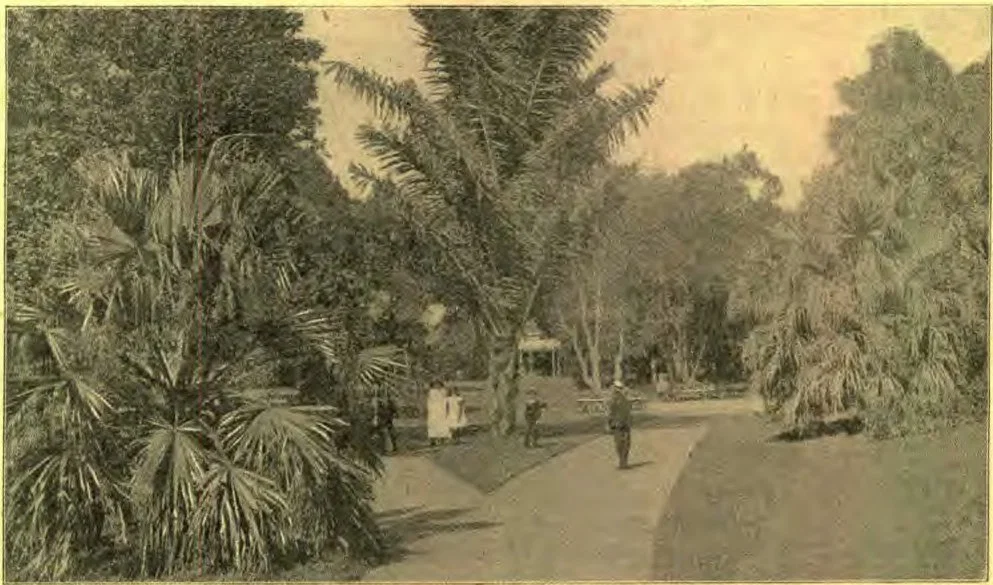
VIEW IN THE BOTANICAL GARDENS.
The first settlement in the country was made in 1825, when a penal colony was opened for the reception of criminals from the Old World. This unfortunate introduction to the civilized world was not long continued; for in 1842 the country was thrown open to settlers. In 1859 a separate colony was formed. Up to the present time the country has received a population of not far from half a million white persons. In the meantime, the aboriginal race is fading rapidly away, and is now perceptible only as one visits the interior or one of the reservations.
The natural resources of Queensland are more varied and abundant than those of any of the other colonies. It is true that far interior the country is arid and subject to continued droughts; but nearer the coast, rains are more frequent, and here are found vast ranges for cattle and sheep. Still nearer the coast we find a range of low mountains extending throughout the entire colony. Here are gigantic forests of useful timber, fertile valleys and plains, and rich mines of gold. There are also extensive areas of coal lands. On the higher lands, grains and fruits of a temperate zone are grown; while on the lower and coastal grounds are found an abundance of the tropical fruits,—bananas, oranges, mangoes, pineapples, guavas, and a long list of others, with even the names of which the most of our readers are unacquainted. But a stranger not only has to acquaint himself with the name; he must also overcome a large amount of gustatory prejudice and sundry squeamish sensations before he can come into really friendly relations with most of them. When this is accomplished, he soon loves the things he once despised.
Brisbane, the capital city of Queensland, is a place of rare beauty. It is situated on the Brisbane River, about a dozen miles from the ocean. The site is the hilly slopes of the banks of the river, which winds its way in a tortuous course through the high range of hills. Many of the streets follow the ridges, or course, down the valleys without much regard to the points of the compass. A good system of trams, or street-cars, traverses the principal thoroughfares. The public gardens are attractive, and the people are of a progressive and enlightened class.
A movement to federate the Australian colonies in the form of a commonwealth, quite after the model of the Union of the United States, has been carried by a popular vote, and will be given effect in the next few months. In Queensland the food question is assuming a deservedly important aspect. The use of meat for food has from the outset been very prevalent. Now the cattle are becoming so infected with disease as to cause alarm in the minds of those who have the public welfare at heart. Conventions are frequently called to discuss the situation, and the government is urged to take stringent measures to prevent the increase of death and destruction from the infection. It is fortunate and providential that at this time special efforts are being made to introduce to the people better habits of living, and a far more healthful diet than that which consists of the flesh of slaughtered animals, with tobacco, tea, coffee, and intoxicants. With an abundance of fruits and grains the year round, there is no necessity for slaughtering animals for food.
Fresh vegetables are always in the market. Ripe tomatoes may be had the entire year. Indeed, there is no other thing that so puzzles me as to attempt to grasp the methods of the farmers. They seem to plant, plow, or sow, to reap and thrash, whenever the notion takes them to do so. No doubt there is something of method in their movements, but it is not the principal feature of their work, I am sure. To-day I have seen corn just coming out of the ground, and other fully eared. Potatoes and cabbages are always growing, and just now the orange trees have three crops upon them.
G. C. TENNEY.
Faithful in Few Things
By Frances Ridley Havergal
YOUR “few things” may be very few and very small, but He expects you to be faithful over them.—Frances Ridley Havergal.
SCIENCE LETTERS FROM UNCLE JOHN
By Uncle John
MY DEAR BOYS: Your letters, with the one from Cousin Ralph, came this morning; and I will now try to answer his questions about snow and hail,—how the different-shaped snowflakes are formed, and what it is that makes the rings on the inside of a large hailstone.
As we have already learned, all the water that falls to the earth as rain, dew, and so on, is carried up into the air in the form of vapor. This vapor forms clouds, which float high above us until they come to a place where the air is cold enough to condense it, when it falls as rain. But if the air is so cold that the vapor is frozen before it has time to form into drops of water, it falls as snow instead of rain. As they fall, these tiny particles of frozen moisture gather together in little groups; thus the snowflakes are formed.
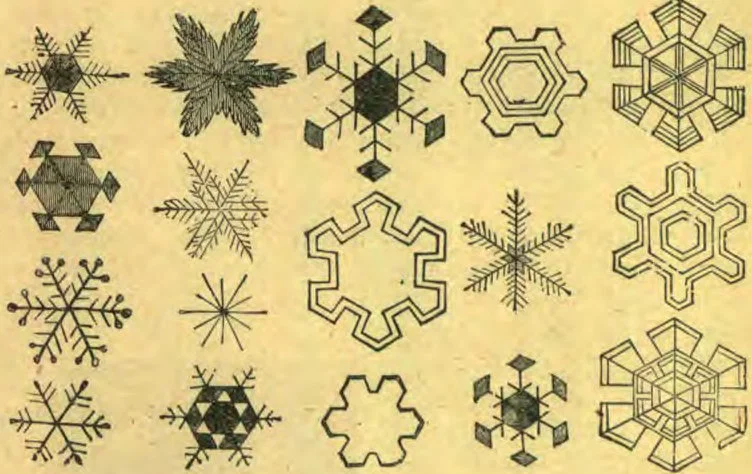
FIG. 1.
You may have noticed that the flakes are much larger at some times than at others, and that the larger ones fall in warmer weather. This is because the little ice-crystals are not frozen so hard in the warmer weather, and so stick together more readily.
As we look out on the snow, it appears like one great mass of white; but if you will catch a few of the falling flakes on a piece of dark cloth, and examine them under your magnifying-glass, you will see that each particle of the frozen moisture is a beautiful little ice star-crystal. These appear in an almost infinite variety, but all are some form of the six-pointed star.
I have always liked to think that David and Job were thinking of these beautiful little snow-crystals when they said: “He giveth snow like wool: he scattereth the hoarfrost like ashes. He casteth forth his ice like morsels: who can stand before his cold?” “God thundereth marvelously with his voice; great things doeth he, which we can not comprehend. For he saith to the snow, Be thou on the earth; likewise to the small rain, and to the great rain of his strength.” I shall not tell you where to find these texts; for I would like to have you find them for yourselves, and write them in your books.
Here are some pictures I have made of the little snow-stars. Fig. I. See how many of these forms you can find to draw in your books.
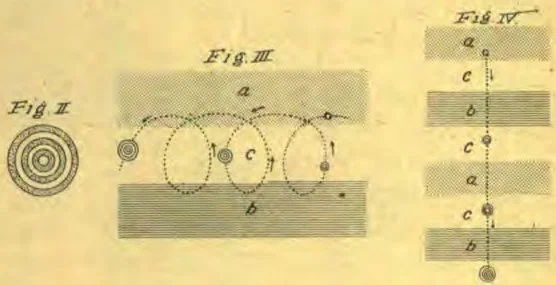
Hail, too, is moisture that is frozen high up in the air. If you will take a large hailstone, and press it against a warm stove, or some other surface that is hot enough to melt away half of it, you will probably find a tiny snowball at the center, and around this the rings of which Ralph spoke. Fig. II.
Some hailstones do not have these rings, but are simply drops of rain that have passed through a layer of air cold enough to freeze them on their way down. Sometimes several of these frozen raindrops freeze together, and form a larger hailstone.
No one really knows what makes the rings that Ralph asked about, but there have been two theories advanced, either of which may be correct. I will explain them both to you. The first is that the tiny snowball that you found at the center of the hailstone was caught by a sort of whirlwind, and kept whirling round and round through a cloud containing particles of snow and another holding particles of water, with a layer of cold air between them. As the tiny snowball passes down through the cloud containing particles of water, some of these collect around it and are frozen, forming a layer of ice as it passes back through the cold air; when it passes through the snow-cloud, some of the particles of snow stick to the surface, and are frozen fast to it in their turn, thus forming another layer, or ring. And so on until the lump of ice is too heavy for the wind to carry, and falls to the earth. If you will study the figure marked No. III, it will help you understand this process. The line and arrows represent the path and direction of the wind; a represents a cloud containing snow; b, one containing particles of water; and c, a layer of cold air.
The second theory is that as the snow starts to fall, it passes through several layers of cloud, with layers of cold air between them, thus forming the different rings. Fig. IV will help you understand this.
Please send this letter to Ralph as soon as you have read it.