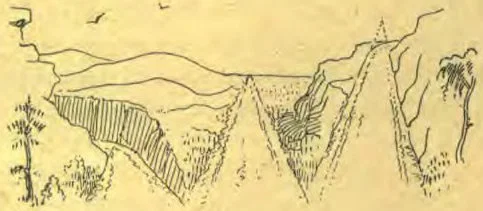
As we have learned, parallel receding lines converge at a point called the vanishing point. Only when they are parallel with the ground plane, do they meet on the horizon. In the drawing shown below, the road in the center is level, or parallel with the ground plane, and therefore meets at a point on the horizon.
Where the receding lines are not parallel with the ground plane, they converge at a point outside the horizon line. For instance, the road on the left is at an angle with the ground plane, and meets outside the horizon. As the road is downhill, the lines meet below the horizon. The uphill road to the right meets at a point above the horizon.
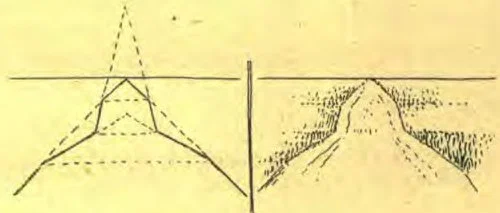
Now as we know that all upward lines meet above the horizon, and that all lines running down meet below the horizon, we shall have no difficulty in drawing roads so they will appear to be uphill or downhill, as the case may be.
Below is a picture of a road so drawn that it appears to be level, then downhill, next uphill, then level again. Notice how, in the outlines, the uphill and downhill lines meet above and below the horizon.
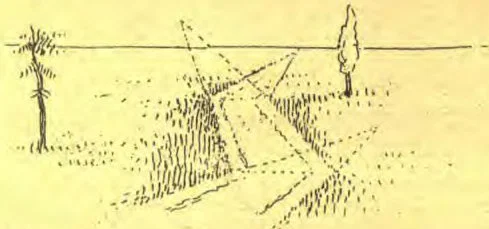
When a road is not straight, but has several bends in it, there is, of course, more than one vanishing point on the horizon. In other words, as soon as any part of the road is not in line with the observer’s eye, it follows a different direction in receding toward the horizon, and converges at a point of its own.
If part of the road goes uphill or downhill, there are just as many points, only those parts that are not level do not meet on the horizon, but above if uphill, or below if downhill. In the accompanying drawing are shown the directions in drawing a road when some parts are not level, or not at right angles with the ground plan.
This lesson ends the study of Perspective in Nature. In the remaining lessons the study of form, light, and shade, in Drawing from Nature, will be begun. PEDRO LEMOS.
THE GREATER PART
By Adelaide Procter
I hold him great who, for love’s sake,
Can give with generous, earnest will;
Yet he who takes for love’s sweet sake
I think I hold more generous still.
Glorious it is to wear the crown
Of a deserved and pure success;
But who knows how to fail has won
A crown whose lustre is not less.
Great may be he who can command
And rule with just and tender sway;
Yet is diviner wisdom taught
Better by him who can obey.
Blessed are they who die for God
And earn the martyr’s crown of light;
Yet he who lives for God may be
A greater conqueror in his sight.
— Adelaide Procter.
DO THE CHILDREN WISH TO BECOME HEATHEN?
By S. Roxana Wince
A Danger Signal
“Why Auntie Wince! what makes you ask such a question? As if any of us who have the Bible to read, and beautiful Christian songs to sing, and pleasant churches to worship in, and dear fathers and mothers and teachers to tell us about the one ‘eternal, unchangeable’ Jehovah, who has promised to be our God to eternity, could ever become heathen!”
Are you certain there is no danger? How, then, has it come about that there are eleven million Spiritualists in the United States, and so many Christian science people, or Buddhists? Where did they come from? They had the Bible; they sang the same dear songs that you sing; they went to church; they had as good Christian fathers and mothers as were ever known.
Yet they fell into idolatry: and you may fall.
You wonder how?—By not watching; by not knowing what idolatry is. The Bible tells us not to “seek unto them that have familiar spirits.” The mediums that pretend to get messages from your dead friends have such spirits. The spirit hypnotizes the medium, just as one man hypnotizes another. When a person is hypnotized, he can be made to do and say just what the hypnotist desires him to do and say. In this way the spirit controls the medium, deceives him, and makes him deceive others. It is not your dead friends who talk, but the wicked spirit, speaking through the medium, and personating your friends.
SAFE!
Such things have been done ever since the children of Israel were in Egypt, and long before. The little “teraphims” that Rachel and her people used were only little images, through which the unseen spirits were consulted. Spiritualists sometimes use a wooden machine, called a “planchette,” when they wish to talk with the spirits. I once saw one of these machines, and asked that I might burn it up; but the young girl who owned it would not let me.
In China, in India, and in Africa, evil spirits take possession of men and women, just as they do in our country; but there the spirits own up that they are demons. They do not try to make their victims deceive the people, probably because the people already believe in these spirits, their religion being a religion of demons.
“But we thought you asked us if we wished to be heathen? Being a Spiritualist is not being a heathen, is it?”—Spiritualists believe in spirits, and consult them, just as the heathen do. They are not satisfied with the revelations God has given; they are sure something more and better can be found. Are we not commanded to make our requests known unto God by prayer and supplication? If we make requests to other beings, and ask them to answer us, is it not the same as praying to them? Do we not perform an act of worship in doing this?
God looks at it in that light; and this we know because in the very text where he tells us not to “seek unto them that have familiar spirits,” he also says, “Should not a people seek unto their God?” as much as to say, If you seek to these, you make them your gods in place of me.
Be careful, dear ones; you can worship the same gods that the heathen worship, even though you may not have the images that are pictures of the gods. The prayers of the heathen are not supposed to be heard by the idol, but by the god, or spirit, that the idol represents.
You can never guess how many young people like you have been led astray in our country. It is terrible! But “you thought Christian science was some Christian way of making sick people well.” That is just where the danger comes in; the devil puts on “the armor of light,” so you can hardly tell whether he is the devil or not. Strike him with the Bible, and you will find out.
Christian science “talks of God and praises Jesus,” “teaches morality and the duty of doing good.” But it lets you “walk with the world in all its pride and pleasures.” It tells you that there are no such things as pain and disease; that you can get well by just thinking that you are not sick; and many other things that flatly contradict the Bible. It is only Buddhism, painted over; let it alone.
In London young people like you, who, of course, have the Bible,—young people in high circles,—are founding what they call a new religion. They say that “the kingdoms of earth are unhappy because they have forsaken the worship of their ancient gods,” and that mankind must be “led back to the gods of Cæsar,”—to Jove and Apollo and all their train.
If these young people—beautiful girls and high-born young men—can become heathen, is there not danger for you?—There certainly is, if you do not clothe yourselves in impenetrable armor, taking the breastplate of righteousness, the shield of faith, the helmet of salvation, the girdle of truth, and the sword of the Spirit.
Auntie Wince loves you, and does not want to see you lost. Look at these things in the light of the Bible, love the Bible, study the Bible, believe and obey the Bible: thus only can you be saved.
S. ROXANA WINCE.
A BOY WHO IS LIKED
JACK knows nothing about it. Indeed, he hasn’t the remotest idea that he is looked upon in the Washington Park school as anything but the most ordinary of scholars. And yet every one in authority there, from the principal down to old Pat, the janitor, takes a deal of pride in the boy.
“It ain’t that he’s so uncommon smart,” Pat explained to the superintendent one day; “it ain’t that, sorr, though he do be quick enough at his lessons, for the matter of that, they say. But he has such a way with him that the groutiest couldn’t help liking the lad. It’s always, ‘Good morning, Pat,’ in the most gentlemanly tones, as soon as he comes in. There do be some boys, sorr, that laugh at an old man like me, and make jokes on him, but Jack never does that. Then he’s so careful like, sorr, keeping things in order, and taking care of the school property. There’s a bit of lawn there in front that I like to keep nice, but some54of the boys will trample it down, though they don’t mean harm,—they’re careless, that’s all. But Jack, he’s as careful as can be, and he kind of seems to influence the rest; for when he’s around, there ain’t a mite of mischief done.”
The teachers, too, sometimes talk about Jack when they are together. “It’s a pleasure to have that boy in school,” one of them remarked the other day, after Jack had passed through the room where they all were, “he is so mannerly and kind. I often notice how he acts. He is as careful about the feelings of others as any one can be.”
In order to know what his school friends think of him, you have only to hear them talking among themselves. “There’s nothing mean or tricky about Jack,” one of them was heard to say to a companion one day, when Jack was absent. “I wish he had come. He’s the best kind of fellow to play with, and I hate to start a game without him.”
Is it any wonder that there isn’t a happier lad to be found anywhere than this same Jack? — Young People’s Weekly.
BOSE'S BURGLAR
Rap, rap, rap! “Oh, here's a snap!” Said Bose, in kennel snugly lying; “I'll get a burglar in a trap!” And round the house he went a flying! But not the least of man or beast Could he descry in all his round; So after all his vigil ceased, He hied him back to slumber sound.
Rap, rap, rap! “He's spoiled my nap! I'll catch him this time, sure as fate! I'll eat him up from shoes to cap, Ere he can reach the garden gate!” And round he went, on havoc bent; But all was quiet near the house; So back he came without a scent Of anything—not e'en a mouse.
Rap, rap, rap! “Same old mishap! Some one's playing jokes, I fear, Or else the rogue's a wily chap: I'll watch with eye as well as ear.” And glancing round, he quickly found His tail was wagging 'gainst the wall; And then he knew what caused the sound, And burglar there was none at all.
1. An Example of Prayer.—Daniel, an aged man, after a lifetime of the truest service to God, pours out his heart in humble confession of the sins of the Jewish people, identifying himself fully with them. His fervent appeal in behalf of the cause of God should touch every heart. Referring to this prayer, the Spirit of God has told us: “There is great need to-day of just such sincere, heart-felt repentance and confession.”
2. Fasting, Sackcloth, and Ashes.—In all ages and among all nations, fasting has been practiced in times of sorrow and affliction. Sackcloth was a coarse-woven cloth made of goats’ or camels’ hair. It was commonly used for sacks or bags. Rough garments made of it were worn by the Jews as a sign of mourning or penitence. On occasions of extreme sorrow, ashes were sprinkled upon the head, and numerous instances are given of lying down upon, or sitting in, ashes. Read Job 2:8; Esther 4:3; Jonah 3:6.
3. What Is Prayer?—One writer says, simply: “It is talking with God.” A beautiful definition is given in “Steps to Christ:” “Prayer is the opening of the heart to God as to a friend.” Prayer is communion with God. Connect with this two sentences from the Spirit of Prophecy: “Communion with God imparts to the soul an intimate knowledge of his will.” “In order to commune with God, we must have something to say to him concerning our actual life.” Another helpful definition is this: “Prayer is the offering of the emotions and desires of the soul to God, in the name, and through the mediation, of our Lord and Saviour, Jesus Christ. It is the communion of the heart with God through the aid of the Holy Spirit, and is to the Christian the very life of the soul.”
4. “Caused to Fly Swiftly.”—When Daniel began his prayer, the Lord sent Gabriel to him. How many minutes does it take to read the prayer from beginning to end? It took just the length of time that Daniel was praying, for the angel messenger to speed from heaven to Daniel. The marginal reading of verse 21 would give the idea that he came so swiftly that he was wearied.
5. Precious Promises.—The immediate recognition of Daniel’s prayer, and the lightning-like rapidity of the response, bring to mind at once two or three texts that must be exceedingly precious to the heart of every believer: “For the eyes of the Lord run to and fro throughout the whole earth, to show himself strong in the behalf of them whose heart is perfect toward him.” “The eyes of the Lord are upon the righteous, and his ears are open unto their cry.” Another text, which is usually supposed to have its application at a future time, seems to have been true in the illustration we are studying: “Before they call, I will answer; and while they are yet speaking, I will hear.”
6. Sixty-Eight Years Ago.—It seems very fitting that in the beginning of our study of the twenty three hundred days, we should recall the memory of those faithful students of prophecy who were instrumental, in the hands of God, in revealing that which hitherto had not been understood. William Miller, an honest-hearted farmer, was the first to lead out in the unfolding of this prophecy. From the study of the Bible he became greatly interested in the second advent of Christ. The prophecy that seemed most clearly to reveal the time of this event was Dan. 8:14. He believed what was then the generally accepted view,—that in the Christian age the earth is the sanctuary, and thought that the text referred to the burning of the earth with fire at the coming of the Lord. With the deepest earnestness William Miller devoted whole nights as well as days to the study of the prophecies. After several years of the most careful investigation, he was fully convinced of the correctness of his positions. In 1832 he began to speak publicly. Although he was then fifty years of age, wholly unaccustomed to public speaking, and burdened with a sense of his unfitness for the work, the Lord blessed his labors in a remarkable manner. His very first lecture was followed by such a religious awakening that thirty entire families, with the exception of two persons, were converted. In speaking of his work, this humble laborer said: “My whole object was a desire to convert souls to God, to notify the world of a coming judgment, and to induce my fellow men to make that preparation of heart which will enable them to meet their God in peace.” Is there not as great need now of consecrated earnestness in studying these vital truths, and in placing them before the world, as there was then?
FEBRUARY STUDY OF THE FIELD
Part III: “Matabeleland;” “Missionary Openings in Honduras”
(February 18–24)
1. Basis of Study.—For Part III of the study for February read “Matabeleland,” page 63, and “Missionary Openings in Honduras,” page 69, of the February issue of the Missionary Magazine.
2. The Matabeles.—These people place no value on human life, and instances have occurred in which the inhabitants of an entire town were killed for the fault of their chief or of one man among them. They are superstitious. Horrible cruelties and all manner of crimes have resulted from their belief in witchcraft. The condition of this people has been bettered since they came under the rule of the white man. Before that time they would not work, but now it is easier to hire them to labor. The chiefs, who before the war held the lives of their subjects in their hands, have had this power of life and death taken from them, and the people do not now live in dread of them as before.
3. Our Mission Farm in Matabeleland.—Our original farm in Matabeleland consisted of twelve thousand acres. This was secured from the government by five of our workers at Cape Town, who left that city in May, 1894, for that purpose, and who selected the location. Since that time two other farms have been added,—the Druillard and the Burton, the former in the vicinity of the original farm, and the latter about twenty-five miles northwest of it,—thus increasing the holdings to about eighteen thousand acres.
4. School on the Farm.—Our school on the mission farm numbers about thirty children. Most of these are orphans who were gathered together during the famine that followed the Matabele war. An orphanage has been built for them. These children are bright, and quick to learn. One of our laborers who visited the farm tells us that while he was there, he taught them a number of English gospel songs, which they greatly enjoyed. Having until lately been taught in the Matabele tongue, they can speak but little English; but although they can not speak it, they understand what is said when they are spoken to in that language.55
5. Honduras.—This republic was established in 1838. It is the third largest state of Central America, having an area of forty-six thousand four hundred square miles. The population is about four hundred and thirty-two thousand. The coast-line is between four and five hundred miles long.
6. Ancient Monuments and Ruins.—Monuments belonging to a former civilization are found scattered over the plains of Honduras. These are conical, pyramidal, terraced, or are merely walls of stone. The sizes vary from twenty feet square to eighty feet broad by three hundred feet long. They were probably used for religious purposes, or as defenses in time of war. Most of them are one story high. Where two, or even three, stories in height, each successive story was smaller than the one below it. Great quantities of pottery have been unearthed in these mounds. Ruins of similar mounds are found in Mexico. It is supposed that these monuments in both countries were built by the same race.
7. Stock-Raising and Mining.—These two industries form the chief resources of wealth for Honduras. The broad table-lands furnish grazing for thousands of herds of cattle. Large numbers of cattle are shipped every year to Cuba. Honduras abounds in minerals. The silver mines furnish the chief mineral wealth. Gold, copper, iron, coal, zinc, tin, platinum, opals, asbestos, chalk, limestone, and marble are found.
8. The Carib Indians.—These people formerly occupied the West Indies, and were powerful and numerous about the time of Columbus. They were warlike and aggressive, and opposed all advances of European civilization. They have now almost entirely disappeared from their former home, large numbers having removed to Honduras, where they are generally industrious and prosperous. Their ancient language, with many of their superstitious beliefs and customs, is still retained by them. It is believed that they were formerly cannibals. Honduras is now the principal settlement of these people.
9. Opening for a School in Honduras.—The government is making efforts to improve the country. Brother H. A. Owen, of Bonacca, Bay Islands, while on a visit to this state, met a government official who has been for some time wishing to establish an industrial school. This gentleman asked Brother Owen why he did not open such a school there, and said there would be no difficulty in securing land, and the people would do all they could to advance the interests of such a school, even giving a sum of money yearly to its support. They do not care what religious influence the school is under, whether Methodist, Presbyterian, or Adventist; what they do desire is that the boys shall be taught useful industries, and learn to work in improved manner.
Think for Yourself
“THINK for yourself, and you will soon think for your neighbors.”
DOES SHE THINK?
I know a lady in this land,
Who carries a Chinese fan in her hand;
But in her heart does she carry a thought
Of her Chinese sister, who carefully wrought
The dainty, delicate, silken toy,
For her to treasure, admire, and enjoy?
This lady has on her parlor floor
A lovely rug from the Syrian shore;
Its figures are woven with curious art—
I wish that my lady had in her heart
One thought of love for those foreign homes,
Where the light of the gospel never comes.
To shield my lady from chilling draft
Is a Japanese screen of curious craft.
She takes the comfort its presence gives,
But in her heart not one thought lives—
Not one little thought—ah, me! ah, me!—
For the comfortless homes that lie over the sea.
My lady in gown of silk is arrayed;
The fabric soft was in India made.
Will she think of the country whence it came?
Will she make an offering in His name,
To send the perfect, heavenly dress,
The mantle of Christ's own righteousness,
To those who are poor and sad and forlorn,
To those who know not that Christ is born?
— Woman's Work for Woman:
God's Book Worth More Than Gold
“Men's books with heaps of chaff are stored;
God's Book doth golden grains afford.
Then leave the chaff, and spend your pains
In gathering up the golden grains.
Yea, were the sun one chrysolite,
This earth a golden ball,
And diamonds all the stars of night,
This Book were worth them all.”
Time: A. D. 31. Place: Jerusalem. Persons: Jesus, Peter and John, chief priests, scribes, elders, false witnesses, Annas, Caiaphas, servants of the high priest, Jewish council.
QUESTIONS
1. What was done with Jesus when he was seized by the mob? John 18:12. To whom was he first taken? Why? V. 13; note 1. What had Caiaphas before advised concerning Jesus? V. 14.
2. In reference to what did the wily Annas question Jesus? V. 19. What reply did Jesus make? Vs. 20, 21; note 2. Angered by Jesus’ answer, what did one of the officers do and say? V. 22. What response was made by the Saviour? V. 23.
3. Failing to entrap Jesus in any way, what did Annas do? V. 24. Who were at the high priest’s palace, waiting for Jesus? Mark 14:53; note 3. Which of the disciples followed Jesus to this place? John 18:15. In their relations to Jesus, how did the action of the two men differ? How did Peter come to go in? Vs. 15, 16; note 4.
4. What was the one object of the mock trial now given Jesus? Mark 14:55; note 5. What trouble was experienced with the testimony of the witnesses? V. 56. What special charge was finally brought against Jesus? Vs. 57–59.
5. Addressing Jesus, what did the high priest angrily inquire? V. 60. What course did Jesus now take? V. 61, first part. What appeal from the high priest did his silence call forth? V. 61, last part. Knowing that his time to speak had come, what stirring answer did Jesus give? Matt. 26:64.
6. Beside himself with rage, what did Caiaphas now do and say? V. 65. What was the judgment of the council? V. 66.
NOTES
1. The high priest at the time of the Passover . . . was Caiaphas. The real head of the priesthood, however, was the crafty Annas, without whom nothing of moment was done in the affairs of the theocracy. On reaching Jerusalem, Jesus was first led to the mansion of Annas, the head of the reigning priestly family, either in deference to his recognized influence, or because, as the oldest high priest, he was still recognized as the rightful, if not the legal, dignitary. He could see Jesus, hear his defense, and advise his son-in-law how to act. His “snake-like” craft might help the less acute Caiaphas.—Geikie.
2. Annas, by his questions, sought to bring out something that could be made to prove that Jesus was “seeking to establish a secret society, with the purpose of setting up a new kingdom.” He could then be pronounced a disturber of the peace, and turned over to the Romans. But Jesus, who knew the hearts of all men, saw what was planned; and in his answer he denied the thoughts hidden in his accuser’s mind. How different were the methods of his enemies, who long had been, and were still, working in secrecy to overthrow him! See “The Desire of Ages,” chapter 75.
3. Those assembled at the palace of Caiaphas were the members of the Jewish Sanhedrin. This was not a legal court, but rather, as Geikie expresses it, “a mob of dignitaries.” The word “sanhedrin” means “an assembly.” At this time it had been hurriedly called together by Caiaphas, before daylight, in order to condemn Jesus, if possible, before the news of his arrest could be learned by the people. Nicodemus, and Joseph of Arimathaea, though members of the Sanhedrin, were not called, because of their known friendliness to Jesus.
4. Peter followed “afar off” from the time his sword was ordered into the sheath by the Saviour. The one spoken of as “another disciple,” was John, who, having regained himself to some extent from his cowardice “went in with Jesus.” John identified himself fully with Jesus, and by so doing escaped trouble. He “was known unto the high priest.” It is always best to be open and frank in our profession; for in so doing many a snare will be avoided, and, best of all, we shall enjoy a clear conscience, the most valuable possession man can have.
5. It was an axiom that “the Sanhedrin was to save, not to destroy, life. . . . When an accused person was brought before the court, it was the duty of the president, at the outset, to admonish the witnesses to remember the value of human life, and to take care that they forgot nothing that would tell in the prisoner’s favor. Nor was he left undefended; a ‘Baal-rib,’ or council, was appointed, to see that all possible was done for his acquittal. . . . The ‘court,’ from the first, sought to condemn; not, as the law required, to acquit.”—Geikie. The whole trial of Jesus before Caiaphas, says the same writer, was simply an outrage, according to the rules governing the Sanhedrin.
TAKE THE Canadian Pacific Railway
for . . . CHATHAM, OTTAWA, MONTREAL, LONDON, GALT, QUEBEC, WOODSTOCK, TORONTO, BOSTON, PORTLAND, and
All points in New England, the Maritime Provinces, Great Britain, and the Continent.
Illustrated literature, time-tables, and full particulars, upon application to—
J. FRANCIS LEE, GEN. AGENT,
Passenger Dep’t. 228 SOUTH CLARK ST., CHICAGO
Branch Offices: 76 Ottawa St., Grand Rapids, Mich.; Room D, Chamber of Commerce, Cincinnati, Ohio; 315 Chestnut St., St. Louis, Mo.
To Reach BATTLE CREEK
FROM
CHICAGO, BUFFALO, DETROIT, OR TOLEDO.
Purchase Tickets Reading over the MICHIGAN CENTRAL
“The Niagara Falls Route.”
A First-class Line for First-class Travel between Chicago and New York and Boston. Elegantly equipped through trains pass Battle Creek in each direction daily.
R. N. R. WHEELER, Ticket Agent, Battle Creek.
G. W. RUGGLES, Gen’l P. and T. Agt., Chicago, Ill.
Cincinnati Northern Railroad Co.
TIME TABLE NO. 3.
IN EFFECT SEPT. 24, 1899.
Trains Pass Battle Creek, as follows:
WEST-BOUND.
No. 21, Mail and Express — 6.58 P. M.
No. 23, Accommodation — 2.07 P. M.
No. 27, Local Freight — 8.25 A. M.
EAST-BOUND.
No. 22, Mail and Express — 8.25 A. M.
No. 24, Accommodation — 1.45 P. M.
No. 28, Local Freight — 5.30 P. M.
Direct connections are made at Toledo with all roads diverging. Close connections for Detroit and Cincinnati.
J. L. READE, Ticket Agt., Battle Creek.
E. R. SMITH, City Pass. Agt., 6 West Main St.
GRAND TRUNK RAILWAY SYSTEM.
By A. S. Parker
Time-Card in Effect November 19, 1899.
C. & G. T. DIVISION.
WEST-BOUND FROM BATTLE CREEK.
No. 9, Mail and Express, to Chicago — 12.15 P. M.
No. 1, Chicago Express, to Chicago — 9.00 A. M.
No. 3, Lehigh Valley Express, to Chicago — 3.40 P. M.
No. 5, Pacific Express, to Chicago, with sleeper — 1.10 A. M.
No. 75, Mixed, to South Bend — 8.20 A. M.
Nos. 9 and 75, daily, except Sunday.
Nos. 1, 3, and 5, daily.
EAST-BOUND FROM BATTLE CREEK.
No. 8, Mail and Express, to Pt. Huron, East, and Detroit — 3.45 P. M.
No. 4, Lehigh Express, to Pt. Huron, and East — 8.27 P. M.
No. 6, Atlantic Express, to Pt. Huron, East, and Detroit — 9.25 A. M.
No. 2, Leh. Exp., to Saginaw, Bay City, Pt. Huron, and East — 6.50 A. M.
No. 74, Mixed, to Durand (starts at Nichols) — 7.15 A. M.
Nos. 8 and 74, daily, except Sunday.
Nos. 4, 6, and 2, daily.
A. S. PARKER, Ticket Agent, Battle Creek.
Madame Lehmann's Vegetarian Principles and Refusal of Wine
MADAME LILLI LEHMANN, the grand-opera prima donna, is a strict vegetarian, partaking of neither animal food nor wine. Her adherence to these principles is regarded as simply a “fad,” by those with whom she travels; but she is not betrayed into compromise by either their annoyance or their flattery. One evening, according to the Saturday Evening Post, before she went out to sing, some one offered her a glass of wine, with the remark, “Madame Patti sang Lucia on roast chicken and this wine.”
“Indeed?” replied Madame Lehmann; “well, I sing Brunhilde on a plate of rice and water.”
While singing in New York not long ago, she was called upon by a delegation of ladies, and asked to sing for the benefit of some charity in which they were interested. She consented, on one condition—that the ladies of the committee promise never again to wear the feathers of song-birds on their hats. Of course the promise was given.
All honor to the kind heart that loses no opportunity to save life instead of to destroy it!