THIS is the rallying-cry sounded to its readers by the Pacific Christian Advocate of Oct. 2, 1912. It feels that Protestants are asleep, and that in the activity of the Roman Church in the United States at the present time there exists imminent peril to Protestantism:—
Why is it that the Roman Church in these United States is thrusting itself so energetically into our State and national politics? Never before was the activity of this church in politics so general, so persistent, and so arrogant. The bishops and archbishops of that church do not scruple to challenge with irritating boldness everything in our government and national life that does not square with their notions and their purposes. History must be rewritten to suit them; laws must be nullified to suit them; institutions such as the public school must be destroyed to suit them; the American people must accept their claims of supremacy in the affairs of this country or they will not be suited; and the secular press of the country must publish nothing derogatory to their character, their claims, their purposes, or their political program, else there will be trouble in the camp.
It is generally avowed that the Pope, through his episcopal agents, has entered upon a definite campaign in this country to make America Roman. Political parties, the public press, the platform, all ways and all means, must be persistently exploited in the interests of Romanism. Whining, complaining, denouncing, ridiculing, praying, pleading, and every other device for promoting their ends are to be the means and methods by which they hope to get a hearing and then a position and then a victory which will put the American people in religious vassalage to Rome.
It is time to wake up! We are getting tired of this persistent self-pushing of Roman prelates into our political affairs. Where are the Baptists, the Presbyterians, the Methodists, the Congregationalists? Why are they not forever pushing themselves into national politics? Why do they not seek to control the United States? Archbishop Gleason and Ireland now want a new census taken. Why? Why not one for all other denominations? Why for the Romanists only? Ireland and Gleason want to start a Romanizing campaign. Very well. It may be that in the long run it will be found easier to start one than it will be to stop it. Wake up! Take these Romanizing politicians at their word, and give them all the campaign they want.
Is It Right to Protest?
THIS is the question which the Christian Herald of Oct. 23, 1912, discusses editorially in the consideration of the warning which that journal has been sounding for some time against the encroachments of the Roman Catholic hierarchy upon the liberties of this country. It believes that the religion of Christ is not wholly a matter of concession or of yielding compliance for the sake of peace, love, and harmony.
These three are indeed to be greatly desired, but never at the sacrifice of a vital principle. There comes a time when, great principles being at stake, duty demands that we take a firm stand in order that the whole world may know clearly where our allegiance lies. As Paul dealt with Alexander the coppersmith on a certain occasion, so we must “withstand to the face” those who would destroy the sanctities of our national and religious life.
Continuing, the Christian Herald believes that a dangerous situation confronts the Christian church to-day in the peril of Roman domination. It is a situation that has been forced upon Protestantism by the defiant utterances of the papal prelates and press. It asks:—
How, then, are we to deal with the oft-reiterated intimations that it is the purpose of the Romanists to “make America Catholic,” to dominate our politics, to come to “their own” by “securing more Catholics in Congress”? How are we to treat with a foe which for twenty years has boasted that Protestantism is “decadent and will soon disappear”? How shall we estimate the political activities of a church which claims absolute temporal power throughout the world; which has already set up at least three thrones of temporal power in the United States; which claims for its cardinals the official precedence due to “princes of the blood;” which is already in the saddle in a political sense in some of our biggest municipalities, and whose sudden growth in wealth and power is only surpassed by its arrogant claims for the future?
In reply to this question the Herald declares:—
But when any church or denomination leaves its legitimate sphere and plunges into politics, as the Roman Church has done, with the avowed purpose of overriding all other religionists and “making America Catholic,” it becomes a proper subject for public criticism.
With a view to determining how the Roman peril is regarded by the leading churchmen of the nation, the Herald has invited an open discussion of this subject in its columns. It begins in this issue (October 23) the publication of this correspondence. Letters are presented from Rev. Josiah Strong, Rev. Charles M. Sheldon, Rev. Francis E. Clark, and other leading ministers of various churches, and professors of theological schools. These with one voice agree with the Christian Herald, and with the position which has often been taken in our denominational papers, that the Roman menace is the great danger now threatening this country.
There is only one means by which this danger may be met, and that is by earnest and consistent agitation, and by the enlightenment of the people in proclaiming the pure principles of the doctrine of Christ, and in contrast with these principles exposing the delusive errors of the Roman Church. The giving of this message in its fulness constitutes the message of this movement. This is the warning that Seventh-day Adventists are set in the world to give. May God help us to be true to our entrusted mission. May he anoint our eyes that we may see clearly the evil which threatens us, that we may discern in these growing conditions the signs of the times, and the need of our sounding a note so loud and clear that in the babble of voices on every side those who love God and his truth may hear the warning call and enroll themselves under the banner of Prince Immanuel.
ANOL GRUNDSET
By Anol Grundset
Abyssinia
ANOL GRUNDSET
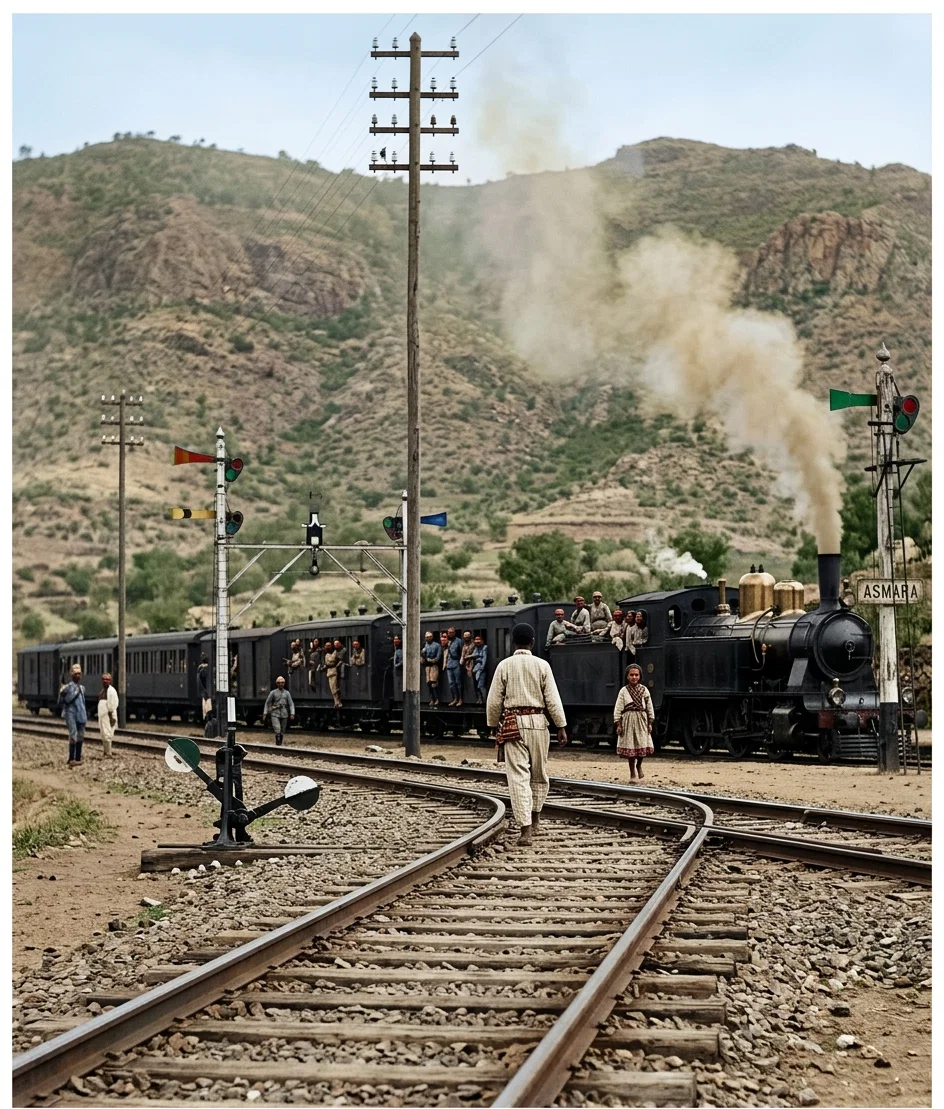
The twelfth day of August was a day long to be remembered by the native populace of Asmara and vicinity, for at 12:40 P. M. appeared the first section of trains bringing back Abyssinian soldiers having served under the Italian flag at Tripoli.
The public road for half a mile or more was filled with native people, and large, anxious crowds were gathered at the station. I especially noticed amid the multitude two classes; one class was overjoyous and happy in the expectation of meeting their loved ones again, and the other class were mourners, on whose countenances no happy, anticipating joy was seen, but a trace of sorrow rested there. If possible they would press themselves through the throng to get from some fellow soldier a detail of the death and last words of some loved one. I asked one if he expected a brother on the incoming train. His eyes filled with tears as with quivering lips he replied, “I had a brother that went, but he is no more.” How comforting that we still have an open door of comfort to which we may point those oppressed by sorrow and affliction!
Now the train is whistling in the distance, and the commanding officers have all they can do to keep order and the lines open. The train pulls in under the playing of the Italian band, and a deafening outburst of the peculiar Abyssinian victory cry. At the entrance the military department seemed well organized, from highest to lowest, to act its part in the welcome. What interested me still more, however, was the religious welcome arranged for. Immediately to the rear the Abyssinian priests, with all the sacred paraphernalia of the native church, awaited the believers of the Coptic faith. At their side another company of religious leaders unfurled their banners, upon which conspicuously were exhibited the half-moon and stars, thus plainly identifying themselves as followers of Mohammed, the false prophet. Immediately to the other side was seen the Catholic prelate. The Protestant leaders were also well represented, to show to those who were inclined toward Protestantism that they were not forgotten.
FIRST TRAIN AT ASMARA BRINGING ABYSSINIAN SOLDIERS RETURNING FROM TRIPOLI
In the midst of this welcome a pouring rain of about fifteen minutes’ duration fell over the large and mostly unsheltered gathering. This, however, in no way seemed to affect or lessen the joy of the joyful, though adding only another gloom to those whose thoughts in sorrow went out for loved ones, fallen on yonder battle-field.
After the formalities were over, the returned soldiers filed through the gates, and were soon out in the open to meet and converse with the waiting ones. The scenes which then took place I shall long remember. As I witnessed their embracing, kissing, and great joy, it showed that the same implanted divine love abides naturally in all mankind of whatever color or race. God “hath made of one blood all nations of men for to dwell on all the face of the earth.” My own heart was moved as I beheld that African throng, and thought of their country’s great need and the everlasting gospel due them in this generation.
When we were departing to our homes, my mind went out to that final gathering soon to take place,—the home-coming of God’s enlisted soldiers of the cross, of all generations, from all the ends of the earth. In that joyous multitude, welcomed by the Lord himself and his angelic host, there will be no missing ones of those who have truly served their heavenly country while on earth, for though they may have fallen in momentary death, by power of the Christ life, hidden in Jesus, they only sleep, to be raised in the resurrection morn and join in the triumphant song of victory over sin and death. Another company will then be seen, those who have spurned the day of preparation, the ungodly of all time, intermingled with those who have become “weary in well-doing” amidst the momentous fight against sin and temptations to gain a full salvation. O, what fathomless, holy joy for the prepared; what unspeakable sorrow for the unprepared! Among what company do we stand in heart and life to-day? With what company will we be found “at the end of the days”? Our daily life will determine in the ultimate our final destiny.
The voice of Jesus still calls: “Come unto me, all ye that labor and are heavy-laden, and I will give you rest. Take my yoke upon you, and learn of me; for I am meek and lowly in heart; and ye shall find rest unto your souls.” Matt. 11:28, 29. The compassionate Saviour is still waiting. Who will heed to-day his loving invitation? Ere the sun has set on the horizon of time, let us ponder well where we shall spend eternity.
Asmara, Eritrea, East Africa.
G. F. JONES
By G. F. JONES
Singapore
G. F. JONES
WE have had the joy of baptizing ten more converts at Singapore. They seem all the more precious because they have been won to the love of the truth in the face of opposition. Many methods have been employed to hinder our work, which naturally necessitated our doing some steady pulling up-stream, and holding each fort as we pushed onward. This was done, and we were able to build a fine church in view of the main thoroughfare of the city. Truly God has wrought for his work. There are sixty church-members, and over one hundred members of the Sabbath-school.13
As scores of the happiest young people of Singapore are seen going to and coming from this memorial of present truth, it is verily a witness that the Lord is with this gospel. With this corps of young people, well drilled in missionary endeavor, we shall be able to enter the numerous islands of Dutch India, such as Borneo, Celebes, and a thousand more, with a population of fifty million people who are waiting for us to quickly give the third angel's message. We have already the plan of an industrial training-school that can at once provide for fifty students and two European teachers; but the saddest phase of our work is that so many of our foreign workers are from time to time returning home owing to broken health. We must, however, train our native converts, who are able to stay, and thus follow the apostolic methods of establishing the truth in every land.
Looking Unto Jesus
By Pearl Waggoner
PEARL WAGGONER
Looking unto Jesus every day and hour;
Looking unto Jesus is the source of power;
Looking unto him, the secret of all strength,
Which will lead to victory, and to home at length.
Looking far above the trials at our feet;
Looking unto Jesus,—O, how blest, how sweet!
Looking gives an anchor to the storm-tossed soul,
Bringeth calm, and makes us from earth’s bruises whole.
Looking unto Jesus makes the way less long,
Tunes the heart to gladness, fills the mouth with song,
Makes the burden lighter, cheers the path we tread,
Sheds a hope and radiance o’er the way ahead.
Looking unto Jesus helps us to endure,
Giveth for our faith foundation that is sure;
For the race gives patience, sets aside each weight,
Helps us travel lighter toward the heavenly gate.
Looking unto Jesus till the race is run,
Looking unto Jesus till the prize is won;
Then, O blessed Saviour, our delight shall be
Still through countless ages looking unto thee.
Hinsdale, Ill.
ARTHUR W. SPAULDING
By Arthur W. Spaulding
Come, Let Us Live With Our Children — No. 6
ARTHUR W. SPAULDING
Courtesy
Awkwardness springs from self-consciousness, boorishness from lack of culture, discourtesy from selfishness. All these faults can be avoided or corrected in the home. At all events, the worst of them can. It is more offensive to be boorish than to be awkward, less excusable to be selfish than to be boorish. Our children must be taught to be unselfish, and I know of no way to teach them except by being unselfish ourselves. It accomplishes nothing to point the finger of shame at a little girl who refuses to share her candy, except to make her resolve to eat it in secret hereafter. The cry “Piggy” at a boy has for its chief recommendation the making of a young cynic. Nor can mere directions of how to act in this place or on that occasion, give the charm of heartfelt courtesy. Courtesy, like flowers, can not be made out of paper nor rebuked into being from burs.
The foundation to be laid is the sense of joy at making others happy. Teach the children so that they will plan for the comfort and pleasure of others. This can not be done while depriving the child himself of pleasure. The child is a little animal that must be appealed to first through his senses, and afterward taught the higher pleasures that come through self-denial and giving. Give first to him, and out of his abundance he may be taught to give to others.
For the teaching of unselfishness this giving must be of no common kind. It appeals little to the child that his parents furnish him food, clothing, and home. These are the commonplace things of life to him, which, for all his experience has taught him, come naturally and without effort as his due. He can not easily conceive of his not having them; therefore their gift from father or mother, however emphasized by words, gives him no real knowledge of his parents’ effort or sacrifice for him. But something out of the ordinary, which may cost far less, will give that sense. A donkey ride, or a home-made jumping-jack, or a Christmas tree will make him realize without being told that some one has planned and worked to give him pleasure, and his full tide of joy may be turned, then or later, into the channel of giving some one else pleasure. Without burdening him too much with a sense of obligation, (“You would be selfish, when mama has worked so hard for you, not to give little sister something!”) but simply drawing upon the inherent love of sharing an abundance, he may be led into the habit of planning for others. The love of mystery and surprise, the love of making something, the natural love of brother for brother and friend for friend, can be requisitioned to help in making him unselfish. Then in your story-telling often use stories of sacrifice and helpfulness.
Children who learn courtesy are children to whom courtesy has been shown. Don’t forget to say “Please” and “Thank you” to a child from whom a service is asked or received. Defer to a child’s talk, and don’t interrupt him or ignore him if it can be helped. Pass behind him instead of between him and the fire. Ask him to excuse you for a mistake and forgive you for a wrong. These points of etiquette will be his models, and a gentle reminder when he forgets will recall him to his family’s standards. And while his courtesy is to be shown toward his own companions, he is to be taught by precept special consideration for his elders and the aged. In this your own custom will be marked; your child will know whether you are especially courteous to his gray-haired grandmother and to the old people of the neighborhood.
The table is an important place to teach courtesy. There are some people that I know—Christians—who despise as affectation the niceties of table usage.14But it has no little bearing, not merely upon one’s standing in society, but upon Christian demeanor and influence in the world, whether the child chews with closed or unclosed lips, whether or not he asks to be excused if he must leave the table, whether he knows the use of a napkin, and whether or not he can find time between his mouthfuls for conversation. The table should be made a pleasant place, with simple but tasteful arrangement. Flowers have a wonderful influence in making it seem more like heaven, and in enabling us to follow the injunction to receive our daily bread as a sacrament. Every member of the family should be prompt in his place at the beginning of the meal, and wait till all are ready to be seated together. The mother and father, besides teaching the science and art of proper eating, must exert themselves to make the meal-time pleasant and profitable in conversation which the children can understand and join. If this is done, and the table made a pleasant place, it will be less difficult to hold the members together until all are ready to rise.
There is no disputing that it is necessary to teach much by precept if our children are to learn the proper forms of social intercourse, and above that, of unselfish courtesy. But personal practises must reenforce precept, or precept is valueless. Out of a loving heart let parents show courtesy to their children, and not only expect, but require from their children courtesy toward themselves and others.
Mission Notes
W. F. BEAMAN, a Baptist clergyman who recently returned from China, having labored in the large southwestern province of Szechwan, is “hopeful as to the final outcome of the revolution, and believes in the ability of the people to adapt themselves to the new order; but he recognizes the tremendous difficulties that have to be overcome, and the time required. The question in doubt is the willingness of the masses to accept the provisions made by the government, when these involve an apparent yielding to foreign influences. We must remember that the people at large are not educated in public affairs; that there is no Chinese daily press in all parts of the land to carry the news and enlighten the masses, and that the provinces are very loosely connected with the new government. A large part of the people do not yet know what the new government is with any degree of particularity, nor do they care, so long as taxes are not heavier and the rice crop is fair. This will give some idea of the perplexities of those who would like to prophesy as to China’s future.”
BROTHER E. E. FRAUCHIGER, in Turkey, writes: “I returned yesterday from my journey to Brusa. We had good meetings there, which were well attended by those not of our faith. I have great hopes for this town. Both the Protestant ministers in the town were present at different times in my meetings. A sister only sixteen years old desires to be baptized, but has been persecuted by her mother on account of the truth. I brought her with me to Constantinople to be baptized. She still goes to the American school. The condition of the government was never in such confusion as now. It was feared yesterday, on the occasion of a national celebration, that a revolution would break out, and precautions were taken against it. But we are glad that the government became master of the situation. Who knows what the next excitement will be? One lives here in continual dread of what the future will bring.”
He Will Bear the Load
By C. E. GREY
C. E. GREY
“He shall gather the lambs with His arm,
and carry them in his bosom.” “For I the
Lord God will hold thy right hand, saying
unto thee, Fear not: I will help thee.” Isa.
40:11; 41:13.
Does the way seem dark and dreary?
Is the burden hard to bear?
Do the days seem long and weary?
Is there none the load to share?
Yes, there’s One who oft has traveled
Over ways more dark and drear,
And much heavier burdens carried;
He has promised to be near.
Yes, this Friend will walk beside thee,
And thy hand in his he’ll hold;
He will ever, ever guide thee,
Till thou tread the streets of gold.
And when all thy strength doth fail thee,
And it seems thou must have rest,
Jesus in his arms will bear thee,
Safely pillowed on his breast.
Courage then; keep pressing onward,
For the time will not be long
Ere the Saviour comes in glory,
And we sing redemption’s song.
MRS. S. N. HASKELL
By Mrs. S. N. Haskell
Desserts
MRS. S. N. HASKELL
Dietetic Value of Desserts
THE food value of a dessert depends upon its ingredients and the way it is prepared. Pastry made of flour soaked in lard, and heavy, indigestible cakes do not come within the list of foods that can be eaten to the glory of God. 1 Cor. 10:31.
As usually served, the dessert is only a “snare and delusion” by which people are tempted to overeat or to take into the system food that is a hindrance to health.
The simplest desserts are made of some of the many varieties of nuts or fruits that can always be found on the market. Care should be taken in planning the dessert to select something that combines well with the dinner that is to precede it.
Orange and Banana Custard
One quart of milk, one cupful of sugar, two tablespoonfuls of corn-starch, two eggs, three large oranges, two bananas, salt. Heat three-fourths quart of milk with three-fourths cupful of sugar to boiling, and stir in slowly corn-starch which has been blended with the remaining cup of milk. Boil well in a double boiler, for ten minutes, then stir in the beaten yolks, grated rind of one orange, and a little salt. When well heated through, remove from fire, and cool. Grated coconut may be added to custard if desired. Peel and slice the fruit and put into a glass dish. Beat the whites of the eggs to a stiff froth, adding remainder of sugar; fold into the cold custard, and pour over the sliced orange and banana. Other fruit in season may be used.
Pumpkin Pie Without Eggs
Cut pumpkins into halves and remove seeds. Cut into moderately small pieces, but do not peel; steam until tender, and then put through colander. For two medium-sized pies, heat a pint and a half of milk in a double boiler to boiling-point. Stir into it two scant tablespoonfuls of white flour until it thickens. Add three-fourths cupful sugar to a pint and a half of pumpkin, and after beating well together, stir this into the hot milk, and add a little nutmeg. Bake in an undercrust.
Pastry With Vegetable-Oil Shortening
Two cupfuls of flour, three-fourths cupful of vegetable-oil, one teaspoonful of salt, and cold water.
Rice Balls
Steam one cupful of slightly salted rice until tender. Wring pudding cloths ten inches square out of hot water, and spread the rice one third of an inch thick over each cloth. Put in the center of the rice a stoned peach or apricot, or a cored tart apple that has been pared, and cover, filling the cavity of fruit with sweetened rice. Draw up the cloth until the rice smoothly envelops the fruit; tie, and steam from fifteen to thirty minutes. Remove cloths carefully, put balls on saucers, and serve with sweet custard sauce. The sauce made from peach- or apricot-juice may be used.
Banana Farina Pudding
Three cupfuls of milk, one cupful of cream, four and one-fourth tablespoonfuls of farina, four tablespoonfuls of sugar, three very ripe bananas. Heat milk and cream with sugar in double boiler; stir in dry farina, cook one hour, flavor with vanilla. Fold in carefully the sliced bananas. Serve cold with custard sauce in cups, the day it is made. Cold cooked farina may be used.
Jelly Whip
One glass of any kind of tart jelly, whites of three eggs; beat jelly a little. Beat the whites of the eggs very stiff and dry; combine the two, and beat together until stiff. Make custard of one pint of milk, yolks of three eggs, two tablespoonfuls of sugar; when cold, put into glasses with whip on top. The whip may be put into glass first, and whipped cream piled on top.
Cranberry Tapioca
Three cupfuls of cranberry-juice, juice of one orange, one-half cupful of minute tapioca or sago, one-half cupful of sugar. Boil gently for fifteen minutes. Serve with nut cream.
Steamed Fig Pudding
One pint of hot milk, one and one-fourth cupfuls of dry bread-crumbs, two eggs, one-half cupful of sugar, one-half teaspoonful of vanilla, one cupful of finely chopped figs. Pour milk over crumbs, add sugar, beaten eggs, and vanilla, and lastly, the chopped figs. Steam in a mold one and one-half hours. Serve hot with orange or raspberry sauce.
Molded Apples
Grind (not too fine) tart apples; put at once into boiling sirup of equal quantities of sugar and water. Use enough to cook apples and leave them dry. Do not stir. When thick, turn into mold to cool; unmold, and serve with custard or unsweetened whipped cream.
Fruit-Juice Mold
Heat to boiling the juice of raspberries, currants, or grapes, and thicken by stirring into the boiling fruit-juice cornstarch that has been blended with water. Pour into molds to cool. Remove from molds and serve with whipped cream.
Raspberry Cream Sauce
One pint of cream, one cupful of sugar, three-fourths pint of raspberry juice. Dissolve sugar in juice, add to boiling cream, boil, stirring until the consistency of thin cream. It will be much thicker when cool. May be used as a sauce for almost any pudding, and is especially nice for gelatine. Grape- or other fruit-juice may be used.
Apple Roly-Poly
Make a raised biscuit dough as follows: One-third cake of compressed yeast or one-fourth cupful of home-made yeast, one cupful of nut milk. Let rise until very light, then add one-fourth cupful sugar, one cupful of nut meal, a little salt, and flour enough to make a stiff dough. Roll out two thirds of an inch thick. Have ready two cupfuls of chopped apples, one-half cupful of raisins, and one tablespoonful of walnut meats. Mix and spread on the dough, then beginning at one end, roll up like a jelly-roll cake. Press edges well together to keep in the juice. Set where it will rise, and when light, wrap in a cloth, and steam for one hour or more.
The Noon-Hour Prayer
“Evening, and morning, and at noon, will I pray, and cry aloud: and he shall hear my voice.” “And the Lord turned the captivity of Job, when he prayed for his friends.”
The purpose of prayer is neither to convince nor to persuade God that he should bless us. He is more anxious to bestow his blessing upon us than we are to receive it. He does not, however, view things always from our standpoint. He sees the end from the beginning. He ministers his grace with the view to the accomplishment of our eternal good. In our human weakness and blindness we oftentimes subordinate eternal interests to temporal. God’s great love for his children does not permit him to do this. The true object of prayer is to bring the soul into such relationship to God, through the renunciation of sin and through consecration to God’s service, that we shall become the willing agents in whose lives God can work his own perfect will, and through whose service15he can minister his grace to the world.
In this experience the soul can reach out by faith and grasp that which God is anxious to bestow. The experience of delayed blessings, as rightly viewed, will serve only to cause faith to shine more brightly.
Answered Prayer
We are glad to be able to present two experiences of answered prayer. A sister writes from Mississippi: “I had partial deafness in one ear for about six years. This year both ears became affected, and I seemed to be losing my hearing entirely. While at camp-meeting I felt impressed to ask for prayer. My case was brought before the Lord at the early morning service on the last day of the meeting. About six weeks afterward I awoke one morning and found my deafness almost gone. I praise the Lord for his goodness and mercy to me.” From an elderly sister in Oregon we have a letter telling of her wonderful healing from appendicitis. She was ill eight days, and the doctors gave no hope of her recovery, as she could not endure an operation. The elders of the church were called in to offer prayer, and the Lord restored her instantly.
Requests for Prayer
Others this week come with requests for help. Some are discouraged, some afflicted, some longing and laboring for the conversion of others. Let us present to the God of all mercies these requests, praying him out of his fulness and his great wisdom to answer each in that time and way which he sees will be for the best.
130. A burdened mother writes from Oregon asking our united prayers for the healing of her daughter.
131. From the same State (Oregon) a daughter sends the request for prayer in behalf of her mother, who has suffered for years with severe headaches, for which there seems to be no human help. This sister also has very unpleasant home influences with which to contend. Let us pray for her healing, and that the influences surrounding her may not prove a source of discouragement.
132. This request comes from Oklahoma: “I ask prayer for the conversion of my husband and son and of my daughter and her husband.”
133. A brother in Texas, who is suffering from an affliction which confines him to the house, asks prayer that he may be restored to health. He is anxious to be actively engaged in the Master’s work.
134. From Vermont an anxious mother sends the request that we offer prayer for the conversion of her four children.
135. A brother who has been suffering from fever since last August requests prayer that if it be God’s will he may be healed.
136. “I earnestly request the prayers of God’s people in behalf of my husband, who has known the truth for twelve years, but has not had the courage to accept it. The world is drawing him farther and farther away from God,” writes a sister in Ohio.
137. A widow who has recently accepted the truth writes from South Dakota asking prayer for her relatives who are much opposed to her observing the Sabbath; for her married daughter who has left her husband, that they may be again united, and learn to love this truth; and for herself and her thirteen-year-old son, that they may be faithful to God in the midst of opposition.
138. A Tennessee sister desires prayer for healing. She has been a sufferer for years.
139. A young woman in Kansas asks prayer that she may regain her health and be enabled to complete the nurses’ course, of which she has already had nearly two years. She writes: “I long to fill some humble place in this great cause.”
140. From the same State (Kansas) a brother sends the request that we pray for the restoration of his daughter, who was injured so seriously by a fall some weeks ago that physicians have almost despaired of her life.
141. A burdened mother asks prayer for the conversion of her four sons who are without hope in God.
142. In sending her subscription for the REVIEW a Missouri sister makes the following request: “I desire to be remembered in the prayers of God’s people that I may overcome a violent temper, and all the temptations with which I am beset. Pray also for my husband’s conversion.”
Who Leads in Reform?
By Clarence Santee
CLARENCE SANTEE
The Chicago (Ill.) Telephone Company passed regulations that took effect July 17, 1912, in regard to the dress of its army of operatives as follows:—
“Don’t wear a satin gown or a party frock to work.
“Don’t wear shoes with high heels.
“Don’t wear a picture hat covered with plumes.
“Do dress for comfort.
“Do wear wash waists of simple design.
“Do wear plain skirts.
“Do wear ‘common-sense shoes.’”
“No, we do not want the girls to wear a uniform,” Mr. Foster explained, as reported in the Los Angeles Evening Herald of July 17, 1912. “We consider that the girls—and there are not a finer-appearing set of girls anywhere—represent the company to the public. . . . The girl who is conspicuously overdressed upsets the working routine of the entire office force.”
According to the same paper, the members of the Chicago W. C. T. U. have also arrayed themselves against the “modern tendencies” that are to be summed up in the following: “The tendencies to be fought in Chicago are smoking circles and the vicious cigarette; nipping in the afternoons in restaurants; mixed bathing at the beaches; flirting on the streets; wearing tight dresses, peek-a-boo waists, low shoes and silk stockings, short skirts and large hats, and the use of rouge, powder, and eyebrow blackening.”
The protest against the evils mentioned is becoming strong, and there was never a time more opportune for true Seventh-day Adventist women to teach the principles in regard to healthful, modest dress and deportment than the present, when they can be assured of the cooperation of the strong, influential women of such organizations.
The true, sincere people all through the world are seeking the right way, and when they see true Christian example, they will be drawn toward it. The precious light we have had for years is due the world, and those who have had it should be leaders; yet we see financial organizations and other religious organizations outside of this people who have a truth that will fit those who accept it for the coming of the Saviour, actually taking the lead in raising the standard against many of the evils that are leading toward Sodom. God will bless them for it, but really, in God’s plan, who should lead?
Loma Linda, Cal.
An Antidote for Blues
Of course the Christian ought never to have the blues, but very excellent Christians are sometimes thus afflicted. This would be bad enough if the malady affected only the one individual, but as is well known, this is a contagious and infectious disorder. So it is of tenfold importance that any case that develops should be immediately isolated and cured.
Sometimes the remedy can be administered by another person. There is a class of chronic cases in which this is necessary, as the individual afflicted refuses to be cured. He really seems to enjoy being miserable.
But we are addressing ourselves only to acute cases, and would suggest that on the first indication of an attack you think of the happiest person of all your acquaintance and consider the basis of his happiness.
You will find that the rule of his life is to “trust in the Lord, and do good.” Happiness is a by-product in his life. You must consider despondency equivalent to distrust of God, and any moment spent in such a mood, as a shirking of some immediate task of helpfulness. All of us wish to be happy, and the universal human instinct is to go after that which we want. There are some other blessings besides happiness that are not won in this way, but this is chief of them all.
Your mind can not dwell long upon the state of a really happy person, with his tranquil trust in God and his joyous service of his fellow men, before you realize that the same blessings are open to you, and that whatever your failings or shortcomings, whatever your outward circumstances or limitations, even regardless of your sufferings and privations, there belongs to you inalienably “the peace of God, which passeth all understanding.” — Northwestern Christian Advocate.