There is only one power that can guide the heart and mind in paths of truth and righteousness. We must know the love of Christ in our individual experience. This love in the soul will purify the entire being and renew it in the likeness of God. More and more familiar are we to become with Christ’s divine human life; we are to make it ours by personal experience, until it can be said of us as it was said of Him, “Thou hast loved righteousness, and hated iniquity.”
The prayer of Christ for His disciples was, “Sanctify them through Thy truth; Thy word is truth.” Truth may occupy a small compass, but it will ever be effectual for the perfecting of the church of Christ. If studied and obeyed, the word of God works in the heart, subduing every unholy attribute. The Holy Spirit comes to convict of sin; and the faith that springs up in the heart works by love to Christ, conforming us in body, soul, and spirit, to His own image.
Meet All Our Needs.
The truths of the word of God meet man’s great practical necessity,—the conversion of the soul through faith. These grand principles are not to be thought too pure and holy to be brought into the daily life. They are truths which reach to heaven and compass eternity, yet their vital influence is to be woven into human experience. They are to permeate all the great things and all the little things of life. Received into the heart, the leaven of truth will regulate the desires, purify the thoughts, and sweeten the disposition. It quickens the faculties of the mind, and the energies of the soul. It enlarges the capacity for feeling, for loving.
When in our Christian experience the word of God becomes our meat and our drink, the righteous character of Christ will be revealed in us. Beholding Him in the study of His word, we learn to love and practise His virtues and living the word of God before a world fallen through sin, we are changed into the same divine image. When we really receive Christ as our Redeemer, our life becomes one with His life. We are born again, not of flesh, but of the Spirit; and day by day we learn to reveal more fully the sacred principles that mark the sons and daughters of God. Partakers of the life of Christ, we are partakers of His nature, and reproduce in our lives the very characteristics that made His life that of no other man.
Lifting Up Christ.
The Lord would have us very earnest in making the truth of the Gospel our hope and crown of rejoicing. A sincere belief in Christ’s sacrifice in our behalf will beget in the soul an intense desire to lift up Christ before men and to magnify His great6grace. It will awaken a determination to represent Christ in the individual experience and to create a desire in other souls for the truth of the Gospel.
The figure used by the disciple John, in which the believer is represented as eating the flesh and drinking the blood of the Son of God, is an illustration of the growth of Christian experience. “As the living Father hath sent Me, and I live by the Father,” the Saviour declared, “so he that eateth Me, even he shall live by Me.” As we partake of Christ’s experience of self-denial and self-sacrifice, we are making Him a part of our life. But to feast upon Christ we must trust Him fully; we must claim the salvation He has provided. Unless we hunger and thirst for His righteousness, we can never rejoice in Him as our Saviour, or receive the benefits of His perfect life.
A Creative Power.
The leaven of truth works a change in the whole man, making the coarse refined, the rough gentle, the selfish generous. By it the impure are cleansed, washed in the blood of the Lamb. Through its life-giving power it brings all there is of mind and soul and strength into harmony with the divine life. Man with his human nature becomes a partaker of divinity. Christ is honored in excellence and perfection of character. As these changes are effected, angels break forth in rapturous song, and God and Christ rejoice over souls fashioned after the divine similitude.
The apostle Peter exhorts us, “As He which hath called you is holy, so be ye holy in all manner of conversation, because it is written, Be ye holy; for I am holy.” And Paul exhorts, “If ye then be risen with Christ, seek those things which are above, where Christ sitteth on the right hand of God. Set your affections on things above, not on things on the earth. For ye are dead, and your life is hid with Christ in God. When Christ, who is our life, shall appear, then shall ye also appear with Him in glory.”
“Put on therefore, as the elect of God, holy and beloved, bowels of mercies, kindness, humbleness of mind, meekness, long-suffering; forbearing one another, and forgiving one another, if any man have a quarrel against any; even as Christ forgave you, so also do ye. And above all these things put on charity, which is the bond of perfectness. And let the peace of God rule in your hearts, to the which also ye are called in one body; and be ye thankful. Let the word of Christ dwell in you richly in all wisdom; teaching and admonishing one another in psalms and hymns and spiritual songs, singing with grace in your hearts to the Lord. And whatsoever ye do in word or deed, do all in the name of the Lord Jesus, giving thanks to God and the Father by Him.”
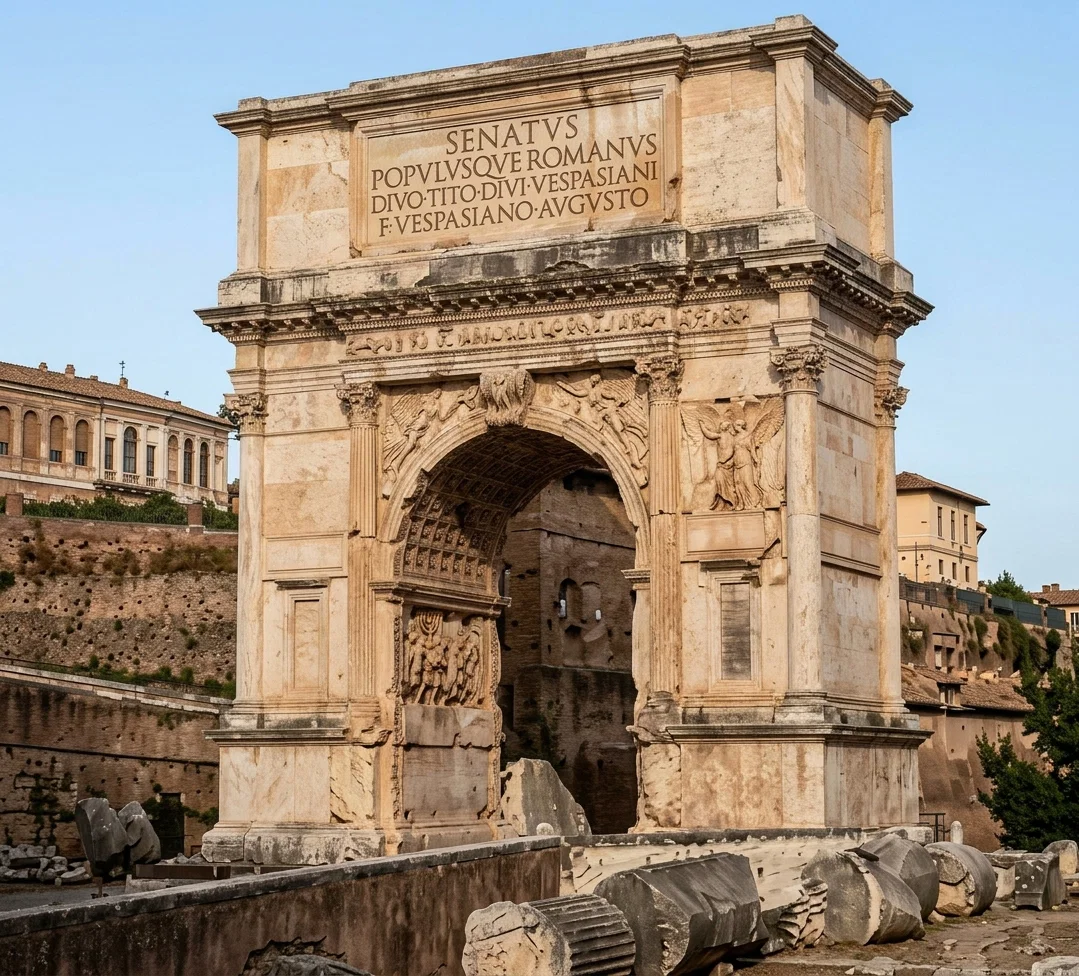
Arch of Titus, upon which is displayed in relief the conquest and capture of Jerusalem.
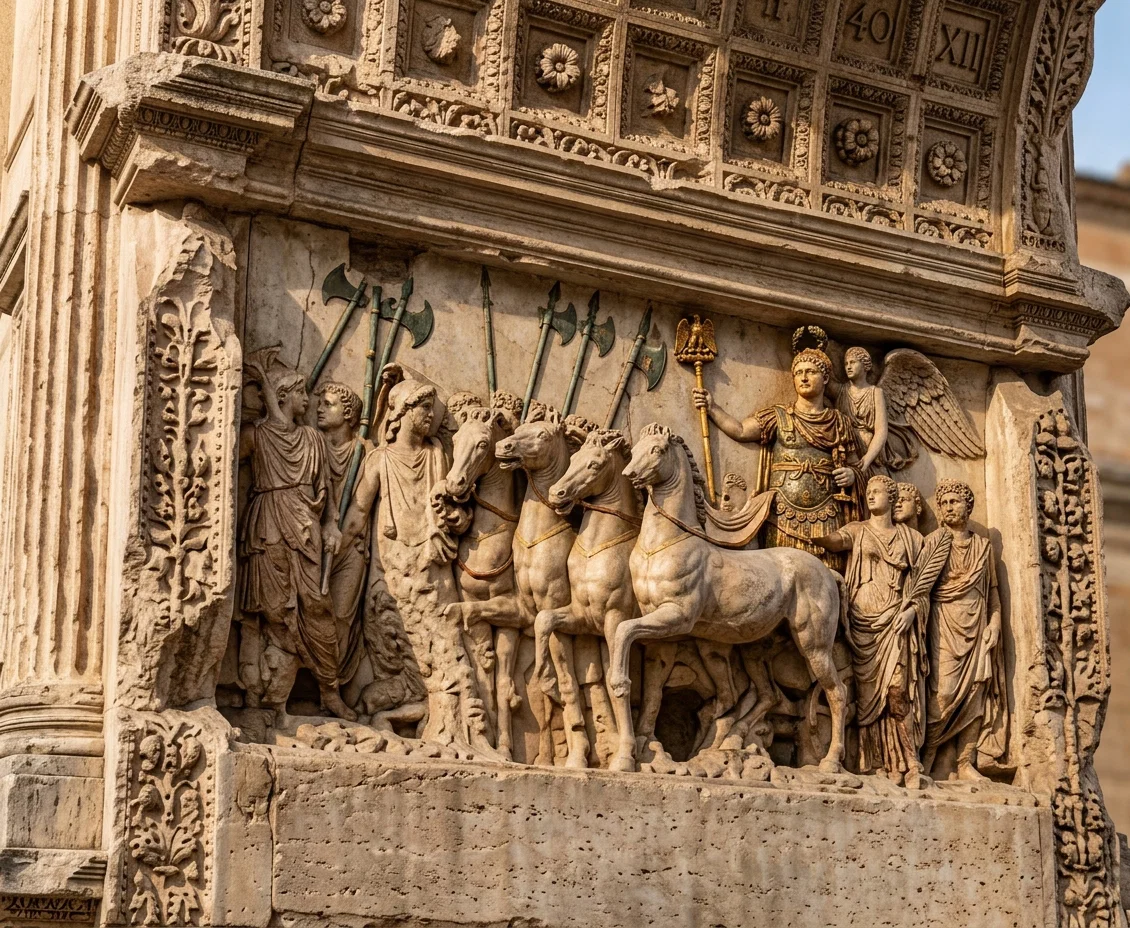
A relief on the triumphal Arch of Titus, representing victory crowning the Roman general.
Rome and the Stone Kingdom.
And the fourth kingdom shall be strong as iron: forasmuch as iron breaketh in pieces and subdueth all things; and as iron that breaketh all these, shall it break in pieces and bruise.” Dan. 2: 40. Great had been the power of the Macedonian phalanx; but greater still was the strength of the Roman legion. The Romans came on from the west like an irresistible storm; and the remaining fragments of Alexander’s empire were torn from their places of dominion. Death had hardly seized hold upon Alexander before his would-be successors beheld a new power asserting itself upon the seven-hilled city of Italy. The Eastern world soon heard the splash of oars upon the Mediterranean as the Roman triremes sailed away to the conquest of northern Africa and Spain. The struggle with Macedonia could not long be delayed. In the beginning of the second century, Rome, upon the pretext of friendship to a smaller power, imperiously interfered in Grecian affairs. War was declared; and upon the battle-field of Cynosphaelae in 197 B.C. the Macedonian phalanx went down before the Roman short sword.
The Government of Municipalities.
Two or three more important battle-fields, and the Eastern world became Roman territory. Over all their conquests in the East, as well as in the West, Romans extended a new and peculiar form of government. “Forasmuch as iron breaketh in pieces,” were the words of Daniel to Nebuchadnezzar. The Roman Empire, according to the famous historian Guizot, was a collection of municipalities. A municipality is the form of government for a city—not for a state or nation. The force sending out the legions to conquest, was, not a Nebuchadnezzar, nor a Cyrus, nor yet an Alexander. It was a municipality—a city government so thoroly convinced that its own form was the only enduring one, that it modeled all its conquests after itself. The world was therefore broken up into municipalities.
A Divided Kingdom.
Rome was deceived, however. The municipal form of government proved no more eternal than the empires of Greece or Babylon. “And whereas thou sawest the feet and the toes, part of potters’ clay, and part of iron, the kingdom shall be divided; but there shall be in it of the strength of the iron, forasmuch as thou sawest the iron mixed with miry clay.” Dan. 2: 41. There is only one force which can establish a nation—the truth of God. Practically all the conquests of Rome had been made before the birth of Christ. It was then ready for the Gospel. The Gospel would have solidified it and would have made its power enduring. But Rome rejected the Gospel. In the persons of the apostles and saints, it persecuted the Lord Jesus Christ. Morals declined, vice increased, the sturdy character of the people became undermined, and the empire was shaken by the strife of contending rivals. Eventually after many adjustments the imperial power was split in two and the Eastern and Western empires arose.
A house divided against itself can not stand. Ruin soon followed division. “And as the toes of the feet were part of iron, and part of clay, so the kingdom shall be partly strong and partly broken.” Dan. 2: 42. As the iron descends toward the toes, or as the empire approached the days of division into ten kingdoms; the elements of weakness, represented by the clay, began to appear. Great masses of men, barbarians, issuing from the forests of the north, fell upon the Western Empire. Its early strength gone, it was unable to withstand the attacks. In A.D. 476 the Western Roman Empire passed away, its territory occupied by various kingdoms. England, France, Germany, Spain, Portugal, Italy, etc., etc., arose in harmony with the predictions of the Hebrew chapter.
Efforts to Reunite.
Daniel foretold the efforts to reunite these fragments. “And whereas thou sawest iron mixed with miry clay, they shall mingle themselves with the seed of men; but they shall not cleave one to another, even as iron is not mixed with clay.” Dan. 2: 43. Charlemagne, that grand warrior of the ninth century, sought by the strong blows of his battle-ax to drive back again into one the nations which had split asunder. That is why he founded in 800 A.D. the Holy Roman Empire. In vain. No sooner had his mighty7figure passed away than years of confusion followed. Seven hundred years later, Charles V sought to encompass the same object. Yes, Napoleon called him a fool to have failed in seizing the grand opportunity events offered him. But Napoleon himself did no better. Tho for twenty-five years Europe shook under the tread of the armies of this commanding soldier of destiny, nevertheless Napoleon founded no enduring empire.
The Stone Kingdom.
What was the difficulty?
“My kingdom is not of this world,” said Christ.
“Forasmuch as thou sawest that the stone was cut out of the mountain without hands,” cried Daniel to Nebuchadnezzar. The kingdom of Christ alone is eternal. Over none of the preceding empires was Jesus Prince and Ruler. Over one kingdom only shall Christ sit on the eternal throne of His right—the stone kingdom. This leads us to three considerations.
1. The stone kingdom is not Christianity.
Christianity is with us to-day; it is a force which is invisible, tho its effects may be visible. The stone kingdom on the other hand is, or is to be, outward, tangible, visible. The head of gold symbolized Babylon. The kingdom of Babylon was not an invisible force; it had its visible king, capital, territory, and armies. So did Medo-Persia, Greece, and Rome, represented respectively by the silver, brass, and iron. All this is not true, however, of Christianity as it dwells among men to-day. It is a spiritual power, mighty to be sure, but symbolized in no manner by the characteristics of the stone kingdom.
2. The stone kingdom is Christ’s everlasting kingdom:
The stone kingdom is not the United States.
Nor is it any other earthly nation past, present, or future.
All such nations have been set up by human hands. In particular the United States was founded by a Washington, a Jefferson, a Hamilton, and their associates. But of the stone kingdom, Daniel expressly declared “the stone was cut out of the mountain without hands.”
Moreover the stone kingdom is eternal. Of it the prophet said, “The God of heaven shall set up a kingdom which shall never be destroyed.” None of the four empires represented in the image itself were enduring; no reasoning can assure a better future to the United States.
There is only one nation that can be represented by the great stone. It is that everlasting kingdom of Christ, of which God declared, “Of the increase of His government and peace, there shall be no end, upon the throne of David, and upon His kingdom, to order and to establish it with judgment and with justice from henceforth even forever.” Isa. 9: 7.
3. The stone kingdom is near.
The complete fulfilment of the dream was not left to indefinite time. “There is a God in heaven that revealeth secrets, and maketh known to the king Nebuchadnezzar what shall be in the latter day.” Dan. 2: 28. The TIME of the events, as well as the events, of the future was clearly stated. We have seen set up the empires of Babylon, Medo-Persia, Greece, and Rome. Yes, we have seen set up the ten kingdoms of Italy, Spain, France, England, etc. Fourteen hundred years have passed since the date which history sets when the latest of these was set up. Surely we must be near the time for the stone to crush the image on the feet, to become a great mountain and fill the whole earth. Listen to the solemn declaration of Daniel: “And in the days of these kings [of the ten kingdoms] shall the God of heaven set up a kingdom which shall never be destroyed.”
Reader, the time allotted to the image has almost run out. Putting one hand upon Nimrod, the founder of the head of gold, and the other hand upon the second coming of Christ, the image spans a period of nearly 5,000 years. The universe pauses yet a few moments longer before the execution of the final sentence, “All is finished.” Precise signs, foretold by other chapters of Daniel and by Christ Himself, are sweeping across the face of each day’s record, to announce that the return of Jesus, the setting up of the stone kingdom, is impending. The movements of Providence await only one last act—the final preparation of those who shall be “alive and remain” (1 Thess. 4) when the Lord descends from heaven. It is for you that the Lord gave and interpreted the image. May you be ready at His coming.
The More Sure Word of Prophecy.
1. By what figure does the Lord express the condition of this world in the last days?
“For, behold, THE DARKNESS SHALL COVER THE EARTH, and gross darkness the people.”Isa. 60:2.
“We have also a MORE SURE WORD OF PROPHECY; whereunto ye do well that ye take heed, as unto a LIGHT THAT SHINETH IN A DARK PLACE, until the day dawn.”2 Peter 1:19.
3. What will the coming of the day of the Lord be to the wicked?
“For yourselves know perfectly that the day of the Lord so cometh AS A THIEF IN THE NIGHT. For when they shall say, Peace and safety; then sudden destruction cometh upon them, as travail upon a woman with child; and they shall not escape.”1 Thess. 5:2, 3.
4. How will it be with the people of God when the world is in darkness?
“But YE, BRETHREN, ARE NOT IN DARKNESS, that that day should overtake you as a thief. Ye are all the CHILDREN OF LIGHT, and the children of the day: we are not of the night, nor of darkness.”1 Thess. 5:4, 5.
5. How does the Lord express the same truth by another prophet?
“Surely the LORD GOD WILL DO NOTHING, but He REVEALETH HIS SECRET unto His servants the PROPHETS.”Amos 3:7.
6. What is one of the purposes which God has in giving us prophecy?
“Remember the former things of old: for I am God, and there is none else; I AM GOD, AND THERE IS NONE LIKE ME, DECLARING THE END FROM THE BEGINNING, and from ancient times the things that are not yet done, saying, My counsel shall stand, and I will do all My pleasure.”Isa. 46:9, 10.
NOTE.— It will be seen, from the above text that one of the great purposes which God has in giving predictions of the future is to reveal to the world that He is God, that He knows the end from the beginning; understands all causes and their effects, and who is able to control not only the great things, but all the minutia that enter into this great world’s history.
7. What other purpose has the Lord in giving His prophetic word?
“He REVEALETH the deep and secret things: He knoweth what is in the darkness, and the light dwelleth with Him.” “There is a God in heaven that REVEALETH SECRETS, and MAKETH KNOWN . . . WHAT SHALL BE IN THE LATTER DAYS.” “This secret . . . is REVEALED . . . FOR THEIR SAKES that shall make known the interpretation to the king.”Dan. 2:22, 28, 30.
8. Did the prophets themselves understand the messages which God gave through them?
“And I heard, but I UNDERSTOOD NOT: then said I, O my Lord, what shall be the end of these things?”Dan. 12:8.
“Unto whom it was revealed, that NOT UNTO THEMSELVES, but UNTO US THEY DID MINISTER the things, which are now reported unto you by them that have preached the Gospel unto you with the Holy Ghost sent down from heaven.”1 Peter 1:12.
9. What promise did God give of a revelation of these things in the future?
“But thou, O Daniel, SHUT UP THE WORDS, AND SEAL THE BOOK, EVEN TO THE TIME OF THE END: many shall run to and fro, and KNOWLEDGE SHALL BE INCREASED.” “And He said, Go thy way, Daniel: for the words are closed up and sealed TILL THE TIME OF THE END.”Dan. 12:4, 9.
10. By whose Spirit did Daniel and the other prophets speak?
“The SPIRIT OF CHRIST which was in them.”1 Peter 1:11.
11. To whom is the assurance given of the understanding of the prophecy in the time of the end?
“Many shall be purified, and made white, and tried; but the wicked shall do wickedly: and none of the wicked shall understand; but THE WISE SHALL UNDERSTAND.”Dan. 12:10.
“The secret of the Lord is WITH THEM THAT FEAR HIM; and He will shew them His covenant.”Ps. 25:14.
12. Give one example of a prophecy definitely fulfilled.
“And the Lord shall SCATTER THEE AMONG ALL PEOPLE, from the one end of the earth even unto the other.”Deut. 28:64.
NOTE.— This last is a prophecy concerning the Jews. There are many others equally definite. But the fulfilment of this is so evident that all intelligent people can understand it. Go where one will, in every civilized nation of the earth, and one finds that there has gone before him the Jew. Frederick the Great, a skeptic, once asked the court chaplain for one evidence that the Bible is true. Laconically the Lord’s servant replied: “Sire, the Jews.”
Opposition to the Sabbath.
The California Christian Advocate, of December 24, in pleading for a “moral” Sunday law, speaks thus of the opposition:
“Strange to relate, and yet strongly true, the opposition to a Sunday law comes from a sect professing to be Christian—the Seventh-day Adventists. They are unwise from their own standpoint. The claim they set up that a civil sabbath is essentially wrong is in effect to cut the ground from all contention for a sabbath on any day of the week. It is pretty hard to say, but it is very easy to believe, that our Seventh-day Adventists, just now in tremendous activity, are not sincere in their opposition to the passage of a Sunday-rest law. Christian men can not sincerely and conscientiously unite with the evil contingency in every community in the state to oppose the enactment of a law proposed by the majority of the Christian people of the state. The opposition to the proposed Sunday-rest law is insincere and unscrupulous. They claim that they would oppose the enactment of a Saturday-rest law. Such a statement reverses the principle underlying their propagandism. They are either insincere in advocating the Saturday-Sabbath or they know perfectly well that a Saturday-Sabbath can not be enacted, and they therefore affect not to want legislation favoring such a Saturday-Sabbath in order to appear consistent in opposing a Sunday-Sabbath. In either case they are insincere. They are openly and flagrantly unscrupulous in joining with all the evil contingency of the state, the gamblers, the saloon-keepers, the liquor dealers, the race-track promoters, in trying to defeat the proposed Sunday-rest law.
“The hope of the Seventh-day Adventists is not to make out a case before the public, but to afford an excuse for inaction by giving out the impression that even the Christian people are not united as to which is the Sabbath day. It is a political game. If they stood up squarely and contended straightforwardly that Sunday is not Sabbath and that Saturday was the true Sabbath, we could respect their contention. So long as they conceal their real purpose behind an insincere contention that the liberties of the citizens are being imperiled in order to form a plausible excuse for inaction, we can only look upon their miserable fiasco with pitiable contempt.”
We note some points in this quotation:
1. The title to the article is “Opposition to the Sabbath.” Let the Advocate know once and forever that opposition to a Sunday law and opposition to the Sabbath are two things decidedly different. The one is opposition to religious legislation, a basis of tyranny and a feeder of hypocrisy. The other is opposition to a command of God and a blessing to the race. To the first, Seventh-day Adventists, and many other good and eminent citizens, among whom we are constrained to believe are not a few Methodists, plead guilty; the latter they emphatically deny. In no way are they opposed to the Sabbath of the Lord. Nor are they opposed to any soul’s keeping whatsoever day he will.
2. In the third sentence quoted above, the Advocate virtually confesses that the chief ground it has for a Sabbath is civil law. Does the Advocate believe that a law to enforce baptism or the Lord’s Supper would be right? It surely would reply, No. It would think such laws “essentially wrong.” But to set up a claim that a civil baptism or Lord’s Supper were essentially wrong, “is in effect to cut the ground from all contention” for baptism or Lord’s Supper at any time, or in any manner! The logic is as good in one case as in another. Seventh-day Adventists believe that the Sabbath is of God; that His law is all-sufficient; that if men will not observe the day from loyal, loving obedience to God, no enforcement of human law can compel such obedience. Coercion may make men slaves or hypocrites; it can never convert hearts or make men pleasing to God.
3. Seventh-day Adventists are opposed to all religious legislation whatsoever. If others join them in that opposition, that is their right. They do not by that indorse the morals or principles of others who may oppose such legislation any more than the editor of the Advocate would indorse the principles and life of the gambler who voted with him the Republican ticket. Seventh-day Adventists oppose Sunday legislation on the broad grounds of Christianity, because they are Christians, and as opposed to the principles embodied in the charters of our government. They have never modified or compromised these principles to gain favor or support.
4. They would oppose the enactment of a Seventh-day Sabbath law. They believe that God can and will care for His own without Peter’s sword. The “all power” of Christ’s commission is sufficient. Knowing that, they would be false to Him if they should even ask for legislation in behalf of the Seventh-day Sabbath. That day is of God; it was instituted of Him; it is hedged about by His law; it was hallowed by Jesus Christ their Lord and Saviour; and they find His grace and promises sufficient to enable them to observe that day and live notwithstanding all the greed of men. If an employer demands work upon that day on the penalty of dismissal, better the dismissal of man than the disloyalty to God. If in God’s providence they are thus deprived of work, He has some better place for their services.
If the editor of the Advocate knew the principles of true Christian liberty, he would not, could not, make the argument he does. Holding the principles they do, Seventh-day Adventists could not ask for Sabbath legislation if they were sure it could be secured. This we have many times stated. Of course, it is not pleasant to be told in effect that all our statements are false, that we “are openly and flagrantly unscrupulous,” that we “are not sincere,” etc., but all this we are willing to leave with God. The manner of the Advocate seems to have become a fixed habit. Two years ago it made equally bold and false statements concerning, not doctrines or motives, but persons, acts, and places, and would not even correct its misstatements when they were pointed out. Two years ago the Seventh-day Adventists argued before the legislative committee against the Sunday law. Their representatives stood alone. After the hearing was over, representative labor men, whom the editor of the Advocate and his associates claimed to represent, assured us that they stood with us. In the great final issue, every disreputable element will stand with the Advocate.
The Seventh-day Adventists have many times “made out their case before the public,” in the halls of Congress, in many state legislatures, and throughout the world among the people. They have stood up squarely, and still do stand, and say, on the authority of God’s word and all authentic history, confirmed by numerous first-day theologians, that Sunday is not the Sabbath, but that the seventh day is, and the Advocate knows this to be the fact. But the question of the particular day is not a matter for legislation. It is not the business of any civil tribunal to decide and enforce any day as the Sabbath. Just as soon as that step is taken, that civil body assumes the place of God and the lord of the conscience. It makes itself a party to religious controversies. It favors by legislation one class, and wrongs another. Even so began the Dark Ages.
It is not the business of Seventh-day Adventists to say that the Advocate editor shall observe the seventh day or no day. They9may persuade him if they can; they may coerce him never. They believe in the Golden Rule, and that forever prohibits religious legislation.
In pleading for the absolute separation of church and state, in their opposition to a Sunday law, Seventh-day Adventists are pleading for the liberty of the editor of the Advocate. He may be persuaded some day to observe the Mohammedan Friday, or he may become an Orthodox Jew. We do not wish to have a law passed now even by his consent which will work hardship upon him then. True religious liberty is liberty for the other man.
Is It Not Strange?
THERE are millions in the world to-day who believe in the Lord Jesus Christ. They believe, first, on the authority of the word of God, the Bible; and, secondly, on the confirmation of that word by the work it has wrought in the regeneration of the souls of men throughout the ages.
Is it not strange that so many of these take no interest in the great prophetic utterances of the Bible, indorsed by our Lord Jesus Christ, in fact, given through Him?
Is it not strange that they do not see that as many of these prophecies have been fulfilled in part in the past, so surely all will be fulfilled in the future?
Is it not strange that so many can not see that every fulfilment of the past is a pledge, an assurance, of every fulfilment of the future?
Is it not strange that so many who profess to love our Lord show no regard to His promises of the great unknown?
Is it not strange that, when there is so much said in the Scriptures concerning the second coming of Christ, Christians should say so little about that vitally important event?
Is it not strange that so many who hope in the salvation of Christ and talk of Him as their friend are not interested in His personal coming?
Is it not strange that if we accept a part of the testimony of Scripture concerning our Lord, we do not accept it all?
Why not find comfort and hope and cheer and strength in believing “every word” of God? Even so the Master believed. Matt. 4:4. Are we wiser than He? Are we less needy?
Not Good Baptist Doctrine.
THE Word and Way, a weekly Baptist journal published in Kansas City, Mo., in referring to the going out of office of Judge Wallace, declares that “Judge Wallace has fought a good fight,” and “The most regrettable thing of it all is the slight sympathy and feeble support given to Judge Wallace by the Christian men and churches of Kansas City, in his heroic effort to save our Christian Sabbath from desecration.”
Now, entirely apart from the fact that Sunday has absolutely no claim whatever to the title “Christian Sabbath,” for it was neither given by Christ nor kept by Christ, it is a strange position for a Baptist paper to take, with all the Baptist traditions of hundreds of years behind it against a union of church and state. Sunday legislation is religious legislation. For that Judge Wallace himself stood; and this was stated over and over by himself emphatically. A few years ago every Baptist paper in the United States was against Sunday legislation; now they are yielding to the demand; one after another has turned from the only true Christian position and favored religion by law.
The word “Exodus” means “a going out,” and the book records the going out of the children of Israel from Egypt on their journeys to the promised land. The first two chapters give an account of the oppression of the children of Israel in Egypt, of their prosperity despite the oppression, and the birth and rearing of Moses. Chapters 3 and 4 record the call of Moses, and his mission to go down to Egypt to deliver the Lord’s people. Chapter 5 records again the cruel tasks required of the Israelites. The fifth verse of that chapter would seem to indicate that they worked every day, while Moses and Aaron would bring them back to the keeping of the Sabbath. Pharaoh’s complaint to these men was that ye make the people “rest,” or literally, sabbatize, from their burdens.
---
Chapters six to twelve inclusive, give us an account of the ten plagues upon Egypt, and God’s merciful deliverance to His children. Note also His mercy to Pharaoh and the Egyptians, how reasonable the request that He asks of them. “Let My people go that they may serve Me.” He would have left them in Egypt if they had had the privilege of serving Him, but Pharaoh would not grant that. Read also the word “Lord” when found in capital letters as “Jehovah.” Pharaoh did not ask, “Who is the Lord?” but “Who is Jehovah?” “I know not Jehovah, neither will I let the people go.” Mark also that the Lord did not bring any of these plagues at first against human beings, but against the gods which the Egyptians worshiped. Almost every plague is connected with their worship in some way to show them that their gods were utterly unworthy of being trusted. Also note that in the commission to Moses, the Lord predicted that He would harden Pharaoh’s heart, but this hardening does not come until Pharaoh utterly rejects every appeal which God makes to him, and then the Lord does the only thing that He can do—withdraws His Spirit, and Pharaoh’s heart “remains hardened,” as given in the Revised Version. During all these times that God was pleading with him, Pharaoh made hard and stubborn his heart, till finally the Lord leaves him when there is no hope whatever of saving him. One other point which is worthy of note, and that is the word “borrow.” The word would better be rendered “ask.” The children of Israel did not borrow jewels of gold and silver of the Egyptians, but they asked them as their perfect right for their long service and labor, and the Egyptians were anxious to give.
---
Chapters 13 to 18 record the journeys of the children of Israel from Egypt to Mount Sinai, with the instruction of the Lord, the incidents by the way, and the Lord’s marvelous working, including the passage of the Red Sea and the fall of the manna. Chapter 16 forever shows us that it was not an indefinite seventh portion of time which God chose for His Sabbath, but a clearly definite day; namely, the seventh day, which had been hallowed by His resting, and appointment. God pointed out this definite day for forty years by the falling of the manna. There could be no mistake on Israel’s part as to the right day. Read the prophecy concerning Amalek in the 17th chapter, and Moses’ wisdom in the portioning of the burdens of the people in chapter 18. Mark the character of the men that he chose. It is a lesson for all.
---
In our evening readings we begin at Matthew 14 and conclude with the 20th verse of Matthew 18. The topics covered are of great variety and interest. Note them: John the Baptist beheaded; five thousand fed; Jesus walking on the water; ceremonial defilement and real sin; the Canaanitish woman; the four thousand fed; how the Pharisees and Sadducees sought after a sign; Jesus foretelling His coming passion and resurrection; the transfiguration, with its wonderful lessons; the healing of the epileptic boy; the power of faith; the question of rank among His disciples, and of stumbling blocks; the parable of the lost sheep; closing with the wonderful lesson of how we should treat our brethren, and of God’s assurance that He hears the united prayers of His children. How full and rich and blessed are all these scriptures! It surely ought to be to the reader a week of instruction and triumph even as God’s children triumphed of old.
Bible Band Readers.
WE ARE gratified to find so many of the old Bible Band who are renewing their allegiance to it this year. Some have been saying that they started out with fear and trembling, hardly thinking they could go through the year and keep up the reading, but they have done so.
One of our readers writes that when he made it a part of his daily work the same as he did every other duty, he had no trouble at all. He finished the year on time and received great benefit, and his interest was the result of awakening the interest of others.
A very busy man, the manager of our largest publishing-house, sent us last year quite a large number of names with his own, as readers of the Bible Band. This year he writes again and tells us how much benefit and blessing he received from the readings, and again sends in a larger list of names. And so the word comes to us from all over the field. We hope that this year’s reading will be abundantly blessed.