The Youth’s Instructor, Vol. 54, No. 44.

The Wonders of a Bird's Bill

The Youth’s Instructor

Oct 30, 1906

Review and Herald Publishing Assn. · Takoma Park Station, Washington, D. C. · Oct 30, 1906

The Wonders of a Bird's Bill
Probably few persons ever stop to think what a wonderful organ a bird's bill really is, less as to structure than to what is accomplished with it. It has been asked what a man would do if he had to build his home and procure his food with his hands tied behind him. This is in effect what the bird has to do, and the constructive and artistic work shown in nest building has ever defied all effort of man to successfully imitate.
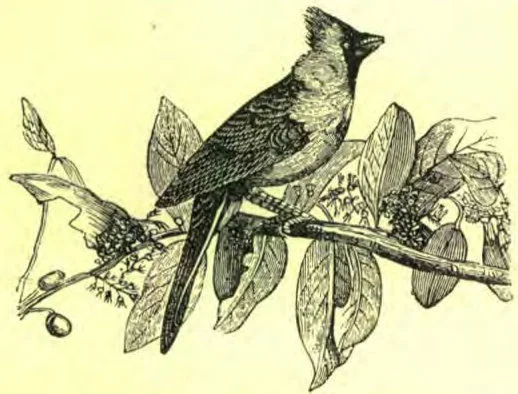
CARDINAL GROSBEAK, OR VIRGINIA NIGHTINGALE
A bird's bill is hand and mouth. As a hand it takes, holds, and carries food and nesting material, constructs and cleans its nest, dresses its feathers, and cares for the cleanliness of its young, and in some cases, as the parrots, assists itself in climbing. As a mouth the bill tears, cuts, or crushes the food, according to what it consists of. The bill is both lip and tooth to the bird, which has neither.
The general shape of the bill is such as to give the greatest strength with the utmost lightness and delicacy. It is formed of light, projecting skull bones, sheathed in horny cases, instead of being covered with skin.
The primary functions of a bird's bill are, first, the securing of food, and second, the building of the nest. These being the main requirements, it might be supposed that there would be comparatively little deviation from one general pattern of bill. The difference in the nature of the food, however, and in the manner of procuring it, among the different orders and families of birds, is such that there is probably no other one feature common to the members of any group, in which is to be found so much diversity in the matter of form and general size.
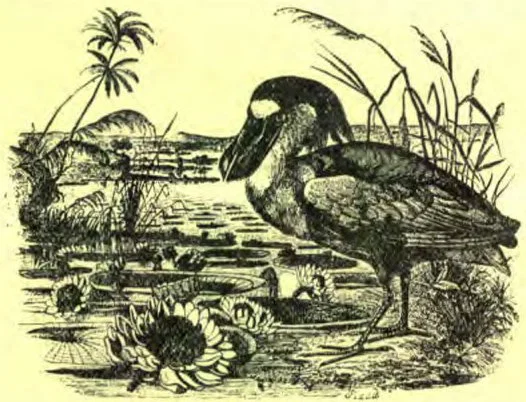
THE BOAT-BILL, OR CRAB-EATER
For the most part, the form of the bill is found to correspond pretty closely with the nature of the food and the manner of procuring it.
The various requirements of nest building and minor matters seem to be made subservient to this essential one. Taking as a type form of bill the shape common to birds which are omnivorous in food habits, we have a nearly straight conical bill, of moderate proportions, of which the crow's is a fair example. Such a bill, while not so well adapted to the procuring of any one kind of food as some specialized form, yet seems best adapted to meet the needs of obtaining a varied bill of fare under diverse conditions. In many cases the general nature of the food of two or more families is alike, but the method of procuring it varies greatly among the different orders of birds, a fact which results in considerable difference in size and shape of bill.
The food of both pelican and man-o'-war bird is fish. The former is an honest fisherman, and, like other honest fishermen, has times of abundant success, and others when he has only “fisherman's luck.” It is therefore to his advantage to have a bill adapted for the rapid gobbling up of the small fish of the schools with which he may come in contact, as well as a basket in which they may be deposited until a time of leisure for devouring them presents itself. Strength is not an essential, hence we find the bill of the pelican attaining a length of ten or more inches , the upper mandible only of sufficient strength to meet the requirements, the lower mandible a light, pliable framework, divided nearly to the tip, and supporting a capacious pouch.
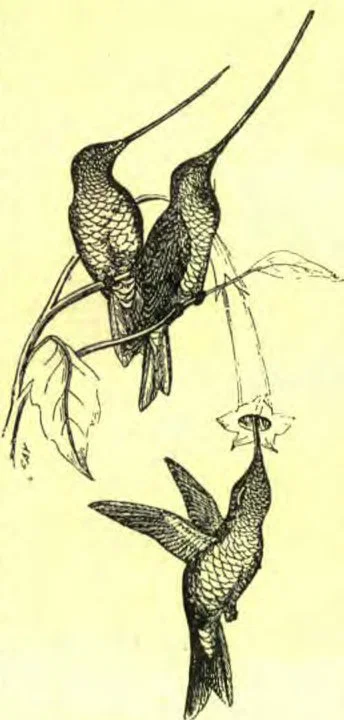
“The flower-fed humming-bird his round pursues”
The man-o'-war bird, besides being sometimes an honest fisherman, is often a robber of other fishermen, worrying other birds who have made a catch until the prey is dropped, to be seized by the marine highwayman. While the bill is of the same general pattern as that of the pelican, it is modified to meet the difference in habit, lightened and made less cumbersome by being much shortened (4⅜ inches), and decidedly firmer, with a greatly reduced pouch.
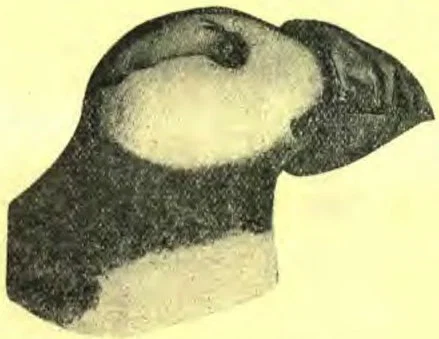
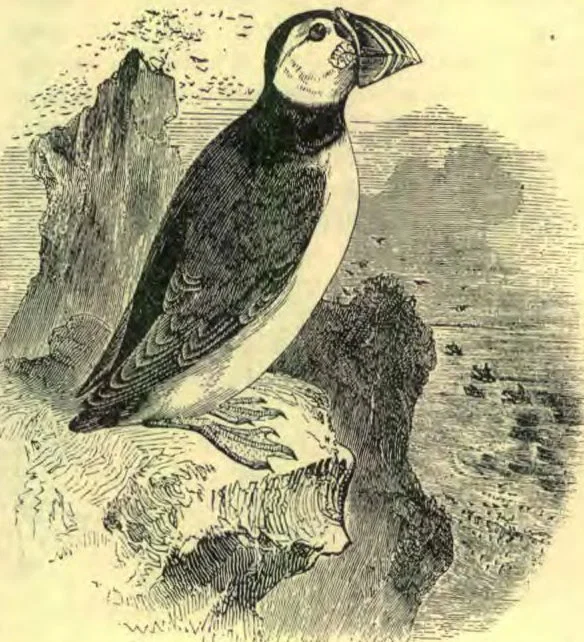
The puffins, another family of seabirds, include crustacea with fish in their bill of fare, and find a most radically different form of bill best adapted to their needs.
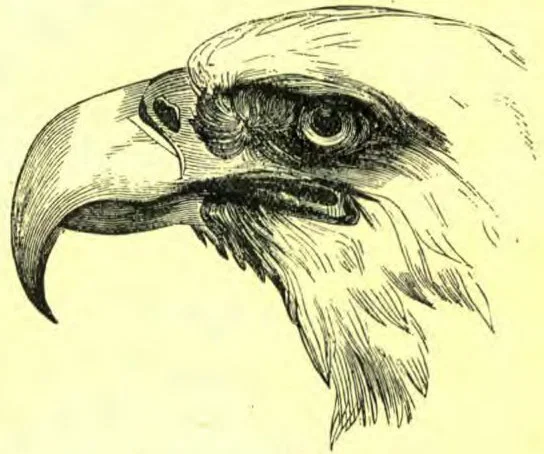
HEAD OF BALD EAGLE
HEAD OF BALD EAGLE
The gulls and terns, birds of the seas and great lakes, are more omnivorous in their food habits, being water scavengers, and their bills approach much more nearly the type selected. Seabirds either build no nest at all, laying their eggs on bare rock or sand, or construct a loose, shabby affair, of seaweed, so that they are unhampered in this task by the lack of a more delicate organ.
The flamingo, feeding in more or less shallow lagoons, on certain crustacea, is compelled, by its height, to take its feed with bill inverted—that is, the lower mandible is above while feeding, as the bird's neck is bent down. Often scraping the food from the bottom of the pools, an exceedingly peculiar shape of bill is the result of the bird's special needs.
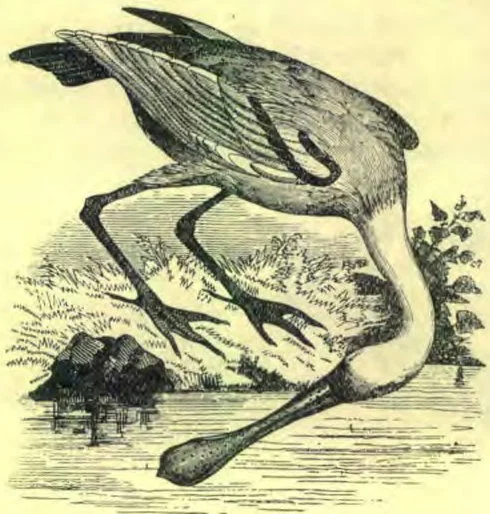
The typical shape of bill in the duck family is familiar to every one from the bill of the domesticated bird. It varies to a considerable extent in the different forms, but the general shape remains. The spoonbill has a very well-shaped ladle for scooping up its food.
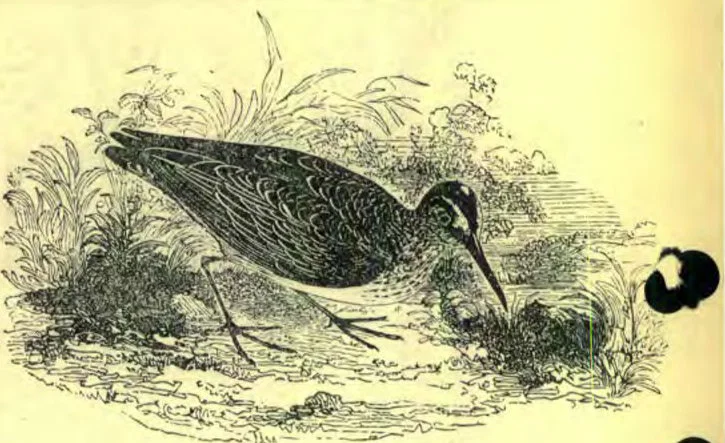
The bill of the woodcock is a striking example of perfect adaptation to special requirements. Long, slender, and tubular in shape, the upper mandible projects beyond the lower, and the tip is flexible, and exceedingly sensitive. The bird feeds by probing in soft, damp earth for worms and the like, the flexible mandible tip acting as a sensitive finger to locate and extract the prey. The snipe, with a bill almost exactly similar, has about the same habits in feeding. The sandpipers, with food habits more intermediary between the woodcock's and those of birds possessing the type form, have bills more approaching in shape those of the latter, and the plovers have still more typically shaped beaks.
THE ARCTIC PUFFIN
THE ARCTIC PUFFIN
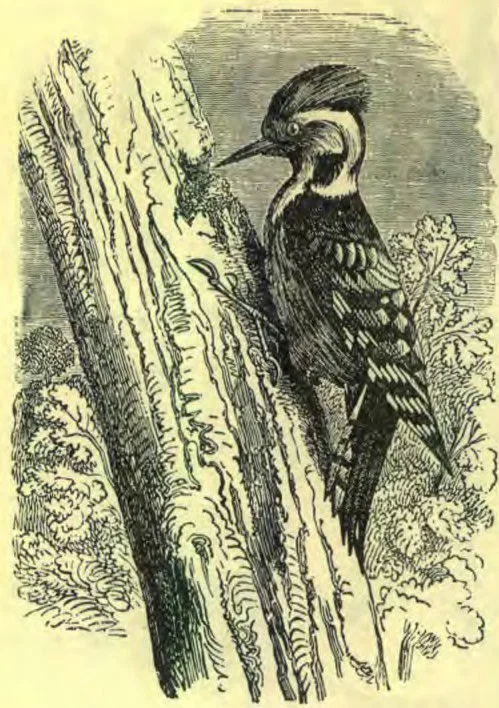
THE MIDDLE SPOTTED WOODPECKER
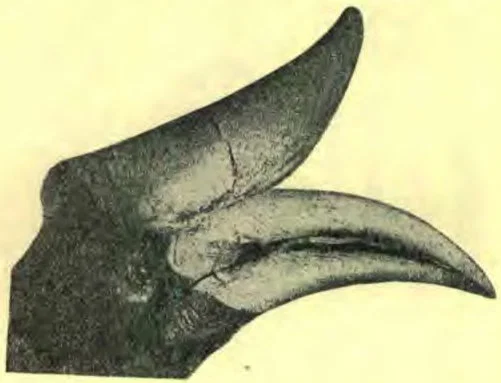
There are examples of very remarkable bills, whose strange shapes are not explained by requirements of food getting or nest building. These are most conspicuous among certain foreign species. The rhinoceros hornbill of Africa is an example of one of these very peculiar forms of bill. In such cases it is supposed that the decorations of the bill serve as sexual attractions.
The gallinaceous birds, to which our domestic fowl belongs, are more or less omnivorous in feeding, and the bill forms are not widely divergent from the type.
The eagles and owls require bills that will hold and tear prey, and they have prolonged and strongly curved upper mandible and bills of great strength. The shrike, belonging to a very different order, yet with food habits much the same, has a similar shape of bill. The kingfisher, securing his prey with a scissors-like motion of the bill, after a dive, has a large and powerful beak, well suited to cut the water as he plunges. A small relative, found only in the West Indies, the tody, feeds upon small insects, taken both on the wing and from the foliage, and the bill is wide and long, to better adapt it to the ready securing of its prey. Both of these birds excavate holes in banks of earth for nesting, for which work their bills form excellent spades.
The bill of the parrot is well adapted to its fruit-eating habits, but is also a very useful member in climbing. It is very heavy and strong, with the upper mandible well curved. The tongue of the parrot is also remarkable among bird tongues for the resemblance it bears to the human tongue. This probably accounts for the facility with which these birds learn to articulate words. The food of humming-birds consists of two quite different substances, the nectar of flowers and minute insects. Even the latter are taken chiefly from the interior of flowers, and to facilitate the obtaining of this food the birds are equipped with bills taking the form of long, slender tubes, and with tongues of unusual and very interesting structure.
In the tyrant flycatchers, comprising the kingbird, crested flycatcher, least flycatcher, woodpewee, and others, a rather typically formed bill is considerably widened, tending to render more easy the capturing of insects on the wing. The typical woodpecker bill is a very efficient chisel, accompanied by a tongue which acts as a probe. This structure finds its highest perfection in the ivory-billed and pileated woodpeckers, while the flicker, feeding much of the time in the manner of the meadow-lark, and nesting usually only in the softest of dead wood, has a bill shaped more like that of a meadow-lark than that of other woodpeckers.
Intermediate between these two forms come the downy and red-head, with many other species. A peculiar construction, permitting of the extreme protrusion of the tongue in woodpeckers, is the great length of the roots of that organ, in some species extending from the base of the tongue around the back of the head, on either side of the neck, over the top of the skull, with the ends resting close to the base of the upper mandible.
Among the smaller birds, as a rule, the more the food consists of seeds and vegetable matter the more the bill tends to a heavy, short, conical shape , while those species feeding more exclusively on insects tend to have more slender, elongated, conical-shaped bills, in some species more or less decurved. In the grosbeaks, some species of the tanagers, and some of the southern sparrows, the seed-eating type of bill finds its most extreme proportions. The warblers are among the birds exhibiting the other extreme, with the thrashers, wrens, and creepers, as examples of the decurved form of bill.
One remarkable example of the surprising manner in which nature secures for her creatures that structure best adapted to their needs is shown in the case of the crossbill. One unfamiliar with the bird's method of feeding would suppose that it would be fatally hampered in eating by the crossed mandibles, but after having watched the dexterity and rapidity with which the bird extracts the seeds from cones (its principal food), one will readily agree that the bill is shaped to its needs.
THE ROSEATE SPOONBILL
The growth of the bills of birds continues through life as with our finger nails. Where freak or accident prevents the proper meeting of the mandibles, the resulting interference with the ordinary functions of the bill minimizes the wear to a point where it is exceeded by the growth, resulting, sometimes, in peculiar malformations. Such a case was exhibited by a Porto Rican woodpecker which I collected. It had suffered an injury to the lower mandible near the base. Apparently, as this injury healed, the edges of the wound contracted, warping the mandible to that side, and tending to a corkscrew-shaped growth. The bird was debarred from hammering by the weak, misshapen bill, and the growth which normally would have replaced wear abnormally prolonged both mandibles, though why the lower so much more than the upper is not easy to understand. In this bird the upper mandible had exceeded the average length by about a third of an inch, while the lower mandible was nearly three times the normal length. The lower mandible made a half turn, so that what should have been its lower surface, was, at the tip, the upper. It would have been interesting to know if this bird was able to feed on seeds and fruit, which normally form a large part of the food of this species, or whether it was fed by the mate, which was with it when shot. At the time it was collected, the stomach was empty, while that of the mate contained the remains of a large dragonfly.
As in the time of Noah the dove returned to the ark with an olive branch in its bill as a token of promise, so now, each spring, the birds return to our dooryards and shade trees, bearing nesting material, as if it were a sign of the delightful intercourse we may have, and the study of the beautiful creatures we may enjoy if we will but meet them in friendly spirit half-way.
The horny sheath of the bill is called rhamphotheca, and is formed by the outer layers of the malpighian cells. It resembles in structure the other horny parts, such as claws, nails, and spurs. In some birds, as some of the ducks, this covering remains soft except near the tip, which contains tactile organs. In the hawks and parrots the distal end of the upper mandible is hard; basal portion, called the cere, is thick and soft. This latter is usually very sensitive, and in it the nostrils are enclosed.
In most species the cere is bare, but in some species of parrots it is covered with feathers, and in such cases its structure is similar to the ordinary skin.
The covering about the nostrils is soft in some species, and presents a means of externally closing them, though without special muscles. Such an arrangement is called an operculum, and is prominent in pigeons.
In petrels and shearwaters the operculum forms a complete tube, whence these birds are called Tubinares, or tube-nosed birds.—B. S. Bowdish.
THE BROAD-BILLED SANDPIPER
RHINOCEROS HORN-BILL

The Same Old Cat

JAMES WHITCOMB RILEY, in his inimitable way, tells the story of a “much-aggrieved and unappreciated lad” who made up his mind that he “could not stand the tyranny of home longer,” and so early one morning he put a long-contemplated plan into execution, and ran away.
All day long he played down at the old “swimming hole” with the other boys, making a raid on an orchard at noon to stifle the pangs of hunger. At night, when his companions went home, he was left alone, “with a lump in his throat that hurt worse when he didn’t notice it than when he did.” As it grew dark, he wandered toward home. He climbed the back fence into the big back yard, which had a “homey” look that he had never noticed before. After roaming round, getting acquainted with his home that he had left so long ago (about twelve hours since), he wandered into the sitting-room, where father was reading the evening paper, and mother was sewing. They took no notice of him, and he sat down on the remote edge of a chair and waited to be recognized. He could hear the boys playing out on the commons their nightly game of “town-fox,” but he didn’t want to join them. He just wanted to stay right there at home forever. The clock ticked, O! so loudly, but otherwise the silence was so deep that it was painful. Finally, when it became more than he could bear, he cleared his throat and mustered up courage enough to say, “Well, I see you’ve got the same old cat.”
God bless the boy, who, finding he has made a mistake in his valuation of home, is brave enough to go back, and prove just how much “the same old cat” is worth as compared with no cat and a homeless life.—Selected.

A Charm of Youth

If young people only knew it, nothing renders them so charming as a beautiful deference to their elders. The girl who, as naturally as a flower to the sun, turns to her father and mother, anticipating their wishes and yielding her own desires in ready consent to their will, is simply irresistible. The stronger the nature, the finer and sweeter it becomes if this grace of obedience gives it its final and crowning charm.
Foreigners understand this as American girls do not, or shall we say, as American mothers fail to do? The pretty English girl looks up to mama for direction, and accepts mama’s guidance in perfect docility, until her wedding day. The German, the Swiss, the French, the Italian girl of good family is solicitous to please her mother, and wears the grace of filial courtesy as if it were a decoration. The manners of our young country women are often at fault in this regard. “How unamiable and unformed is the younger Miss Ransom,” said a dignified Dutch matron to the writer in criticism of a young lady, born with the traditional silver spoon, and educated in one of our best seminaries. “Her tone of patronage, and her supercilious air in addressing her mother, mark her as insufferably ill bred.”
Girls little know, when they snub their mothers, or assert their independence of these older, wiser heads, how disagreeable an impression their conduct makes. The young man looking for a wife will do well to avoid the pert, flippant young woman in her teens or her twenties who fancies she is sufficient in herself, and scorns the advice of her mother.
Character is often indicated by apparent trifles. The girl who brings a shawl to wrap around mother’s shoulders, who slips a cushion in the precise angle to relieve a tired back, or remembers a hassock for her mother’s feet, will one day make a loving wife to the man whose heart shall safely trust in her. She will do him good, and not evil, all the days of her life. For true wearing qualities, warranted to last through all stress of weather, we recommend the girl who is the tender, thoughtful, and deferential daughter at home.
I once knew a dear girl, in years little more than a child, whose study it was to make up all the deficiencies in her mother’s lot. Her father was brusque and tempestuous, but Kathleen always bore the brunt of his temper, and managed to coax him into a sunny mood before her mother had time to be wounded by his petulance. A baby came, and the mother was much worn by the interruptions the little one made in her slumbers. Many a night the little crib was carried into Kathleen’s room, and the daughter cared for the baby that her mother might rest. Kathleen was of sturdy fiber, and had New England granite in her composition, but all her courage, vigor, and resolution were tributary to her mother’s enjoyment.
As for young men, it is needless to say that nothing imparts to them such an air of distinction as devotion in word and look to their parents. Youth is ardent, impetuous, impulsive, and apt to chafe at restraint. The very qualities which enable young men to conquer the world, which make them heedless of obstacles, and cause them to smile at impediments alarming to older and more cautious friends, interfere to prevent their willingness to be controlled. Yet never was there a good soldier or a good citizen who did not learn by strict discipline to rule himself and to defer to others. This lesson acquired, he was in a position to command.
Even when parents and teachers are arbitrary and unreasonable, it is the duty of young people to bear with them respectfully. In the long conflict with trouble, in the disappointments and anxieties which they have borne, parents may have been embittered, or may have grown pessimistic and discouraged. Youth is the true season of optimism. We shall never be sorry, we who are young, that we have been loving and patient with the parents who were in truth a little exacting at times. When they are gone, and the generation that now stands between us and eternity is no longer a breakwater against the flowing sea, we shall be glad of every kind word we ever said, of every bit of self-control we ever showed, while still the happy circle was intact.
— Mrs. Margaret Sangster.

The Lighthouse Lamp

The winds came howling down from the north, Like a hungry wolf for prey, And the bitter sleet went hurling forth, In the sinking face of the day.
And the snowflakes drifted near and far, Till the land was whitely fleeced, And the lighthouse lamp, a golden star, Flamed over the waves’ white yeast.
In the room at the foot of the lighthouse Lay mother and babe asleep, And little maid Gretchen was by them there, A resolute watch to keep.
There were only the three on the lighthouse isle, For father had trimmed the lamp, And set it burning a weary while In the morning’s dusk and damp.
“Long before night I’ll be back,” he said, And his white sail slipped away, Away and away to the mainland sped, But it came not home that day.
The mother stirred on her pillow’s space, And moaned in pain and fear, Then looked in her little daughter’s face Through the blur of starting tear.
“Darling,” she whispered, “it’s piercing cold, And the tempest is rough and wild; And you are no laddie, strong and bold, My poor little maiden child;
“But up aloft there’s the lamp to feed, Or its flame will die in the dark, And the sailor lose in his utmost need The light of our islet’s ark.”
“I’ll go,” said Gretchen, “a step at a time; Why, mother, I’m twelve years old, And steady, and never afraid to climb, And I’ve learned to do as I’m told.”
Then Gretchen up to the top of the tower, Up the icy, smooth-worn stair, Went slowly and surely that very hour, The sleet in her eyes and hair.
She fed the lamp, and she trimmed it well, And its clear light glowed afar, To warn of reefs, and of rocks to tell, This mariner’s guiding star.
And once again when the world awoke In the dawn of a bright new day, There was joy in the hearts of the fisher folk Along the stormy bay,
When the little boats came sailing in All safe and sound to the land, To the haven the light had helped them win, By the aid of a child’s brave hand.
— Margaret E. Sangster.

Refuge

“Who shall separate us from the love of Christ?” Rom. 8:35.
Two loving friends—a father and his child— Strolled side by side one day, ’Cross verdant fields, midst blossoms fair and wild, And loitered by the way.
The little one, in quest of “posies” sweet, Ran on in sportive glee, And finding some, with joy knelt down to pluck The blooms so fair to see.
From father’s sight the child had gone aside, Regardless of alarms. A shadow grim o’ercast, she cried, and sprang Into her papa’s arms.
And so in life, when trials thick and fast Our daily walk beset, ’Tis but the mist that veils our Saviour’s face, Which we should not forget.
Misfortunes dire are not a signal sure That God has left us ’lone; More oft it is our Saviour bending o’er, To hover near his own.
’Tis not a truth, in conflicts fierce, that God From us has gone away; ’Tis then he comes to us more closely still, To prove our hope and stay.
So when the storm-clouds low’r in darkness o’er, To Jesus look above; ’Tis only he who o’er thee bends to give His kiss of matchless love.
G. E. Pooler.

November Study of the Field

OPENING EXERCISES:—
Singing.
Responsive Scripture Reading: Psalm 90.
Prayer.
Singing.
FIELD STUDY:—
Among the Waldensians.
In Cuba.
Among the Santals.
Among the Islands.
SINGING: “Christian, Onward” (Review and Herald, September 6).
Two-Minute Reports from George W. Casebeer, O. E. Davis, W. H. Meredith, A. H. Piper, P. Giddings, W. J. Tanner, H. C. Goodrich, Georgia A. Burgess, D. C. Babcock, F. B. Armitage, C. E. Rentfro, H. W. Miller.
SINGING.
QUESTION BOX.
COLLECTION.
CLOSING EXERCISES.

Note

The material for this month’s study will be found in the September numbers of the Review and Herald. Do not forget that a map always adds to the interest of the meeting, and can be easily constructed in outline at least if one is not at hand.
The following questions suggest what may be found in the issues of the Review during September. These or similar questions could be handed out the previous week, and a lively and interesting exercise be prepared to close the field study:—
1. How did the offering to missions during 1905 compare with the offerings of the previous year?
2. What was the total amount raised in the denomination for evangelistic purposes in 1905?
3. How many were baptized in the German Union Conference during the first six months of 1906?
4. What is the approximate circulation of the London periodicals preaching present truth?
5. How many baptisms are reported from Amoy, China?
6. Name the new workers that have recently joined our laborers in Honan, China.
7. About how many Catholics have taken their stand for the truth in Europe during the past year?
8. What prophecy concerning Burma is being fulfilled?
9. How many Sabbath-keepers were recently baptized in Burma?
10. In what way has the work in Portugal been strengthened?
11. What remarkable progress among the boys is reported from Somabula Mission, South Africa?
12. What new witness for the truth is at work in Bohemia?
13. How many were recently baptized in Hayti? What is remarkable about this?
14. What interesting experience among the school children was reported from Rarotonga?
E. H.
Continue reading: The Indispensable Agent