THERE exists in some small minds an aversion, an antipathy, a dislike, to what is exemplified by the words “canvassing agent.” Why, perhaps no one can tell. Although often derided and made little of, and scorned by men of little wit, there is no profession or calling more worthy and deserving of commendable praise than that of the canvassing agent.
The canvassing agent has done more to advance the interest of the people than all the printers, publishers, editors, teachers, lecturers, and merchants combined. He is the teacher of the people by object-lessons on nearly all subjects in which man is interested. There is hardly a good article or implement, improvement, invention, or discovery that to-day stands favorably before the people that was not placed there primarily and principally by the efforts of the canvassing agent. It is he who paved the way when the road was the most difficult, who taught to believe when the people were most unbelieving, and to-day, when the sales of these articles mount up into the millions, it can all be traced to the nucleus formed by this king pioneer, the canvassing agent.
Coal was first introduced by agents. The use of “stone coal,” as it was called within the memory of men yet living, was unknown until agents were sent out to canvass directly among the people, not alone to sell it, but to teach its use to those ignorant, to show how to build fires, to demonstrate its cheapness compared to wood fuel. The parlor heater and the cook-stove, the sewing- and the knitting-machine, the iron plow, the steel point, the thrashing-machine and the fanning-mill, the reaper and the mower, the corn-sheller and hay-rake, the sulky plow and riding cultivator, as well as the drill and needle, were each and all introduced in turn by the canvassing agent, and great were his efforts in convincing the people of their superiority over “father’s way,” and their absolute necessity.
It was the canvassing agent who sold our mothers the old family Bibles we prize so highly, and the hymn-books from which the songs that still linger in our memory were learned. It was the canvassing agent who surmounted mountains in inducing our fathers to buy those volumes which imparted to us our knowledge of the world, its men and affairs.
Many of the men in history, who won fame and renown as statesmen, soldiers, authors, and scientists, or gained a world-wide reputation in commercial life, laid the foundation of their success, perhaps gained a knowledge of men and human nature which was of infinite worth to them, by acting as canvassing agents.
Napoleon Bonaparte, when a poor lieutenant, took the agency for a work entitled “L’Histoire de la Revolution.” In the foyer of the Louvre can be seen to-day the emperor’s canvassing outfit, with the long list of subscribers he secured. George Washington, when young, canvassed around Alexandria, Virginia, and sold over two hundred copies of a work entitled, “Rydell’s American Savage.” Mark Twain was a book agent. Longfellow sold books by subscription. Jay Gould, when starting out in life, was a canvasser. Daniel Webster paid his second term’s tuition at Dartmouth by handling “De Tocqueville’s American” in Merrimack County, New Hampshire. Gen. U. S. Grant canvassed for Irving’s “Columbus.” James G. Blaine began life as a canvasser for a “Life of Henry Clay.” Bismarck, when at Heidelberg, spent a vacation canvassing for one of Blumenbach’s hand-books.
Our canvassers should feel that they are God’s workmen, and the love of souls should lead them to make every effort to enlighten men and women in regard to truth.
We have a grand work to do for the Master, to open the Word of God to those who are in the darkness of error. Come, join our corps of canvassers. The canvassing work is God’s means of reaching many who otherwise would not be impressed with the truth.—J. R. Ebersole, in Atlantic Union Gleaner.
The Beauty of the Morning
By Elisha Safford
O, the beauty of the morning! It showers its splendors down\nFrom the crimson robes of sunrise, the azure mountain's crown;\nIt smiles amid the waving fields, it dapples in the streams,\nIt breathes its sparkling music through the rapture of our dreams.
It floats upon the limpid air in rainbow-clouds of mist,\nIt ripples through the glowing skies in pearl and amethyst,\nIt gleams in every burnished pool, it riots through the grass,\nIt splashes waves of glory on the shadows as they pass.
It steals among the nodding trees, and to the forest croons\nIn airy note and gentle voice, 'neath waning plenilunes;\nIt calls, and lo! the wooded brakes, the hills and tangled fens —\nA world of life and mystery — swarm with its denizens.
It trembles in the perfumed breeze, and where its ardor runs,\nA thousand light-winged choristers pant forth their orisons;\nA thousand echoes clap their hands, and from their dewy beds\nA million scarlet-throated flowers peer forth with startled heads.
O, the beauty of the morning! It rains upon our ears:\nThe music of the universe, the chiming of the spheres;\nFrom cloistered wood and leafy vale its tuneful medleys throng,\nTill all the earth is drenched in light, and all the world in song!
— Elisha Safford, in Will Carlton's Magazine.
The Work of “a Lost Soul”
By Nelson A. Jackson
PRESIDENT BROWNE, of Harpoot College in Turkey, says: “One evening I was riding into one of our lowest villages in eastern Turkey, and my horse almost stepped upon something in the mire. As I looked, I saw a little humpbacked girl. When she opened her mouth, her utterance was more foul than the mud and mire beneath her. Arriving at the teacher’s house, I spoke to him about that little humpbacked girl, and he said: ‘Don’t tell me anything about that girl; she is a lost soul.’ I worked five days there in that village to persuade the parents of this little girl to allow her to come to our school. Within a year her heart had melted, a character had begun to develop, and her face became bright and hopeful. As the years went by, she developed a marvelous capacity for patience and love, and when from the villages came especially hard cases, we would bring them to her. When she was graduated, she was made the principal teacher in our college. She had rare talents for teaching; we had never seen anything like it before. But one day she came to me and said, ‘I am not contented to be a teacher in the college.’ ‘Why not?’ I asked. ‘Why are you not satisfied here?’ ‘I want to go,’ she replied, ‘to the places where others do not wish to go.’ So I sent her out to a place on the northern branch of the Euphrates, where she did a work that none of our teachers had been able to do. She introduced the gospel and founded four churches. Think of it! This ‘lost soul’ had founded four churches, in spite of her deformity and the early influences of her life.”—Nelson A. Jackson.
Joseph
By Sarah Jeanette Burke
TWELVE children like the patriarch, has the year:
Which loves the best? Ah! that I may not say;
But well I know October triumphs in
“A coat of many colors” glad and gay.
—Sarah Jeanette Burke.
Mr. Dickey One-Leg
By L. A. Reed
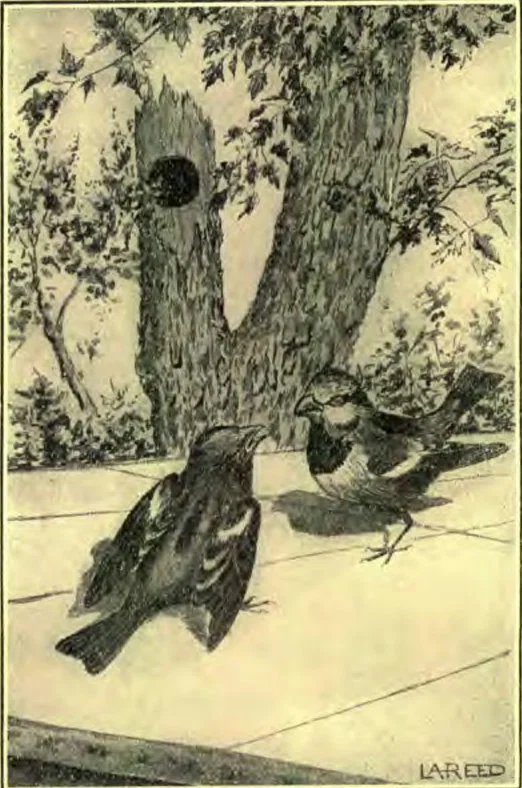
He came into the world one day in late summer. He did not seem much different from any other English sparrow in the neighborhood. He was simply the same little bunch of brown feathers and business that they all are. But from among his fellows he soon came to be known by the fact that he had chosen for a roost a sheltered spot beneath the roof of the back porch.
At first he always flew out when any one came near, and as his chosen resting place was near the pump, he was often disturbed. As the days went by, and no one seemed to pay any attention to him, he sometimes stayed when any one came to the well for water. After a time he became more bold, and would even take his place at roosting time, although some of the women were chatting on the back steps but a few feet away.
There was some very cold weather that winter, and one day in February the thermometer went down to twenty-seven below zero. It would seem that all the birds out of doors would freeze to death. But Mr. Dick of the back porch did not intend to freeze, not at least when there was so much warmth inside the house.
That evening he began to realize that the weather was much colder than usual, and, when it got worse than he cared to endure, he left his perch under the porch and knocked on the window; anyway his bill did some good tapping. Whether he was knocking for entrance or only trying to fly into a place that his instincts taught him to be warmer than where he was, I can not say. I have known more than one bird to be puzzled by the mysteries of glass.
The lady within heard the noise, and being very kind and hospitable, she let down the window, and Mr. Dick flew in. He lighted on the curtain pole above the window, and looked down on his hostess in a very serious and interested way. She gently closed the window and went back to her place by the table. Woman and bird watched each other for a time, and then Mr. Dick concluded it was all right, and settled down for his night's rest. In the morning he was impatient to be away, and the lady let him out, and gave him a fine breakfast on the snow just outside.
The weather kept cold. There was nothing anywhere for a bird to eat, and no comfortable place to sleep, and the next night Mr. Dick came back and knocked once more on the window. Again the lady let him in, and he slept safely and comfortably on the curtain pole above the window.
But next day the weather grew warmer, and he seemed to think his old place under the porch was good enough, so he went back to roost on the ledge under the shelter of the roof. Sometimes he seemed afraid to stay there in the evening until it had grown somewhat dark so that the foolish little fellow thought no one would notice him. Then he would fly under when no one was looking, or at any rate he thought there was not, and there he would remain. More than once, just at bedtime, the man went out and lighted a match, to find Mr. Dick perched up in his corner, all safe and comfortable.
When the spring came, Mr. Dick found a mate, and they built a nest in the rotten stub of a silver maple, where a woodpecker had made his hole the previous winter. When Mrs. Sparrow settled down to the work of brooding, Mr. Sparrow was kept busy getting food for her and the babies. But sometimes he had a little leisure, and perched on the highest stub of the old maple, where he tried his best to warble the thankfulness he felt. Sometimes it seemed as if he really would manage a trill or two, and possibly a few rounds of melody, but they were mere suggestions, that failed to develop into reality. He couldn't sing, that was very evident; but he continued to persist in making the attempt. Aside from showing how he felt, he certainly failed completely.
In Morgan County, I am told, there is a royalty of two cents paid for the head of an English sparrow. The boys, consequently, are growing quite expert with their deadly sling shots in their ambitious efforts to earn spending-money. In process of time one of these ambitious youngsters passed by the old silver maple, where Mr. Sparrow was trying to sing his head off. Whiff! went the sling shot, and Mr. Sparrow flew away with one of his legs missing. It had been shot off just above the joint by the keen cutting shot of the boy's weapon.
Crutches are unknown among sparrows, and hopping on one leg is neither graceful nor easy. Mr. Sparrow came back to his tree after a time, but he was scolded severely by Mrs. Sparrow when he did. She did not seem to know what was the matter with him, or seemed to think he was merely playing lazy. She told him to be off on a hunt for food. He argued back, and tried to explain he was hurt and couldn't work any more that day.
Then Mrs. Sparrow became angry and flew at him to give him a flouncing. Lame as he was, he could fly as well as ever, and he kept out of her way. Then she coaxed him, and pleaded with him, and reminded him of the babies. He had settled on the tin roof of the back porch. He could not stand very easily on one leg, so he squatted down on his breast and closed his eyes as if he felt pretty miserable. I have no doubt he did feel so, having one of his legs chopped off. But Mrs. Sparrow did not intend to let him sleep or to give him very much peace. Every now and then she landed near him, sometimes talking to him in a quiet, earnest way, sometimes scolding him pretty thoroughly, always urging him to help about getting food. And when Mrs. Sparrow was not busy coaxing or entreating or scolding her mate, she was busy getting food for the young sparrows in the nest.
Sometimes Mr. Sparrow would rouse a little, tumble or hop about on one leg, using his wings very vigorously the while. Then he would settle down again, close his eyes, and with bill open, seemingly pant for life.
Mrs. Sparrow either could not understand what ailed him, or else thought he was a mere good-for-nothing. Anyway, she made up her mind to get a divorce from him then and there, and marry somebody who would work, instead of lying around on the roof all day.
Shortly after coming to this conclusion, she appeared with a new husband. He was a fat, smart, rather young-looking creature. He followed Mrs. Sparrow until he caught sight of Mr. Sparrow-with-the-one-leg, and then he stopped and shouted out a challenge.
Mr. One-leg answered him back. At this, Mr. New Sparrow assumed a fighting attitude and challenged again and called names. Mr. One-leg answered him back, challenge for challenge, name for name. But Mr. One-leg wouldn't leave his rest on the roof. Then Mr. New Sparrow flew a trifle nearer the nest and challenged again. Mr. One-leg brightened up a trifle, and challenged louder than his enemy. Then Mr. New Sparrow attempted to fly to the twig just in front of the stub that held the nest. That was the signal for a fight.
Mr. One-leg went at Mr. New Sparrow like a shot from a gun. Mr. New Sparrow was off with a vengeance, and kept well out of the way of Mr. One-leg, who soon came back and settled in a crotch of the maple. The next day was a repetition of what the previous day had been. Mrs. Sparrow found several mates, and brought them to the maple, only to have them all driven away again by the furious attacks of Mr. One-leg. And he not only attacked the birds she brought, but he gave her a good scolding each time into the bargain. Sometimes he remonstrated, sometimes he waxed wrathly. But she could scold, too, and they had it back and forth quite considerably.
She objected to having to do all the work herself, and he, of course, couldn't help, and wouldn't allow any other bird to do what plainly it was his duty to do. She called him a miserable, lazy good-for-nothing. He tried to explain that he wasn't lazy, but sick, and ought to be in the hospital instead of having to fight for his rights and be abused by her. But after a day or two he grew much better, seemed to get his6spirits again, and managed to use his one leg quite dexterously. Once in a while he would wabble a little and have to hop some to keep his balance.
As soon as he was well enough to gather food, he found little trouble in making up with his wife, and he was soon as useful and as happy a bird as he ever had been. His mate followed him around as lovingly and dutifully as in the former days. And the young birds grew and flourished under their care, and soon went out into the world to brave their own dangers, such, for example, as boys and sling shots.
It seems to be true with birds, as well as with people, that if one only has the spirit and courage to push ahead, he can succeed in spite of great and many obstacles. A handicap does not necessarily prevent or hinder success. So it has proved with Mr. Dickey One-leg.—L. A. Reed, in “My Garden Neighbors.”
Who Loves Best?
By The Round Table
Who loves the trees best?
“I,” said the Spring.
“Their leaves so beautiful
To them I bring.”
Who loves the trees best?
“I,” Summer said.
“I give them blossoms,
White, yellow, red.”
Who loves the trees best?
“I,” said the Fall.
“I give luscious fruits,
Bright tints to all.”
Who loves the trees best?
“I love them best,”
Harsh Winter answered.
“I give them rest.”
— The Round Table.
A Brave Little Newsboy
A True Incident
A RAGGED newsboy had lost his mother. In the tenderness of his affection for her he was determined that he would raise a stone to her memory. He and his mother had lived together, and they had been all in all to each other, but now she was taken, and the little fellow’s loss was irreparable. Getting a gravestone was no easy task, for his earnings were small; but love is strong. Going to a cutter’s yard and finding that even the cheaper class of stones were far too much for him, he at length fixed upon a broken shaft of marble, part of the remains of an accident in the yard, and which the proprietor kindly named at such a low figure that it came within his means. There was much yet to be done, but the brave lad was equal to it. Next day he hauled the stone away on a little four-wheeled cart, and managed to have it put in position. One of the men at the cutter’s yard, curious to know the last of the stone, visited the cemetery one afternoon, and he thus describes what he saw and learned: “Here it is,” said the man in charge, and sure enough there was the monument at the head of one of the larger graves. I knew it at once. Just as it was when it left our yard, I was going to say, until I got a little nearer to it, and saw what the little fellow had done. When I saw it, there was something blurred my eyes so that I couldn’t read it at first. The little man had tried to keep the lines straight, and evidently thought that capitals would make it look much better and larger, for nearly every letter was a capital. I copied it, and here it is, but you want to see it on the stone to appreciate it:—
MY mOTHER
SHEE DiDE LAST WEAK
SHEE WAS ALL I HAD. SHEE
SED SHED Bee—
And here the lettering stopped. After a while I went back to the man in charge, and asked him what further he knew of the little fellow who brought the stone.
“Not much,” he said, “not much. Didn’t you notice a fresh little grave near the one with the stone? Well, that’s where he is. He came here every afternoon for some time, working away at that stone, and one day I missed him, and then for several days. Then the man came out from that church that had buried the mother, and ordered the grave dug by her side. I asked if it was the boy. He said it was. He had sold his papers all out one day, and was hurrying along the street out this way. There was a runaway team just about the crossing, and it ran over him, and he didn’t live but a day or two. He had in his hand when he was picked up, an old file, sharpened down to a point, that he did all his lettering with. They said he seemed to be thinking only of that until he died, for he kept saying, ‘I didn’t get it done, but I meant to finish it,’ and he died with those words on his lips.”
When the men in the cutter’s yard heard the story of the boy the next day, they clubbed together, got a good stone, inscribed upon it the name of the boy, which they succeeded in getting from the superintendent of the Sunday-school which the little newsman attended, and underneath are the touching, expressive words, “He loved his mother.”—Selected.
HENRY W. ROSE
By Henry W. Rose
Chats on Letter-Writing—No. 4
THE element of permanency distinguishes written words from spoken words. Letters are likely to be preserved, and this makes it advisable to give a word of caution with regard to what is put in them. We should avoid very carefully, putting into a letter anything which we would not care to meet in later years. It may be that we feel inclined to write something unpleasant or discreditable regarding some individual, and years may prove that our views were unfounded. How unpleasant and uncomfortable then it might be to face these written statements, in after days. On general principles, even of kindness, to say nothing of the lower motives of policy and wisdom, we should abstain from writing what is uncharitable or depreciatory of any one. It should also be borne in mind that the letter may fall into hands we little suspected would ever get it.
Another important point is that we shall do well to avoid writing that which we would feel ashamed of, were the letter to be made public, as might and does occasionally happen. If we write only that which is kind, not defamatory in any way, we need never fear the light of publicity; but if we give expression to thoughts which would cause us to repent having written them, we have good reason to dread their ever being read by those for whose eyes they were not intended.
Again: letters have a value according to the writer; and in many instances they are kept as mementoes of those by whom they are composed. What a pity, then, to have preserved, for future reading, any unworthy thoughts. If we write to relatives, our letters are sure to be treasured, and we should do wisely to refrain from writing anything that will cause our loved ones to regret that such sentiments were entertained by us. It is just as easy, and infinitely better for both reader and writer, to confine our expressions on paper to what is good, beautiful, pleasant, helpful, inspiring, and uplifting. Then let us ever try to write only such letters as will by no means cause pain or sorrow to those who read them, and never lead to repentance or remorse on the part of those who wrote them, at any time or under any circumstances.
Your letter may reach the addressee when he is sad, and needs encouragement. How much more helpful, just then, would a letter be that breathed a spirit of good cheer, of gratitude, hopefulness, and resolution. It may be that the very word your friend most needed when your letter arrived, was what you felt prompted to put into it. It is a good thing to make our letters suggestive of brighter and better thoughts, at all times, than are brought to mind by the daily round and the commonplaceness of the life of most of us. We can make our letters messengers of heaven, if we put into them the spirit of brotherly love, of true human comradeship, of Christian sympathy, and genuine interest.
Letter-writing is an art worthy of our best and highest efforts, and any endeavor directed to the attainment of proficiency in it will not be wasted, but rather reward the student abundantly.
HENRY W. ROSE
Scripture Enigma
Whither did Jonah vainly seek from God to flee?
Who once three angels entertained beneath a tree?
A noted brook that flowed beside Jerusalem.
A “ready scribe” who wrote the book that bears his name.
A judge who hoped to gain a bribe for Paul’s release.
Who made a molten calf rebellious tribes to please?
A man that grossly mocked and cast stones at his king.
Whom did Paul ask his parchments, books, and cloak to bring?
Who unto Solomon for God’s house workmen sent?
And where was it for precious gold his servants went?
Whom, four days dead, out of the grave did Jesus call?
Who loved this evil world, and hence deserted Paul?
On whose behalf did Paul an earnest letter write?
To whom was he conveyed a prisoner by night?
Whom did his godly father on an altar bind?
And for whose vineyard was it that a king repined?
A word the Ephraimites could not pronounce aright.
Where Paul, from Troas traveling, tarried for a night.
Where was the birthplace of the prophet Samuel?
Who touched God’s ark, and instantly a victim fell?
Who cherished angry thoughts, and then his brother killed?
And into whose young mind were holy truths instilled?
A king’s son on his bed once barbarously slain.
Who proved a friend to Paul, ashamed not of his chain?
A man that timidly, with deeply felt concern, came unto Christ by night, the way of truth to learn.
In the letters of each name combined
A gracious admonition you will find.
— Selected.
HERMAN T. PRICE
GALESBURG, ILL., Sept. 2, 1906.
DEAR EDITOR: Enclosed you will find the answers to the Scripture Enigma published in the INSTRUCTOR of August 28. I got my paper at Sabbath-school yesterday afternoon, and I spent my spare time this morning in finding the answers. With the knowledge gained in church-school of the Bible, I found them readily. In looking these up, I have not only read the chapters in which the answers were found, but have read parts of others, thus gaining valuable information. Hoping that you will soon again publish some such questions, I will close.
Sincerely, IRMA HAGGENJOS.
INGERSOLL, O. T., Sept. 12, 1906.
DEAR FRIENDS: You will find my renewal for four months. I would like to send for one year, but can not now. I am twelve years old. I have no brothers or sisters. I have just returned from the Oklahoma camp-meeting. We had a good meeting, and many gave their hearts to the Lord. I very much enjoyed hearing Elder Loughborough talk of the early days of this message. I loved to look at him in his old age, and think how God had kept him. I want to be among the boys who shall carry this message in the days of peril. I love our YOUTH'S INSTRUCTOR. May the dear Lord bless the editor.
HERMAN T. PRICE
The Farmer’s Hymn
By Edward Wilbur Mason
LORD God of nature, I give thanks to thee
For all the boundless heavens stretching far.
And for the earth that thou hast given me,
So shapen like a star.
I thank thee for the daybreak and the dark:
I thank thee for the green and spreading bough,
And for the four great winds, and for the lark
That guides with song my plow.
I thank thee for the storm and cloud of white;
I thank thee for the field’s exhaustless wealth;
But most I thank thee for the common light,
Thy robe whose touch gives health!
—Edward Wilbur Mason.
VI—Creation of the Earth
(November 10)
MEMORY VERSE: “In the beginning God created the heaven and the earth.” Gen. 1:1.
REVIEW.—At one time all the angels were ——. Then one of them wanted ——. His name was ——. He became proud because ——. He said in his heart ——. Then he began to find fault with ——. Other angels —— with ——. Then there was ——. There were —— armies. —— led the good angels, and —— led the evil angels. —— was cast out of ——. His angels were —— with ——. Satan now works to ——. He goes about like ——. ’At other times he appears as ——. He has come down having —— because ——. The fallen angels will be —— in ——.
8. How much time did he use in creating all things? Ex. 20:11. Why were they created? Rev. 4:11.
9. For what purpose was the world made? Isa. 45:18.
10. What change will come to the heavens and earth? Ps. 102:25-27.
11. What honor did God give to man when he was created? Ps. 8:4-8. Over what was he to have rule, or dominion? What was under his feet?
12. Name some of the things over which he was to rule. Does he rule all of these now? How do you think God intended he should treat the birds, beasts, and fishes?
Lesson Story
“In the beginning was the Word, and the Word was with God, and the Word was God.”
As John saw heaven opened and the Son of God coming to earth, he says, “and his name is called the Word of God.” This shows that Jesus is the Word.
“All things were made by him; and without him was not anything made that was made.” He was in the beginning with God in the work of creation.
Children inherit the name of their father, and so Jesus inherited the name of God, his Father. “But unto the Son he [God] saith, Thy throne. O God, is forever and ever.” “And, thou, Lord, in the beginning hast laid the foundation of the earth; and the heavens are the works of thy hands.”
“For he spake, and it was done; he commanded, and it stood fast.”
“In six days the Lord made heaven and earth, the sea, and all that in them is.”
“For thus saith the Lord that created the heavens; God himself that formed the earth and made it; he hath established it, he created it not in vain, he formed it to be inhabited.”
The Lord wishes the earth to be filled with holy, happy people, and his purpose will be carried out, for he says, “As truly as I live, all the earth shall be filled with the glory of the Lord.”
In its present state “one generation passeth away, and another generation cometh: but the earth abideth forever.”
“Of old hast thou laid the foundation of the earth: and the heavens are the work of thy hands. They shall perish, but thou shalt endure: yea, all of them shall wax old like a garment; as a vesture shalt thou change them, and they shall be changed.”
“What is man, that thou art mindful of him, and the son of man, that thou visitest him? For thou hast made him a little lower than the angels, and hast crowned him with glory and honor. Thou madest him to have dominion over the works of thy hands; thou hast put all things under his feet: all sheep and oxen, yea, and the beasts of the field; the fowl of the air, and the fish of the sea, and whatsoever passeth through the paths of the seas.”
Grasshoppers’ Ears
In the tibia of grasshoppers’ and crickets’ forelegs may be seen a bright, shiny spot, oval in form, which is said to be a true ear. Old naturalists supposed these strange structures helped in some way to intensify the penetrating, chirping sounds of crickets. No one for a moment thought they might be ears. Sir John Lubbock and other naturalists have decided that crickets, bees, ants, and other little animals shall not keep their sense organs a secret any longer, and although they are often in unsuspected places, careful experiments show they are to be discovered. Some grasshoppers have no ears in their legs, and, as a rule, these can not sing.—Selected.
“Daresn’t Take a Dare”
A boy of fourteen who had been noted for reckless, not to say foolhardy daring, by the death of his father became practically the man of the house, and the real dependence in many ways of his mother and sisters. The other boys were quick to notice a sudden change, even in his ways of playing, though he was still a leader in sports when he had time to be. “I b’lieve you daresn’t ‘take a dare’!” cried one of them, disgustedly, when he had quietly refused a perilous leap that was proposed to him. “What’s the matter, anyway?” “No matter!” was the prompt answer. “But I’ve got something besides my own skin to think about now; that’s all. Father gave me mother and the rest to take care of, and I have to take care what I do.”—The Friend for Boys and Girls.
The Burning of Oakwood School
THE Oakwood School building at Huntsville, Alabama, burned down on the evening of October 11. Scarcely anything was saved from the fire. One of the older boys lost his life, having gone to his room to get some things after having once made his escape from the building.
The insurance is two thousand dollars; but the loss was much more than this.
Why these calamities come one after another, we can not tell. It may be that our various institutions do not lie close enough to our hearts, so close that there arises daily to our Father above a united petition from his people all over the world that his protection may be over every institution, whether large or small.
Buttons on Coat Sleeves
FREDERICK THE GREAT, of Prussia, who was a great admirer of smart uniforms, finding that his soldiers were in the habit of wiping their faces with the sleeves of their coats, ordered that a row of buttons should be placed on the upper side of each, and this broke the habit. The original purpose has been long since forgotten, and the buttons were placed under the sleeves to be out of the way.—Selected.
VI—Work of the Angels in the Plan of Salvation
(November 10)
MEMORY VERSE: “The angel of the Lord encampeth round about them that fear him, and delivereth them.” Ps. 34:7.
To whom do the angels minister? Heb. 1:14; note 1.
Mention one way in which they minister to God’s children. Ps. 91:11, 12.
Tell how angels ministered to Jesus after his great temptation. Matt. 4:11.
In the heavenly courts, what is their attitude to Jesus? Heb. 1:6.
Relate one instance in which the angels wrought deliverance for the army of Hezekiah. 2 Chron. 32:21, 22.
When Daniel was in urgent need of protection and deliverance, who was sent to his relief? Dan. 6:16-22.
Who was sent to warn Lot concerning the destruction about to fall upon Sodom? Gen. 19:1; note 2.
As Lot lingered, what did the angels do for his safety? Gen. 19:16.
What promise was fulfilled in these instances? Ps. 34:7.
As the message of the third angel is about to close, what work is done by the angels? Rev. 7:1-3.
As Jesus comes the second time to gather his faithful ones, who will come with him? Matt. 25:31.
What is the last joyful work of the angels in making the plan of salvation complete? Matt. 24:31.
Notes
G. DOANE WONG
ONE thousand dollars a week is expected of the Sabbath-schools for mission offerings during the year 1906. Nearly twenty-seven thousand dollars, almost one thousand dollars more than half the amount, has been raised during the first six months.
A LITTLE fellow was being chased by a bumblebee. In his fright he ran to his mama for protection. To save her child the mother quickly placed her own hand between him and the bee, receiving the sting herself. Then she tried to quiet the child by assuring him that there was no need of alarm; the bee had only one sting, and mother had that in her own hand. Thus it is with us. We need not fear however much the enemy of our souls may annoy us. We are safe; for our Saviour has borne for us the sting of death.
THOSE who read Brother Wong’s series of articles that recently appeared in the INSTRUCTOR will be interested in the following note just received from him:—
“After three months’ visit in Honolulu, I am now ready to sail on the ‘China,’ leaving the fifth of October for my native land. The opening providences of God for my future career are remarkable; and I hope I shall have time before long to report through the INSTRUCTOR some of my experiences.
“Please send my INSTRUCTOR to Canton, China, care of the British post-office.
“Hoping to have your prayers for the work in China, and wishing you much of the Lord’s blessing and Holy Spirit, I am,
“Yours in his service,
G. DOANE WONG
THERE is an allegory which some have read, and more have read of. Men sit, Plato says, in a cave with their backs to the sunlight. To and fro behind them pass things real and stable and everlasting, the shadows of which fall upon the wall of the cave.
The men of the cave are for the most part content with its twilight, which they take for light, and with the shadows on the wall, which they take for realities; but now and then one of them bethinks himself, and turning his eyes round to the light, understands. He then discerns everything, not as it seems, but as it is—real manhood, real beauty, real truth, real life.
We are in the cave of sin and death, and not until we are turned about by the Spirit of God and made to face the Sun of Righteousness, do we see the beauty of real life, the beauty of Christian character.
May God early make our young people discontented with the twilight and darkness of sinful flesh and turn them about to see, love, and live the holy, just, and pure.
When the Corn was Sacrificed
By Cara S. Park
SEVERAL years ago there was a great revival in Ohio. One man who had for years sold his corn to the distillers, was earnestly pleading for a pure heart. All at once he arose, walked down the aisle, took his seat by the door, and finally slipped away. For two nights he was absent, but the third night he returned, his face glowing with peace. He said that every time he tried to pray, the question, “What will you do with your corn?” sounded louder than his prayer. At last he knelt down in the barn and said, “Lord, I shall not rise from my knees until this matter is settled.” Then came with greater force than ever, “What will you do with your corn?” Although there was no other place to sell it, and he needed the money, he said, “Lord, I will let every bushel of corn in these bins rot before I will sell one to the distillers.” “Immediately,” said he, “the Lord flooded my whole being with light, joy, and peace. And, brethren, I will never sell another grain of corn to the distillers as long as I live.” In less than a year the price of corn went up, and he sold his corn for double the price he could have gotten from the distillers. God always gives us more than he takes away, although perhaps we can not always see it as plainly and quickly as this man did.—Cara S. Park, in Sunday School Times.
What One Person Did
IN the Northern California Conference is a sister who is not in good health, but she loves this message, and is anxious to take the light of truth to others. She visited every house in San Francisco with our literature. She disposed of six thousand one hundred and forty-two copies of the Capital and Labor number of The Signs of the Times, secured places for twenty-five Bible readings, sold fifty-four books and one thousand tracts.
Youth and Age
ONE old man in his ninety-first year, sold fifteen hundred copies of the Earthquake number of The Signs of the Times.
The experience a young boy got selling the Earthquake special of the Signs, enabled him to earn this last summer a scholarship by canvassing. He is also helping his brother obtain one.
There are now fifty students in Walla Walla College who earned scholarships by canvassing last summer.
I can hardly think of anything that would be more pleasing to heaven than to see every State in the Union dotted with young men and women, boys and girls, going from house to house selling our literature, and by this means earning money for a course in one of our training-schools. May the experience of these fifty young men and women inspire many others to follow their course.