THE spirit of prophecy has told us that where there are at least half a dozen children in one community whose parents are Seventh-day Adventists, there should be a church school. There are many more than half a dozen in the Kilmarnock (Va.) church, in Lancaster County, one of the southernmost counties of the District of Columbia Conference; but they are so widely scattered that it is quite out of the question for more than half a dozen to attend such a school at any one place.
A PIONEER CHURCH SCHOOL
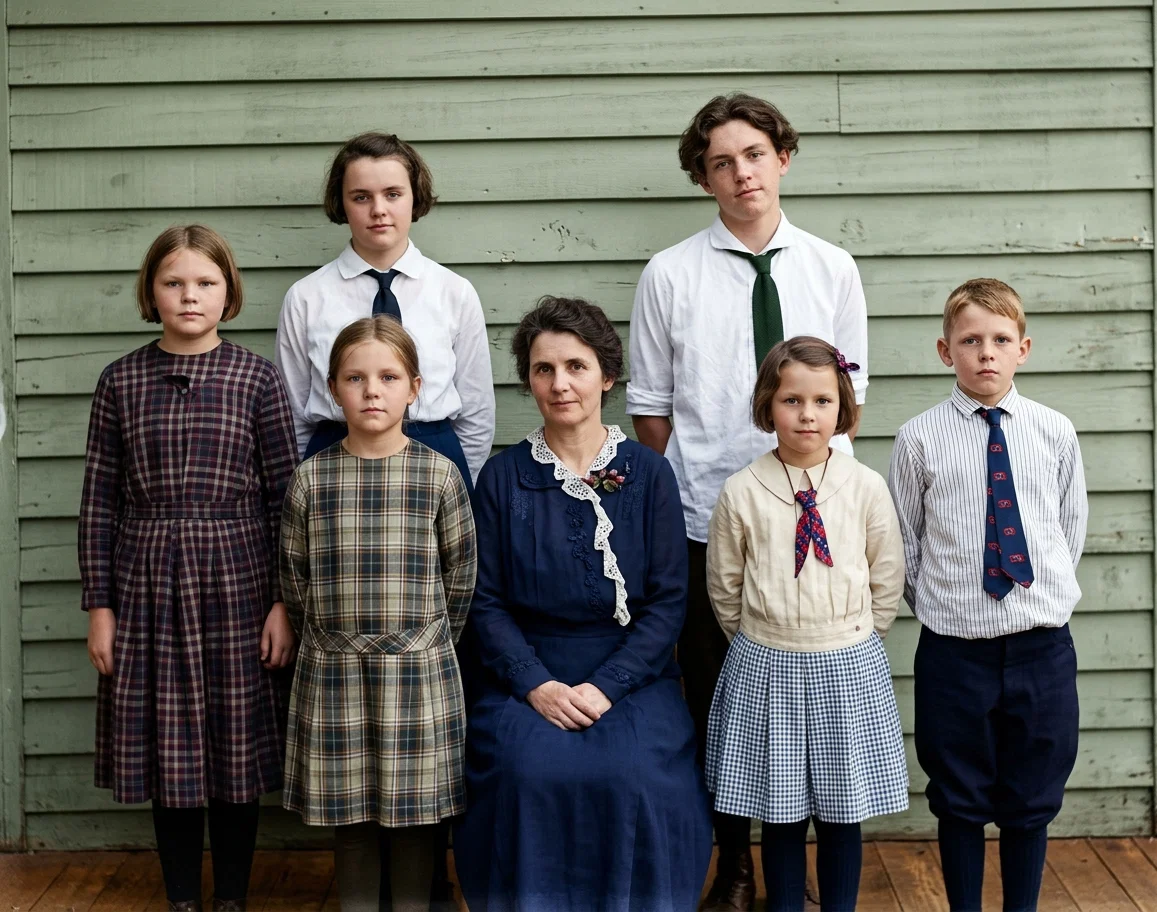
Brethren Kenneth and Harry Gould, who live three and a half miles from the church, secured the services of Miss Eva Kern, and soon after the holidays there was opened in the home of Mrs. Hanna Gould the first church school ever conducted in that section.
It was the pleasure of the writer to inspect the schoolroom, which is a large one and is well lighted, well ventilated, heated with hard coal, and amply equipped for real, aggressive work. In fact, it surpasses many similar schoolrooms used by this denomination.
Miss Kern, whose home is in Takoma Park, is greatly enjoying her work, and is giving the utmost satisfaction. She is also rendering valuable assistance to the church, which is likewise appreciated.
It is hoped that this is but the beginning of the educational work of this denomination in that portion of the field, as the needs are becoming more apparent with each passing year.
On this page is a half-tone reproduction of Miss Kern and her pupils.
E. R. BUTTON.
In the Southern Union Conference
By C. B. Stephenson.
DURING the month of May I spent two weeks visiting the colored churches in some of the large cities in the Southern Union Conference. Sabbath, May 8, I was at Nashville, Tenn. The church here is very nicely located in a prominent section of the city, on a corner lot. The building has been purchased recently at a very reasonable price, and has a seating capacity of three hundred, with two vestries, for Sabbath school and for the day school. This church has increased in membership the last three years from about twenty to sixty-five, with a corresponding increase in tithes and offerings.
I visited Louisville, Ky., next, spending one day, and speaking Sunday night in the church, which is located in the best part of the city. It is a nice brick building, with a seating capacity of two hundred, I should judge. The house was filled, and I felt much freedom in presenting the message of the baptism of the Holy Ghost for service. Five years ago this church consisted of eighteen members, and meetings were conducted in a private home. The present membership is nearly one hundred and fifty. The tithes and offerings are good.
My next appointment was at Memphis, Tenn., Monday night. Elder W. R. Elliott, the president of the conference, met me, and we spent some time in studying the work. We met with the little company at night, and felt the same good spirit which was present in the other meetings. We have no church building there, but hold meetings in a hall. Plans are being made, however, to begin work on a new church soon. With the new church and a strong tent effort, I am sure Memphis will follow Nashville and Louisville in the line of progress.
Stopping at Lexington, Miss., I spoke in the Presbyterian church one night, then went on to Jackson, Miss., for the Sabbath. Elder C. S. Wiest met me and gave assistance to my work in his conference. We studied the various conditions and the best method of work for the colored race, and I spoke twice—Friday night to church No. 1, and Sabbath morning to No. 2. We have a church building there and a membership of forty. Plans are made for a strong tent effort preceding the camp meeting, which we hope will increase the membership.
Monday night I met with the church at Vicksburg. At this place the missionary steamer "Morning Star" landed years ago with a few faithful missionaries who felt a call from Heaven to do something for the colored people of the South. Elder I. E. White and others17began work, which resulted in the erection of a commodious house of worship, and a residence for the workers. While there are few of the charter members there now, the membership has kept up very well. I think there are some thirty members. No doubt the time will soon come when strong efforts will be made to build up the work there.
From Vicksburg I went to Yazoo City, where we have a nice church and an active membership. The Lord came very near as we studied the message which God has so graciously given to us to present to a lost world. I dwelt upon the importance of a depth of consecration which meets the divine requirement, and will bring into the life more power for efficient service.
My next stop was in Meridian, Miss. While our company there is small, they are hard at work to add to their numbers. They have purchased a small house for service and are quite nicely located. A few hundred dollars would go a long way in helping some of these small, weak churches to prepare suitable houses of worship to which they could invite the public. Where we have such churches the work is making much more rapid progress.
My last appointment brought me to Birmingham, Ala. Brother Miller, the president of the conference, was not there, but I had a pleasant visit at the office. Brother Roberts had made all plans for the service. The Lord met with us in a marked manner and blessed the presentation of his Word. We studied the experience of the early church in receiving from the Lord himself the great commission to go and preach this gospel to all the world, dwelling upon the preparedness of the church, and the conditions which brought the promise of the Father and the bestowal of the necessary power to carry forward the work of saving souls. They have a church building, but it is not well located, and is not the sort of building a city like Birmingham should have. Plans are being made to erect or purchase a better one soon.
I found in every place a desire on the part of all to consecrate themselves to God for better service in labor for their fellow men. The greatest need is more workers, and more means with which to support the work. I tried to impress upon every one the importance of personal service, that every one should be a worker for God in some way.
C. B. STEPHENSON.
Philadelphia, Pa.
By J. S. Washburn
APRIL 9-15 Elder F. C. Gilbert held meetings in the West Philadelphia church. Great interest was manifested by the church and by those not of our faith. Many Jewish people attended the Bible studies held every afternoon, and the evening sermons. They showed a deep interest in the unusual presentation of the types and prophecies of the Old Testament. The Bible studies were on the special subject of the inspiration of the Scriptures, and how to read them, so that we may receive the blessing that is in the divine Word. Some very interesting illustrations were given to show the value of systematic and continued study of the Bible.
The Sabbath meeting was a real revival, many making an advance step in the work of preparation for the end of all things so near at hand. On Sunday night the Passover table was spread as in the days of Jesus, and many striking gospel lessons were drawn from this great memorial service. The large attendance of Hebrews was surprising, and their deep and respectful interest in the unanswerable proofs that Jesus is the true Messiah, the only Saviour of Jew and Gentile, was most encouraging. The subjects of the war, the Sabbath, the seventy weeks, and the sanctuary attracted and held the attention of both Jews and Gentiles. The unusually close acquaintance of the speaker with the original customs and language of God's ancient people, made it possible to present the old, old truths in a new setting. Decisions were made by some to keep the Sabbath, and others who became interested are still studying. The meetings were a great blessing to the church and the people of West Philadelphia.
J. S. WASHBURN.
A Mission Boat
By E. R. BUTTON
It is marvelous how the Lord opens the way for the book work to be carried forward, even when the finite mind does not see how a certain territory, because of its immense waterways, is ever going to be worked.
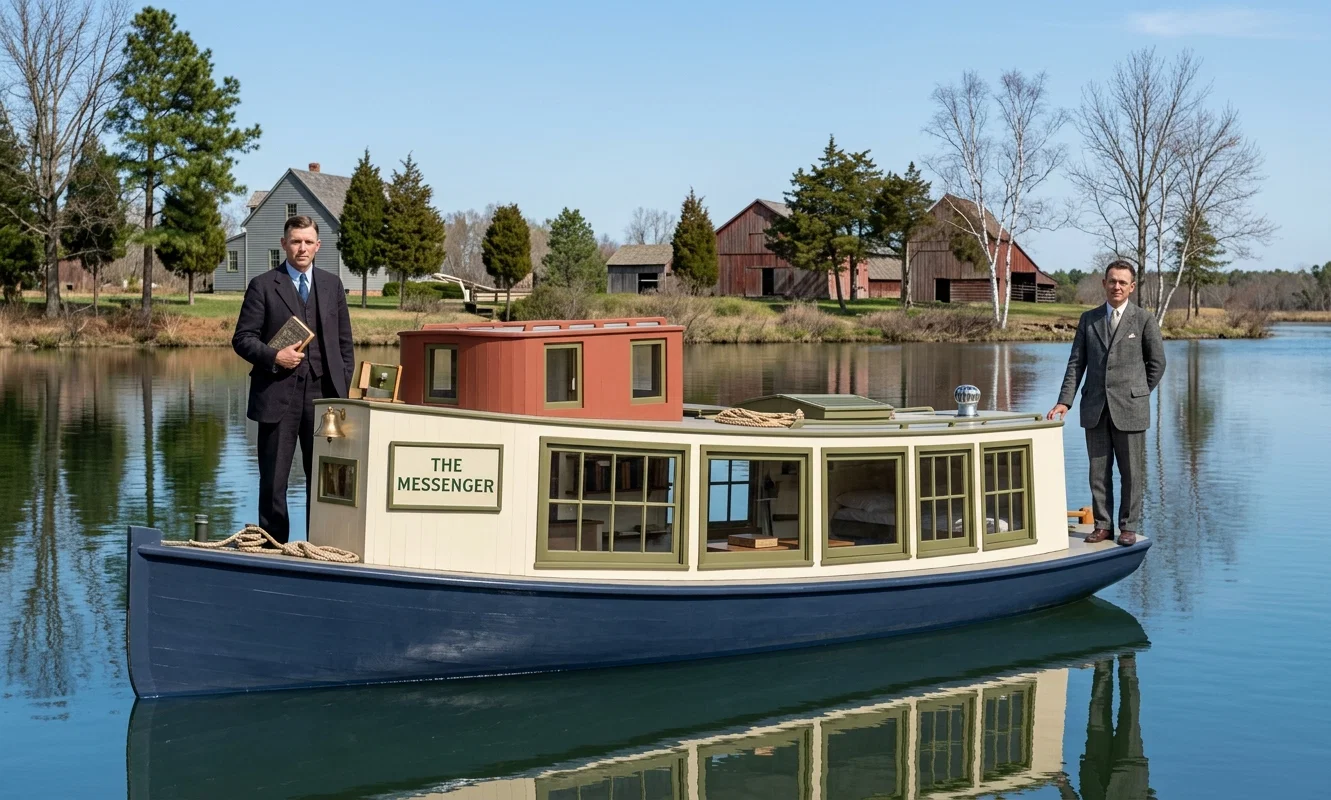
Northumberland and Lancaster Counties, the two southernmost counties in the District of Columbia Conference, have an immense area of water. Hence, seeing the advantages that would accrue to the individual who would undertake the colporteur work with a gas launch, Brother Kenneth Gould, a member of the Kilmarnock church, and Brother H. A. Wright constructed a boat of sufficient size to meet their need, equipped it with a good engine, and recently started on their mission. As evidence of how the Lord is blessing their efforts, it need only be stated that the first week of forty-two hours they secured orders to the value of $116, while their cash sales amounted to $14.65. They cook, eat, and sleep in the boat, thus reducing their expenses to the minimum.
Brother Harry L. Gould, who has a thirty-foot gas launch, a twenty-two-foot house boat, and a small rowboat, has likewise dedicated himself to the Lord for service, and will be ready to start on a summer's campaign of book selling as soon as four or five consecrated workers can be got together to accompany him. The plan is to anchor at a town, be it small or great, and while two of the workers canvass the people there, the others will travel over the rural districts for a radius of about six miles. By this means a quick work in spreading the message can be done in that part of the conference.
On this page is a half-tone reproduction of Brethren Gould and Wright, and of their boat “The Messenger.” The writer not only had the pleasure of dining in this boat, but of making a sixteen-mile journey in it, and found that it rides the waves splendidly.
E. R. BUTTON.
Field Notes
Recently ten persons were baptized at Loveland, Colo.
The baptism of six persons is reported from Kroonstad, South Africa.
Five new believers were recently baptized at Bartlesville, Okla., by Elder John Isaac.
Elder F. H. Henderson reports the baptism of twenty-five persons at Akron, Ohio, on Sabbath, May 1.
Twelve persons were baptized by Elder P. C. Hanson recently at Poy Sippi, Wis., and four at Berlin.
As a result of recent tent meetings held in Manila, P. I., forty new Sabbath keepers have been baptized.
The new church building at Decorah, Iowa, was recently dedicated. At Des Moines thirteen adults were baptized on a recent Sabbath.
Twenty-three persons have united with the Kalispell, Mont., church by baptism, and six have been added to the company at Great Falls.
Thirteen have been added to the company of colored believers at Omaha, Nebr. At the close of the seventh week of a series of meetings in Nebraska City, fourteen decided to obey the truth.
Our Medical College
By W. A. Ruble, M. D.
Another prosperous and encouraging year in the College of Medical Evangelists is drawing to a close. During the year there have been sixty-three students enrolled in the medical course proper, ten in the medical evangelistic course, and seventy-three in the nurses' and preparatory nurses' courses. This gives a total of one hundred and forty-six young people in training for medical missionary service.
In the recent past the annual constituency and board meeting of the college was held at Loma Linda. Brethren from all parts of the field, including Elder I. H. Evans, Elder W. T. Knox, Dr. H. W. Miller, and others from Washington, were in attendance. During this meeting some advance steps were taken in planning for the future of the college. One matter of much importance was a vote to reduce the time of the medical course from five years to four. This is made possible by a change in the medical law of California requiring 4,000 hours of work during the course instead of 4,800 as heretofore, thus bringing California into conformity with other States in the number of hours in the medical course.
Then, too, the two years of college work required for entrance to the medical course, when added to a five-year course, makes the preparation for service too long. This will also make possible a provision for giving some of the studies formerly outlined in the medical course during the two years of premedical preparation. The four-year curriculum will begin with the 1915-16 session.
Three years of the course will henceforth be conducted at Loma Linda and one year in Los Angeles. At Loma Linda many improvements were planned. Several new members were added to the faculty, the school was departmentized more fully, and negotiations were entered into whereby greater advantages will be offered at the San Bernardino County Hospital.
Bonds have just been voted for constructing a new $150,000 San Bernardino County Hospital within easy access of the college. The board of supervisors of the county hospital has appointed seven members of the faculty of the college as members of the staff of the county hospital, which gives far greater privileges in that institution which accommodates 150 patients. Now all the wards of that institution, both surgical and medical, are open to the school.
Our own private hospital received considerable attention, and plans were laid to make it more valuable as a clinical asset by increasing the patronage and improving facilities.
The Los Angeles end of the work received much study. For two years a dispensary has been conducted in a very favorable part of the city, in which nearly ten thousand treatment cases have been in attendance a year. Here the students treat patients two hours a day six days in the week throughout the year. The average daily attendance has reached thirty-three patients. A dozen of our own physicians are in attendance each week to assist the students in their dispensary work.
For a long time it has been very evident that the present dispensary is entirely inadequate in room. Action was taken to double the floor space as soon as possible. The location, too, could be improved. Furthermore, a small hospital where a few patients may be kept for surgical and other attention is a necessity. Recognizing this need a committee was appointed to draw up plans for a dispensary and a hospital to accommodate about fifty patients, to decide upon an appropriate location for the same, to obtain estimates, and to find a company who will construct such a building and lease it to the college for a reasonable rental—all this to be reported at the fall council of the General Conference at Loma Linda for consideration.
Never before has the board grappled so decidedly with the problem of making the school meet the mind of the Lord in preparing active medical missionaries as at this session. In view of the signs of the times which are so rapidly fulfilling at present it is realized more than ever before that our first and most determined efforts must be put forth in qualifying medical missionaries. All our students, whether preparing for medical practice or for nursing, must first be missionaries. Our physicians must be missionaries. Our medical evangelists must be missionaries. Our nurses must be missionaries.
It is true that as yet the college has not received recognition in all the States of this country for legal practice of its students, but to the true medical missionary, doors are open everywhere.
Preceding the board meeting, a medical council, at which many of our physicians from the west coast were present, was held at Loma Linda. This was a very profitable meeting. At this council the interests of the medical college were considered, as well as the need for medical missionary workers for all parts of the field. It was unanimously voted by this council to recommend all of our young people who are expecting to study medicine, to take their course in this college.
There is but one work for Seventh-day Adventists today, and that is the work of carrying the closing message to the world. Preparation for this work cannot be got in schools of the world any more than preparation for our peculiar work in any other line can be got there. The school at Loma Linda is established to prepare consecrated young people for service as medical missionaries. Incidentally it is expected that the school shall give a thorough training in medical lines that will enable its graduates to meet any legal requirements; but this is of secondary importance—incidental to the great object of securing a fitting for service in preparing people for the coming of Christ.
Men and women are needed at Loma Linda who have a firm faith in God, in his Word, and in his instruction regarding the education they should receive for service, men and women who, having by faith stood true to principles of divine teaching in securing their education, will go out and by faith be true to God in service.
W. A. RUBLE, M. D.
Medical Convention Report
By L. A. HANSEN
The Training and Work of Nurses
THE nurse and her work received much consideration in our recent medical conventions. The interest shown in this phase of our medical missionary work was gratifying and bespoke an earnest desire on the part of leaders to see our nurses occupying a place of greater strength in connection with our denominational work. The discussions recognized that we have in these workers an asset that should be wisely conserved, and that more can be accomplished for the good of nurses and their work in our institutions and in the field than is now being done.
Dr. H. W. Miller presented the matter in a few remarks, as follows: “There has not been as full appreciation of the work of our sanitariums as training schools as there should be. This is an important feature aside from the regular sanitarium work. We have about as many students in our sanitarium training schools as we have in our colleges and academies, and the education we give is equivalent to any other school work, take it year for year. We regard our conference educational work of sufficient importance to have educational secretaries to look after it, but we do not have such secretaries for our medical educational work. We do not have medical secretaries devoting time to this work alone.
“Perhaps one of the first things we should do in organizing this educational work is to establish standards. We should have uniform entrance requirements. These are often too low. We should seek to secure a mature class of students. The work of a nurse is too responsible to place on immature girls.
“The preliminary education should be sufficient to give the student a proper influence and a fitness for her work and studies. Our nurses should be prepared to rightly represent our work and present the truths we hold. Twelfth-grade work is not too much of a preliminary requirement. Bible workers need a good preliminary requirement. We have many calls for nurses who can do Bible work and if they are to be properly qualified for it they must have proper preparation.
“We must give serious consideration to the training of workers for this cause. A doctor would not be prepared to enter upon his work with only his textbook study. He must have practical experience. So must we give our nurses a practical training if they are to be prepared for field work on graduation.
“Adopting higher standards will mean limiting the number of people who will take the training, but it will only be an elimination of such as are not the best prepared to take it. It will also mean limiting the number of schools giving training, but it will be an elimination of such schools as are not prepared to give a training according to the standard we set.
“A fourteen-grade academy would not grant an A. B. degree. If it did, the one receiving such a degree would be placed under embarrassment in not having received an education equivalent to the degree. So in our training schools we should give an education and training that will qualify according to the diploma we give. The effect of such a step will be to reduce the number of nurses graduated each year. We will19have fewer nurses in the field but we will have better ones, and this will enable us to find more ready employment for graduate nurses than we now can.
“And here we come to a problem that is giving us a great deal of anxiety. A few of our nurses are being sent to foreign fields and some find work here at home, but we are losing many of them from active service in our cause. Our conferences are not offering them employment because they are not well prepared to do conference work. It is a serious thing for our young people not to be able to find suitable work after taking a course of training with the purpose of becoming well-qualified workers. It must be that there is fault in the training. Those responsible should do everything possible to help solve this problem.”
Prof. F. Griggs: “The problem of employing our young people in this cause is one of the greatest with which we have to deal. It is a pitiable fact that so many of our young people are going into the world to seek employment. I think the fault lies with us who have to do with the shaping of their education. We must have all our young people employed in this cause in some way; they are the greatest asset of this denomination, but we are not using it as we ought. When I was a young man there was no opening but the ministry, and nothing for the young woman, but now we have every opportunity to use every faculty. We have reached a time when the whole rank and file of our people are to be ready for the finishing of the work.”
Dr. D. D. Comstock thought that if the educational features of our sanitarium work were eliminated it would mean great loss to the institution, taking out the life and spirit of the work. While every sanitarium might not have a training school, all should carry some educational work.
Speaking to the point of standards, he had seen young people taking the nurses and medical courses who should never have been in either one. “It would solve our problems if we did our weeding out at the beginning; then there would be no question as to whether these young people would be accepted by conferences.”
Elder I. H. Evans: “I would like to emphasize one suggestion, and that is that we strengthen our Bible work in the nurses’ course. There are many conferences that would gladly receive these workers if they were assured they were capable of doing Bible work. I think the Division Conference could place not less than twenty nurses in the various conferences if we could only give assurance that they had had good evangelistic work.
“No class of Bible workers should be prepared to do better work than the consecrated, God-fearing nurse who is capable of teaching the truth. The trained nurse who is well qualified to do Bible work has a better means of getting into the homes of the people than one without that training. We cannot pay them large salaries, but the schools should breathe into the workers such a spirit of sacrifice that they will be willing to do this kind of work; but no man can breathe the spirit of Christ into another if he does not have it himself. We need to strengthen our Bible work. I think it is a pity that those who are graduated from the nurses’ course are not required to master the Bible as thoroughly as any other subject.”
Remarks by other speakers will be given in another article, together with recommendations on this important subject.
L. A. HANSEN,
Medical Missionary Department
W. A. RUBLE, M. D. — General Secretary
L. A. HANSEN — Assistant Secretary
H. W. MILLER, M. D. — N. Am. Div. Secretary
Real Evangelistic Canvassing
By W. W. EASTMAN
THE following letter, written recently to Brother Covey, field agent of Eastern New York, by one of his colporteurs, so beautifully sets forth real evangelistic canvassing, and that, too, by actual experience, that we think it should be passed on to the entire field. Note these facts: The worker has a burden for souls, is filled with the spirit, doors are open to him everywhere, and the people are eager for his book, and, of course, he enjoys his work. The letter reads as follows:—
“I am glad I can send you a better report this week than last—not in dollars, but in experience. Dollars do not count in this work. O, I wish you could have been with me this week, not to help me (for I now have a better Helper even than you), but to see the eagerness of the people. It is wonderful. I found many who were as eager for the book as children are for candy. I do not know how else to express it.
“Yesterday a young lady who is a graduate from the music department of Syracuse University, was so excited that she could hardly wait for the opportunity to sign her name. She said, ‘It is just what20I have been looking for. There are many ideas in the world, and I am all mixed up. I wish to know what the Bible says.’
“Tuesday afternoon I canvassed a woman and her daughter. I had a deep burden for them, but could not get an order. The woman mentioned that a school-teacher who boarded with them might be interested in the book. On Thursday, when I was near that section again, I was told that the lady whom I visited on Tuesday wished to talk with me, and she said if I would call at the schoolhouse I would get an order. I had to go about half a mile, but it did not take long. I never saw any one apparently more pleased than was that teacher. I did not give her an exhibition, but handed the prospectus to her, and gave a brief synopsis. She gave me her order, and said, ‘I am glad you came, for I had given up all hope of ever seeing you.’ She had tried by telephone to find me on both Tuesday and Wednesday.
“Friday morning I took four orders, as follows: a poor woman doing housework by the week, a German cheese-maker, a Catholic woman, and the music teacher whom I mentioned before. The canvasser can reach all classes if he has crucified self and becomes filled with the Holy Spirit. But it is a daily, yes, hourly, crucifixion. I have found it so, anyway. For three years I have asked God to give me a burden for souls, but it never came. Why?—Because I was not in a condition to be trusted with it. It does not come by simply asking for it; it comes by praying for the people.
“Perhaps you would be interested to know how God and I carry on this co-partnership plan of working. First, I try to spend about one hour each morning studying his Word and in prayer, pleading for a special message for each home I shall visit. He sends his angels ahead to prepare the way. When I visit a home I speak as directed by his Spirit. It is very seldom that a deep interest is not aroused, and often hearts are deeply moved. Persons like to hear of the love of Jesus. I always bring that in during the first of the canvass. (See ‘Manual for Canvassers,’ page 33. By the way, I am making an almost daily study of the ‘Manual.’) I often have opportunity to tell persons how I work, and of God’s blessings. I strive, with the help of the Holy Spirit, to make the canvass from start to finish reveal God’s love, and it is having a marked influence on my life.
“I cannot praise God enough that he has been so persistent in calling me. Now my one great desire is to be ever able to say, ‘Not my will, but thine, be done.’
“At night I take every order to God in prayer. I try to see the needs of the persons I visit, and then I ask the Lord to supply them. Every day I feel that I am growing stronger, but at the same time the task and responsibility loom up greater.
“May God’s blessing rest upon the work and give you heavenly wisdom is my prayer. ROY CARR.”
This sort of work brings results in the sale of our books. The report accompanying this letter shows sales to the amount of $108, and the week before, $111.
The Lord is not partial in the bestowal of his blessings; others may enjoy the same blessed experience.
W. W. EASTMAN.
Medical and Health Books
By L. A. HANSEN
A LITTLE cookbook that is greatly appreciated by those having it is “Food and Cookery,” by H. S. Anderson. It is a handbook for teachers and pupils for use in cooking classes and demonstrations. The 128 pages are devoted to the most essentials of healthful cookery, containing clear statements of fundamental principles, with several food charts and a number of recipes not found elsewhere.
The author has had many years of experience in practical cooking in leading hotels and clubs and for the past five years has been connected with the Loma Linda Sanitarium. He is deeply interested in presenting the subject of healthful cookery in its true bearings, and his efforts are to be greatly appreciated.
“Food and Cookery” is now in its third edition. It has been well received. With it is given a twenty-four-page supplement, “Food Facts,” which gives valuable quotations from the Bible, Testimonies, and scientific works. This is given free with the cookbook. Price, postpaid, 35 cents. Order of Review and Herald Publishing Association, or The College Press, Loma Linda, Cal.
We have had many calls for a work on medical electricity, suited to our nurses. We are glad to call attention to “Medical Electricity, for Medical Students and Nurses,” by G. K. Abbott, M. D., professor of clinical medicine, College of Medical Evangelists, Loma Linda, Cal. This work contains 132 pages. It is written in such simplified terms as to make it serviceable for first instruction and yet complete enough to cover the main fundamental principles of therapeutic application of electricity. The text is elementary and thoroughly practical throughout. Considerable attention is given to various electric appliances, and detailed instruction is given on how to use them. A short list of review questions appear at the end of each chapter.
We believe the book would be appreciated by our training schools and by graduate nurses. Price, $1.25. Order of W. B. Saunders Company, West Washington Square, Philadelphia, Pa.
“State Registration for Nurses,” by Boyd, gives full information about registration requirements, fees, exemptions and restrictions, violations, revocation, reciprocity, compulsory laws, recording certificates, with full text of State laws on the subject. Price, $1.25. W. B. Saunders Company, Philadelphia, Pa.
L. A. HANSEN.
Washington (D. C.) Treatment Rooms
By Margaret Ross Stewart
WHEN it was finally decided to close the Branch Sanitarium, in the city of Washington, D. C., we began to pray earnestly that the Lord would direct us in choosing just the right location for treatment rooms, and we are glad to believe that this prayer was answered. Five large, airy rooms have been secured on the first floor of a building situated in the most desirable portion of the city. We are surrounded by elegant apartment houses, hotels, splendid club buildings, and fine residences. Our offices and treatment rooms are well equipped, and have been open just six months. During this time our faithful nurses have given 1,936 treatments. The expenses are heavy, of course, but we have been able to pay all our bills and keep a small surplus on hand.
The patients who come to us are usually most appreciative. From eighteen to twenty-five persons visit our offices daily, and we aim that no one shall go away dissatisfied. Some come worn out with social duties. Teas, dinners, formal calls, theater and card parties bring to us many a tired woman. Not all of these are social butterflies, and many would be glad for freedom from such bondage which social position demands. We meet many delightful women who have lost their health through overambition. Coming here from all parts of the country, knowing the uncertainties of political life, they take up studies, attend lectures, join classes and educational societies, and in their efforts to improve well the time of their stay at the nation's capital, go beyond their strength. Others come to us nervous, unhappy, or in trouble. We do what we can to help each class of patients.
Our gentleman nurse is doing much good. On his list are doctors, lawyers, judges, Congressmen, bankers, and many others who feel that our treatments are important factors in strengthening them for their many responsibilities.
Our one desire and prayer is that the treatment rooms may prove a real blessing to the people of this great city.
MARGARET ROSS STEWART, M. D.
Publishing Department
N. Z. TOWNGeneral SecretaryW. W. EASTMAN N. Am. Div. Secretary