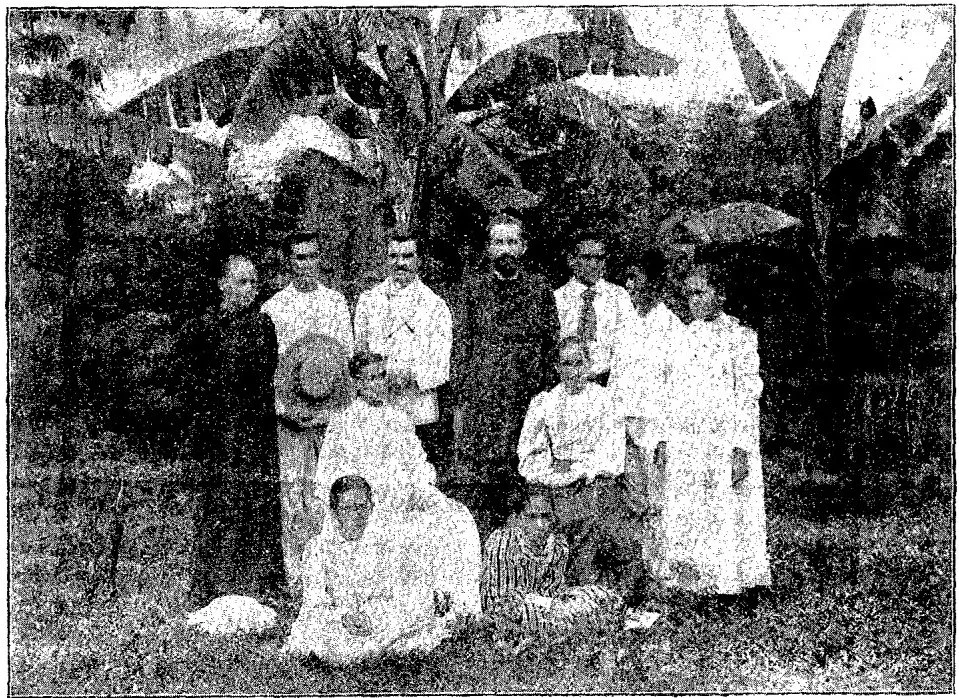
Upon the first visit of the “Pitcairn” to these islands, an interest was aroused in the truth, and from that a few accepted the views held by Seventh-day Adventists. Gradually, others have learned of these things, and have cast in their lot with our people, until now we have about one hundred Sabbath-keepers in this group, including men, women, and children. More than half this number are children and young people, and it is of these that we wish to speak particularly at this time. It is from among them that we hope for our best workers in the future.
The older a person is, the harder it is for him to change his manner of living. He gets set in his habits, and since he has usually been educated in that way by the example of his parents and grandparents, he is apt to feel that his way is good enough, and perhaps the best. It is very much that way with the Tahitians. They have many customs and habits which are detrimental to spiritual progress as well as injurious physically. But because of their limited knowledge, it is very hard to root erroneous ideas from their minds.
Now those who have the responsibility of being teachers or leaders of the people, should be such as understand what is right, and uphold only that which is good, discountenancing everything which is evil. But before they can uphold the right, they must know what it is, and why it is right, or the principles of it. The people do not generally believe all that is told them by others, but when they have learned the principle underlying the right course, it is much easier for them to believe and obey. Therefore, if we would have these youth grow up to be intelligent and consecrated Christians and workers for the Master, we must educate them. If they receive their education from their parents, they will remain just as low as they; for the fountain can rise no higher than its source.
What we need here is a boarding-school for our youth, where they can be taken away from their homes, and be influenced as little as possible by their parents. It is our desire to have a sort of industrial school, combining physical with mental labor, so the students can help pay their own expenses in the school, and also learn to be industrious and useful. In such a school our children would have an opportunity to develop their faculties, and learn to make the best possible use of their lives.
Both the Protestant and Catholic denominations recognize the school as being a very important factor in their mission work, and both furnish free schools which are well attended. These schools are, indeed, a great help to their work. We also need such a school for our own children. The influence in these other schools is not favorable to the truth, and besides, the weekly holiday of most of the schools is on Thursday, and school is in session on the Sabbath. This gives only four school-days a week to the children of Sabbath-keepers.
OUR MISSIONARY FAMILY AT TAHITI.
We find that the native children are as bright and quick to learn as any other children. We have had two with us for over a year now, and the rapid progress they have made has been very encouraging. We now have seven with us, whom we are trying to train. We do this work without remuneration from the parents, as they are too poor to pay us, with the exception of one girl from Raiatea, whose father is a Dane. We formerly taught two of his children while at Raiatea, and he gives us donations from time to time, as he feels able. Brother Green teaches the boys the printers’ trade and also reading, etc., and the two youngest girls attend the French Protestant school in Papeete. One of them reads English well now, and we thought it time for them to begin to learn the French language, which is the principal language of this group. Mrs. Cady teaches the other two girls, and teaches music to five of the children. We also give them two Bible lessons a week, and one in physiology. We hope that this is only a beginning, and that we can soon have a school which will take in all those children who might be benefited.
The Lord has gone before us and raised up French teachers for our school, and now we need a home for fifty or more, with a good family to take charge of it. We cannot get this without means, and we must have money to pay the teachers and support the school. We feel that this is our greatest need here now; for without training, most of these children will be lost, but with proper care they can be made a blessing to the cause.
The Lord has surely blessed the seed which has been sown here in the past, and we feel of good courage to go on with our work, knowing that we are not dependent on our own strength, but that God is our helper, and he will carry on the work until it is finished.
November 12. B. J. CADY.
[The above is a picture of the missionary family on Tahiti. Brother Cady and wife occupy the middle of the group, with Brother Joseph Green and wife at their right. The others we do not recognize.—ED.]
LABORS IN AUSTRALIA.
By E. W. Farnsworth
After our arrival in Sydney, we held meetings with the church one week. Sister White came down from Cooranbong, and took a large share in the burdens of the meeting. The readers of the REVIEW will be glad to know that her health is generally good. She seems as active, or more so, than when she left America, and in every way as well, with one exception,—her hearing is slightly impaired, so that in ordinary conversation she does not hear quite as readily as in years past. The climate seems to agree with her perfectly, and it seems to have been a great blessing to her that circumstances have called her outdoors considerable. She has built for herself a little house in a grove somewhat retired from where the school buildings are to be; and in this quiet retreat she can think and write and commune with God. We could not but feel, while there, that the blessing and peace of God were over her dwelling, and that this situation is a blessing indeed to her. She is sixty-nine years old this month (November).
I speak of her home as a quiet retreat. It is so in one sense, and yet her family, including those who work for her in writing, and the poor whom she is trying to assist, make an average family of twelve or fourteen. But those who know her best know that this is a part of her life.
Our meetings in Sydney were good. Five were baptized. We enjoyed our labors with Brethren Israel and Semmens very much, and we think the meetings were of profit to the church. There is a large field for labor in this city and its suburbs, and we are glad to know that plans are being laid to carry forward the work here. After our meeting closed, we went southwest five hundred miles to Melbourne. Here we were glad to meet a number of familiar faces,—Brother and Sister Daniells, Brother and Sister Baker, Brother and Sister Colcord, from Iowa, and Brother and Sister Salisbury, from Battle Creek. Brother Salisbury stands at the head of the publishing work. Brother and Sister E. A. Palmer, from Vermont, are at the head of the canvassing work; and Sister Anna Ingels, from California, is the secretary of the tract society. It was an enjoyable experience to meet with so many we had seen before. We held meetings here for about ten days. The new church building, recently erected, was dedicated at this time. In size it is forty by one hundred and ten feet. The auditorium, which will seat about three hundred, is in front, and four smaller rooms for Sabbath-school and other purposes extend back. The house is quite conveniently arranged, and will serve the purposes of the church well.
The Central Australian Conference is largely located in and around Melbourne. The city has about four hundred thousand inhabitants, and Sydney is a little smaller. Like all Australian cities, they are rather peculiarly organized. The city proper is not very large, but surrounding it, and closely connected with it in every way, are numerous suburbs, which extend quite a long distance from the main part of the city. It is in these suburbs where our churches are mostly located. In Melbourne and its suburbs we have five churches and one unorganized company. In Sydney we have four churches and one unorganized company. These churches are located not many miles apart. When occasion seems to require, they can meet together, and so hold quite a large meeting with but little expense or trouble. Most of these churches have been raised up as the results of camp-meeting labor.
In some respects the camp-meetings here are conducted on different plans from those our brethren have in America. When a camp-meeting is to be held, after the location is decided, a camp-meeting edition of the Bible Echo is printed, in which the camp-meeting is thoroughly advertised, and a synopsis is also given of the leading points of our faith, with any other items of interest. A good corps of canvassers is then sent to the place where the camp-meeting is to be held, and every family is visited. These papers are sold for two cents each. Most families will take a copy at this price, but where one does not choose to purchase, the workers leave a cover of the paper, which advertises the meeting. Sometimes the ground is canvassed two or three times, and thus every family in the place knows of the meeting. They have read one, two, or three copies of the Echo, and many of the families have become really interested in the truth before the meeting begins, so that at the commencement of the meeting the congregation is largely composed of interested listeners. Quite a number have embraced the truth through reading the Echo alone. One lady who received a copy of the paper, in some way failed to notice where it was published, yet she appreciated its contents so highly that she loaned it to her friends till she found it was wearing out, and through fear that she would lose its contents, she copied the entire paper with pen and ink. It is needless to say that when one of our canvassers afterward found her, she was ready to embrace the whole truth. Many instances of a similar nature might be related.
But to return to the camp-meeting. After the meeting proper has ended, the work for the community has but just begun. The brethren here have acted on the principle that the camp-meeting arouses an interest, and that the interest should be developed till all the fruit which can be obtained is gathered from it. So they leave the strongest corps of workers which they can combine in the place to develop the work, and here they stay gathering out as many as they can of these interested souls. In a little while it will be seen that there is an interest in another part of the city, or in another suburb, and then they move their tent to that place. It may be several miles away, or it may be only a short distance, but they go and develop the interest. They frequently remain all summer laboring in this way, and then in the autumn hold meetings in halls or other places they may be able to secure. Last year three good churches were brought out and quite firmly established in Melbourne as the result of its camp-meeting. Similar results have been seen in Sydney, and the same work is now going on in the city of Adelaide.
When I compare these results with what has been accomplished in many American cities, I wonder if our brethren there have gathered all the fruit that might have been gathered from their camp-meetings. When I think of the numerous camp-meetings held in such cities as Des Moines, Lincoln, Minneapolis, St. Paul, Kansas City, Grand Rapids, Indianapolis, and many others which might be mentioned, and then think of the comparatively small returns from those great meetings, I am compelled to conclude that we have yet many things to learn in the management of camp-meetings, in order to secure the greatest results. Why should not the Signs of the Times be used in America as the Bible Echo has been used in Australia? Personally, I should be glad to see the good old REVIEW step into that field, and have no doubt that its publishers would be perfectly willing. It is possible that this plan might help to solve the problem of how to increase the circulation of our good church papers. Ten thousand copies of the Echo were sold as an advertising medium before the Adelaide meeting this year, and those papers, with the prayers that went with them, were a tremendous force in interesting the people and removing prejudice. Brethren in America, think of these suggestions.
My permanent address is 57 Tory St., Wellington, New Zealand.
November 27. E. W. FARNSWORTH.
NEW ZEALAND.
By W. M. Crothers
SINCE my last report, which was written on the camp-ground at Adelaide, South Australia, we have seen fresh evidences that the Spirit of the Lord is in our midst to shed light and blessing upon every heart and mind that will yield to its holy influence and submit to its guidance and direction. After enjoying the good meetings at Adelaide, and accomplishing my mission to that place, where I had the pleasure of meeting Elder E. W. Farnsworth and his wife, and Elder S. N. Haskell, I started on the morning of October 18, in company with other brethren, for Melbourne, which place we reached late the following day.
The next afternoon I sailed via Hobart, Tasmania, for New Zealand, arriving at the “Bluff,” or southern extremity of New Zealand, after an uncomfortable passage of five days. From there I went by rail and coach to Tokonui, to visit a family that had recently accepted the truth through reading and correspondence. They had already made arrangements for meetings to be held in a schoolhouse, which I attempted to do. But the weather and roads were so bad, and the people so far apart, that public meetings were given up after holding four services, and I spent several days visiting on horseback those who had become interested through the efforts of those already come into the faith. Before leaving, several families fully acknowledged the truth, and I trust they will soon be with us.
While at Tokonui, I received an invitation from the leading men of a village some ten miles distant to speak on the Sabbath question in that place. This I did in a hall which was provided at their expense for the purpose. I could remain but two nights there, but several Bible studies were held, and there is now an earnest inquiry for more light. I think one family will obey. Time and circumstances would not allow me to remain at either of these places; but could a protracted effort have been made, I am sure a company would have been organized.
At Dunedin I had a pleasant day with two sisters, one of whom is but a child, who are selling the Bible Echo and small books in the city. For several months these workers have sold twenty-four dozen papers each week, besides books, and now they are to use an additional club of twelve dozen, making thirty-six dozen in all. Many of their customers have taken the paper regularly for a year, and a good interest is being awakened. One lady is already keeping the Sabbath. Why cannot a similar work853be done in all our large cities where there are Sabbath-keepers?
At Christchurch I had the pleasure of seeing a young man give his heart to God for the first time, and embrace the truth. He is now rejoicing in the Lord, and will soon enter the canvassing work.
At Fielding five persons have received the light, and are now working for others. One brother has sold about fifty-five dollars’ worth of “Thoughts on Daniel and the Revelation,” and I think he will make a good worker. None of these have ever seen a minister or other laborer, but have received the truth through a relative. In this city also a young man has just kept his first Sabbath, and others are so shaping their business so that they may do so.
I am now in Wellington, preparing for our conference, which begins December 10. Brethren Haskell and Farnsworth were expected to reach Auckland yesterday, and a general meeting will begin there to-morrow. Elder Steed has been holding meetings near this city for a few weeks, and reports a growing interest. After the conference, we expect to hold a series of tent-meetings in Christchurch, where colportage has been done for some time, and there is some interest to hear. We have been much in need of help for a long time, and all are rejoiced that it has at last come in the person of Elder Farnsworth. We expect, with the blessing of God, that the work in this field will move forward.
W. M. CROTHERS.
Wellington, November 25.
VICTORIA
By A. G. Daniells
Our ministers who first came to Australia selected the colony of Victoria in which to begin their work. Their first efforts were made in the city of Melbourne. Here was organized the first church of Seventh-day Adventists in the southern hemisphere; and it was in Melbourne that the publishing work in this country was begun. This has made Melbourne thus far the headquarters of our work in Australasia.
There are now six congregations, with a total membership of about four hundred, meeting for worship every Sabbath in different parts of Melbourne. Four of these churches, with a membership of one hundred and seventy-five, were raised up as a result of the two camp-meetings held in this city. Perhaps this statement should be qualified by saying that these four churches were raised up by the camp-meetings and the tent work that followed them. This city, with its four hundred thousand inhabitants drawn from the various nations of the world, is an excellent missionary field; and through the labors of the Melbourne brethren and sisters, believers are continually embracing the truth and being added to the churches.
There has not been a great deal of work done in Victoria outside of Melbourne. This is to be regretted. One good church was raised up in the city of Ballarat by Brethren Corliss and Israel in the beginning of their work here. This place is about seventy-five miles inland from Melbourne. Tent efforts have been made in a few other places, but with only small results. More or less literature has been distributed over the colony by the Victorian members, and as a result, people in all parts of Victoria have learned of our message. There are now Sabbath-keepers scattered throughout the colonies.
Of late we have seen marked evidences that the Spirit of God is working on the minds of the people. Some years ago, tent-meetings were held in Geelong, a very nice town, some fifty miles from Melbourne. Very little interest was manifested in the meetings, and only a few accepted the truth. But those who did have taken pains to distribute reading-matter to their neighbors, and thus lead them to investigate the truth. They are now rejoicing over the fruits the seed thus sown is bearing. A few weeks ago a man came from Geelong to our office in Melbourne to visit us. He told us that he and his wife had been reading our literature, that they had seen new light in the Scriptures, and that they had begun to keep the Sabbath according to the commandment. He was filled with joy when we told him of the little company in Geelong, who were keeping the Sabbath and meeting for worship. He and his wife had supposed that they were the only persons in that place who were observing the seventh day. A week or so after this interview, we received a letter from another man in Geelong, who said that he had just begun to keep the true Sabbath. He enclosed an order for twenty-five dollars in tithes. A little later we heard of others in that place who were interested in the truth, so we sent a minister there to look into the matter. He found an opening for labor. After holding meetings a few weeks, two or three others embraced the truth. There are now eighteen who meet together for worship. They have secured a good place for regular meetings, and desire to be organized into a church.
We are constantly hearing of and from persons who are coming to the light. Their attention is sometimes called to the truth in very peculiar ways. A few days ago a man living some miles from Melbourne came to our office to talk with us. His experience was very interesting. He has been a prominent worker in the Sunday-school for twenty years. About two years ago his mind was impressively called to the Sabbath question while looking over the church catechism. As he read the reasons assigned for the change to the first day, he was deeply convicted that they were not sufficient to warrant such a change. His mind was so troubled about the matter that he could not get rid of it. He finally decided to begin with the first chapter of the Bible and read all that the word says about the Sabbath. The result of such an investigation may be easily imagined. He believes that he has been led and taught of God.
Among the striking evidences that we have that God is working in a special manner on the hearts of the people is the case of Pastor C. F. Hawkins, a Wesleyan minister, who has recently united with us. As an account of his experience has lately appeared in the REVIEW, I will not repeat it. As time passes, both Brother Hawkins and ourselves are led to praise God more fervently for what he has wrought. Brother Hawkins was ordained at the Adelaide camp-meeting, and he and his wife are now connected with the tent work in Adelaide.
As such incidents as these referred to come to us from month to month, we are deeply impressed that we are in the “loud cry” of the message. The Spirit of God is surely being poured out on “all flesh.” The minds of men are being called to the truth in remarkable ways, and deep conviction is taking hold of them. God is working. Praise his holy name! A. G. DANIELLS.
THE ADELAIDE CAMP-MEETING.
By E. W. Farnsworth
Five hundred miles northwest of Melbourne, and one thousand miles from Sydney, is the beautiful city of Adelaide. This was the place selected by the brethren in the Central Australian Conference to hold their camp-meeting. It was indeed quite an undertaking, as the great body of the conference resides near Melbourne, and it was feared that but few could attend the meeting if held so far away. It was as though the churches composing the Iowa Conference were located near Council Bluffs and Omaha, and their camp-meeting was to be held at Chicago, or the Michigan camp-meeting should be held in central New York, or the Indiana camp-meeting in Georgia. But we were all pleased at the good attendance at this meeting. The brethren turned out well, and did what they could to make the meeting a success. There were sixty-two tents pitched on the ground, and about three hundred brethren and sisters present. The general features of the meeting were quite similar to most of our camp-meetings. There was an excellent interest on the part of the citizens of the place from the start. Our congregations were large not only in the evening but in the afternoon, and the subjects presented were such as to give special help to those investigating. The business part of the meeting was managed discreetly and well, and was soon out of the way. Elder Daniells's administration in the conference seems to have been a successful one, and he has the confidence and love of his brethren. The utmost harmony prevailed in all parts of the meeting. Brother Haskell arrived from Africa during the meeting, and we were glad to meet this veteran in the cause. His words of faith and good cheer were an inspiration to all.
While the interest in the meetings was most excellent, the opposition from some sources was the most determined I have ever witnessed. Nearly every evening, as soon as the services were concluded in the tent, opposition sermons would be given in the street just outside the enclosure where we were camped, and frequently they would come into the tent and make public demonstrations. In this country I find that if persons do not wish to hear a man speak, they have a very decided way of making him appreciate that fact, and they are not at all modest in giving expression to their feelings. If pleased, they give hearty response by saying, “Hear! hear!” but if displeased, they groan, hiss, and make so much disturbance that the speaker cannot be heard. In this meeting, however, the great mass of the people were so much in sympathy with us and the spirit of the meeting, that they were in no mood to tolerate those who came to disturb the meetings, and made short work in silencing the disturbance. Near the close of the meeting about twenty were baptized. Twelve had begun to keep the Sabbath. The brethren returned to their homes with courage in God and a desire to push the work more vigorously during the year to come.
Near the close of the meeting, Brother C. F. Hawkins, who has recently united his interests with us, was ordained to the ministry. God greatly blessed on this occasion and set his seal to what was done. Brother Hawkins's wife is now rejoicing with him in the truth, greatly to his comfort and her own joy and satisfaction. Sister White attended the camp-meeting and took an active part in preaching the word, speaking once a day nearly all through the meeting. Brother W. C. White also attended and participated earnestly in its labors.
At the close of the meeting we returned to Melbourne, and spent a few days in special meetings there. Then, in company with Brother and Sister White and Elder Haskell, we visited Cooranbong, the place which has been selected for our school. It is about seventy miles north of Sydney and ten miles inland from the sea. It is located on a river, or inlet to the sea, so the tide rises and falls quite perceptibly at the college grounds. A light-draft steamboat might be run from the ocean to the college grounds.
After much labor in searching, prayer, and consultation, the brethren have selected this site. There are fifteen hundred acres of land in the purchase. It is almost entirely covered with timber, which is quite largely composed of different species of the eucalyptus-tree, some Australian mahogany, and a few other varieties. One half or more of this land is believed to be good agricultural land. The remainder will make good grazing land. I think it is better, and the brethren have a better location generally, than they at first feared. God's Spirit seemed to point to this location, and we believe that in time it will be seen that the move was a wise one.
Everything grows well. Peach-trees set out last year have borne considerable fruit this year, and other varieties of fruit are doing nicely. Vegetables do well, and wheat in the country834yields well. The latitude is about the same as central South Carolina, Georgia, Alabama, and our school at Keene, Tex., so there is practically no winter, as we in the Northern States understand it. Flowers bloom outdoors perpetually, and only slight frosts are occasionally experienced. The productions of the soil are not only those of temperate climates, but those of tropical climes as well. Oranges, lemons, pomegranates, bananas, and such fruit-trees seem to do well. A beginning has been made on the school buildings, and we think we shall be able to report in a few months the completion of one of the dormitories. Many difficulties and perplexities have arisen in connection with this enterprise, but progress is being made, and we believe that in due time the buildings will be completed, and the school will be a great success. God is blessing the labors of Sister White and others at this place, and some of their neighbors and friends are embracing the Sabbath. There is a railroad station within two and one-half miles of the school grounds, which is of convenient access.
After our visit to the school grounds, we attended the New South Wales Conference held in Sydney. Since the departure of Brother Israel for America, Brother White has acted as president of the conference. Our meetings were indeed meetings of blessing to the church and for those who attended. Elder W. L. H. Baker, of Iowa, was elected president of the conference. A beginning has been made in the health work in this city. Brother Semmens, who took the nurses' course at Battle Creek, has opened a small health home, and he and his wife are doing good work. The brethren are enthusiastic in its support, and they expect to enlarge the enterprise as soon as the work demands. The meetings were interesting and helpful. Brother Haskell and Sister White had many words of good counsel, comfort, and cheer for the brethren.
At the close of the conference, in company with Elder Haskell, my wife and I set sail for New Zealand, after nearly three months' labor in Australia. We are now engaged in a series of meetings in Auckland. Our present field of labor is nearly fifteen hundred miles from our brethren in Australia, and as far as accessibility and means of communication between us are concerned, we are as far as America is from Europe. Brother W. M. Crothers is the only person on the island whom we have ever met before.
New Zealand is a long, narrow island, or rather three islands. Its length and latitude would correspond to the distance from northern Minnesota to central Mississippi, or as far as from Boston to Des Moines, Ia. Its average width is one hundred and forty miles. There are nearly a million inhabitants in New Zealand. The climate is mild throughout the entire island. Almost everything is raised here that is raised anywhere in the world. The people are intelligent and industrious, nearly all being of English and Scotch descent. We have just begun our meetings in this place. There is some interest, and we hope that a good work will be done. God is blessing our efforts, and to him we give the praise.
E. W. FARNSWORTH.
November 27.
PRUSSIA
By John Norton Loughborough
JESZIORKIN.—This place is in eastern Prussia, about fifteen miles from the line of Russia. There are nine companies of Sabbath-keepers in this part of Prussia. In these companies there are over two hundred Sabbath-keepers. Some of these first had their attention called to the subject some fifteen years ago by one Stangnowski, of Königsburg. He is now dead, but many of his followers have accepted the truths of the third angel’s message. Jesziorkin being a central point, it was chosen as the place for a general meeting for these nine companies. In the spacious farmhouse of Brother Szybolski, is a room twenty-four by twenty feet, and in this the meeting was held by Brother Conradi and myself, from November 17–23. The elders, leaders, and many members from these various companies attended the meeting. Most of the time our meeting room was crowded to its utmost capacity. In our audience three languages were represented,—German, Polish, and Livonian. Brother Conradi and I each gave eight discourses. The brethren and sisters of these companies seemed to feast on the truth presented. A brother and his wife who had accepted the truth by reading and the labors of a canvasser, were baptized. The closing meeting was one for the celebration of the ordinances of the Lord’s house. Here Brother Conradi and I separated, he to spend a day or two with each of the companies in this quarter, and I to go to Norway, where I expect to spend the month of December.
November 24. J. N. LOUGHBOROUGH.
AFRICA
By G. B. Tripp
Since writing my last report for the REVIEW, but little change has taken place here other than that the demand for food has become more imperative. We endeavor to share our allowance with the most needy, and have already taken to our homes twelve children. One aged woman, whom I should think to be eighty years old, came and said she had no home, and had been driven from the kraal where she had been staying, and wanted to stay with us and have us give her food. What could we do? Send her away? Where? None would take her, as they had all they could do to supply food for their own families. We thought of “I was an hungered, and ye gave me no meat.” “Inasmuch as ye have done it unto one of the least of these my brethren, ye have done it unto me.” What! turn away the Saviour and not share what we have? “Inasmuch as ye did it not to one of the least of these, ye did it not to me.” Looking at it from this standpoint, we could do no less than give her food, and she has stayed with us since.
We have desired for some time that we might have native children under our control, so that we could teach them. The people seemed comparatively willing to have the children come, if they could return home at night, but to get them where they would be continually under our eye, seemed impossible. Now the parents come and plead with us to take the children for life. We are glad to do this, and so have taken some. We have already seven in our family, and Brother Anderson has five in his. Just now this is quite a strain on us, as food is so high; but we hope that after the present season they can, by tending garden, nearly support themselves. We feel that the Lord’s hand is in this, and we do not wish to turn those away who ought to be received. We daily pray for wisdom that we may be led aright.
If I should state some things that come under our observation, the reader would probably better appreciate the situation. I will mention one or two. Our oxen that were saved from the Matabeles have been dying of late of the deadly disease, rinderpest (they are all dead now, so we have no team at all). The natives would watch them closely to ascertain when one was dead, and would then skin and eat it with as apparent relish as any one accustomed to meat would eat the finest stalled ox. They do not leave a scrap; even the entrails are devoured with a relish. However, this is not, of itself, an evidence of great hunger, as it is their custom to eat animals that die of disease. But now they will come and beg for the scraps of hide that have lain for weeks in the sun, and are dried as hard as it is possible for them to be. This shows they want food.
You may be shocked to think that we would allow them to eat these carcasses. Well, we would have been shocked ourselves at one time, but I find circumstances are not always the same. I am not sure but if I were in the same condition some of them are, I would eat it with the same relish. I have seen the time when to sit down to a pot of ripe corn boiled for an hour or so would not have been very inviting, but I have found even this to be most palatable, and corn-meal mush, with a few spoonfuls of milk, a dainty. So we see circumstances do change things sometimes. We concluded to let them eat the meat, and hoped it might not kill them, nor make them sick, and it does not seem to have done so. The constant call for food for the last few weeks has somewhat worried us, as it is impossible to supply all; and we look forward with great desire to the time when there will again be plenty.
Dear brethren and sisters of America, if it were possible, I would gladly transmit some of these appeals, groans, and tears to you, just as they come to us, as an appeal for this field, believing they would fill the missionary-boxes and inspire a zeal such as is not always manifested. The truth of God’s word alone can give to these poor souls permanent relief. Shall they not have it, and have it soon? Thousands are yearly going down into the grave unsaved. Could not we, by sacrifice and diligent efforts, have given them the truth that would have saved them? If so, why has it not been done? While in America, surrounded with friends and enjoying plenty, I confess I did not fully realize my responsibility to those outside; but these are all God’s creatures, and should have the message at once. I think I realize this more than ever before. Our company are not yet sorry that they came to this field, but are willing still to do and bear even until the work shall be finished.
At present, farming operations seem rather at a standstill, as we have no team, but we shall do our best to get in a small piece with the hoe, and look to the Lord to open the way to success. From what I have said, I trust none will get the idea that we have to go hungry. We are getting along nicely, and continually rejoice that we have so much, and we are really blessed in this respect beyond many. We look for the Lord to open the way before us.