The Youth’s Instructor, Vol. 64, No. 34.

Child Marriage

The Youth’s Instructor

Aug 22, 1916

Review and Herald Publishing Assn. · Takoma Park Station, Washington, D. C. · Aug 22, 1916

Child Marriage

MORE than four hundred Christian Chinese in this country and Canada have appealed to the Christian people of these countries to urge their missionaries in China to help discourage the harmful practice of child marriage. They give the following reasons for their appeal:—
“1. The practice of child marriage has caused race degeneracy and economic ruin.
“2. It has been proved conclusively by accurate tests and reliable statistics that the offspring of more mature marriages have the following advantage: Better memory, greater mental power, increased bodily strength, greater expectation of life, greater height and weight, greater power of physical endurance, greater resistance to disease, and an extension of the child-bearing period of life.
“3. These advantages will increase general efficiency and consequently the wage-earning capacity, and will thus remove the cause of much vice, crime, misery, and poverty.
“4. When a man postpones his marriage one or two years, he gains that much time in which to prepare for the responsibility of parenthood by acquiring more education, experience, or wealth. Being thus prepared, he will be better able to educate his children and provide for the needs of his family. He gains that much time also for the development of his own body and mind, so as to be able to produce brighter and stronger children.
“5. The need of charity will greatly decrease if our people do not marry younger than customary in Christian countries, or postpone matrimony till able to maintain a family.
“6. This practice will be abolished sooner than most people expect, and rapid improvement of conditions will follow, if friends of China will help through their missionaries, as there are 117,600 foreign missionaries and other Christian workers in China today who will be glad to help and who have more or less influence over fifty or sixty millions of our people.”

Brief News Items from 1916 Periodical

JAMES WHITCOMB RILEY died in Indianapolis, Indiana, on July 22, at the age of sixty-nine.
DURING the first six months of 1915 the Review and Herald Publishing Association sold 264,913 tracts; during the corresponding months in 1916 there have been sold 563,924.
THE government's safety-first train, carrying exhibits illustrating the life and property saving devices used by the government, has entered upon a tour of the Missouri, Kansas & Texas and Union Pacific railroad systems. During the tour of the Baltimore & Ohio system more than a third of a million persons viewed the exhibits.
THE Yukon Territory Legislature recently passed a bill for a referendum election on prohibition in Yukon Territory, to be held not later than September 1, next. The bill prohibits the manufacture and sale of intoxicants of all kinds. If it passes, only intoxicants for medicinal and mechanical purposes will be permitted to enter the territory.
FOR the first time in the history of the world, so far as known, a meeting has been conducted by telephone, as if the participants were in the same city and hall, though some of them were three thousand miles away. It was a meeting of the American Institute of Electrical Engineers, and several sections met in different cities, motions being put in one, seconded in another, and voted for in all. Dr. J. J. Carty, who presided, received the following night the Franklin Medal in recognition of his achievements in telephony.

Household Suggestions from Here and There

RUGS and mats may not be beaten or shaken in Chicago in any place where dust from them will pass into occupied premises, the reason being that such dust is frequently laden with disease bacilli. It is not ungenerous for one voluntarily to refrain from forcing dust and disease germs upon others by careless shaking of rugs and carpets. Law should not be necessary for one’s protection in such a case.
“My husband,” says one woman, “has made me a little article which I have found most convenient, and which saves me a great deal of work. It is a small platform mounted on casters. On it I keep my coal-scuttle. When I sweep the kitchen, instead of having to stoop and lift the heavy scuttle out of my way, I simply give the platform a shove with my foot, and presto! Then, when I mop up the floor, I find it very convenient for holding the pail of water, for I do not have to lift it from place to place. This little platform is easily made, and requires only a small board and four casters.”
When I make out my shopping list, I use the face of an envelope. Any samples of lace, ribbon, or material I slip into this envelope, and my samples are never lost or scattered through the small parcels in my bag.
Quilting is quite the fad again, and heirlooms are proudly displayed on the four-poster beds now so much in vogue. For those who are struggling to learn the art so familiar to our grandmothers the suggestion of a practical aunt may be helpful. For the filling, get Shaker flannel. A quilt is for only a light cover, anyway; and the cloth filling not only facilitates the quilting, but simplifies the laundering, as it eliminates the possibility that any cotton will collect in bunches.
French knots are so extensively used in embroidery that I was interested to learn from a Florida tourist a quick way of making them. Take a stitch as though you were starting outline stitch, but before pulling the needle through throw the left-hand thread around the point of the needle one way and the thread at the other end of the needle around it in the opposite direction. Then when the needle is pulled through, you have a knot which will always stand up. With a little practice they can be made very rapidly.

When to Love

Folks need a lot of loving in the morning; The day is all before, with cares beset— The cares we know, and those that give no warning; For love is God's own antidote for fret.
Folks need a heap of loving at the noontime, In the battle lull, the moment snatched from strife, Halfway between the waking and the croon-time, While bickering and worriment are rife.
Folks hunger so for loving at the nighttime, When wearily they take them home to rest, At slumber-song and turning-out-the-light time; Of all the times for loving, that's the best!
Folks want a lot of loving every minute, The sympathy of others and their smile! Till life's end, from the moment they begin it, Folks need a lot of loving all the while.
— Strickland Gillilan, in the Ladies' Home Journal,

The Parting of the Ways

On the Boundless Deep—No. 5

The Parting of the Ways
MRS. C. M. SNOW
Not all the passengers of the “Sierra” return to the ship. When we reassemble on deck, some of our former mates are missing. One of these, a Greek woman named Anastasia Erokommoupoulos, was detained unwillingly for theft committed in San Francisco. Thus retribution follows even across the sea.
A tall young man remained at Honolulu to spend five or six months in perfecting the various wireless stations on the islands; for Hawaii gets the world’s news simultaneously with the cities of the mainland. He seemed extremely young for such a task, but is apparently qualified, as his father is one of the chief directors and instructors in this science.
One family of three discontinued their voyage here. This left Ivanilla the only girl on board the ship. They brought with them their automobile, and were to spend a delightful time touring on and among the islands. We almost envied them.
WAIKIKI BEACH
WAIKIKI BEACH
Others from our number are on shore to wave farewell. Among these, to our regret, stands one of our special party of five, a young man from Australia. While en route to America, he formed the acquaintance of Elder Fulton and his family. Through them he first learned of the truth, and was baptized in America. On this voyage, with Elder Fulton as cabin mate, he was diligently studying the truth, to teach it to the folks at home.
Through him we were learning, too, of our new home by object lesson,—the different names applied to articles, of their customs and their monetary systems, so that when we reached there we might seem to the manner born, and escape the perplexed looks of others and our own chagrin when we or they talked of things of which the other had never heard. For instance, before we enjoyed the dining-room very well, he offered to bring on deck a plate of biscuit. We anticipated the light, crispy food so tempting to the capricious appetite. When we saw the sweetened crackers, the desire uppermost was to pitch them overboard. In Australia, crackers are firecrackers only, and these are never demanded—on the Fourth of July. Our biscuit are their scones. A pie with no upper crust is a tart; a little tin pail is a billy; a spool of thread, a reel of cotton; a chemise, a singlet; yarn is wool; a davenport, an ottoman; a cart or gig, a jinker; a field or pasture, a paddock; a merchant, a draper; and a store, a shop.
We looked forward to continuing these lessons during the weeks to come. But at Honolulu word was received that caused our tutor to hasten on board just before the gangplank was withdrawn, remove his luggage, and bid us an indefinite good-by, as he was to take the next boat back to America.
At the last moment the jolly chief kitchenman is seen coming up the plank. Round and merry, with a circumference about equaling his height, and almost no neck or other figure lines, he is bedecked with innumerable wreaths and laises of every kind, length, and color. One encircles his hat. Some are of fluted yellow paper, and many are made of flowers, one being a beautiful combination of white pond lilies, maidenhair fern, and rosebuds. Arrayed thus, he makes a fantastic picture of merriment and good nature. A halt is called, kodaks are leveled, and many pictures are made of this striking figure.
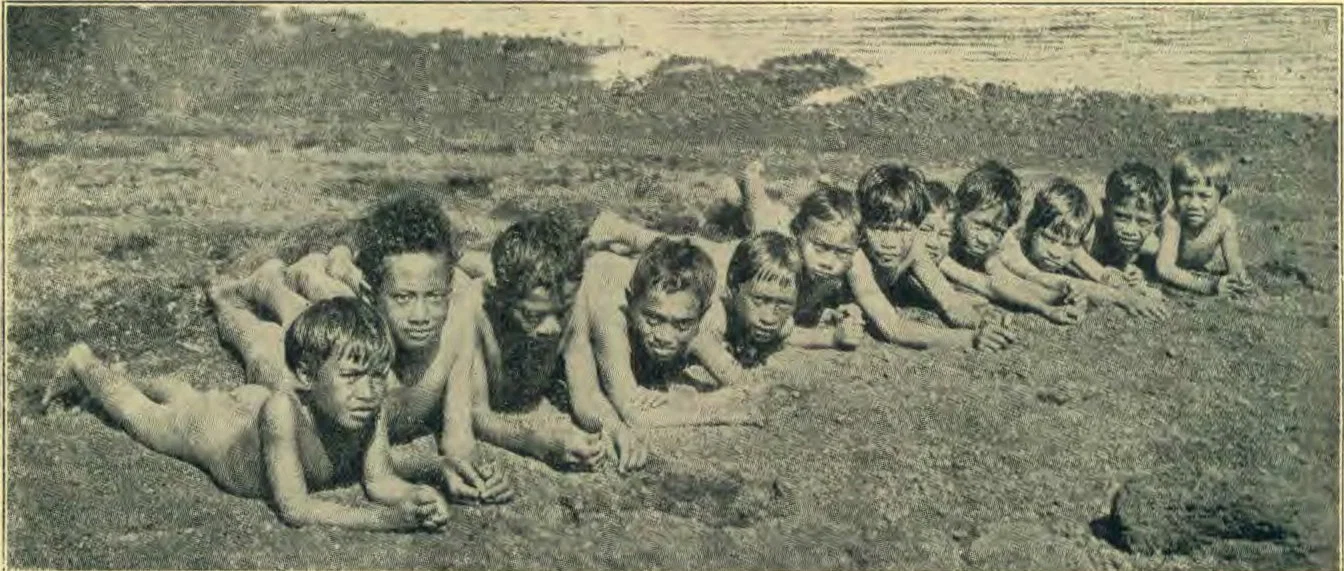
The anchor is hoisted, and out we sail from the deep-water lagoon, through the natural coral piers. Young swimmers are again in evidence, clad in the briefest of trunks and chattering like magpies. Their rivalry for possession of the coins tossed overboard is energetic and accompanied by shrieks of laughter. The winner rises to the surface with the money in his mouth for safe-keeping. It is surprising how many pieces the champion’s mouth can hold.
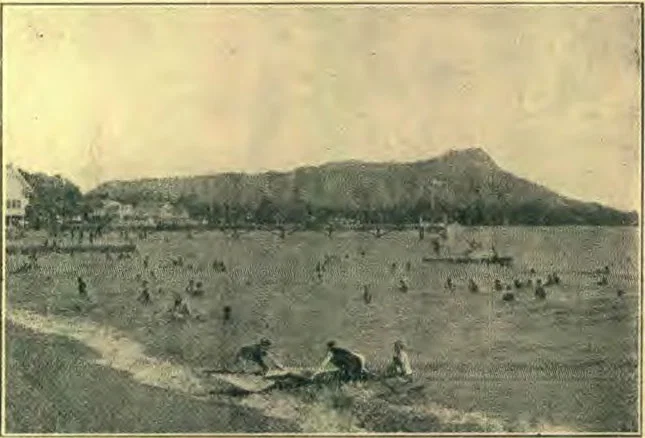
We see again the famous Waikiki Beach, with its magnificent ocean front stretching in graceful curves for miles, until stopped by the bold crags of Diamond Head. Waikiki Beach is a safe place for bathers—no undertow, sea puss, or sharks. The outer coral reef protects from these dangers. It is said that in no other country in the world can such delightful surf bathing be enjoyed, and both sexes become exceedingly expert in the water. As swimmers they are noted, and count in their ranks the champion swimmers of the world. Even the wee toddlers play in the surf, and then run about on the sand while old Sol dries their few dripping garments. They are not overburdened with raiment at any time.
On entering port we had scarcely noticed, amid the many things to be seen, the forest of masts that crowd the harbor. Almost every variety of craft lies at anchor here. The beautiful Stars and Stripes floats out to the breeze from an armored cruiser. The Union Jack waves proudly; and the kaiser’s flag also is seen, as two German ships are interned here. There are the full-rigged ship and the barkentine, and among these larger vessels, puffing launches make a great deal of apparently unnecessary noise. White-sailed yachts skim the water noiselessly, like overgrown swans, and the swift-going picturesque native boats with their curved outriggers flit here and there.
READY FOR A PLUNGE IN THE SURF
We remain at the rail, looking backward, until Honolulu, beautifully kneeling at the feet of its hills and mountains, is lost to view, when some one in the group exclaims, “Adieu, Honolulu, one of the happiest-appearing cities in the world.”

Passengers on the “Sierra”

At no time is dirt noticeable anywhere on the ship. Every morning witnesses a grand cleaning up, and boys are about all day scrubbing the paint and shining the metal work. There are no cinders or smoke,—except tobacco smoke,—and there is no dust flying, even when the wind blows. But when we return from our six hours on shore, it can be noted with more senses than one that there has been an entire freshening up of staterooms, dining-rooms, every part of the good ship. Everything is spotless.
This morning the whole crew, from captain down to the careful and tidy man who sets one’s cabin to rights, doffed their blue uniforms and appeared in immaculate white, which they will continue to wear until an appointed day during the last week of the voyage.
The regular motion of the ship no longer nauseates one, although it persisted in accompanying us on land, and proved very uncomfortable there, materially decreasing the enjoyment of our trip. We now drop into the pleasant routine of ship life.
Acquaintance is made easily and with little ceremony where a number of people are compelled to associate together for several weeks—acquaintance that often develops into lifelong friendship. We have a quiet and respectable company of fellow travelers.
Any formality or restraint that might otherwise exist is dissipated by the occasional appearance on deck of nine or ten merrymaking passengers. They generally remain in the lower part of the ship, and come up only one or two at a time. When they do favor us with their presence, their vivacious conversation, singing, whistling, and laughter are infectious and mirth-provoking.
One of them was unable to speak or understand a word in any other language than Spanish when he embarked on this voyage. He learned our little daughter’s middle name in the first lesson. When she tries to teach him to say Ivanilla, he will say, soft and low, “Jaunita.” When she persists, he will shriek out the same word, and break into a peal of laughter and song. He betrays himself, too, by his changeable moods and volatile temper. Sometimes he responds to love words and caresses with winsome coos and cuddles and dainty pecks with his bill. But beware! he is as fickle as Warburton weather. Notwithstanding, he is the favorite one of his party, and oftenest in demand by the audience.
American loyalty prompts us to mention first, and as most distinguished of the interesting people we meet on the “Sierra,” the nephew of our honored President. We understand now that nationality is a stronger link to Americans away from home than is social rank. This brings to mind one amusing incident. When a table mate heard some one say that President Wilson’s nephew was on board, he straightened himself with pride, and with wondrous dignity responded, “I am my father’s son.” He himself is a street fiddler. His companion is a thin-chested, sallow-faced lad, destroying himself as fast as possible by constant use of the cigarette and frequent trips to the bar. I think he must get up in the night to smoke. However early in the morning or late at night we see him, he is accompanied by the despicable cigarette.
Finally my desire to help him could not longer be silenced. Leading him to talk about himself, I learned that he has no ideals and no ambitions. Then, overcoming my scruples and fear of wounding his pride, I warned him of the deadening effects of the habit to which he is so addicted. Its dangers were pointed out as convincingly as I knew how. His response was that nothing could ever separate him from the cigarette as long as he could get one to smoke—even if he knew that death would follow the next one. And, although apparently once a bright boy, he is getting to look the part of a cigarette fiend. I often think of the future of these two boys, so far from home and its influence—if they have any home. We chanced to be near when their trunk was examined by the inspector, and it was almost empty.
How I wished for copies of the TEMPERANCE INSTRUCTOR. When at sea, people will read anything, and printed words are so much more effective, sink so much deeper, than those spoken. They cannot be answered back.
Never could there be greater need of anti-tobacco lessons than in this assemblage. Two men, one a Scotchman, proud of his Gordon name and blood and of his position in the ranks, and the other a young Englishman, are never seen, except at the table, without their pipes. In fact, one can scarcely find a corner to escape cigar and cigarette smoke. The men think nothing of puffing the smoke into the ladies’ faces. Lieutenant Gordon is very friendly with all, and some one asked him one day if he slept with his pipe in his mouth. He understands the entire mechanism of the ship, and is today taking all who dare venture, on a tour of inspection below.
One poor little mother draws on my sympathy. She left her home in Brisbane when but fourteen years old. The next year she married. Now at the age of twenty-four she is returning home with four boys. All but one are sickly, and she leaves in San Francisco the little graves of a son and her only daughter. Although the baby is five months old, it is so thin as almost to seem inhuman. The young mother knows less about the proper care of her children than does many a little girl who has tended only her dollies.
The father, who seems fond of his boys, smokes cigarettes all the time, and in play oftentimes blows the smoke directly into their faces and mouths. It makes my heart ache to see such ignorant cruelty. I talked with her about it, and she said she did wish he would give up smoking, it was such an expensive habit, and maybe, as I said, bad for her and the children. He had tried to give it up, she said, but couldn’t.
The stewardess is much interested in present truth, and also in the temperance question. She is a well-informed woman, and asks many questions, and desires literature. We give her what we have, and promise more, praying that the Lord of the harvest will nourish the seed sown, and that it may bring forth an abundant fruitage.

Stephen’s Preparedness

In an illuminating chapter on the “Work and Martyrdom of St. Stephen,” Dean Farrar writes:— “We would fain know more of one who, in so brief a space of time, played a part so nobly wise. But it was with Stephen as it has been with myriads of others whose names have been written in the book of life; they have been unknown among men, or known only during one brief epoch, or for one great deed. For a moment, but for a moment only, the first martyr steps into the full light of history. Our insight into his greatness is derived almost solely from the record of a single speech and a single day—the last speech he ever uttered, the last day of his mortal life.”—“The Life and Work of St. Paul,” chap. 8, par. 2.
And yet there is sufficient in the narrative itself to give inspiration and courage to every follower of Jesus who desires to make a real success of the Christian life. “It was the faith of Stephen, together with his loving energy and blameless sanctity, which led to the choice of him as one of the seven.”—Id., par. 3. And every observant reader of Luke’s stirring words concerning Stephen must be impressed with the thought that his wonderful success as a witness for God in a time of grave crisis, came as the result of conscientious and thorough preparation through a series of busy years. Not because of some mere accidental circumstance was a deacon rather than an apostle chosen to withstand the Hellenistic debaters who sought by cunning argument to undermine confidence in the teachings of the apostles concerning Jesus. In the language of Lowell:—
“The man’s whole life preludes the single deed That shall decide if his inheritance Be with the sifted few of matchless breed Or with the unnoticed herd that only sleep and feed.”
Thus it was with Stephen: his entire lifetime was one continuous preparation for his supreme hour of opportunity.
An English writer has observed that when some great leader “comes suddenly to the front, and shows that he has the very qualities which the occasion needs, it will always be found that he has been preparing himself,—unconsciously, perhaps, but really,—for years, by the careful discipline of daily labor, for the work which is now so successfully performed by him. While others were asleep, he was at his toil; and by the study of many earnest months, perhaps also by the labor of many midnight hours, he has been laying up that reserve supply, on which at the moment of necessity he has been able to draw. Thus, though the revelation of his ability may have been sudden, the growth of it has been gradual; and because in times of quiet and safety he kept up the discipline of work, the crisis which swept others into oblivion only floated him into fame.”—The Rev. Wm. M. Taylor, in “The Parables of Our Saviour,” chap. 11, par. 11.
When, in the great war still in progress, the Central Powers struck at the very heart of France in a supreme effort to capture Verdun, the Allied armies were placed under the command of one who but a few brief months before was merely a colonel, altogether unknown to fame, and about to retire from active service. Whence came success to General Petain, while others have failed? Contemporary prints describe him as an officer who has long been faithful in little things; today he is proving faithful over much.
This secret of success—diligent faithfulness in the doing of that which must needs be done during long years of preparation—has been expressed thus by Dr. J. R. Miller in his “Summer Gathering for Winter’s Need,” pp. 28, 14, 15:—
“The soldier cannot learn the art of war after the battle has opened. If he has not been diligent in the days allotted him for instruction and for discipline, he cannot stand before his foes when the conflict opens. Losing yesterday’s opportunity for training, we cannot meet today’s stern struggle.”
“We are not living in a world of chance; this is our Father’s world. There is no doubt, therefore, that in the wise providence of God there come to every one in youth opportunities which if properly improved will prepare for noble, beautiful, and successful life in the mature days.” A true and wise use of these opportunities, “whether they come in the sunshine of comfort and ease, or in circumstances of poverty and hardship, will fit one for whatever of task or struggle may fall to one’s lot in the after-days. God has a plan for every life, and that plan takes in the life’s training and preparation as well as its work and service. There is always opportunity, too, for just the preparation that is needed for the mission which is God’s thought and plan for the life.”
As in worldly attainment, so in spiritual progress. The doing with diligence of that which comes to hand from day to day, brings spiritual power. To quote once more from Dr. Taylor’s exposition of the parables: “If in our daily life we seek to form and maintain, by the help of the Holy Spirit and through faith in Christ, a holy character, then, when the testing hour comes, we shall be able to stand. But if we have been satisfying ourselves with a merely nominal Christianity, and have not endeavored to carry out in every respect the principles of the gospel, then the crisis of sudden temptation or unexpected trial will only reveal our weakness, and we shall be proved to be none of Christ’s.”
“The daily work of the blacksmith not only leaves, as its results, the articles which that day he has made, but adds also a certain deposit to the strength of his arm and the skill in his craft, which he has in store for the undertaking of something else. So, every time we perform a duty out of regard to Christ, the soul is made thereby so much the stronger for something else; and every time we overcome a temptation through faith in Christ, the soul is made so much the mightier for the resistance of the next assault. The daily life of the man who meets every duty as something to be done for Jesus, and bears every trial as something to be borne for Jesus, has its result not only in the doing of these duties, and the bearing of these trials, but also in the deposit of reserve force which is left thereby in his character for future emergencies.”
“‘Watch ye therefore, for ye know neither the day nor the hour wherein the Son of man cometh.’ . . . In a very important sense, the Son of man is coming to us every hour of every day. Each new hour brings new duties and responsibilities. . . . The last one we had, laid some new obligation on us. It brought some work to be done, or some evil to be resisted, or some privilege to be improved. Have we risen to the occasion? If we have, then we have brought out of it some reserve force of character, on which afterwards we may draw; but if we have not, then we have come out of it weaker than we were before we entered it.
“Thus, whether we will confess it to ourselves or not, there is a constant process going on within us, either of invigoration or of deterioration; and, if we meet Christ continually as he comes to us in the common duties of a common day, we shall not be dismayed at last when he comes in state with the flaming outriders of his majesty.”—Chap. 11, pars. 12, 13.
C. C. CRISLER.

ERNEST LLOYD

George Muller — No. 1

ERNEST LLOYD
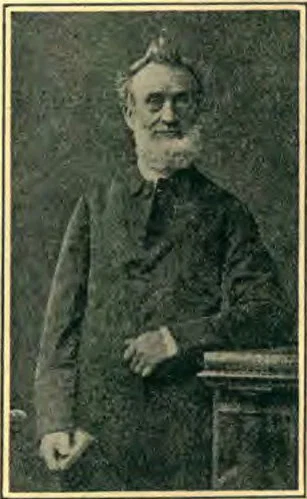
ONE Saturday night in November, 1825, a disreputable young man entered a little devotional meeting held in the house of a Christian merchant in the town of Halle, Germany. He was accompanied by a friend, who, reasonably, had misgivings about introducing him to such a gathering, the young man being an ardent seeker after pleasure, careless, indifferent, sinful, one who might be expected to find no enjoyment in the society of Christian people. At the card table or in the ballroom or the theater he would be at home, but not in a prayer meeting. However, by a singular fancy, he had expressed a wish to go, and the friend had consented to take him.
The kindly reception at once won his sympathy: “Come as often as you please; house and heart are open to you!” The small company sang a hymn; and then one of the number fell upon his knees and asked a blessing upon the meeting. This was quite a new experience to the visitor, and made a very deep impression upon him. He had never seen any one on his knees in prayer. Then a chapter out of the Bible and a printed sermon were read, and another hymn and prayer brought the meeting to a close. It was a very quiet, simple gathering, but the work of conviction was done,—and more. From that moment this godless young man resolved to be a Christian. “All my former pleasures are as nothing in comparison with this evening,” Müller told his companion as they walked home. It was the simple act of prayer that brought about the change.
A sinful youth, the young man's career up to this time had not only been marked by idle pleasure, but by dissipation and dishonesty. Born in the town of Kroppenstedt, Prussia, Sept. 27, 1805, George Müller had very early given himself up to a course of sin.
His father, who was the collector of the excise, seems to have made the mistake of allowing the boy too much money to spend, considering his age—not in order that he might spend it, but to accustom him to possess money without spending it. The principle had an opposite effect altogether. It led him into many sins. He repeatedly spent a part of the money in a childish way, and afterward, he declares, when his father looked over his little treasures, sought to deceive him in making up the accounts, either by not putting down all the money which had been given him, or by professing to have more in hand than was the case. The deceit was found out, however, and the boy punished; but without any good effect.
Before he was ten years old, he frequently stole the government money in his father's keeping. The father on one occasion found some missing money in one of the shoes George was wearing. Again he was punished, the only result being to set him thinking how he could do the thing more cleverly next time.
When between ten and eleven years of age, he was sent to a classical school at Halberstadt, there to be prepared for the university, his father's desire being that his son should become a clergyman. His time was now spent partly in study, partly in novel reading, and partly in sinful practices. Such was his way of life until his fourteenth year, when his mother was removed by death. While she lay dying, George Müller, unaware of her sickness, was card playing till two in the morning, and on the next day he went with some of his companions to a tavern, and afterward roamed through the streets half intoxicated.
The bereavement made no lasting impression upon his mind. In fact, he went from bad to worse. Even when he came to be “confirmed” in the spring of 1820, he actually defrauded the clergyman by handing him only a twelfth part of the fee which his father had given him as an offering. His time until midsummer, 1821, though spent partly in study, was largely taken up in playing the piano and guitar, reading novels, and frequenting taverns. His money was often spent on pleasure, so that once, to satisfy his hunger, he stole a piece of coarse bread, the allowance of a soldier.
In 1821 he robbed his father still more by giving people receipts for different sums which were owing, at the same time leading his parent to understand that the money had never been paid. In November of the same year, at the age of sixteen, he set off, without permission, on an excursion to Magdeburg, where he “spent six days in much sin;” and next proceeded to Brunswick, staying at an expensive hotel, where he passed a week in extravagant living, and barely escaped arrest when his trickery was found out. His best clothes had to be left as security, and with this he was allowed to go.
GEORGE MULLER
GEORGE MULLER
He now proceeded to Wolfenbüttel, where he again put up at an inn, and, still without money, lived in fine style. In trying to run away, however, he was arrested, and taken between two soldiers to a police officer, who ordered him to jail.

In Prison

After a few days he made the discovery that a thief was occupying the adjoining cell, and so far as a thick wooden partition would allow, the two conversed together. Eventually, by Müller’s request, the governor of the jail permitted the thief to share his cell. They passed their time in relating their adventures, and, says Mr. Müller, “I was by this time so wicked that I was not satisfied with relating things of which I had been really guilty, but I even invented stories to show him what a famous fellow I was. After about ten or twelve days, my fellow prisoner and I disagreed, and thus we two wretched beings, to increase our wretchedness, spent day after day without conversing together.”
Müller remained in jail for over three weeks, by which time his father had consented to pay the bill at the inn and the prison charges. For a time the experience through which he had passed and the chastisement his father administered when he arrived home were not without some good effect. In October, 1822, he was sent to a school at Nordhausen, where he studied with such diligence that he was held up as an example to his class. But he still lived “secretly in much sin,” in consequence of which he was taken ill, and for thirteen weeks was confined to his room. At this time he had about three hundred books of his own, but no Bible!
While at Nordhausen he was guilty of some deceit which cost him the good opinion of the principal of the school, which he had done so much to gain by his devotion to study. In consequence of his dissipation, he had contracted debts which he had no means of discharging. One day, after having received a sum of money from his father, and having purposely shown it to some of his companions, he feigned that it had been stolen.
He then ran into the principal’s room, with his coat off, and appearing greatly frightened at what had happened, declared that he had been robbed of his money.
As he had anticipated, he was greatly pitied, and some friends gave him as much money as he pretended he had lost. The circumstance also afforded him ground upon which to ask his creditors for further leniency. But the principal guessed the truth, though he could never prove anything.
In 1825, George Müller became a member of the Halle university. One day, while in a tavern with some fellow students, he saw among them one of his former schoolfellows named Beta, whom he had known at Halberstadt, but whom at the time he had despised because he was quiet and serious. Müller soon became the close friend of Beta; while Beta, in a moment of weakness, acquiesced in the friendship of a very bad companion.
In August of this same year, Müller and his new friend, with two other students, drove about the country on pleasure for four days, defraying the expenses by pledging some of their belongings. This merely tended to whet their appetite for a more extended expedition, and a trip to Switzerland was suggested.
Says Mr. Müller, “The obstacles in the way—the want of money and the want of passports—were removed by me. For, through forged letters from our parents, we procured passports; and through pledging all we could, particularly our books, we obtained as much money as we thought would be enough.”
The truants traveled for forty-three days, almost always on foot. “I was on the journey like Judas,” we find Mr. Müller confessing, “for, having the common purse, I was a thief. I managed so that the journey cost me but two thirds of what it cost my friends!” Upon arriving home, he told many lies in order to satisfy his father concerning the traveling expenses, and succeeded in deceiving him.
Thus had George Müller spent his life up to the time when he was led to the little prayer meeting already mentioned, which resulted in his conversion. Beta was the friend with whom he went to meeting.

The Moorish Palace

DON'T get into the Moorish Palace, whatever you do! I saw it years ago in one of our parks. It had a small grottolike entrance into which we were invited by placards announcing its wonders and beauties, but once inside there were only mirrors, and whichever way you turned, you saw only yourself. You looked in one direction and you had grown tall and thin, in another short and wide. Your face expanded or lengthened in the most astonishing way. Every way you turned there were grotesque representations of yourself. In every direction the mirrors lured and deceived you, promising exits where there were none, only bringing the bewildered wanderer face to face with some other distorted reflection of himself — always himself.
There are people who spend their lives in the Moorish Palace. Whichever way they turn they see nothing but self, and soon it grows to be an exaggerated and distorted self. They see it made little by fancied slights, and they are resentful. They see it grow into importance by some success, and their pride is gratified. Even when they think they are working for God, it is self that always slips into the foreground.—Kate W. Hamilton, in “The Queen’s Garden.”
Continue reading: The Pearl of Great Price