The Youth’s Instructor, Vol. 32, No. 17.

ELIZABETH FRY

The Youth’s Instructor

Apr 23, 1884

S. D. A. Publishing Association · Battle Creek, Mich. · Apr 23, 1884

ELIZABETH FRY.

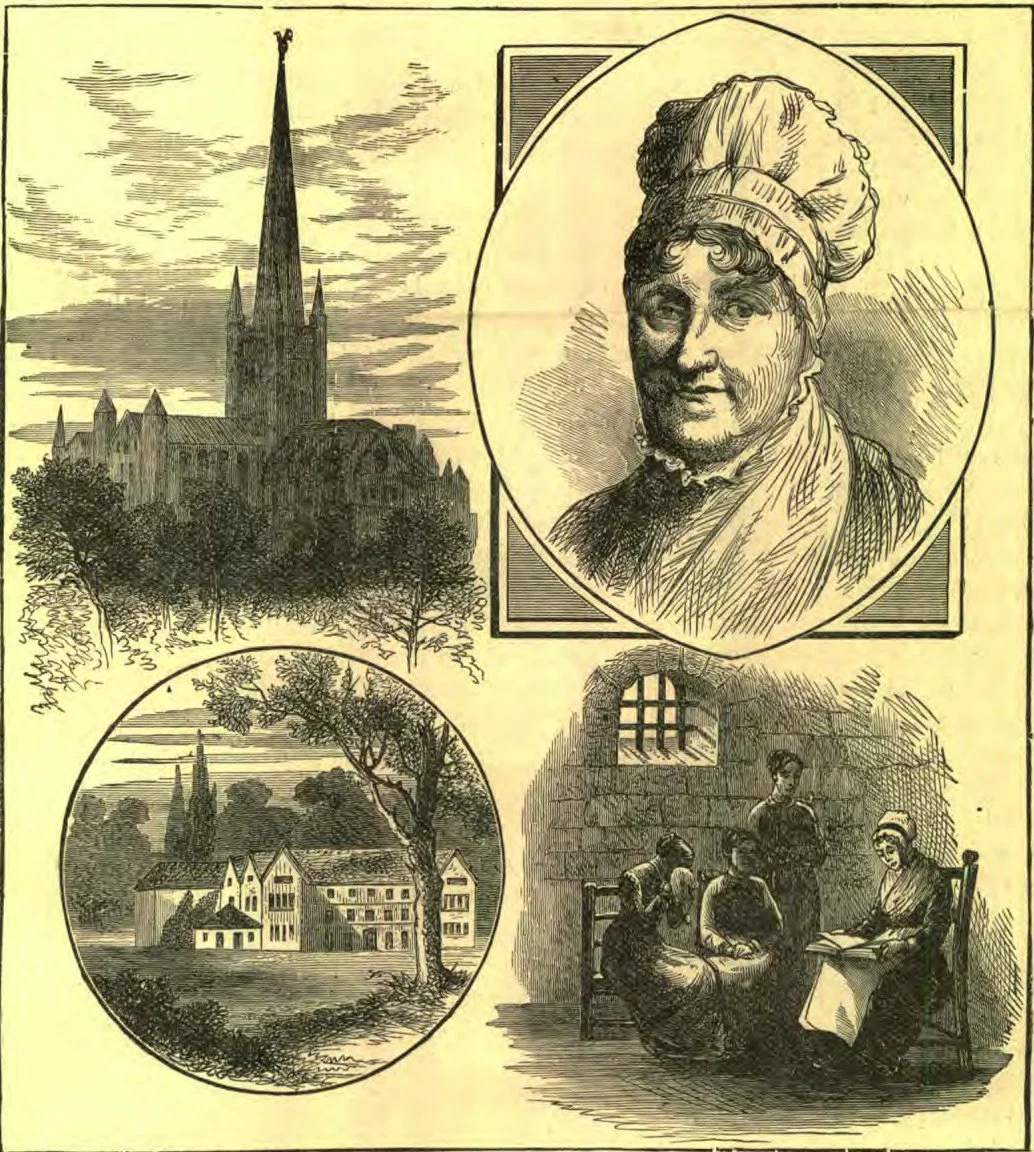
A LITTLE more than one hundred years ago lived the woman whose kindly face looks out at us from the accompanying engraving. Elizabeth Fry was born May 21, 1780. Her father, John Gurney, was a wealthy merchant and banker, living near Norwich, England. Her parents belonged to the Society of Friends, as had their ancestors for several generations.
In 1798, William Savery, an American Friend, made a visit to the Friends in England. At this time, Elizabeth was inclined to love dress and pleasure; but under the influence and preaching of this godly minister, the whole course of her life was changed, and she became an earnest and consistent Christian. She began to visit the poor on her father's estate, aiding them in temporal and also in spiritual things. For the benefit of the poor children in the vicinity, she organized and taught a school, which grew so rapidly that it soon numbered nearly one hundred scholars.
Two years after this time she married Joseph Fry, a wealthy London merchant. In this city, Mrs. Fry found a large field of usefulness. Her husband nobly encouraged all her benevolent plans, aiding her whenever he could. She became the mother of a family of eleven children; and although she personally gave them the most careful training, she still found time to help her suffering fellow-creatures.
Ten years after her marriage, she became a preacher among the Friends, doing, in this capacity, faithful and efficient work. Gradually her attention was turned to the deplorable condition of the inmates of the prison houses, and she set about producing a reform in the prison regulations. To understand the Herculean task that Mrs. Fry had set herself to, we must know something of the condition of the prisons at that day. There were then no separate apartments for men and women, but parents and children, men and women, young and old, were herded together like wild beasts. In one hundred jails, capable of holding only eight thousand and five hundred persons, were found thirteen thousand. Under such circumstances, it happened that many went away from the prison house far more familiar with vice and crime than when they entered its walls.
It required no small amount of courage to enter one of these dens; yet Mrs. Fry did not shrink from the task before her. By her dignity and gentleness she gained the respect of the prisoners, and won their attention. On her second visit to Newgate prison, she read to them the parable of the lord of the vineyard, as related in Matthew's Gospel. Finding on her next visit that the prisoners were still willing to be helped, she began, in one of the cells, a school for the children, many of whom were under seven years of age. She then set about furnishing employment for the women. To carry out this plan the more successfully, she formed a committee of twelve ladies, some of whom every day visited the prison, teaching the women how to sew and knit, and reading to them from good books.
Mrs. Fry's system required separate apartments for the men and women, and such a classification of individuals that those young in crime should be away from those who had spent a lifetime in sin; it compelled the prisoners to work, and provided for regular instruction. The sheriffs and officers of the prisons heartily approved of these efforts. In a few months the most astonishing results were seen. The blasphemy and obscenity ceased, and the women were reclaimed to an upright life and habits of industry and piety.
After such a success among the London prisoners, Mrs. Fry received many urgent calls to help in other places; accordingly she journeyed through the more populous portions of England, laying her plans before the people. In almost every town of considerable size, a ladies' aid association was formed. As far away as St. Petersburg, the people heard of the fame of this enterprise, and began a similar reform themselves. Queen Victoria befriended the movement, and lent it her aid.
Mrs. Fry afterward visited the Continent, inspecting the prisons of France, Germany, Belgium, Holland, and Prussia. This work made sad inroads on her health, and in 1842 she was obliged to relinquish her plans for greater activity. But she had the satisfaction of knowing that the authorities throughout Europe were becoming aroused to the need of a reform, and were putting into practice the principles she advocated.
In the spring of 1845 she visited Bath, but receiving no benefit from the change, returned to her home, where she died October 12, 1845. She was sincerely mourned throughout Europe. As it was said of one of America's heroes, so might it be said of her:—
“Were a star quenched on high, For ages would its light, Still traveling downward from the sky, Shine on our mortal sight.”
“So when a great man dies, For years beyond our ken, The light he leaves behind him lies Upon the paths of men.”
W. E. L.

THE BLUE BIRD.

LISTEN a moment, I pray you! What was that sound I heard? Wind in the budding branches, The ripple of brooks, or a bird? Hear it again, above us, And see a flutter of wings! The blue bird knows it is April, And soars to the sun, and sings.
Never the song of the robin Could make my heart so glad; When I hear the blue bird singing In spring, I forget to be sad. Never was sweeter music— Sunshine turned into song, To set us dreaming of summer, When the days and the dreams are long.
Winged lute, that we call a blue bird, You blend in a silver strain The sound of the laughing waters, The patter of spring’s sweet rain, The voice of the winds, the sunshine, And fragrance of blossoming things. Ah! you are a poem of April That God endowed with wings.
—Eben E. Redford.

BESSIE'S DISAPPOINTMENT.

It was such a warm, sleepy day, such bright sunshine, such dreamy sounds. Oh, how heavy little Bessie's eyes were—in church, too! What should she do to keep awake?
She counted the little blue spots down the front of her dress; then she winked very hard at the little three-year-old piece of perpetual motion just in front of her, till he nearly turned a somersault over the back of the pew trying to reach her, and his mamma set him down very hard, close up in the corner, so he couldn't turn around any more. She wondered if good people ever got sleepy in church, or if it was only the very, very wicked ones; and she peeped around to see if her mother was wide awake. Then she watched a wee bit of yellow sunlight that had crept in, and was dancing upon the wall. Wasn't it wicked, she wondered, for it to dance like that in church?
The minister repeated his text again, “Draw nigh to God, and he will draw nigh to you.”
It sounded very far away, just as if he was in their parlor, and she was out in the kitchen with Hannah. How should she keep awake?
Then she thought she was in the woods down by the river, gathering ferns, mosses, and acorn-cups. It was a sunny, green spot; and, as she looked around, she saw right by her side a cluster of tall, white lilies. They were very beautiful in the sleepy summer light, nodding gently one to another as the soft air stirred them. She would look down into their white hearts, and see if there were any wee bits of yellow sunlight there. What did it mean? Right in the heart of each lily lay a little sleeping angel, with folded wings. Could this be heaven, and was she in it? Oh, no; there wouldn't be any acorn-cups in heaven, nor any little girls who were sleepy in church!
While she stood wondering and wondering what it could mean, she heard a sweet voice close beside her say: “Little one, consider the lilies of the field; in the heart of each one of them is a little messenger of your Heavenly Father's love; and if you will open the door of your child-heart, he will send just such a messenger to you.”
She turned and saw one standing beside her whom she had never seen before.
“Are you Jesus, the Christ?” she said, softly, looking up into his face; “and did you die to save little children who get so sleepy in church?”
He lifted her in his arms, and pillowed her sleepy head on his bosom, as he said, “Suffer little children to come unto me, for of such is the kingdom of heaven.”
Then the tall white lilies bowed their heads, and the sunlight grew more golden, and the great trees whispered one to another that the dear Lord Christ was passing by with a little child pillowed on his bosom.
Was the minister repeating his text again? No! She rubbed her sleepy eyes wide open, as she heard him say: “My dear friends, Christ is with you all to-day, waiting to bless you. It is for you to say whether you will have this Friend or not. Open your hearts wide, and bid him enter, and he will abide with you forevermore. As you go home to your noon-day meals, he will go with you; he will sit with you at your tables, and will give you the bread of life to eat. Then let the prayer of every heart in this congregation be, ‘Lord, evermore give us this bread!’ Let us pray.”
Bessie's eyes were wide open now. She wasn't sleepy any more; for didn't the minister say Christ was going home to dinner with them?
A few minutes later, Hannah was startled in the act of putting the table-cloth on for dinner, by a little girl who ran in all out of breath, and snatching the table-cloth off from the table, said, “Hannah, we must put the very bestest table-cloth on, and the whitest napkins, for Christ is coming home to dinner with papa and mamma, and he is the King of kings, and must have the very best of everything!”
She ran to the closet where the linen was kept, and was spreading on the best table-cloth when her mother came in. Hannah found words then to say to her mistress, “Indeed, I dinna ken what the bairnie means. I'm thinking she's gone daft.”
“O papa!” said Bessie, as her father came in from another room, “did He come? Is He in the other room?”
“Who, Bessie? Papa doesn't know who you mean.”
“Why, Christ—the dear Lord Christ. Didn't the minister say he would come home to dinner with us, papa?” she said, her eyes filling with tears.
Mamma's eyes filled, too; and papa's voice quivered a little, as he said, leading her into the other room, “Let papa tell his little daughter what it was the minister meant. Not that Christ as a person would come home with us and sit at our table, but Christ as a spirit, in our hearts. You know we cannot see Christ, my daughter—”
“But I saw him, papa!” she said, earnestly. “I saw him, and he did take me in his arms!” And she told her father the dream she had in church; what she saw in the lilies; and how the trees bowed and whispered to one another, “The dear Lord Christ is passing by with a little child pillowed on his bosom.”
Dinner was late that day; for it was long before Bessie could be soothed—before the great tears of disappointment would stop coming—before the grieved look went out from the brown eyes.
The best table-cloth was kept on, and the whitest napkins were out; and I think when at last they gathered around the table, the dear Lord Christ was with them.—The Christian Weekly.

STOP-A-WHILE

There is growing in Africa a thorn called “Stop-a-while.” If a person once gets caught in it, it is with difficulty he escapes with his clothes on his back, for every attempt to loosen one part of his dress only hooks more firmly another part. The man who gets caught by this thorn is in a pitiable plight ere he gets loose. You would not like, would you, boys, to be caught in this thorn? And yet many, I fear, are being caught by a worse thorn than “Stop-a-while.” Where do you spend your evenings? At home, I hope, studying your lesson and attending your mother’s words; for if you have formed a habit of spending them on the streets with bad boys, you are caught in a thorn far worse.—Selected.

EDITOR'S CORNER.

SOMETIMES we fear the young do not, all of them, attach that importance to meeting with God's people when they assemble for worship that they should; and that for slight excuses they remain at home, and thus deprive themselves of a blessing, and of the strength to resist temptation, which Christ always imparts to the diligent seeker; for his promise is, if but “two or three are gathered together in his name,” he is in their midst.
How is it with the readers of the INSTRUCTOR in their attendance at the house of God? Do you take your seats promptly in your several places of worship? and if so, for what purpose are you there? Not, we hope, to have a pleasant chat with your friends, or to make a display of yourselves, as the young sometimes do; but we trust you go to receive religious instruction, and to learn more perfectly what God requires at your hands.
Paul's experience made him a wise counselor and faithful teacher; besides, his words were directed by the Holy Spirit, and should have great weight with us. He instructed the early Christians not to forsake the assembling of themselves together for religious worship; and he not only bade them meet together, but exhort one another; that is, speak words which should help one another; and to do this “so much the more” as they saw “the day approaching.” The “day” to which he refers, is evidently the day of Christ's second appearing.
Paul knew that in common times, Christians needed stated hours for seeking God together, and for counseling and encouraging one another; but he knew that near the close of the gospel dispensation the times would be so perilous that they would need one another's prayers and exhortations all the more; hence, his instruction was to meet to help one another “so much the more” as they neared the close of time. Malachi prophesied that God's people who lived in the time of the end would “speak often one to another, and that the Lord would hearken, and hear it, and a book of remembrance would be written before him for them that feared the Lord, and that thought upon his name.”
Christ gave certain signs to show us when to look for him; and he said when they came to pass, we should know that he was “near, even at the door.” As surely as the budding fig-tree foretells the summer, so surely will these signs proclaim his advent near. Those signs are nearly all fulfilled, and we need to improve all our religious privileges if we hope to plant our feet upon Mount Zion.
If you have been irregular in your attendance at the house of God, or if you have not been as faithful in the house of prayer to confess your faults and to encourage others by your testimony as you should have been, now is a good time, at the beginning of this new quarter, to covenant together to be more faithful in the future. How many victories we shall gain over past failures during the next three months will depend upon our own individual efforts; for the Lord always gives grace sufficient for every need when we make his service our first choice. Let us all make the experiment, to see if this is not so. M. J. C.

Character as the Foundation for Lasting Life

THERE is wisdom in the counsel of one of the keenest of our satirical writers, when he says to the average young man of to-day: “I don't want to see you try to build a six-story house on a one-story foundation.” It is the character of the foundation that decides the capability of the building to stand in all weather.—Sel.

NEW-TESTAMENT HISTORY.

LESSON 184.—THE CONSPIRACY AGAINST PAUL.

1. How far did the Jews allow Paul to continue his speech on the stairs of the castle? Acts 22:17–21.
2. What did they then say? Verse 22.
3. What demonstration did they make? Verse 23.
4. What command did the captain then issue?
5. How did he propose to examine Paul? Verse 24.
6. As they proceeded to bind Paul, what did he ask the centurion who stood by?
7. What effect had this question? Verse 26.
8. Relate the conversation between Paul and the chief captain. Verses 27, 28.
9. What caused the chief captain some alarm? Verse 29.
10. What action did he take on the morrow? Verse 30.
11. How did Paul address the council? Acts 23:1.
12. How did the high priest show his contempt for Paul’s words? Verse 2.
13. How did Paul reply to this insult? Verse 3.
14. What was said by some who stood by? Verse 4.
15. What apology did Paul then make? Verse 5.
16. How did Paul cause a division among his persecutors? Verse 6.
17. What was the chief point of difference between these sects? Verse 8.
18. What did the Pharisees now say? Verse 9.
19. What did the chief captain fear? Verse 10.
20. How did he secure Paul’s safety?
21. Who visited Paul during the following night? Verse 11.
22. What did the Lord say to him?
23. What conspiracy was made against Paul? Verses 12, 13.
24. What plan did they lay for getting Paul into their hands? Verses 14, 15.
25. How did Paul get knowledge of this plan? Verse 16.
26. What did Paul do? Verse 17.
27. How was his request complied with? Verse 18.
28. How was the young man treated by the chief captain?
29. How did the young man do his errand? Verses 20, 21.
30. With what charge did the chief captain dismiss the young man? Verse 22.
31. What orders did the chief captain give? Verses 23, 24.

NOTES.

Acts 22:23. Cast off their clothes.—This means, not throwing off their garments as a preparation for stoning Paul; for he was now in the custody of the Roman captain; but throwing them up, tossing them about, as a manifestation and an effect of their incontrollable rage.—Hackett.
Ver. 24. Commanded him, etc.—He had been unable to follow Paul’s address, on account of his ignorance of the language; and, witnessing now this renewed outburst of rage, he concludes that the prisoner must have given occasion for it by some flagrant offense, and determines, therefore, to extort a confession from him.—Ibid.
Ver. 25. Is it lawful.—By the Roman law, no magistrate was allowed to punish a Roman citizen capitally, or by inflicting stripes, or even binding him; and the single expression, I am a Roman citizen, arrested their severest decrees, and obtained, if not an escape, at least a delay of his punishment.—Comp. Bible.
Chap. 23:3. God shall smite thee.—God did smite him in a remarkable manner; for, about five years after this, after his house had been reduced to ashes, in a tumult raised by his own son, he was besieged and taken in the royal palace; where, having attempted in vain to hide himself, he was taken out and slain.—Comp. Bible.
Ver. 12. Would neither eat nor drink.—Here was such a fast as the Lord through Isaiah had condemned many years before,—a fast “for strife and debate, and to smite with the fist of wickedness.”—Life of Paul, Mrs. E. G. White. Lightfoot remarks, however, that they could be absolved from this vow by the Rabbins, if they were unable to execute it. Under various pretenses they could easily be freed from such oaths, and it was common to take them.—Barnes.
Ver. 23. The third hour.—Nine o’clock, so that they might elude the vigilance of the Jews.
Ver. 24. Felix was the Procurator of Judea, having received this office from the Emperor Claudius. He was originally a slave, and was a man of energy and talents, but avaricious, cruel, and licentious.—Hackett.

LAND, HO! AND BONNIE SCOTLAND

FOREIGN TRAVEL.—NO. 3.

LAND, HO! AND BONNIE SCOTLAND

The landsman first crossing the briny deep, eagerly welcomes the approach to terra firma. Nine or ten days of shaking up, tossing and heaving, externally and internally, usually satisfy him. He will be found about noon each day carefully consulting the log of the ship, in which is daily given the latitude, and longitude, and distance sailed, and how far he has still to go to complete his voyage.
The passengers were up the last morning in good season, watching for the headlands of the north of Ireland. The previous day we had smelled the burning peat far out at sea. We got a bare glimpse of the land through the fog; and not long after, first sighted the bald headland of Scotland, called the Mull of Cantire. The word mull is the old Gallic word for head. It is a high, rocky point, against which the waves vainly beat with all their fury. We sailed down the Irish Channel, and up the Firth of Clyde, past several islands, the firth gradually narrowing up into the river Clyde.
We passed several pretty villages and places of summer resort, which looked neat and inviting. As the tide was out, we could not sail up the river to Glasgow, our big ocean steamer drawing too much water. We therefore left our ship at Greenock, and went by rail to Glasgow, which we reached late in the evening. It seemed good to place our feet once more on the solid earth, though we had, on the whole, quite a pleasant voyage for the season of the year, and our ship and its officers had proved themselves well worthy of our confidence.
Glasgow is the commercial and industrial metropolis, and the second city in size, in the United Kingdom. It is the greatest ship-building place in the world. Nearly two-thirds of the ocean and river steamers of Great Britain are built here. Our captain said that a large majority of the engineers of the ocean steamers throughout the world hail from Glasgow. It is a clean and beautiful city. The people in the streets looked intelligent, well dressed, and well cared for. There is an immense amount of manufacturing carried on here. The chemical works of Messrs. Tennant & Co. are the largest in the world, employing one thousand men. At their establishment is a chimney four hundred and fifty feet high, and another adjacent four hundred and sixty-eight feet high. In George Square there is a statue of Sir Walter Scott, of colossal size, bronze statues of Sir John Moore, James Watt, Sir Robert Peel, the Duke of Wellington, and Prince Albert, and Queen Victoria. It is a very beautiful place.
We had not long to stay in Glasgow, so taking the cars, we passed through Edinburgh, New Castle, Hull, and several smaller towns. The ride was very pleasant, and the scenery very beautiful. Though this was in the month of February, when snow, ice, and cold prevail in America, here in Scotland the farmers were plowing in the fields, the grass was quite green, the buds were opening, and the birds were singing. Yet Scotland is much farther north than many of the States where greater cold prevails. The influence of the sea and the great gulf stream flowing from the Gulf of Mexico, across the ocean, past England and Scotland, to distant Norway, moderates the climate greatly. As we passed along, we were struck with the neat appearance of the farms and the houses. Instead of shingles, they were mostly covered with brick-colored tile. Many things seem strange and new to us.
Though in Great Britain, where our own language originated, many of the terms are very differently used than in America. Instead of street cars, it is trams, and the track is a tramway; our baggage is all luggage; the ticket-office is a booking office; the conductor or brakesman is a guard; the baggage car is a van, and the freight cars are wagons.
Instead of going into the end of the car, as in America, and having the conductor go through the car to collect the tickets, we go in at the side, the car being divided up into little rooms, with a seat on each side, so that ten persons can sit in each compartment, and face each other. Instead of having stoves and a fire to keep the whole car warm, two large cans of hot water are occasionally put into the compartment, so that we can warm our hands and feet. The car doors are usually locked while the train is in motion. In the cities the omnibuses and trams are double deckers, having steps running up so that about half of the passengers ride on top.
The streets are usually kept much cleaner and nicer than in America. We found the people very courteous and accommodating. In the larger places the depots are very fine buildings, usually roofed with thick glass, so the light can come in. Books and papers are kept for sale in many of them. They do not have any system of checking baggage, as in America, though they seem to take great care that it shall be safely carried.
The people of Scotland are intelligent. There are very few who cannot read or write. They are an enterprising and industrious people, and very proud of their country and its past history. It is rather amusing to a traveler to see how the people of every country think their own is the best, and their nation superior to all others. I suppose America is no exception to this rule.
Scotland has produced many eminent men. Sir Walter Scott was a great poet, William Wallace and Robert Bruce were great heroes and patriots, and John Knox was a valiant reformer. Many other names have made Scotland illustrious. She has produced many of the great thinkers of modern times. The Scotch character is noted for its energy and tenacity. Scotland is an interesting country. Its mountains, rivers, and lakes are visited by large numbers from other lands, and the scenery is well worth beholding. UNCLE IDE.

The Teacher's Opportunity in the Half-Hour Class

THE teacher’s opportunity is that precious half-hour with his class, when he is to impress the lesson of the day upon the hearts of those before him. It is worth the faithful study and prayer of a week, to be able to use that opportunity so wisely, that it shall not be looked back upon with vain regrets.

Teachers Should Arrive Before Their Sabbath-School Classes

If you have a class of restless and mischievous boys in Sabbath-school, and want to keep them up to their busiest work in their line, you would better let them get in their places before you, and take a fair start without their teacher’s being on hand to check them. Ten minutes sooner or later on your part in getting to your place will make a solid hour’s difference in your control of your class for one day. If a teacher is ahead of his scholars in getting into place, he can keep ahead there. If his scholars are ahead of him to begin with, they are not likely to lose their lead till school closes.

“BEFORE IT GREW.”

THIS acorn’s all broken frew at the top!” said Harry Marling, as he watched and helped his sister Hepsy unpack her basket from the woods.
“O Harry, be careful!” exclaimed Hepsy, as his little fingers were busy with a queer-looking acorn. “Be careful! Broken ‘frew!’ I guess it is. Lay it right down this minute!”
“Hepsy!” said a gentle voice, and Hepsy blushed as she saw her mother was watching them.
“Well, he may have as many whole acorns as he wants, but the ‘broken frew’ ones are sprouted ones, and they’ll grow! They’re all started, now!”
Hepsy took the sprouted nut, and handed it to her mother; and Mrs. Marling explained what was new to Harry, and new once to every little boy and girl,—how there was something hidden inside of every acorn and chestnut, and every tiny seed,—something which makes it very different from a pebble, or a bit of coal, or anything else,—a little secret life, which works away, tugging and pushing right through the tightest, hardest brown walls that ever a seed or nut built up.
“So tender, too,” said Hepsy. “This little white finger, I don’t see how it ever got through the shell!”
“That ‘little finger’ is the ‘plumule,’ or part which will grow and unfold into leaves, and after awhile into the oak-tree.”
“What makes the push inside?” asked Harry.
“It must be God,” said Hepsy, thoughtfully. “No person can do it. They can make acorns that look like this, there are some on my hat, you know, but they’ll never have a ‘plumule’!”
Harry, picking up Hepsy’s hat, and rubbing his finger over one of the smooth acorns hid among the oak-leaves, echoes,—
“Never have a poomool! I wouldn’t have acorns on my hat that couldn’t come to life!”
“Is this a plumule, too?” asked Hepsy, touching a white ‘finger’ at the other end of the nut.
“Not unless you expect to have two trees from one nut,” said her mother. “That makes the root, which is to go down deep into the ground, and hold the tree firmly in its place. It is called the ‘radicle.’ Perhaps you can remember these two words, and take them for your first lesson in botany.”
“Does every seed in the world have these two things when it grows?” asked Harry.
“Yes, one to go down, and one to go up. You won’t forget that?”
“And did every tree and every flower that ever was, come out from the seed, top and bottom, like this?” asked Harry.
“Now I can answer that, and tell you a very strange thing,” said their mother. “Once a great while ago, there were some trees—a great many of them, too—that didn’t come out of a seed in that way. In fact, they didn’t come out of a seed at all.”
“That’s a fairy story,” said Hepsy.
“No, it’s a true story. I have read about them, and I am sure it is true.”
“What sort of trees were they?”
“A great many sorts. Some oaks, no doubt, and some pines, and sycamores, and orange-trees, and olive-trees—”
“Oh, but there must have been an orange or a sycamore ball first, mother.”
“Yes; if this had not been, as I told you it was, a very strange and wonderful thing. Indeed, so wonderful that it has never happened but once.”
“Tell us about it,” said Hepsy.
“I have told you now pretty nearly all I know about it, except that no rain had helped these trees to grow, not even one shower had fallen on them, and no man had ever planted one of them, nor taken the least care of them. If you would like to read the story, you may. You can read it in one minute for yourself.”
“Where is it?” asked Hepsy.
“Bring me your Bible,” said her mother, “and I will show you.”
Hepsy brought her Bible, and her mother turned to its first page, and pointed to one verse for her to read. It was the fifth verse of the second chapter of Genesis. Harry listened eagerly while Hepsy read: “And every plant of the field before it grew; for the Lord God had not caused it to rain upon the earth, and there was not a man to till the ground.”
“How strange to think of all the trees, all over everywhere, and nobody had planted them,” said Hepsy.
“Just made whole,” said Harry.
“That is all we can say about it,” said their mother, “and yet, wonderful as these words, ‘and every herb of the field before it grew,’ are, I do not know as it was any more strange than the way they grow now, starting from the little seed. As Hepsy said, ‘God does it.’ Man cannot make one little acorn, with what Harry calls the ‘push’ inside. Only He who first made the whole trees can ever do that.”—Mrs. Julia P. Ballard.

SEVEN TIMES'ONE.

THERE'S no dew left on the daisies and clover, There's no rain left in heaven; I've said my "seven times" over and over— Seven times one are seven.
I'm old, so old, I can write a letter; My birthday lessons are done; The lambs play always, they know no better; They are only one times one.
O moon! in the night I have seen you sailing, And shining so round and low; You were bright! ah, bright! but your light is failing,— You're nothing now but a bow.
You moon, have you done something wrong in heaven, That God has hidden your face? I hope if you have, you will soon be forgiven, And shine again in your place.
O velvet bee, you're a dusty fellow; You've powdered your legs with gold! O brave marsh marybuds, rich and yellow, Give me your money to hold!
O columbine, open your folded wrapper, Where two twin turtle-doves dwell! O cuckoopint, toll me the purple clapper That hangs in your clear green bell!
And show me the nest with the young ones in it; I will not steal them away; I am old! you may trust me, linnet, linnet— I am seven times one, to-day.
—Jean Ingelow.
Continue reading: Letter Budget