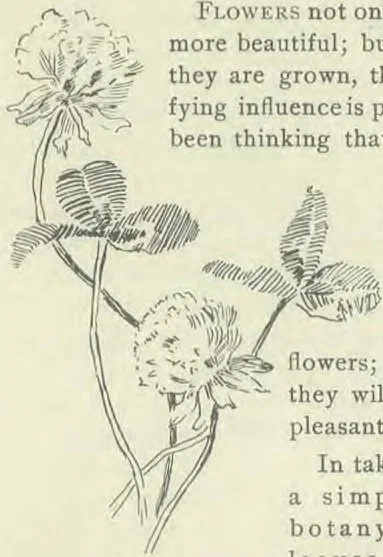
Flowers not only make the world more beautiful; but no matter where they are grown, their refining, purifying influence is perceived. I have been thinking that perhaps the INSTRUCTOR girls and boys would like to have some instruction in making pen-and-ink drawings of flowers; and I am sure they will find this study pleasant and of benefit.
In taking up the work, a simple knowledge of botany and the form of leaves will be a material help. It is not necessary to know the botanical name of each flower, as many of these are difficult to remember; but a certain understanding of their parts, and of the general laws of their growth, is essential.
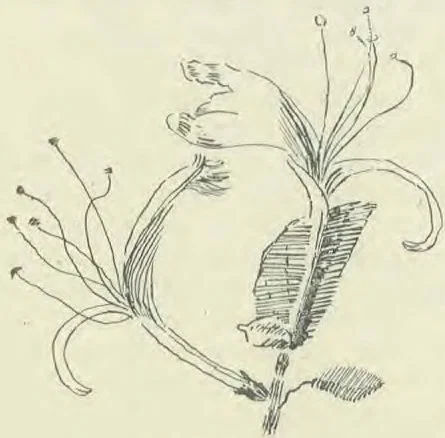
HONEYSUCKLE.
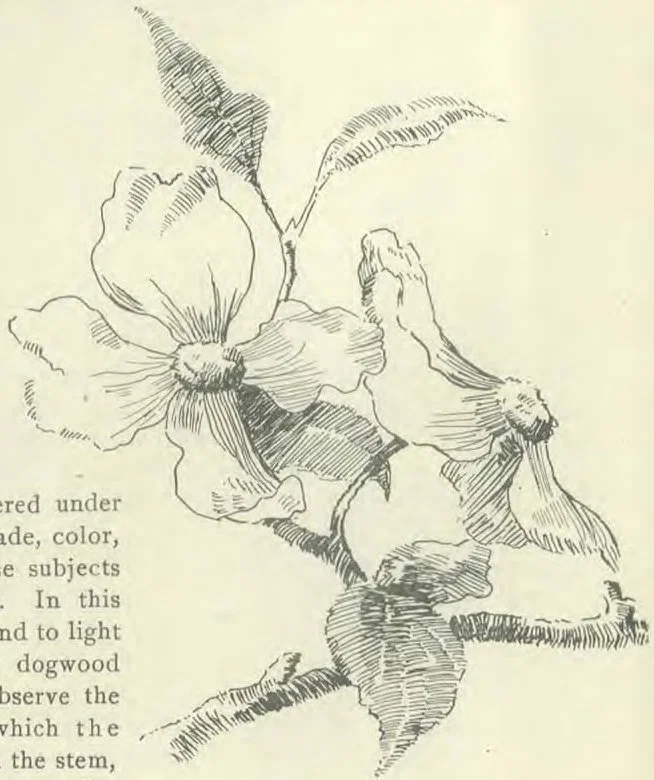
Pen-work done solely for study should be considered under four distinct conditions; namely, form, light and shade, color, and texture. It is not necessary to include all these subjects in one drawing; but each should receive attention. In this talk we will consider the subject as related to form and to light and shade. Taking, for example, the early spring dogwood blossom, we observe the manner in which the flower is set on the stem, the way the leaves spring out, and the character and shape of the petals. All this will come under the head of form.
In drawing flowers from nature, it will be more satisfactory for the beginner not to make too large an attempt, but to arrange a few blossoms in a simple way.
First make a preliminary pencil sketch, with a hard lead-pencil, on a sheet of smooth white paper or bristol-board, and only outline the shadows. When this is done, go to work with your pen. An ordinary sharp school pen is as good as any, and the ink must be absolutely black.
Endeavor to avoid many outlines, and draw in the petals as simply as possible. Try to express fearlessly your conception of the group of blossoms before you; and if the attempt is a failure, try again, as the flowers will last several days.
We will now consider the light and shade in the drawing. The darker part of the flowers turned away from the light is apparent. Notice the shadows of the leaves, and the light and shade on the stem. The lines which form the shading should be closely and more evenly drawn where the shadow is darkest. In shading the rounded stems, be careful that the lines of shade follow the form of the stem; that is, curved lines must be used to shade any object whose surface is curved. Let the light which strikes your study come from only one window, as otherwise the shadows will be confused.
Although many discouragements and failures attend these pen-studies, the true flower-lover can not but rejoice in the beauty that lies before him, as he earnestly tries to reproduce309it in pen and ink. There is a charm about this work; and the more deeply one can feel the shape and texture of that which is before him, the more truly will the likeness finally appear upon his paper.
We will consider the subject of color and texture in our next talk. EVA M. CARTER.