Exposition Notes

5%

Review and Herald Publishing Assn. · Takoma Park Station, Washington, D. C. · Aug 24, 1915

FromThe Youth’s Instructor, Vol. 63, No. 34.

Read the full edition

Exposition Notes

More than forty nations have combined to make the Panama-Pacific Exposition, which represents a total value of $350,000,000, an object lesson of the triumphs of peace and industry.
The exposition covers 625 acres, and has hundreds of buildings. The Palace of Machinery is the largest one. It is 968 x 368 ft. One mile and a half of cornices were used in ornamenting the building. Four carloads of nails and fifteen tons of steel (bolts and washers) were used in its construction.
In the Amusement Zone, which covers 65 acres and represents an investment of over $10,000,000, is a “reproduction of the Panama Canal, through which, seated in comfortable chairs on a moving platform, one is carried slowly past the great dams, locks, lakes, and the Culebra Cut. Here also the impressive production of the Grand Cañon of Colorado, another of Yellowstone National Park, and an expurgated edition of a miners’ camp of ’49. In this Zone is also a lake in which one may have a ride under water in a veritable submarine.”
According to the country’s best art critics, the most impressive work of art at the exposition is the exposition itself. “The color scheme, illumination, the architectural unity, and the perfect adaptation of the exposition to its natural setting,” all combine to make it a spectacle of wonderful beauty. The universal verdict is that nowhere else has color and illumination been used to such satisfying effect.
The Canadian Building is perhaps quite generally acknowledged as the most attractive, though the French and the California State Building do not come very far behind it, if at all. California has exploited her resources in novel and attractive ways. Her fruits, nuts, and grains are all made into the most interesting mosaics, covering walls and ceiling. A glass refrigerator show case, with exquisite butter roses, is one of the attractions of the dairy exhibit.
The visitor to the fair from the East is entranced at the lavish display of flowers upon the exposition grounds. There are acres of pansies arranged in generous beds that the Yankee multimillionaire never dreamed of in his most extravagant night visions. In fact, all California is one great flower bed.
The exposition wall is of special interest. It is a living green on both sides. The construction is unusual, as it consists of cement boxes, filled with earth and piled one upon another until a wall eight or ten feet high is secured. The front and back sides of these boxes are missing. After the seed is sown, a strong wire netting is nailed over the box. In a short time the box is filled with a gray-green moss-like plant, which covers both netting and box, so that very soon only a wall of green can be discerned.
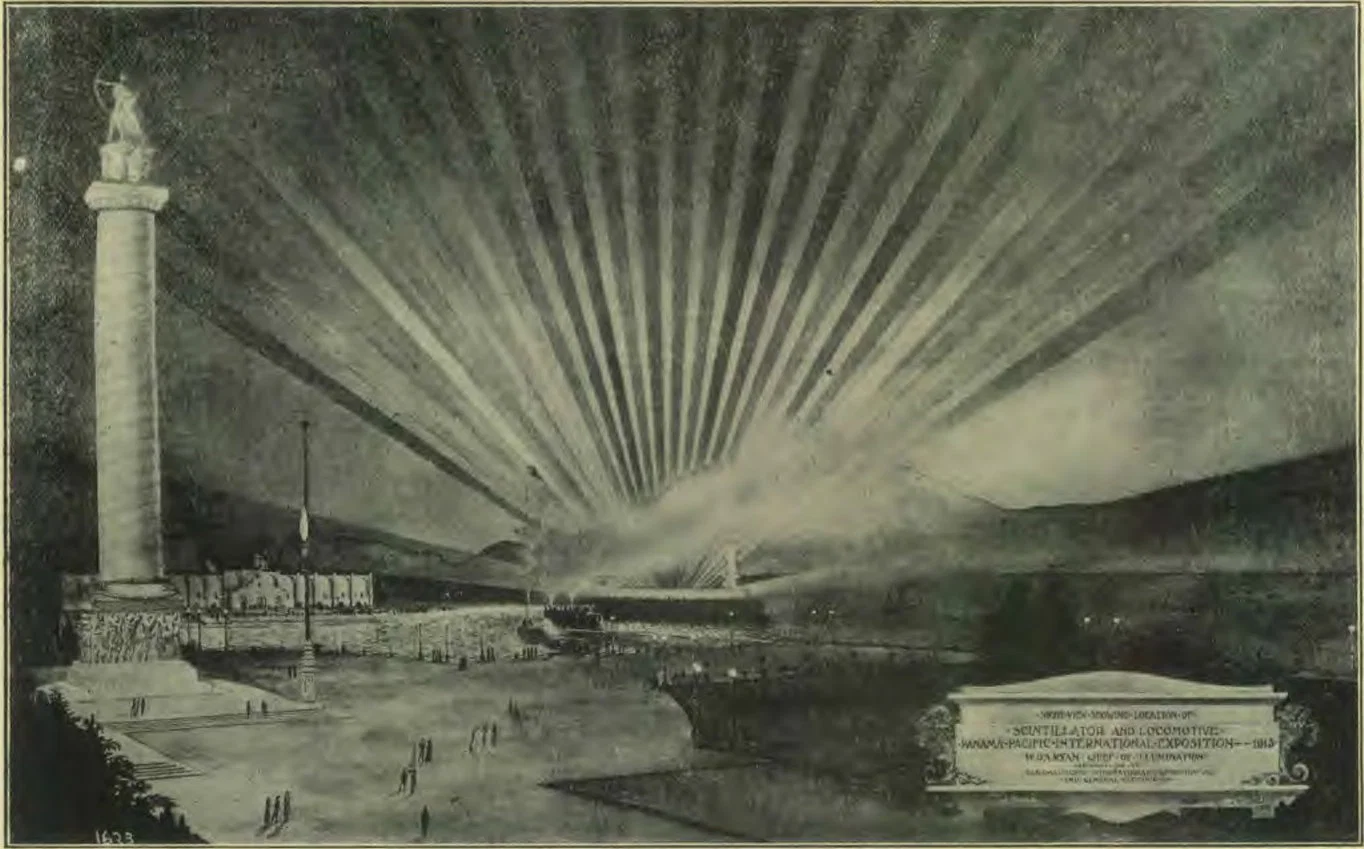
VIEW OF AN ELECTRICAL DISPLAY AT THE EXPOSITION
A date palm weighing twenty tons was dug from its growing place and transferred from San Jose to the exposition grounds, where it was replanted in the State horticulture exhibit. Seven men required two weeks in which to remove the large tree from the earth, crate it, and place it on flat cars preparatory for shipment. It is about forty-five years old, stands forty-five feet in height, and measures four feet in diameter. Two cars were used in hauling it a distance of fifty miles, and although difficult to handle, it showed little sign of injury after it had been transplanted.
Despite the unfavorable conditions, the fair has not been left to languish unvisited. The turnstiles registered 516,611 people for the first five days, whereas during the first five days of the Louisiana Purchase Exposition, at St. Louis, the attendance was 431,789, and the corresponding figure for the Columbian Exposition, at Chicago, was 225,717. The 2,000,000 mark of the present exposition was reached on the thirtieth day after the opening, which greatly surpasses the record of any of the other expositions.
There are over 80,000 individual exhibits, and it is estimated that it would cost $250 for one to see all that the fair offers, and $87.50 to see all that the Zone might show one.
The Underwood Typewriter Company has a unique advertising scheme. First of all, its gigantic fourteen-ton typewriter attracts much attention. The machine cost $100,000. It is manipulated at a distance by a young woman, and “thuds out its bulletins on a giant sheet of paper high overhead.” It is equal to 1,728 ordinary typewriters, being twenty-one feet wide and fifteen feet high. Scattered all around this giant machine on the rest of the floor space are a score or more of small tables or desks, each of which holds a standard Underwood typewriter. These are for free use; hence the small boy is everywhere in evidence. There being no discrimination for age, sex, color, or clothes, the Negro lad and the grimy newsboy, together with young men, old men, and little girls all find delight in the freedom of the Underwood section. Without doubt the company will capture a number of future buyers from this incongruous company of typists now taking their first lessons in manipulating the machine.
The visitor at the Panama-Pacific Exposition can hear the Atlantic waves beat upon the shore at Coney Island by means of a telephone line from New York to San Francisco. An ordinary conversation in New York may be heard very clearly at the telephone company’s pavilion, after traversing the 3,400-mile line.
Mr. Art Smith gives frequent nightly exhibitions of his aviation skill. He now wears “the perilous crown of popularity as a dare-devil aviator.” By his aerial maneuvers he writes in the sky his name, the number 6,000,000, and performs many other equally thrilling feats.
A new phonograph using an Edison diamond disk is on exhibit at the fair. This machine has been so perfected that no trace of the metallic sound that has hitherto accompanied the human voice as it came from even the best phonographs, was discernible.
Mr. Herman Whittaker gives the following interesting description of the exposition during a storm:—
“Already I had seen the exposition bathed in golden sunlight, a fair city of the sun, a walled town of the Orient laved by blue seas, glowing like a rich topaz in its setting of street-crowned hills; and because I had a shrewd suspicion that its beauty was waterproof, not to be washed off like rouge from the face, I wished to see it in the grip of a storm. And surely I did.
My first glimpse from the Fillmore Street hill showed its miles of buildings swept by a fifty-mile gale, towers and domes sheeted in gray rain, flag halyards wildly flapping against swaying poles, the thousands of palms along the avenues and esplanades tossing with the roar and rattle of a tropical jungle in the grip of a typhoon. So strong was the wind that the forty-pound iron tassels, which hold down the great heraldic standards, swung and flapped like their silken prototypes; and it sent me spinning, a reluctant projectile, down the Avenue of Progress past the giant porticoes of Machinery Hall to the ‘Marina,’ where huge combers broke and threw fine spray clean over the top of ‘Morro Castle’ lighthouse into ‘Exposition Harbor.’
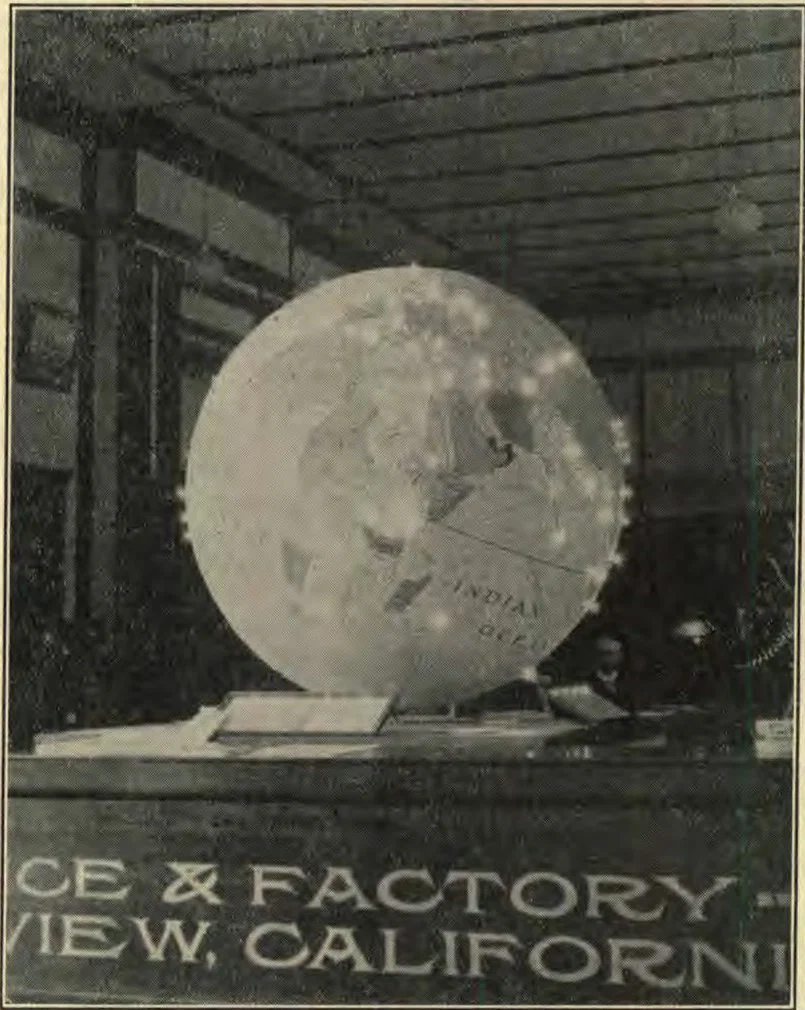
THE GOSPEL-LIGHTED GLOBE
Far out on the yeast of waters a wave would rear its green head, take a look at the exposition, then come rolling in, only to smash on the sea wall and spend itself in a last desperate leap at the rear facade of California Hall; and always its booming was spaced by the brazen complaint of a bell buoy and wild skirling of wheeling gulls.
“It was glorious! The rain that blackened the statuary and stained the long travertine facades with the green hues of time, had brought all to perfect tone and carried it back five thousand years. It was now coeval with the pyramids. Like them, it stood square on its solid bases, defying, and affording shelter from, the storm.”