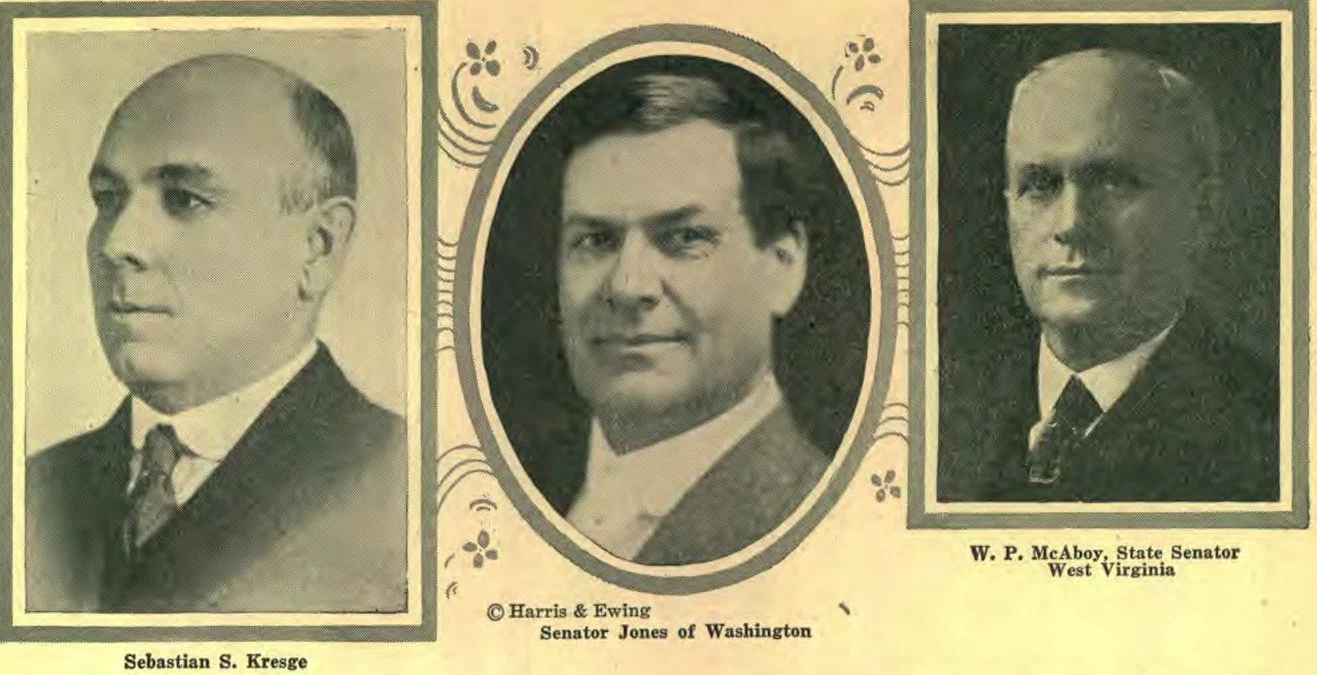
At this meeting, called by the Manufacture and Business Committee of the Anti-Saloon League of America, stirring testimonials for prohibition were given. Mr. Sebastian S. Kresge, who owns a chain of five-and-ten-cent stores throughout the country, is chairman of the committee, and presided over the meeting. Mr. Kresge believes so thoroughly in prohibition that he pledged to the Anti-Saloon League $20,000 a year for five years to help the league in its work for national prohibition.
The first to bear witness to the benefits of prohibition was—
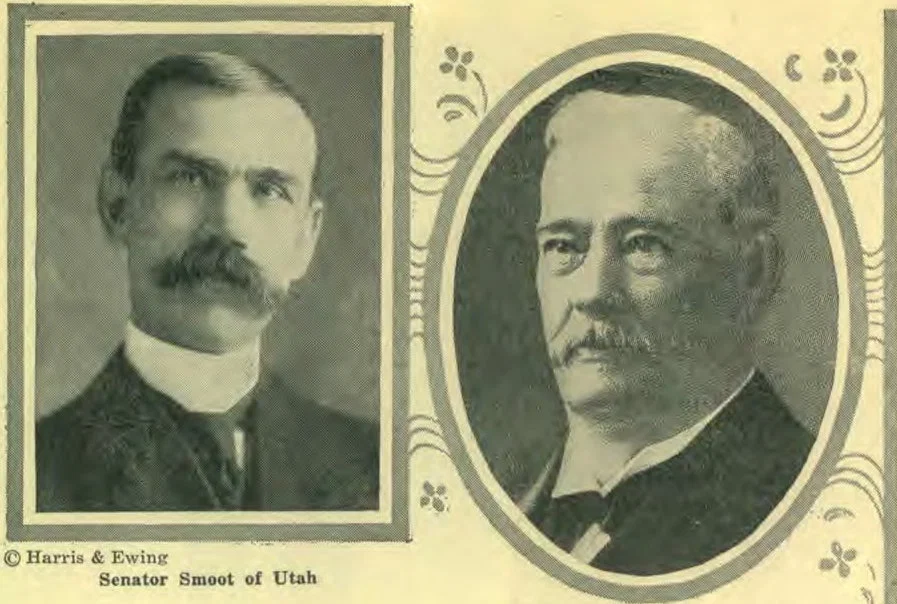
Senator Smoot of Utah: “Many men, business men, bankers, mine owners, and smelter operators who were bitterly opposed to State-wide prohibition are today the strongest advocates of it. I have heard men from all classes say that they could never again vote against prohibition. The smelters do not have half the trouble with the men that they had before the prohibitory law was enacted. Before, a few days after pay day perhaps half of the men would not be at work. Smelters would not be running full force, and the same would be true of other lines of work. In those centers in which liquor was sold lawfully and open saloons were in evidence, men that patronized them are today strong morally, physically, and financially. We find men with bank accounts who never had one before. We find in our State a savings increase every month. We find prosperous homes and contented workmen. The results of State-wide prohibition have been far in advance of our expectations and more than was promised by the temperance advocates. Can there be any stronger testimony? Can there be any better cause that men can work for than that of national prohibition? The majority of the American people have made up their minds that they are going to try nation-wide prohibition, and not many years are going by until it is in force.”
Ex-Governor Harris of Georgia: “I was governor of Georgia for two years, and it was during my administration that Georgia became a bone-dry State. I had a part in making her so. False and sundry predictions were heard as to the evil effect of prohibition on the business of the State. I was a little troubled about it on account of the large number of saloons that had grown up in the State, there being a great deal of money invested in them. Terrible predictions were made. The legislature itself revolted. No bills were passed on account of filibuster. The legislators declined to make any appropriations, and adjourned a week before the session was ended by the constitution. Public officials could not be paid. The governor could not be paid. We could not get any money for anything, because the legislature had made no appropriations. They knew I must call an extra session, and when an extra session meets it has no limitations as to time. Therefore a filibuster cannot be managed in a special session. They did not know just what I would do, but they knew the temperance issue was at stake. Just as soon as the legislature adjourned, people began urging that an extra session be called. Some suggested putting in the prohibition clause, and some that it be left out. Now I knew from the beginning what I should do about it, but of course I had to hear from the people, because if that law had been passed without the people’s being stirred up, it would have been repealed by the next legislature.
“A call went out for the prohibition forces to come before the governor and tell him what they wanted. Our wet friends did not need any call. They came without. The liquor interests came. Little children came before me with their hands stretched out and said: ‘O Governor, will you please close the saloons and take away their temptation and save us?’ The W. C. T. U. were there and said, ‘We expect you to put in the prohibition clause.’ And the Anti-Saloon League came before me with their claim, and said: ‘We are looking to you to save Georgia.’ One day a poor woman, a middle-aged woman, came to my door and said: ‘Governor, I want you to put in the prohibition clause. I have a good husband. He is a skilled mechanic and makes enough money to take care of his family; but when he has his pay in his pocket he must stop as he passes the saloon, and when he comes home he does not have enough money left to buy bread. O Governor, in the name of the women of Georgia, and in the name of the dear One whom you and I serve, I beg you to put in the prohibition clause.’
“And I went home to the little woman that had me in tow, and I told her all about it. The tears rained down that dear face as I said, ‘What shall I do about it?’ And she said, ‘Put it in;’ and so of course I had to put it in. A year or more after prohibition was in force I met that poor woman who pleaded with me for the prohibition clause, and she thanked me, and said, ‘O Governor, a great change has come. We are very happy in our home. My husband brings all his wages home, and we have plenty. The children are properly clothed and fed.’ Thousands of cases just like this might be cited.
“But the real result of prohibition is increased happiness. We have also twice the number of banks we had before the law was in force, and double the amount on deposit. When the State became dry, men employed by the liquor interests went into other business, and it was not long till Georgia began to prosper in a remarkable way. We had more money in the State, and our people were saving it and investing it wisely.
“And the impulse from Georgia has spread over the nation, and Georgia holds out her hands to her sister States, to the lawmakers in our national Congress, asking them to join her in this fight until the liquor evil shall be driven into the outer darkness of an avenging public.”
Senator Wesley L. Jones of Washington: “As the result of prohibition in our State since January, 1916, crimes have diminished greatly, in many parts of the State by one half. Our jails are being emptied and our jailers are losing their jobs. They are practically the only ones suffering from prohibition. Poorhouses are losing their occupants. Former inmates have gone to work, and those who might be candidates for admission are also engaged in gainful occupations. Even in our asylums minds clouded by the effects of alcohol are getting clearer and there are fewer minds being destroyed through the liquor traffic. The business houses today say that since the adoption of prohibition their sales to laboring people have increased immensely, so that happiness has come into homes that had never known it. And when you go into the clothing stores and shoe stores you find the same principle at work. The proprietors tell you that they are selling far more clothing and more shoes to the ordinary average man and woman than ever before. Many of them can give you instances of men and women to whom they have never before sold goods, coming into the stores and purchasing clothing and shoes, and paying cash for them. Debts are being paid, and less credit is being asked for than before. This is a benefit to the business man, which shows that if there is any class of people that should be against the liquor traffic it should be business men. Deposits in banks have increased greatly. There has been a tremendous increase in savings banks, both in number of banks and in the deposits. More ordinary homes are being established; more homes are being built; more lots are being acquired and houses built thereon by individual owners than ever before, showing that money that formerly went over the bar for the debauching of body and mind is being used in the establishment of homes.
“The effect of the abolition of the liquor traffic in the lumber mills and large manufacturing industries is most marked. The difference is most marked on Monday morning. While the liquor traffic was free to ply its pernicious trade, when Monday morning came many of their most efficient workmen would be incapacitated. Now these men can always be depended upon. When Monday morning comes, all are ready to go to work and ready to do good work. And so we find that many of these men who were formerly opposed to prohibition are now its strongest advocates.”
W. P. McAboy, of West Virginia: “Prohibition in our State has counted for an increase in every line of business. During the campaign a man came from Chicago, representing the disbelievers in prohibition, and he said: ‘If you vote for prohibition, dog fennel will grow in your streets; your industries will never prosper, and a great number of people will be thrown out of employment, and many people will be idle.’ On the contrary, we find that every saloon building has been occupied by some legitimate business, and every man thrown out of the saloon business has had profitable employment ever since and is making an honest living, saving money and putting it into the bank.
“In Huntington, where I live, we have been receiving from the city about $35,000 in revenue from the liquor traffic. The first year after the prohibition law took effect, the value of real estate so increased that without this revenue we reduced our tax rate one cent. The next year, after West Virginia went dry, we had a deficit of $600,000; but today we have the deficit made up and a surplus of $600,000 in the treasury.
“West Virginia is one of the richest little States in natural resources, such as coal, oil, and gas, of any State in the Union. People engaged in these industries say they could not afford to go back to former conditions. West Virginia has become a dry commonwealth to remain so.”
Senator Shafroth of Colorado: “I recognize that in a mountain State like Colorado, which was frontier country, it was somewhat difficult to establish prohibition, but it has come, and it has come to stay. We have had one year’s experience, and that experience has been good. The results of the closing of our 615 saloons and 17 breweries have been most excellent in Colorado, as these figures will demonstrate: Arrests from drunkenness in Denver were reduced from 32,019 in 1915, the wet year, to 1,549 in 1916, the dry year. This is really an excellent showing, when we consider the fact that we have two neighboring States with saloons wide open. The arrests for vagrancy in Denver dropped from 37,013 in 1915, to 1,148 in 1916. Gambling has decreased greatly, there being only 252 arrests in 1916.
“The warden of our penitentiary has been compelled to close the big wing because there is no one to occupy it. During 1916 there was a great increase in business, and with it there has been an increase in bank deposits. Since prohibition laws have been in force the building permits of Denver have increased 100 per cent, notwithstanding the prediction that prohibition of liquor would bring a decrease in prosperity.10
“People predicted that our State would suffer from loss of tourists; that people would not travel in a State where there were prohibition laws. The number of tourists who visited Rocky Mountain Lane Park in 1915 was 31,000. In 1916 the records show 51,000, and in 1917 there have been 98,000.
“The manufacturing output of the State for 1916 exceeded that of the previous year by $20,000,000. The value of the State mining output, barring coal, increased more than $11,000,000. Predictions made by the liquor people have been shown to be absolutely unreliable.
W. J. Herwig, of Topeka, Kansas: “Yes, Kansas is dry, so dry that bullfrogs six years old have hardly learned to swim. Let me compare Kansas and Missouri. The population of Missouri is 3,400,000; of Kansas, 1,800,000. The State of Missouri has 4,000 saloons. To every 3,000 population Missouri has ten criminals, and Kansas one. Bank deposits in Missouri are $20 per capita, and in Kansas $140. Assessment property value per capita in Missouri is $300; in Kansas, $1,700. There is an automobile to every 100 families in Missouri, and one to every 24 in Kansas. Kansas has 40 counties, out of 105, which did not send a prisoner to the penitentiary last year. Kansas is one of the very few States in the Union without bonded indebtedness. January 1, 1916, there was a unique gathering in our capital, and the last bond was burned. Thirty-two counties in Kansas have abandoned their poor farms, and as in the last two years we have had one of the largest corn crops in history, in some counties the buildings are being used for corncribs.
“We have had prohibition for twenty-two years. We know its worth, and if the issue were to come before the people of Kansas today, at least 98 per cent of them would vote to retain prohibition laws.”
E. F. Sheffey, manufacturer from Lynchburg, Virginia: “I am from the State that proudly claims for its sons Washington, Jefferson, Lee, and that other great man who today rules the destiny of our country, Woodrow Wilson. We have in Lynchburg one of the largest shoe-manufacturing houses in the country. Before the State went dry we had a great deal of trouble with the laboring men. On Monday our help was inefficient. Since the dry law went into effect we have not had this trouble. The men come in fresh on Monday and attend strictly to business. Recently they subscribed $50,000 to the Liberty Loan. One of our colored porters invested $2,500 in Liberty Bonds and paid cash. We can now boast far greater prosperity than we could under wet laws.”