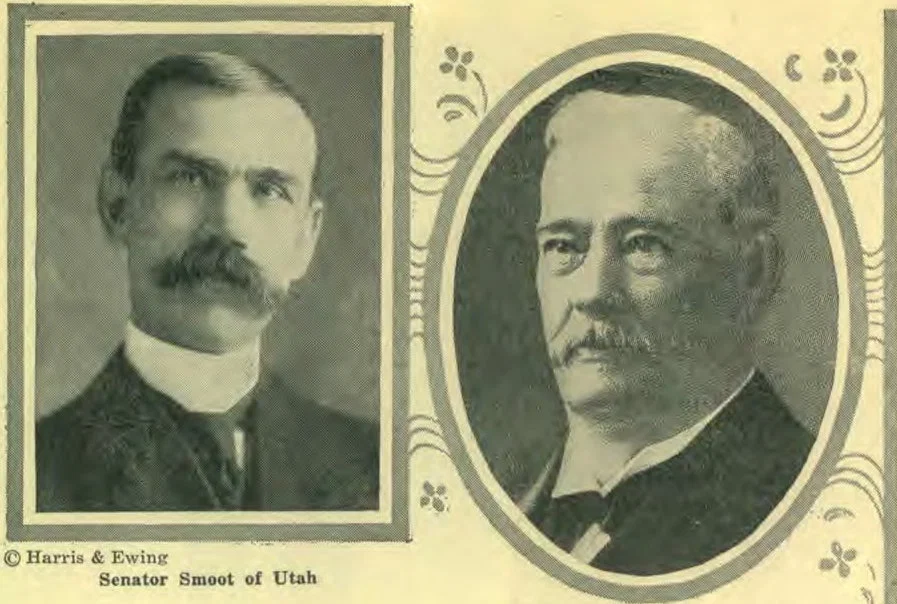
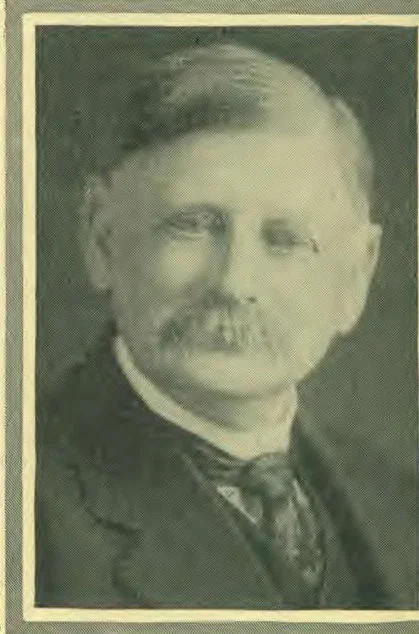
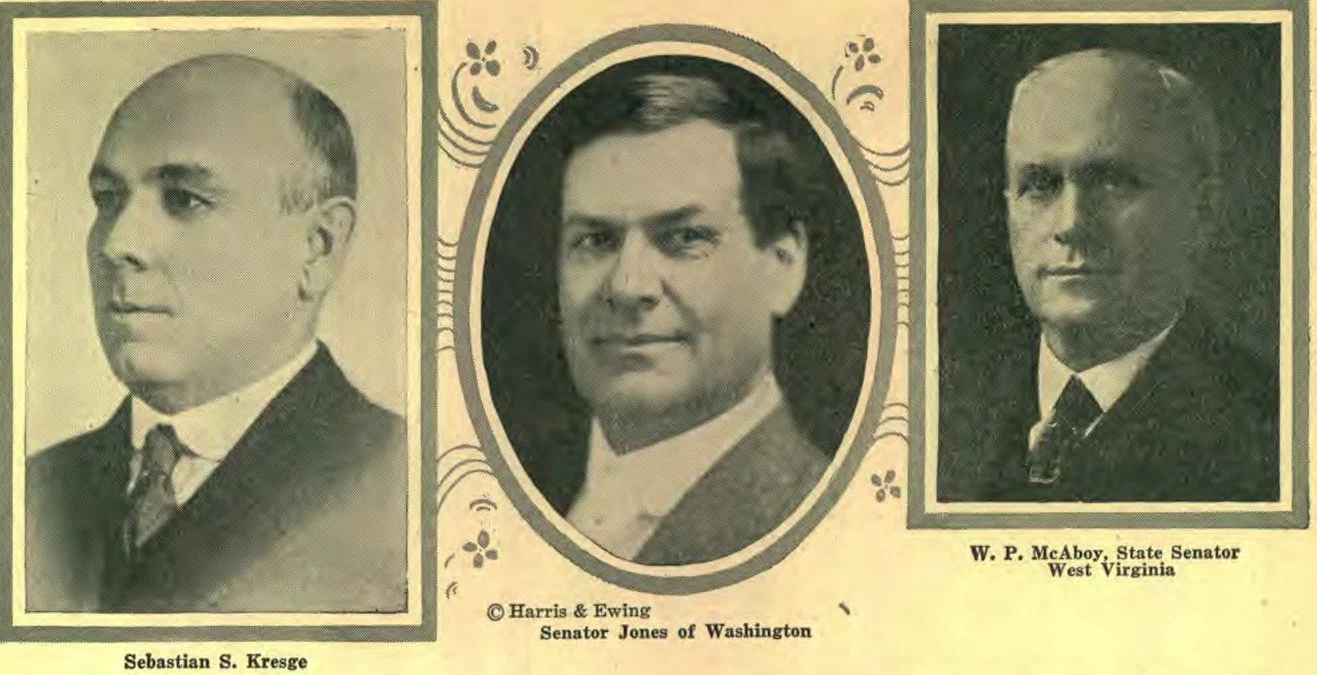
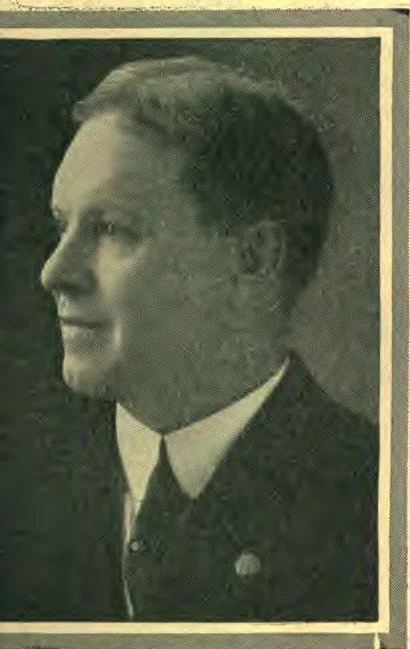
At this meeting, called by the Manufacture and Business Committee of the Anti-Saloon League of America, stirring testimonials for prohibition were given. Mr. Sebastian S. Kresge, who owns a chain of five-and-ten-cent stores throughout the country, is chairman of the committee, and presided over the meeting. Mr. Kresge believes so thoroughly in prohibition that he pledged to the Anti-Saloon League $20,000 a year for five years to help the league in its work for national prohibition.
The first to bear witness to the benefits of prohibition was—
Senator Smoot of Utah: “Many men, business men, bankers, mine owners, and smelter operators who were bitterly opposed to State-wide prohibition are today the strongest advocates of it. I have heard men from all classes say that they could never again vote against prohibition. The smelters do not have half the trouble with the men that they had before the prohibitory law was enacted. Before, a few days after pay day perhaps half of the men would not be at work. Smelters would not be running full force, and the same would be true of other lines of work. In those centers in which liquor was sold lawfully and open saloons were in evidence, men that patronized them are today strong morally, physically, and financially. We find men with bank accounts who never had one before. We find in our State a savings increase every month. We find prosperous homes and contented workmen. The results of State-wide prohibition have been far in advance of our expectations and more than was promised by the temperance advocates. Can there be any stronger testimony? Can there be any better cause that men can work for than that of national prohibition? The majority of the American people have made up their minds that they are going to try nation-wide prohibition, and not many years are going by until it is in force.”
Ex-Governor Harris of Georgia: “I was governor of Georgia for two years, and it was during my administration that Georgia became a bone-dry State. I had a part in making her so. False and sundry predictions were heard as to the evil effect of prohibition on the business of the State. I was a little troubled about it on account of the large number of saloons that had grown up in the State, there being a great deal of money invested in them. Terrible predictions were made. The legislature itself revolted. No bills were passed on account of filibuster. The legislators declined to make any appropriations, and adjourned a week before the session was ended by the constitution. Public officials could not be paid. The governor could not be paid. We could not get any money for anything, because the legislature had made no appropriations. They knew I must call an extra session, and when an extra session meets it has no limitations as to time. Therefore a filibuster cannot be managed in a special session. They did not know just what I would do, but they knew the temperance issue was at stake. Just as soon as the legislature adjourned, people began urging that an extra session be called. Some suggested putting in the prohibition clause, and some that it be left out. Now I knew from the beginning what I should do about it, but of course I had to hear from the people, because if that law had been passed without the people’s being stirred up, it would have been repealed by the next legislature.
“A call went out for the prohibition forces to come before the governor and tell him what they wanted. Our wet friends did not need any call. They came without. The liquor interests came. Little children came before me with their hands stretched out and said: ‘O Governor, will you please close the saloons and take away their temptation and save us?’ The W. C. T. U. were there and said, ‘We expect you to put in the prohibition clause.’ And the Anti-Saloon League came before me with their claim, and said: ‘We are looking to you to save Georgia.’ One day a poor woman, a middle-aged woman, came to my door and said: ‘Governor, I want you to put in the prohibition clause. I have a good husband. He is a skilled mechanic and makes enough money to take care of his family; but when he has his pay in his pocket he must stop as he passes the saloon, and when he comes home he does not have enough money left to buy bread. O Governor, in the name of the women of Georgia, and in the name of the dear One whom you and I serve, I beg you to put in the prohibition clause.’
“And I went home to the little woman that had me in tow, and I told her all about it. The tears rained down that dear face as I said, ‘What shall I do about it?’ And she said, ‘Put it in;’ and so of course I had to put it in. A year or more after prohibition was in force I met that poor woman who pleaded with me for the prohibition clause, and she thanked me, and said, ‘O Governor, a great change has come. We are very happy in our home. My husband brings all his wages home, and we have plenty. The children are properly clothed and fed.’ Thousands of cases just like this might be cited.
“But the real result of prohibition is increased happiness. We have also twice the number of banks we had before the law was in force, and double the amount on deposit. When the State became dry, men employed by the liquor interests went into other business, and it was not long till Georgia began to prosper in a remarkable way. We had more money in the State, and our people were saving it and investing it wisely.
“And the impulse from Georgia has spread over the nation, and Georgia holds out her hands to her sister States, to the lawmakers in our national Congress, asking them to join her in this fight until the liquor evil shall be driven into the outer darkness of an avenging public.”
Senator Wesley L. Jones of Washington: “As the result of prohibition in our State since January, 1916, crimes have diminished greatly, in many parts of the State by one half. Our jails are being emptied and our jailers are losing their jobs. They are practically the only ones suffering from prohibition. Poorhouses are losing their occupants. Former inmates have gone to work, and those who might be candidates for admission are also engaged in gainful occupations. Even in our asylums minds clouded by the effects of alcohol are getting clearer and there are fewer minds being destroyed through the liquor traffic. The business houses today say that since the adoption of prohibition their sales to laboring people have increased immensely, so that happiness has come into homes that had never known it. And when you go into the clothing stores and shoe stores you find the same principle at work. The proprietors tell you that they are selling far more clothing and more shoes to the ordinary average man and woman than ever before. Many of them can give you instances of men and women to whom they have never before sold goods, coming into the stores and purchasing clothing and shoes, and paying cash for them. Debts are being paid, and less credit is being asked for than before. This is a benefit to the business man, which shows that if there is any class of people that should be against the liquor traffic it should be business men. Deposits in banks have increased greatly. There has been a tremendous increase in savings banks, both in number of banks and in the deposits. More ordinary homes are being established; more homes are being built; more lots are being acquired and houses built thereon by individual owners than ever before, showing that money that formerly went over the bar for the debauching of body and mind is being used in the establishment of homes.
“The effect of the abolition of the liquor traffic in the lumber mills and large manufacturing industries is most marked. The difference is most marked on Monday morning. While the liquor traffic was free to ply its pernicious trade, when Monday morning came many of their most efficient workmen would be incapacitated. Now these men can always be depended upon. When Monday morning comes, all are ready to go to work and ready to do good work. And so we find that many of these men who were formerly opposed to prohibition are now its strongest advocates.”
W. P. McAboy, of West Virginia: “Prohibition in our State has counted for an increase in every line of business. During the campaign a man came from Chicago, representing the disbelievers in prohibition, and he said: ‘If you vote for prohibition, dog fennel will grow in your streets; your industries will never prosper, and a great number of people will be thrown out of employment, and many people will be idle.’ On the contrary, we find that every saloon building has been occupied by some legitimate business, and every man thrown out of the saloon business has had profitable employment ever since and is making an honest living, saving money and putting it into the bank.
“In Huntington, where I live, we have been receiving from the city about $35,000 in revenue from the liquor traffic. The first year after the prohibition law took effect, the value of real estate so increased that without this revenue we reduced our tax rate one cent. The next year, after West Virginia went dry, we had a deficit of $600,000; but today we have the deficit made up and a surplus of $600,000 in the treasury.
“West Virginia is one of the richest little States in natural resources, such as coal, oil, and gas, of any State in the Union. People engaged in these industries say they could not afford to go back to former conditions. West Virginia has become a dry commonwealth to remain so.”
Senator Shafroth of Colorado: “I recognize that in a mountain State like Colorado, which was frontier country, it was somewhat difficult to establish prohibition, but it has come, and it has come to stay. We have had one year’s experience, and that experience has been good. The results of the closing of our 615 saloons and 17 breweries have been most excellent in Colorado, as these figures will demonstrate: Arrests from drunkenness in Denver were reduced from 32,019 in 1915, the wet year, to 1,549 in 1916, the dry year. This is really an excellent showing, when we consider the fact that we have two neighboring States with saloons wide open. The arrests for vagrancy in Denver dropped from 37,013 in 1915, to 1,148 in 1916. Gambling has decreased greatly, there being only 252 arrests in 1916.
“The warden of our penitentiary has been compelled to close the big wing because there is no one to occupy it. During 1916 there was a great increase in business, and with it there has been an increase in bank deposits. Since prohibition laws have been in force the building permits of Denver have increased 100 per cent, notwithstanding the prediction that prohibition of liquor would bring a decrease in prosperity.10
“People predicted that our State would suffer from loss of tourists; that people would not travel in a State where there were prohibition laws. The number of tourists who visited Rocky Mountain Lane Park in 1915 was 31,000. In 1916 the records show 51,000, and in 1917 there have been 98,000.
“The manufacturing output of the State for 1916 exceeded that of the previous year by $20,000,000. The value of the State mining output, barring coal, increased more than $11,000,000. Predictions made by the liquor people have been shown to be absolutely unreliable.
W. J. Herwig, of Topeka, Kansas: “Yes, Kansas is dry, so dry that bullfrogs six years old have hardly learned to swim. Let me compare Kansas and Missouri. The population of Missouri is 3,400,000; of Kansas, 1,800,000. The State of Missouri has 4,000 saloons. To every 3,000 population Missouri has ten criminals, and Kansas one. Bank deposits in Missouri are $20 per capita, and in Kansas $140. Assessment property value per capita in Missouri is $300; in Kansas, $1,700. There is an automobile to every 100 families in Missouri, and one to every 24 in Kansas. Kansas has 40 counties, out of 105, which did not send a prisoner to the penitentiary last year. Kansas is one of the very few States in the Union without bonded indebtedness. January 1, 1916, there was a unique gathering in our capital, and the last bond was burned. Thirty-two counties in Kansas have abandoned their poor farms, and as in the last two years we have had one of the largest corn crops in history, in some counties the buildings are being used for corncribs.
“We have had prohibition for twenty-two years. We know its worth, and if the issue were to come before the people of Kansas today, at least 98 per cent of them would vote to retain prohibition laws.”
E. F. Sheffey, manufacturer from Lynchburg, Virginia: “I am from the State that proudly claims for its sons Washington, Jefferson, Lee, and that other great man who today rules the destiny of our country, Woodrow Wilson. We have in Lynchburg one of the largest shoe-manufacturing houses in the country. Before the State went dry we had a great deal of trouble with the laboring men. On Monday our help was inefficient. Since the dry law went into effect we have not had this trouble. The men come in fresh on Monday and attend strictly to business. Recently they subscribed $50,000 to the Liberty Loan. One of our colored porters invested $2,500 in Liberty Bonds and paid cash. We can now boast far greater prosperity than we could under wet laws.”
More to Liquor Than to the Germans
Mr. Arthur Mee, editor of the London Spectator, says: “Drink and its results cost us one million pounds [$5,000,000] a day. During the war the national drink bill has reached four hundred million pounds [$2,000,000,000]. We must have poured more of our financial strength into this trade since August, 1914, than we have fired away in France. We are giving an enemy trade the power to waste our wealth, scatter our resources, drain our people’s savings, and break down our reserves. We let the drink trade use hundreds of millions of cubic feet of space in ships, congest our docks, streets, and railways, use up the labor of hundreds of thousands of men. We have not men enough to carry on the war, but we have men enough to lift and move from place to place a weight of drink stuff every year three times as heavy as the Great Pyramid. It took a hundred thousand men a generation to set up the Great Pyramid, but if we had pulled it down and set it up again three times since the war began, it would have taken less labor than the shifting of this drink stuff that ships pour everlastingly into our docks. Every week our railways carry enough of it to fill over a thousand trains of two hundred tons each.”
“We shall not win the war until we have built a trench between the British home and the public house;” and the American people demand a trench between the British public house and the American soldier.”
“Enough wheat to feed sixteen million people for a whole year11could be grown on the acreage devoted to the barley and hops England uses in beer making.”
“Fifteen tons of sugar in one day were poured into one brewery in Nottinghamshire under the eyes of a farmer who reported it. Sugar is a valuable energy-furnishing food, but when fermented to make beer or whisky its food value is destroyed.”
“The Prime Minister, Mr. Lloyd-George, reports that in one week:
“Poor people waited in lines to buy sugar in London.”
“Cartloads of sugar were destroyed in London breweries.”
“Submarines destroyed twenty-seven British cargoes, mostly over 1,600 tons.”
“Brewers destroyed twenty-seven British food cargoes totaling 9,000 tons.”
“The granaries of Canada were crammed with wheat waiting for British ships, but there were no ships to transport the food.”
“The rum quay at London docks was crammed with casks of rum to last till 1920, but a ship arrived with 1,000 casks more.”
“A woman was fined twenty-five dollars for destroying a quarter loaf of bread.”
“Brewers were fined nothing for destroying millions of loaves.”
To us who are sacrificing our food materials for Britain, it is incomprehensible that such conditions should be allowed to exist. There must come a change; but if we wish to call to Britain in a way that she will listen, we must cut every rope that binds us to the liquor traffic. We must stop the manufacture of beer and wine, as we have of whisky. We must stop the sale and use of all intoxicants. Then if she still holds her connection with the diabolical evil, let the world judge her.
What more need be said? One of our own soldiers has been hanged on French soil, for a terrible crime committed while under the influence of French liquor. Unless the traffic is abolished, there will be deeds committed that will make the American people hang their heads in shame. Why delay? Let us now strike the blow for ourselves that will kill the traffic, and then request in as strong a way as possible that our European allies follow suit.
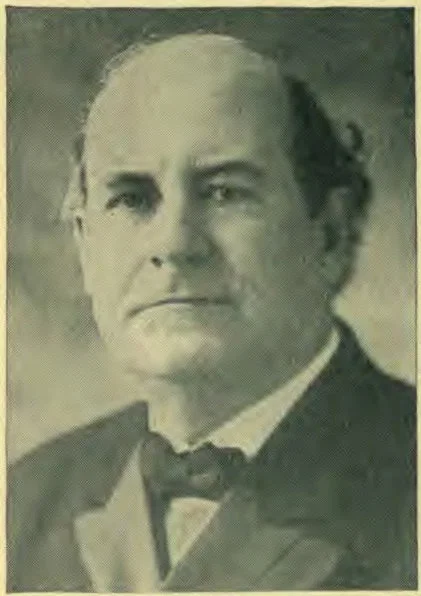
HON. W. J. BRYAN
Ex-Secretary of State
You had better organize your burglars into a personal liberty league, and license them on a percentage basis to go out and steal from your homes. Burglary is a more respectable business than the liquor industry.—W. J. Bryan.
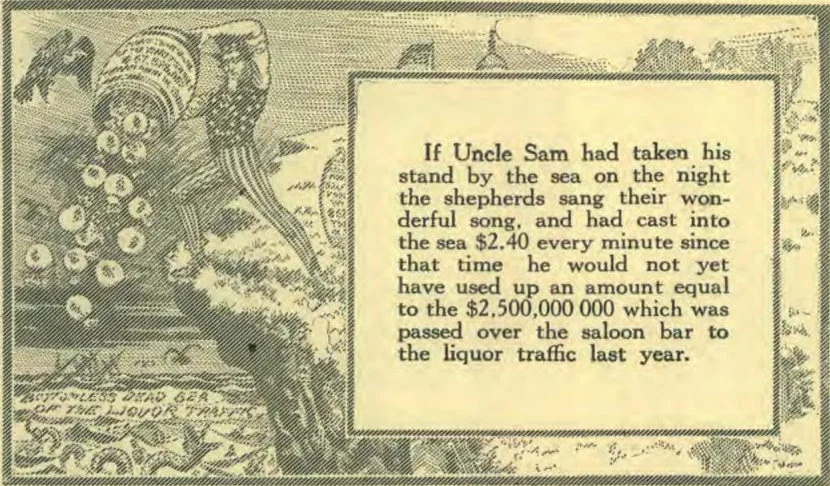
Liquor Traffic Spending Compared to Uncle Sam's Waste
If Uncle Sam had taken his stand by the sea on the night the shepherds sang their wonderful song, and had cast into the sea $2.40 every minute since that time he would not yet have used up an amount equal to the $2,500,000,000 which was passed over the saloon bar to the liquor traffic last year.
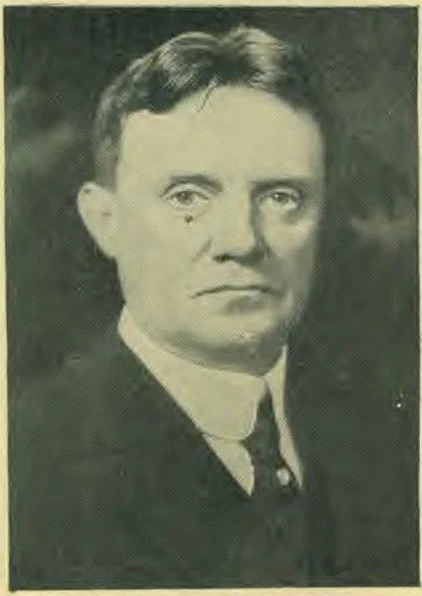
GOVERNOR WHITMAN
By Charles S. Whitman
of New York
I have found that 72 per cent of crimes coming before me as a magistrate are due to drink. In fact, in the great percentage of cases intoxication was urged as a defense. How far it influenced the remainder I have no means of knowing, but it is safe to say that in one way or another it was responsible for many of them. Out of an experience which has touched all classes and conditions of men, I am willing to state my belief that in this present crisis the United States would be better able to meet the high duties before it if prohibition were general and absolute.—Charles S. Whitman.
Millions of Gold in Sunken Ships
By Editor
A COMPANY of hard-headed business men are now endeavoring to secure some of the gold that has long lain in the depths of the ocean. In twenty-three of the thousands of ships that have been buried in the sea there is hidden nearly $200,000,000 of gold. In 1702 a fleet of seventeen Spanish vessels brought a three years’ accumulation of treasure from South America, consisting of gold, silver, and jewels, valued at $140,000,000. Before reaching port the vessels were attacked by a combined British and Dutch fleet. Rather than allow the great treasure to fall into the hands of the enemy, the Spaniards sank the seventeen ships. Later six of the vessels that lay in shallow water were raised and $20,000,000 secured.
The “General Grant,” with a cargo of $15,000,000, was sunk off the Auckland Islands; and the “Florentia,” with another $15,000,000, went down off the coast of Scotland.
We do not throw our money into the sea rather than let it fall into the hands of the enemy; we rather vie with each other, as it were, for the privilege of passing it over to the greatest enemy of humanity, the licensed liquor traffic. Each year we thus throw away twenty times as much gold as the rich galleons of Vigo Bay contained. All this we could redeem by a stroke of the pen, for national Constitutional prohibition would restore the $5,000,000,000 lost annually by the traffic.
We need the money now. An aroused American people demand the conservation of these billions for legitimate uses instead of worse than throwing them into the ocean’s depths.
W. P. BORLAND
By W. P. Borland
U. S. Representative from Missouri
I shall vote for the anti-liquor measures. Whenever an issue is presented between bread and booze I intend to vote for bread. In doing so I am confident that I shall be serving the highest and best interests of my country.—W. P. Borland.
MAJOR PULLMAN
By Raymond W. Pullman
Chief of Police of the District of Columbia
Former opponents of prohibition, hotel men, merchants, and men in other lines of business, all virtually admit that having seen the prohibition law in operation they realize their attitude toward it was wrong. We have today 60,000 more people than a year ago, and almost every one is sober and happy. Prohibition is responsible for the marked decrease in arrests for crime and drunkenness, the percentage decrease in the first three months after the dry law went into effect being 69.1 per cent, almost seventy per cent. There were actually handled 1,664 fewer cases.—Raymond W. Pullman.
Prohibition and Rising Savings Deposits
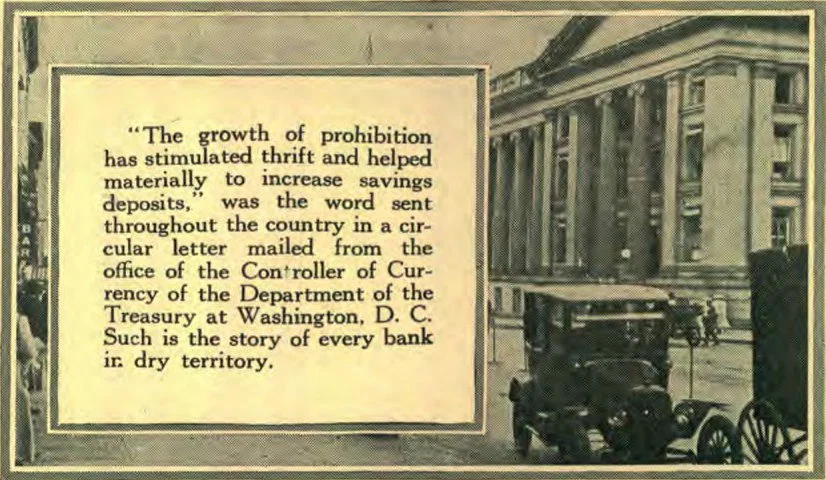
“The growth of prohibition has stimulated thrift and helped materially to increase savings deposits,” was the word sent throughout the country in a circular letter mailed from the office of the Controller of Currency of the Department of the Treasury at Washington, D. C. Such is the story of every bank in dry territory.
The Liquor Traffic and Its Destructive Ingratitude
To “bite the hand that is feeding you” is the basest ingratitude; but the liquor traffic destroys both soul and body of those from whom it filches its millions.
The World’s Deepest Crime
H. B. Woodill, champion of the liquor cause, says: “Of all the crimes and follies of prohibition, the solemnest, the deepest,13and the worst is that it chokes the personal freedom of the individual to regulate his own life.”
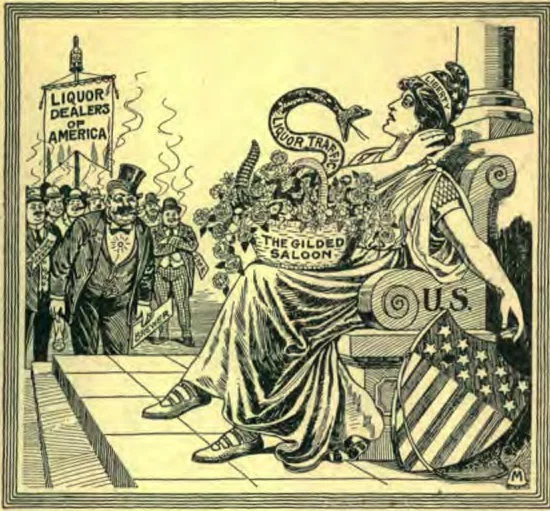
As surely as the deadly asp hidden in the basket of flowers given to Cleopatra, Egypt's beautiful queen, killed the queen, when it lifted its head from its roseate bed and planted its fangs in her bosom; so the serpent of the still, which lurks in the gilded saloon, if not annihilated by the American people, will eventually destroy our beautiful queen, American Liberty.
Nay. “Of all the crimes and follies of the world, the solemnest, the deepest, and the worst is that” of the liquor traffic, which “chokes the personal freedom of the individual,” the freedom of the wife and child, the mother, and others less directly concerned, each “to regulate his own life.” Suppose prohibition did infringe upon the rights of the brewer, distiller, and drinker, what honest jury would decide in their favor instead of in favor of the women and children whose lives are blighted by the accursed traffic? Better were it for one’s tongue to be burned out than for it to plead for the personal freedom of the brewer, distiller, and drinker to make and dispense a beverage that is the chief cause of the world’s crime, poverty, sorrow, and disease.