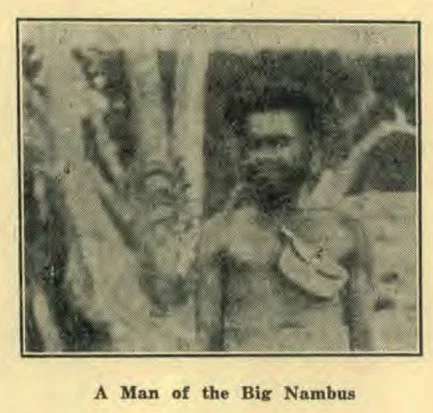
THE only photograph I saw of the Big Nambus people, of the New Hebrides, showed a savage-looking face, with nearly naked body. The name of this people, Big Nambus, is the name of a grass out of which they make the only piece of clothing worn.
I thought again of our young people as missionary pioneers as we bade good-by to Brother and Sister N. Wiles as they turned their faces toward that northwestern corner of Malekula, where the Big Nambus people live. Our friends were young—seeming almost like boy and girl setting out for one of the most trying posts on our missionary frontier line. But they are tried workers, having served one term among this same wild people. (Mrs. Wiles, by the way, was once a little Battle Creek girl, daughter of Elder and Mrs. E. S. Butz.)
Wait a few years, and see if there do not come to us stories of transformations wrought among these islanders who have welcomed these young missionaries back to their villages.
I met a brother who was engineer on the mission launch “Melanesia” when it first visited the Big Nambus coast. The Solomon Islanders in the crew had come of raw enough stock, but our brother said that even these men of the Solomons drew the line at the Big Nambus. “Big Nambus man no good,” said they. They kept close eye upon the men who came down to the launch.
“I saw one of our crew meet one of the Big Nambus,” said our engineer brother. “It was a formal meeting. Our man walked up to shake hands with the stranger. First our man put out his left hand, catching hold of the gun that the other carried, then with his right he shook hands with him. This ceremony of new friendship over, our Solomon Islander backed off, continued walking backward until at a good distance, keeping his eye every instant upon his new acquaintance. ‘Big Nambus man no good; he one bad man,’ he insisted.”
But these are the people who begged us to help them find a better way, and whose good intentions have stood a severe test. While Brother and Sister Wiles were off on furlough, attending the union conference, the bushmen came down and did some violence to traders, I believe. The French authorities sent in a punitive expedition, and some Big Nambus people were killed. These people, notwithstanding they had suffered for the crime of their cannibal neighbors, held to their desire to have the white missionary come, and when Brother Wiles arrived alone, to spy out the land, he was urged to bring his wife and settle among them, assured that they would keep them safely from the bushmen cannibals on their border, and that the Big Nambus people would listen to the teaching.
At the farewell meeting at the union conference session, Brother Wiles said: “In a few days’ time we shall sail again for the New Hebrides, and, as you know, our work is somewhat hard. We are not yet able to report fruit for our labor. The people are in heathenism and great darkness. As we planned to go back and again take up our work, it was with some misgivings as I thought over the situation; but after the good instruction we have received here, and all that we have heard of the onward march of God’s4message, the text comes to me with renewed force, ‘I am with you alway, even unto the end of the world.’ My courage is strong to go forward in the Lord’s work. I believe that soon out there among the Big Nambus and other tribes of which we have heard, we shall see glorious results for the Lord. We shall see a people gathered out as a result of the teaching of the good old Book.”
A Man of the Big Nambus
His reception on his return to that people was surely a token that the Lord had indeed gone before our young friends in their perilous and yet glorious quest.
Is it not wonderful that our young people, in the fear of God, may go out into any dark region with the “good old Book,” and lo, as the years pass, souls are born again into the kingdom of God, and this cause is represented in that previously barren waste by the fruitage of believers praising God for the truth even as we ourselves do?
There is no other work like this for the consecrated youth. Let us turn their eyes toward the unentered fields.
“With such an army of workers as our youth, rightly trained, might furnish, how soon the message of a crucified, risen, and soon-coming Saviour might be carried to the whole world!”
S. S. “Tango Maru,” Strait of Manipa, East Indies.